The Kharg Gambit: Trump Threatens Ground Invasion of Iran's Oil Lifeline as NATO Allies Revolt
On Day 31, the President floats sending Marines to seize a 20-square-kilometer island holding 90% of Iran's oil exports. Spain shuts its skies. Brent crude hits $115. The war just entered a new phase.

US naval assets are converging on the Persian Gulf as invasion speculation reaches fever pitch. Photo: Unsplash
Thirty-one days into the war with Iran, President Donald Trump pulled back the curtain on what may become the conflict's defining escalation. In a Financial Times interview published Sunday and a social media broadside Monday morning, Trump suggested American ground forces could seize Kharg Island - Iran's crown jewel oil export terminal - and threatened to "completely obliterate" the country's power plants, oil wells, and desalination infrastructure if Tehran does not agree to a deal "shortly."
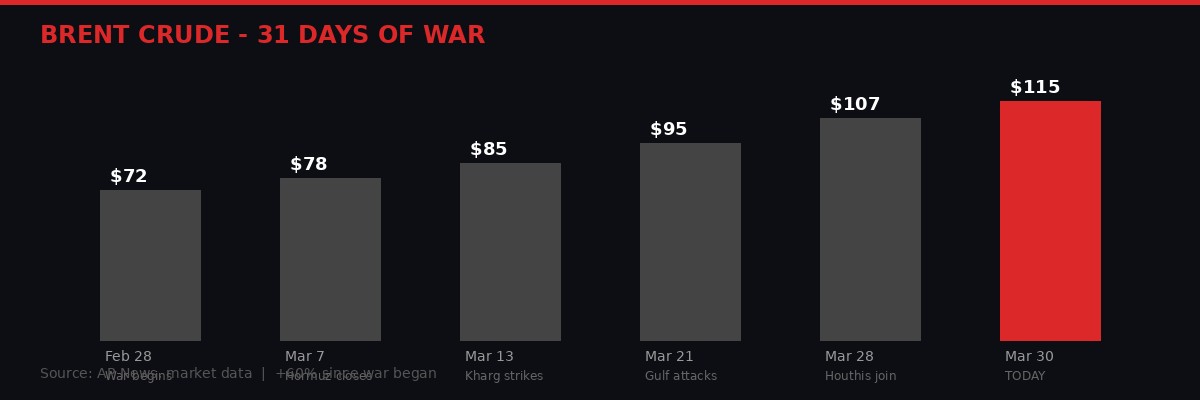
The response was immediate and fractured. Spain formally closed its airspace to all US aircraft involved in Operation Epic Fury. Iran's parliament speaker vowed to "rain fire" on any American boots touching Iranian soil. Brent crude surged past $115 a barrel - up 60% since February 28. NATO, already strained by two years of disagreement over defense spending, cracked along a new fault line: not Ukraine, but Iran.
This is no longer a contained air campaign. This is a president publicly floating the seizure of a sovereign nation's territory, a Western alliance splitting in real time, and an oil market pricing in the possibility that the world's most important energy chokepoint stays closed for months. Everything that happens next flows from what was said today.
Sources: BBC News, AP, CBS News, Frank Gardner/BBC Security
The Island at the Center of Everything

Very Large Crude Carriers can load 2 million barrels at Kharg Island's deep-water jetties. Photo: Unsplash
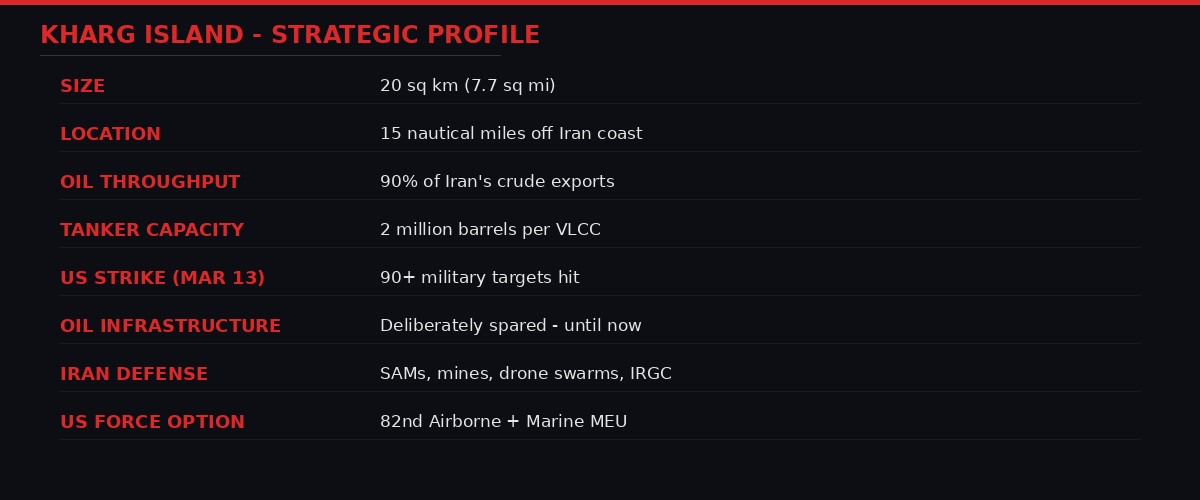
Kharg Island is a rocky outcrop of just 20 square kilometers sitting 15 nautical miles off Iran's southern coast in the Persian Gulf. Its deep-water port can accommodate Very Large Crude Carriers, each capable of loading approximately 2 million barrels of crude oil. Roughly 90% of Iran's oil exports pass through Kharg's terminal, transported via underwater pipelines from the mainland. It is, in the clearest possible terms, the artery through which Iran's economic lifeblood flows.
The island has history as a battlefield. During the Iran-Iraq war of the 1980s, Iraqi jets struck it repeatedly, targeting its loading infrastructure in an effort to choke Iran's war-funding capacity. The damage was significant but never fatal. Iran rebuilt. The oil kept flowing.
On March 13, 2026, the United States struck Kharg with what Trump called "one of the most powerful bombing raids in the History of the Middle East." US Central Command confirmed it destroyed more than 90 military targets on the island, including naval mine storage facilities, missile bunkers, an airport control tower, and a helicopter hangar. Crucially, the oil infrastructure was deliberately spared.
"For reasons of decency, I chose NOT to wipe out the Oil Infrastructure on the Island," Trump posted at the time. That restraint, which preserved Iran's ability to resume exports after any potential ceasefire, now appears to be running out.
In the Financial Times interview, Trump's language shifted unmistakably toward territorial seizure. "Maybe we take Kharg Island, maybe we don't. We have a lot of options," he said. He acknowledged occupation would require a sustained presence - "It would also mean we had to be there for a while" - before adding: "I don't think they have any defence. We could take it very easily."
He is wrong about the defenses. He may not be wrong about the intention.
The Force Package: 7,000 Troops and Rising

The 82nd Airborne and Marine Expeditionary Units are trained for exactly the kind of rapid island seizure being discussed. Photo: Unsplash
The military math is already public. On Saturday, US Central Command announced that 3,500 additional sailors and Marines arrived in the Middle East aboard assets led by the USS Tripoli, an America-class amphibious assault ship. They join roughly 2,000 paratroopers from the 82nd Airborne Division and an existing Marine Expeditionary Unit already deployed to the region. The total ground-capable force now exceeds 7,000 personnel, with enabling assets including Osprey tilt-rotor aircraft, Landing Craft Air Cushioned hovercraft, and naval air support.
Sources told CBS News that Pentagon officials have drawn up detailed preparations for deploying ground forces into Iran. Neither the Pentagon nor the White House has confirmed or denied specific operational plans, but both have repeatedly emphasized the option "remains available."
BBC security correspondent Frank Gardner, reporting from Riyadh, outlined the likely scenario. Paratroopers from the 82nd Airborne would execute a nighttime airborne assault to seize key positions on the small island. Marines would follow via amphibious landing from ships equipped with LCAC hovercraft. The operational challenge is not the island itself - it is the approach. US naval vessels would need to transit the Iranian-controlled Strait of Hormuz, sailing past hidden drone and missile launch sites scattered along Iran's coastline. An airborne approach eliminates that risk for the initial assault force, but resupply remains vulnerable.
Gardner compared the scenario to Ukraine's Snake Island in the Black Sea, which Russia seized in the opening days of its 2022 invasion, only to be driven off by constant harassing fire from the Ukrainian mainland. Kharg, at 15 nautical miles from Iran's coast, sits well within range of Iranian artillery, drones, and anti-ship missiles. Occupying it means defending it under continuous bombardment - indefinitely.
"Such is the awesome fighting power of these Marine Expeditionary Units that the US force would almost certainly prevail, but it could come at the expense of a severe number of casualties."- Frank Gardner, BBC Security Correspondent, March 30, 2026
Iran has not been idle. CNN reported, citing multiple people familiar with US intelligence, that Tehran has reinforced Kharg Island in recent weeks. Additional military personnel and air defense systems have been deployed. Shoulder-fired surface-to-air missiles have been positioned across the island. Anti-personnel and anti-armor mines have been laid in surrounding waters. Iran's parliament speaker, Mohammad Bagher Ghalibaf, delivered the clearest warning yet: Iranian forces are "waiting for American soldiers" and will "rain fire" on any troops attempting to enter Iranian territory.
An Iranian military official told local media that shipping in the Red Sea would be targeted in the event of a ground invasion - a threat that would extend the conflict's economic damage far beyond the Persian Gulf.
Sources: AP News, official government statements, Lebanese Health Ministry
The Ultimatum: Obliterate Everything

Trump has now explicitly threatened Iran's power plants, oil wells, and desalination systems. Photo: Unsplash
Trump's Monday social media post took the rhetoric further than any previous statement in the five-week conflict. He claimed "great progress is being made" with "A NEW, AND MORE REASONABLE, REGIME to end our Military Operations in Iran." In the same breath, he threatened that if a deal is not reached "shortly" and the Strait of Hormuz not reopened immediately, the United States would begin "completely obliterating" Iranian power plants, oil wells, Kharg Island, and "possibly even desalination plants."
The inclusion of desalination infrastructure is particularly striking. Iran's Gulf coast population depends heavily on desalinated water. Targeting these facilities would constitute an attack on the civilian water supply - a line that international humanitarian law draws with unusual clarity. Legal scholars cited by AP News noted that attacks on civilian infrastructure are permitted only when military advantage clearly outweighs civilian harm, describing this as "a high bar to clear." Causing excessive suffering to civilians, they added, can constitute a war crime.
Iran's response came through its Foreign Ministry. Spokesman Esmail Baghaei confirmed Tehran had received a 15-point proposal from the Trump administration, which he described as containing "excessive, unrealistic and irrational" demands. He denied any direct talks had taken place. The Pakistani-facilitated backchannel, which multiple parties have described as the only viable diplomatic track, appears to have delivered a document but not an agreement.
Ghalibaf, Iran's parliamentary speaker, went further, dismissing the Pakistan talks as diplomatic cover for military buildup. "Our forces are waiting for the arrival of American troops on the ground to set them on fire and punish their regional partners forever," he told Iranian state media. The phrase "regional partners" is a thinly veiled reference to the Gulf Arab states hosting US military assets - a signal that a ground invasion of Kharg could trigger retaliatory strikes on Saudi Arabia, the UAE, Kuwait, and Bahrain.
The pattern has become grimly familiar. Trump announces progress. Trump threatens annihilation. Iran denies talks are happening. Iran promises fire. And in between, the missiles keep flying.
Spain Breaks Ranks: The NATO Fracture Deepens

The Rota and Moron air bases in southern Spain are now off-limits to US forces involved in the Iran conflict. Photo: Unsplash
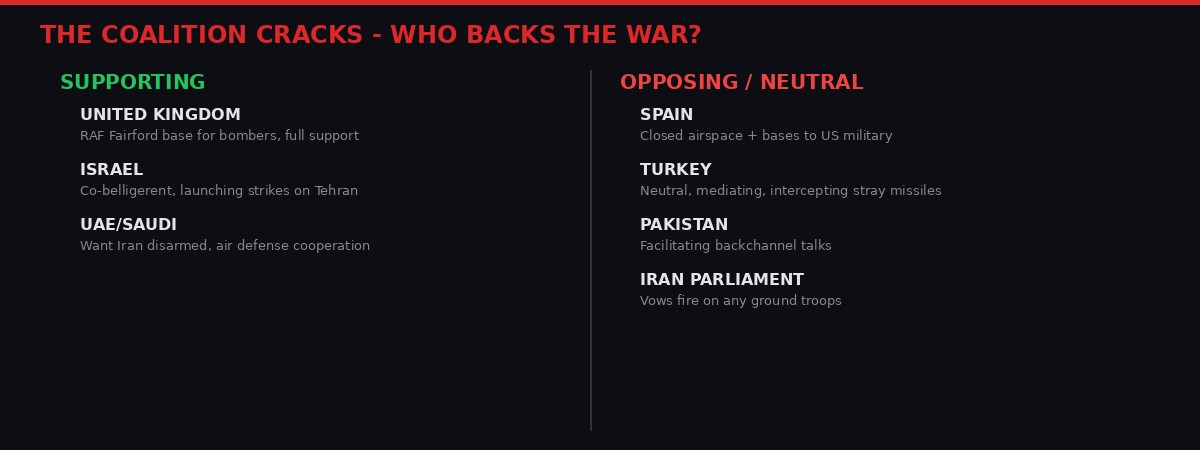
While Trump was threatening scorched earth in the Persian Gulf, Spain was burning bridges across the Atlantic. Defence Minister Margarita Robles announced Monday that Spain has closed its entire airspace to US aircraft involved in attacks on Iran. This escalates Madrid's earlier refusal to allow the US to use the jointly operated Rota and Moron military bases in Andalusia for operations connected to the conflict.
"We will not authorise the use of Moron and Rota for any acts related to the war in Iran. This was made perfectly clear to the American military and forces from the very beginning."- Margarita Robles, Spanish Defence Minister, March 30, 2026
Foreign Affairs Minister Jose Manuel Albares said the decision aimed "to not do anything that could encourage an escalation in this war." Spanish Prime Minister Pedro Sanchez has been Europe's most vocal opponent of the US-Israeli campaign, describing it as "reckless," "illegal," and "profoundly unjust." In a televised address earlier this month, he reflected on the wars in Ukraine and Gaza, as well as the Iraq War, and declared his government's position could be "summed up as no to war."
The White House dismissed Spain's defiance. An official told the BBC that the US military was "meeting or surpassing all of its goals under Operation Epic Fury and does not need help from Spain or anyone else." Trump has previously threatened a full trade embargo against Madrid over its opposition. The two countries have already clashed over Spain's refusal to raise defense spending to the 5% of GDP that other NATO members agreed to under Trump's pressure - Sanchez has maintained that 2.1% is sufficient.
The practical impact is significant. US bombers operating from RAF Fairford in Gloucestershire, England - where the UK has allowed American forces to station following Prime Minister Keir Starmer's approval on March 1 - now must bypass the entire Iberian Peninsula. Flight paths must route either over the eastern Atlantic or through French airspace. Spain's newspaper El Pais reported that US aircraft may only transit Spanish airspace in cases of emergency.
The diplomatic reward for Spain's stance arrived from an unexpected quarter. The Iranian embassy in Madrid announced that Tehran would be "receptive to requests from Spain concerning transit through the Strait of Hormuz" because Spain was "committed to international law." If this translates into preferential access for Spanish-flagged vessels, other European nations may find themselves weighing military solidarity against economic survival.
Sources: AP News, BBC News, Al Jazeera, official statements
The $115 Barrel: Markets Price In the Worst

Markets are swinging on every Trump statement, with investors giving his pronouncements decreasing weight. Photo: Unsplash
Brent crude closed around $115 on Monday, up nearly 60% from the $72 level that prevailed before the war began on February 28. The S&P 500 rose 0.5% in volatile midday trading, coming off its worst week since the war started. The Dow gained 411 points. The Nasdaq edged up 0.4%. None of it felt like confidence - it felt like traders catching their breath before the next headline.
The real story is in the bond market. The 10-year Treasury yield fell to 4.33% from 4.44%, offering some relief from a relentless climb since the war began. Before February 28, it sat at 3.97%. The spread tells you everything about how fixed-income markets are pricing the Federal Reserve's options: inflation from oil is running hot enough that rate hikes are on the table, but the economic damage from war is severe enough that the Fed may be trapped. Morgan Stanley strategists led by Michael Wilson noted "growing evidence the S&P 500 correction is getting closer to its ending stages," pointing out that the index looks 17% cheaper than before the war on a forward earnings basis. That analysis holds only if the Fed does not hike rates - a condition that gets harder to meet with every dollar Brent adds.
The deeper crisis is the supply gap that no price signal can fix. Lars Jensen, shipping expert and former director at Maersk, told the BBC that oil shipped from the Gulf more than a month ago was still arriving at refineries around the world - and that flow is about to stop. "The oil shortages we've been seeing, they're only going to get worse, even if magically the Strait of Hormuz would re-open tomorrow," he said. "We will face massive energy costs, not just while this crisis goes on but also for six to 12 months after it's over."
International Energy Agency director Fatih Birol warned earlier this month that the world is "facing the greatest global energy security threat in history." He specifically said it exceeds both the 1970s oil shocks and the natural gas crisis triggered by Russia's invasion of Ukraine. Economist Alicia Garcia Herrero of Natixis put numbers to the comparison: the 1970s crisis cut global supply by 5-7%, while the current Hormuz closure affects 20% of world supplies. "Today's Iran war crisis can end up being a bigger shock if the situation does not improve soon," she said.
Trump claimed Monday that Iran had agreed to allow 20 oil tankers through the Strait of Hormuz starting today "as a sign of respect." There was no independent confirmation that any ships were actually moving. The market's muted response to this claim - Brent barely twitched downward - suggests traders have learned to discount presidential optimism.
Sources: AP News, market data. Brent crude up ~60% since February 28.
The Battlefield: Missiles, Fires, and a Dead Peacekeeper

The Haifa oil refinery caught fire for the second time during the war after an Iranian strike Monday morning. Photo: Unsplash
While diplomats talked past each other and markets lurched, the war itself continued grinding across the entire Middle East on Monday. The geographic scope of Day 31 operations underscored just how far this conflict has spread from its original US-Israeli strikes on February 28.
In Israel, a fire erupted at an oil refinery in the northern city of Haifa - the second time the facility has been hit during the month-long war. Sirens sounded at dawn near Israel's main nuclear research center, which has been targeted repeatedly in recent days. Israel's military also intercepted two drones launched from Yemen, where Iran-backed Houthi rebels formally entered the war on Saturday with their first missile attack.
Iran continued hammering its Gulf Arab neighbors with a campaign that has turned the entire Persian Gulf littoral into a war zone. Saudi Arabia intercepted five missiles targeting its oil-rich Eastern Province. A fireball erupted over Dubai as the UAE's air defenses knocked down an incoming missile. In Kuwait, an Iranian attack struck a power and desalination plant, killing one Indian worker and wounding 10 soldiers, according to the state-run KUNA news agency.
NATO air defenses intercepted a ballistic missile over Turkey - the fourth such incident since the war began. Iran has denied firing the previous three. Turkey, which has tried to maintain neutrality while participating in mediation, finds itself involuntarily drawn into the conflict zone by geography alone.
In Lebanon, an Indonesian United Nations peacekeeper was killed and three others wounded by an exploding projectile in the south, where Israel has expanded its ground invasion against Hezbollah. An Israeli airstrike on a Beirut suburb killed one person and wounded 17, including four children. Over the weekend, Prime Minister Benjamin Netanyahu announced the military would widen the invasion, expanding the "existing security strip" in southern Lebanon.
Israel launched yet another wave of strikes on Iran, saying it was hitting "military infrastructure" across Tehran. Explosions were heard in the Iranian capital. Iranian state media reported a petrochemicals plant in Tabriz sustained damage in a separate airstrike. The UAE's minister of state at the Foreign Ministry, Noura Al Kaabi, published a column in the state-linked newspaper The National that read less like diplomacy and more like a war objective.
"An Iranian regime that launches ballistic missiles at homes, weaponizes global trade and supports proxies is no longer an acceptable feature of the regional landscape. We want a guarantee that this will never happen again."- Noura Al Kaabi, UAE Minister of State, The National, March 30, 2026
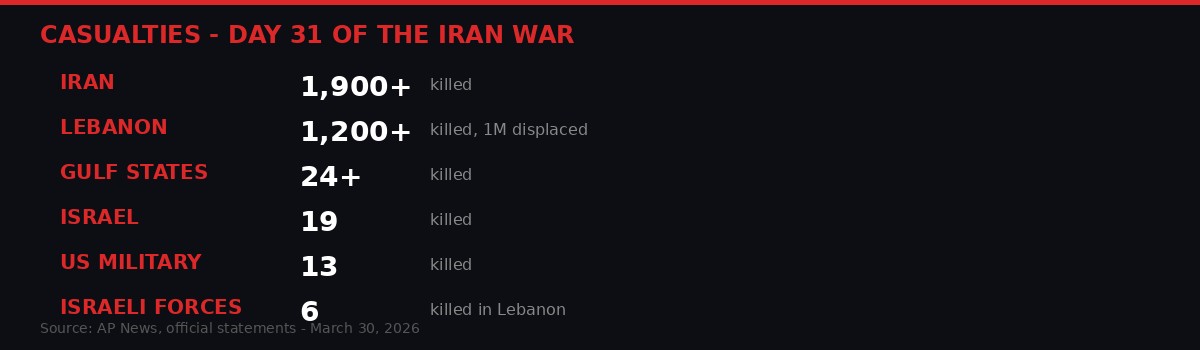
The casualty toll continues to climb. Iran reports more than 1,900 killed. Lebanon has counted over 1,200 dead, with more than one million displaced. Twenty-four people have died in Gulf states and the occupied West Bank. Nineteen Israelis have been killed. Thirteen American service members have died. Six Israeli soldiers have been killed in Lebanon. These numbers, already grim, will look small if ground forces hit Kharg Island.
The Rationing World: From Free Buses to Fuel Cards

Fuel prices have doubled in some import-dependent countries, forcing governments into emergency rationing measures. Photo: Unsplash
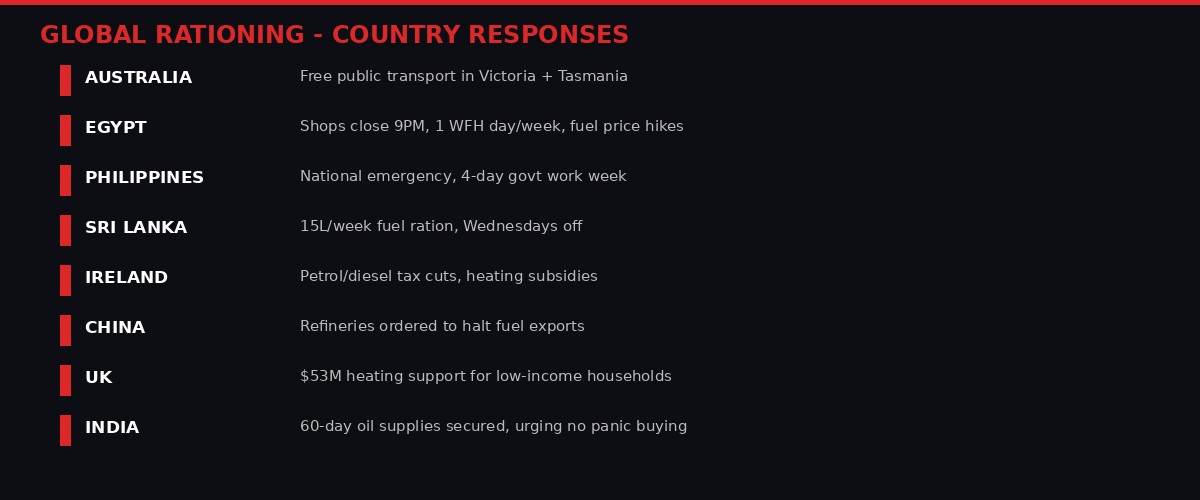
The war's economic fallout is no longer theoretical. Governments on four continents are now implementing emergency measures that range from modest subsidies to full-blown wartime austerity. The list of countries forced to act reveals the true global footprint of a conflict centered on a narrow waterway between Iran and the Arabian Peninsula.
Australia has made public transport free in two states. Victoria's trains, trams, and buses carry passengers for nothing starting Tuesday. Tasmania's buses, coaches, and ferries are free through June. The average petrol price in Australia jumped from A$2.09 per liter before the war to A$2.38 on March 22 - and it has not stopped climbing.
Egypt imposed nightly curfew-like measures: shops, restaurants, and cafes must close at 9 PM. Non-essential government workers work from home one day per week. Petrol prices and public transport fares have been hiked. Large, energy-intensive state projects have been paused. Government vehicle fuel allowances were slashed by nearly a third.
The Philippines declared a national emergency. With 98% of its oil imported from Gulf states, diesel and petrol prices have more than doubled. The government ordered a four-day work week for civil servants, reduced ferry services, offered subsidies to transport drivers, and pledged to stockpile an additional million barrels. "Nothing is off the table," President Ferdinand Marcos said.
Sri Lanka - still recovering from its 2022 financial collapse - introduced hard rationing: 15 liters per week for car owners, 5 liters for motorcycles. Wednesdays have been declared public holidays for government institutions, schools, and universities to reduce commuting fuel consumption.
China ordered its refineries to halt fuel exports to preserve domestic stocks. Beijing has roughly 900 million barrels in strategic reserves - about three months of imports. That buffer is significant but not infinite. Ireland cut petrol and diesel taxes. The UK announced 53 million pounds for heating-oil support for low-income households. India claims 60 days of supply security and urged citizens not to panic buy.
The pattern is clear: the more a country depends on Gulf oil, the more drastic its response. The Philippines and Sri Lanka are in emergency mode. Australia and Egypt are making painful but manageable adjustments. Europe and North America are still in the subsidy-and-hope phase. A Kharg Island seizure - whether successful or botched - would push every one of these countries further down the ladder.
Sources: BBC News, AP, government statements from respective countries
The 1970s Comparison - and Why This Could Be Worse

Experts warn the current crisis could dwarf the 1970s oil shocks in both scale and duration. Photo: Unsplash
The question every economist is now answering differently: is this the 1970s again? The consensus is splitting between "yes, but worse" and "bad, but manageable." The truth likely sits closer to the former.
The 1973 oil crisis was a deliberate policy decision. Arab producers embargoed the US and allies over support for Israel during the Yom Kippur War and coordinated production cuts. Prices quadrupled within months. Fuel rationing spread across major consuming nations. Recessions hit the US and UK from 1973 to 1975. The crisis helped bring down Ted Heath's Conservative government in Britain.
The current crisis is different in mechanism but potentially larger in magnitude. As economist Dr. Carol Nakhle of Crystol Energy told the BBC, the 1970s shock was "the result of a deliberate policy decision" - a targeted embargo. Today's disruption is a physical blockade of the Strait of Hormuz combined with active military destruction of energy infrastructure across an entire region. It is not a tap being turned off by choice. It is the plumbing being bombed.
The numbers tell the scale story. The 1970s embargo cut global supply by 5-7%. The Hormuz closure affects approximately 20% of global oil and natural gas flow. Natixis economist Alicia Garcia Herrero called this reality "dwarfing the 1970s shock" and warned of "sharper price spikes, broader inflation pain, and deeper recession risks, especially in import-heavy Asia."
The world does have advantages it lacked in 1973. Strategic petroleum reserves exist in the US, China, Japan, and across Europe. Energy intensity per unit of GDP has fallen. Renewable energy sources provide a partial buffer. Markets are more sophisticated and faster-reacting.
But Jensen's point about the pipeline delay is critical. Oil shipped before the Hormuz closure is still arriving at its destinations. When that flow terminates in the coming weeks, the real impact begins. "We will face massive energy costs, not just while this crisis goes on but also for six to 12 months after it's over," he said. Even a sudden ceasefire tomorrow would not prevent months of economic pain - the supply chain takes that long to refill.
A ground operation on Kharg Island would not just extend the timeline. It would fundamentally change the nature of the crisis. An embargo can be lifted with a decision. A military occupation of a country's primary oil export facility transforms a trade disruption into a territorial conflict with no clear exit. Iran has promised to mine the entire Persian Gulf if US troops set foot on its soil. The 1970s crisis lasted months. This one could last years.
What Comes Next

The Persian Gulf's energy infrastructure sits at the center of a conflict with no visible offramp. Photo: Unsplash
The situation on the evening of March 30, 2026, is this: the President of the United States has publicly stated he might invade Iranian territory. He has also said a deal could come at any time. Both statements may be true simultaneously - the threat is the leverage, the deal is the goal. The question is whether Iran views the threat as a reason to negotiate or a reason to escalate.
History offers little comfort. Twice during Trump's second term, the US has attacked Iran during active diplomatic talks, including the February 28 strikes that started the current war. Iran has every reason to view military buildups near Kharg not as pressure tactics but as rehearsals for actual invasion. Ghalibaf's statement - that the Pakistan talks are "cover while more US troops are brought to the region" - reflects a reading of US behavior that is, by the evidence, entirely rational.
The Pakistan-facilitated backchannel remains the only visible diplomatic track. Pakistan, Saudi Arabia, Turkey, and Egypt have assembled a team for indirect talks between Washington and Tehran. Whether those talks have achieved anything beyond document exchange is unclear. Iran says the US demands are unrealistic. The US says progress is being made. Both things cannot be true.
On the battlefield, the war is expanding, not contracting. Yemen's Houthis have joined. Lebanon's invasion is widening. Gulf infrastructure is being struck with increasing frequency. NATO air defenses over Turkey are intercepting Iranian missiles. An Indonesian UN peacekeeper is dead in southern Lebanon. The geographic scope of combat on Day 31 is wider than on Day 1.
Oil market analysts are now modeling scenarios that seemed extreme two weeks ago: Brent at $130 if Kharg is seized, $150 if Iran retaliates by mining the full Persian Gulf, $90 if a ceasefire materializes in the next two weeks. The market's baseline expectation - embedded in futures pricing - is that this crisis continues for months. No serious analyst is pricing in a rapid resolution.
The Western alliance is fragmenting along predictable lines. The UK stands with the US. Spain stands against. France, Germany, and Italy have been conspicuously quiet - a silence that reads as hedging. If Iran offers preferential Hormuz transit to countries opposing the war, the economic incentive to break with Washington will compound daily as energy prices climb.
Trump may never order the Kharg invasion. The troops may be pressure, not prelude. The deal he claims is close may actually be close. But the market, the military, and the Middle East are all behaving as though the next escalation is a matter of when, not if. On Day 31, the gap between diplomacy and catastrophe has never been thinner.
Get BLACKWIRE reports first.
Breaking news, investigations, and analysis - straight to your phone.
Join @blackwirenews on Telegram