BLACKWIRE / CIPHER Bureau
The cage at the Coca-Cola Arena in Dubai's City Walk district holds 6,000 spectators. On the evening of June 14, 2025, two of those seats in the front row VIP section were occupied by men with $5 million bounties on their heads - Christy Kinahan, founder of one of Europe's most violent drug cartels, and his son Daniel, the man U.S. authorities say runs its trafficking operations. They sat at opposite ends of the ring. The man who organized the event - former UFC fighter Mounir "The Sniper" Lazzez - can be seen in footage moving between them, crouching beside Christy, talking with Daniel, visible across six hours of officially streamed video.
That footage alone would have made headlines. But a new investigation published by Bellingcat and The Sunday Times goes further - much further. Corporate records unearthed through the Panama Flag Registry show that in 2023, while still living in Dubai and launching his fight promotion business, Lazzez was listed as director of two shell companies incorporated in the Marshall Islands. Those companies paid a combined total of more than $80 million for two crude oil tankers. Both tankers were subsequently sanctioned by the U.S. Treasury's Office of Foreign Assets Control for their roles in transporting Iranian oil in violation of U.S. sanctions.
And then there is the address. Both of Lazzez's shell companies were registered at a Marshall Islands address routinely used to incorporate offshore entities. That same address was used to register Matthew Maritime Inc. - the company that owned the MV Matthew, a Panamanian-flagged bulk carrier seized by the Irish Navy in September 2023, 100 miles south of Cork, carrying 2.07 tonnes of cocaine worth €157 million. The largest drug seizure in Irish history. A smuggling operation that Irish authorities and investigative reporters linked directly to the Kinahan cartel.
BLACKWIRE has reviewed the Bellingcat investigation in detail, cross-referencing it against OFAC sanctions records, U.S. Treasury designations, and published corporate data. What emerges is a pattern connecting a sanctioned Irish narco-trafficking empire, a former elite fighter turned Dubai events promoter, Iranian oil smuggling operations, and the world's most permissive major financial jurisdiction - all orbiting a single address in the Pacific.
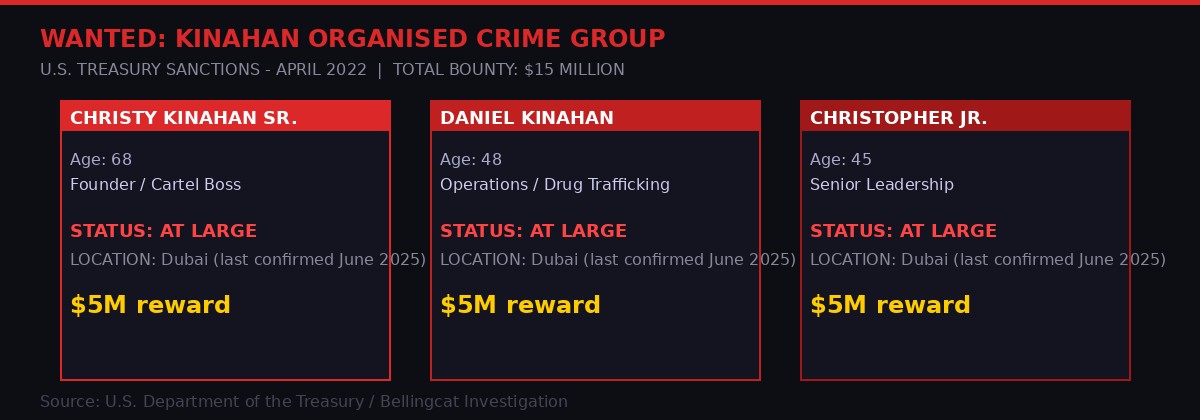
The three senior members of the Kinahan Organised Crime Group are subject to U.S. Treasury sanctions and a collective $15 million reward for information leading to their arrest. All three are believed to reside in Dubai. Source: BLACKWIRE / U.S. Department of the Treasury
Who the Kinahans Are
The Kinahan Organised Crime Group is an Irish transnational criminal enterprise estimated to be worth approximately €1.5 billion. Its origins lie in Dublin, where patriarch Christy Kinahan Sr. began building a drug supply network in the 1990s. By the 2000s, the family had relocated to Spain's Costa del Sol, embedding themselves in the European cocaine trade and cultivating alliances with Colombian and Moroccan trafficking networks. They were major participants in what Europol investigators dubbed the "Super Cartel" - a loose network of European-based traffickers that at its peak controlled an estimated 30% of Europe's cocaine supply.
In 2016, a gangland feud with the rival Hutch family - which left seventeen people dead on both sides - forced the Kinahans to flee Spain for Dubai, where they have lived ever since. The UAE has no extradition treaty with Ireland and has shown a consistent pattern of non-cooperation with Western law enforcement when it comes to individuals who keep their wealth and behavior locally compliant.
In April 2022, the U.S. Treasury Department designated the Kinahan Organised Crime Group under the Kingpin Act, sanctioning Christy, Daniel, and Christopher Kinahan Jr. and five associates. The announcement came with a $15 million collective bounty - $5 million per Kinahan - and a stark summary of the cartel's activities.
"The Kinahan cartel is a murderous organisation that has spread its tentacles across the globe," said Anne Milgram, then-administrator of the Drug Enforcement Administration, at the time of the sanctions. "The Kinahan cartel has been working to build an international criminal empire that buys and sells weapons, facilitates the movement of drugs and cash, and launders money."
The sanctions cited the cartel's alleged ties to Iran's intelligence services and to Hezbollah, the Lebanon-based militant group. The Sunday Times had previously reported on the Kinahan network's involvement in arms smuggling, with alleged clients including Iranian intelligence agencies seeking weapons procurement. These connections, though complex to document, have been corroborated by multiple law enforcement sources across multiple investigations.
After the bounties were announced, Daniel Kinahan's boxing management company MTK Global - which had signed world heavyweight champion Tyson Fury and managed hundreds of professional boxers - shut down overnight. The three Kinahans dropped from public view and have remained largely invisible since, communicating through intermediaries and avoiding the public sightings that might enable arrest. Until, it appears, the evening of June 14, 2025.
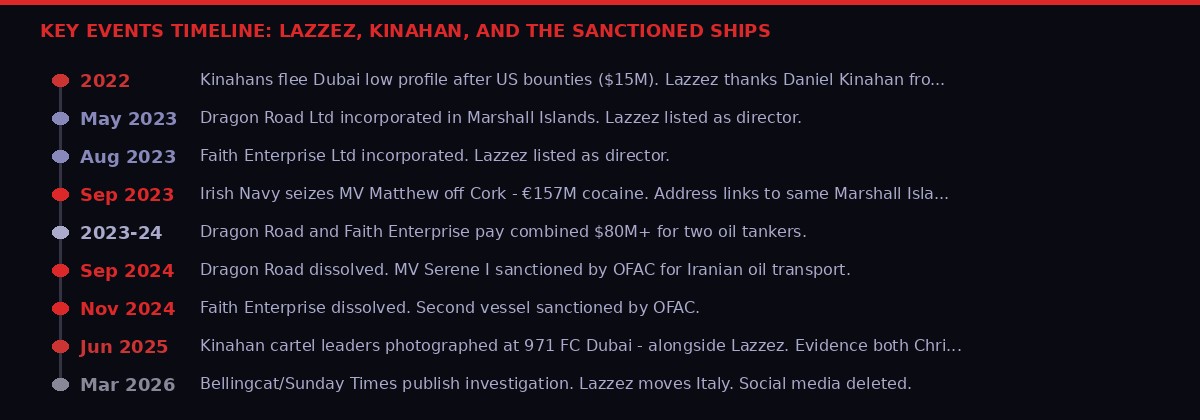
Timeline of documented events linking Mounir Lazzez, the Kinahan cartel, and the Iranian oil tanker sanctions. Source: BLACKWIRE / Bellingcat / OFAC
The Sniper and His Sanctioned Ships
Mounir Lazzez is 38 years old, Tunisian-born, Italian-naturalized, and was the first Arab born-and-raised fighter to be signed to the UFC. He arrived in Dubai around 2011 on what he described as a "business opportunity," built a career in MMA, and was signed to the UFC's welterweight roster in 2020 after a recommendation to long-time UFC president Dana White. He won his nickname "The Sniper" for precision striking and fought four times before retiring from competition in 2023.
During the latter part of his career, Lazzez was represented by MTK Global - Daniel Kinahan's management firm. He has spoken publicly and repeatedly about his closeness to Kinahan. In 2021, he wrote on social media: "I've never met a man like him." In April 2022, three days after U.S. sanctions were announced against Kinahan, Lazzez thanked the then-newly designated cartel boss from inside the cage at a UFC event in Las Vegas, telling thousands of fans: "Without him, I would never be the man who I am today."
When questioned about those comments afterward, Lazzez said Kinahan was "a friend and adviser." He acknowledged the relationship but not its implications.
After retiring from competition, Lazzez founded the 971 Fighting Championship in 2024 - the name a reference to the UAE's country code - and co-owned a gym in Dubai's industrial Al Quoz district. By all appearances, he was a retired fighter transitioning into promotion and business. But corporate records told a different story.
In May 2023, a Marshall Islands company called Dragon Road Limited was incorporated, with Mounir Lazzez listed as director. In August 2023, a second Marshall Islands entity, Faith Enterprise Limited, was created with Lazzez again listed as director. Both companies paid combined totals exceeding $80 million to acquire crude oil tankers. Both vessels were subsequently sanctioned by OFAC for transporting Iranian oil in violation of U.S. sanctions law. Both companies were dissolved in the months immediately following the sanctions designations. Source: Panama Flag Registry, C4ADS Horizons platform, Bellingcat (March 2026).
Bellingcat confirmed Lazzez's involvement through a process of documentary cross-referencing. His signature appears on the Panama Flag Registry title documents for the vessel acquisitions, certified authentic by named Panamanian consular officials. The Italian passport number used in those documents was verified through a government of Dubai commercial licence for Lazzez's gym - the Nine Seven One Rising Mixed Martial Arts Academy LLC - publicly accessible on the Dubai government's official website.
The identification method was forensically sound. Lazzez had posted publicly about obtaining Italian citizenship in 2022, and his Italian passport number was traceable through official business registration documents he had filed under his own name for a legitimate enterprise. There is no ambiguity about who signed the ship-purchase documents.
Dragon Road was annulled in September 2024, the same month the first vessel it purchased - the MV Serene I - was sanctioned by OFAC. Faith Enterprise was dissolved in September 2024, nine weeks before the second vessel was sanctioned in November 2024. The timing of both dissolutions immediately preceding or following sanctions designations is consistent with a pattern investigators frequently observe in sanctions-evasion networks: dissolving the paper entity the moment it draws regulatory attention.
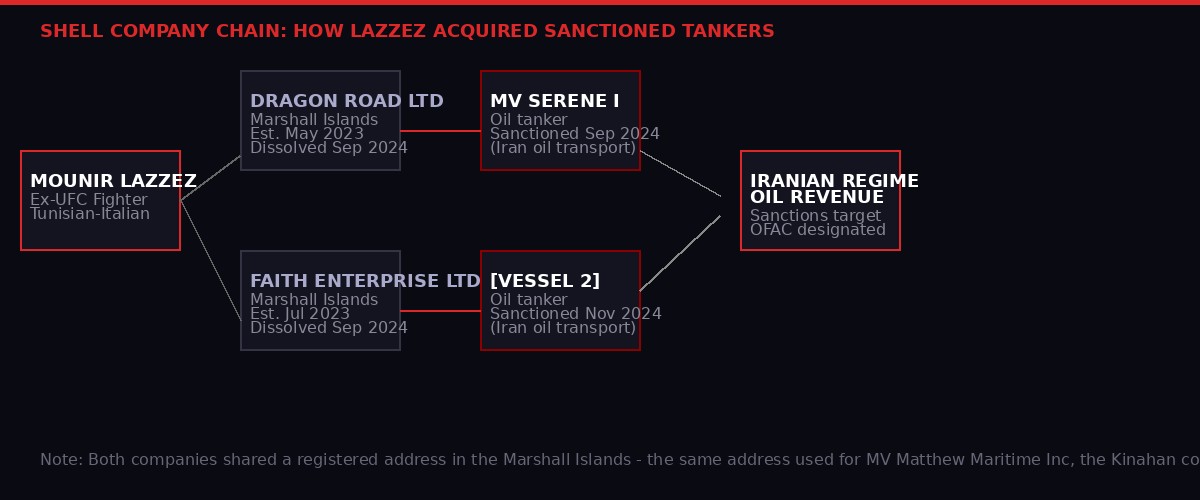
The documented corporate chain from Lazzez as director to the two Marshall Islands entities to the sanctioned Iranian oil tankers. Both companies were dissolved within weeks of OFAC sanctions designations. Source: BLACKWIRE / Panama Flag Registry / C4ADS
The Marshall Islands Address and the Cocaine Ship
The Marshall Islands is a Pacific archipelago nation with a population of approximately 42,000 people and one of the world's most permissive ship registration and corporate incorporation regimes. Its flag is carried by more vessels than almost any other national registry - a consequence of its loose regulatory environment, which makes it attractive to shipping operators seeking minimal scrutiny. Its corporate registry allows the identities of directors, shareholders, and beneficial owners to be withheld from public records.
Within the Marshall Islands corporate ecosystem, certain registered agents act as nominees for hundreds or thousands of companies simultaneously, providing a common mailing address that appears in multiple company registrations across multiple industries - and, as investigators have repeatedly found, across multiple categories of criminal and sanctions-evading enterprise.
Bellingcat's investigation found that both of Lazzez's companies - Dragon Road Limited and Faith Enterprise Limited - were headquartered at a Marshall Islands address commonly used for registering offshore entities. This finding alone would be unremarkable. But the same investigation identified another company registered at that address: Matthew Maritime Inc., the company that owned the MV Matthew.
On September 26, 2023, the Irish Naval Service boarded the MV Matthew approximately 100 nautical miles south of Cork, Ireland, acting on intelligence from Europol and the Drugs and Organized Crime Agency. Below decks, investigators found 2.07 tonnes of cocaine - 82 bales wrapped in vacuum-sealed packaging - with an estimated street value of €157 million. It was, and remains, the largest single drug seizure in Irish history.
The MV Matthew was a Panamanian-flagged bulk carrier. Its registered owner, Matthew Maritime Inc., was incorporated in the Marshall Islands. Subsequent reporting by The Irish Times and The Sunday Times identified the smuggling operation as part of a conspiracy involving the Kinahan cartel and the Colombian Clan del Golfo. Authorities also reported that the operation was being coordinated from Dubai, and that investigators suspected the involvement of Hezbollah and the Iranian government - connections consistent with long-documented Kinahan alliances.
"The operation was directed from Dubai. Multiple agencies across multiple countries were tracking it. The Kinahan connection is not speculative - it has been confirmed by law enforcement." - Irish Times, citing law enforcement sources, 2025
Bellingcat's finding that Lazzez's two shell companies shared a registered address with Matthew Maritime Inc. represents a documented factual link - not a proof of personal involvement. The investigation explicitly acknowledges this: the shared address does not establish that Lazzez had any knowledge of the cocaine operation or any direct relationship with the cocaine ship or its owners.
What the shared address does establish is that Lazzez's corporate infrastructure was embedded in the same anonymous offshore architecture that was simultaneously being used by parties operating a cocaine freighter linked to the same cartel whose leadership Lazzez photographed himself alongside, whose boss he publicly praised, and whose management company represented him during his professional career.
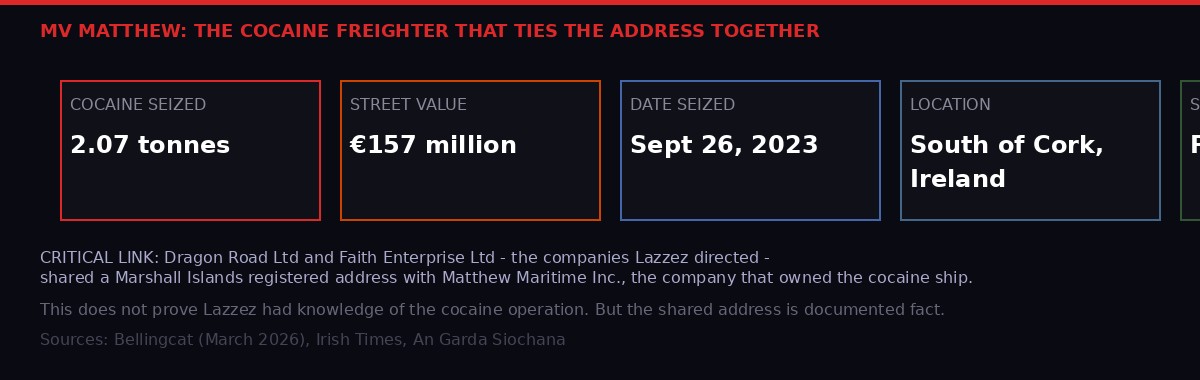
Key facts from Ireland's largest-ever cocaine seizure, September 2023. The registered address for the ship's ownership company matches the Marshall Islands address used for Lazzez's two tanker-holding companies. Source: BLACKWIRE / An Garda Siochana / Irish Navy
Dubai: The Jurisdiction That Keeps Not Noticing
To understand why all of these threads converge on Dubai, you need to understand what the UAE has become in the post-2008 world: a jurisdiction that has mastered the performance of financial compliance while systematically failing its substance.
The UAE has implemented the formal architecture of an anti-money-laundering state. It has signed Financial Action Task Force commitments, established Financial Intelligence Units, enacted laws against money laundering and terrorism financing, and issued press releases about its compliance efforts. In 2024, after years of pressure, it was removed from the FATF grey list - a designation that had placed it among countries with deficient anti-money-laundering controls.
But the empirical record tells a different story. The Kinahan cartel bosses have lived openly in Dubai for nearly a decade, despite U.S. Treasury sanctions, $15 million in bounties, and international arrest warrants. Hossein Shamkhani, the sanctioned Iranian oil magnate identified by OFAC as running a billions-dollar sanctions-evasion network, used the UAE to hold $29 million in luxury real estate under Caribbean aliases - as OCCRP documented earlier this month. Ali Ansari, sanctioned by the UK for financing the IRGC, held properties in multiple European countries while maintaining UAE-based corporate entities. Russian oligarchs flooded Dubai after the 2022 sanctions wave, parking hundreds of billions in UAE real estate that has been largely untouched.
The pattern is consistent and documented: high-value targets subject to Western sanctions designations use Dubai as a base precisely because the UAE's enforcement apparatus - whatever its formal commitments - does not translate those designations into operational disruption. People live there. Businesses operate there. Properties are held there. And the consequences, for the individuals involved, have remained minimal.
In the Kinahan case specifically, the UAE extradited one cartel lieutenant - Sean McGovern, charged with murder and directing criminal activities - in early 2025, a development that observers noted as unusual. It did not extradite the family members carrying the U.S. bounties. The June 2025 fight night, where Christy and Daniel Kinahan sat openly in the front row of a 6,000-person event that was simultaneously being live-streamed globally, represents either a significant intelligence failure or a level of protection that goes beyond operational security into something closer to tolerance.
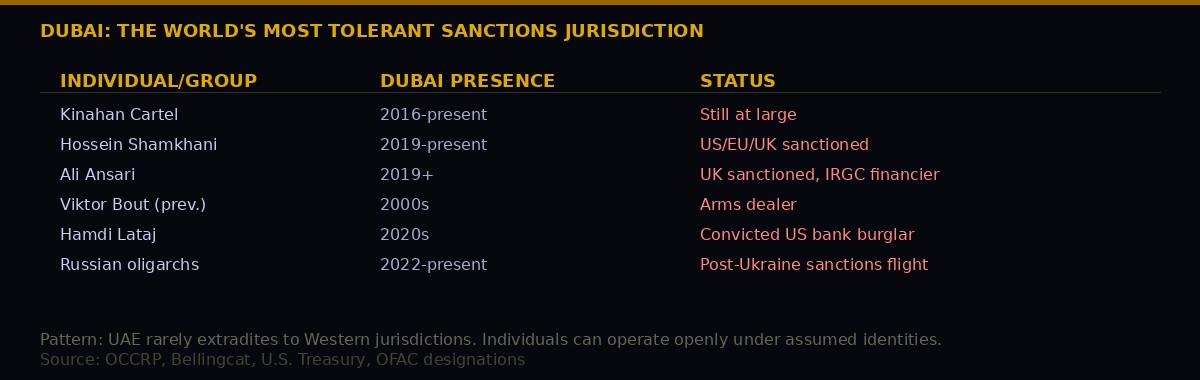
A partial record of sanctioned or criminally designated individuals documented as operating in Dubai. The UAE's formal anti-money-laundering commitments have not translated into enforcement against major Western-designated targets. Source: BLACKWIRE research / OCCRP / Bellingcat / OFAC
The Iranian Connection: Tankers and Sanctions Architecture
The specific nature of the sanctions against the two tankers acquired by Lazzez's shell companies situates them within a well-documented pattern of Iranian oil sanctions evasion that the U.S. Treasury has been tracking for years.
Following the re-imposition of U.S. sanctions on Iran's oil sector in 2018 and their tightening through subsequent administrations, Iran developed an extensive sanctions-evasion infrastructure relying on ship-to-ship transfers in offshore waters, flag-switching, document falsification, and crucially - the use of anonymously-owned shell companies to hold the vessels nominally involved. When OFAC designates a specific tanker for sanctions violations, the ship's registered owner - a shell with no traceable beneficial owner - can simply be dissolved. A new shell is incorporated. Another ship is purchased. The oil keeps moving.
OFAC's designation notices for both vessels acquired through Dragon Road Limited and Faith Enterprise Limited cite their role in the transport of Iranian crude oil in violation of Executive Order 13846, which reimposed sanctions on Iran's petroleum sector. The designations are administrative - they don't require criminal conviction. They require documented evidence that the vessel has been used to transport sanctioned oil. OFAC had that evidence.
What OFAC typically cannot access - because of the deliberate opacity of jurisdictions like the Marshall Islands - is the identity of the beneficial owners behind the shell companies holding the ships. In this case, Bellingcat's open-source methodology penetrated that opacity by cross-referencing the Panama Flag Registry's requirement for director signatures on title documents against publicly accessible UAE business records.
The Kinahan cartel's documented relationships with Iranian intelligence services - reported by multiple outlets citing law enforcement sources - and the allegations linking the MV Matthew cocaine operation to Iranian government involvement add a further dimension to the picture. Whether these represent a coherent operational relationship or simply overlapping criminal networks sharing infrastructure remains unresolved. But the overlap is documented.
Lazzez has not responded to questions about his directorship of Dragon Road or Faith Enterprise, about the sanctioned tankers, or about the shared Marshall Islands address. According to Bellingcat, his gym in Dubai confirmed he had had no involvement in the business since October 2025. He was located in Italy - where his wife is from - and social media accounts were deleted or made private immediately after Bellingcat made contact.
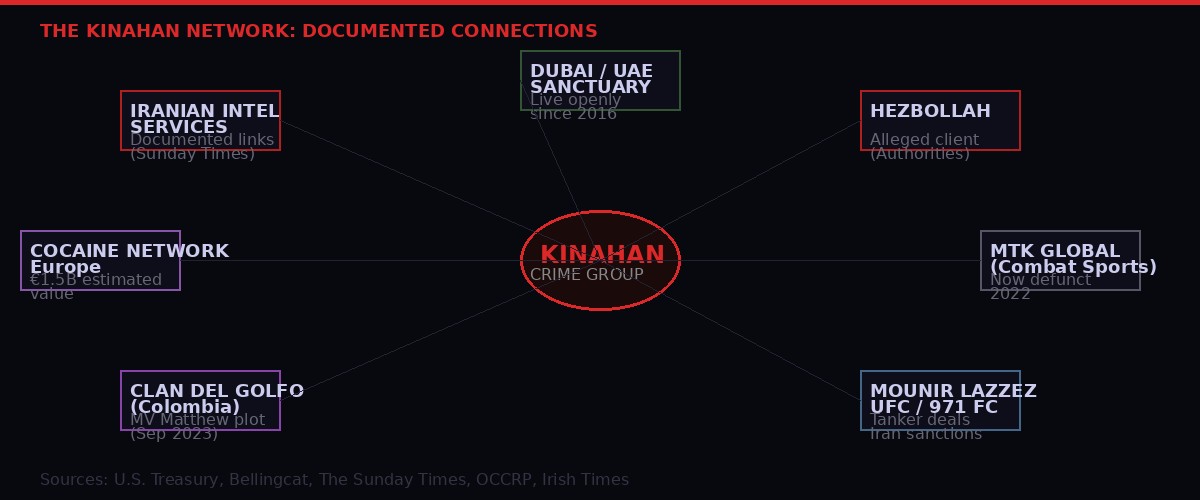
The documented network of connections linking the Kinahan Organised Crime Group. The cartel's alliances with Iranian intelligence, Hezbollah, and South American trafficking groups have been reported by multiple investigative outlets citing law enforcement sources. Source: BLACKWIRE / U.S. Treasury / Bellingcat / Sunday Times
The Laundering Architecture of Combat Sports
The intersection of the Kinahan cartel with professional boxing and mixed martial arts was not accidental. It was strategic - and it was documented while it was happening.
Daniel Kinahan co-founded MTK Global in 2012 as a boxing management company. By the late 2010s, MTK had become one of the most powerful management firms in professional boxing, signing hundreds of fighters across weight classes, including Tyson Fury, Carl Frampton, Michael Conlan, and dozens of others. The firm operated simultaneously as a legitimate business and, investigators alleged, as a vehicle for money laundering, placing proceeds from drug trafficking into legitimate fight promotion, management fees, and fight purses - cash flows that are notoriously difficult to audit.
Combat sports promotion is an ideal money laundering vehicle for several structural reasons. Ticket revenues are partly cash-based. Promotional fees and management percentages can be inflated or deflated. The valuation of a fighter's services is inherently subjective. International fight cards involve complex multi-jurisdiction financial flows - purses paid in one country, management fees taken in another, promotional agreements structured through holding companies. The entire industry operates on handshake deals and relationships, with limited formal disclosure requirements compared to, say, a publicly listed company.
MTK Global's shutdown in 2022 following the Kinahan sanctions removed the most obvious corporate vehicle. But the 971 Fighting Championship - Lazzez's promotion, launched in 2024, headquartered in Dubai - inhabits the same structural space. It is a legitimate event business in a legitimate industry. It held a 6,000-seat event at a major arena. It live-streamed globally. And at that event, the founders of the €1.5 billion cartel that previously managed Lazzez's career sat ringside.
"When you're trying to understand how criminal networks maintain coherence after major disruptions - sanctions, arrests, asset seizures - you look for the connective tissue. Sports and entertainment are frequently that tissue. They're the spaces where sanctioned individuals can appear without obvious criminal context, and where financial flows can be legitimized." - Financial crime analyst, cited in OCCRP analysis of sports money laundering (2024)
The 971 FC's investors and financial backers have not been publicly identified. Lazzez's two Dominica-citizen co-owners at his Dubai gym - one of whom studied law in Iran and specializes in maritime law, the other named in the Panama Papers with shipping industry connections - raise questions that the available documentation does not fully answer. Both declined to respond to Bellingcat's questions.
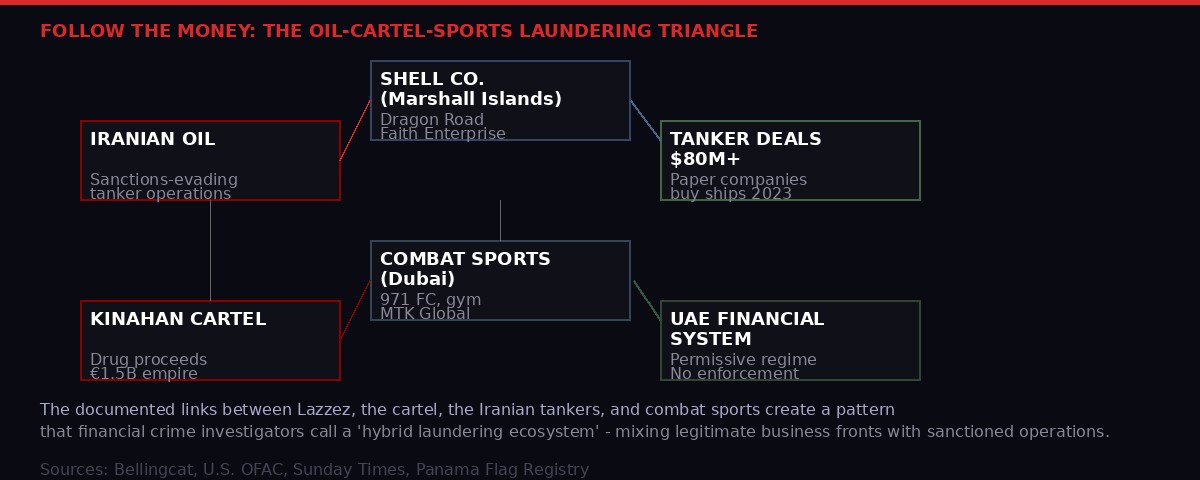
The documented intersection of Iranian oil sanctions evasion, Kinahan cartel operations, and combat sports promotion - all converging on Dubai. Financial crime investigators describe this pattern as a 'hybrid laundering ecosystem.' Source: BLACKWIRE analysis / Bellingcat / U.S. Treasury
What the Investigation Establishes - and What It Does Not
Investigative journalism operates with a different evidentiary standard than criminal prosecution, and precision about what is and is not established matters. This investigation does not allege that Mounir Lazzez is a member of the Kinahan cartel. It does not allege that he knew the cocaine was aboard the MV Matthew. It does not allege that he personally directed the transportation of Iranian oil, or that he knew the tankers he acquired through his shell companies would be used for that purpose.
What is documented in corporate records, examined by Bellingcat and verified through open-source methodology, is the following:
- Lazzez was the listed director of two Marshall Islands shell companies that paid more than $80 million for crude oil tankers subsequently sanctioned by OFAC for Iranian oil transport.
- Both companies were incorporated weeks before the vessel purchases and dissolved within weeks of the sanctions designations.
- Both companies were registered at a Marshall Islands address also used by the corporate owner of the MV Matthew, a vessel linked by law enforcement and investigative reporters to the Kinahan cartel's cocaine trafficking operations.
- Lazzez was a publicly acknowledged close associate of Daniel Kinahan for at least five years, represented by Kinahan's management company, and openly photographed with both Kinahan cartel leaders at a private event in June 2025.
- Following Bellingcat's inquiries, Lazzez's social media was deleted, his gym in Dubai confirmed he had departed, and calls and messages to his Italian contact information went unanswered.
Each of these facts is documented and sourced. Their combination raises serious questions about the nature of Lazzez's corporate activities, who directed the shell companies beyond the formal director role, and what the relationship between those corporate structures and the Kinahan network's broader financial infrastructure actually looks like. Those questions cannot be fully answered from publicly available records - which is precisely the function that offshore corporate secrecy serves.
This is the operating principle of sophisticated financial crime: not to be provably illegal in any single documented transaction, but to be collectively impenetrable. Each layer of the structure - the Marshall Islands company, the Panama flag, the nominee director, the dissolved entity - is individually explainable. It is the pattern that exposes the architecture.
The corporate structure linking Lazzez's directorship to the sanctioned tankers through Marshall Islands shell entities, as documented in Panama Flag Registry records and verified by Bellingcat. Source: BLACKWIRE / International Registries Inc. / C4ADS Horizons
The Bigger Picture: Offshore Architecture as Criminal Infrastructure
The investigation into Lazzez and the Kinahan cartel tankers is a case study in a problem that governments and regulators have been unable to solve despite decades of formal effort: the use of anonymous offshore corporate structures as critical infrastructure for organized crime and sanctions evasion.
The Marshall Islands corporate registry's opacity is not an accident. It is the product. The value proposition of registering a company or a ship in the Marshall Islands is specifically that beneficial ownership remains hidden and the entities can be dissolved and recreated with minimal friction. The 2022 FinCEN beneficial ownership reporting requirements in the United States, the EU's beneficial ownership registers, and the FATF's global standards have all made formal progress toward transparency - but they have not closed the offshore jurisdictions that serve as the operating environment for exactly this kind of structure.
For sanctioned Iranian oil to move through international markets, it requires three things: ships, corporate ownership structures that obscure who controls those ships, and financial jurisdictions willing to process the transactions. The Marshall Islands provides the corporate obscurity. Dubai provides the operational base and financial gateway. The Kinahan network - based in Dubai, with documented connections to Iranian state actors, and long experience operating across financial and criminal jurisdictions - provides what investigators call "facilitation capacity": the relationships, the infrastructure, and the experience to operationalize the movement of sanctioned goods through nominally clean structures.
Whether Lazzez was an active participant in that architecture or a nominal figure whose identity was used without his full understanding is a question that law enforcement, not journalists, is positioned to investigate. What journalism can do is trace the documented links, name the names, and map the structure. The rest is for prosecutors, regulators, and the law enforcement agencies who have been watching the Kinahan network for decades.
As for the principals: Christy and Daniel Kinahan remain at large in Dubai, four years after their U.S. sanctions designations and the $15 million in bounties attached to their names. The fight night at the Coca-Cola Arena, captured on a globally distributed live-stream, suggests they feel confident enough in their current position to sit openly in a 6,000-seat arena.
That confidence - earned through years of impunity in a jurisdiction that has proven consistently inhospitable to Western enforcement actions - is itself the story. The architecture works. Until it doesn't.
Get BLACKWIRE reports first.
Breaking news, investigations, and analysis - straight to your phone.
Join @blackwirenews on Telegram