American Journalist Shelly Kittleson Kidnapped in Baghdad by Iran-Backed Militia
Snatched from Saadoun Street despite repeated warnings. One suspect arrested in highway chase. FBI, Delta Force, and Iraqi counter-terrorism forces now coordinating a rescue operation as Iraq's fragile neutrality cracks under the weight of the Iran war.

The war correspondent's world: Kittleson spent 15 years in conflict zones before Baghdad caught up with her. Photo: Pexels
Shelly Kittleson knew something was wrong. The American freelance journalist had been warned - repeatedly, urgently, as recently as Monday night - that an Iranian-backed paramilitary group operating in Baghdad had her name on a list. The threat was specific. Kataib Hezbollah, one of the most powerful and violent Iran-aligned militias in Iraq, was hunting female journalists. Kittleson was told not to go.
She went anyway.
On Tuesday evening, March 31, assailants grabbed Kittleson near the Baghdad Hotel on Saadoun Street, a central thoroughfare in the Iraqi capital. Two vehicles were involved. Iraqi security forces launched an immediate pursuit based on what the Interior Ministry called "precise intelligence," chasing the kidnappers southwest toward Babil province. One of the vehicles flipped during the chase near the town of Al-Haswa. A suspect was arrested. But Kittleson was not inside that car.
She remains missing. As of Wednesday morning, the FBI, the National Security Council, the State Department, Delta Force, and Iraq's Counter-Terrorism Service are all in contact about the situation, according to sources familiar with the investigation cited by CBS News. The operation to locate her is active and ongoing.
This is the most significant kidnapping of an American journalist in the Middle East in years - and it arrives at the worst possible moment. With the Iran war entering its second month, Iraq has become a pressure cooker of competing armed factions, eroding state authority, and escalating threats against Western nationals. Kittleson's abduction is both a human crisis and a strategic signal: the war next door is bleeding into Baghdad, and nobody is safe.
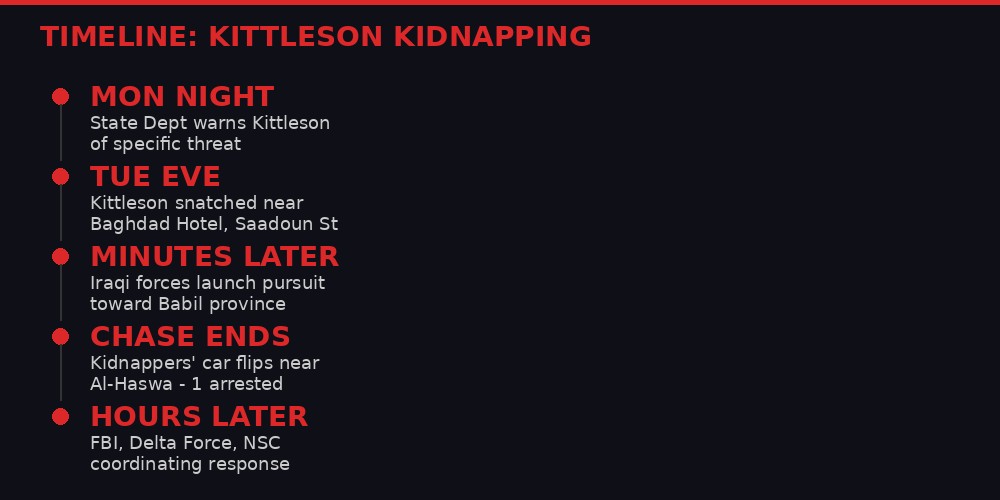
Infographic: The chain of events from warning to abduction to pursuit. BLACKWIRE
Who Is Shelly Kittleson

Kittleson has spent over a decade covering the world's most dangerous conflicts. Photo: Pexels
Shelly Kittleson is an Italian-American freelance journalist who has spent more than fifteen years covering the Middle East's most dangerous conflicts. Based in Rome, she has reported extensively from Iraq, Afghanistan, and Syria for publications including Al-Monitor, The National, and several other international outlets. She has built a reputation as a fearless, independent reporter willing to go where institutional journalists often cannot or will not.
In a 2017 interview with TRT World for its "Women on War" series, Kittleson said she did not particularly like being called a "war journalist" but acknowledged that reporting from conflict zones "has changed me a lot." Her career began in late 2010, when she picked up a camera and flew to Afghanistan. She taught herself photography alongside her journalism, filing dispatches from some of the most volatile districts in Helmand and Kandahar provinces before shifting her focus to Iraq and Syria.
Her reporting has been marked by a commitment to covering the stories that fall between the cracks of major news cycles - the displacement of minorities in Nineveh, the internal politics of Iraqi Shia factions, the quiet negotiations that shape security in Baghdad's corridors. She was not a parachute journalist. She lived in the region, maintained deep local contacts, and understood the granular dynamics of Iraqi politics in a way that few Western correspondents do.
According to Kiran Nazish, the founder and director of the Coalition for Women in Journalism, Kittleson was in touch with her on Thursday, before she left for Baghdad. Nazish told CBS News that Kittleson was traveling to stay with a family there who had reassured her that she would be safe. Kittleson told Nazish via text message that she had been advised not to travel, but that "she was doing what she had always done." That sentence carries the weight of a career built on calculated risk - and the particular vulnerability of a freelancer who lacks the institutional armor of a major news organization.
The State Department confirmed that warnings had been issued to Kittleson. Assistant Secretary of State for Global Public Affairs Dylan Johnson stated on X that the department "previously fulfilled our duty to warn this individual of threats against them." A U.S. official told reporters that Kittleson had been contacted multiple times, including as recently as Monday night, the evening before her abduction. The warnings were specific: her name appeared on a list in Kataib Hezbollah's possession. The militia was allegedly targeting female journalists for kidnapping or killing.
A second source confirmed to CBS News that Kittleson had been told of the risk but believed it was likely false information. This disconnect between threat intelligence and individual judgment is a recurring pattern in journalist safety cases. The State Department can warn, but it cannot compel a journalist to stay away. And freelancers, who depend on their access for their livelihood, often accept risks that staff correspondents for major outlets would be ordered to avoid.
The Abduction: What We Know

Saadoun Street in central Baghdad - once a symbol of the capital's recovery, now the site of the highest-profile kidnapping in years. Photo: Pexels
The kidnapping took place on Tuesday evening near the Baghdad Hotel on Saadoun Street, one of the Iraqi capital's most recognizable commercial arteries. Two Iraqi security officials, speaking on condition of anonymity, confirmed that two vehicles were used in the abduction. The operation was fast. Witnesses reported little warning before Kittleson was pulled into a waiting car.
Iraq's Interior Ministry released a statement saying that security forces had launched an immediate pursuit "based on precise intelligence and through intensive field operations, tracking the kidnappers' movements." The chase headed southwest out of Baghdad toward Babil province. Near the town of Al-Haswa, roughly 60 kilometers south of the capital, one of the kidnapping vehicles overturned during the pursuit. Iraqi forces intercepted the crashed vehicle and arrested one suspect.
Kittleson was not in that vehicle. A second car, carrying the journalist, apparently split from the first during the chase and has not been intercepted as of early Wednesday. The Interior Ministry acknowledged as much in its statement, saying that "efforts are ongoing to track down the remaining perpetrators and secure the release of the abducted woman."
The arrested suspect was quickly identified as having ties to Kataib Hezbollah, according to the U.S. State Department. Dylan Johnson confirmed on X that "an individual with ties to the Iranian-aligned militia group Kataib Hizballah believed to be involved in the kidnapping has been taken into custody by Iraqi authorities." The Iraqi government, notably, did not publicly name the militia, referring only to "unknown individuals" - a careful omission that speaks to the political sensitivities surrounding Iraq's relationship with its own Iran-backed armed factions.
The Al-Monitor news organization, for which Kittleson has been a regular contributor, published a statement saying it was "deeply alarmed" by her kidnapping and calling for her "safe and immediate release." The National Press Club's president Mark Schoeff called the abduction "alarming and unacceptable," adding that "journalists are not targets and treating them as such is an assault on press freedom everywhere."
The response from Washington has been swift. Sources familiar with the investigation told CBS News that the FBI, National Security Council, State Department, Delta Force special operations forces, and the Iraqi Counter-Terrorism Service are all actively engaged. The involvement of Delta Force indicates that military rescue options are at least being assessed alongside diplomatic channels.
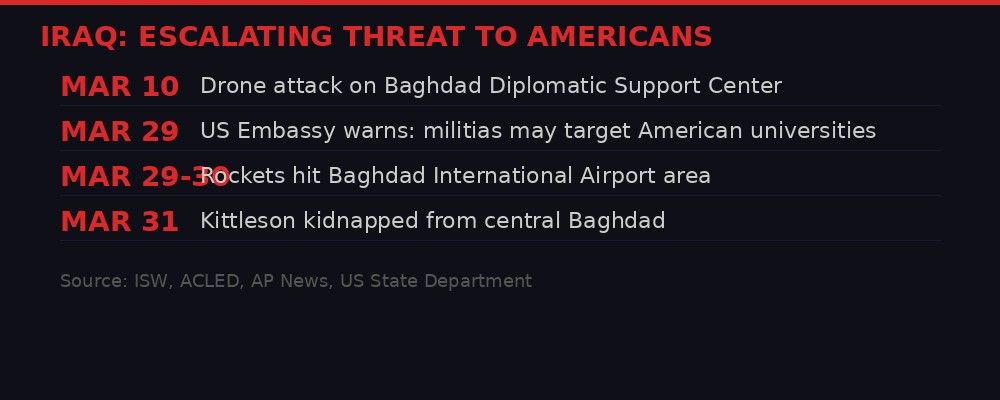
Infographic: The escalating pattern of threats against Americans in Iraq since the war began. BLACKWIRE
Kataib Hezbollah: The Militia Behind the Grab
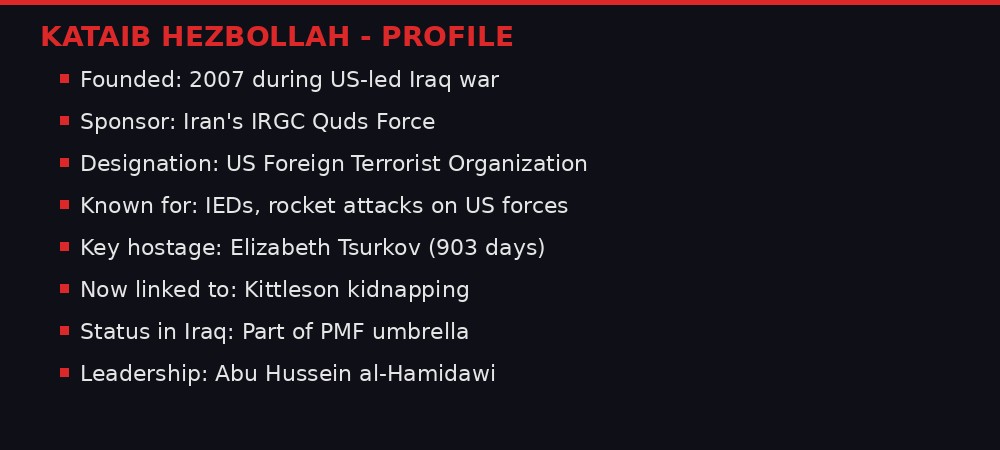
Infographic: Kataib Hezbollah at a glance - from roadside bombs against US troops to hostage-taking. BLACKWIRE
Kataib Hezbollah is not a fringe group. It is one of the most powerful, well-funded, and operationally capable Iran-backed militias in Iraq, with deep organizational ties to Iran's Islamic Revolutionary Guard Corps Quds Force. Designated a Foreign Terrorist Organization by the United States, KH has been responsible for some of the most lethal attacks against American personnel in Iraq over the past two decades.
The group emerged during the U.S.-led occupation of Iraq in 2007 and quickly gained a reputation for sophisticated improvised explosive device attacks, improvised rocket-assisted mortar strikes, and ambushes targeting American convoys and forward operating bases. According to the Counter Extremism Project, KH "earned a reputation for planting deadly roadside bombs and using improvised rocket-assisted mortars to attack U.S. and coalition forces." The U.S. Department of the Treasury designated KH for sanctions, and its leadership has been targeted by American drone strikes in the past, most notably the January 2020 killing of Abu Mahdi al-Muhandis alongside Iranian General Qassem Soleimani at Baghdad International Airport.
Despite these losses, KH has reconstituted and remains a central player within Iraq's Popular Mobilization Forces, the state-sanctioned umbrella of predominantly Shia paramilitary organizations. The PMF was formally integrated into Iraq's security architecture after the fight against the Islamic State group, giving militias like KH a veneer of legitimacy while allowing them to operate with significant autonomy from Baghdad's civilian government.
KH's current leader, Abu Hussein al-Hamidawi, has maintained the group's anti-American posture while navigating Iraq's internal politics. The militia has repeatedly attacked U.S. positions in Iraq over the past month, contributing to the broader pattern of Iran-aligned groups opening a second front against American forces even as the main war rages in Iran proper. Rockets and drones launched from Iraqi territory have targeted Baghdad International Airport, the Baghdad Diplomatic Support Center, and coalition facilities in Erbil, according to the Institute for the Study of War.
The Kittleson kidnapping is not KH's first foray into hostage-taking. In March 2023, Elizabeth Tsurkov, a Russian-Israeli doctoral researcher at Princeton University, was kidnapped from a cafe in Baghdad. She was held in captivity for 903 days - more than two and a half years - enduring solitary confinement and what she later described as harrowing conditions. Tsurkov was eventually freed in November 2025 through a deal brokered by the United States. Her case demonstrated both KH's willingness to use hostages as leverage and the excruciating difficulty of extracting captives from the group's custody.
The Tsurkov Precedent: A Haunting Parallel
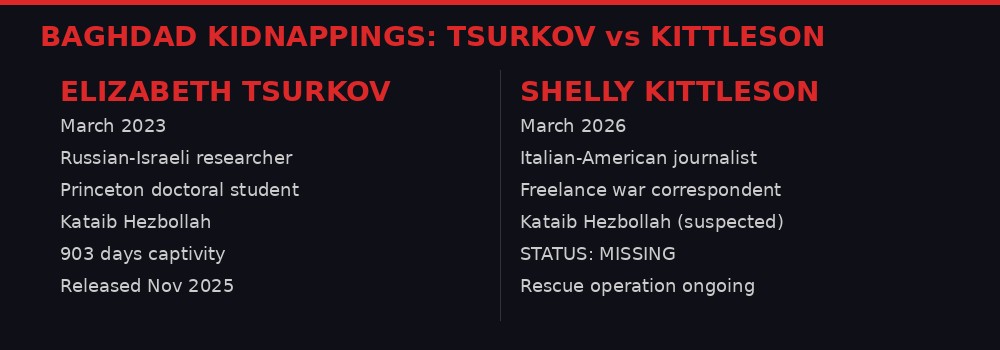
Infographic: Two kidnappings, three years apart, same suspected militia. BLACKWIRE
The parallels between the Tsurkov and Kittleson cases are impossible to ignore. Both women were taken from central Baghdad. Both cases involve Kataib Hezbollah as the primary suspect. Both abductions occurred during periods of heightened tension between the United States and Iran-backed groups in Iraq. And in both cases, warnings existed before the kidnapping that went unheeded or were insufficiently acted upon.
Tsurkov's kidnapping in March 2023 was initially shrouded in confusion. She had been conducting field research on Iraqi Shia politics when she was blindfolded, assaulted, and dragged into a vehicle. Her captors held her in isolation for months before any diplomatic channel could confirm her status. The negotiation process was agonizing, involving intermediaries across multiple governments, and it took until November 2025 before she was released. PBS News reported that Tsurkov endured more than 900 days of captivity, a period during which her physical and psychological health deteriorated significantly.
The Tsurkov case established several uncomfortable truths about kidnapping dynamics in Iraq. First, Iraqi state security forces have limited ability to compel KH to release hostages. The militia operates within the PMF framework, giving it political protection that makes direct military rescue operations extraordinarily risky. Second, diplomatic channels are slow. The U.S. does not maintain direct communication with KH, meaning negotiations must pass through Iraqi intermediaries, Iranian back-channels, or third-party states. Third, KH has demonstrated patience. The group held Tsurkov for nearly three years, suggesting it views hostages as long-term strategic assets rather than short-term bargaining chips.
For Kittleson's case, the Tsurkov precedent suggests that a quick resolution is unlikely unless the circumstances are dramatically different. The fact that Iraqi security forces managed to intercept one vehicle and arrest a suspect within hours of the kidnapping is more progress than was made in the Tsurkov case at the same stage. But the journalist remains in captivity, and the second vehicle escaped, suggesting the operation involved multiple cells or safe houses.
The key variable is the broader geopolitical context. When Tsurkov was taken in 2023, the region was in a period of relative stability. The Iran war had not yet begun. Iraq's government was focused on internal reconciliation. KH had less leverage and less urgency. Today, with the Iran war raging, American troops surging into the region, and Iran-backed militias actively attacking U.S. positions, the kidnapping of an American journalist carries exponentially higher political stakes. KH may see Kittleson as a more valuable card in a much larger game.
Iraq's Impossible Position

Iraq's security forces are stretched thin between state authority and militia power. Photo: Pexels
Iraq has tried to stay neutral in the Iran war. Prime Minister Mohammed Shia al-Sudani, who governs through a coalition that includes Iran-aligned political blocs, has publicly declared that Iraq will not be a staging ground for attacks on Iran. But the reality on the ground contradicts this position almost daily.
Iran-backed militias within the PMF have launched rockets and drones at U.S. facilities in Iraq throughout March. On March 10, a drone attacked the Baghdad Diplomatic Support Center. On March 29 and 30, rockets targeted Baghdad International Airport and surrounding areas. The Institute for the Study of War reported that likely Iranian-backed militias fired from Rusafa, eastern Baghdad, and Iraqi security forces found three rocket launch platforms afterward. On the same day, the U.S. Embassy in Iraq issued an advisory warning that "Iran and its aligned terrorist militias may intend to target American universities in Baghdad and other cities."
The Kittleson kidnapping exposes the gap between Iraqi government rhetoric and operational reality. The Interior Ministry's response was notably swift - the pursuit, the arrest, the public statement all came within hours. But the ministry conspicuously avoided naming Kataib Hezbollah, instead referring to "unknown individuals." This evasion is not accidental. It reflects the political impossibility of Iraq's position: acknowledging that a state-sanctioned militia carried out the kidnapping of an American journalist would force a confrontation that Baghdad cannot afford.
According to ACLED's March 2026 special report on the Middle East, Iraq is home to "a constellation of pro-Iran militias" that "retain the ability to operate independently of Baghdad's authority, despite attempts to integrate them into the regular Iraqi forces." The report noted that Iraq's government is struggling to contain these factions, and that the situation risks "renewed internal fragmentation after a period of relative calm."
Foreign Policy reported on March 31 that Iraq occupies a "uniquely fraught position" in the Iran war, with "centrifugal forces straining the Iraqi government's ability to enforce its decision to sit out the conflict." The magazine noted that the United States and Israel are courting Iranian Kurdish opposition groups operating in Iraq's northeastern Kurdistan region, adding another layer of tension to an already volatile picture.
For ordinary Iraqis, and for the foreign journalists and workers who remain in the country, the message is clear: the state cannot guarantee safety. Baghdad's security improvements since the defeat of the Islamic State group in 2017 were real but fragile. The Iran war has shattered that fragility. Kidnappings of this nature had become rare in the capital. Kittleson's abduction signals that the old rules no longer apply.
The Broader Pattern: Americans Under Threat

The Iran war has turned the entire Gulf region into a threat environment for Americans. Photo: Pexels
Kittleson's kidnapping does not exist in isolation. It is part of a rapidly escalating pattern of threats against Americans in the Middle East since the Iran war began on February 28.
The IRGC itself issued an extraordinary threat on Tuesday, naming 18 American technology companies - including Apple, Google, Microsoft, Tesla, and Boeing - as targets for retaliatory strikes across the Gulf starting at 8:00 PM Tehran time on Wednesday, April 1. The statement warned employees to "immediately leave their workplaces to preserve their lives." It was the first time during the conflict that Tehran publicly designated multinational civilian corporations as legitimate military targets.
In the Gulf states, Iranian drones and missiles have struck civilian infrastructure repeatedly. On Wednesday morning, Iranian drones hit fuel tanks at Kuwait International Airport, sparking a "massive blaze" according to Kuwait's Public Authority for Civil Aviation. A Bangladeshi national was killed in the UAE's Fujairah emirate when shrapnel from an intercepted drone hit a farm. Iranian missiles struck the Batelco telecommunications headquarters in Hamala, Bahrain - a building that hosts Amazon Web Services infrastructure.
The war has claimed at least 1,937 lives in Iran, at least 20 in Israel, 13 U.S. soldiers, and 26 civilians in Gulf states, according to preliminary figures compiled by Al Jazeera as of Wednesday. These numbers are expected to rise as the conflict enters its second month with no ceasefire in sight.
For Americans in Iraq specifically, the threat environment has deteriorated dramatically. The U.S. Embassy's March 29 advisory was unusually blunt, warning of potential militia attacks on American-associated universities. The State Department's travel advisory for Iraq was already at Level 4 - "Do Not Travel" - before the war began. Kittleson was well aware of these warnings. She chose to enter the country despite them, a decision that speaks to the particular calculus of freelance journalism in conflict zones, where the story always competes with the threat.
The involvement of Delta Force in the response suggests that Washington is taking the tactical situation seriously. Delta Force, the Army's premier special missions unit, is not typically deployed for diplomatic negotiations. Its engagement indicates that military planners are at least considering the possibility that Kittleson cannot be recovered through negotiations alone. Whether that assessment leads to a rescue operation depends on intelligence about her location, the hostage-takers' posture, and political decisions that will be made at the highest levels of the U.S. government.
Press Freedom in the Crossfire

Iraq remains one of the deadliest countries in the world for journalists. Photo: Pexels
Iraq has long been one of the most dangerous countries in the world for journalists. The Committee to Protect Journalists has documented hundreds of journalist deaths in the country since the 2003 invasion, making it the deadliest conflict for press in the modern era. The security improvements of the 2020s reduced the rate of journalist killings but never eliminated the underlying risks, particularly from armed groups that operate beyond state control.
The Kittleson case highlights the specific vulnerability of freelancers. Staff correspondents for major news organizations typically operate with institutional security protocols, hostile-environment training, armored vehicles, fixers vetted by their employers, and sometimes armed escorts. Freelancers work alone or with minimal support. They negotiate their own access, arrange their own security, and accept risks that organizations would never approve for their employees. When things go wrong, the institutional response is often slower and less resourced.
Al-Monitor's statement calling for Kittleson's release underscored this dynamic. The outlet described her as a "contributor" - language that reflects the precarious employment relationships that define modern freelance conflict journalism. Kittleson filed stories for multiple publications, maintained her own network of sources, and bore the full burden of her own safety. The State Department warned her. Her emergency contact warned her. A colleague in the Coalition for Women in Journalism was in touch days before the trip. But no institution had the authority or the leverage to stop her from going.
The National Press Club's condemnation was swift and emphatic. President Mark Schoeff called the kidnapping "alarming and unacceptable" and declared that "journalists are not targets and treating them as such is an assault on press freedom everywhere." The Coalition for Women in Journalism expressed grave concern. Multiple international press freedom organizations are expected to issue statements in the coming hours.
But statements do not free hostages. The Tsurkov case demonstrated that advocacy and media attention can help keep a kidnapping in the public consciousness, but the actual mechanics of release depend on intelligence, leverage, and the willingness of intermediaries to engage. For Kittleson, the next hours and days are critical. The longer she remains in captivity, the more likely it is that she will be moved to a secure location outside the reach of Iraqi security forces, making recovery exponentially harder.
What Happens Next

The next 48 hours will determine whether this becomes a hostage crisis or a rescue story. Photo: Pexels
The Kittleson case now enters a critical phase where multiple clocks are running simultaneously.
The tactical clock is the most urgent. Iraqi security forces are actively searching for the second vehicle and the remaining kidnappers. The arrested suspect may provide intelligence about the destination, the cell structure, and the chain of command. If Kittleson can be located within the first 24 to 48 hours, a rescue operation becomes feasible. After that window, the probability of her being moved to a hardened location increases dramatically.
The diplomatic clock runs on a different timescale. If a rescue is not possible, the United States will need to engage intermediaries who can communicate with KH or its Iranian patrons. In the Tsurkov case, this process took months to produce results. The current geopolitical environment complicates matters further. The U.S. is at war with Iran, making Iranian back-channels less accessible. Iraq's government is a potential intermediary but lacks the authority to compel KH to cooperate. Pakistan, Egypt, and Turkey have served as mediators during the broader Iran conflict, but their leverage over an Iraqi militia is uncertain.
The political clock matters in Washington. President Trump is scheduled to address the nation on Wednesday evening with "an important update on Iran," according to White House Press Secretary Karoline Leavitt. The kidnapping of an American journalist by an Iran-backed militia gives that address an additional dimension. Trump has been oscillating between claiming diplomatic progress with Iran and threatening to escalate the war. The Kittleson case provides ammunition for both hawks who want a harder line against Iran's proxy network and critics who argue the war has made Americans less safe.
The information clock is the most dangerous for Kittleson herself. In the hours following a kidnapping, the captors' decision-making is often fluid. If KH's leadership has ordered the operation, there may be a clear plan. If the abduction was carried out by a lower-level cell acting independently, the situation is more unpredictable. The history of hostage-taking in Iraq suggests that the first few days are the most dangerous, before institutional channels stabilize the captors' calculations and introduce the possibility of negotiation.
For now, the world waits. Shelly Kittleson, a journalist who spent fifteen years telling the stories of the Middle East's wars, has become part of one. The same courage and stubbornness that drove her career - the refusal to be told where she could and couldn't go, the insistence on being present for the story - placed her directly in the path of a militia that treats foreign nationals as instruments of leverage. Whether that story ends with rescue, negotiation, or something darker depends on decisions being made right now, in Baghdad safe houses and Washington situation rooms, by people whose names will never appear in any byline.
Get BLACKWIRE reports first.
Breaking news, investigations, and analysis - straight to your phone.
Join @blackwirenews on TelegramSources: AP News, BBC News, CBS News, Al-Monitor, Al Jazeera, Channel News Asia (AFP), Times of India, Politico, Institute for the Study of War, ACLED, Counter Extremism Project, PBS News, CNN, U.S. State Department