The Ghost Trial: France Puts the Magnitsky Affair's Alleged Mastermind in the Dock
Dimitry Klyuev, the Russian banker accused of engineering the $230 million tax fraud that killed Sergei Magnitsky, is being tried in absentia in Paris. He is believed to be sitting in Russia. The empty chair in the courtroom tells you everything about how international justice works - and how it doesn't.
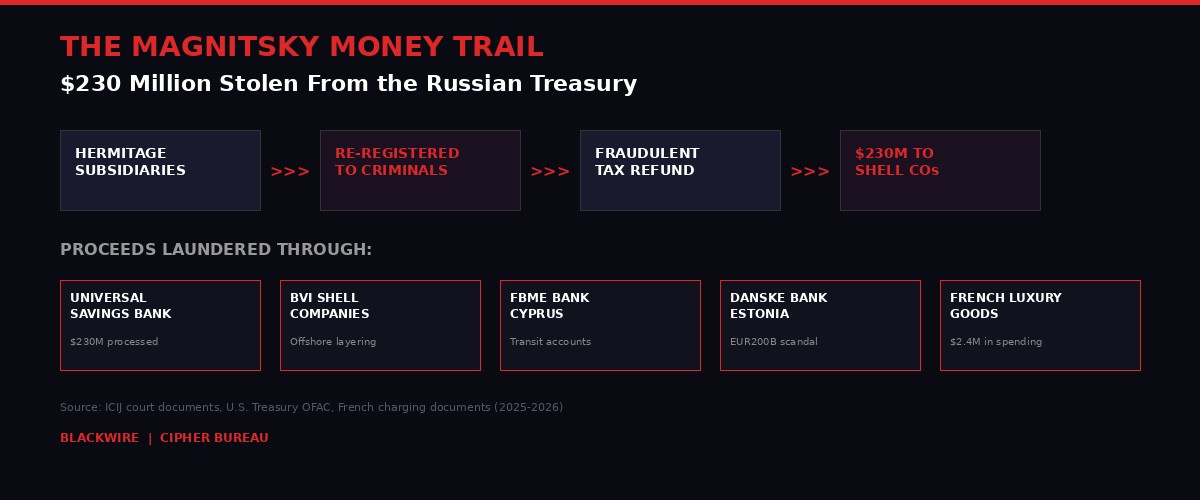
On March 30, 2026, a Paris criminal court opened proceedings against Dimitry Klyuev on charges of aggravated money laundering. The defendant's chair was empty. Klyuev, 58, is believed to be living in Russia, a country that does not extradite its citizens. The charges - filed secretly last summer and unsealed the same day the trial began - allege that Klyuev spent more than $2.4 million of the proceeds of the largest tax fraud in Russian history on luxury goods in France, including jewelry, artwork, and designer clothing. The documents were obtained by the International Consortium of Investigative Journalists.
This is the first time Klyuev has faced criminal proceedings in any Western country. It took nearly two decades to get here. The man who allegedly orchestrated the theft of $230 million from the Russian state, whose scheme led directly to the arrest, torture, and death of a 37-year-old tax advisor named Sergei Magnitsky, has never once answered for it in a courtroom outside of Russia. Until now.
The trial is a single day. One day for a case that spans 19 years, seven countries, hundreds of shell companies, and the death of a man whose name became synonymous with the global fight against kleptocracy. If convicted, Klyuev faces up to ten years in a French prison. The French authorities know he will never serve a single day. They are trying him anyway.
That choice - to prosecute a man you cannot catch - tells a story about the state of international anticorruption enforcement in 2026. It is a story of partial victories and systemic failures, of dirty money that moved faster than the law could follow, and of a dead man whose legacy continues to reshape the architecture of global sanctions.
01 The Crime: How $230 Million Vanished on Christmas Eve
The fraud that launched a global anticorruption movement started with a set of stolen corporate seals.
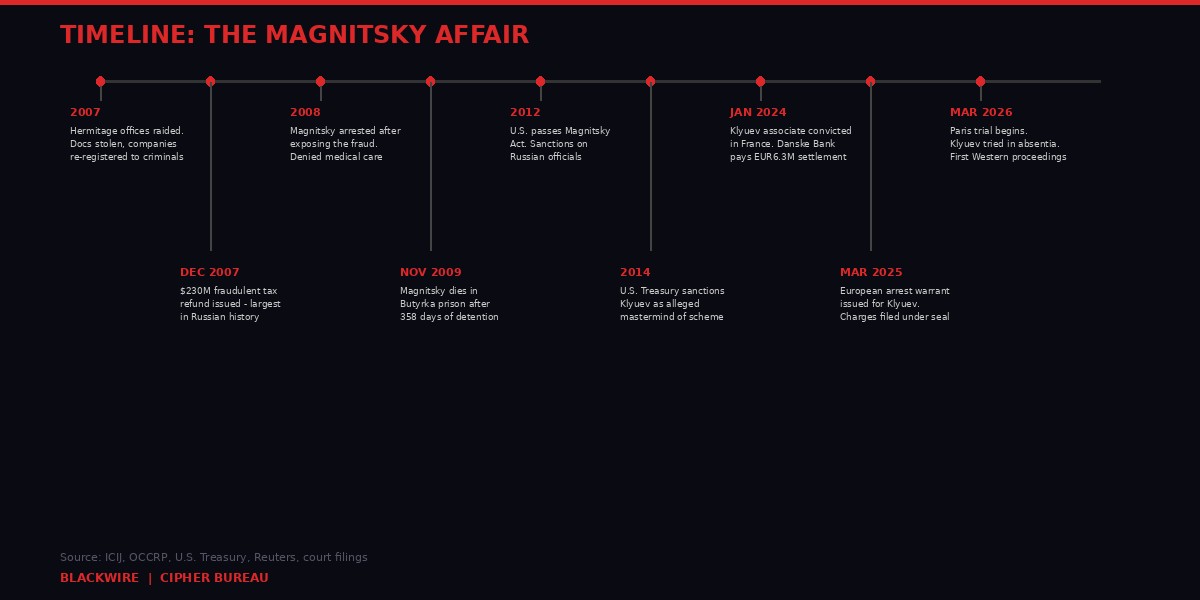
On June 4, 2007, approximately twenty officers from Russia's Ministry of Interior raided the Moscow offices of Hermitage Capital Management, then the largest foreign portfolio investor in Russia. Simultaneously, they raided the offices of Firestone Duncan, an American law firm that handled Hermitage's legal work. The search warrant authorized seizure of materials related to a single Hermitage subsidiary, Kamaya. The officers took everything - corporate documents, tax filings, and the official stamps and seals for multiple Hermitage companies. This was not an investigation. It was a heist conducted under the color of law.
What happened next was methodical. Using the stolen documents and corporate seals, the perpetrators re-registered three Hermitage holding companies to new owners. The new nominal owner of at least one of these companies was Viktor Markelov, a convicted murderer who had been released from prison after serving only two years of his sentence. Shell companies controlled by the conspirators then fabricated liabilities against the re-registered Hermitage firms - claiming debts that had never existed. In each case, lawyers hired by the criminals showed up in court pretending to represent Hermitage and immediately agreed to the fabricated claims. Hermitage had no idea any of this was happening.
The manufactured debts were the key. They made the Hermitage subsidiaries appear to have generated massive losses, which in turn justified a request for a refund of the $230 million in taxes those companies had legitimately paid the Russian government when they were actually operating under Hermitage's control. On Christmas Eve 2007, the Russian treasury approved the refund. It was the largest tax rebate in Russian history. The approval took a single day. Standard processing time for a refund of this size was months. Someone was in a hurry.
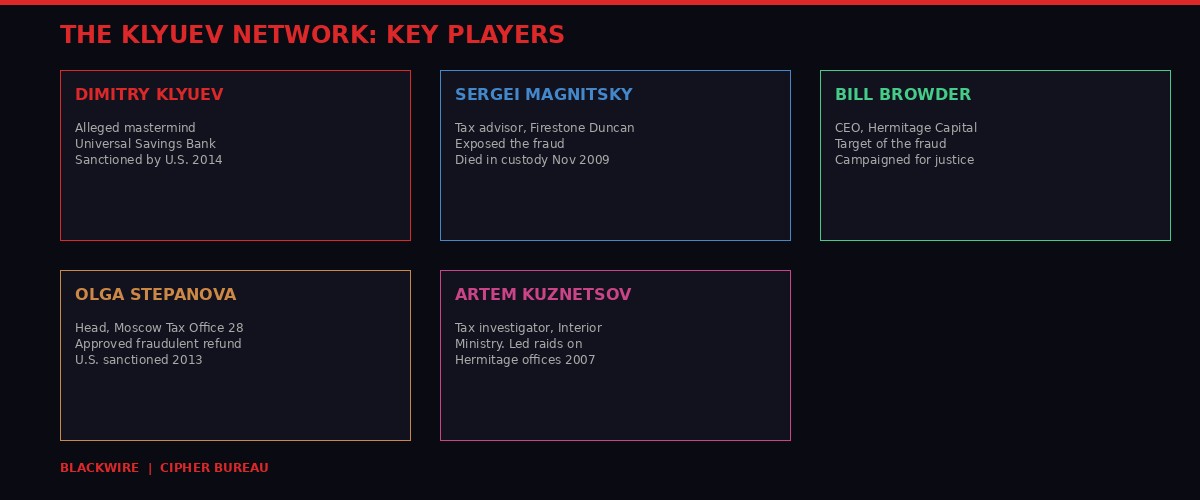
According to U.S. Treasury sanctions designations issued in 2014, the alleged architect of this scheme was Dimitry Klyuev. Klyuev, a Russian citizen, controlled Universal Savings Bank, a small Moscow-based institution that prosecutors say served as the primary conduit for the stolen funds. The money moved from Universal Savings Bank to accounts controlled by shell companies registered in the British Virgin Islands, then to accounts at FBME Bank's Cyprus branch, and from there into the wider European financial system. By the time Western law enforcement began to trace the funds, they had been scattered across more than a dozen jurisdictions.
The operation was technically elegant and morally monstrous. Russian government officials were directly involved in approving the fraudulent refund. Olga Stepanova, head of Moscow Tax Office Number 28, signed off on the payment. Tax investigator Artem Kuznetsov, who had led the original raids on Hermitage's offices, was later implicated in coordinating the re-registration of the stolen companies. Both were sanctioned by the U.S. Treasury in 2013. Neither has faced criminal charges in Russia.
02 The Whistleblower Who Died for the Truth
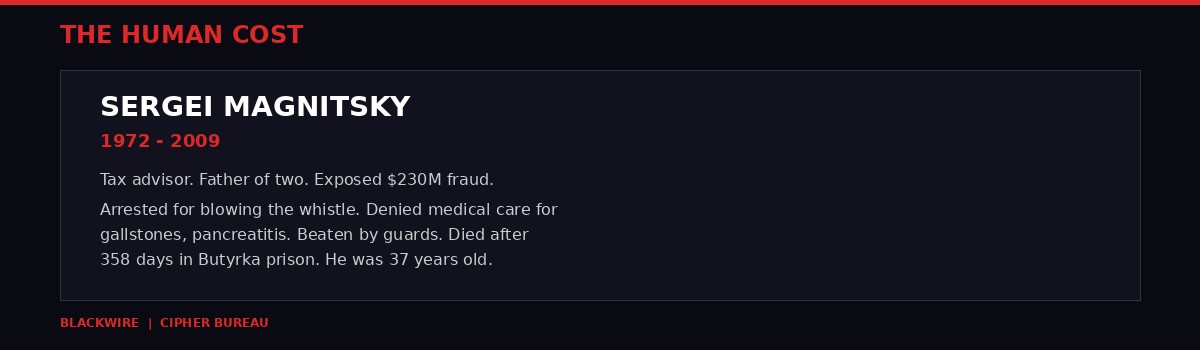
Sergei Leonidovich Magnitsky was not a dissident, an activist, or a spy. He was a tax advisor. Born in 1972 in Odessa, he worked at Firestone Duncan's Moscow office, heading the firm's tax practice. When Hermitage Capital needed someone to investigate the suspicious seizure of its corporate documents, Magnitsky was assigned the case. He was methodical, precise, and fearless in a way that may have come from not fully understanding what he was walking into.
His investigation uncovered the entire scheme - the stolen documents, the fraudulent re-registrations, the manufactured debts, the Christmas Eve refund. Magnitsky documented how Interior Ministry officials, tax authorities, judges, and criminal networks had collaborated to steal $230 million from the Russian state. He named names. He filed official complaints with every relevant Russian government body. He testified against the very officials who had orchestrated the fraud.
The Russian state's response was not to investigate the criminals Magnitsky had identified. It was to arrest Magnitsky himself.
On November 24, 2008, Magnitsky was taken into custody on charges that he had committed the tax fraud he had exposed. The accusation was an act of brazen retaliation - the whistleblower recast as the perpetrator, the investigator transformed into the accused. He was held in pre-trial detention at Moscow's Butyrka prison, one of Russia's oldest and most notoriously overcrowded facilities. Russian law permitted holding a suspect without trial for up to one year.
Over the next 358 days, Magnitsky's health deteriorated catastrophically. He developed gallstones, pancreatitis, and a blocked gall bladder. He submitted more than 20 complaints requesting medical treatment. Each was denied or ignored. Prison medical staff documented his conditions but did nothing to treat them. When he was finally transferred to a facility with a medical unit - Matrosskaya Tishina prison - it was not for treatment. According to findings from a human rights council established by the Kremlin itself, Magnitsky was beaten by prison guards using rubber batons on the night of November 16, 2009. He died that same night. He was 37 years old. He left behind a wife, Natalia Zharikova, and two children.
The Russian government's official position was that Magnitsky died of heart failure. An independent forensic analysis commissioned by the Kremlin's own Presidential Council for Civil Society and Human Rights found evidence of blunt cranial trauma consistent with beatings. A subsequent investigation by the council concluded that Magnitsky had been "intentionally deprived of medical help" and subjected to "cruel, inhuman treatment." The council's recommendations were ignored. No one was prosecuted for Magnitsky's death.
In a final act of juridical cruelty, Russian authorities put Magnitsky on trial posthumously in 2013 - the first posthumous trial in the history of the Russian Federation. He was convicted. Bill Browder, the American-born British financier who had founded Hermitage Capital and become Magnitsky's most vocal advocate, was convicted alongside him in absentia.
03 The Laundromat: Tracing the $230 Million Through Europe's Banks
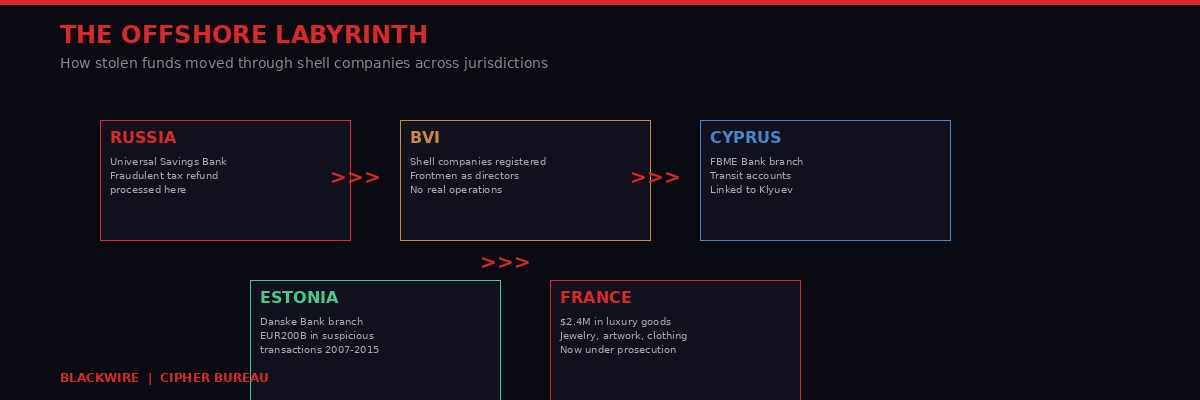
The $230 million did not sit in a vault in Moscow. It moved. And the path it took revealed the infrastructure of a money laundering system that extended far beyond Klyuev's immediate network into some of Europe's most prestigious financial institutions.
According to court filings and enforcement actions across multiple jurisdictions, the proceeds from the fraudulent tax refund were initially channeled through accounts controlled by or linked to Klyuev's Universal Savings Bank. From there, they moved into a web of shell companies registered in the British Virgin Islands - entities with no employees, no offices, and no business activities beyond moving money. These BVI shells held accounts at FBME Bank, a Tanzanian-chartered institution that operated primarily through its branch in Limassol, Cyprus. FBME was later shut down by U.S. regulators for facilitating money laundering on a massive scale.
But the most explosive link in the chain was Danske Bank. Sweden's public broadcaster SVT reported that Diron Trade LLP - one of the Hermitage subsidiaries stolen through the fraudulent re-registration scheme - was used to facilitate $5.8 billion in money laundering transfers between Swedbank's Baltic subsidiaries and Danske Bank's Estonian branch during a six-month period in 2010 and 2011. The stolen Hermitage entities, stripped of their legitimate owners and repurposed as laundering vehicles, had been plugged directly into the infrastructure of what would become the largest money laundering scandal in European history.
Danske Bank's Estonian branch processed approximately EUR 200 billion in suspicious transactions between 2007 and 2015. Much of this money originated from Russian sources, including accounts linked to relatives and associates of Russian President Vladimir Putin and the Federal Security Service (FSB). The branch operated as a de facto laundromat for Russian dirty money, using its own separate IT systems and conducting business in Russian and Estonian while its Danish parent company either failed to notice or chose not to look.
The connections between the Magnitsky fraud and the broader Danske scandal illustrate a crucial point: the $230 million was not an isolated theft. It was one stream feeding into a continental-scale laundering operation. The same channels that moved Klyuev's stolen funds also moved money from the Azerbaijani Laundromat - a $2.9 billion slush fund linked to the ruling Aliyev family - and from networks connected to pro-Russian political operatives across the Baltics. Aivars Bergers, a board member and major financier of Latvia's leading pro-Russian party Harmony, received EUR 270,000 from two of the shell companies linked to both the Magnitsky fraud and the Azerbaijani Laundromat.
In 2022, Danske Bank pleaded guilty to bank fraud in U.S. federal court and agreed to pay a combined $2 billion in fines to American and European regulators. The fine was historic. But none of it went to the Russian treasury that had been robbed of $230 million. None of it compensated Magnitsky's family. And Klyuev, the alleged architect of the scheme that first exposed Danske's vulnerability to Russian dirty money, remained untouched.
04 The Paris Docket: What the French Charges Actually Say
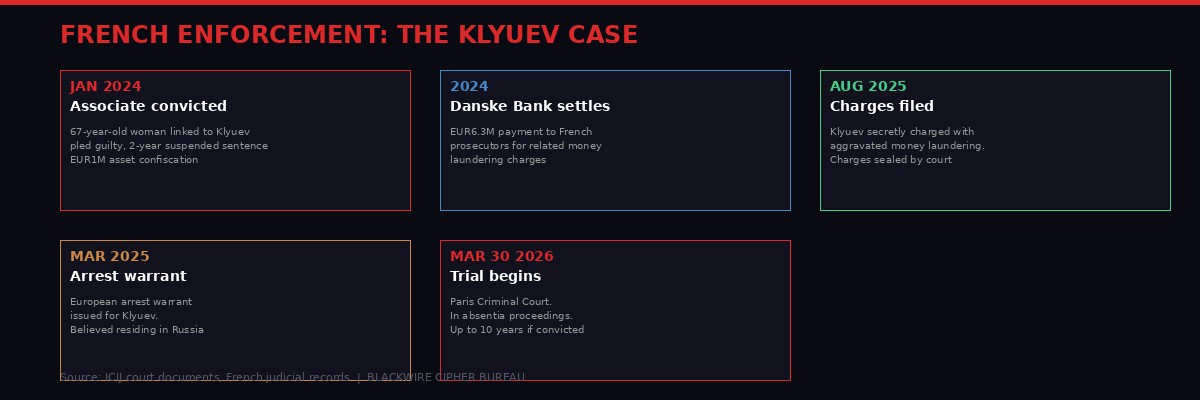
The French case against Klyuev is narrow by design. Prosecutors are not attempting to retry the entire Magnitsky fraud. They are focused on one specific allegation: that between 2007 and 2012, Klyuev spent more than $2.4 million (EUR 2.1 million) on French soil, purchasing luxury goods including clothing, jewelry, and artwork, using funds that originated from the fraudulent tax refund.
According to the charging document obtained by ICIJ, Klyuev was involved "in the placement, concealment, or conversion of proceeds directly or indirectly derived from organized fraud committed" against the Russian state and treasury. The charge is aggravated money laundering - "aggravated" because the underlying offense involves organized crime. Under French law, this carries a maximum sentence of ten years' imprisonment.
The charges were filed secretly in August 2025. French authorities kept them under seal on the chance that Klyuev might travel to France or to a country that would honor a European arrest warrant. That warrant was issued in March 2025 and remains outstanding. Klyuev is believed to be living in Russia, which does not extradite its citizens and has shown zero interest in prosecuting him for the original fraud.
The decision to try Klyuev in absentia reflects both pragmatism and principle. French prosecutors know they cannot compel his attendance. But an in absentia conviction creates a permanent legal finding of guilt that can be enforced if Klyuev ever sets foot in any EU member state or in a country with a mutual legal assistance treaty with France. It also opens the door to asset seizure proceedings against any property or funds Klyuev may have parked in French or EU-accessible jurisdictions.
The Paris trial did not emerge from a vacuum. It builds on a series of earlier French enforcement actions targeting the same network. In January 2024, a 67-year-old woman associated with Klyuev was convicted of money laundering after entering a guilty plea. She received a two-year suspended sentence and a EUR 1 million asset confiscation order. Her identity has not been publicly disclosed. Later in 2024, Danske Bank agreed to pay EUR 6.3 million to settle related money laundering charges brought by French prosecutors - a separate enforcement action from the far larger $2 billion U.S. settlement.
Bill Browder, who has spent the better part of two decades campaigning for accountability in the Magnitsky case, told ICIJ that the French trial "sends a powerful message to Russian money launderers everywhere, that no matter how long it takes, or how far they try to hide, justice will catch up with them." He added: "As Russia continues its brutal invasion of Ukraine, this message is especially important, and makes clear that Russian corrupt money is no longer welcome in the West."
Browder's framing is politically astute. The Magnitsky case has always existed at the intersection of anticorruption enforcement and geopolitical confrontation with Russia. The French trial is happening against the backdrop of the ongoing Russia-Ukraine war, Western sanctions on Russian oligarchs and state entities, and a broader push to de-risk European financial systems from Russian influence. The Klyuev prosecution is both a legal proceeding and a political statement.
05 The Legislation That Changed the World
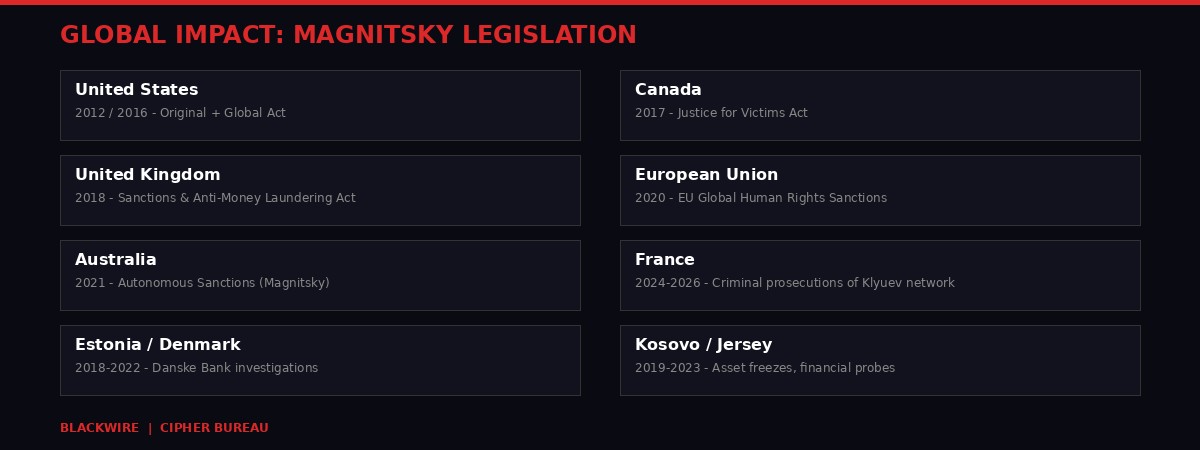
Sergei Magnitsky died in a Moscow prison cell in 2009. By 2012, his name was attached to one of the most consequential pieces of anticorruption legislation in modern history.
The Russia and Moldova Jackson-Vanik Repeal and Sergei Magnitsky Rule of Law Accountability Act of 2012 - known simply as the Magnitsky Act - was signed into law by President Barack Obama on December 14, 2012. The law authorized the U.S. government to impose visa bans and asset freezes on Russian individuals responsible for Magnitsky's death or involved in the underlying fraud. It passed the House of Representatives 365-43 and the Senate 92-4. In an era of deepening partisan division, the Magnitsky Act was one of the most bipartisan pieces of legislation Congress produced.
The original act targeted Russian officials specifically. But in 2016, Congress expanded its scope dramatically with the Global Magnitsky Human Rights Accountability Act, enacted as part of the National Defense Authorization Act for Fiscal Year 2017. The Global Magnitsky Act extended the sanctions framework to foreign officials from any country involved in gross human rights violations or significant corruption. It gave the U.S. Treasury's Office of Foreign Assets Control a new tool to target kleptocrats, torturers, and corrupt officials worldwide.
The impact was immediate and far-reaching. In December 2017, President Donald Trump signed Executive Order 13818, which used the Global Magnitsky Act to sanction an initial batch of individuals including Yahya Jammeh, the former president of The Gambia, and Dan Gertler, an Israeli billionaire implicated in corrupt mining deals in the Democratic Republic of the Congo. Subsequent designations targeted Saudi officials linked to the assassination of journalist Jamal Khashoggi, Chinese officials responsible for the mass detention of Uyghurs in Xinjiang, and Eritrean military leaders accused of war crimes in the Tigray conflict.
By 2026, Magnitsky-style legislation has been adopted by Canada (2017), the United Kingdom (2018), the European Union (2020), Australia (2021), and several other nations. Each of these laws creates a mechanism for imposing targeted sanctions on individuals responsible for corruption or human rights abuses, regardless of their country of origin. The Magnitsky framework has become the default model for Western governments seeking to punish kleptocrats without resorting to broad economic sanctions that hurt civilian populations.
Russia's response to the original Magnitsky Act was telling. Moscow retaliated by banning the adoption of Russian children by American families - a measure known as the Dima Yakovlev Law, named after a Russian toddler who died in a hot car in Virginia. The choice to punish orphans in response to anticorruption sanctions revealed the Kremlin's priorities with brutal clarity. Russia also posthumously convicted Magnitsky and attempted, through multiple Interpol red notice requests, to have Bill Browder arrested internationally. Interpol rejected every request, classifying them as politically motivated.
Klyuev himself was designated under the Magnitsky Act by the U.S. Treasury in 2014, alongside several other individuals linked to the fraud. The designation froze any assets Klyuev held in the U.S. financial system and barred him from entering the country. Combined with the new European arrest warrant and French criminal charges, Klyuev's world has shrunk considerably since 2007, when he allegedly orchestrated the fraud from behind the respectable facade of a licensed Moscow bank.
06 The Danske Connection: Europe's Biggest Money Laundering Scandal
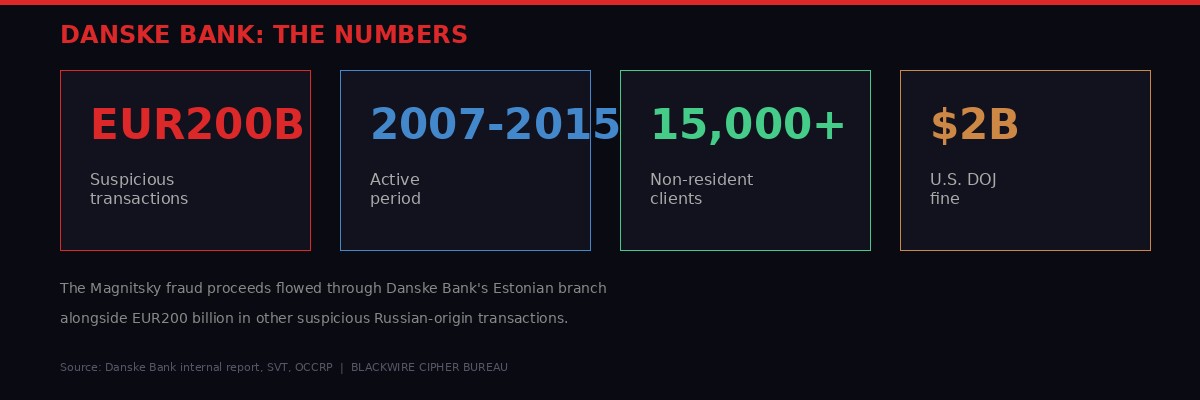
To understand the Klyuev case, you have to understand Danske Bank. Not just as a corporate scandal, but as a structural failure of European financial regulation that enabled Russian state-connected criminals to move hundreds of billions of euros through the Western banking system for nearly a decade.
Danske Bank, headquartered in Copenhagen, is Denmark's largest financial institution. In 2007, it acquired Sampo Bank's Estonian operations, inheriting a branch in Tallinn that had built a lucrative business serving non-resident clients - a banking industry euphemism for Russians and other former Soviet citizens looking to move money westward. The Estonian branch operated on its own IT systems, conducted business in Estonian and Russian, and generated profits wildly disproportionate to its size. In 2012, non-resident portfolios from Russia alone accounted for 35% of the branch's profits, despite Russian clients making up only 8% of its customer base.
Between 2007 and 2015, approximately EUR 200 billion in suspicious transactions flowed through the branch. The clients included associates of Putin, members of the FSB, participants in the Azerbaijani Laundromat, and networks connected to the Magnitsky fraud. A whistleblower named Howard Wilkinson, former head of trading for Danske Bank in the Baltics, flagged the suspicious activity internally. The bank's executive board discussed the Estonian branch's "AML challenges" at a meeting in October 2014. According to the Danish Financial Supervisory Authority, the conclusions of a critical Estonian regulatory report were "toned down" in the board's minutes. The board appeared more interested in the branch's earnings than in its compliance failures.
JPMorgan Chase had seen enough by 2013, cutting off correspondent banking services to Danske's Estonian branch over money laundering concerns. Other banks continued providing services until 2015. The full scope of the scandal did not become public until 2017-2018, when investigative journalists and regulatory probes revealed the extent of the laundering.
The Magnitsky fraud's connection to Danske ran through the stolen Hermitage subsidiaries. Diron Trade LLP, one of the companies that had been fraudulently re-registered away from Hermitage's control, was used to move $5.8 billion between Swedbank's Baltic branches and Danske's Estonian operation in just six months. This was not a minor tributary. The stolen Hermitage shells were integral infrastructure in a laundering system of continental proportions.
Danske Bank's $2 billion settlement with the U.S. Department of Justice in 2022 was the largest penalty ever imposed for a bank secrecy violation. The bank also paid EUR 6.3 million to French prosecutors in 2024 to settle charges specifically related to the Magnitsky-linked laundering. But financial penalties, however large, have not been accompanied by proportionate personal accountability. No senior Danske executive has served prison time. The bank's former CEO, Thomas Borgen, was charged with fraud in Denmark but the case was dropped. The institutional rot that allowed EUR 200 billion in dirty money to flow unchecked has been acknowledged, fined, and largely moved on from.
07 The Broader Network: Golden Passports, London Property, and the Architecture of Impunity
The Klyuev case sits within a broader pattern of Russian and post-Soviet dirty money exploiting Western financial systems, real estate markets, and citizenship-by-investment programs to establish itself beyond the reach of any single jurisdiction.
Consider the case of Su Jiangbo, exposed by OCCRP and the Sunday Times just days before the Klyuev trial. Su, a Chinese national wanted by Chinese law enforcement for alleged involvement in illegal gambling, used a St. Kitts and Nevis "golden passport" - purchased for approximately $270,000 - to register twelve companies in the United Kingdom. Through these companies, he purchased at least 85 luxury properties in London worth $108 million, including a $13 million penthouse overlooking St. Paul's Cathedral. He never visited the development. The UK's Crown Prosecution Service froze the properties in March 2026 using Unexplained Wealth Orders. No one involved in selling him the apartments flagged the transactions as suspicious.
The Su Jiangbo case mirrors the Klyuev pattern in critical respects. Both involve the use of offshore corporate structures to obscure beneficial ownership. Both exploit the willingness of Western financial gatekeepers - banks, lawyers, real estate agents, corporate registrars - to process large transactions without asking inconvenient questions. Both demonstrate that the infrastructure of impunity is not hidden in shadowy offshore jurisdictions alone. It runs through the heart of London, Paris, Copenhagen, and Tallinn.
Golden passports are a persistent vulnerability. Klyuev's network used BVI shell companies. Su Jiangbo used a St. Kitts passport. Others have exploited citizenship-by-investment programs in Malta, Cyprus, Portugal, and the Caribbean to create layers of identity that make tracing beneficial ownership exponentially more difficult. The European Commission has pushed for tighter regulation of these programs, but progress has been slow. Cyprus shut down its golden passport scheme in 2020 after a series of scandals, but other countries continue to sell citizenship to anyone who can afford it.
The UK's Unexplained Wealth Orders, introduced in 2018 under then-Prime Minister Theresa May, were designed to force individuals to explain the origins of assets disproportionate to their known income. In theory, they are a powerful tool. In practice, they have been used sparingly. The Su Jiangbo case is one of the most significant deployments to date. Conservative MP Alicia Kearns told OCCRP that the orders were intended to "target and hunt down criminal money launderers and protect our markets" and called for them to be "used to their full extent."
The pattern is consistent across jurisdictions. Laws are written. Tools are created. Enforcement is cautious, underfunded, and politically complicated. The criminals move faster than the regulators, exploit every gap in the system, and retreat to safe harbors when the pressure builds. Klyuev's retreat to Russia is the most extreme version of this dynamic, but it is not qualitatively different from the oligarchs who moved their yachts from Mediterranean ports to Turkish or UAE harbors when Western sanctions bit in 2022.
08 What the Empty Chair Means: Justice Without the Defendant
The Paris trial of Dimitry Klyuev is, in one sense, a formality. The defendant is absent. He will not be compelled to appear. If convicted, the sentence will not be enforced unless Klyuev leaves Russia - something he has shown no intention of doing. The practical impact on Klyuev's daily life will be approximately zero.
But in absentia trials serve functions beyond the immediate case. They establish a legal record. They create a binding judicial finding that can be invoked in future proceedings - asset recovery cases, mutual legal assistance requests, sanctions designations. They signal to other potential targets that Western courts are willing to invest resources in cases even when the outcome is uncertain. And they provide a measure of accountability, however symbolic, for victims who have no other recourse.
For the Magnitsky family, the French trial represents the closest thing to Western judicial accountability that the case has ever produced. Russia tried and convicted Magnitsky posthumously. The United States passed a law in his name but never prosecuted anyone for his death. Various European countries have imposed sanctions on individuals linked to the fraud but have not brought criminal charges. France is the first Western country to put any part of the Magnitsky scheme before a criminal court.
The limitations of this approach are obvious. A conviction without imprisonment is not the same as justice. Asset confiscation orders are meaningless if the assets are already in Russia or hidden behind layers of offshore structures that have not been fully mapped. The EUR 1 million seized from Klyuev's associate in the 2024 conviction is a rounding error on a $230 million fraud. The EUR 6.3 million from Danske Bank is slightly more meaningful but still represents a fraction of the profits generated by the laundering operation.
And yet. The Magnitsky Act exists because one man refused to stay silent about a theft. He died for it. Every Magnitsky-style law passed in the eighteen years since - in the United States, Canada, the United Kingdom, the European Union, Australia, and beyond - traces its origins to Sergei Magnitsky's decision to name names in a country where naming names gets you killed. The French trial is a small, late, incomplete chapter in that story. But it is a chapter. And the story is not over.
09 The Epstein Connection: When Russian Intelligence Meets Western Impunity
One of the more unsettling threads to emerge from the Magnitsky network in recent months involves Jeffrey Epstein's operation. OCCRP reported on March 27, 2026, that Svetlana Pozhidaeva, a longtime assistant to Epstein, has spoken publicly amid reports of family ties to Russian intelligence. Pozhidaeva says she was manipulated, physically abused, and coerced into vetting young women for Epstein.
The Epstein-Russia connection is not new, but it has gained fresh attention as investigators continue to map the financial and intelligence networks that enabled Epstein's operation. Epstein's ties to foreign intelligence services have been the subject of speculation and partial reporting for years. The intersection with the Magnitsky world - the same offshore banking centers, the same golden passport jurisdictions, the same willingness of Western institutions to look the other way when the money was right - suggests that these are not separate scandals but different facets of the same structural problem.
The problem is this: Western financial systems were designed to move money efficiently. They were not designed to ask where the money came from. For decades, banks, law firms, real estate agents, and corporate service providers in London, New York, Paris, and Zurich competed to attract wealthy clients from Russia, China, the Gulf states, and other regions where the line between legitimate wealth and stolen wealth is blurred to the point of invisibility. The compliance frameworks that were supposed to prevent dirty money from entering the system were, in practice, checkboxes that sophisticated launderers could satisfy with minimal effort.
The post-2022 sanctions regime has forced some of this money to relocate. Russian oligarchs have moved assets to Dubai, Istanbul, and other jurisdictions less willing to enforce Western sanctions. But the underlying infrastructure - the shell companies, the golden passports, the nominee directors, the compliant professional service providers - remains intact. As long as there are jurisdictions willing to sell secrecy, there will be customers willing to buy it.
The Klyuev trial, the Su Jiangbo asset freeze, the Danske Bank settlements - these are meaningful actions, each representing years of investigative and legal work. But they are also symptoms of a system that generates these cases faster than courts can process them. For every Klyuev tried in absentia, there are dozens of operators who will never face any proceedings at all.
10 Follow the Money Forward: What Happens Next
The French court is expected to issue its verdict in the Klyuev case within weeks. Legal observers anticipate a conviction, given the strength of the documentary evidence and the absence of any defense. The question is not whether Klyuev will be found guilty but what a guilty verdict means in practice.
Several outcomes are likely. First, an asset seizure order extending to any property or funds linked to Klyuev that can be identified within French or EU jurisdiction. French investigators have been mapping Klyuev's spending in France for years, and the EUR 2.1 million in luxury purchases documented in the charging papers may be the tip of a larger iceberg. Second, the European arrest warrant will remain active, meaning that Klyuev cannot travel to any EU member state or to many countries with EU mutual legal assistance agreements without risking arrest. His geographic options continue to narrow.
Third, and most importantly, the French conviction will create legal precedent that other European jurisdictions can build on. Germany, the Netherlands, Switzerland, and the United Kingdom have all been investigating aspects of the Magnitsky money trail for years. A French conviction establishes factual findings that can be cited in parallel proceedings, potentially accelerating enforcement in other countries.
The broader implications extend beyond Klyuev. The Magnitsky framework is being tested in real time against the backdrop of Russia's war in Ukraine. Western governments froze approximately $300 billion in Russian Central Bank reserves in 2022. The legal and political debates about whether to seize those assets - rather than merely freeze them - and transfer them to Ukraine are ongoing. The Magnitsky Act's architecture of targeted sanctions has been deployed against hundreds of Russian oligarchs, officials, and entities since February 2022. The French trial of Klyuev is a reminder that the Magnitsky framework was built for exactly this purpose: holding individuals accountable for state-sanctioned corruption and violence, one case at a time.
Bill Browder has spent seventeen years campaigning for justice in the Magnitsky case. He has been banned from Russia, convicted in absentia by Russian courts, and targeted by multiple Interpol red notice requests, all of which were rejected as politically motivated. He has testified before parliaments on four continents and lobbied for Magnitsky legislation in dozens of countries. He has been called Putin's "number one enemy" and has lived with security threats for nearly two decades.
When asked about the Paris trial, Browder called it proof that "justice will catch up" with Russian money launderers "no matter how long it takes." He is right that the case represents progress. He also knows that progress is not the same as completion. Klyuev is in Russia. Russia does not extradite. The $230 million has not been recovered. Sergei Magnitsky is still dead.
The empty chair in the Paris courtroom is a statement. It says: we see you, we know what you did, and we will not stop. It also says: you are beyond our reach. Both of those things are true at the same time. That tension - between the aspiration of universal justice and the reality of sovereign impunity - is the defining feature of international anticorruption enforcement in 2026. The Magnitsky case did not resolve it. But it made it impossible to ignore.
Get BLACKWIRE reports first.
Breaking news, investigations, and analysis - straight to your phone.
Join @blackwirenews on Telegram