Kuwait Airport Burns as Iran Mocks U.S. Ceasefire Plan
A drone struck a fuel tank at Kuwait International Airport early Wednesday, sparking a fire visible for miles. Hours later, Iran's military command called the U.S. peace proposal a joke. Oil fell anyway. The 82nd Airborne is already packing.

Kuwait International Airport was targeted by an Iranian drone in the early hours of March 25 - the latest strike on Gulf civil aviation infrastructure. (Illustrative - Pexels)
The General Civil Aviation Authority of Kuwait confirmed that a drone struck a fuel storage tank at Kuwait International Airport shortly before dawn on Wednesday, igniting a fire that firefighters worked to contain through the morning. Officials said the drone was among multiple projectiles fired at the country overnight. Other incoming drones were shot down before reaching their targets, the authority said.
The airport strike, confirmed by the Associated Press, came within hours of Washington's most significant diplomatic move since launching the war with Israel on February 28. The Trump administration had submitted a 15-point ceasefire framework to Iranian officials through Pakistani intermediaries, according to a person briefed on the plan who spoke on condition of anonymity.
Iran's Khatam Al-Anbiya Central Headquarters - the command structure that oversees both the regular military and the Islamic Revolutionary Guard Corps - responded in a televised statement that left no ambiguity about their position.
"Have your internal conflicts reached the point where you are negotiating with yourselves? Someone like us will never come to terms with someone like you. Not now, not ever." - Lt. Col. Ebrahim Zolfaghari, spokesman, Iran's Khatam Al-Anbiya Central Headquarters, March 25, 2026
The statement was broadcast on Iranian state television. It was accompanied by a second message from the same command structure declaring that Washington was in "no position to negotiate" and that its claimed military superiority had become "strategic failure."
The 15-Point Plan Nobody Agreed To

Pakistani Prime Minister Shehbaz Sharif wrote publicly that Islamabad is "ready to facilitate meaningful and conclusive talks" - but Iran has not agreed to sit down. (Illustrative - Pexels)
The ceasefire proposal, delivered late Tuesday through Pakistan, marked the Trump administration's most direct diplomatic overture since the war began. The full contents of the 15 points have not been made public. But officials familiar with the document said it covers a range of issues central to the conflict - from the closure of the Strait of Hormuz to Iran's ballistic missile programs and its nuclear enrichment activities.
Pakistani Prime Minister Shehbaz Sharif confirmed on X that his country was ready to "facilitate meaningful and conclusive talks," and three Pakistani officials told AP that Washington had agreed "in principle" to join negotiations in Islamabad. Separately, an Egyptian official and a Gulf diplomat confirmed the same, all speaking anonymously because they were not authorized to comment publicly.
The Egyptian official said the current effort was focused on "trust-building" - not a formal ceasefire, but a pause in fighting and a "mechanism" for Iran to reopen the Strait of Hormuz. A diplomat from the region suggested talks could happen by early next week, with U.S. envoy Steve Witkoff and Trump's son-in-law Jared Kushner representing Washington.
The problem: Iran says none of this is happening.
Iranian Foreign Minister Abbas Araghchi confirmed he had been in contact with Pakistani and other regional diplomats but flatly denied any negotiations with the United States. Parliament Speaker Mohammad Bagher Qalibaf - who had been mentioned in media reports as a possible Iranian interlocutor - went on X to deny talks were taking place. The same day, a senior military spokesman declared the conflict would continue "until complete victory."
"We have a very catastrophic experience with U.S. diplomacy. Someone who bombed us twice while diplomatic talks were underway is not a credible negotiating partner." - Esmail Baghaei, Iranian Foreign Ministry spokesman, speaking to India Today, March 24, 2026
The reference was to U.S. strikes that occurred during prior high-level diplomatic windows, including the February 28 attacks that started the current war. From Tehran's perspective, the pattern is consistent: Washington talks while it bombs.
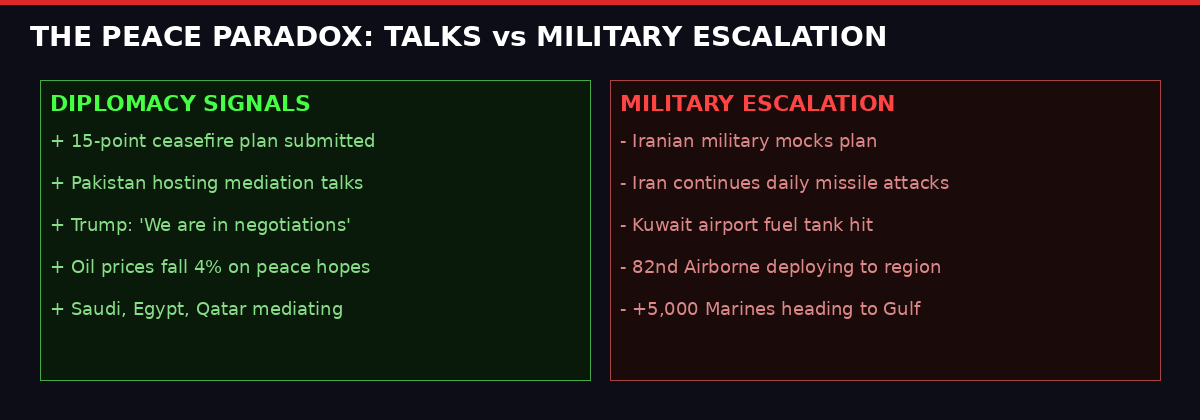
The peace paradox: diplomatic signals and military escalation are running in parallel, not opposition. (BLACKWIRE analysis)
Israel Strikes Qazvin. Missiles Rain on Tel Aviv. Bahrain Sirens.

Israeli warplanes launched "new wide-scale attacks" on Iran early Wednesday, targeting government infrastructure in the northwestern city of Qazvin. (Illustrative - Pexels)
While diplomats floated peace plans, the military machinery ground forward on every front.
The Israeli military announced it had begun a new round of wide-scale strikes on Iran early Wednesday, targeting government infrastructure. Witnesses in the northwestern Iranian city of Qazvin reported airstrikes. Missile alert sirens sounded across Israel as Iran launched its own retaliatory attacks, a pattern that has continued every single day since the war began.
Saudi Arabia's Defense Ministry confirmed it had intercepted and destroyed at least eight drones fired at the kingdom's oil-rich Eastern Province overnight. Missile alert sirens were activated in Bahrain, where the U.S. Navy's Fifth Fleet is headquartered. Both countries have been under near-daily attack since Iran escalated its strikes on Gulf Arab states following the deaths of its top military and political leaders.
The Kuwait airport strike was the most dramatic single incident of the overnight period. The drone, according to the General Civil Aviation Authority, bypassed air defenses that had successfully intercepted other incoming projectiles. It hit a fuel storage tank on the airport grounds. The fire was contained by morning, but the message was clear: Iran's reach extends to civilian aviation infrastructure across the Gulf.
Iran has also confirmed it is charging ships for passage through the Strait of Hormuz. Iranian Foreign Ministry spokesman Esmail Baghaei told India Today on Tuesday that the practice was happening, saying "absolutely" when asked directly, though he declined to elaborate on rates or conditions. The Strait, through which roughly one-fifth of the world's oil shipments pass in peacetime, has been effectively blockaded since February 28. Iran has allowed a trickle of vessels through - but none from the United States, Israel, or countries it deems aligned with them.
Oil Markets React to Peace Signals, Then Reality

Brent crude fell more than 4% Wednesday as ceasefire speculation briefly calmed markets - before Iranian military statements reasserted the reality on the ground. (Illustrative - Pexels)
Financial markets initially responded to the ceasefire speculation with controlled optimism. Brent crude, the international benchmark, fell 4.2% in early Wednesday trading to $96.07 per barrel, down from around $104 on Tuesday. Benchmark U.S. crude dropped 3.8% to $88.89 a barrel.
Asian equity markets rallied. Tokyo's Nikkei 225 climbed 3% to 53,806. South Korea's Kospi gained 1.6%. Hong Kong's Hang Seng rose 0.7%. Taiwan's Taiex was up 2.5%. U.S. futures were up more than 0.7% in pre-market trading, according to AP Business reporting from Hong Kong.
The context for those numbers is stark. Brent crude sat around $72 per barrel on the eve of the war's outbreak on February 28. By mid-March it had pushed past $119 as Iran's stranglehold on the Strait tightened and strikes on Gulf energy infrastructure mounted. The brief retreat to $96 represents the market pricing in a ceasefire premium - not a reflection of any actual change in supply flows.
Gold, which had surged past $5,000 per ounce earlier in March, was trading at $4,557.30 per ounce early Wednesday - up 3.6% in early Asian trading - as investors balanced peace optimism against persistent inflation fears. Higher oil prices have stoked fears of a global stagflation cycle that central banks, still managing post-pandemic debt loads, are poorly positioned to combat.
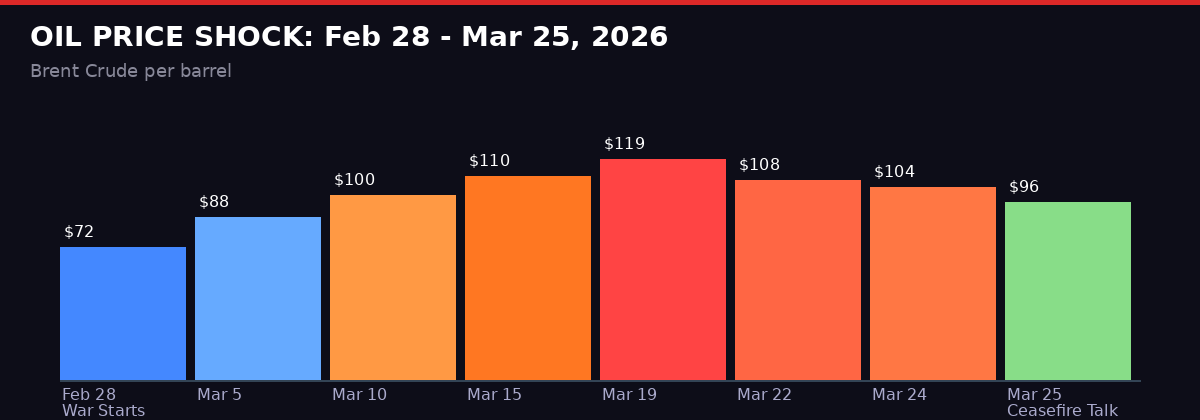
Brent crude price trajectory since the war began February 28, 2026. The sharp drop on March 25 reflects ceasefire speculation only - the Strait remains effectively closed. (BLACKWIRE)
82nd Airborne Deploys as Trump Claims "Max Flexibility"

The 82nd Airborne Division, based at Fort Bragg, North Carolina, is the U.S. Army's designated rapid-response airborne force - trained to parachute into hostile territory. (Illustrative - Pexels)
While the diplomatic track activated, the Pentagon's deployment orders moved in the same direction they have been moving since the war began.
At least 1,000 troops from the 82nd Airborne Division will deploy to the Middle East in the coming days, according to three people with knowledge of the plans who spoke to AP on condition of anonymity. The contingent includes a battalion from the 1st Brigade Combat Team and Maj. Gen. Brandon Tegtmeier, the division's commander, along with division staff.
The 82nd Airborne's designation matters. Unlike Marine expeditionary units - which are trained for missions including embassy support, civilian evacuation, and disaster relief - the 82nd is the Army's emergency airborne assault force. Their core capability is parachuting into contested or hostile territory to secure key terrain and airfields on short notice. The unit's deployment is not a defensive posture signal.
They join a force already significant in scale. The U.S. currently has approximately 50,000 troops in the Middle East. The Navy has ordered the Japan-based USS Tripoli and the 31st Marine Expeditionary Unit from exercises near Taiwan to the region. Two additional Marine Expeditionary Units deploying from San Diego will add about 5,000 Marines and thousands of sailors.
White House spokeswoman Anna Kelly deferred questions about the deployment to the Pentagon but noted that "President Trump always has all military options at his disposal." Officials framed the combined troop movement as giving Trump "max flexibility" - a formulation that analysts at the Soufan Center noted could mean either an offensive escalation or, conversely, leverage for a deal.
"Trump could be actively seeking an offramp. Or he could be positioning to land troops. The 82nd Airborne's presence does not narrow the range of options - it expands them." - The Soufan Center, New York, published analysis, March 24, 2026
Members of the Senate Armed Services Committee are scheduled for a classified Pentagon briefing on Wednesday, where the 82nd Airborne deployment is expected to be addressed.
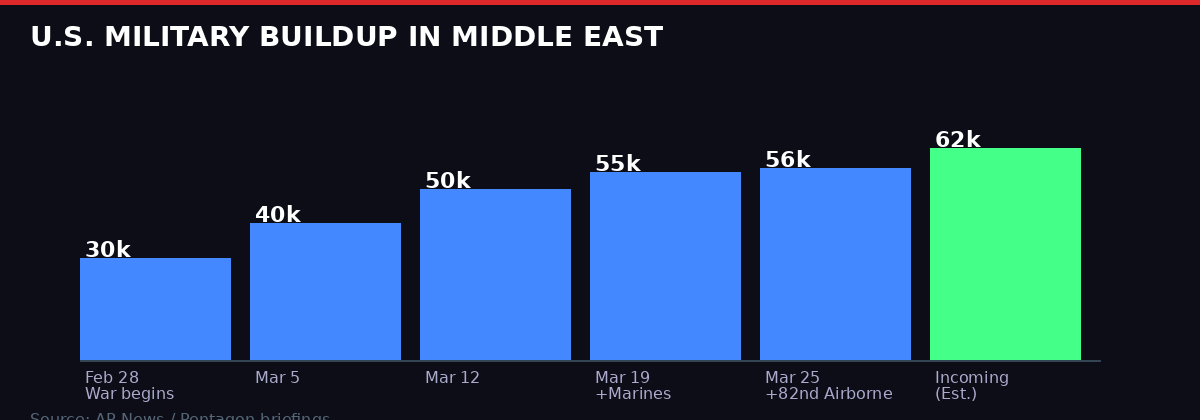
U.S. military presence in the Middle East has grown steadily since the war began. The 82nd Airborne deployment will push total American forces past 56,000 personnel. (BLACKWIRE)
Philippines Declares National Energy Emergency

The Philippines joined a growing list of nations declaring emergency economic measures as the Iran War's impact on global energy prices spreads far beyond the conflict zone. (Illustrative - Pexels)
The war's economic shockwaves reached Southeast Asia on Tuesday when Philippine President Ferdinand Marcos Jr. declared a state of national energy emergency - the most dramatic policy response to the conflict from any nation outside the immediate theater.
The declaration, which will remain in force for an initial period of one year, established a contingency committee under Marcos's direct leadership. The committee is tasked with ensuring the availability and distribution of fuel, food, medicines, agricultural products, and other essential goods. Authorities were ordered to act against hoarding, profiteering, and price manipulation in petroleum markets.
The Philippine government has begun distributing 5,000 pesos ($83) each to large numbers of motorcycle taxi drivers and public transport workers nationwide to offset soaring fuel costs. Free bus rides have been provided to students and workers in selected cities.
The humanitarian dimension is acute. About 2.4 million Filipino workers and residents are in the Middle East, including approximately 31,000 in Israel and 800 in Iran. The Department of Migrant Workers has been instructed to prepare for large-scale rescue and evacuation operations. A Filipina caregiver, Mary Ann de Vera, was killed in Tel Aviv on February 28 - the war's first day - while helping her elderly charge reach a bomb shelter during an Iranian missile strike.
The Philippines is not an isolated case. It is the most visible example of the war's cascading economic effects reaching countries with no direct stake in the conflict. Sri Lanka, Pakistan, and several sub-Saharan African nations have implemented fuel rationing measures. European governments are managing emergency natural gas reserves after the Strait of Hormuz closure cut off LNG shipments from Qatar to global markets.
Who Controls Iran - And Can They Deal?

Iran's leadership structure has been shattered by Israeli targeting campaigns. The question of who actually holds decision-making power - and who can sign a deal - remains unanswered. (Illustrative - Pexels)
One of the deepest structural problems facing ceasefire efforts is a question Washington cannot confidently answer: who in Iran has the authority to negotiate, and who can make commitments that will hold?
Supreme Leader Ayatollah Ali Khamenei was killed in the opening strikes of the war. His son, 56-year-old Mojtaba Khamenei, was quickly named as successor by the Assembly of Experts. But Mojtaba has not been seen in public since the strike that killed his father - and reportedly wounded him. His wife, Zahra Haddad Adel, was killed in the same attack.
Israeli Prime Minister Benjamin Netanyahu put it bluntly at a Thursday press conference last week.
"I'm not sure who's running Iran right now. Mojtaba, the replacement ayatollah, has not shown his face. Have you seen him? We haven't, and we can't vouch for what exactly is happening there. Iran's command and control structure is in utter chaos." - Israeli Prime Minister Benjamin Netanyahu, press conference, late March 2026
Ali Larijani - the secretary of Iran's Supreme National Security Council and one of the country's most powerful figures - has also been killed in Israeli strikes. So have a string of top military commanders and intelligence chiefs. The full scope of the targeting campaign against Iran's leadership has systematically removed the interlocutors that previous diplomatic tracks had relied on.
"The Revolutionary Guard is the state now," Ali Vaez, Iran project director at the International Crisis Group, told AP. "The civilian leadership was subservient to it before the war. Now it barely exists."
The IRGC's Khatam Al-Anbiya Central Headquarters - the body that issued Wednesday's defiant statement - is both Iran's military command structure and, in the current vacuum, its de facto political authority. That body has said, in the clearest possible terms, that it will not negotiate with the United States. The question of whether any political figure in Tehran can override that position, let alone enforce a ceasefire against IRGC units already operating in semi-autonomous mode across the Gulf, is genuinely unanswered.
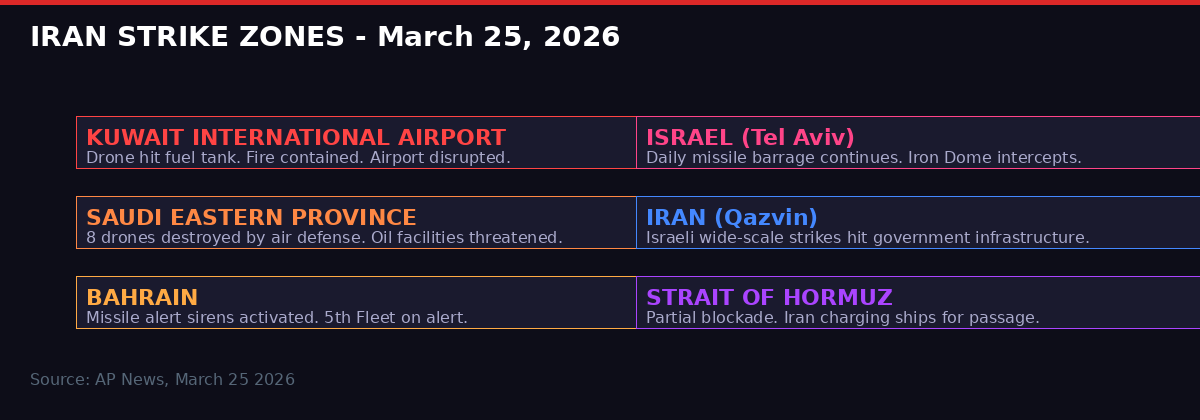
Iranian strike zones across the Gulf on March 25, 2026. Kuwait airport, Saudi Eastern Province, and Bahrain were all targeted overnight. (BLACKWIRE analysis)
The Hormuz Chokepoint: Iran's Leverage and Its Limits

A fifth of the world's oil transited the Strait of Hormuz before the war. Iran's near-total closure of the passage has disrupted global energy markets in ways that will outlast any ceasefire deal. (Illustrative - Pexels)
The Strait of Hormuz is the single most important variable in the war's global economic calculus. It is a 21-mile-wide passage connecting the Persian Gulf to the Arabian Sea and the broader global ocean network. Before the war, approximately one-fifth of the world's crude oil and significant volumes of liquefied natural gas moved through it daily.
Since February 28, Iran has made the strait effectively impassable for most international shipping. The blockade has not been total - Tehran has selectively allowed vessels to pass, primarily those from China and countries not deemed hostile to the Islamic Republic. Iran's foreign ministry confirmed this week that it is charging ships for passage, a form of maritime taxation imposed under wartime conditions that has no precedent in the modern era.
The closure has triggered a cascade of downstream effects. Gulf Arab producers, including Saudi Arabia and the UAE, have found their export infrastructure partially functioning but cut off from normal shipping lanes. Qatar's LNG exports to European and Asian customers have been severely disrupted. India and Japan - major importers of Gulf crude - have been negotiating alternative supply arrangements at significant cost premium.
The 1980s Tanker War, when Iran and Iraq attacked commercial shipping during their eight-year conflict, provides the closest historical parallel - but even that conflict never involved Iran imposing fees on transit passage or maintaining a sustained blockade of more than a month's duration.
Reopening the strait is listed as a priority in the U.S.-led ceasefire framework, and Egyptian mediators confirmed to AP that creating a "mechanism" for Hormuz to reopen is at the center of the trust-building effort. But Iran views Hormuz access as its primary leverage over the United States and the global economy. Giving that up without ironclad guarantees - guarantees Washington has historically been unwilling to put in writing - is a concession Tehran is unlikely to make on the basis of a 15-point plan delivered through third parties.
WAR TIMELINE - KEY EVENTS
What Happens Next
Three tracks are now running simultaneously, and none of them is moving toward resolution.
On the military track, the United States is deploying more offensive-capable forces to the region while framing the move as providing "options." The 82nd Airborne's involvement expands the available menu from naval strike and Marine expeditionary options to include airborne assault on fixed targets - which could mean Iranian-controlled islands in the Strait or airfields on the Iranian mainland. Israel is continuing its daily strike operations on Iranian government and military infrastructure. Iran is continuing its daily barrages on Israel and Gulf Arab states, with demonstrated reach into civilian infrastructure across the region.
On the diplomatic track, Pakistan and Egypt are working to build enough "trust" between parties who do not trust each other to get them into the same room. The target date of "early next week" is aspirational at best. Iran's military command has publicly declared the effort illegitimate. Israeli officials, who were reportedly surprised by Washington's submission of a ceasefire plan, are on record favoring continued military pressure over talks.
On the economic track, the war is generating costs that are now severe enough to matter politically in countries far from the conflict. The Philippines' national emergency declaration is a signal of the breadth of economic disruption already underway. Oil at $96 still represents a roughly 33% premium over pre-war levels. Every week the Strait remains effectively closed adds to a structural energy deficit that will not resolve quickly even if a ceasefire is signed tomorrow.
The most likely near-term scenario, based on the stated positions of all parties, is continued fighting while low-level diplomatic activity continues in parallel. Trump has built his negotiating posture on the threat of escalation - power plants, ground forces, full Hormuz seizure operations. Iran has built its posture on the credibility of indefinite resistance. Neither side has yet reached the point where the cost of continuing exceeds the cost of compromise.
Kuwait's burning fuel tank is a data point in that calculation. So is the price of a barrel of oil. So is the number of Filipino workers who cannot afford to fill their motorcycles. The war is a month old. Its bill is still being written.
Get BLACKWIRE reports first.
Breaking news, investigations, and analysis - straight to your phone.
Join @blackwirenews on Telegram