Two Pilots Dead at LaGuardia: Air Canada Jet Hits Fire Truck at 100mph, Controller Says "I Messed Up"
A Jazz Aviation regional jet slammed into an airport emergency vehicle crossing an active runway just before midnight Sunday, killing both pilots and leaving a flight attendant strapped to her seat - outside the aircraft. The crash shut New York's LaGuardia Airport for hours, cancelled 600-plus flights, and cracked open a years-old argument about whether the FAA has enough staff to run the world's busiest aviation system.

Airport tarmac scene. Emergency vehicles responded to the crash as passengers evacuated via wing slides. (Pexels)
BREAKING NEW YORK - The pilot and copilot of an Air Canada regional jet are dead after their aircraft collided with a Port Authority fire truck on an active runway at LaGuardia Airport, striking the vehicle at approximately 100 miles per hour during landing late Sunday night. The crash - the latest in a string of catastrophic runway incidents at U.S. airports - exposed what aviation safety experts have been warning about for years: a dangerously understaffed federal air traffic control system operating on the edge of its limits.
The collision occurred at approximately 11:45 p.m. Sunday, March 22, when a Jazz Aviation Bombardier CRJ regional jet operating as Air Canada Flight 2259 from Montreal-Pierre Elliott Trudeau International Airport struck Airport Rescue and Fire Fighting Truck 1 as the vehicle crossed Runway 13. The aircraft's nose was destroyed on impact. Both the pilot and co-pilot, both based in Canada, were killed. Their names have not been publicly released as of Monday afternoon.
In one of the most disturbing details to emerge from the crash scene, a flight attendant was found alive - still strapped into her jump seat - outside the aircraft. Her seat had fallen through a hole ripped in the plane's floor during the collision. She was conscious with serious but non-life-threatening injuries, according to CBS News, citing sources familiar with the NTSB investigation. Forty additional passengers and crew were taken to area hospitals, some with serious injuries. Most had been released by Monday morning.
Key Facts
- Two pilots killed - both based in Canada, names not yet released
- Flight attendant found alive outside the plane, still strapped to her seat
- Aircraft hit fire truck at approximately 100mph during landing roll
- 41 passengers and crew hospitalized; 32 released by Monday morning
- ATC controller heard on frequency: "I messed up"
- LaGuardia closed Sunday night through Monday afternoon, 600+ flights cancelled
- NTSB has launched a full investigation
- FAA has an estimated 3,000+ controller shortage nationwide
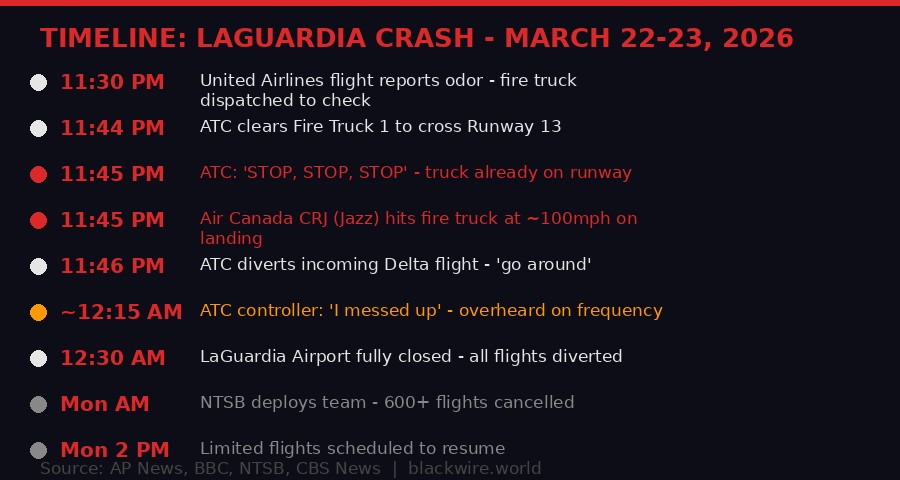
The Sequence: Fire Truck on Runway 13

Air traffic controllers manage both ground and air traffic from the tower. Questions are mounting about staffing levels on the Sunday overnight shift. (Pexels)
The sequence of events that killed two pilots began with a routine call. A United Airlines flight on the ground at LaGuardia reported a concerning odor onboard and requested fire department support. Airport Rescue Fire Fighting Truck 1 was dispatched to respond.
The fire truck was given clearance by an air traffic controller to cross Runway 13 - the same runway the incoming Air Canada CRJ was already lined up to land on. What happened next plays out in brutal clarity on the publicly released ATC audio.
"Stop, Truck 1. Stop." - LaGuardia air traffic controller, seconds before the collision. The truck was already on the runway.
The controller frantically repeated the stop instruction and simultaneously issued a "go around" diversion to an incoming Delta Airlines flight that was also approaching to land. But the Jazz Aviation CRJ was too close and moving too fast. There was no time to abort. The plane struck the fire truck at approximately 100 miles per hour.
Two Port Authority employees in the fire truck survived with injuries not believed to be life-threatening. The truck was left flipped onto its side, most of the damage concentrated at its rear half. The aircraft's nose was fully crushed, with cables and debris dangling from the ruined cockpit. Stairways were pushed up to emergency exits as passengers slid down the wing to escape.
Roughly 20 minutes after the impact, one controller on the frequency was heard saying, "We were dealing with an emergency earlier. I messed up." That three-word admission is now the center of what promises to be one of the most consequential aviation investigations in years. (Source: AP News, CBS News)
The Survivor Who Fell Through the Floor

Emergency responders rushed to the crash scene. Forty-one people were transported to hospitals, most with non-life-threatening injuries. (Pexels)
The most extraordinary survival story from the crash is a flight attendant who was discovered outside the plane, still buckled into her jump seat. The seat had fallen through a hole torn open in the aircraft's floor during the collision. She was found by first responders on the tarmac, conscious and alive, suffering serious but non-life-threatening injuries.
The detail - relayed by CBS News citing sources familiar with the investigation - underlines the catastrophic structural force of the impact. A Bombardier CRJ at landing weight and approach speed carries enormous kinetic energy. Hitting a stationary fire truck head-on concentrated all of that force into the nose section, where both pilots were seated. Neither survived.
Passenger Rebecca Liquori was on the flight, returning from a cousin's baby shower in Montreal. She described the moments after impact to News12 Long Island, a station where she had previously worked before becoming a nurse.
"Everybody just jolted out of their seats. People hit their heads. People were bleeding. I'm just happy to be alive. I would have never pictured a one-hour flight that I've done countless times ending like this." - Rebecca Liquori, passenger, Air Canada Flight 2259
Liquori said she helped open an emergency exit door and recalled passengers helping each other slide down a wing to get off the aircraft. The organized evacuation, in the dark, from a plane whose nose had just been destroyed, almost certainly prevented additional deaths.
Canadian Prime Minister Mark Carney called the accident "deeply saddening" in a statement Monday morning. President Donald Trump told reporters it was "a terrible situation" and said "they made a mistake," without specifying who he meant. (Source: AP News)
"I Messed Up": The ATC Question at the Center of the Investigation

Air traffic controllers manage hundreds of aircraft movements simultaneously. Investigators will examine whether understaffing contributed to the sequence of errors that caused the crash. (Pexels)
The NTSB investigation will center on a single critical question: how did a fire truck receive runway crossing clearance at the same time an aircraft was cleared to land on the same runway? The audio record suggests at least two separate clearances were issued - one sending the truck across, another authorizing the CRJ's landing - and that whoever issued the truck clearance did not immediately recognize the conflict.
Aviation safety expert Kivanc Avrenli, a professor at Syracuse University specializing in commercial aviation safety, told the BBC that the audio raises the possibility one controller was handling both ground traffic and air traffic simultaneously.
"One controller may have been handling both ground and air traffic, especially since the same voice appears to be issuing instructions related to both runway use and ground movement. Having one controller handle both ground and air traffic is technically possible at a busy airport like LaGuardia, but it is far from ideal." - Kivanc Avrenli, aviation safety professor, Syracuse University
Mary Schiavo, former Department of Transportation Inspector General, was blunt in her assessment speaking to AP News. "I don't know how many wake-up calls the FAA needs, but this has been happening for years and sadly some of the most horrific air crashes in history happen on the ground at the airport."
Former FAA air traffic control chief Mike McCormick noted that LaGuardia is "not a control tower that has perennial staffing problems." But he acknowledged that at 11:45 p.m. on a Sunday, the tower would have been operating on a skeletal overnight shift - and that investigators would be looking at overtime hours and consecutive working days as potential fatigue factors.
LaGuardia is one of 35 major U.S. airports equipped with an advanced surface surveillance system designed to alert controllers to potential runway incursions. Whether that system was active, whether alerts were generated, and whether controllers received and acted on any warnings will be central to the NTSB's findings. (Source: AP News)
The FAA Staffing Crisis: Years in the Making
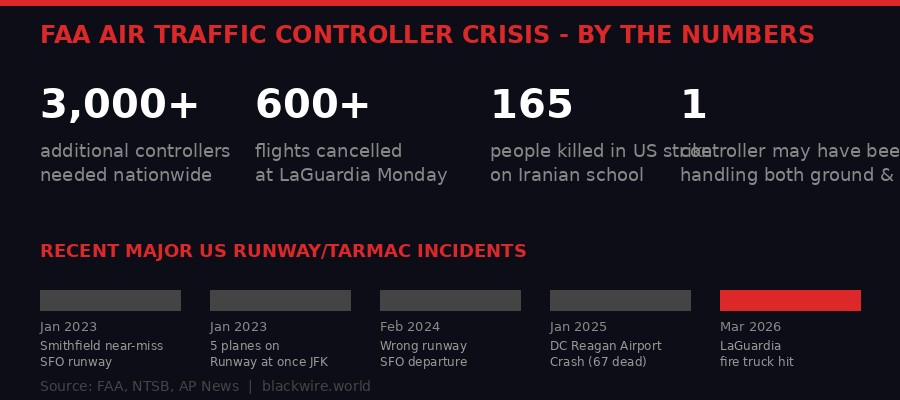
Sunday night's crash did not happen in isolation. It landed on top of a years-long, well-documented crisis inside the Federal Aviation Administration - one that safety advocates have been warning about in congressional testimony, investigative reports, and accident analyses for most of the past decade.
The FAA has been short-staffed by an estimated 3,000 or more air traffic controllers for years, according to the agency's own assessments and independent analyses. Training pipelines are slow - it takes up to three years to fully certify a controller from scratch, and attrition through retirement has outpaced hiring. The result is an agency running many of its busiest facilities with controllers who are overworked, undertrained at the margins, and increasingly fatigued.
Recent incidents catalogue the pressure. In January 2023, five aircraft were on a JFK runway simultaneously. A near-miss at San Francisco International in the same month prompted a Senate inquiry. In February 2024, an aircraft was cleared to take off from a wrong runway at SFO. Each time, the NTSB found human error at the root - and each time, the structural conditions enabling that error went largely unchanged.
The most comparable tragedy in recent memory is the January 2025 collision at Ronald Reagan Washington National Airport, where a U.S. Army Black Hawk helicopter flew into the path of an American Airlines regional jet on approach to Runway 33. Sixty-seven people were killed. That crash triggered congressional demands for action on ATC staffing and air traffic management at busy airports. The response, by most accounts, has been incremental at best.
Now LaGuardia joins that list. The airport - technically the 19th busiest in the country by enplanements but geographically compressed and surrounded by water on three sides, with some of the most constrained approach corridors in commercial aviation - has always been an airport where margins are thin. (Source: AP News, FAA)
The Shutdown Factor: TSA Chaos and Understaffed Airports

Spring break travel season was already strained by TSA staffing shortages tied to the partial DHS shutdown. Sunday's crash added 600-plus flight cancellations to the chaos. (Pexels)
The crash arrived at the worst possible moment for U.S. air travel. The Department of Homeland Security has been operating without full funding since mid-February, after Congress failed to reach an agreement on an appropriations bill. The DHS shutdown - tied to a political standoff over immigration enforcement rules following federal agents' fatal shooting of two people during a Minnesota immigration operation - has left the Transportation Security Administration without regular pay for more than a month.
The TSA staffing impact has been severe. Security checkpoint lines at major hubs have stretched to two and three hours during peak travel periods. Agents are calling out at elevated rates. Lawmakers moved a funding bill last week that included back pay for TSA workers, but it failed to advance in the Senate on Friday.
Air traffic controllers - classified as essential workers - are technically immune from the shutdown's direct pay effects. But they have worked without pay during prior shutdowns, and the cumulative strain of operating in a system under political siege, with a staffing crisis that predates the current administration, and with equipment maintenance budgets perennially squeezed, creates a backdrop in which error becomes more likely.
"Air traffic controllers are not impacted by the partial government shutdown," AP noted in its coverage - but the framing undersells the ambient pressure on a workforce that knows the system they rely on is being cut. Several aviation safety advocates have pointed out that the DOGE-era federal workforce reductions have touched FAA administrative and safety staff even when they have not directly touched active controllers.
By midday Monday, more than 600 flights had been cancelled at LaGuardia according to FlightAware data. The airport's closure cascaded into delays and cancellations at other major airports, particularly for Delta Air Lines, which has its largest east coast hub presence at the Queens airport. Some passengers reported being stranded overnight; others arrived at the terminal to find empty baggage carousels and no staff available to rebook them. (Source: BBC, AP News, FlightAware)
Who Were the Pilots?

The two pilots who died were both based in Canada. Air Canada and Jazz Aviation have not yet released their names. (Pexels)
The pilot and copilot who died have not been publicly identified. The Port Authority of New York and New Jersey confirmed both were based out of Canada. Air Canada and Jazz Aviation issued statements confirming the fatalities and extending condolences but did not release names, citing respect for the families as notifications were ongoing.
Jazz Aviation LP is a Halifax-based regional carrier that has operated on behalf of Air Canada for decades under the "Air Canada Express" brand. The airline operates a fleet of Bombardier CRJ and Dash 8 aircraft across regional routes in Canada and the northeastern United States. It is one of the primary regional feeders into Air Canada's hub network.
The Bombardier CRJ - in this case a variant used on short-haul routes - is one of the most common regional jets in service in North America. It carries between 50 and 90 passengers depending on configuration. The aircraft involved in Sunday's crash had 72 passengers and four crew aboard, according to Air Canada.
The flight itself - a short hop from Montreal's Trudeau International to LaGuardia - is one of the most heavily traveled regional routes in North America. It operates multiple times daily and is considered one of the most routine legs a crew could fly. Many of the passengers on board were leisure travelers catching spring break flights; at least one, Liquori, had been at a family gathering.
The Bombardier CRJ has an extensive safety record. This crash is not, by any preliminary indication, a matter of aircraft failure. It is a matter of two vehicles - one in the air moving at approach speed, one on the ground given clearance to cross - occupying the same point in space at the same time. (Source: Air Canada, AP News, Jazz Aviation)
Historical Context: America's Runway Problem

Runway incursions - incidents where aircraft or vehicles enter a runway without authorization - have been a persistent problem at busy U.S. airports. (Pexels)
The deadliest aviation accident in U.S. history happened on a runway. On March 27, 1977, two Boeing 747s collided on the runway at Tenerife-North Airport in the Canary Islands, killing 583 people - not in the U.S. but involving American carriers and reshaping aviation safety globally. The lessons drawn from Tenerife became the foundation of modern runway safety protocols.
Yet runway incursions continue. The FAA defines a runway incursion as "any occurrence at an aerodrome involving the incorrect presence of an aircraft, vehicle, or person on the protected area of a surface designated for the landing and take-off of aircraft." The FAA tracks them closely. The trend in serious incursions - those categorized as Category A or B, meaning a collision or near-miss with significant safety risk - has not been reliably declining.
After the January 2025 Reagan Airport crash, Transportation Secretary Sean Duffy promised urgent action on ATC staffing, technology upgrades, and airspace redesign. Some measures were announced. Investigators and safety advocates said the response was not proportionate to the scale of the problem.
Sunday's crash in New York will renew that debate - and this time with the added pressure of an ongoing government shutdown, a demoralized federal workforce, and an aviation industry already strained by the broader economic turbulence of the Iran war driving fuel prices higher across all sectors. The cost of aviation fuel has risen sharply in recent weeks as Brent crude traded near $120 before Monday's oil-market relief following Trump's extended Iran deadline. That pressure has cascaded into ticket prices, route suspensions, and airline budget stress - making cuts to already-thin safety margins even more fraught.
Mary Schiavo's quote sits as a kind of bitter coda to every one of these incidents. "This has been happening for years." The crashes come. The investigations proceed. The findings echo each other. And then, somewhere, another clearance is issued to a vehicle that shouldn't be there, and another aircraft is lined up with nowhere to go. (Source: FAA, NTSB, AP News)
What Comes Next: The Investigation and the Political Fallout

The NTSB has deployed a go-team to LaGuardia. Congressional hearings are expected. The political pressure on the FAA and the Trump administration will intensify in the coming days. (Pexels)
The National Transportation Safety Board deployed its go-team to LaGuardia Sunday night and has assumed lead investigative authority. The probe will take months to complete. But in the near term, several threads are already pulling.
First, the controller who said "I messed up." Federal law gives that individual certain protections in terms of what statements can be used against them in any legal proceedings, under voluntary disclosure programs the FAA and NTSB operate. But the political protection is non-existent. That audio clip is now attached to every news report about the crash. Congress will want to know how many hours that controller had worked, what their training record showed, and whether they were alone in the tower that night.
Second, the question of runway incursion alerting technology. LaGuardia has the advanced surface surveillance system. Whether it generated an alert - and whether anyone acted on it in time - will be a key technical finding. If the system generated an alert and was ignored, that is one story. If it failed to generate one, that is another. Either outcome raises serious questions.
Third, the political question of the shutdown. Democrats in Congress have already been hammering the Trump administration over TSA staffing gaps. The LaGuardia crash - even though ATC workers are not directly furloughed - will sharpen that argument. Any evidence that staffing cuts elsewhere in the FAA or NTSB contributed to conditions at LaGuardia will be politically devastating.
Fourth, Air Canada and Jazz Aviation face the legal exposure that accompanies any fatal crash. Families of the two pilots, and potentially passengers with serious injuries, will seek answers in civil proceedings. The preliminary investigation will shape those claims.
LaGuardia is expected to resume limited commercial operations Monday afternoon, with full recovery taking days given the scale of the flight cancellations and the ongoing NTSB work on the runway where the aircraft remains. The wreckage - the crushed nose of the CRJ tilted skyward, the fire truck on its side - will be preserved in place as investigators document the scene. (Source: NTSB, AP News, Port Authority of New York and New Jersey)
Get BLACKWIRE reports first.
Breaking news, investigations, and analysis - straight to your phone.
Join @blackwirenews on Telegram