Fifty Years of Land Day: The Olive Trees Palestinians Cut Down Themselves
On the 50th anniversary of the day that turned soil into symbol, the pace of dispossession has never been faster. The people who planted the trees are now the ones pulling them out - because the alternative is watching soldiers do it.
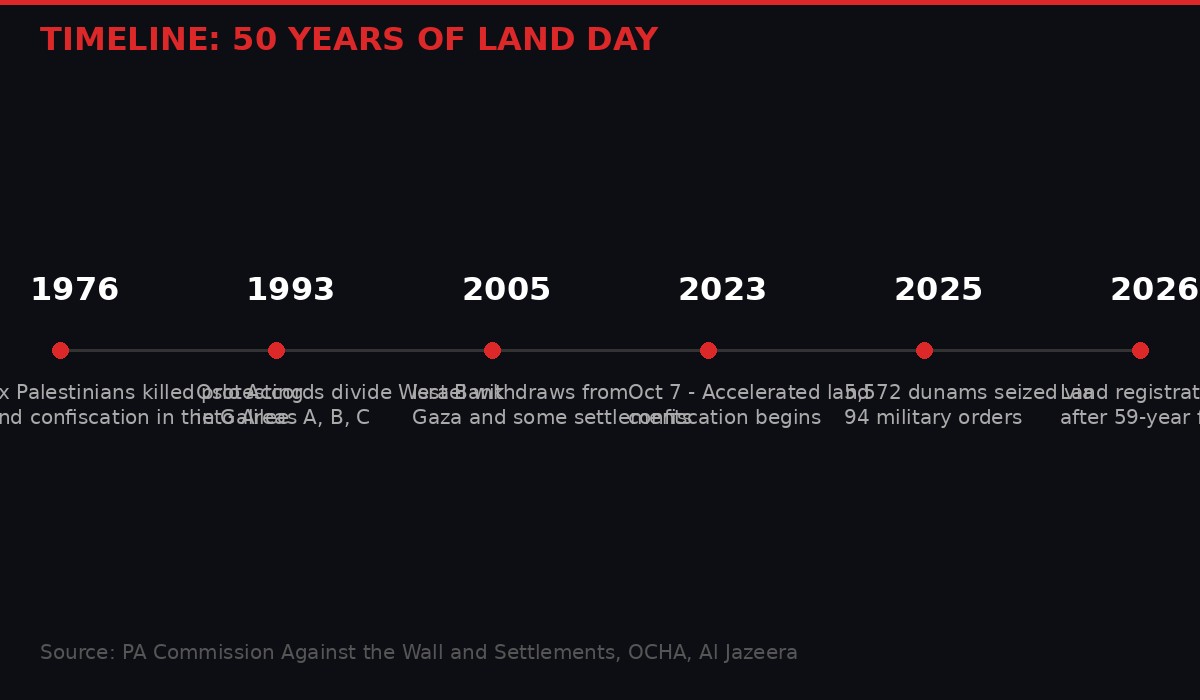
Fifty years of struggle mapped on a single line. Each dot represents a turning point. The distance between them keeps shrinking.
Abdul Rahman Azzam is 65 years old. He has spent most of those years planting olive trees on land south of Jenin in the occupied West Bank - land his father worked, land his grandfather ploughed, land that has been in the family longer than anyone alive can remember.
Last December, when the Israeli government issued a confiscation order for 513 dunams - roughly 127 acres - to build a settlement road connecting the illegal outposts of Homesh and Tarsala, Azzam did something that no one who plants trees ever expects to do.
He cut them down himself.
He wept while he did it. And when he looked up through the blur, he saw his neighbors doing the same thing across their plots - men and women pulling their own olive trees from the earth because the Israeli military bulldozers were coming anyway, and it was less painful to destroy what you love with your own hands than to watch strangers grind it into mud.
"It's easier for us to cut them down ourselves than for the army or settlers to do it. This is our land, and our trees are like our children; we cherish them and treat them with kindness because we toiled to cultivate and care for them." - Abdul Rahman Azzam, Palestinian farmer, speaking to Al Jazeera
Today is March 30, 2026. It is the 50th anniversary of Land Day - the date in 1976 when Israeli authorities announced mass confiscation of Palestinian land in the Galilee, sparking protests that ended with six Palestinians shot dead and hundreds arrested. It became a national symbol, etched into the calendar like a scar you learn to live with.
Fifty years later, the confiscation has not stopped. It has accelerated. And the human stories coming out of the West Bank in 2026 are not abstractions about geopolitics or border disputes. They are about a man cutting down his own trees because the alternative is worse.
The Numbers That Define Dispossession
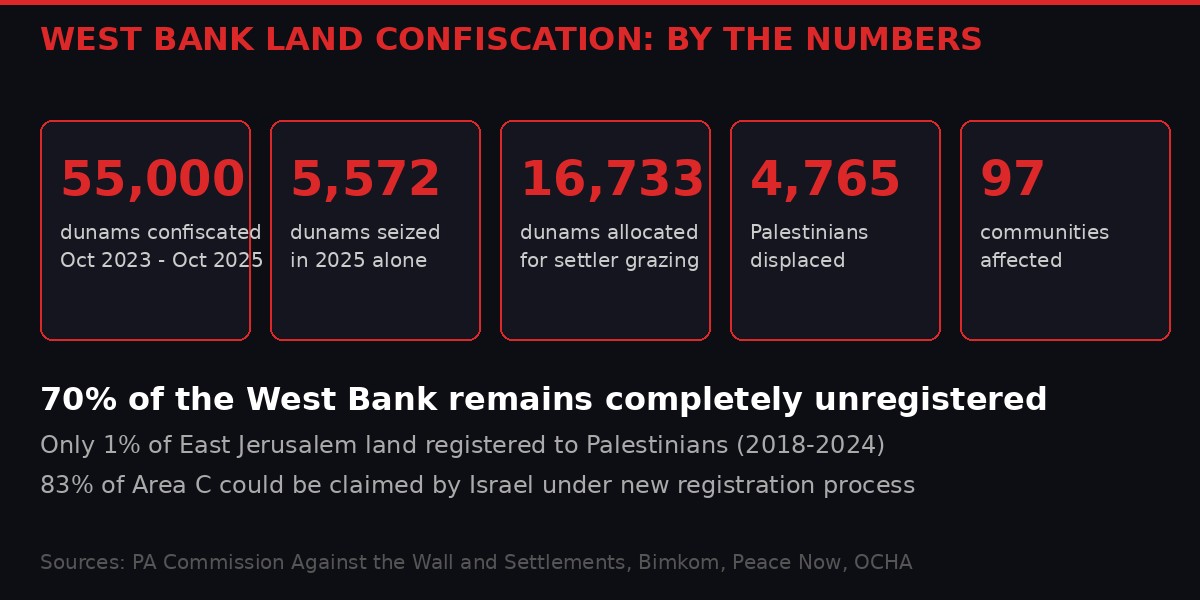
The scale of seizure since October 2023, compiled from PA Commission Against the Wall and Settlements data, OCHA reports, and Bimkom research.
The Palestinian Authority's Commission Against the Wall and Settlements has been tracking what it calls an "unprecedented acceleration" of land confiscation since October 2023. The numbers tell a story that words struggle to convey.
Between October 2023 and October 2025, Israel confiscated approximately 55,000 dunams of Palestinian land in the occupied West Bank. To put that in perspective, a dunam is roughly a quarter of an acre. That is 13,750 acres - an area larger than Manhattan - seized in just two years.
The methods vary but the result is consistent. According to the commission's annual report, 20,000 dunams were taken under the pretext of modifying boundaries of nature reserves. Another 26,000 dunams were claimed through 14 declarations of "state land" across Jerusalem, Nablus, Ramallah, Bethlehem, and Qalqilya. A further 1,756 dunams were confiscated through 108 military orders for towers, security roads, and buffer zones around settlements.
In 2025 alone, Israel seized 5,572 dunams through 94 confiscation orders for military purposes, plus three expropriation orders and four additional state land declarations. Concurrently, 16,733 dunams of previously confiscated land were allocated specifically for settler grazing - a move the commission described as "a dangerous escalation in the tools of control."
Key figure: More than 700,000 Israeli settlers now live in illegal settlements across the occupied West Bank, according to international monitoring groups. The International Court of Justice ruled in July 2024 that Israel's occupation is unlawful and must be terminated "as rapidly as possible." Israel has not complied.
But the most insidious change came in February 2026, when the Israeli government approved a proposal that human rights organizations are calling the most consequential land policy shift since the occupation began in 1967.
The Registration Weapon
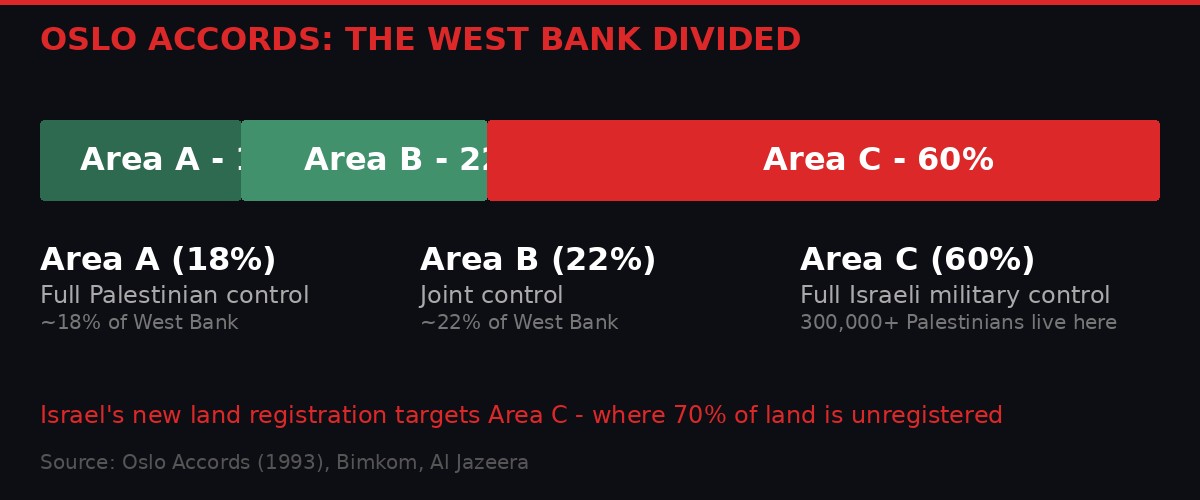
Area C - 60% of the West Bank - is under full Israeli military control. The new land registration process targets this zone, where 70% of land remains unregistered.
On February 15, 2026, Israel's government approved a plan submitted by far-right Finance Minister Bezalel Smotrich, Justice Minister Yariv Levin, and Defence Minister Israel Katz to resume the "settlement of land title" process in the West Bank. This process had been frozen since 1967 - for 59 years.
The mechanics sound bureaucratic. They are anything but.
Under the plan, Israel will begin formally registering land ownership in Area C of the West Bank - the 60% of the territory under full Israeli military control where more than 300,000 Palestinians live. Anyone claiming ownership must submit documents proving it. The burden of proof falls entirely on the Palestinian landowner.
Here is why that matters: approximately 70% of the West Bank is "completely unregistered," according to Michal Braier, head of research at Bimkom, an Israeli human rights organization focused on land and housing rights. Land registration under Jordanian administration before 1967 covered only about 30% of the total area. The rest exists in a legal limbo that Israel is now exploiting.
"The legal bar for proving land ownership is very, very high, in a way that most Palestinians won't have the proper documents to prove it." - Michal Braier, Bimkom, speaking to Al Jazeera
The documents required often date back to the British Mandate era or the Jordanian period - a century ago. Many were lost during the wars of 1948 and 1967. Others are stored in homes that Palestinian refugees can no longer access. For Bedouin communities who have lived on the same land for generations but never engaged with colonial-era bureaucracy, the paperwork simply does not exist.
Smotrich was blunt about the intent. He called the move a continuation of "the settlement revolution to control all our lands." Levin described it as an expression of the government's commitment "to strengthening its grip on all its parts."
Hagit Ofran, director of Peace Now's Settlement Watch programme, calculated what this means in practice. "Palestinians will be sent to prove ownership in a way that they will never be able to do," she told the Associated Press. "And this way, Israel might take over 83% of the Area C, which is about half of the West Bank."
The precedent already exists. When Israel began land registration in occupied East Jerusalem in 2018, Bimkom's research found that between 2018 and 2024, only 1% of registered land ended up in Palestinian hands. The remaining 99% was claimed by the Israeli state or private Israeli owners.
One percent. In six years. On land where Palestinians have lived for centuries.
The Man Who Watched His Land Disappear
Mohammed Fouad is 56. He owns 15 dunams of agricultural land in the town of Ein Yabrud, east of Ramallah. His plot sits about one kilometer from the illegal Israeli settlement of Beit El.
On a Wednesday in late March, Fouad learned that an Israeli army bulldozer was razing his land. Not through an official notice. Not through a letter. A neighboring farmer told him.
He went to the nearest accessible point and watched as the machine removed his trees, carving what appeared to be a road for settlers.
"My land is 15 dunams and is only 1km from the Beit El settlement, which is built on land north of Ramallah. I fear this bulldozing is a prelude to its annexation to the settlement, especially since it's classified as Area C." - Mohammed Fouad, Palestinian farmer, speaking to Al Jazeera
When Fouad approached the armed men accompanying the bulldozer to ask what was happening, they identified themselves as Israeli army and intelligence personnel. They expelled him from his own land.
No confiscation order. No legal proceeding. No notification whatsoever. Just a bulldozer and guns.
"I've always cared for this land, and now I'm watching it being bulldozed right before my eyes, unable to reach it," Fouad said. "It's as if they're forcing me to leave. But I'll try to reach it every day."
This pattern - confiscation without paperwork, seizure without orders - has become increasingly common, according to field researchers. Raed Muqadi of the Land Research Centre told Al Jazeera that settlers have begun simply fencing off Palestinian lands to claim them, particularly in the Jordan Valley. Thousands of dunams of pasture and agricultural land have been enclosed this way. Palestinians arrive to find fences where there were none, with no legal recourse and no one to appeal to.
The Israeli Knesset recently approved what researchers call "lifting the ban on data concerning landowners in the West Bank," which makes it easier for settlers to identify, target, and purchase Palestinian land - even in Area A, which is supposedly under full Palestinian control - through settlement associations acting as intermediaries.
The Communities That Ceased to Exist
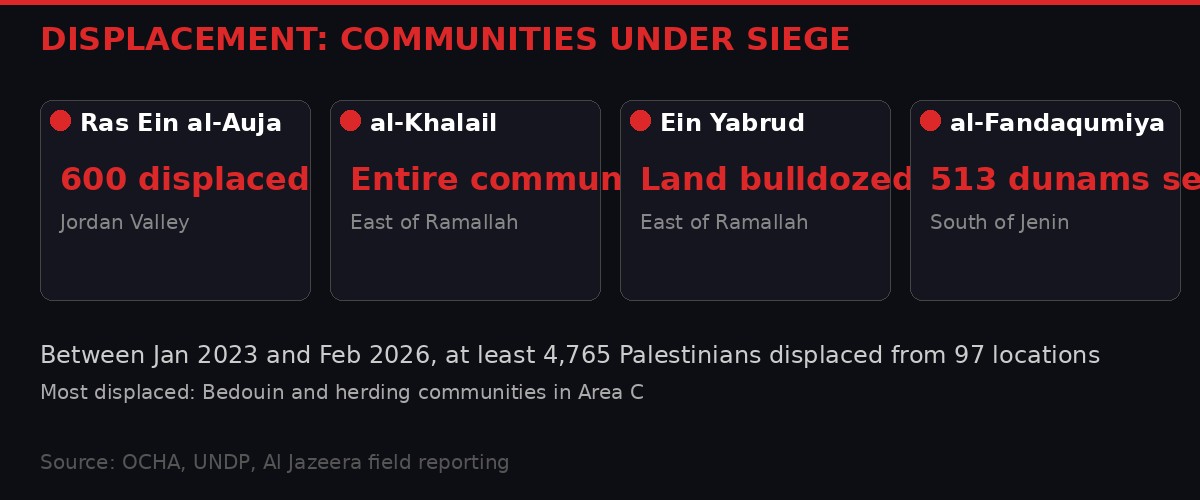
Four communities among dozens facing erasure. OCHA data shows 4,765 Palestinians displaced from 97 locations between January 2023 and February 2026.
Qusay Abu Naim is 23. He used to live in the Bedouin community of al-Khalail, in the village of al-Mughayyir, east of Ramallah. He does not live there anymore. Nobody does.
The community emptied in February 2026 after what Abu Naim describes as a sustained campaign of settler violence that made daily life impossible. The attacks began in December 2024 and escalated relentlessly.
On February 21, Israeli settlers attacked the community in waves, assaulting men, women, and children. Four members of a single family were injured, including two children. When the Israeli army arrived, they did not intervene against the settlers. Instead, after settlers filed a complaint claiming the Palestinians had "resisted" them, soldiers opened fire. Two children, aged 12 and 13, were shot and wounded.
"This incident was the last straw. We decided to leave because the attacks were almost constant. When we returned from the hospital to dismantle our homes, we were shocked to find that the settlers had destroyed them and vandalised their contents." - Qusay Abu Naim, al-Khalail community, speaking to Al Jazeera
The residents sought help from international solidarity activists, but the activists were themselves attacked. Abu Naim's brother had his arm broken so badly it required a metal plate to repair. While receiving medical treatment, the Israeli army arrested him. He remains in administrative detention - held without charge.
The attacks were deliberately designed to force evacuation. Settlers broke into homes and stole food from refrigerators. They targeted women specifically. They stole sheep - attacking the economic foundation of Bedouin life.
It worked. The entire community of al-Khalail relocated to neighboring villages. Their former home is now under the control of settlers and the Israeli military. No Palestinian is permitted to enter.
This is not an isolated incident. According to the United Nations Office for the Coordination of Humanitarian Affairs (OCHA), at least 4,765 Palestinians were displaced from 97 locations between January 2023 and mid-February 2026 due to settler violence. Most were from Bedouin and herding communities in Area C.
At the start of 2026 alone, 600 people were forced from a single Bedouin village - Ras Ein al-Auja in the Jordan Valley. The United Nations Development Programme estimates approximately 40,000 Palestinian Bedouins live in the West Bank, most originally from the Naqab Desert, displaced during the 1948 war, then again after 1967, then through the 1980s, and continuing to the present day. Each generation inherits the displacement of the one before.
The World Responds - and Doesn't
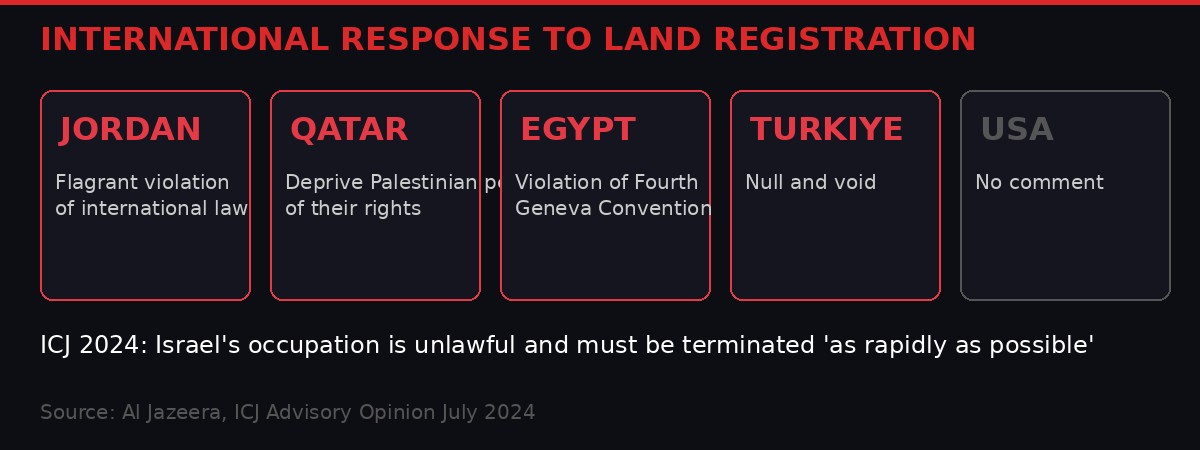
A regional chorus of condemnation - and one conspicuous silence from Washington.
The international response to Israel's land registration decision followed a pattern that Palestinians have learned to expect: strong words from countries with no leverage, silence from the one that matters.
Jordan's Ministry of Foreign Affairs condemned the decision "in the strongest terms," calling it a "flagrant violation of international law." Qatar said it considered the move "an extension of its illegal plans to deprive the Palestinian people of their rights." Egypt called it a "flagrant violation" of international humanitarian law, particularly the Fourth Geneva Convention. Turkiye declared the move "null and void."
The United States offered no comment.
This silence is not new, but it carries extra weight now. Previous American administrations - including those broadly sympathetic to Israel - maintained at least rhetorical opposition to settlement expansion. The current dynamic between Prime Minister Benjamin Netanyahu and President Donald Trump has eliminated even that pretense. The two leaders have met seven times in the past year alone. While Trump has technically ruled out formal Israeli annexation of the West Bank, his administration has taken no action to curb what human rights groups describe as annexation by another name.
Xavier Abu Eid, a political analyst based in Ramallah, put it plainly in an interview with Al Jazeera: "People should understand this is not just a step towards annexation. We are experiencing annexation as we speak today. What the Israeli government is doing is implementing their political programme: a policy that has already been presented."
He described the land registration decision as "packing annexation into a bureaucratic move."
The International Court of Justice's 2024 advisory opinion - which found Israel's occupation unlawful and called for its termination "as rapidly as possible" - remains unimplemented. Israel's Supreme Court rejected a petition against the land registration process, filed by four Israeli human rights organizations, calling it "premature" to rule on. The case was brought by Bimkom, Yesh Din, the Association for Civil Rights in Israel, and HaMoked.
Hamas denounced the land registration as "a null and void decision issued by an illegitimate occupying power" and "an attempt to forcibly impose settlement and Judaisation on the ground." The Palestinian presidency called it "a grave escalation and a flagrant violation of international law" amounting to "de facto annexation," and called on the international community - particularly the United States and the UN Security Council - to intervene.
Neither the United States nor the Security Council intervened.
What an Olive Tree Means
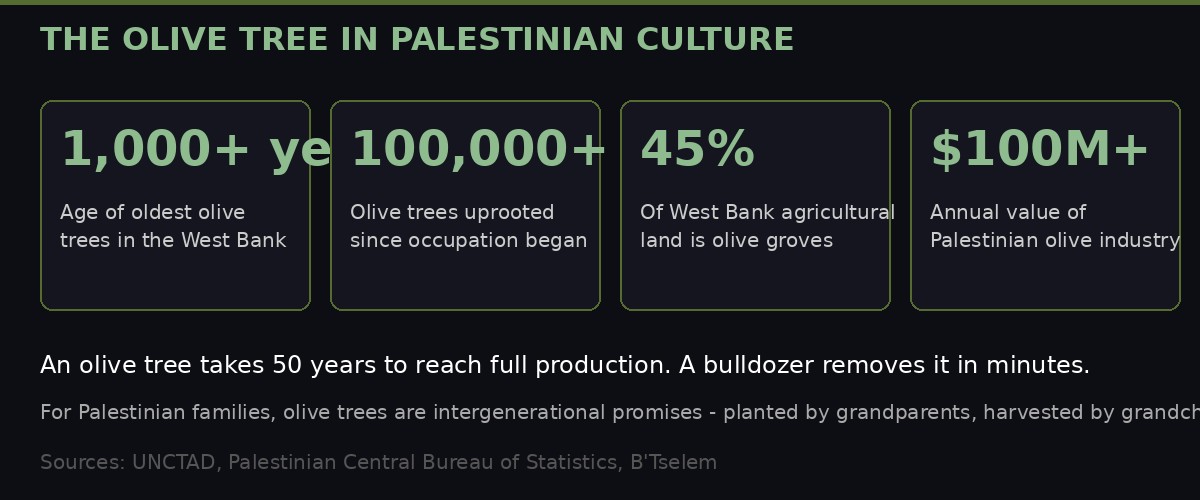
More than agriculture. More than economics. The olive tree is an intergenerational covenant between Palestinian families and their land.
To understand Land Day, you need to understand what olive trees mean in Palestinian culture. They are not just crops. They are not just economic assets. They are identity made physical.
An olive tree can live for hundreds of years. Some of the oldest in the West Bank are estimated to be over a thousand years old. Families mark their connection to the land through these trees - generations of planting, pruning, harvesting, pressing oil. The tree outlives the person who plants it, and the person after that, and the one after that. It is a promise made to the future.
When settlers uproot olive trees - which happens routinely, documented by organizations including the UN, B'Tselem, and Yesh Din - they are destroying something that cannot be replaced in a single lifetime. A mature olive tree that took 50 years to reach full production is gone in minutes. The economic loss is real: olive farming is a significant income source for rural Palestinian families. But the symbolic violence cuts deeper.
When Azzam cut his own trees, he was making a calculation no one should have to make. Let the army do it, and they become a symbol of your powerlessness. Do it yourself, and you retain some fragment of agency - the cold comfort of choosing how you lose what you love.
Across the West Bank, Palestinian farmers have described the same logic in different words. The trees are coming down regardless. The bulldozers are coming. The settlement roads are being built. The only question is whether you stand there and watch, or whether you walk away, or whether you pick up the saw yourself.
Land Day began in 1976 because people refused to accept confiscation quietly. Six people died for that refusal. Fifty years later, the confiscation continues, but the scale has shifted so dramatically that individual acts of resistance feel like trying to hold back the sea with your hands.
The olive groves south of Jenin where Azzam's family planted for generations are now a construction site. The settlement road connecting Homesh and Tarsala - two outposts that had been evacuated in 2005 and have since been repopulated by settlers - will run straight through land that once produced oil pressed by the same hands that planted the trees.
The Bedouin Question
The roughly 40,000 Palestinian Bedouins in the West Bank represent perhaps the most vulnerable population in the occupied territories. Their way of life - pastoral, mobile, deeply connected to grazing land and open space - makes them particularly susceptible to the kind of territorial enclosure Israel has perfected.
Most West Bank Bedouins trace their displacement to 1948, when they were expelled or fled from the Naqab (Negev) Desert during the creation of Israel. They were displaced again after the 1967 war. And again through the 1980s. Each time, the space available to them shrank.
Now, with settlers fencing off thousands of dunams of traditional grazing land in the Jordan Valley, and the new land registration process threatening to formalize the seizure of territory they have never held documents for, Bedouin communities face what OCHA data suggests is an existential threat.
The displacement numbers are stark. In the first weeks of 2026, a single village - Ras Ein al-Auja - lost 600 residents. Across the West Bank, 97 communities have been affected since 2023. The pattern is consistent: settler violence escalates until life becomes impossible, the army arrives to protect the settlers rather than the residents, and the community eventually breaks.
For people whose cultural identity is rooted in the land itself - in the act of moving across it, grazing animals on it, living in relationship with its seasons and contours - displacement is not just a change of address. It is a form of cultural destruction.
Abu Naim's community in al-Khalail is gone. The people scattered to neighboring villages. They carry memories of "a beautiful Bedouin life" that exists now only in their minds. The physical space where that life happened belongs to settlers and soldiers.
"Of course, it is now forbidden for any Palestinian to access the al-Khalail community area, which is under the control of settlers and the Israeli army," Abu Naim told Al Jazeera. "We left it, but the land will return to its original owners."
That last sentence is Land Day distilled into seven words. We left it, but the land will return. It has been fifty years since the first Land Day. The land has not returned. But the sentence persists, spoken by a 23-year-old who has already been displaced once and expects it may happen again.
The Legal Architecture of Erasure
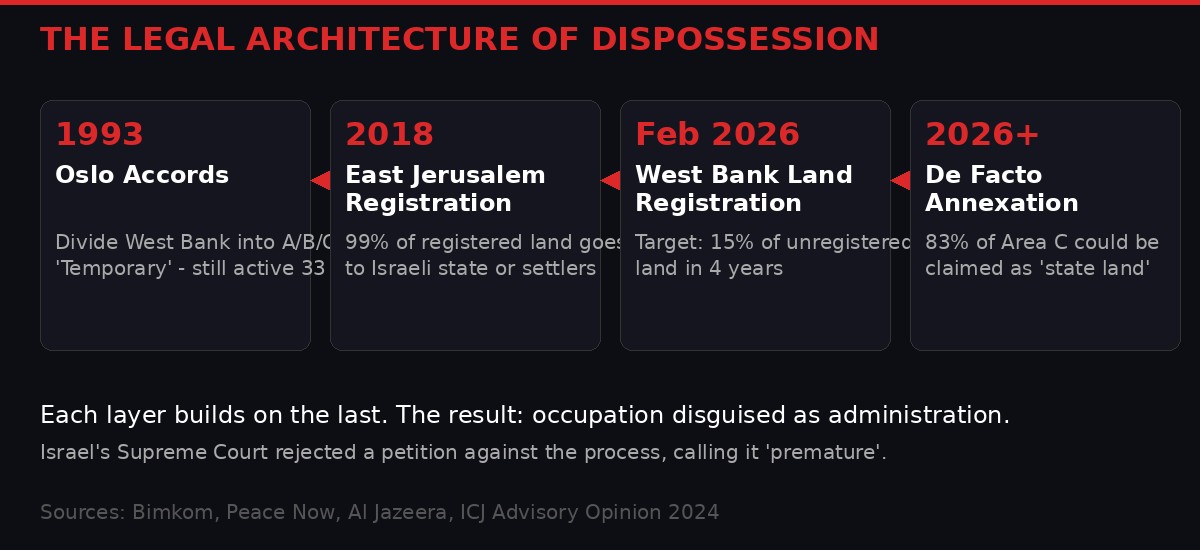
From temporary accords to permanent seizure: each legal layer builds on the last.
What makes the current moment different from previous waves of confiscation is the degree to which Israel has systematized the process. This is not ad hoc land theft by rogue settlers - although that continues. It is a coordinated legal and bureaucratic project designed to make Palestinian dispossession permanent and irreversible.
Consider the layers. The Oslo Accords of 1993 divided the West Bank into three zones: Area A (18%, nominally under full Palestinian control), Area B (22%, joint control), and Area C (60%, full Israeli military control). This framework was supposed to be temporary - a five-year interim arrangement leading to final status negotiations that would establish a Palestinian state.
Thirty-three years later, the "interim" arrangement remains in place, and Israel has used every year of it to deepen control. Area C - where the most fertile agricultural land, the largest water resources, and the most strategic territory are located - has become a zone of effective Israeli sovereignty in everything but name.
The new land registration process adds another layer. By requiring documents that most Palestinians cannot produce - Ottoman-era title deeds, British Mandate certificates, Jordanian administration records - Israel has created a system in which the absence of paperwork becomes proof of non-ownership. Land that families have worked for generations, land where the olive trees are older than the Israeli state, can be claimed as "state land" because no one alive has a 100-year-old certificate with their name on it.
The government allocated specific funding for this process under the 2026 budgetary law. A dedicated administrative unit was established. The stated objective is to settle 15% of unregistered West Bank land within four years. Given that 70% of the West Bank is unregistered, and the East Jerusalem precedent saw 99% of registered land end up in Israeli or state hands, the trajectory is clear.
Peace Now called it "a mega land grab." Bimkom called it "systematised dispossession." The Palestinian Authority called it "de facto annexation." Xavier Abu Eid called it "annexation packed into a bureaucratic move."
They are all describing the same thing: the transformation of occupation into ownership through the machinery of law.
What Land Day Means Now
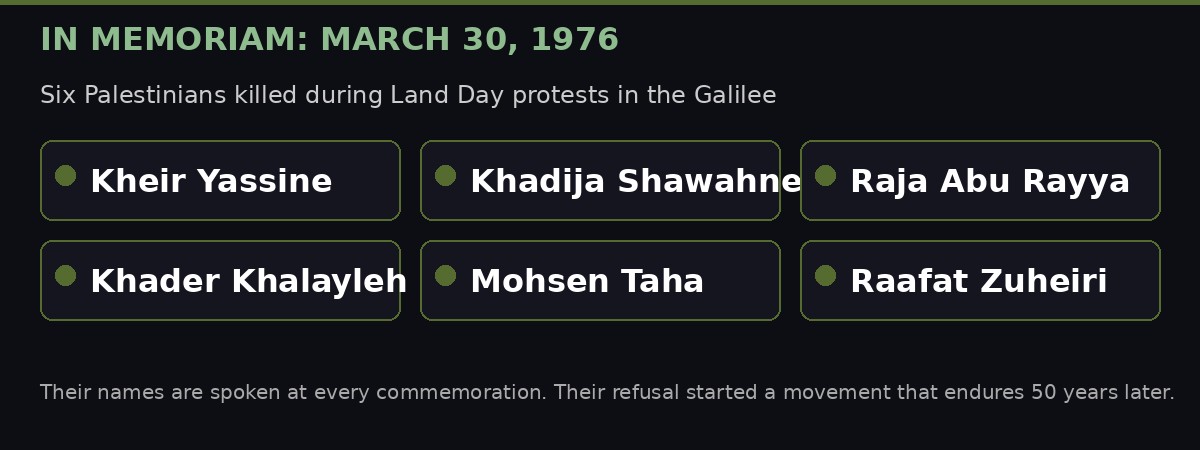
Six names. Fifty years. The refusal they embodied on March 30, 1976 became a movement that outlasted them all.
In 1976, Land Day was born from a single act of collective refusal. The Israeli government announced confiscation. Palestinians said no. The cost was six lives, hundreds of injuries, mass arrests. But the refusal was recorded. It entered the calendar. It became a date that every Palestinian child learns.
Fifty years later, the nature of the struggle has changed. The confiscation is no longer announced in a single dramatic decree. It arrives in military orders, in bulldozers that appear without warning, in fences that materialize overnight, in bureaucratic processes that require documents nobody has. It is slower and faster at the same time - slower in its day-to-day visibility, faster in its cumulative effect.
The six people killed in 1976 - Kheir Yassine, Khadija Shawahneh, Raja Abu Rayya, Khader Khalayleh, Mohsen Taha, and Raafat Zuheiri - are remembered every March 30. Their names are spoken at commemorations. Their sacrifice is invoked as evidence that the connection between Palestinians and their land is not negotiable.
But on this 50th anniversary, the question that hangs over every commemoration is whether remembrance alone is sufficient. The land is disappearing faster than memory can hold it. The olive trees are coming down. The Bedouin communities are scattering. The legal architecture being constructed is designed to make all of this permanent.
Abdul Rahman Azzam wept as he cut his own trees. Qusay Abu Naim, at 23, already speaks of his community in the past tense. Mohammed Fouad watches from a distance as bulldozers reshape land his family has farmed for decades. These are not abstractions. These are people making impossible calculations in real time - how to maintain dignity in the face of dispossession, how to resist when the tools of resistance have been systematically removed, how to keep saying "the land will return" when every day there is less of it to return to.
The 50th anniversary of Land Day falls on a Monday in 2026. It is a workday. In the villages south of Jenin and east of Ramallah, in the Jordan Valley and the hills around Bethlehem, Palestinian farmers will mark it the way they have marked the last 49 - by going to their land, or to the fences around where their land used to be, and refusing to forget.
What they will find when they get there - whether the bulldozers have come, whether new fences have appeared, whether the olive trees are still standing - depends on a machinery of state they have no power over and a world that issues condemnations but takes no action.
Fifty years. Six dead in the Galilee. 55,000 dunams seized. 4,765 displaced. One percent of East Jerusalem land registered to its inhabitants.
And a 65-year-old man, weeping as he saws through the trunk of an olive tree he planted when he was young enough to believe it would stand forever.
Get BLACKWIRE reports first.
Breaking news, investigations, and analysis - straight to your phone.
Join @blackwirenews on Telegram