Courtside With Criminals: The Bank Burglar, El Chapo, and the Man in Drake's Music Video
Hamdi Lataj left Kosovo in the 1980s, built a criminal record in New York, and turned up in Toronto living in a penthouse, sitting courtside at NBA finals, and laughing with Drake. What connects this man to the Sinaloa cartel, the 'Ndrangheta mafia, and the Hells Angels - and how does someone with "unknown" income fund that kind of life?

Toronto, Canada: a city where organized crime networks have quietly embedded themselves in luxury real estate, sports arenas, and entertainment culture. (BLACKWIRE/Generated)
The video has almost ten million views. In it, Drake - one of the world's most famous musicians - sits in a dimly lit gambling den, playing cards and shooting pool with a group of men wearing red leather jackets blazoned with the Albanian double-headed eagle. To his right, laughing easily, is Hamdi Lataj.
At 62, Lataj has the kind of life that looks effortless from the outside. He lists his address as a penthouse in one of Toronto's most exclusive downtown towers. He sits courtside at Toronto Raptors games. He poses beside a Range Rover and a $400,000 Porsche GT2RS. He has donated more than 200,000 euros to community facilities in his native Kosovo.
He also has no visible profession. In Canadian police files, his occupation is listed simply as "unknown."
A joint investigation by the Organized Crime and Corruption Reporting Project (OCCRP) and the University of Toronto's Investigative Journalism Bureau (IJB), published March 25, 2026, draws on US federal court records, RCMP documents, and Ontario Provincial Police files to lay out what investigators have long known about Lataj - and what the public has never been told.
The picture that emerges is one of a man who crossed borders illegally, built a criminal record across two countries, surfaced repeatedly in police files connecting him to the world's most dangerous drug networks, and ultimately landed in Canada without apparent difficulty - living better than most people who work legal jobs for forty years.
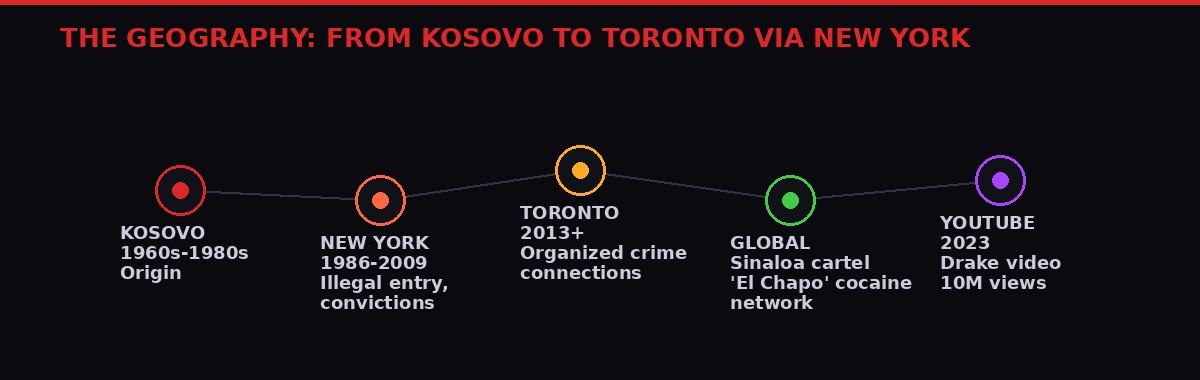
The trail from Kosovo to New York to Toronto - each stop adding another layer to an obscure but documented criminal biography. (BLACKWIRE/CIPHER)
The Brooklyn Job
Hamdi Lataj left Kosovo sometime in the 1980s, crossing into the United States illegally in 1986. He applied for asylum in 1987 and was rejected. Deportation proceedings began, but Lataj was granted voluntary departure rather than forced removal - a detail that would prove significant, because he never actually left.
He stayed. He appealed. He built a life in the New York area, moving through communities of Albanian and Yugoslav emigres who, according to federal prosecutors, had found a particular niche in commercial burglary.
In 2001, Lataj was arrested following a bank burglary attempt in Brooklyn. Federal court documents describe a gang that had "engaged in and planned several commercial and bank burglaries in the New York area." The target was a Brooklyn bank. The method was blunt: breach the roof with cutting tools and get in from above. Police found the breach. They found Lataj in his Cadillac, attempting to flee.
He was convicted of conspiracy to commit bank burglary and sentenced to two years in federal prison. He was released in March 2003. The US government ordered his deportation to Kosovo.
That deportation was formally ordered in 2009. Lataj had managed to extend the process for six years through appeals, at one point arguing to immigration authorities that returning to Kosovo would endanger him - his family, he claimed, was involved in a blood feud. Whether that claim was accurate or strategic is unclear. What is clear is that Lataj did not, in any meaningful sense, return to Kosovo. At some point he arrived in Canada, where he has lived ever since.
How Lataj arrived in Canada, and under what legal status, is one of many questions the investigation raises without being able to fully answer. What police records and court filings do establish is that, by 2013, Lataj was already on the radar of Canadian law enforcement - for reasons far more serious than a single bank burglary.
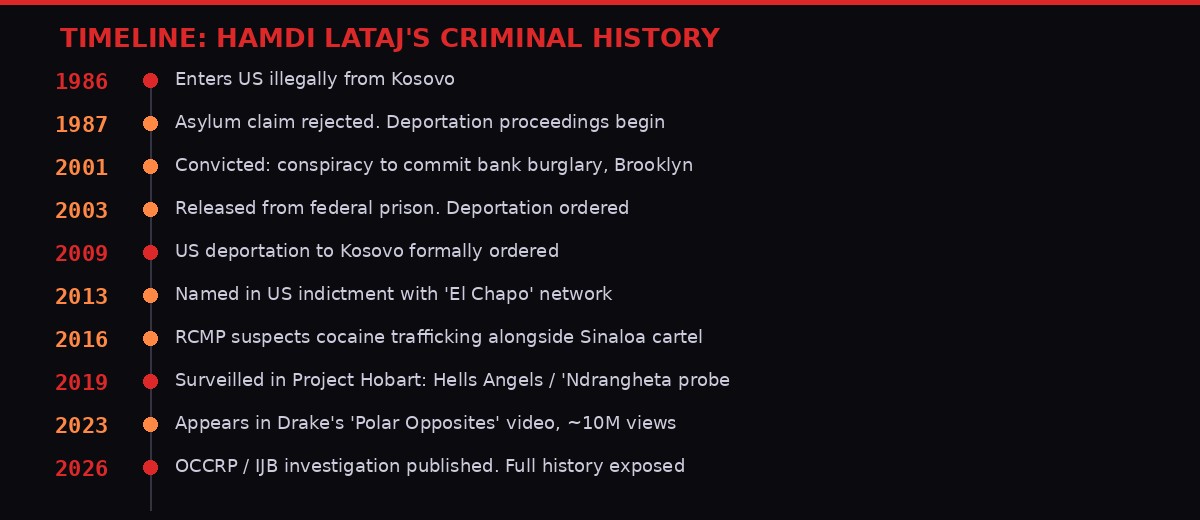
A decade-by-decade record: from illegal entry and asylum rejection to federal conviction, Sinaloa cartel suspicion, and multiple organized crime probes. (BLACKWIRE/CIPHER)
The El Chapo Connection
In 2013, a US federal indictment from the Eastern District of New York named Hamdi Lataj alongside a figure called Arif Kurti - known to law enforcement as "the Bear." Kurti was identified by US authorities as an alleged leader of a drugs and money-laundering operation out of New York. He was eventually convicted of drug trafficking in 2014.
Lataj was never brought to trial in that case. His name was redacted from the current public version of the indictment. Reporters at OCCRP and IJB noted, however, that a poor redaction effort in an earlier version of the document made his name briefly visible before the error was corrected. Officials at the Eastern District of New York declined to explain why Lataj was redacted or whether charges were ever filed against him specifically.
That same year, 2013, Canadian police were building a separate file on Lataj in Toronto. A 2016 RCMP document - obtained by OCCRP and the IJB - records a police officer swearing on "reasonable grounds" that Lataj had committed the "indictable offence of Trafficking a substance included in Schedule I of the Controlled Drugs and Substances Act, to wit: cocaine."
The name listed alongside Lataj's in that document: Joaquin "El Chapo" Guzman.
"In this case, the officer is swearing that he had reasonable grounds to believe that individuals including Joaquin 'El Chapo' Guzmán Loera, Hamdi Lataj and others committed offences related to cocaine trafficking and participation in a criminal organization." - Calvin Chrustie, retired RCMP senior operations officer, now at Critical Risk Team advisory firm
Chrustie, speaking to the IJB, was careful to note that "reasonable grounds to believe" is a legal threshold that sits above suspicion but below proof beyond a reasonable doubt. Court endorsements on the form indicate some of the charges were later withdrawn. The case formally targeted a co-conspirator, Stephen Tello - a Toronto real estate broker who was eventually sentenced to prison in Canada on drug offences connected to the Sinaloa cartel.
Tello's ties to El Chapo were independently corroborated by Alex Cifuentes-Villa, Guzman's longtime righthand man, who testified in US proceedings that Tello had at one point been the Sinaloa cartel's principal "worker" in Canada. The charges against Tello in the specific case that included Lataj's name were ultimately withdrawn. Tello was convicted in a separate case.
Neither Lataj nor Guzman appear to have been charged in the Canadian cocaine trafficking case. Guzman is currently serving a life sentence in a US federal prison.
The RCMP document also describes how cocaine was allegedly being moved from Colombia into Canada using coal boats - a logistics chain that, according to the file, involved Tello, Guzman, and Lataj, among others.
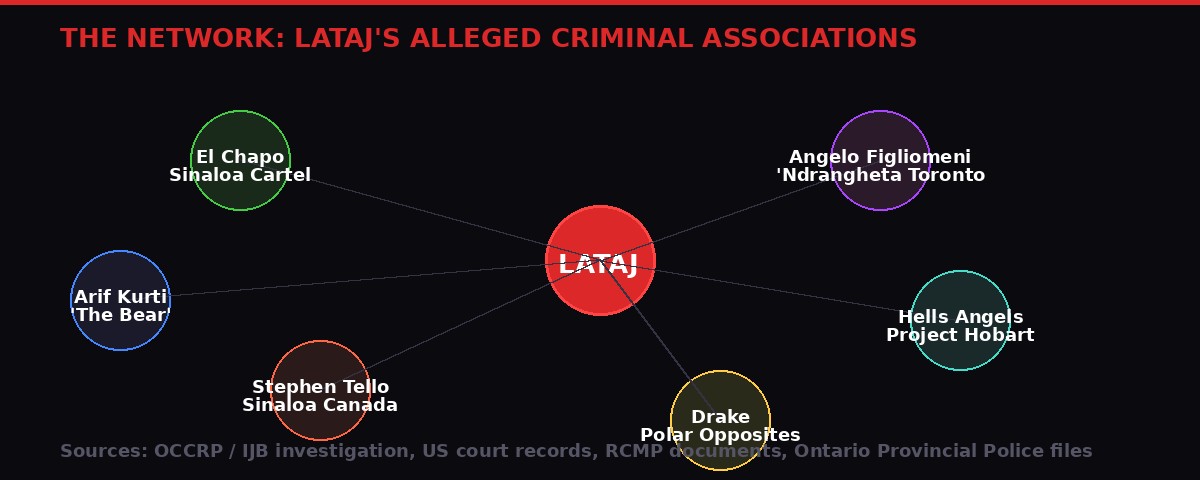
The alleged web: from a Brooklyn bank burglary to the Sinaloa cartel's Canadian operations to Toronto's 'Ndrangheta network. Each connection is documented in police files or court records. (BLACKWIRE/CIPHER)
Project Hobart: Where the Hells Angels Meet the 'Ndrangheta
If the Sinaloa cartel connection might be explained away as a single police document that led nowhere, what followed six years later is harder to dismiss.
In August 2019, Ontario police were deep into a sprawling investigation called Project Hobart. The probe targeted an alleged illegal gambling and money laundering ring that investigators believed was controlled by members of the Hells Angels biker gang. The ring operated through online sports betting platforms, illicit gaming parlors, and a network of money moving operations that moved cash through multiple layers.
Court documents from the case - specifically an application for discovery by the defendants - show that a judge granted police permission to surveil Hamdi Lataj's car and cellphone. His name appears on the court-approved list of "principal known persons" in the investigation.
The same list included Angelo Figliomeni.
Figliomeni is not a minor figure. OCCRP has previously investigated Figliomeni and reported that Canadian and Italian police suspected him of being the boss of the Toronto faction of 'Ndrangheta - Italy's most powerful and ruthless organized crime syndicate, a criminal organization that has grown from Calabrian roots to operate across four continents, laundering billions through legitimate businesses and maintaining strict codes of silence that have made it notoriously difficult to prosecute.
That Lataj and Figliomeni appear on the same judicial surveillance authorization in the same organized crime investigation is not, by itself, proof of a working relationship. Police surveillance lists are broad by design, and being surveilled is not being charged. Neither Lataj nor Figliomeni was ever listed as charged in the Hobart case. A lawyer for Figliomeni did not respond to requests for comment. Ontario Provincial Police declined to answer specific questions about Lataj's involvement.
But the cumulative picture is striking. A man with no known income, no visible profession, and no Canadian criminal record has managed to appear in court-authorized surveillance lists connecting him to the Hells Angels, the 'Ndrangheta, the Sinaloa cartel, and an Albanian drug and money laundering network - across multiple law enforcement jurisdictions, over more than a decade.
"Whether Drake...was aware of Lataj's criminal history or not, hanging out in a video with someone who had been alleged to be a real-life gangster could allow him 'to achieve some sort of cred.'" - Alan Cross, music historian and podcaster, commenting to IJB
Living Large on Unknown Income
The question that runs through every page of the OCCRP-IJB investigation is a simple one: where does the money come from?
Corporate registration documents show Lataj's company address at a penthouse unit in a downtown Toronto tower where monthly rents were listed at more than CAD $11,000 - roughly $8,000 US - in 2025. He appears in photographs sitting in front-row seats at Toronto Raptors games, including courtside shots from the 2019 Eastern Conference championship run. Courtside tickets at an NBA playoff game sell for thousands of dollars. Front row in a conference final can reach tens of thousands.
Lataj's social media shows him posing next to a Range Rover and a Porsche GT2RS worth over $400,000. It is not confirmed he owns the vehicles, but they appear in posts associated with his account alongside license plates that match those recorded in the Project Hobart case files.
He has also donated substantially to Kosovo. Social media posts and local news clippings from his home region document at least 200,000 euros in charitable donations to community facilities. That is a significant sum by any measure, and by the standards of Kosovo - one of Europe's poorest countries - it is a gesture that carries weight and visibility back home.
What OCCRP and IJB could find by way of legitimate income: two companies registered in Lataj's name, both reporting very little activity. One invested in a junior mining company. Neither generates any significant documented revenue.
In Canadian police files, the field for occupation reads: "unknown."
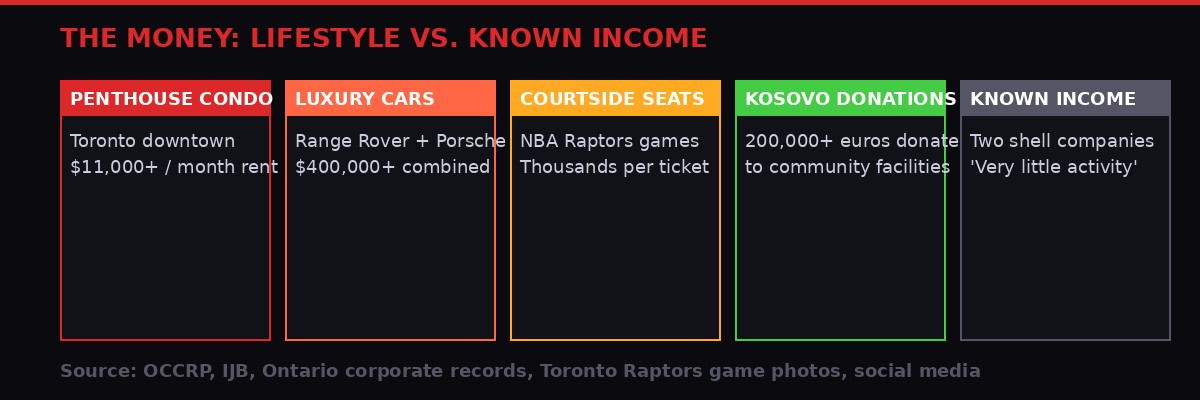
A luxury lifestyle on paper, zero visible income on record. The gap between what Lataj spends and what investigators can document as earned is the central unanswered question. (BLACKWIRE/CIPHER)
The investigation was careful not to allege that Lataj is currently engaged in any criminal activity. His criminal conviction in the US is documented fact. His appearances in police files are documented fact. The conclusions about what those files mean, and whether they tell the complete story of how he funds his life in Toronto, are what investigators have not been able to close.
That gap - between documented history and provable present - is precisely the space in which organized crime operates most effectively in major Western cities.
The Drake Video and What Celebrity Access Does for Criminal Networks
In 2023, Drake released a music video for the song "Polar Opposites." The visual concept was deliberate and atmospheric: dark gambling dens, pool tables, men in Albanian-flag-emblazoned jackets, a studied air of authenticity that played directly into the public beef Drake was engaged in with rapper Kendrick Lamar over questions of street credibility.
Lamar had famously derided Drake in the track "Euphoria" as "a scam artist with the hopes of being accepted," pointedly referencing his privileged upbringing and career as a child actor on the Canadian teen drama Degrassi. The Polar Opposites video appeared to be a response - a visual argument for realness, shot in what looked like an underground world Drake rarely inhabits.
In that gambling den, laughing and chatting with Drake, was Hamdi Lataj. The Albanian-language media outlet Ballkani identified him the day the video dropped, describing him simply as Drake's "friend." A Kosovar community Facebook group celebrated the appearance, writing that Lataj had "made us proud."
Drake has not responded to questions. His publicists did not respond to multiple follow-up requests. His lawyers did not answer emails or phone messages. Whether Drake knew anything about Lataj's history before filming the video together is unknown.
But the celebrity dimension of this story matters beyond entertainment gossip. Appearances in music videos watched by ten million people, courtside seats at championship games, philanthropic donations that generate local news coverage - these are not incidental. They are, in the language of money laundering investigations, reputation laundering.
The mechanism is straightforward: proximity to legitimate celebrity and respected public figures creates a social patina that makes it harder to ask uncomfortable questions. When a man is photographed laughing with Drake and standing beside an NBA star, the default assumption changes. He becomes Drake's friend. He becomes a generous benefactor of his home community. The criminal history in US federal records and Canadian police files becomes an uncomfortable asterisk rather than the lead paragraph.
"He's not from the inner city of America, he's something completely different. He's a child actor turned hip hop star." - Alan Cross, on Drake's vulnerability to credibility attacks, speaking to IJB
Cross, the music historian, noted that associating with someone who has alleged real underworld connections could serve Drake's image in specific ways, regardless of whether Drake knew anything. The rap world rewards authenticity, and the Polar Opposites video was built entirely around projecting it.
Whether that calculation was made deliberately, naively, or somewhere in between, the practical result is the same: a man who has appeared in US drug indictments and Canadian organized crime surveillance authorizations now has a clip on his social media standing next to one of the world's most famous musicians, viewed nearly ten million times.
Canada's Organized Crime Gap - How Networks Survive Scrutiny
The Lataj story is, in one sense, personal. It follows one man's documented trajectory through multiple criminal networks across two countries over thirty years. But it is also a case study in something structural: the specific vulnerabilities that allow organized crime figures to establish themselves in major Canadian cities and, once established, to persist despite recurring law enforcement attention.
Canada has long been a destination of choice for organized crime networks from multiple regions. The country's large Albanian, Italian, and Caribbean immigrant communities - most of them entirely law-abiding - have been exploited as cover by criminal organizations that move through diaspora social structures. The 'Ndrangheta's Toronto presence, which OCCRP has previously investigated at length, is one of the most extensively documented examples of this pattern. Italian investigators have described the Toronto cell as one of the most significant 'Ndrangheta operations outside Italy.
Project Hobart itself illustrates the limitations of the Canadian prosecution model. The investigation was substantial - police seized guns, gold, cash, vehicles, and homes. But the case ultimately "fizzled in court," as London Free Press reported in an extended analysis of the probe. Complex organized crime cases require sustained institutional commitment, and Canadian prosecutors have struggled to bring the same kinds of conspiracy and organized crime charges that US federal prosecutors routinely deploy.
The result is a pattern critics have described as "surveillance without consequence" - law enforcement can identify and document criminal networks but cannot translate that documentation into convictions. Names like Lataj appear in court-authorized surveillance lists, their phones tapped, their vehicles tracked - and then the case ends, charges are withdrawn, and the names disappear back into the city's texture of luxury condos and NBA courtside seats.
The Albanian criminal networks present a related but distinct challenge. Unlike the 'Ndrangheta, which has centuries-old institutional structures, Albanian criminal organizations emerged rapidly in the post-communist chaos of the 1990s, establishing themselves in Western drug markets with particular efficiency. They operate through flexible, horizontal structures that are difficult for intelligence agencies to penetrate through traditional informant methods. The combination of diaspora social networks, clan loyalty, and aggressive operational security has made Albanian criminal groups one of the priority targets for law enforcement across the EU and North America.
Where Lataj fits within these networks - whether as a peripheral figure who happened to cross paths repeatedly with criminal enterprises, or as a more central operator - is not something the OCCRP-IJB investigation was able to definitively establish. What the investigation documented is a series of connections that, taken together, describe something more than coincidence.
The Questions That Remain Open
The OCCRP and IJB investigation was meticulous in what it claimed and what it left open. The reporters did not allege that Lataj is currently committing crimes. They did not claim that Drake knowingly associated with a criminal. They noted that Lataj has no criminal record in Canada, and that the cases in which his name appeared either ended without charges against him or were ultimately withdrawn.
What they documented is a trail that raises questions that Canadian authorities have, to date, left unanswered.
How did a man with a US federal conviction and a US deportation order end up living in a downtown Toronto penthouse? Canadian immigration records are not public. The Department of Immigration did not respond to the investigation's questions.
What is the source of income that supports a lifestyle costing tens of thousands of dollars a month in documented expenses? Two companies with "very little activity" cannot account for it. No other income source has been identified.
Why was Lataj's name redacted from the US federal indictment that named him alongside convicted drug trafficker Arif Kurti? The Eastern District of New York declined to comment.
Why was the connection between Lataj, El Chapo's Canadian network, and the Sinaloa cocaine route into Canada not prosecuted? The RCMP said the historical nature of the case file prevented them from assisting reporters.
These are not rhetorical questions. They are specific gaps in the public record that, in a functioning accountability system, would have answers somewhere in some government file. The OCCRP-IJB investigation found the questions but could not locate the answers - not because they don't exist, but because the institutions that hold them declined to provide them.
That silence is itself part of the story.
"That legal threshold, 'reasonable grounds to believe,' sits above suspicion but below proof beyond a reasonable doubt. The document records sworn allegations used to initiate the criminal process, and court endorsements on the form indicate that some of the charges were later withdrawn." - Calvin Chrustie, retired RCMP senior operations officer
Lataj himself did not respond to messages, phone calls, or hand-delivered letters from the investigation team. His silence is legally his right. But combined with the silence of the institutions that should be able to provide context and accountability, it creates a picture of a man who has navigated the spaces between jurisdictions and between what police can document and what prosecutors can prove - and who has done so with considerable success.
He sits courtside at the NBA. He donates to Kosovo. He appears in music videos watched by millions. His occupation remains, in the official record, unknown.
Background: How Reputation Laundering Works in Plain Sight
There is a term that money laundering investigators use for a related but distinct phenomenon: "reputational capital." The concept is simple. Legitimate wealth and social status function as a kind of insulation. They change the questions people ask. They change what doors open. They change how law enforcement and prosecutors approach a target.
Organized crime figures in major Western cities have understood this for decades. The 'Ndrangheta has systematically invested in legitimate businesses - construction, agriculture, restaurants, transportation - not just to generate clean revenue but to build social networks that include politicians, lawyers, and prominent businesspeople. The Sinaloa cartel spent years cultivating relationships with Mexican political figures. Al Capone threw lavish parties for Chicago's social elite.
The specific innovation of the 21st century is celebrity culture. Social media, music videos, sports arenas - these are platforms where proximity generates hundreds of millions of impressions at virtually no cost. A thirty-second appearance in a Drake video reaches more people than any press release, any philanthropy, any society dinner. The Albanian flag jackets, the gambling den aesthetic, the casual laughter with one of the world's most famous musicians - these images overwrite everything else.
Whether Lataj consciously pursued this kind of visibility, or whether it came to him through genuinely shared interests in basketball and music, is something only he knows. Drake's involvement appears, on the available evidence, to have been inadvertent - a production team that cast an atmospheric video without fully investigating who they were filming.
But inadvertent or not, the outcome is the same. A man with a documented criminal history in the United States, a file that crosses El Chapo's network, the Hells Angels, and the 'Ndrangheta, with no identifiable income source, now has a public profile that includes charitable work, celebrity associations, and the kind of lifestyle that makes hard questions feel impolite.
This is how it works. Not in dark rooms with unmarked bags. In NBA arenas. On YouTube. In penthouse towers with legitimate lease agreements and companies with very little activity.
The OCCRP and IJB investigation has done the work of connecting the dots. What happens next depends on whether the institutions that received the same questions - RCMP, Ontario Provincial Police, Canadian immigration authorities, the Eastern District of New York - decide the questions deserve answers.
So far, they have not.
Get BLACKWIRE reports first.
Breaking news, investigations, and analysis - straight to your phone.
Join @blackwirenews on Telegram