Lebanon Expels Iran's Ambassador: The Patron That Became a Curse
Beirut has ordered Tehran's top diplomat out of the country by Sunday. Over 1,000 Lebanese are dead. A million more are displaced. For four weeks, Iran's proxy war has consumed Lebanon from the inside out - and now the Lebanese state has had enough.

Strikes on Beirut's southern suburbs have accelerated over the past week. Source: Unsplash
Lebanon declared Iran's ambassador persona non grata on Tuesday and ordered him to leave the country by Sunday - a diplomatic rupture that would have been unimaginable one month ago.
For more than four decades, Iran was Lebanon's most powerful patron, the force that built, funded, and armed Hezbollah, the militant group that grew into a state-within-a-state controlling swaths of Lebanese territory, politics, and social life. That relationship has now cracked under the weight of a war Tehran helped ignite and cannot contain.
The expulsion came as Israeli strikes on Beirut's southern suburbs killed at least eight people Tuesday - including a 3-year-old girl in a residential apartment southeast of the capital - and as Iran's own missiles and drones continued to target Israel and Gulf states in the same 24-hour cycle. (AP News, March 24, 2026)
Lebanon also announced it had banned Iranian flights from landing in Beirut, citing fears they could carry weapons or funding for Hezbollah. Senior Lebanese officials have gone further, publicly accusing Iran of dragging Lebanon into a war Beirut never authorized and could not stop.
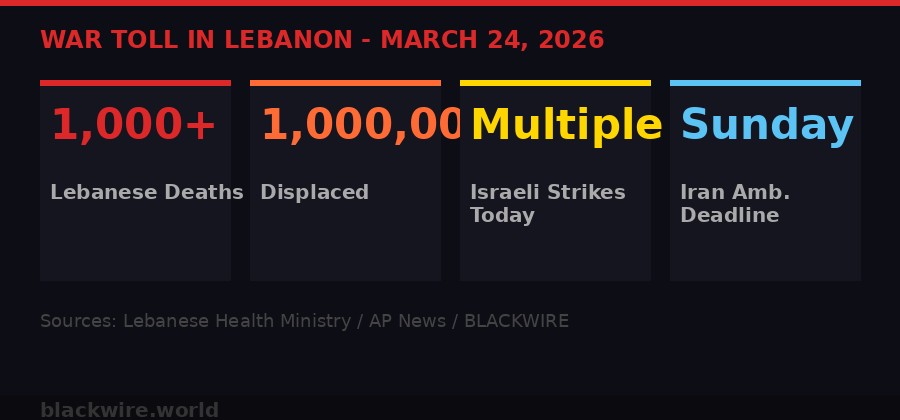
The human cost: Lebanon's toll in Week 4 of the Iran-Israel-US war. Data: Lebanese Health Ministry / AP.
Four Decades of Dependency - Ending in Rubble
The Islamic Republic founded Hezbollah in 1982, during Israel's first major invasion of Lebanon. Iran's Revolutionary Guards trained fighters in the Bekaa Valley, provided weapons, money, and ideology, and helped build what would become one of the most powerful non-state military forces in the world.
That investment paid off in influence. For decades, Hezbollah gave Iran a forward military position on Israel's northern border, a mechanism to project power into the Levant, and leverage over Lebanese politics that no other outside actor could match. Iran did not occupy Lebanon. It did something more durable: it built an army that operated within it.
The arrangement worked, in Tehran's terms, because Lebanon was too fractured to push back. A confessional political system that dates to the French Mandate era split power between religious communities, leaving no faction strong enough to confront Hezbollah's weapons directly. The Lebanese state governed around the group rather than over it.
That fragile accommodation held through multiple crises - the 2006 war with Israel, the Syrian civil war, the assassination of prime ministers, the 2020 Beirut port explosion that killed over 200 people and devastated the capital. Each time, Hezbollah survived. Each time, Iranian influence deepened. (Reuters, historical record)
Then February 28, 2026 arrived. US and Israeli forces struck Iran directly, hitting nuclear and military sites in what the Trump administration framed as a preventive strike against Iranian weapons of mass destruction. The war was between Tehran and Tel Aviv, between Iranian missiles and American carrier groups. Lebanon, officially, had nothing to do with it.
Hezbollah had other plans.
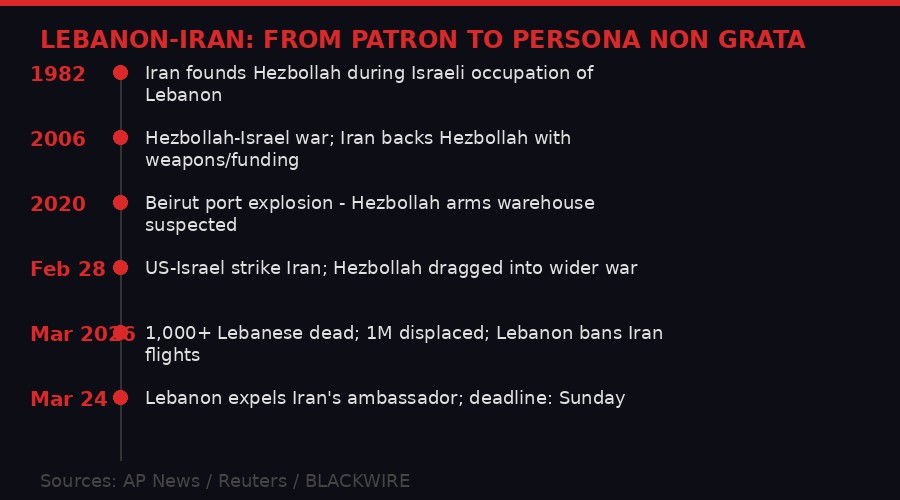
Four decades of dependency - from founding Hezbollah in 1982 to expelling Iran's ambassador in 2026.
How Lebanon Got Dragged In
Hezbollah opened a second front against Israel within days of the war's start, firing rockets and anti-tank missiles into northern Israel as it had in conflicts past. The group calculated that Iran's direct confrontation with Israel created an opening - or an obligation - to fight.
Israel's response was not surgical. Air strikes on Beirut's southern suburbs, Hezbollah's stronghold and effectively a densely populated civilian area, began within the first week and have not stopped. The Lebanese Health Ministry's death toll passed 1,000 people on Tuesday. The displacement figure has reached over one million - roughly one-fifth of Lebanon's entire population. (AP News, Lebanese Health Ministry, March 24, 2026)
Five people were killed in southern Lebanon Tuesday alone. A strike on a residential apartment block southeast of Beirut killed three, including the 3-year-old. Israel said it was targeting infrastructure used by Hezbollah. Lebanon said it was killing civilians.
For Lebanese officials who had spent years carefully managing coexistence with Hezbollah while publicly distancing themselves from its military activities, the war stripped away all pretense. The Lebanese government could not control Hezbollah. It could not stop the strikes. It could not protect its people. And it could not pretend Iran was a neutral party.
"Iran has been dragging Lebanon into another war with Israel." - Senior Lebanese government officials, quoted by AP News, March 24, 2026
The flight ban came first. Authorities grounded Iranian aircraft from landing in Beirut, citing weapons smuggling concerns. The ambassador expulsion followed Tuesday, with a Sunday deadline to leave. Lebanon also warned Iran that any future interference in Lebanese territory would be treated as a hostile act by a foreign power.
It is a statement that, six weeks ago, no Lebanese politician would have survived making.
The Cascade: Lebanon is Not Alone
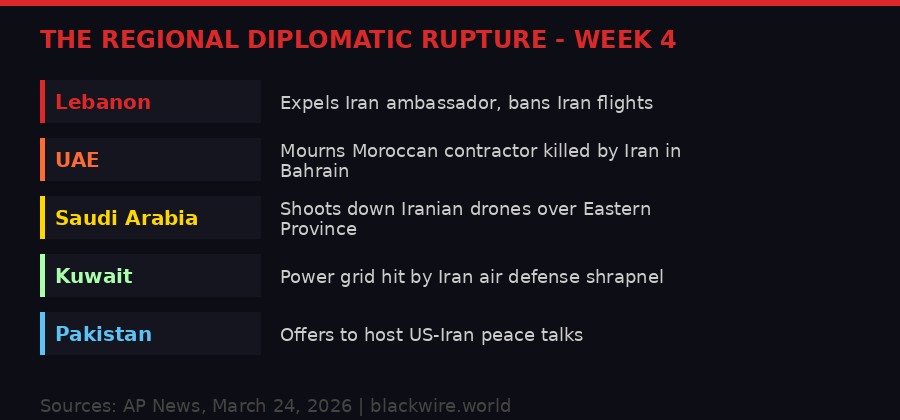
How Iran's war has fractured its relationships across the region. Data: AP News / Reuters, March 24, 2026.
Lebanon's expulsion of Iran's ambassador is the sharpest rupture in Iranian regional relationships since the war began, but it is not the only one.
Tuesday alone produced a cascade of incidents illustrating how Iran's military campaign is isolating Tehran even from countries and communities it once considered allies or sympathizers.
In Bahrain, a Moroccan civilian contractor working with the United Arab Emirates' armed forces was killed in an Iranian attack. The UAE Defense Ministry confirmed the death and condemned the strike. Bahrain, home to the US Navy's Fifth Fleet and a country that has hosted American forces for decades, has become a repeated target. (AP News, March 24, 2026)
In Kuwait, power lines were struck by debris from air defense systems responding to Iranian drones, causing partial electricity outages across several areas for hours. No group claimed the debris as a weapon, but the disruption was direct and visible.
Saudi Arabia said it shot down Iranian drones targeting its Eastern Province - the heartland of Saudi oil production, home to Aramco's main facilities and millions of people. The Eastern Province has been a target throughout the war. Saudi Arabia has shot down previous attempts. Each interception carries a cost in interceptor missiles, radar wear, and population anxiety. (AP News, March 24, 2026)
The pattern is consistent: Iran claims it is fighting Israel and American imperialism. Its weapons land in Lebanon, Bahrain, Kuwait, Saudi Arabia. The people dying and the lights going out are not Israeli or American. They are Lebanese, Moroccan contractors in the Gulf, Kuwaiti civilians, Saudi oil workers.
Iran's argument that it represents a resistance axis defending the region's peoples is harder to maintain when the region's governments are expelling its diplomats and shooting down its drones.
Trump's Claim, Iran's Denial, and the Diplomacy Running in Parallel
Amid the continued strikes on all sides Tuesday, an unusual diplomatic signal emerged - and immediately fractured into competing narratives.
President Trump claimed over the weekend that the United States and Iran had productive talks about ending the war, conducted through his envoys Jared Kushner and Steve Witkoff with unnamed Iranian officials. He cited those talks as the reason he delayed his threatened strike on Iranian power plants, which he had promised within 48 hours if Tehran did not reopen the Strait of Hormuz.
Iran denied any such talks took place.
"No negotiations have been held with the US. Fakenews is used to manipulate the financial and oil markets and escape the quagmire in which the US and Israel are trapped." - Mohammad Bagher Qalibaf, Speaker of Iran's Parliament, on X, March 23, 2026
Markets moved sharply on Trump's announcement before recovering. Brent crude fell from near $120 at its weekly peak to briefly below $96, then climbed back above $100 by Tuesday. The S&P 500 had its best single day since the war began on Monday, then gave back gains Tuesday as Iran's denial circulated. (AP News, March 24, 2026)
Pakistan's Prime Minister Shehbaz Sharif offered a different channel Tuesday: Islamabad, he wrote on X, is ready to "facilitate meaningful and conclusive talks" to end the war. Three Pakistani officials, one Egyptian official, and a Gulf diplomat confirmed to AP that the US had agreed in principle to talks in Pakistan - but that mediators were still working to bring Iran to the table. Those talks became more complicated after news of the diplomatic effort leaked publicly. (AP News, March 24, 2026)
White House press secretary Karoline Leavitt called it a "fluid situation" and warned that "speculation about meetings should not be deemed as final until they are formally announced by the White House."
The Egyptian official said the immediate priority was a mechanism to reopen the Strait of Hormuz, starting with trust-building measures - not a full peace deal. Israel is not involved in those discussions.
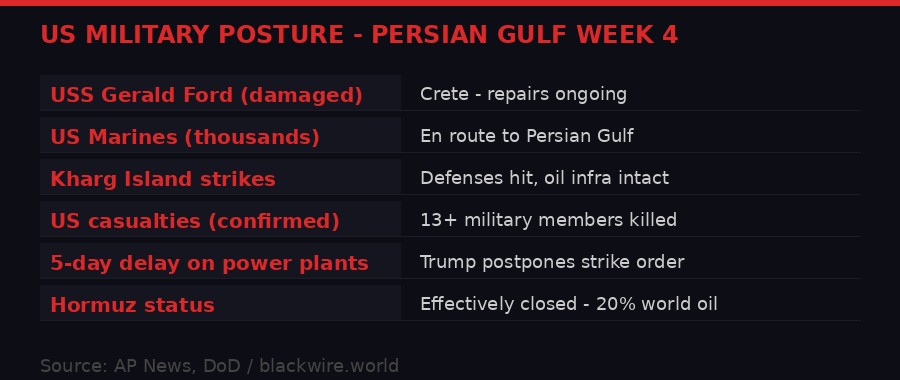
Where US forces stand as negotiations stall and Marines head toward the Gulf. Data: AP News / DoD, March 24, 2026.
Marines, Kharg Island, and the Military Clock
The diplomatic activity runs alongside a military escalation that shows no signs of pausing.
Thousands of additional US Marines are en route to the Persian Gulf. Trump confirmed the deployments without specifying their mission, but the movement has triggered widespread speculation - including from US lawmakers - that the United States may be preparing a ground operation to seize Kharg Island, Iran's primary oil export terminal.
Kharg Island handles nearly all of Iran's crude oil exports. US forces struck the island more than a week ago, destroying its air defenses, radar systems, the airport, and a hovercraft base while leaving oil infrastructure intact. Satellite imagery from TankerTrackers showed vessels still arriving and loading at Kharg after the strikes.
Senator Lindsey Graham, a close Trump ally, framed the stakes starkly.
"He who controls Kharg Island, controls the destiny of this war." - Sen. Lindsey Graham (R-SC), on X, March 2026
Petras Katinas, an energy researcher at the Royal United Services Institute, told AP that control of Kharg would give the US decisive economic leverage over Iran regardless of which political faction held power in Tehran. Iran has exported 13.7 million barrels of oil since the war started - largely to China. A seizure of Kharg would functionally bankrupt whatever government ran Iran, regardless of ideology. (AP News, March 2026)
Iran's response has been a warning: if US forces appear poised to land troops, Iran will mine the Persian Gulf. That threat would close the waterway entirely - not just slow it - and would trigger an immediate oil price shock that would make the current disruption look mild.
JPMorgan's global commodity research team warned in a March investment note that a seizure of Kharg "would immediately halt the bulk of Iran's crude exports, likely triggering severe retaliation in the Strait of Hormuz or against regional energy infrastructure." The firm put the scenario in a category of tail risks that now look considerably less tail-like than they did 30 days ago.
Trump has said he would "hold off" on a final decision about Kharg for the moment - the same phrasing he used about the power plant strikes before delaying that threat by five days. The pattern is becoming familiar: threat, delay, market move, Iran denial, repeat.
The Water Nobody Talks About
Oil prices dominate the financial news. The water crisis building across the Gulf is getting less attention and carries potentially more dangerous long-term consequences.
On Sunday, Bahrain accused Iran of damaging one of its desalination plants. Iran said a US airstrike had damaged an Iranian desalination facility. Hundreds of desalination plants operate along the Persian Gulf coast, turning seawater into the drinking water that sustains Gulf cities.
Kuwait gets approximately 90% of its drinking water from desalination. Oman gets 86%. Saudi Arabia, 70%. The UAE, which hosts millions of people in cities built on sand and salt water, is similarly dependent. These are not redundant systems with easy backups. They are the infrastructure that makes those populations possible. (AP News, March 2026)
"Everyone thinks of Saudi Arabia and their neighbors as petrostates. But I call them saltwater kingdoms. They're human-made fossil-fueled water superpowers. It's both a monumental achievement of the 20th century and a certain kind of vulnerability." - Michael Christopher Low, Director of the Middle East Center, University of Utah, AP News
On March 2, Iranian strikes on Dubai's Jebel Ali port landed within 12 miles of one of the world's largest desalination plants. Kuwait's Doha West facility sustained damage in earlier fighting. The Fujairah complex in the UAE was targeted, though its operator said it remained operational.
Iran has explicitly threatened to target Gulf energy and desalination infrastructure if the US moves against Iranian power plants. The threat is not hypothetical: it has already happened in lesser form. A sustained campaign against Gulf desalination plants would create a humanitarian emergency for tens of millions of civilians that no amount of oil revenue or military firepower could quickly resolve.
Brent crude from pre-war levels through Week 4, including Monday's brief dip on peace talk rumors. Data: AP News market coverage.
Lebanon's Reckoning - and What Comes Next
The expulsion of Iran's ambassador is both a political statement and a desperate plea. Lebanon has no military capable of stopping Israeli airstrikes. It has no political lever capable of silencing Hezbollah. It has, for the first time in decades, made an unambiguous public statement that Iran is not welcome in Lebanese territory as a co-belligerent.
Whether that statement has any practical effect is another question.
Hezbollah does not answer to the Lebanese government. Its weapons do not cross the border through Beirut's official channels - or haven't for years. An ambassador expulsion removes a diplomatic presence but does not close the weapons pipeline that runs through Hezbollah's own logistics networks, through Syria, through the porous border regions Iran's Revolutionary Guard has cultivated for 40 years.
What the expulsion does signal is a change in Lebanese political will. For years, the official position of the Lebanese state was studied ambiguity - neither endorsing Hezbollah's military activities nor confronting them. That ambiguity kept Lebanon out of formal alliance with Iran and out of direct confrontation with Israel, at least officially.
That position is gone now. Lebanon cannot claim neutrality when its cities are being bombed by Israel in response to Hezbollah operations, when Iranian-supplied rockets are being fired from Lebanese territory, and when over a million Lebanese people have fled their homes.
The Lebanese government's accusation that Iran dragged the country into the war is, in a precise sense, accurate. Hezbollah made the decision to open a second front. That decision was not made by the Lebanese state, was not authorized by the Lebanese parliament, and was not voted on by the Lebanese people. It was made by an armed group that answers primarily to Tehran.
Now Tehran's ambassador has a Sunday deadline.
Key Figures: Week 4
The End Game Nobody Has Mapped
Four weeks into a war that has killed over 2,500 people, displaced more than a million, sent oil prices surging 40%, and now prompted Lebanon to expel Iran's ambassador, the path to an exit remains genuinely unclear.
Trump's core objectives as publicly stated - degrading Iran's missile capability, destroying its defense industrial base, eliminating its navy, preventing nuclear weapons development, and reopening the Strait of Hormuz - remain largely unachieved. Analysts have noted that Trump would "strain credulity" claiming success on any of those goals at this point, particularly the nuclear question: the IAEA and US assessments estimate approximately 970 pounds of highly enriched uranium remains buried beneath rubble at damaged but not destroyed Iranian nuclear sites. (AP News, March 24, 2026)
On the Iranian side, the government that started the war is no longer the government running it. Supreme Leader Ali Khamenei was killed in the February 28 strikes. His son Mojtaba has been named successor but has not appeared publicly since reportedly being wounded in a subsequent strike. Multiple power centers within Iran's theocracy - the Revolutionary Guard, the parliament, the clerical establishment - are competing for control of a government under active military pressure. That fragmentation makes negotiations complicated in the extreme.
Iran's parliament speaker Qalibaf, who denied being Washington's negotiating partner despite reports that he was floated in that role, is a 64-year-old former Revolutionary Guard commander who spent nearly two decades building a reputation as a pragmatist the West could work with. He told The Times in 2008 that he wanted Iran to "advance issues through dialogue." In 2026, he is posting on X that Trump's talk of deals is market manipulation. Whether that is genuine belief or political positioning in a fragmented government is something even analysts close to the situation cannot definitively answer.
Pakistan, Egypt, Turkey - three countries with different interests and relationships with both Washington and Tehran - are all now in the mediation business. That coordination is unusual and potentially encouraging. It is also operating in a context where Iran is being bombed daily, Israel is invading Lebanon, and the United States is moving Marines toward Kharg Island.
Negotiations rarely succeed when the bombs are still falling. The bombs are still falling.
And in Beirut, Iran's ambassador is packing his bags.
Get BLACKWIRE reports first.
Breaking news, investigations, and analysis - straight to your phone.
Join @blackwirenews on TelegramSources
- AP News: "Airstrikes batter Iran as it attacks Israel and Gulf states, while diplomatic efforts gather pace," March 24, 2026
- AP News: "Trump says there are talks with Iran. Tehran says he's buying time," March 24, 2026
- AP News: "Iran's parliament speaker Qalibaf floated as US contact," March 24, 2026
- AP News: "Iran's Kharg Island is key to its economy and security," March 2026
- AP News: "The Gulf resource most imperiled by war may be water, not oil," March 2026
- AP News: "Stocks rally and oil sinks after Trump hints at possible end to war," March 24, 2026
- AP News Live: Iran war updates, March 24, 2026
- Lebanese Health Ministry casualty figures
- JPMorgan global commodity research note, March 2026
- Institute for the Study of War / American Enterprise Institute Critical Threats Project, satellite analysis