Second Front: Three Journalists Die on Air in Lebanon as Israel Moves to Occupy the South
A Reporter Dies Mid-Report
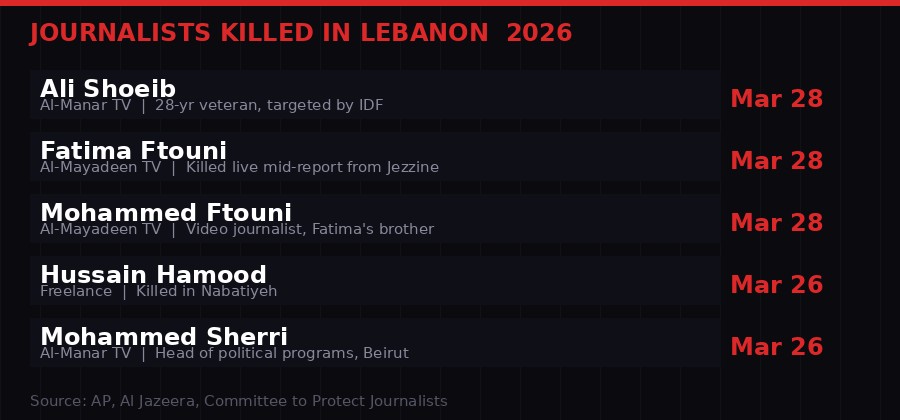
Fatima Ftouni was live on Al-Mayadeen TV when the strike hit. She had just filed a report from the Jezzine district in southern Lebanon. Seconds later, she was dead. Her brother Mohammed, a video journalist working alongside her, was killed in the same strike.
In the same operation, Israeli forces killed Ali Shoeib of Hezbollah's Al-Manar TV. Shoeib had spent 28 years covering the south of Lebanon - every war, every invasion, every occupation and withdrawal. He was one of the most recognizable faces in Lebanese war journalism.
The Israeli military said it had targeted Shoeib, accusing him of being a Hezbollah intelligence operative. No evidence was provided for that claim. The military did not mention Fatima or Mohammed Ftouni in its statement.
"A flagrant crime that violates all laws and agreements that protect journalists." - Lebanese President Joseph Aoun, responding to the killing of the three journalists, March 28, 2026 (AP)
The Committee to Protect Journalists had already recorded the killing of freelance photojournalist Hussain Hamood in Nabatiyeh on March 26. Two days before that, Mohammed Sherri - the head of political programs at Al-Manar TV - was killed in an Israeli airstrike on an apartment in central Beirut, along with his wife.
Five journalists dead in less than three weeks. The Israeli military's pattern of identifying Hezbollah-linked journalists as legitimate military targets mirrors the justifications used in Gaza, where dozens of Palestinian journalists were killed in 2023-2025 under similar accusations.
Al-Manar TV described Shoeib as "distinguished by his professional and credible reporting." They did not respond to Israeli allegations. Al-Mayadeen TV went off-air briefly following the deaths of Ftouni and her brother.
The Second Displacement
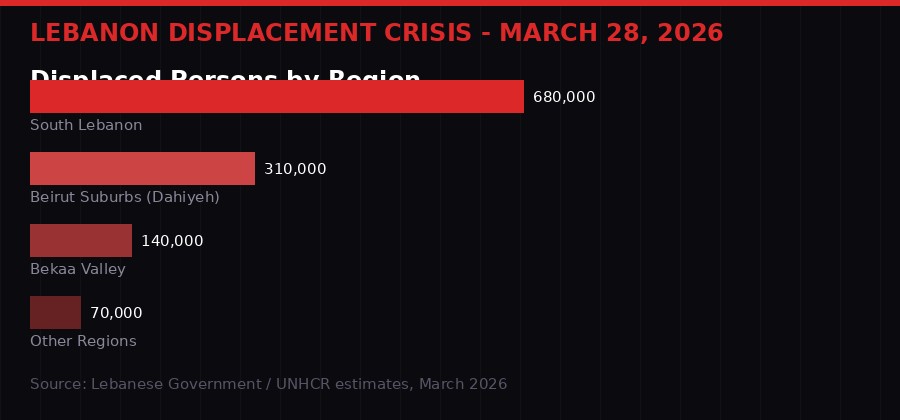
Lebanon is experiencing a displacement crisis on a scale that exceeds what happened in 2024. The Lebanese government estimates that approximately 1.2 million people have fled their homes since March 2 - the day Israel launched its current ground invasion and intensified bombing of the south.
Israel issued sweeping forced evacuation orders for southern Lebanon, Beirut's southern suburbs known as Dahiyeh, and villages in the eastern Bekaa Valley. People had hours to leave. Many had nowhere to go - about 64,000 Lebanese were still displaced from the 2024 conflict when this one began.
The single largest population exodus came from southern Lebanon. An estimated 680,000 people fled the south. Another 310,000 left Dahiyeh when Israel bombed the neighborhood and declared it a military zone. The Bekaa Valley saw roughly 140,000 more people displaced when strikes hit villages along the Syrian border.
Samiha, a Palestinian teacher who had been living near Tyre before relocating to Beirut, described the experience to Al Jazeera with tired familiarity. "It's not the first time for us. Now we know more about where to go," she said. Then added: "We don't know how long this will last and if there is a solution."
The people who knew where to go were the lucky ones. The most vulnerable - migrant workers, Syrians, the elderly, the chronically ill - had no such institutional knowledge and no support structures waiting for them. According to Rena Ayoubi, a volunteer coordinating aid near Beirut's waterfront, cancer patients on dialysis and diabetics unable to keep insulin refrigerated are among the most critical cases she encounters daily.
"Now is significantly different in the scale and speed and number of people impacted. The mass evacuation orders are new. The scale of displacement is new. The fact that civilian infrastructure was targeted is new." - Anandita Philipose, UNFPA Representative in Lebanon, Al Jazeera, March 28, 2026
The UN sexual and reproductive health agency has flagged a specific crisis within the larger catastrophe: thousands of pregnant women cut off from their healthcare providers. Midwives unreachable. Maternity wards emptied or bombed. "Pregnant women do not stop giving birth in the middle of conflict," Philipose said, stating the obvious with the weight of someone watching it go unaddressed.
The Ground Invasion and the Occupation Declaration
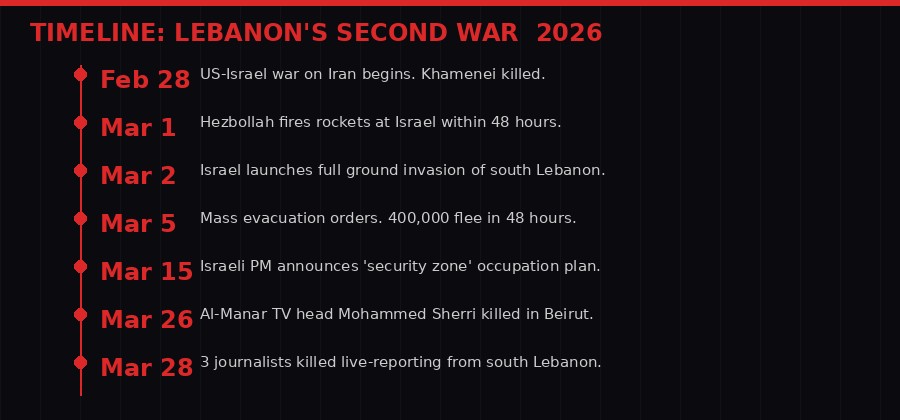
Israel's current military operation in Lebanon is its most ambitious since the 2006 war. The ground invasion began on March 2, within 48 hours of the opening US-Israeli strikes on Iran. Hezbollah fired rockets at Israel on March 1 - citing Khamenei's assassination and existing Israeli attacks in Lebanon as justification - and Israel responded with immediate ground forces.
Within days of the invasion, Israeli Prime Minister Benjamin Netanyahu declared Israel's intention to occupy a "security zone" in southern Lebanon. The territory would effectively mirror the occupation Israel maintained from 1982 to 2000 - a buffer zone intended to push Hezbollah rocket capabilities out of range of northern Israeli communities.
The difference in 2026 is the scale. Israel is destroying entire villages along the southern border, not just Hezbollah positions. The UN recorded over 10,000 Israeli violations of the November 2024 ceasefire before the current escalation began. Hundreds of Lebanese were killed in those "ceasefire" months. When Hezbollah finally fired back, Israel used it as the trigger for a full re-invasion.
The Lebanese army, historically neutral, has been sidelined. The Lebanese government has condemned the invasion and the killing of journalists. Lebanese President Aoun has appealed to international bodies. None of it has changed the operational tempo on the ground.
Beirut's southern suburbs - Dahiyeh - have been subjected to the same level of bombardment that Gaza's neighborhoods experienced in 2023. Israeli aircraft struck Hezbollah's Al-Manar TV headquarters and Al-Nour radio station in the first days of the campaign. Media infrastructure was targeted alongside military sites from the opening hours.
A Nation Seven Years into Collapse
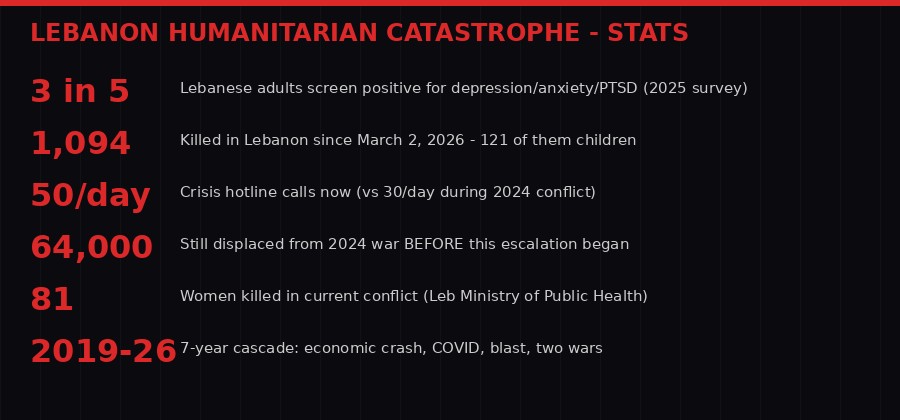
To understand what is happening in Lebanon right now, you have to understand that there is no such thing as starting fresh. This country has been in continuous, compounding crisis since 2019.
It started with economic collapse - one of the worst in the world since the 1800s by World Bank assessment. The Lebanese pound lost more than 90% of its value. Banks froze deposits. The middle class evaporated. Then came the pandemic. Then, in August 2020, the Beirut port explosion killed more than 200 people and flattened a quarter of the city.
There was no real reconstruction. No accountability. The country limped through 2021, 2022, and 2023 with a political class incapable of forming a government for two years. Then in 2024, Israel launched its first major assault on Hezbollah - displacing hundreds of thousands before a November ceasefire that held in theory but not in practice.
A March 2025 survey by Lebanon's National Mental Health Programme found that three in five people in the country screened positive for depression, anxiety, or PTSD. That was before March 2026. Before this war.
"The living conditions we're in is a continuous trauma, because it's never ending." - Jad Chamoun, Operations Manager, National Lifeline 1564 Emotional Support and Suicide Prevention Hotline, Al Jazeera, March 2026
The National Lifeline 1564 hotline, a collaboration between Lebanon's mental health programme and the nonprofit Embrace, saw call volume jump from roughly 30 per day during the 2024 conflict to nearly 50 per day now. Chamoun notes that call peaks typically come months after the fighting ends - when people exit survival mode and the weight of what they've experienced hits. Right now, many are still in survival mode. The real mental health reckoning will come later. If they survive.
Among the most affected: children. World Vision's Lebanon director Heidi Diedrich told Al Jazeera that children are absorbing the violence regardless of their protected status under international humanitarian law - which is not being enforced. Lebanon's Ministry of Public Health figures show that 121 children are among the 1,094 killed since March 2. Eighty-one women. Three thousand one hundred nineteen total wounded.
Iran's Insurgent Doctrine: How Survival Becomes Strategy
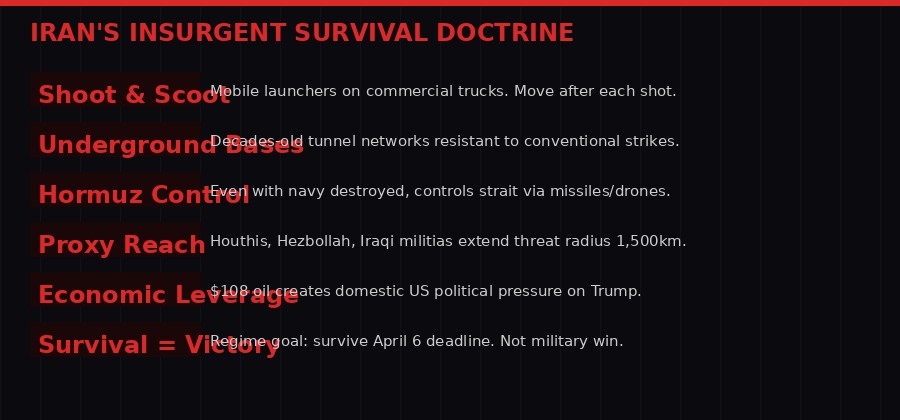
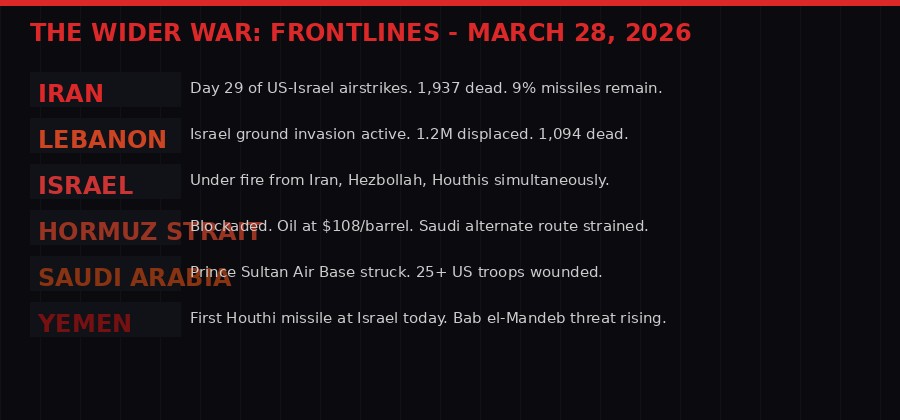
Lebanon does not exist in isolation. It is a secondary front in a war that began with US and Israeli strikes on Iran on February 28, 2026 - strikes that the Pentagon described as carrying "twice the firepower of shock and awe" from the 2003 Iraq invasion.
The architects of those strikes believed the Iranian government would collapse under the initial assault. They killed Supreme Leader Ali Khamenei. They assassinated top IRGC generals. They expected the regime to fold. It did not.
One month in, Iran is fighting less like a nation-state and more like the insurgencies it has long sponsored. AP analysts writing from Dubai on March 28 described the pattern: "Shoot and scoot" mobile launchers disguised as commercial trucks. Underground bases built across decades of preparation. A Strait of Hormuz blockade maintained with drones and missiles even as the Iranian navy was largely destroyed.
"The Islamic Republic understands that it cannot defeat the United States militarily. Instead, its objective is both simpler and more strategic: Survive the war long enough to claim victory." - Shukriya Bradost, Mideast security analyst, quoted in AP analysis, March 28, 2026
Trump told reporters on Thursday that approximately 9% of Iran's missile arsenal remains. That figure, unverifiable, was meant to sound like near-victory. But even 9% of Iran's pre-war stockpile is enough to keep striking. And missiles are not Iran's only weapon. The Strait of Hormuz is still shut. Oil is still above $108 per barrel. Every day the strait stays closed is another day of economic pain that lands on consumers in the US, Europe, and Asia.
Trump has set April 6 as a deadline for Iran to reopen the strait - or face strikes on Iranian power plants. The deadline has already been delayed twice. The Eurasia Group called his posture "escalate to de-escalate," noting that more US paratroopers and Marines are moving into the region in preparation for the possibility of further escalation.
Iran struck a US base in Saudi Arabia on Friday - Prince Sultan Air Base, about 96 kilometers south of Riyadh. Six ballistic missiles and 29 drones hit the facility. According to two people briefed on the matter who spoke to AP on condition of anonymity, at least 15 US troops were wounded in Friday's attack, five of them seriously. Fourteen more were injured earlier in the week in separate strikes on the same base. Total US military casualties at Prince Sultan this week: more than two dozen.
The Houthis Enter: Bab el-Mandeb Is Now in Play
The calculus shifted further Saturday morning when Houthi Brigadier General Yahya Saree announced on Al-Masirah satellite television that the Yemeni rebel group had launched a barrage of ballistic missiles at "sensitive Israeli military sites" in southern Israel. Air raid sirens activated near Beer Sheba. Near Israel's main nuclear research center. Explosions in Tel Aviv.
Israel said it intercepted the projectile. Whether the Houthis actually penetrated Israeli air defenses is secondary to what the launch represents strategically: the opening of a fourth direct front against Israel in this war, in addition to Iran, Hezbollah, and Hamas remnants in Gaza.
More critically, the Houthi entry raises the prospect of attacks on the Bab el-Mandeb Strait - the narrow chokepoint at the southern tip of the Arabian Peninsula through which approximately 12% of global trade typically passes, including traffic heading for the Suez Canal.
The significance: Saudi Arabia has been rerouting oil exports through Bab el-Mandeb to bypass the Strait of Hormuz closure. If Houthis target vessels there - as they did extensively between November 2023 and January 2025, attacking more than 100 ships and sinking two - that alternate route collapses. Global oil markets, already strained, would face a scenario with both Hormuz and Bab el-Mandeb simultaneously threatened.
Ahmed Nagi, senior Yemen analyst at the International Crisis Group, told AP: "The impact would not be limited to the energy market." He is right. This is systemic risk to global trade flowing through 22% of maritime traffic corridors simultaneously.
The USS Gerald R. Ford aircraft carrier, recently repaired in Crete, arrived in Split, Croatia on Saturday. Sending it to the Red Sea would expose it to the same sustained Houthi drone campaigns that wore down the USS Dwight D. Eisenhower in 2024 and the USS Harry S. Truman in the 2025 anti-Houthi operations. The Pentagon has not announced deployment orders for the Ford.
The Timeline: 29 Days That Reshaped the Middle East
Conflict Timeline - Feb 28 to March 28, 2026
What Comes Next: Diplomacy or Escalation
As of March 28, the diplomatic track is active but fragile. Pakistan announced that the foreign ministers of Saudi Arabia, Turkey, and Egypt will arrive in Islamabad on Sunday for two-day talks aimed at ending the war. Pakistan's Prime Minister Shehbaz Sharif said he and Iranian President Masoud Pezeshkian held "extensive discussions" on Saturday about ending the conflict.
Trump has claimed talks are "going very well." Iran categorically denies being in negotiations at all. Iranian Foreign Minister Abbas Araghchi told his Turkish counterpart by phone Saturday that Iran was skeptical of recent diplomatic efforts and accused the US of "unreasonable demands" and "contradictory actions." Trump envoy Steve Witkoff has delivered a 15-point action list to Tehran. Tehran has not publicly acknowledged receiving it.
Trump's April 6 deadline for Iran to reopen Hormuz - or face power plant strikes - has been delayed twice already. The Eurasia Group assesses that Trump's preferred posture is "escalate to de-escalate" and that the US is positioning for further escalation in mid-April. More paratroopers and Marines are en route to the region. The Gerald R. Ford is in Europe, accessible.
For Lebanon, none of this diplomatic activity holds immediate relevance. The front is already open. The ground invasion is underway. The occupation intent has been declared. Whether a ceasefire between the US and Iran is reached by April 6 does not automatically end Israeli operations in Lebanon - 2024 showed that a ceasefire can exist on paper while hundreds continue to die.
The displaced 1.2 million are living in schools, in relatives' apartments, on streets. The mental health system is running at capacity. Pregnant women are delivering without access to healthcare networks. Insulin sits unrefrigerated. The hotline rings 50 times a day. The journalists are dead.
Lebanon has been doing this for seven years without pause. The country's resilience has been tested past the point that most nations would have broken. What is left is not strength - it is exhaustion performing as endurance. And the war is not over.
Get BLACKWIRE reports first.
Breaking news, investigations, and analysis - straight to your phone.
Join @blackwirenews on TelegramSources: AP (March 28, 2026), Al Jazeera (March 28, 2026), Lebanon Ministry of Public Health, UNFPA, Committee to Protect Journalists, Lebanese National Mental Health Programme (March 2025), International Crisis Group, Eurasia Group analysis. All death tolls are as reported by official government and UN sources as of publication.