
One Year After Liberation Day: The $130 Billion Reckoning That Proved the Tariffs Were Never Going to Work
Tomorrow marks exactly one year since President Donald Trump walked into the White House Rose Garden and declared war on the global trading system. He called it Liberation Day. He said it would make Americans wealthy. He said factories would come roaring back. He said trillions of dollars would pour into the Treasury to pay down America's debt.
None of it happened.
Instead, the United States spent twelve months watching every single one of those promises collapse in real time. Manufacturing employment fell to its lowest share of the workforce since 1939. The trade deficit hit an all-time high. American farmers spiraled deeper into financial crisis. Consumer prices climbed by roughly 2% on tariff-affected goods alone, with 90 to 95 percent of the tariff costs landing directly on U.S. households and businesses - not on foreign exporters.
And then the Supreme Court killed the whole thing.
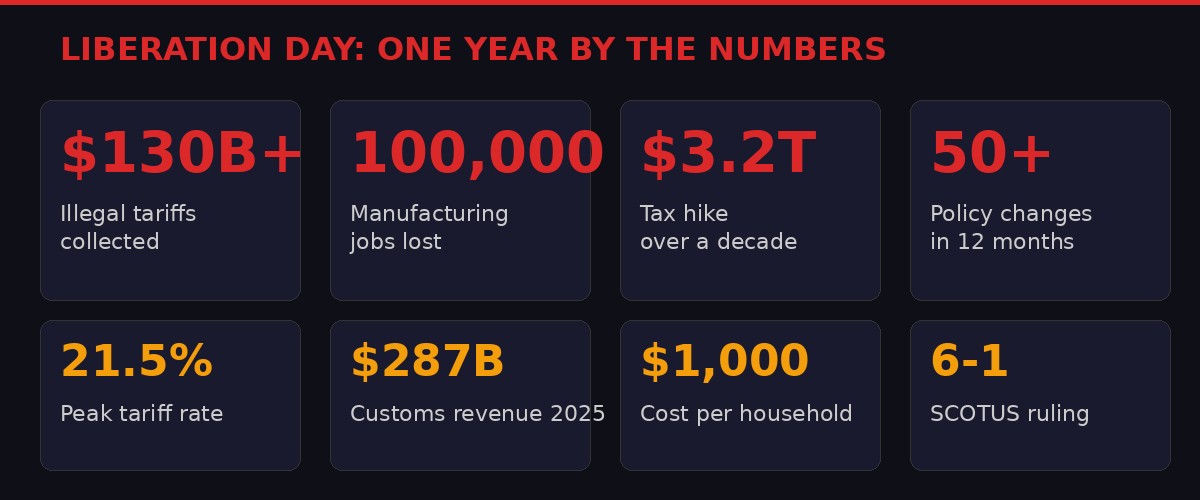
In February 2026, the Court ruled 6-1 in Learning Resources, Inc. v. Trump that the International Emergency Economic Powers Act does not give the president the power to set tariffs. The government had illegally collected more than $130 billion in duties. A federal judge ordered refunds. U.S. Customs and Border Protection told the court it couldn't comply - its technology literally wasn't built to process returns at that scale.
This is the full accounting. Twelve months of the most aggressive trade intervention since the Smoot-Hawley Tariff Act of 1930, measured against every promise that was made to justify it.
The Promise: 'American Industry Was Reborn'

The centerpiece of Trump's Liberation Day pitch was industrial revival. He said the tariffs would force production back to American soil, that factories shuttered during decades of globalization would fire up again, that the manufacturing sector would experience a renaissance.
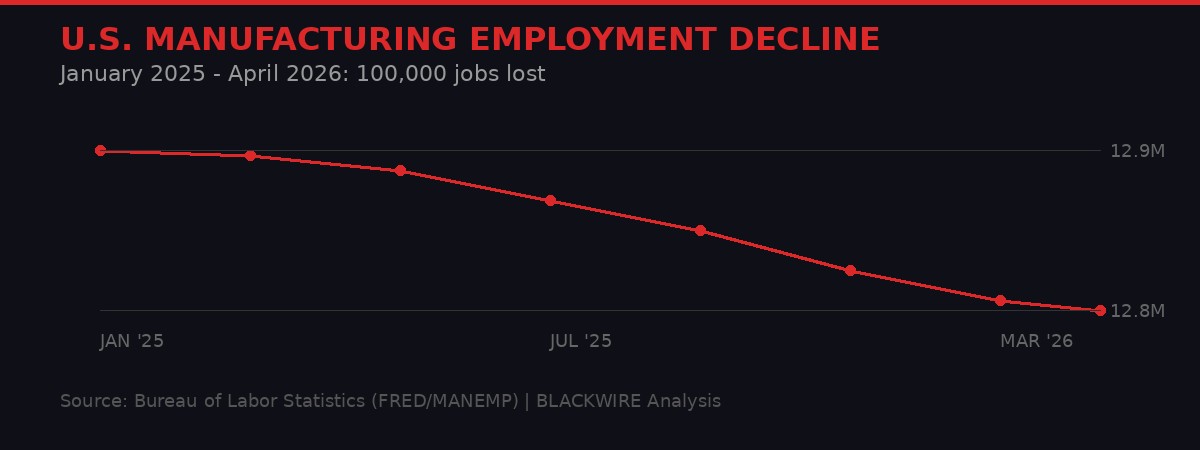
The Bureau of Labor Statistics data shows the opposite. Between January 2025 and April 2026, the U.S. manufacturing sector shed approximately 100,000 jobs. Under the Liberation Day tariff regime, the ratio of manufacturing workers to total nonfarm employment fell to the lowest point since 1939 - the earliest year the BLS has tracked the data.
U.S. manufacturers hired 388,000 fewer workers in 2025 than they did in 2024, according to Federal Reserve Economic Data. The ISM Manufacturing Index, a monthly survey of purchasing managers, showed manufacturing contracted for nine consecutive months after the tariffs took effect, before a weak rebound in early 2026.
"This past year has been quite bad for manufacturing and employment," Alex Durante, senior economist at the Tax Foundation, told DW in reporting published this week. "In fact, the sectors that are growing tend to be ones relatively insulated from the tariffs because of exemptions like computers and AI-related products."
The logic failure was fundamental. Over half of U.S. imports in 2025 were industrial supplies or capital goods - the raw materials and components that American manufacturers need to make things. Tariffs on those inputs didn't protect American industry. They taxed it. They made it more expensive for U.S. factories to buy the steel, aluminum, chemicals, and components required to compete globally. The policy designed to save American manufacturing was, by its own mechanism, strangling it.
Foreign direct investment data further demolishes the administration's narrative. Trump claimed up to $18 trillion in new foreign investment pouring into the United States. The actual number for 2025, according to the Bureau of Economic Analysis, was $288.4 billion - below the prior ten-year average of $320.7 billion and lower than annual FDI totals in 2021, 2022, 2023, and 2024. There was no investment boom. There was a contraction.
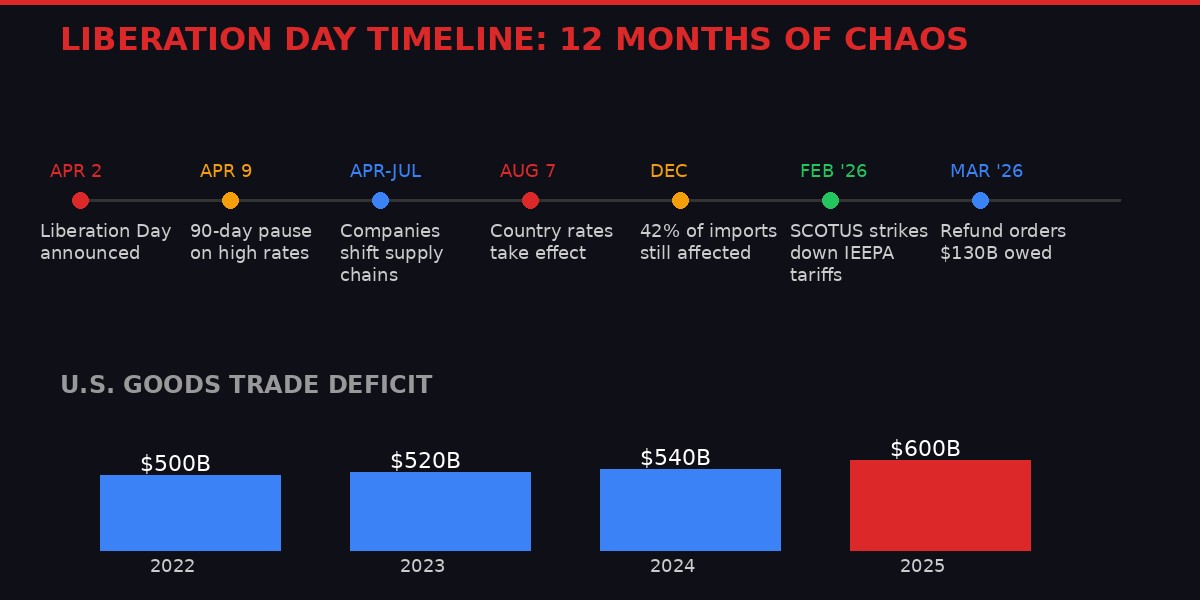
The volatility itself was poison. U.S. tariff policy changed more than 50 times between the April 2 announcement and the February 2026 Supreme Court ruling. Rate increases, rate decreases, new exemptions, new inclusions - businesses couldn't plan because the rules changed every few weeks. The uncertainty functioned as a tax on decision-making, and the result was paralysis rather than investment.
The Trade Deficit: Bigger Than Ever

Trump's executive order was titled "Regulating Imports with a Reciprocal Tariff to Rectify Trade Practices that Contribute to Large and Persistent Annual United States Goods Trade Deficits." The entire legal and economic justification rested on the claim that persistent goods trade deficits constituted a national emergency.
On March 25, 2026, the Bureau of Economic Analysis reported that the U.S. goods deficit increased to an all-time high in 2025.
This was not a surprise to economists. Tariffs reduce the growth of both imports and exports simultaneously. They don't selectively punish imports while leaving exports untouched, because trade is a two-way system. When you make it harder for foreign goods to enter, you make it harder for American goods to leave - retaliation aside. Trading partners who sell less to the United States have fewer dollars with which to buy American products. The trade balance is determined by macroeconomic fundamentals - savings rates, investment flows, currency values - not by tariff schedules.
What the tariffs did accomplish was front-loading. American companies, seeing tariffs coming, raced to fill warehouses before costs increased. Between January and March 2025, the U.S. imported roughly 20% more goods than the 2022-2024 average - an additional $184 billion worth of front-loaded purchases, according to the Wharton Budget Model. Gold imports alone exploded to roughly 50 times their usual volume, totaling around $72 billion, mostly from Switzerland.
After Liberation Day, total import values briefly dipped before returning to normal within months. Companies shifted where they bought from, but they did not buy less. The goods kept flowing. American demand didn't disappear because the president signed an executive order.
The agricultural trade deficit told an even grimmer story. Despite Trump's fact sheet citing Biden-era agricultural trade deficits as justification, the ag trade deficit increased from $37 billion in 2024 to $41 billion in 2025 - a 10.8% jump. Tariffs hit farmers with a double blow: lower exports as trading partners retaliated, and higher input costs as farm machinery, chemicals, and equipment became more expensive.
Who Actually Paid: The $1,000-Per-Household Tax
Trump repeatedly framed tariffs as something foreign countries pay. "They're going to pay us a lot of money," he said during the Rose Garden announcement. The economic evidence from the past year proves this was false.
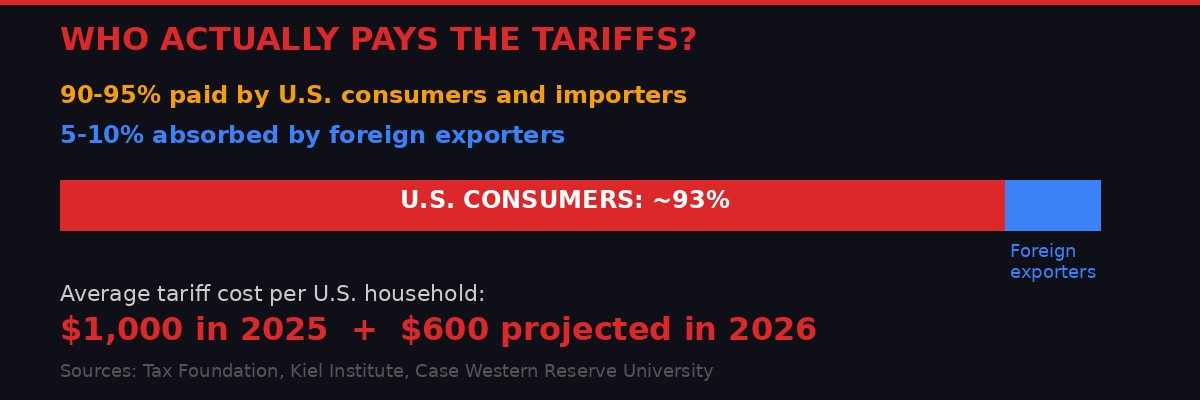
Multiple studies, including analysis from the Kiel Institute for the World Economy, found that higher tariff costs were almost fully paid by U.S. importers, not foreign exporters. Jonathan Ernest, an assistant professor of economics at Case Western Reserve University, estimated that between 90 and 95 percent of actual tariff costs were passed through to American consumers.
"We haven't seen a lot of relief. In fact, we saw tariffs drive up consumer goods' prices by another 2% or so over the last year, and estimates are that somewhere between 90 and 95% of the tariff actual cost is essentially being passed on to consumers."
- Jonathan Ernest, Case Western Reserve University, via Scripps News
The Tax Foundation calculated that the Liberation Day tariffs, combined with other Trump-era duties, constituted a $3.2 trillion tax increase over a decade - the highest tariff rates since 1911. At their peak, the applied tariff rate reached 21.5% under the combination of IEEPA baseline tariffs, country-specific rates, and Section 232 sector-specific duties.
The average cost per American household was approximately $1,000 in 2025, according to multiple analyses. The Tax Foundation estimates the tariffs currently in place in 2026 will add another $600 per household.
The sectors hit hardest were the ones with the thinnest margins. Grocery prices climbed as food importers passed costs through. Consumer durables - appliances, electronics, furniture - experienced cumulative price increases that economists project will continue through 2027. Small businesses that relied on imported components faced the brutal choice of eating the costs or passing them to customers and risking sales declines.
What about the revenue? Trump predicted tariffs would "direct hundreds of billions of dollars and even trillions of dollars into our Treasury to strengthen our economy and pay down debt." In 2025, the U.S. Treasury collected $287 billion in customs duties and related taxes - roughly triple prior years. That sounds impressive until you measure it against total federal revenue: it represented about 5% of all taxes collected. Federal spending remains at approximately 23% of GDP. The tariff revenue didn't come close to covering even a fraction of the budget deficit, let alone paying down debt. The 1880s comparison Trump loved to make was mathematically impossible in a modern economy with modern spending levels.
The Supreme Court Steps In: Learning Resources v. Trump

The legal challenge to the Liberation Day tariffs culminated in one of the most consequential Supreme Court decisions in modern trade law. In February 2026, the Court ruled 6-1 in Learning Resources, Inc. v. Trump that the International Emergency Economic Powers Act does not authorize the president to impose tariffs.
The majority opinion, joined by Justices Sotomayor, Kagan, Gorsuch, Barrett, and Jackson, with Chief Justice Roberts writing separately, was unambiguous. IEEPA grants emergency economic powers - sanctions, asset freezes, transaction restrictions. It does not grant tariff authority. That power belongs to Congress under Article I of the Constitution.
The ruling was devastating for the administration. It didn't just invalidate future tariffs under IEEPA. It retroactively classified every dollar collected under those tariffs as illegally obtained revenue. The government had collected more than $130 billion in IEEPA duties. All of it was now subject to refund.
On March 4, 2026, a federal judge in the U.S. Court of International Trade ordered the Trump administration to begin processing refunds. The order, issued in a lawsuit filed by Atmus Filtration, applied universally to every duty paid under the IEEPA tariffs. On March 6, Customs and Border Protection filed a response telling the court it couldn't comply. The agency's existing technology was incapable of handling an "unprecedented volume of refunds" at that scale.
"In light of the Court's March 5, 2026 amended order, CBP is now facing an unprecedented volume of refunds."
- U.S. Customs and Border Protection filing, March 6, 2026, via CNBC
CBP told the court it was building a new system to process refunds and estimated it would need 45 days to make it operational - without requiring individual importers to file lawsuits. The scale of the refund operation is itself a measure of how deep the tariff policy penetrated the economy. This wasn't a marginal policy adjustment. It was a restructuring of U.S. import costs that touched virtually every sector, and unwinding it is proving as chaotic as implementing it.
Kyle Peacock, principal at Peacock Tariff Consulting, told Scripps News that the refund process creates cascading uncertainty. Importers who passed costs to retailers, who passed costs to consumers, now face questions about who gets the money back. "We may see a wave of litigation that comes through from consumers to retailers," Peacock said, "but it's at the point where retailers haven't received the funds yet. So even if they were going to pass it back to the consumers, it's this vicious cycle."
The administration's response to the Supreme Court ruling was immediate and telling. Hours after the decision, Trump implemented a new global 10% tariff under the Trade Act of 1974 - a different legal authority with a 150-day statutory limit. The president has suggested raising it to 15%. But any extension beyond the 150-day window requires Congressional approval, and the political landscape for tariffs has shifted dramatically in the wake of the SCOTUS defeat.
The Global Reshuffling: Winners, Losers, and the Water Metaphor
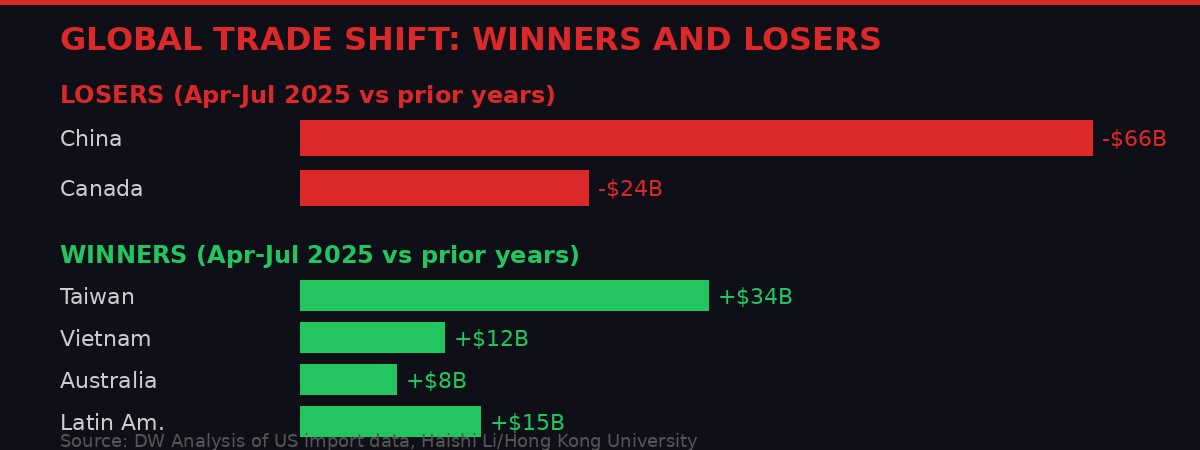
If the tariffs failed domestically, their global impact was a masterclass in unintended consequences. Trade flows didn't shrink. They rerouted.
Haishi Li, an economist at Hong Kong University who studies how tariffs and sanctions impact global trade, described it with elegant precision: "Imports were like water, flowing from high-tariff countries to low-tariff countries."
China took the biggest hit. The U.S. imported $66 billion less from China between April and July 2025 compared to prior years. China faced the highest and most volatile tariff threats - rates escalated to 125% during a tit-for-tat exchange in the weeks after Liberation Day. Canada, separately threatened with 25% tariffs, saw U.S. imports drop by $24 billion.
But the goods didn't stop coming. They came from different places.
Taiwan, facing a nominal 34% reciprocal tariff, saw U.S. imports surge by $34 billion in the same period. Vietnam (46% tariff rate) and Thailand (36%) similarly saw increased flows. The explanation: these countries were established China alternatives with existing supply chain infrastructure, built during Trump's first-term trade disputes. American companies that had already diversified away from China simply accelerated the shift.
The "10% countries" - nations subject only to the baseline tariff, including Australia and most of Latin America - benefited the most. They became the path of least resistance for importers seeking to maintain supply while minimizing costs.
Canada provides a revealing case study. While U.S. imports from Canada dropped by $24 billion, Canada's overall global exports in 2025 fell by only $1.6 billion compared to 2024. Canada simply redirected its goods to other buyers. The tariffs didn't punish Canada. They inconvenienced it briefly before Canadian exporters found other customers.
The broader pattern is consistent with decades of trade economics research. Tariffs create friction, not barriers. They raise costs at specific points, but global supply chains are adaptive systems. Companies route around obstacles. Countries find new trading partners. The goods still move. The only permanent casualty is efficiency - and the consumers who pay for its loss.
The Farm Crisis: Bankruptcy Climbing, Financing Drying Up

American agriculture absorbed some of the deepest wounds from the tariff experiment, and the damage is still accumulating. The numbers tell a story of an industry pushed toward a breaking point.
U.S. agricultural exports declined in 2025. The agricultural trade deficit increased by 10.8%, rising from $37 billion in 2024 to $41 billion. Between February and October 2025 alone, tariffs increased the cost of farm inputs - machinery, agricultural chemicals, equipment - by $958 million, according to analysis from North Dakota State University's Center for Agricultural Policy and Trade Studies.
The double hit was devastating. Farmers couldn't sell as much abroad because trading partners retaliated with their own tariffs on American agricultural products. And the cost of farming itself went up because the inputs they needed - much of it imported - got more expensive. Revenue down, costs up. The classic squeeze.
The country's leading agricultural organizations spelled it out in a letter to Congress that carried the weight of genuine desperation:
"America's farmers, ranchers, and growers are facing extreme economic pressures that threaten the long-term viability of the U.S. agriculture sector. An alarming number of farmers are financially underwater, farm bankruptcies continue to climb, and many farmers may have difficulty securing financing to grow their next crop."
- Joint letter from leading U.S. farm organizations to Congress, January 2026, via American Farm Bureau Federation
This wasn't new territory. During Trump's first term, the Department of Agriculture created the Market Facilitation Program to bail out farmers hit by Section 301 tariffs on China. Those first-term tariffs were much smaller than the Liberation Day rates. Now the government is discussing even larger bailouts - using taxpayer money to compensate farmers for damage caused by a policy that was supposed to help them.
The irony cuts deep. The tariffs were imposed under the claim of national emergency, justified partly by agricultural trade deficits. They made those deficits worse. They accelerated the financial deterioration of the very farmers Trump claimed to be protecting. And now the proposed solution is government payments funded by general revenue - taxpayers subsidizing the consequences of a failed trade experiment.
Rathna Sharad, CEO of shipping platform FlavorCloud, identified the structural impossibility at the core of the reshoring argument: "The expertise isn't there, number one. Number two, the labor costs are nowhere near trying to do that manufacturing in some of these other countries that they currently use." American agriculture, like American manufacturing, exists within a globalized system. You can't legislate that system out of existence with a tariff schedule.
The TACO Trade and Wall Street's Liberation Day Lesson

Wall Street processed Liberation Day in real time, and the initial reaction was violent. Global stock markets plummeted in the days following the April 2 announcement. The selloff was broad, deep, and panicked. Investors had expected tariff action. They had not expected the United States to "essentially declare a trade war on the entire world," as Haishi Li put it.
Then something interesting happened. Trump paused the highest tariff rates on April 9 - just seven days later. Markets rebounded. And a new concept was born: the TACO trade. TACO stood for "Trump Always Chickens Out." The thesis was simple: Trump would announce aggressive policies, markets would panic, Trump would back down to avoid economic pain, and the dip was therefore always buyable.
For months, the TACO trade worked. Every tariff escalation was followed by a pause, an exemption, a modification. The S&P 500 recovered from its Liberation Day trough. Investors who bought the dip were rewarded. The market learned to treat Trump's trade pronouncements as opening positions rather than final policy.
But the lesson of Q1 2026 is that the TACO framework has limits. The stock market just recorded its worst quarter in years, driven not by tariffs this time but by the Iran war. Unlike trade policy, where Trump demonstrated willingness to back down under market pressure, military escalation follows different logic. Investors who assumed every crisis was buyable are learning that some crises aren't.
The broader market impact of Liberation Day is harder to quantify but important to acknowledge. The policy uncertainty index spiked to historically elevated levels throughout the tariff period. Business investment decisions were delayed or cancelled. IPO activity slowed. Companies that couldn't predict their input costs six months out couldn't plan capital expenditure. The tariffs didn't just impose costs on goods. They imposed costs on certainty - and certainty is the foundation of investment.
Investopedia's Q1 2026 wrap captured the shift: "Around this time last year, the stock market had a meltdown when President Donald Trump revealed his sweeping 'Liberation Day' tariffs. After a week of panic, Trump backtracked and the notion of the 'TACO trade' was born." This year, the test is different. The Iran war doesn't have an exemption clause.
The Refund Mess: $130 Billion in Legal Limbo

The Supreme Court ruling in February 2026 created an immediate practical crisis: the government had to give back $130 billion in illegally collected tariffs, and it had no mechanism to do so.
The scale of the problem is unprecedented in American customs history. Every IEEPA tariff payment, from every importer, across every port of entry, over a period of roughly ten months, needs to be identified, calculated, and refunded. CBP's existing technology infrastructure was built for forward collection, not reverse distribution. The agency essentially told a federal judge: "We can't do what you're ordering us to do. Our computers don't work that way."
The March 5, 2026, order from the U.S. Court of International Trade, issued in the Atmus Filtration case, applies universally. It's not limited to one importer or one product category. Every duty paid under IEEPA authority is covered. CBP committed to building a new processing system within 45 days - a system that would allow importers to claim refunds without filing individual lawsuits.
But the refund process creates its own cascade of complications. Importers who paid the tariffs passed those costs to wholesalers, who passed them to retailers, who passed them to consumers. If the importer gets refunded, does the consumer get a price reduction? There's no mechanism requiring it. The likely outcome, as tariff consultant Kyle Peacock identified, is a "vicious cycle" of litigation. Consumers sue retailers. Retailers point to importers who haven't received refunds yet. The money moves slowly upstream while prices downstream remain elevated.
The political implications are equally messy. The administration doesn't want to be seen writing $130 billion in checks to importers - many of them large corporations - while simultaneously arguing for new tariffs. But the court order is binding. And every day of delay generates additional interest liability and legal exposure.
There's a deeper institutional lesson here. The tariffs were imposed through executive action, without Congressional authorization, using an emergency powers law that had never been used for this purpose. The speed and scale of implementation outpaced legal review, institutional capacity, and administrative infrastructure. Now the unwinding is revealing just how much damage can be done when policy moves faster than the systems designed to implement it.
What Comes Next: The 150-Day Clock

The day the Supreme Court struck down IEEPA tariffs, the administration pivoted to a global 10% tariff imposed under the Trade Act of 1974. This authority carries a critical limitation: a 150-day statutory window. Without Congressional action, the tariffs expire automatically.
Trump has signaled he wants to increase the rate to 15%. But expanding or extending the tariffs requires something the administration has avoided throughout the trade war: legislative approval. Congress would have to vote on tariffs, creating a paper trail of accountability that executive orders conveniently avoid.
The political math has changed since April 2025. The one-year track record of Liberation Day tariffs provides ammunition for opponents. Democrats have already begun weaponizing tariff backlash in 2026 midterm campaigns. Scripps News reported the emerging messaging: "Who did this to them?" - pointing at voters who lost jobs, paid higher prices, or saw their farm operations pushed toward bankruptcy.
But the tariff question is also complicated by the Iran war. Oil prices have spiked. The Strait of Hormuz remains under pressure. Adding import taxes on top of war-driven supply disruptions creates a compounding cost burden that could push inflation back to levels that terrify the Federal Reserve.
The National Taxpayers Union's one-year assessment, published this week, concluded with a recommendation that reads like an epitaph for Liberation Day: "One year after Liberation Day, the evidence is in: tariffs failed even by the Trump Administration's own terms. They did not shrink the trade deficit, did not revitalize manufacturing, and did not help farmers. It would be a mistake to replace one set of failed tariffs with another."
As the anniversary arrives, the tariff story isn't over. The 150-day clock is ticking. The refund checks haven't been cut. New tariff authorities are being tested. But the fundamental experiment has been conducted, and the data is in. The largest tariff wall erected around the American economy in a century didn't shrink the trade deficit. Didn't revive manufacturing. Didn't reduce costs for consumers. Didn't generate enough revenue to matter. And ultimately, didn't survive judicial review.
What it did do was cost the average American household $1,000 in 2025, kill 100,000 manufacturing jobs, push farm bankruptcies higher, collect $130 billion in illegal duties, change tariff policy more than 50 times in twelve months, and produce an all-time record goods trade deficit.
Liberation Day liberated nothing. It just sent the bill to the wrong address.
Get BLACKWIRE reports first.
Breaking news, investigations, and analysis - straight to your phone.
Join @blackwirenews on TelegramSources: Tax Foundation Tariff Tracker (April 2026); National Taxpayers Union "Liberation Day One Year Review" (March 31, 2026); Scripps News/Denver7 (March 31, 2026); DW Data Journalism (March 31, 2026); Bureau of Economic Analysis (March 25, 2026); Bureau of Labor Statistics / FRED Manufacturing Employment (MANEMP); ISM Manufacturing Index; Supreme Court of the United States, Learning Resources, Inc. v. Trump, 607 U.S. ___ (2026); CNBC (March 6, 2026); Reuters (March 4, 2026); Axios (March 5, 2026); Wharton Budget Model; Kiel Institute for the World Economy; San Francisco Federal Reserve Economic Letter (March 2026); American Farm Bureau Federation; Investopedia Markets Report (March 31, 2026); Deloitte U.S. Economic Forecast Q1 2026.