Half a Million Marched. Eighteen Were Arrested for Holding a Sign.
Britain's biggest anti-far-right protest in history filled London's streets on Saturday. Three miles away, police arrested 18 people for holding cardboard signs outside Scotland Yard. One country. Two very different versions of who gets to speak.
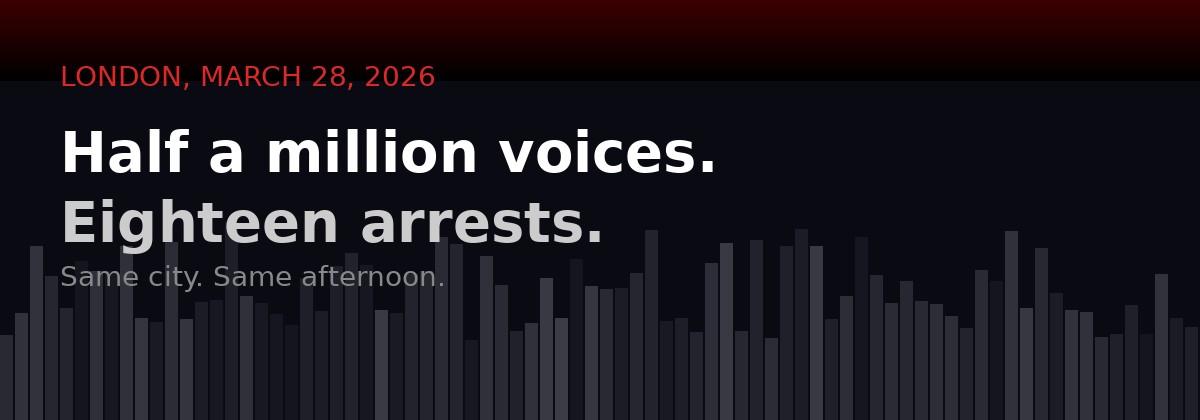
The woman's voice was calm as the officers led her away. She had not thrown a brick. She had not broken a window. She had sat on the stone steps of New Scotland Yard - the headquarters of London's Metropolitan Police - and held a sign that read: "I oppose genocide. I support Palestine Action."
"I'm being arrested for holding a cardboard sign," she said in footage that circulated widely on Saturday, "whereas our government feels the need to sell weapons and use our airbases to commit genocide in Palestine."
Somewhere across the city, perhaps two miles to the northwest, hundreds of thousands of people were walking in the opposite direction. Past Park Lane, past Trafalgar Square, toward Whitehall and the Houses of Parliament. They had come from every corner of Britain - by coach, by train, by car. Trade unionists and teachers, pensioners and teenagers, Windrush descendants and newly arrived migrants. All of them marching against the same thing: the rising tide of hatred they say is no longer confined to the fringes.
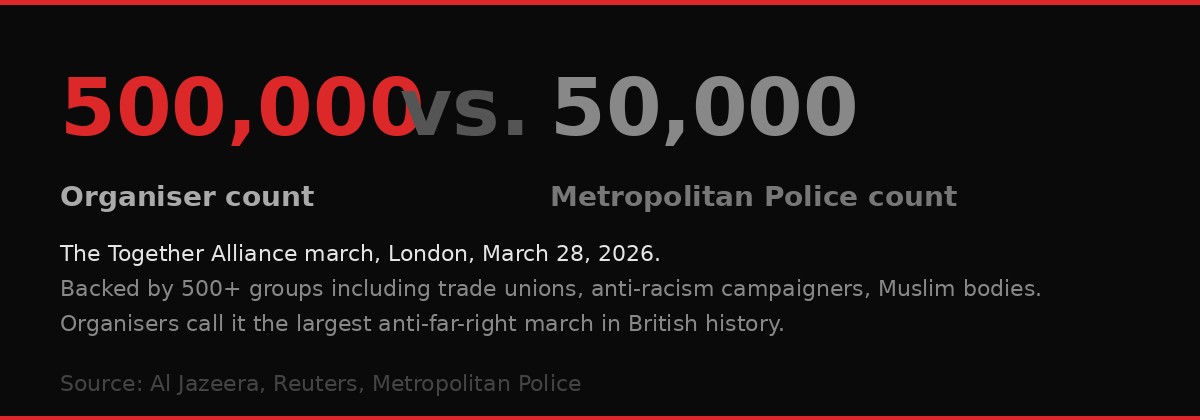
Organizers called Saturday's Together Alliance march the largest anti-far-right demonstration in British history. They put the crowd at half a million people. The Metropolitan Police said approximately 50,000 - though they admitted the figure was difficult to pin down given how far the march stretched. (Al Jazeera, March 28, 2026)
Either number is a statement. And the eighteen people arrested at Scotland Yard while that statement was being made are a different kind of statement entirely.
What Brought Half a Million People to London's Streets
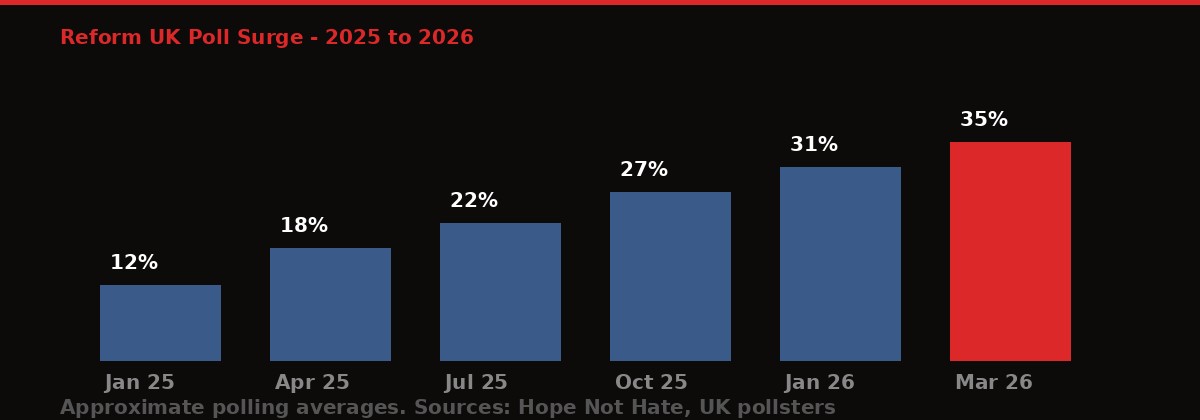
Britain has been watching its political landscape shift for two years. The numbers are not subtle. Reform UK, led by Nigel Farage, has spent 2025 and the early months of 2026 polling between 25 and 35 percent - numbers that would have seemed unthinkable for a hard-right populist party just five years ago. Hope Not Hate, the UK's leading anti-fascism research group, warned in March 2026 that the British far right is now "bigger, bolder and more extreme than ever before." (Hope Not Hate, March 2026)
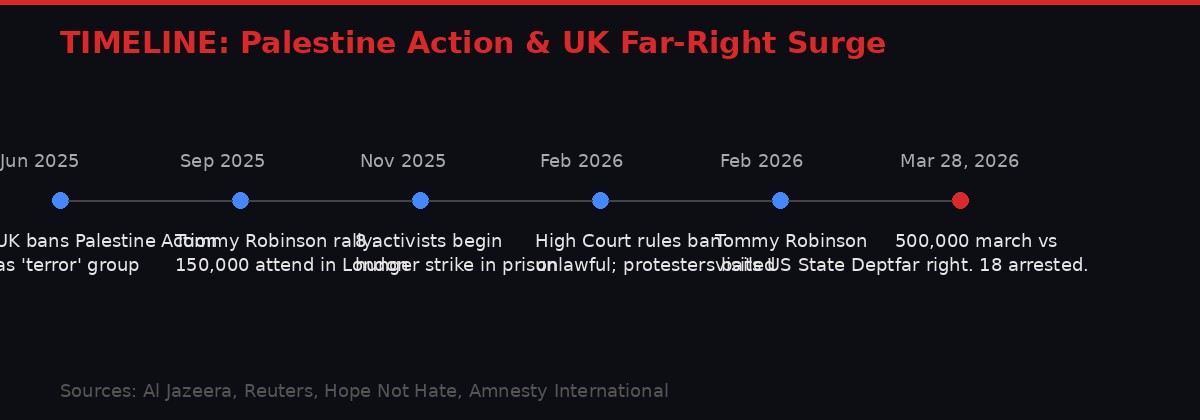
It is not just the ballot box. September 2025 saw Tommy Robinson - real name Stephen Yaxley-Lennon, a man with multiple prison terms and a reputation for anti-Muslim incitement that stretches back over a decade - lead a rally through central London that drew approximately 150,000 people. Counterprotesters and police clashed. Several officers were injured.
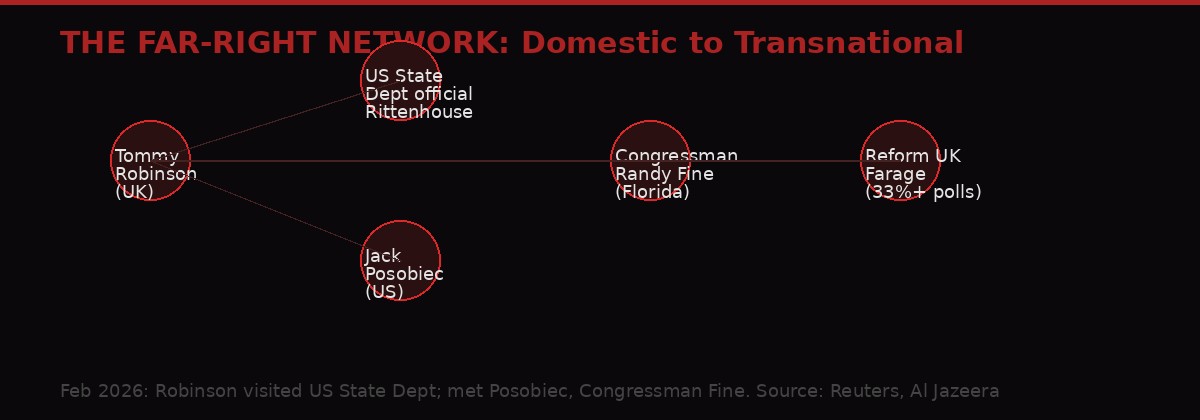
Then in February 2026, Robinson flew to Washington DC. He posted a photo of himself inside the US State Department next to a full-sized American flag. State Department official Joe Rittenhouse, a senior adviser in the Consular Affairs bureau, called Robinson a "free speech warrior" and posted photos of the apparent tour. Robinson met far-right US influencer Jack Posobiec. He filmed a video with Republican Congressman Randy Fine of Florida - himself known for anti-Muslim rhetoric. (Reuters, February 26, 2026; Al Jazeera)
The UK government said nothing publicly. The US State Department did not answer questions about who else Robinson met or what was discussed.
For the people who gathered Saturday, that silence was part of the problem.
"Racism and Islamophobia had moved from the fringes into mainstream politics, and was being pushed by parliamentarians." - Aadam Muuse, trade union activist, speaking at the Together Alliance march (Al Jazeera, March 28, 2026)
The Together Alliance - a coalition of approximately 500 groups including trade unions, anti-racism campaigners, and Muslim representative bodies - had been organizing since early 2026. Kevin Courtney, Alliance chairman, told the assembled crowds that the march "gives us all confidence to carry on." Independent MP Jeremy Corbyn posted that "the problems we face are not caused by migrants or refugees." MP Zarah Sultana pointed her finger at "the billionaires funding division while working class people can't make ends meet." Green Party leader Zack Polanski and Greater Manchester Mayor Andy Burnham were both in the crowd.
Amnesty UK called it a "historic demonstration" - one "calling for a different vision of society, one which places dignity, compassion and human rights at its heart." (Amnesty UK statement, March 28, 2026)
The Faces Behind the Chants: Who Was Actually There
Hamja Ahsan, activist and writer, told Al Jazeera he had been to the Tommy Robinson rally the previous September - as a counter-observer, watching the size of the crowd and feeling unsettled by it. Saturday felt different. "We need to show them that we're the majority," he said. "At a street level, the far right won't take over our streets."
He described the atmosphere as akin to the Notting Hill Carnival - diverse, loud, grounded in joy as much as anger. People from pensioners to children. Union workers beside community organizers. Muslims beside trade unions beside atheist civil liberties campaigners. The Palestine Solidarity Campaign march, which had assembled separately near Hyde Park, converged with the main Together Alliance crowd during the afternoon, adding another dimension to a demonstration that had already grown beyond any single issue.
Ruby, 20, a student from South London, had traveled five hours by coach. Her grandparents came from Montserrat as part of the Windrush generation - invited to Britain in the postwar years to help rebuild the country. Ruby told Al Jazeera they were now feeling increasingly unwelcome in the country they had devoted their lives to. They were, she said, "witnessing a return to the levels of racism they experienced when they came to the country in the 1950s." (Al Jazeera, February 21, 2026)
Llowelyn, 16, had come from Wales with her British Guyanese father. She said her father had received more racial abuse in the past two years than at any other point in his life.
Charlotte Elliston, a museum worker, put it simply: "You think this would never happen here, and then all of a sudden this might happen. You see that it is getting scary."
The counterprotest - those waving Israeli flags and Iran's pre-1979 monarchical flag - was, by all accounts, considerably smaller than the main march. But it was there. The fringes have faces now.
Life Outside the March: Nabila, Zarka, and Anisa
The people marching on Saturday were marching for someone. Often someone specific.
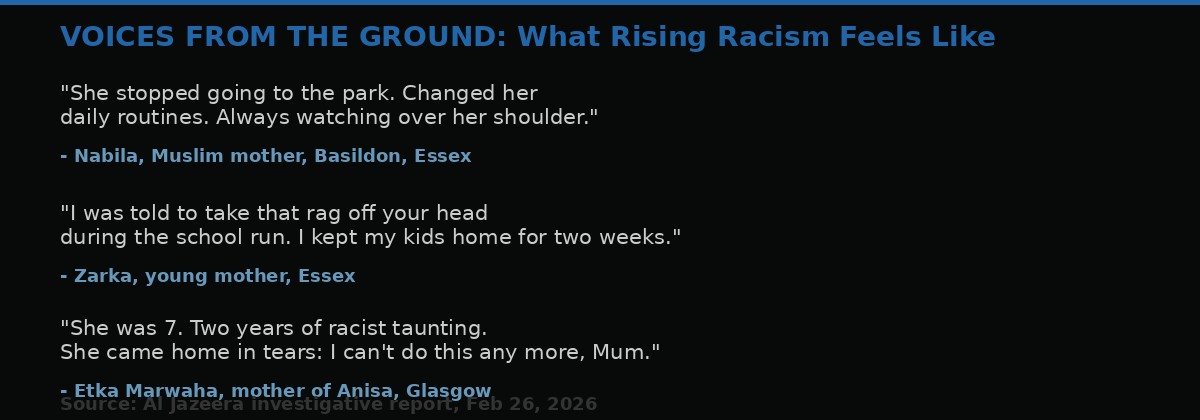
In Basildon, Essex - a town that is 93 percent white, where Muslims make up less than 2 percent of the population - a woman named Nabila has been documenting incidents of racism for months. Glass thrown at Muslim children from residential buildings. A mosque with red crosses daubed across its walls, alongside the words "Christ is King" and "This is England." Reports of drivers deliberately accelerating as Muslim women cross the road with their children. (Al Jazeera investigative report, February 26, 2026)
Nabila stopped going to her favorite park after being racially abused there. She organized a women's listening circle with local authorities. At that circle, another woman - Zarka, a young mother who wears the hijab - described being told to "take that rag off your head" during the school run. She kept her children home for two weeks after that incident. The cumulative weight of hostility - cars not stopping at crossings, hostile stares, verbal abuse at the school gate - had changed how she moved through the world.
"Women are increasingly changing their daily routines," Nabila told Al Jazeera. "Constantly watching over their shoulders. Racism now permeates every aspect of their lives."
Hundreds of miles north in Glasgow, Etka Marwaha's daughter Anisa was seven when the racist taunting at her primary school began. For two years, Etka contacted the school repeatedly. The abuse was minimized, the extent of the problem was hidden. Eventually Anisa broke down in tears: "I can't do this any more, Mum."
Etka moved her daughter to a school outside the catchment area, one with a zero-tolerance policy on racism. No direct bus. Inconvenient. But Anisa is happier now. She can talk about what happened to her. She has language for it.
A doctor in northwest Scotland, who asked to be identified only as Sam, told Al Jazeera he has watched his children absorb casual racism at school that their peers consider normal. "The biggest surprise is how few other students stand up against racism," he said. "When I was growing up, if someone was racist, they would be the person being socially excluded. Now, silence." He said the family was considering leaving Britain.
These are the stories that don't make the front pages. They sit behind the polling numbers. They explain why 500,000 - or 50,000, depending on who you ask - showed up on a Saturday in late March.
The Arrests: Palestine Action and the Law That Won't Let Go
While the Together Alliance march moved through central London, eighteen people were being arrested at New Scotland Yard.
They were supporters of Palestine Action - the direct-action protest group which has spent the last eighteen months at the center of a legal and political crisis that has exposed deep fault lines in Britain's relationship with both free speech and the rule of law.
The protesters had sat quietly on Scotland Yard's steps. They held signs. The signs said: "I oppose genocide. I support Palestine Action." Officers arrested them under terrorism legislation.
The context matters here. In July 2025, the UK government - under Labour Prime Minister Keir Starmer - proscribed Palestine Action as a terrorist organization, placing it alongside al-Qaeda and Hezbollah. The move was immediately controversial. The UN Human Rights Chief Volker Turk called it "disproportionate and unnecessary." Amnesty International said it risked criminalizing legitimate free expression. (Al Jazeera, February 13, 2026)
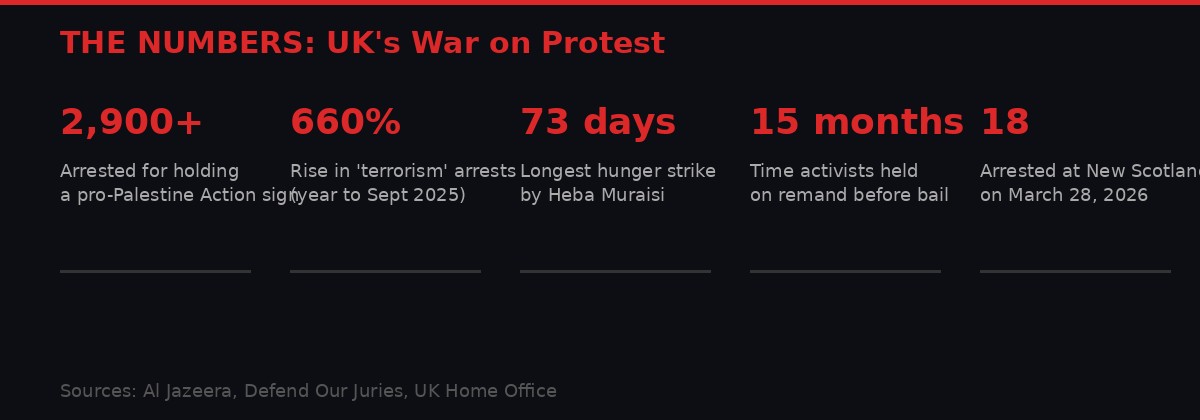
Nearly 3,000 people were subsequently arrested for the act of holding a sign supporting the group. That number contributed to a 660 percent rise in UK terrorism arrests in the year to September 2025 - a statistic cited by the monitoring group Defend Our Juries. (Defend Our Juries / Al Jazeera)
Then, in February 2026, the High Court struck back. Judges ruled the proscription was "disproportionate" - a violation of freedom of expression. They said that at its core, Palestine Action promoted its cause "through criminality and encouragement of criminality," but that the terrorist designation had gone too far. The ban was unlawful.
On the day of that ruling, approximately 150 people stood outside the court holding the same signs that had gotten thousands arrested. Not one of them was detained. (Al Jazeera, February 13, 2026)
But the government refused to accept the verdict. Home Secretary Shabana Mahmood announced she would appeal. A stay was granted. And so the ban remained technically in force while the appeal was pending. Within days, the Metropolitan Police - which had briefly adopted a "proportionate approach" - reversed course again. Deputy Assistant Commissioner James Harman announced on March 26 that the force would resume arrests. "We must enforce the law as it is at the time," he said, "not as it might be at a future date." (Met Police statement, March 26, 2026)
Two days later, eighteen people were sitting on Scotland Yard's steps. By that evening, they had been arrested.
The Hunger Strikers: What the Numbers Don't Show
The eighteen arrested on Saturday were adding their names to a much longer list. But for eight people, this story had already entered the body.
In November 2025, eight young British activists linked to Palestine Action began a rolling hunger strike inside UK prisons. They were on remand - held without conviction, awaiting trial - for alleged involvement in raids on weapons manufacturer Elbit Systems UK. Elbit is Israel's largest private arms company. It has multiple sites in Britain.
The hunger strike lasted until January 2026. It won bail for several activists and drew international attention to what critics called the systematic mistreatment of political prisoners in UK jails.
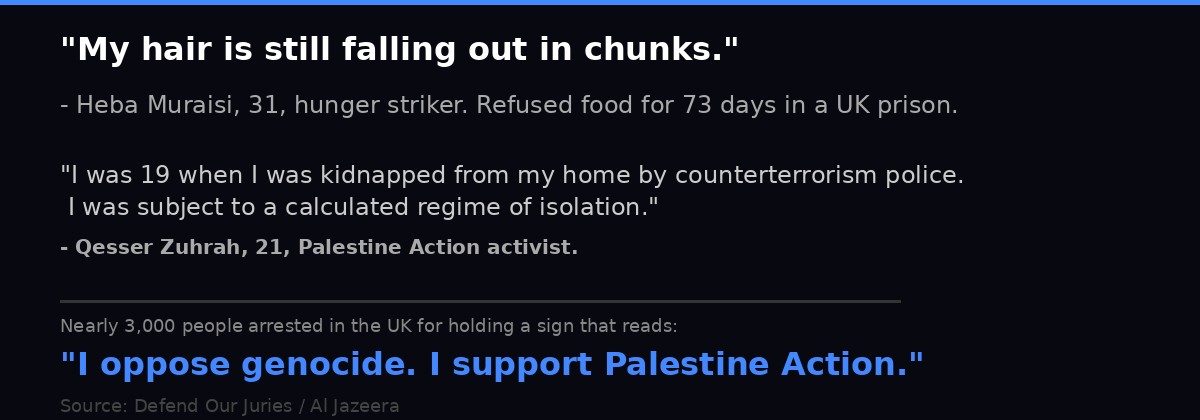
Heba Muraisi, 31, refused food for 73 days. When she spoke publicly in March 2026 - a month after being bailed following the High Court ruling - she described ongoing neurological issues. "My hair is still falling out in chunks," she told Al Jazeera. "I can't walk long distances without needing to take a break. Physically and mentally, I'm still recovering. I'm still not there yet."
Muraisi said her treatment in prison worsened after Palestine Action was proscribed. She was physically assaulted. She was placed in solitary confinement repeatedly. Her keffiyeh was confiscated - she used a pillowcase as a headscarf while praying. She was transferred to a prison in northern England, far from family. Her mother, who is unwell, could not visit for five months. Prison authorities refused to tell her where she was being transferred. She was not provided electrolytes during her hunger strike and only received vitamins after 30 days. (Al Jazeera, March 25, 2026)
Qesser Zuhrah, 21, was arrested by counterterrorism police in a home raid when she was 19. She described "a calculated regime of isolation" - blocked from making friends, particularly other young Muslims. After two prisoners died in the same week, she asked guards to open the cell of a claustrophobic inmate showing signs of suicidal distress. Their response, she said, was to assault her.
"For the entirety of my imprisonment, I was subject to a calculated regime of isolation, blocked from making any friends, especially other young people and Muslims." - Qesser Zuhrah, 21, Palestine Action activist, held on remand for 15 months (Al Jazeera, March 25, 2026)
The four activists - Muraisi, Zuhrah, Teuta Hoxha, and Kamran Ahmed - were bailed in February 2026. Four others remain imprisoned. All of them are now pursuing legal action against the prisons for medical neglect. A mass "Everyone Day" sign-holding event has been called for Trafalgar Square on April 11 as the government's appeal heads to court.
Tommy Robinson's Transatlantic Network and the Mainstreaming of the Fringe
The march's organizers understand something that politicians are slower to say out loud: the UK's hard-right surge is not a purely domestic phenomenon.
When Tommy Robinson walked into the US State Department in February 2026 - a man with multiple prison terms for offenses including contempt of court, assault, and mortgage fraud - something shifted. Not just symbolically. A US government official personally celebrated the visit, describing Robinson as a "free speech warrior." Robinson's next stop was Florida, where he filmed a video with Congressman Randy Fine. Jack Posobiec, one of the US's most prominent far-right influencers, attended.
The UK embassy in Washington did not comment. The State Department did not answer questions about the purpose of the visit or who else Robinson met. (Reuters, February 26, 2026)
This is the shape of the problem the marchers are trying to describe. The street-level racism - the red crosses on the mosque walls, the women changing their school-run routes, the children targeted in classrooms - does not exist in a vacuum. It exists in a political ecosystem where a senior US government official calls a multi-convicted far-right agitator a "warrior," where a major party polls at 35 percent on a platform of mass deportation, where the same government that banned a protest group as "terrorists" continues selling weapons to a government conducting military operations in civilian areas.
In Manchester in February 2026, Britain First - a party that calls for mass deportation and the removal of all Muslims from Britain - marched through the city centre. Their leader Paul Golding, who has previously been imprisoned for religiously aggravated harassment, led the procession flanked by police. Counter-protesters were encircled and physically prodded with flag poles before riot police intervened. (Al Jazeera, February 21, 2026)
A counter-protester named John, arms outstretched in front of far-right agitators livestreaming to their online audiences, put it plainly: "These guys try and intimidate minorities because they think they are a master race."
That is the street. That is what was marching in London on Saturday, in the opposite direction.
What Comes Next: April 11, the Court of Appeal, and the Question of Who Gets to Protest
The legal battles running alongside Saturday's street battles are not resolved. They are accelerating.
The government's appeal of the High Court ruling on Palestine Action's proscription is heading to court. Until that appeal is decided - a process that could take months - the ban technically remains in force. The Met Police has made clear it will continue arresting people under terrorism legislation for holding signs. Chief Magistrate Paul Goldspring has ordered hundreds of related prosecutions paused until after the appeal. But that has not stopped new arrests.
Defend Our Juries has scheduled "Everyone Day" at Trafalgar Square on April 11 - a mass sign-holding event designed to force a confrontation with the question of whether Britain will arrest hundreds more people in public view, within days of the appeal court hearing. The symbolism is deliberate. So is the math: there are only so many cells.
Tommy Robinson is reportedly planning another march in May. The Together Alliance says it will be there to counter it.
Meanwhile, Reform UK's trajectory in the polls continues. A UK general election is not imminent - the next scheduled election is in 2029 - but local elections and by-elections provide a running measure of the shift. In every recent local contest, Reform has outperformed expectations.
The Labour government's position is becoming increasingly uncomfortable. They proscribed Palestine Action and are defending that decision in court while being sued by activists for prison abuse. They are facing the largest anti-far-right march in British history while their own polling numbers continue to deteriorate. Keir Starmer has not found a way to speak to the anxiety that drove 500,000 - or 50,000 - people into the streets on Saturday that does not also alienate voters he has been trying to hold.
Key Developments to Watch
- April 11, 2026: "Everyone Day" sign-holding event at Trafalgar Square - testing the limits of the Palestine Action ban while government appeal is pending
- Court of Appeal hearing: Government challenges High Court ruling that Palestinian Action proscription was unlawful
- May 2026: Tommy Robinson reportedly planning another London march - Together Alliance has pledged to counter-mobilize
- Ongoing: Legal action by Palestine Action hunger strikers against prisons for alleged medical neglect
- Ongoing: Hundreds of prosecutions for sign-holding paused pending appeal outcome
The Two Cities
There is a version of Saturday's story that writes itself as a triumph. Half a million people - let's give them that number, because numbers from organizers and police always diverge and the truth usually lies somewhere in between - took to London's streets and they were not afraid. They wore their colors. They brought their children. They said: we are the majority, and we are not hiding.
That is true. It is also incomplete.
Three miles away, in a different version of the same city, eighteen people sat quietly on stone steps and were taken away in handcuffs. Not for violence. Not for incitement. For a cardboard sign.
Heba Muraisi is still struggling to walk long distances. Qesser Zuhrah was 19 when counterterrorism police raided her home. Anisa, the seven-year-old from Glasgow, had to change schools because the racism in her classroom went unchecked for two years. Nabila in Basildon no longer goes to her favorite park. Sam, the doctor in northwest Scotland, is thinking about leaving a country he has built his life in.
These two cities - the one that marched and the one that arrests people for signs - exist simultaneously. They always have. What is different now is that the gap between them is visible in a way it has not been before. The far right has a name and a polling number and a transatlantic network. The response has a name too: half a million people, or fifty thousand, moving through the same streets in the opposite direction.
The question Britain is trying to answer - who gets to define what counts as threat, who gets treated as a terrorist, whose fear is legitimate and whose safety is expendable - is not going to be settled in a single march or a single court ruling. It is going to be answered, or avoided, in every interaction between a police officer and a person holding a sign, in every school that does or doesn't act on a complaint, in every vote cast and every politician who chooses silence over words.
It was already being answered on Saturday. In two places at once.
Get BLACKWIRE reports first.
Breaking news, investigations, and analysis - straight to your phone.
Join @blackwirenews on Telegram