Not a Show: Macron Publicly Breaks With Trump on Iran as NATO Fractures in Real Time
From Seoul, France's president delivers the most direct European rebuke of American war strategy in a generation - while Trump bombs civilian bridges and threatens to plunge Iran into darkness
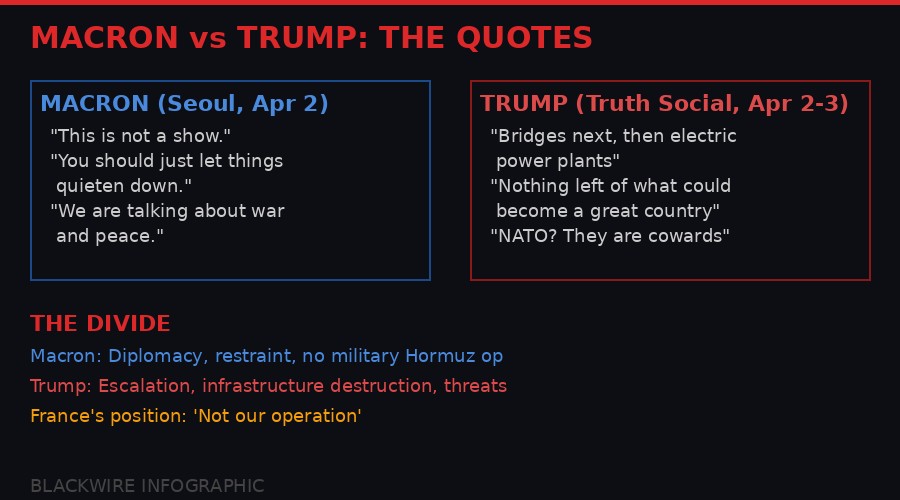
The transatlantic rift laid bare: Macron and Trump's positions on the Iran war are now irreconcilable. BLACKWIRE infographic.
Emmanuel Macron stood at a podium in Seoul on Thursday and did something no sitting European leader has done during five weeks of war: he told Donald Trump, publicly and without diplomatic softening, to shut up.
"This is not a show," the French president told reporters. "We are talking about war and peace and the lives of men and women."
His words landed as US warplanes were striking a civilian bridge in Karaj, west of Tehran, killing eight people and wounding nearly 100 - many of them families picnicking during the final hours of Nowruz, the Persian New Year. Trump posted footage of the destruction on Truth Social, promising "much more to follow" and declaring that "bridges next, then electric power plants" would be targeted.
The contrast was not subtle. One leader was calling for silence and seriousness. The other was broadcasting destruction footage like a highlight reel.
This is no longer a policy disagreement. This is a structural fracture in the Western alliance, unfolding on a live stage, with nuclear-armed allies on opposite sides of a fundamental question: Does bombing civilian infrastructure constitute a legitimate war strategy, or a war crime?
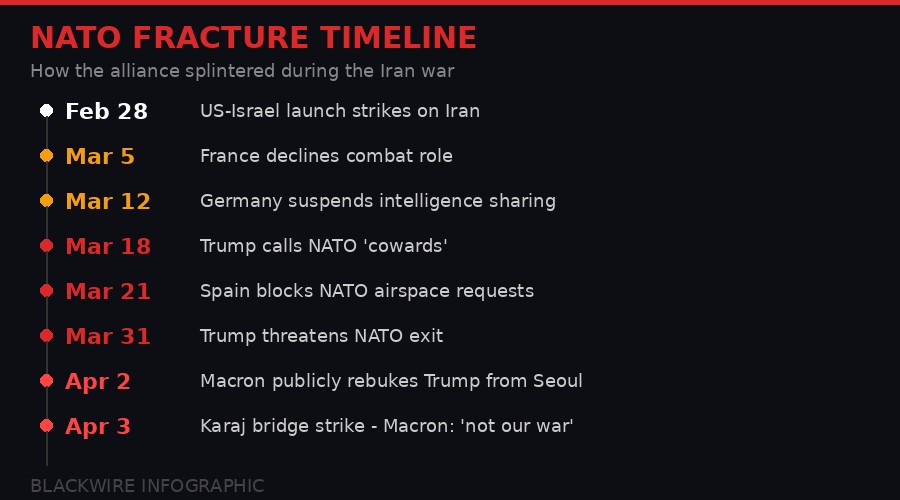
Five weeks of widening cracks: How the transatlantic alliance splintered step by step. BLACKWIRE infographic.
I. The Seoul Rebuke: What Macron Actually Said
Macron's comments in Seoul were calculated to the syllable. Arriving for a state visit to South Korea, he faced a press gaggle hungry for reaction to Trump's latest escalation threats. He did not dodge.
"When you want to be serious you don't say every day the opposite of what you said the day before. And maybe you shouldn't be speaking every day. You should just let things quieten down."
This was not the language of an ally expressing concern through back channels. This was a public dressing-down, delivered in English-language soundbites designed to travel. Macron was speaking to Washington, not Paris.
He went further, directly challenging the premise of the war itself. "I remind you that six months ago we were told that everything had been destroyed and all had been sorted out," Macron said - a reference to Operation Midnight Hammer, the June 2025 strikes on Iran's nuclear facilities that Trump declared a total success.
The French president argued that no amount of bombing could permanently solve the nuclear question. "You still have today and you'll still have in the future people who have the know-how, hidden laboratories," he said. "So it's not targeted military action even lasting a few weeks which can sort out the nuclear problem for good."
Then came the line that will define European-American relations for the remainder of this war: "I feel like there is too much chatter, it's all over the place." And the kill shot: "They then lament that they are alone in an operation they decided on alone. It's not our operation."
Not our operation. Four words that redraw the boundary of the transatlantic alliance. France, a NATO founding member and nuclear power, has formally distanced itself from the largest American military operation since Iraq. Not through a leaked memo or an anonymous diplomatic source - through a public statement by its head of state, delivered 9,000 kilometers from both Washington and Tehran.
The timing was surgical. Macron spoke within hours of Trump's Truth Social post showing the Karaj bridge strike, and within a day of Trump's nationally televised address to the American people on the war - a speech that echoed his past claims of victory without providing any pathway to ending the conflict or reopening the Strait of Hormuz. Macron waited for Trump to commit to his position, then publicly dismantled it.
Barbara Slavin, a distinguished fellow at the Stimson Center, told Al Jazeera that Trump is "scrambling" and trying to escalate the war before ending it. "I think that Donald Trump is looking for a way to end the war without it being an abject failure," Slavin said. "And so he is clutching at various straws at this time."
Macron's reading appears identical - but unlike American analysts, he said it on camera while representing a sovereign government.
II. The Karaj Bridge: When Infrastructure Becomes a Target
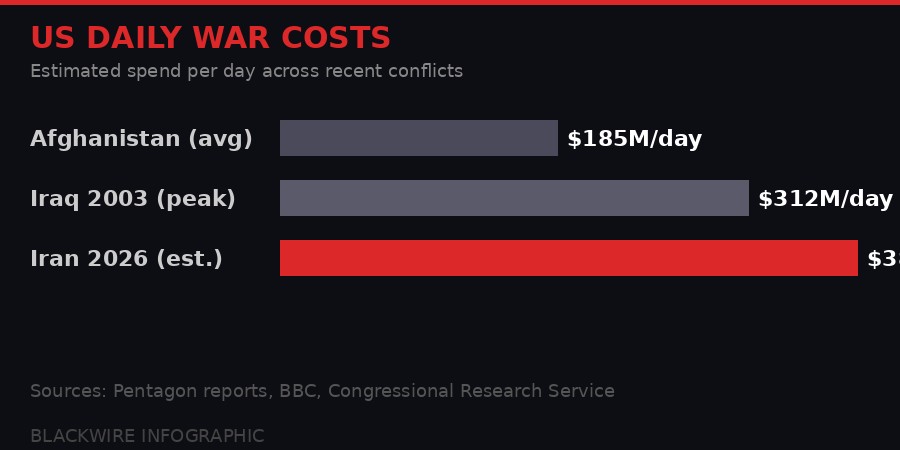
The Iran war costs an estimated $385 million per day - more than any US conflict in the 21st century. BLACKWIRE infographic.
The B1 suspension bridge in Karaj was not a military target. It was a civilian infrastructure project, partially constructed, intended to relieve traffic congestion in one of Iran's most densely populated metropolitan corridors. Karaj sits roughly 30 kilometers west of Tehran and is home to approximately 1.9 million people.
According to Iranian state media - and confirmed by BBC reporting from the region - the bridge was struck by US warplanes on Thursday. The attack killed at least eight people and wounded nearly 100, according to local officials. Many of those near the bridge were families who had gathered in the area for traditional Nowruz outdoor celebrations, which mark the end of the Persian New Year holiday period.
Iranian survivors described the scene with a mixture of shock and fury. A woman in her twenties in Tehran told the BBC, through a Starlink connection that itself carries the risk of imprisonment: "I feel helpless. He posts shamelessly about attacking our bridge. I don't know how much further this is going to go. Why is no one standing up to him? He's really taking us back to the Stone Age."
A Tehran resident in his twenties said: "We'll end up with a ruined country. I am more disappointed and saddened that I am in the middle of a situation where I see Iran being destroyed and I can't do anything. My country is being destroyed more and more every day."
Even pro-war Iranians - those who supported the initial military confrontation in hopes of regime change - expressed alarm. One young man from Karaj who described himself as "pro-war" said: "That bridge could have reduced the traffic in the city. This strike has got me worried. I don't know why they hit it."
Trump's response was characteristically unambiguous. He posted on Truth Social that the US military "hasn't even started destroying what's left in Iran," then followed up: "IT IS TIME FOR IRAN TO MAKE A DEAL BEFORE IT IS TOO LATE, AND THERE IS NOTHING LEFT OF WHAT STILL COULD BECOME A GREAT COUNTRY."
The escalation trajectory is clear. Within the past week alone, Trump has threatened Iranian bridges, electric power plants, and water desalination stations. As Al Jazeera reported, legal experts have noted that attacking civilian infrastructure constitutes collective punishment - prohibited under international humanitarian law, specifically the Fourth Geneva Convention and Additional Protocol I, Article 54, which bans the destruction of "objects indispensable to the survival of the civilian population."
The bridge strike is not an isolated incident. It follows a pattern that BLACKWIRE has documented across five weeks of conflict: the methodical destruction of Iran's non-military infrastructure - its steel plants, refineries, internet backbone, and now transportation networks. The stated goal shifts daily. The bombing does not.
III. The Hormuz Question: Why Macron Said 'Unrealistic'
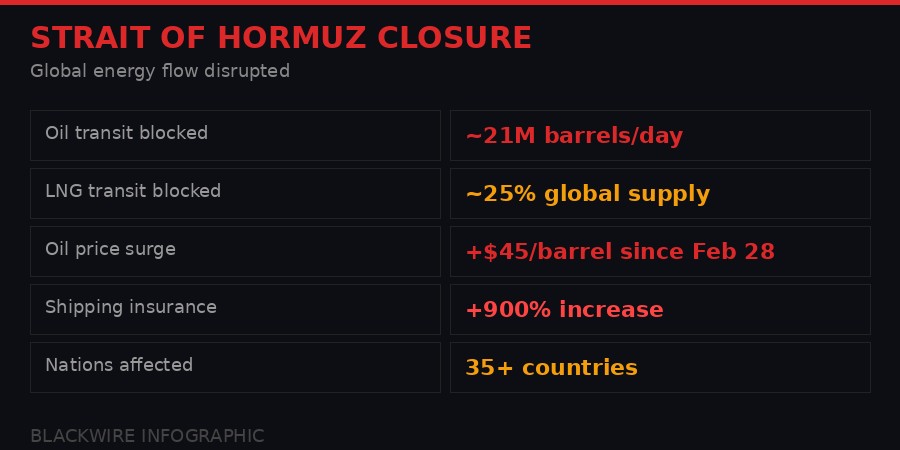
The economic stranglehold: Five weeks of Hormuz closure have reshaped global energy markets. BLACKWIRE infographic.
The Strait of Hormuz remains closed. Iran sealed it in the first days of the war, and five weeks later, roughly 21 million barrels of daily oil transit remain choked off. The economic consequences have been catastrophic for oil-importing nations across Asia and Europe, with Brent crude surging over $45 per barrel since the war began.
Trump's position on Hormuz has been contradictory from the start. He initially promised swift reopening, then pivoted to blaming European and Asian allies for not solving the problem themselves. His now-infamous "go get your own oil" remarks in early April crystallized the confusion: the US started a war that closed the strait, then told the countries most affected to fix it.
Macron addressed Hormuz directly in Seoul, and his assessment was blunt: a military operation to force the strait open would be "unrealistic."
His reasoning was technical, not political. "It would expose anyone crossing the strait to coastal threats from the Revolutionary Guards, who possess significant resources, as well as ballistic missiles, a host of other risks," Macron explained. The Iranian coastline along the strait bristles with anti-ship missile batteries, drone launch positions, and fast-attack craft bases. The IRGC Navy has spent decades preparing for exactly this scenario - a contested strait against a superior naval force.
Military analysts have broadly agreed with Macron's assessment. A forced opening would require sustained suppression of Iranian coastal defenses along hundreds of kilometers of shoreline, mine-clearing operations in some of the world's busiest shipping lanes, and continuous air cover for every commercial vessel transiting the passage. The risk of catastrophic escalation - a burning supertanker blocking the strait entirely - would be enormous.
The 35-nation Hormuz summit that convened without American participation reflected the global frustration. Countries that depend on strait transit are searching for diplomatic pathways because the military option is, as Macron said, a fantasy under current conditions.
Kuwait's Mina al-Ahmadi refinery was struck by Iranian drones again on Friday morning - the third time since the war began. The Kuwait Petroleum Corporation confirmed fires broke out in multiple operational units of the 346,000-barrel-per-day facility. No injuries were reported, but the message from Tehran is unmistakable: Gulf states remain within range, and Iran can touch their energy infrastructure at will.
The Gulf Cooperation Council's secretary general, Jassim al-Budaiwi, has called on the UN Security Council to guarantee "uninterrupted navigation through all strategic waterways." It is a plea that acknowledges what Macron stated explicitly: no single nation or alliance currently has the capacity to force Hormuz open without triggering a wider conflagration.
This leaves the global economy in a structural bind. Oil prices remain elevated. Shipping insurance costs have exploded by over 900% for Gulf routes. And the nations most dependent on Middle Eastern energy - India, Japan, South Korea, the Philippines - are absorbing price shocks that threaten domestic stability. India is already reporting rising costs for plastic and glass bottle production as raw material supply chains through the strait collapse. Beer and bottled water are getting more expensive because of a war Iran did not start.
IV. The NATO Fracture: Anatomy of an Alliance Coming Apart
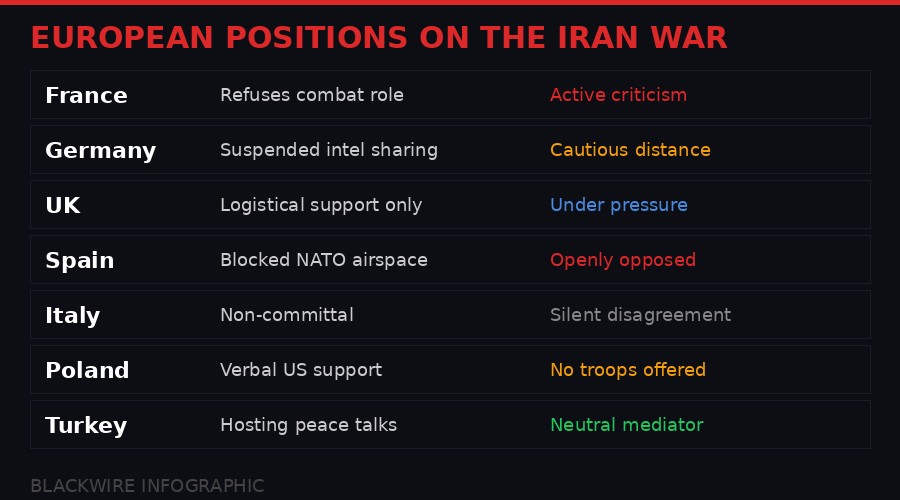
No consensus, no coalition: European governments have scattered across the spectrum on the Iran war. BLACKWIRE infographic.
NATO was built on a principle so simple it fits on an index card: an attack on one is an attack on all. Article 5 has been invoked exactly once, after September 11, 2001. The Iran war has exposed the fragility of that compact when the attacking party is the alliance's leader.
The fracture did not begin with Macron's Seoul remarks. It has been building for five weeks, accelerating with each US escalation and each European refusal to participate.
France declined a combat role in the first week. Germany suspended intelligence sharing by mid-March. Spain blocked NATO airspace requests for operations connected to the Iran campaign in late March. Trump's response was to call European allies "cowards" and threaten to withdraw from NATO entirely - a threat he made in a primetime national address just days ago.
Macron's comment about NATO was perhaps his most cutting. "Alliances like NATO are valuable because of what is unspoken - meaning the trust behind them," he said. Casting doubt on commitments "emptied it of its substance." Partners "sign agreements and show up if issues arise, rather than commenting on them every day to say that you will or will not respect them."
This is a direct response to Trump's pattern of treating NATO membership as a transactional loyalty test rather than a structural security arrangement. The French position is that the alliance's value lies in its reliability, not its rhetoric - and that threatening to leave undermines the deterrent value that justifies the alliance's existence.
The UK has attempted to straddle the divide, providing logistical support while avoiding direct combat involvement. British bases in Bahrain and Cyprus have served as staging points for operations, but Prime Minister Starmer has faced domestic pressure to clarify whether British forces are actively participating in strikes on Iranian soil. The ambiguity is intentional but increasingly untenable.
Poland and the Baltic states have offered verbal support for the US position but no troops, no aircraft, no material contribution beyond diplomatic cover. Italy has been conspicuously silent. Turkey, a NATO member that shares a maritime border with the conflict zone, has positioned itself as a neutral mediator, hosting peace talks in Istanbul while maintaining its own economic relationship with Tehran.
The result is an alliance that exists on paper but functions as a collection of bilateral relationships, each calibrated to its own domestic political risk. NATO's secretary general has issued statements calling for "unity and resolve" - language so generic it confirms the absence of both.
Macron's Seoul statement makes the quiet part loud. France does not consider this its war. France does not believe bombing will solve the nuclear problem. France does not think forcing Hormuz open is militarily viable. France thinks the US president talks too much and contradicts himself too often. These are not subtle diplomatic signals. These are positions staked out in public by a head of state who has decided that the cost of silence now exceeds the cost of confrontation.
V. Trump's Domestic Bind: The Speech That Didn't Convince
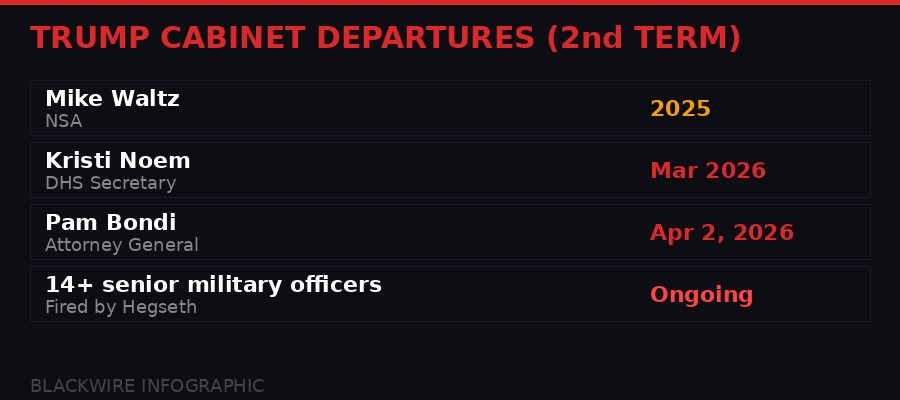
The revolving door reopens: Major departures from Trump's second-term cabinet and military leadership. BLACKWIRE infographic.
Trump's nationally televised address on Wednesday was supposed to be the reset. Five weeks into a war with no clear end state, rising American casualties, soaring gas prices, and declining poll numbers, the White House needed a narrative of purpose and progress. The speech delivered neither.
Trump repeated his claim that the war was being won, pointed to the destruction of military targets, and warned Iran to "make a deal." But he provided no specifics on what a deal would look like, no timeline for withdrawal, and no plan for reopening the Strait of Hormuz - the single issue causing the most economic pain to American consumers and global markets alike.
The war has cost an estimated $385 million per day, according to expert analysis compiled by the BBC. Total expenditure since February 28 has exceeded $13 billion and counting. The Pentagon's initial report to Congress, filed just six days into the conflict, already stood at $11.3 billion. US officials claim costs have declined as Iran's defensive systems weaken, but independent estimates suggest the daily burn rate remains among the highest for any American military operation in the 21st century.
At home, the political terrain is shifting. Trump's approval on handling the war has dropped to 41%, with 59% of Americans expressing disapproval in recent polling. Gas prices have crossed $4 per gallon in most of the country. The war powers debate in Congress has grown louder, with the constitutional 60-day deadline for legislative authorization of the conflict looming within weeks.
Defense Secretary Pete Hegseth added fuel to the fire on Thursday by asking Army Chief of Staff General Randy George to step down "effective immediately." George, a career infantry officer who served in the first Gulf War, Iraq, and Afghanistan, was nominated for the position by President Biden in 2023. His removal marks at least the fourteenth senior military officer fired by Hegseth since entering the Pentagon.
Pentagon spokesperson Sean Parnell said they were "grateful for General George's decades of service" but that "it was time for a leadership change in the Army." George will be replaced by Army Vice Chief of Staff General Christopher LaNeve, described by Parnell as "completely trusted by Secretary Hegseth to carry out the vision of this administration without fault."
The phrase "without fault" stands out. In the context of a wartime military purge, it reads less as confidence and more as a loyalty oath. Combined with the firing of the Chief of Naval Operations and Air Force Vice Chief of Staff in recent weeks, the pattern suggests that Hegseth is constructing a command structure defined not by competence or experience, but by alignment with administration messaging.
This is the domestic context Macron is speaking into. An American president who cannot articulate an exit strategy, a defense secretary replacing wartime commanders at an unprecedented rate, and a legislative branch that has neither authorized the war nor stopped it. From Seoul, Macron can see what many in Washington cannot or will not say: this war has no plan, and the people running it are making it up as they go.
VI. Iran's Posture: Hitting Back While the World Watches
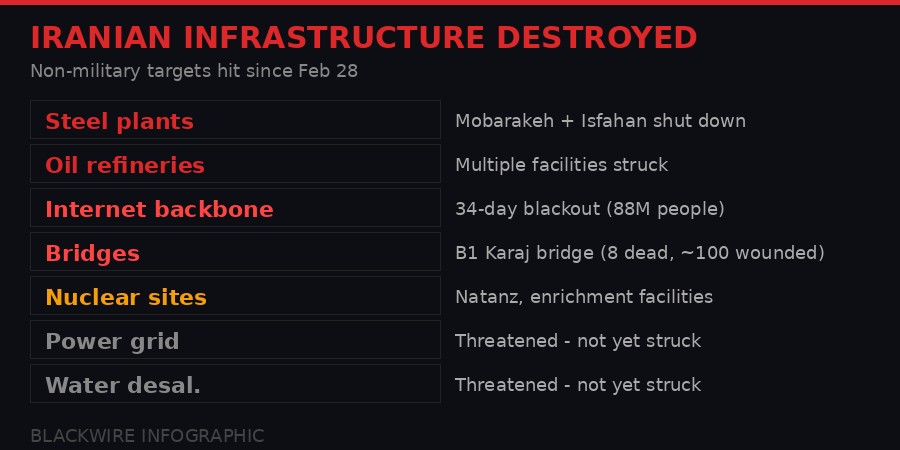
Beyond military targets: The systematic destruction of Iran's civilian and industrial infrastructure. BLACKWIRE infographic.
Tehran has not been passive. Even as its civilian infrastructure burns, Iran has maintained a retaliatory tempo that demonstrates both resilience and strategic calculation.
Overnight on Thursday into Friday, Iranian forces launched missiles toward Israel, with the IDF confirming defensive systems were activated to intercept the barrage. A train station in Tel Aviv was damaged by shrapnel, and a cluster warhead was fired at central Israel - damaging property at multiple sites but producing no reported casualties.
The Kuwait refinery strike on Friday morning represents the third Iranian drone attack on the Mina al-Ahmadi facility since the war began. Kuwait Petroleum Corporation confirmed fires in "several operational units" and said emergency teams were working to contain the blazes. The facility processes up to 346,000 barrels of crude per day and is one of the largest refineries in the Middle East.
Iran's two largest steel plants - at Mobarakeh and Isfahan - have been shut down after Israeli and American airstrikes, according to Iranian state media and BBC reporting. The steel industry is a pillar of Iran's non-oil economy, and its destruction represents a deliberate strategy to inflict long-term economic damage beyond the war's immediate military objectives.
The 34-day internet blackout continues. Iran's population of 88 million remains largely cut off from the global internet, making it the longest wartime communications shutdown in modern history. Those who can connect - primarily through smuggled Starlink terminals, which carry a two-year prison sentence for possession - report a population caught between patriotic anger at foreign bombardment and desperate frustration with their own government's inability to protect them.
Iran's foreign policy has not collapsed, despite the intensity of the assault. Argentina expelled an Iranian diplomat this week amid a rift over blacklisting the IRGC. The GCC continues to demand UN intervention. And Iranian negotiators have engaged with FIFA over World Cup participation logistics, a surreal parallel track that underscores Tehran's determination to project normalcy even as its bridges burn.
The US State Department continues to insist that diplomacy remains an option. Spokesperson Tommy Pigott told Al Jazeera on Thursday that "the president is always open to diplomacy," adding that the administration has been engaged at "the highest levels" with regional partners. But he also accused Iran of attacking "civilians and civilian infrastructure" - a statement that, given the Karaj bridge strike, lands with a degree of irony that the spokesperson appeared not to register.
Iran has rejected negotiations over its missile program, its support for Hezbollah and Hamas, and its right to enrich uranium domestically. These are the same conditions the US imposed before Midnight Hammer. They remain non-starters for Tehran. Without movement on either side's preconditions, "openness to diplomacy" is a phrase without substance - performance for cameras that both sides know will not lead to talks.
VII. The Bondi Exit: Washington Eats Its Own
While the world watches the Iran war, Washington's internal politics continue to consume their own. Trump removed Attorney General Pam Bondi on Thursday - a longtime ally who had served as one of his most visible defenders during both his impeachment and his criminal trial in New York.
Bondi's tenure was dominated by the Epstein files saga. She promised transparency. The Department of Justice said no client list existed. Congress eventually forced the release of millions of documents through legislation. Bipartisan backlash followed. Republican Congressman Thomas Massie celebrated her departure, writing: "I hope the next AG will release all the Epstein files according to the law and follow up with investigations, prosecutions and arrests."
Democrat Ro Khanna told the BBC that lawmakers should refuse to confirm her replacement, Todd Blanche, unless he commits to "investigating and prosecuting this Epstein class - this group of men who felt that they could write their own rules."
Bondi's firing is the third major cabinet departure of Trump's second term, following Kristi Noem's ouster from DHS and National Security Adviser Mike Waltz's earlier removal. The revolving door that defined Trump's first term - a period that saw the departure of an acting AG, an NSA, an FBI director, a chief of staff, a chief strategist, and two press secretaries in the first year alone - appears to be reopening.
The connection to the Iran war is indirect but real. Bondi's removal consumes domestic political oxygen at a moment when the administration needs unified messaging on its most consequential foreign policy gamble. Each firing, each scandal, each internal reshuffling dilutes the focus that a wartime government requires. Macron can criticize Trump's war strategy with impunity in part because Washington is too busy devouring itself to mount a coherent response.
VIII. The Myanmar Shadow: Another Coup Leader Gets a Title
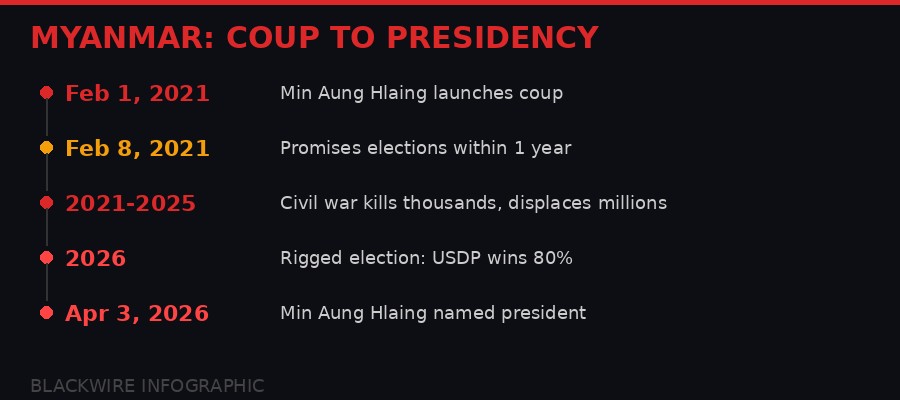
Five years from coup to coronation: Min Aung Hlaing's path from military dictator to president. BLACKWIRE infographic.
While the world's attention is consumed by Iran, other authoritarian consolidations proceed in the darkness. Myanmar's General Min Aung Hlaing, who launched the 2021 coup that plunged the country into civil war, has been formally chosen as president by a parliament stacked with his loyalists.
The military guaranteed itself one quarter of parliamentary seats. Its party, the USDP, won nearly 80% of the remaining contested seats in an election tilted heavily in its favor. Min Aung Hlaing stepped down as armed forces commander to take the presidency, replacing himself at the top of the military with General Ye Win Oo, a hardliner described by analysts as a loyalist whose family maintains close ties to Min Aung Hlaing's.
The BBC's Jonathan Head, reporting from Nay Pyi Taw, described the event as "more of a coronation than an election." Five years after promising to hold elections within one year, Min Aung Hlaing has delivered civilian rule in name only.
The civil war continues. Resistance groups still control approximately 90 towns. The military has responded with air and drone strikes on civilian areas, scorched-earth campaigns, and a "four cuts" strategy designed to devastate communities supporting insurgent groups. ACLED analyst Su Mon told the BBC: "The conflict in Myanmar will remain largely unchanged. The new commander-in-chief is likely to follow in Min Aung Hlaing's footsteps, first and foremost to regain control of lost territory."
The parallel to Iran is uncomfortable but instructive. Both conflicts feature massive civilian suffering. Both involve international communities that express concern but take no meaningful action. Both benefit from a global attention economy that can only hold one crisis at a time. Myanmar's five-year civil war, which has killed thousands and displaced millions, barely registers in international headlines because Iran's five-week war is louder.
This is the cost of spectacle-driven conflict. The noisiest war gets the coverage. The longest war gets forgotten.
IX. What Happens Next: The Unraveling Scenarios
Five weeks into the Iran war, the range of plausible outcomes is narrowing in ways that should alarm everyone.
Scenario 1: Escalation to power grid attacks. Trump has explicitly threatened Iran's electric power plants. If carried out, these strikes would plunge large portions of a country of 88 million into darkness. Combined with the existing internet blackout, this would create a humanitarian crisis of a magnitude not seen in the Middle East since the worst days of the Iraq War. Macron's rebuke suggests Europe would not provide political cover for such an escalation.
Scenario 2: Forced Hormuz operation. Trump's frustration with the strait's closure is growing, and his "go get your own oil" rhetoric suggests he wants someone else to bear the cost of reopening it. But as Macron stated, a military operation against Iranian coastal defenses is impractical without sustained suppression that would amount to a second war within the war. No volunteer has stepped forward.
Scenario 3: Quiet de-escalation through back channels. Pakistan has hosted peace talks. Turkey has offered mediation. The US State Department insists it is engaged diplomatically. But Iran's preconditions have not changed, and Trump's public threats make it nearly impossible for Tehran to appear to negotiate under duress without losing face domestically. Quiet de-escalation requires quiet. Trump does not do quiet.
Scenario 4: Congressional intervention. The War Powers Resolution gives Congress the authority to compel withdrawal if no authorization is granted within 60 days. That clock is ticking. But the current Congress has shown no appetite for confrontation with the White House on military matters, and the political risk of appearing to "lose" a war in an election cycle remains prohibitive for most lawmakers.
Scenario 5: Attrition and drift. The most likely outcome - and the worst. The war continues at its current intensity, burning through hundreds of millions of dollars daily, destroying Iranian infrastructure piece by piece, while Iran retaliates against Gulf states and Israel with diminishing but persistent missile and drone strikes. No deal is reached. No exit is planned. The war becomes the new normal, with oil prices permanently elevated and the global economy restructuring around a world where the Strait of Hormuz is a permanent conflict zone.
Macron's intervention in Seoul changes none of these scenarios directly. France does not have the military leverage to stop the war or the diplomatic leverage to force a deal. What Macron has done is remove the pretense. The Western alliance is not united behind this war. Europe is not on board. The "coalition" is the United States and Israel, with logistical assistance from the UK and reluctant tolerance from everyone else.
That honesty is not a solution. But it is a precondition for one. You cannot fix a fracture you refuse to diagnose.
X. The View From 9,000 Kilometers
There is something clarifying about distance. From Seoul, Macron can see the Iran war in a way that no one inside Washington or Tehran can. He sees an American president who started a war, can't end it, and is escalating to avoid admitting it was a mistake. He sees an Iranian government that is absorbing punishment but refusing to capitulate, because capitulation under bombardment would mean the end of the regime. He sees a global economy hostage to a strait that no one can open. And he sees an alliance - his alliance - being asked to support a strategy that changes every 24 hours.
His response was to say, out loud, what every European capital has been whispering since February: this is America's mess. They made it. They won't clean it up. And we're not going to pretend otherwise.
"I feel like there is too much chatter, it's all over the place."
That sentence, spoken by the president of France about the president of the United States during a live war, will be studied in foreign policy seminars for decades. It is not a declaration of opposition. It is something more dangerous to the American position: a declaration of irrelevance.
Macron is not saying Trump is wrong. He is saying Trump is not serious. And in the world of international diplomacy, that is a verdict from which reputations do not recover.
The Iran war enters its sixth week with no ceasefire in sight, no diplomatic framework for resolution, and a Western alliance that has fractured along lines that may take a generation to repair. The bridges being destroyed are not just in Karaj.
Sources: BBC News, Al Jazeera, AP News, NPR, AFP, Kuwait Petroleum Corporation, US State Department, French Presidential Office, Pentagon/DoD statements, Congressional Research Service, ACLED. All quotes sourced from direct reporting by these outlets.
Get BLACKWIRE reports first.
Breaking news, investigations, and analysis - straight to your phone.
Join @blackwirenews on Telegram