The Deposed President in the Dock: Maduro Returns to Court
83 days after US special forces dragged him out of the Miraflores Palace, Nicolas Maduro sits in a Brooklyn detention cell awaiting a New York judge. The charges could put him away for life. The precedent could reshape international law forever.

A US federal courtroom. Maduro appears before Judge Alvin Hellerstein in the Southern District of New York. (Pixabay)
The man who ruled Venezuela for thirteen years arrived at the Daniel Patrick Moynihan United States Courthouse in Manhattan in handcuffs. No presidential motorcade. No cheering crowds. On Thursday, March 26, Nicolas Maduro - the bus driver's son who became a head of state, who outlasted coups, sanctions, opposition uprisings, and hyperinflation - returned to a federal courtroom to argue that the charges against him should be dismissed entirely.
He will not succeed. Legal experts from Bogota to Brussels have said so. But the hearing is not really about the charges. It is about something much larger: whether a sitting head of state can be physically seized from his own capital by a foreign military force, dragged across international borders, and placed before a court that his captors both financed and assembled.
That question has no clean answer. And the United States government - which planned the January 3 operation, executed it, and is now prosecuting its primary target - is counting on the noise around the Iran war to keep the world from asking it too loudly.
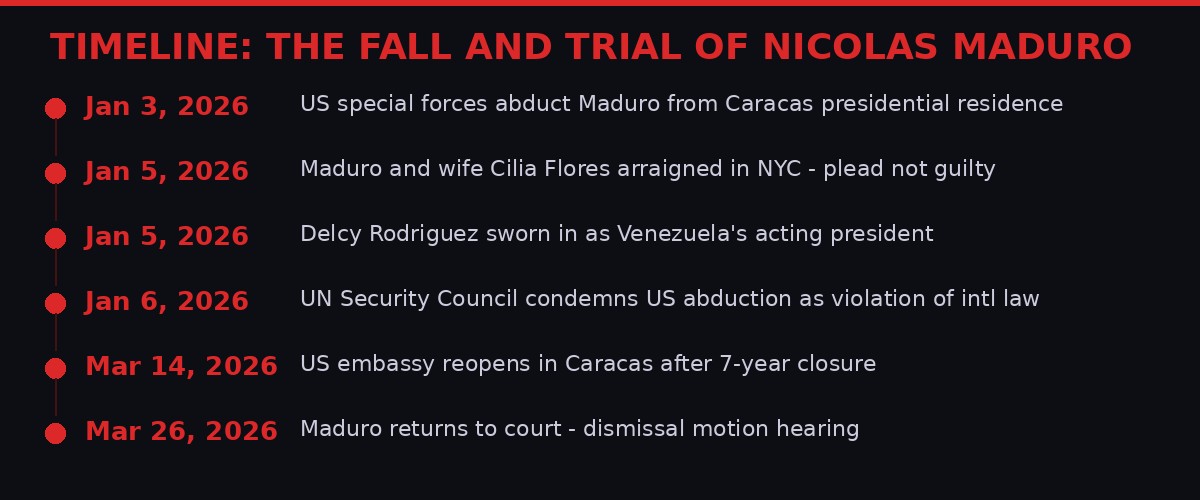
Key events from Maduro's abduction to today's court hearing. (BLACKWIRE infographic)
January 3: The Operation
Shortly before dawn on January 3, 2026, US special operations forces landed in Caracas. The details of the operation remain classified - the Trump administration has not disclosed how many personnel were involved, whether Venezuelan military units facilitated access, or what exactly happened to the palace security detail. What is documented: Maduro and his wife, Cilia Flores, were taken from the Miraflores Presidential Palace and flown by helicopter to a US warship positioned off the Venezuelan coast. From there, they were transported to New York. (Sources: Al Jazeera, Reuters)
The indictment against Maduro had been filed in the Southern District of New York under seal before Christmas Day, December 25, 2025. It was unsealed on the day of his abduction. The simultaneity was deliberate - a legal architecture constructed and ready before the soldiers moved.
US Attorney General Pam Bondi announced the arrests on X. "Nicolas Maduro and Cilia Flores will soon face the full wrath of American justice on American soil in American courts," she wrote. US Secretary of State Marco Rubio and Joint Chiefs Chairman Dan Caine described it to reporters as a "law enforcement function" - a framing designed to sidestep the War Powers Act and congressional notification requirements. Rubio said it was a case where "the Department of War supported the Department of Justice."
At the UN Security Council, the condemnations came quickly. China and Russia called it an illegal act of state kidnapping. Even several US allies expressed discomfort. The secretary-general's office issued a statement emphasizing the UN Charter's protections of state sovereignty. None of it stopped anything. (Source: Al Jazeera)
"I was kidnapped. I am innocent and a decent man, the president of my country." - Nicolas Maduro, at his January 5 arraignment, SDNY Courthouse

Washington constructed the legal case against Maduro before the operation was launched. (Pixabay)
The Charges: What the Indictment Actually Says
The indictment is 47 pages. It accuses Maduro and five co-defendants of running what prosecutors describe as a decades-long cocaine trafficking operation woven into the apparatus of the Venezuelan state. Four counts: narcoterrorism conspiracy, cocaine importation conspiracy, possession of machineguns and destructive devices, and conspiracy to possess machineguns. Maximum sentence: life in prison, on each count. (Source: DOJ SDNY Indictment)
The narcoterrorism count is the centerpiece. It alleges that Maduro and his inner circle knowingly provided financial value to organizations designated as foreign terrorist organizations by the US government, including the FARC dissidents, Segunda Marquetalia, the National Liberation Army (ELN), Mexico's Sinaloa Cartel, Los Zetas/Cartel del Noreste, and Tren de Aragua.
The cocaine count accuses Maduro of conspiring to move "thousands of tons" of cocaine through Venezuela and into the United States, with Venezuelan diplomatic infrastructure used to provide cover for money laundering operations. The indictment alleges that Venezuelan diplomatic passports were provided to drug traffickers, and that planes used for money laundering flew under diplomatic cover.
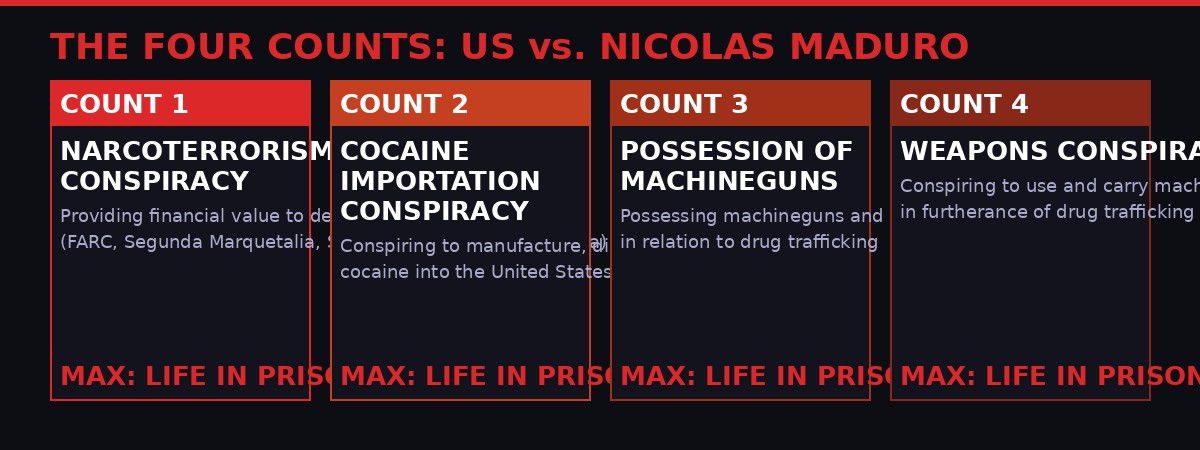
The four criminal counts Maduro faces, each carrying a maximum life sentence. (BLACKWIRE infographic)
The charges are the same as those filed against Maduro in an earlier 2020 indictment during Trump's first term. That indictment was never prosecuted because Maduro was, at the time, beyond US jurisdictional reach. The Trump administration resolved that problem by removing him from that jurisdiction and relocating him to New York.
Legal scholars have raised pointed questions about the evidentiary basis. Venezuela is not a major cocaine producer - the 2023 UNODC World Drug Report placed cocaine cultivation overwhelmingly in Colombia, Peru, and Bolivia, with Venezuela serving as a minor transit corridor. "If they read the indictment... you could probably use that same indictment against any prime minister or president in the world where there's drug trafficking going on inside the country," said Charles Shapiro, a former US ambassador to Venezuela, speaking to Al Jazeera in January. (Source: Al Jazeera, January 2026)
Further complicating the government's case: the Trump administration originally accused Venezuela of trafficking fentanyl, calling it a "weapon of mass destruction." When the charges were announced, fentanyl was conspicuously absent from the indictment. US intelligence agencies had already stated there was no evidence linking Maduro to Tren de Aragua, despite Trump's repeated public claims to the contrary. (Source: AP News)
The Co-Defendants: Maduro's Circle Behind Bars and Abroad
Maduro is not alone in the indictment. Five others are charged: his wife Cilia Flores, currently held alongside him in a Brooklyn detention center; his son Nicolas Maduro Guerra, a Venezuelan politician; Diosdado Cabello, Venezuela's interior minister and former National Assembly president; Ramon Rodriguez Chacin, the former interior minister; and Hector Rusthenford Guerrero Flores, known as "Nino Guerrero," the alleged leader of Tren de Aragua.
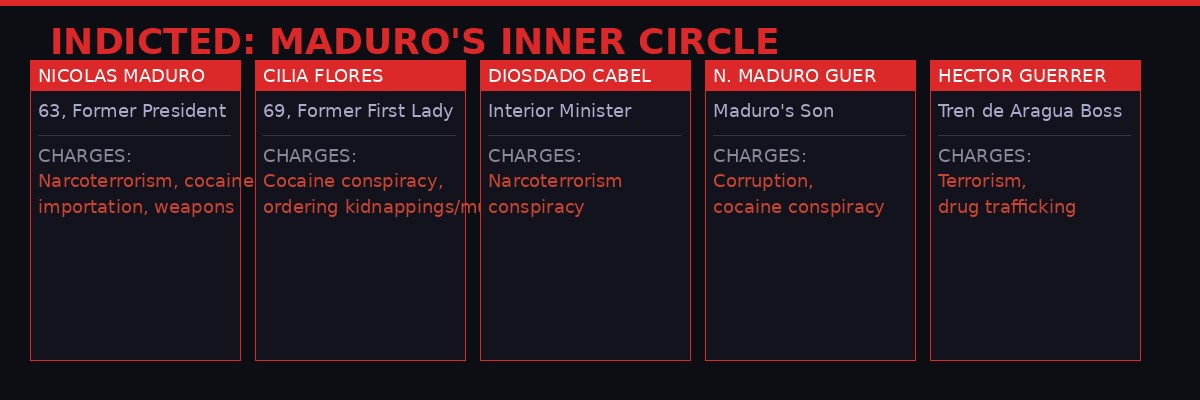
The six defendants named in the SDNY narcoterrorism indictment. (BLACKWIRE infographic)
Flores is perhaps the most consequential co-defendant. Known as the "primera combatiente" - the first combatant - she is a veteran attorney who rose to prominence defending Hugo Chavez after his failed 1992 coup attempt and helped secure his release. She served as the first woman to preside over Venezuela's National Assembly and was the architect of much of the Chavismo legal framework. The indictment accuses her of ordering "kidnappings, beatings, and murders against those who owed drug money or otherwise undermined their drug trafficking operation." (Source: Al Jazeera)
Cabello, Maduro's longtime right-hand man, was not captured. He remains in Venezuela, where acting president Delcy Rodriguez has moved to consolidate her own power base, removing figures loyal to Maduro including, notably, Cabello himself from key positions. Whether and when the US will attempt to extradite the remaining co-defendants is unknown. The Venezuelan government under Rodriguez has shown no inclination to hand over its own officials.
Maduro's son and the Tren de Aragua boss are similarly outside US custody. The DOJ has not publicly stated any extradition requests. The prosecution is proceeding primarily with the two defendants physically present in New York.
"For over 25 years, leaders of Venezuela have abused their positions of public trust and corrupted once-legitimate institutions to import tons of cocaine into the United States." - DOJ Indictment, SDNY, unsealed January 3, 2026
March 26: What Happens in Court Today
Today's hearing before Judge Alvin Hellerstein centers on Maduro's defense team's motion to dismiss the indictment. His attorney, Barry J. Pollack, has argued multiple grounds: the legality of the military abduction itself, Maduro's status as a head of state entitled to sovereign immunity, and the constitutional questions raised by the US government blocking Venezuelan state funds from paying his legal costs. (Source: Al Jazeera, March 26, 2026)
The sovereign immunity argument is the strongest legally, and the least likely to succeed practically. Under customary international law, sitting heads of state enjoy broad immunity from foreign prosecution. But the US position is that Maduro was not a legitimate head of state - the Trump administration considers the 2024 Venezuelan election fraudulent, a position shared by the Carter Center and nine Latin American governments. If Maduro was not a legitimate president, the argument goes, he cannot claim presidential immunity.
The abduction legality argument is thornier. International law scholars at institutions from Kingston University to Birkbeck College have stated clearly that the operation violated Venezuela's sovereignty under the UN Charter. Professor Elvira Dominguez-Redondo at Kingston University told Al Jazeera in January: "From the outside, it is impossible to know what the next steps of the US will be, particularly given the contradictory public statements coming from senior figures... I can say, based on observable facts, that there is no full-scale military invasion or formal assumption of governmental authority by the US." (Source: Al Jazeera)
But US courts have historically allowed prosecutions of defendants brought into US jurisdiction through unlawful means - the "Ker-Frisbie doctrine" holds that a court's jurisdiction is not necessarily invalidated by the manner in which the defendant was brought before it. Pollack will argue for an exception based on the magnitude of the government misconduct involved. Legal observers say this is unlikely to succeed at the district court level. Appeals could drag on for years.
Judge Hellerstein has yet to set a trial date. That announcement could come today. When it does, it will mark the formal beginning of a trial that will force every US ally, and every country that ever wanted to believe in state sovereignty, to decide what they actually think of American power in the twenty-first century.

The case raises fundamental questions about the reach of US law enforcement beyond its borders. (Pixabay)
Venezuela Without Maduro: The Rodriguez Interregnum
While Maduro sits in Brooklyn, Venezuela is being remade. Acting President Delcy Rodriguez was sworn in within hours of his abduction. She has moved methodically since then - removing Maduro loyalists from key government positions, reshaping the national assembly, replacing ambassadors, and dismantling core elements of the self-declared socialist project that Chavismo represented for over two decades. (Source: Al Jazeera, March 2026)
Her primary task has been managing Washington. The Trump administration has been explicit about what it wants: open access to Venezuela's oil reserves, an end to Venezuelan oil flowing to Cuba and other US adversaries, cooperation on drug interdiction, and the gradual removal of the Chavismo political structure. Rodriguez has delivered on most of these demands.
Approximately 80 million barrels of Venezuelan oil have already been transferred into US hands, with proceeds deposited in a US-controlled bank account split between the two countries. The US lifted sanctions on Venezuelan gold sales in March, issuing a limited license following a high-level visit. The Venezuelan national oil company PDVSA, once a symbol of state sovereignty under Chavez, is now operating under a framework that gives Washington substantial oversight over its revenues. (Source: Al Jazeera, March 14)
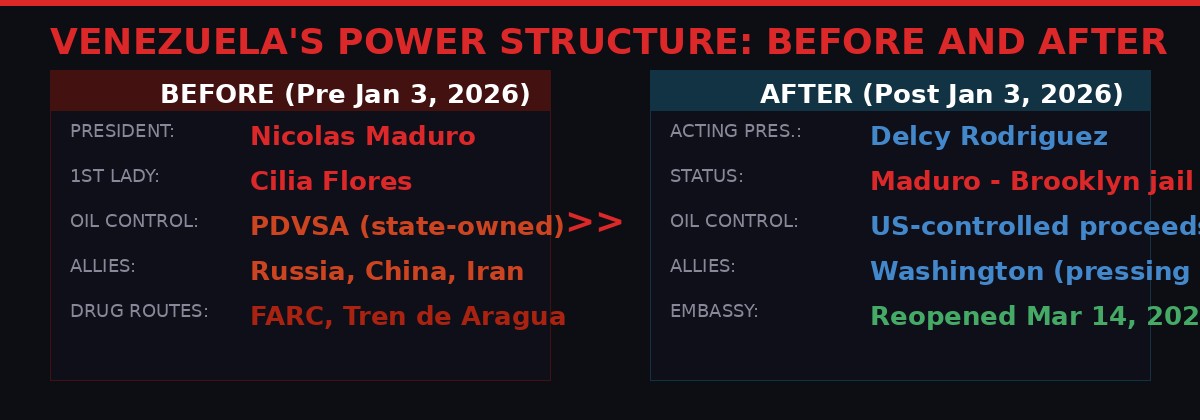
Venezuela's power structure before and after Maduro's removal. (BLACKWIRE infographic)
On March 14, 2026 - exactly seven years to the day after the US flag was lowered at the Caracas embassy in 2019 - Charge d'Affaires Laura Dogu raised it again. "A new era for US-Venezuela relations has begun," she wrote on social media. "Onward with Venezuela." The Trump administration called it a milestone. Critics called it a colonial inauguration.
Trump has also been direct about the coercive dimension. In an interview with The Atlantic published January 4, he warned Rodriguez: "If she doesn't do what's right, she is going to pay a very big price, probably bigger than Maduro." The message required no interpretation. Rodriguez has since been scrupulously cooperative. She has urged Trump to ease remaining sanctions, championed laws opening Venezuela's nationalized oil and mining sectors to foreign investment, and avoided any public statement that could be read as defending Maduro or criticizing Washington.
Meanwhile, Maduro's base still exists. Murals and billboards across Caracas demand his return. His ruling party, despite being hollowed out by Rodriguez's purges, retains organizational infrastructure. The question is whether that base can reconstitute itself around a leader rotting in a Brooklyn jail cell, or whether Chavismo - as a political project - dies with its second figure in custody.
The International Fallout: Sovereignty as a Negotiable Concept
No country that matters to Washington has moved beyond statements of condemnation. Russia and China condemned the operation at the UN. Latin American governments from Mexico to Brazil expressed alarm. But actual consequences - sanctions, diplomatic expulsions, trade disruptions - have not materialized. The United States has once again tested the limits of what the international community will tolerate, and the answer, as usual, is quite a lot.
The operation has been cited extensively in the academic literature on "forcible abductions for law enforcement purposes." The US has done this before - the 1989 Panama operation that captured Manuel Noriega is the most prominent historical parallel. But Noriega was captured during a declared military invasion. The Venezuela operation had no congressional authorization, no formal declaration of war, no invocation of emergency powers. Rubio's framing of it as a "law enforcement function" supported by the military is legally novel and, most international law experts say, without precedent. (Source: Multiple international law scholars cited by Al Jazeera)
"American sweat, ingenuity and toil created the oil industry in Venezuela. Its tyrannical expropriation was the largest recorded theft of American wealth and property." - Stephen Miller, Senior Trump Adviser, December 2025
The resource dimension matters here. Stephen Miller's December 2025 social media posts framing Venezuelan oil as stolen American property were not rhetorical accidents. The Trump administration has openly stated it intends to "run" Venezuela and control its oil sales "indefinitely." International law guarantees every country "permanent sovereignty" over its own natural resources. That principle, enshrined in UN General Assembly Resolution 1803 from 1962, is now effectively suspended for Venezuela. (Source: Al Jazeera; UNGA Res. 1803)
The precedent is not lost on other governments. If a US president can decide that another country's leader is illegitimate, then send special forces to abduct that leader, then control that country's oil revenues while prosecuting him in a US court - the entire architecture of post-colonial sovereignty law is provisional. It depends entirely on whether the target country can defend itself, and whether the international community is willing to push back. Venezuela could not. The international community did not.
Cuba is now under an oil blockade. The Trump administration has cut off Venezuelan oil supplies to Havana and is pressing Mexico and Central American governments on multiple fronts simultaneously. The Maduro prosecution is one node in a wider Western Hemisphere restructuring that the Trump administration is executing without apparent concern for historical norms. (Source: Al Jazeera, Reuters)

Caracas under Rodriguez: the Venezuelan capital navigates a US-managed transition. (Pixabay)
What the Trial Will Look Like - And When
If Judge Hellerstein denies the dismissal motion - which legal observers expect - the case moves toward trial. The DOJ has indicated it is prepared. The evidence base includes wiretaps, financial records, cooperating witnesses from the Colombian and Mexican drug trade, and testimony from defectors within the Venezuelan military and intelligence services who have been building their cases for years under the Department of Justice's Venezuela-focused task force.
Maduro's defense will focus on three angles. First, the abduction argument: even if the Ker-Frisbie doctrine generally permits prosecution of unlawfully seized defendants, the doctrine has a "government misconduct" exception for cases where the conduct is sufficiently outrageous. Seizing a sitting head of state in a military raid on a foreign capital is about as outrageous as it gets. Second, the evidence quality: much of the DOJ's case rests on testimony from cooperating witnesses who have strong incentives to tell the government what it wants to hear. Third, the political dimensions - Maduro will argue throughout that the charges are a pretext for geopolitical regime change, and that the US government's own internal contradictions (dropping the fentanyl claims, acknowledging Tren de Aragua was not directly controlled by Maduro) undermine the credibility of the prosecution.
None of this will be resolved today. The hearing is procedural - a motion hearing, not a trial. But what Hellerstein says, and how he says it, will signal the trajectory of the most consequential foreign leader prosecution in American history. Even Noriega's 1990s trial, which resulted in a 40-year sentence later reduced, did not involve a sitting head of state abducted from his own capital in a peacetime military operation.
A trial date, if set today, could realistically place proceedings sometime in late 2026 or early 2027. Pretrial motions will consume months. The discovery process will be massive - the DOJ has indicated it has evidence spanning decades. Pollack's "voluminous" pretrial filings promise to challenge every aspect of the government's case from jurisdiction to admissibility to the identity of cooperating witnesses.
And in the meantime, Venezuela's oil keeps flowing into US-controlled accounts. Rodriguez keeps dismantling Chavismo. Murals of Maduro fade on Caracas walls. And in a Brooklyn detention facility, the man who once proclaimed himself the heir to Simon Bolivar's revolutionary legacy waits for a judge to tell him whether the case against him can even begin. (Source: Al Jazeera, Reuters)
The Broader Pattern: US Power and the New Rules
The Venezuela operation did not happen in isolation. It was the culmination of a policy trend that accelerated sharply across 2025 and into 2026. Trump deployed warships and thousands of service members to the Caribbean in August 2025. Dozens of strikes on alleged Venezuelan drug boats killed more than 100 people. The indictment was prepared under seal. The operation was planned. The execution was precise.
What it reveals is a US administration willing to exercise military force in ways that previous administrations treated as red lines. The Obama administration pressured Venezuela through sanctions. The first Trump term applied maximum economic pressure. The second Trump term removed the target physically.
The Iran war has partially obscured this. With the Strait of Hormuz contested and US paratroopers in the Gulf, Venezuela barely registers in most international news cycles. That obscurity is useful. It allows the administration to proceed with a trial that could set binding legal precedents - in the US domestic court system, if not internationally - about the reach of American jurisdiction over foreign officials. (Source: Al Jazeera; Reuters; AP News)
If Maduro is convicted, the precedent is clear: the United States can seize any foreign official it designates as a criminal and try them in American courts, regardless of their sovereign status, regardless of international law, and regardless of the methods used to bring them to trial. That is not hyperbole. It is the logical extension of the legal arguments the DOJ is advancing in SDNY today.
If Maduro is acquitted on jurisdiction grounds - which is possible but unlikely at the district level - the blowback for the Trump administration would be severe. An American judge ruling that the US military's seizure of a foreign president was so unlawful that the charges must be dismissed would be a statement with global reverberations. That is why the government is fighting the dismissal motion so aggressively, and why it assembled the legal architecture before the soldiers moved.
"We're going to run it, essentially." - President Donald Trump, on Venezuela, January 3, 2026
Today's hearing is one proceeding in a case that will run for years. But what happens in the Daniel Patrick Moynihan Courthouse in lower Manhattan this afternoon reverberates far beyond Venezuelan politics or American drug enforcement policy. It is a live test of whether the rules that have structured international relations since 1945 still apply - or whether, if you have enough aircraft carriers and the right judge, you can simply make new ones.
The answer, so far, is that you can. And no one is stopping you.
Get BLACKWIRE reports first.
Breaking news, investigations, and analysis - straight to your phone.
Join @blackwirenews on Telegram