Marines Sail for Kharg Island as Diplomacy Collapses: Iran's Economic Heart in the Crosshairs
Thousands of additional U.S. Marines are heading to the Persian Gulf with Iran's primary oil export terminal squarely targeted. Brent crude climbed back above $104 after talks collapsed Tuesday. And 970 pounds of weapons-grade uranium remain buried, unverified, and unaccounted for.

U.S. naval forces in the Persian Gulf region. Thousands of additional Marines are now en route as pressure mounts on Iran's Kharg Island oil terminal. (Pexels)
Day 30 Situation - At a Glance
The Iran war turned 30 days old on Tuesday with no ceasefire, no verified diplomatic channel, and a U.S. Marine force growing toward the most strategically significant piece of real estate in the entire conflict: Kharg Island, the coral outcrop 33 kilometers off Iran's coast that funnels nearly all of Tehran's oil revenue into the global economy.
The math is brutal and simple. Whoever controls Kharg controls the war. That was the assessment of U.S. Senator Lindsey Graham, one of Trump's closest Republican allies, who posted on social media Saturday: "He who controls Kharg Island, controls the destiny of this war." By Tuesday evening, the Marines were already heading to make that assessment a reality. (AP News)
What should have been a day of cautious diplomatic progress turned into one of the starkest demonstrations of how badly fractured the road to peace remains. At the White House, President Donald Trump insisted negotiations were "in the throes of a real possibility." In Tehran, Iran's parliament speaker Mohammad Bagher Qalibaf called it "fakenews," a ploy to "manipulate the financial and oil markets and escape the quagmire." Both statements were issued within hours of each other. Both cannot be true. (AP News)
Meanwhile, the missiles kept flying. Iran fired at least ten waves of ballistic missiles and drones at Israel through the day. Israel struck Tehran's northern neighborhoods and the city center, triggering massive blasts. A Moroccan contractor working for the UAE military was killed in Bahrain. Kuwait lost partial electricity after Iranian drone shrapnel hit power lines. Saudi Arabia intercepted drones targeting its oil-rich Eastern Province. And in Lebanon, a strike on a residential apartment southeast of Beirut killed at least three people, including a three-year-old girl.
Day 30 looked, in almost every meaningful way, like days 1 through 29.
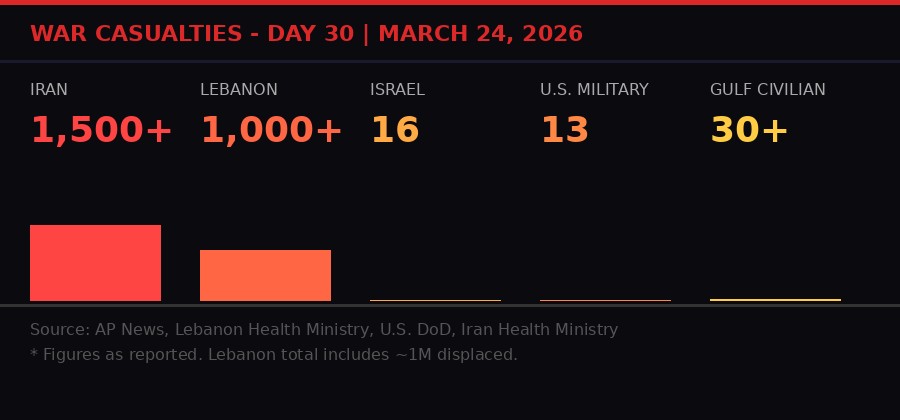
Confirmed war casualties through Day 30. Iran's death toll has surpassed 1,500. More than 1 million Lebanese have been displaced. (Source: AP News, Lebanon Health Ministry)
The Kharg Island Gambit

Oil tankers have been rerouting around the Strait of Hormuz since the war began. Kharg Island is the primary export node for Iranian crude. (Pexels)
Kharg Island is not a secret target. It has been the open subject of Washington's strategic calculus for weeks. The tiny island processes and exports nearly all of Iran's crude oil, sending roughly 13.7 million barrels through its terminals since the war started - even as fighting raged around it. That revenue underwrites everything: the Islamic Revolutionary Guard Corps, the ballistic missile program, Hezbollah's supply chain, and the political survival of whatever leadership structure survives in Tehran. (AP News)
Last Friday, U.S. strikes already hit more than 90 targets on Kharg, including air defenses, a radar installation, the island's airport, and a hovercraft base. But in a deliberate signal, the oil infrastructure itself was left intact. Satellite images posted by TankerTrackers on Saturday and Sunday confirmed vessels were still arriving and loading crude. The message was clear: Washington was holding Kharg's economic function as leverage, not yet destroying it.
Trump reinforced that lever explicitly: if Iran or anyone else interferes with ships passing through the Strait of Hormuz, he warned, the calculation would change. The oil infrastructure is not off the table. It is just not yet on the table.
Petras Katinas, an energy researcher at the Royal United Services Institute, described the island's strategic weight in unambiguous terms: "It doesn't matter which regime is in power - new or old. A takeover would give the U.S. leverage over negotiations with Iran because the island is the main node of its economy." Taking Kharg would not just damage Iran's present government. It would poison the revenue base of any successor government, turning the island into a permanent bargaining chip in whatever post-war architecture eventually emerges.
JPMorgan's global commodity research team put the stakes even more plainly in an investment note last week: a comprehensive strike on Kharg's oil infrastructure would "immediately halt the bulk of Iran's crude exports, likely triggering severe retaliation in the Strait of Hormuz or against regional energy infrastructure." The very retaliation that would justify further escalation. The logic is recursive, and both sides know it.
With thousands more Marines now en route - adding to forces already in the Persian Gulf - speculation has crystallized around two scenarios: a naval blockade designed to squeeze Kharg without destroying it, or a seizure operation aimed at physically taking the island. Neither outcome is a clean path to peace. Both end in fire.
Trump Says Talks. Iran Says Lie.

Pakistan has offered to host ceasefire talks between the U.S. and Iran - but Tehran continues to publicly deny any direct negotiations are underway. (Pexels)
The most consequential diplomatic contradiction of the day did not happen in a war room or a negotiating chamber. It happened in the gap between two social media posts, published hours apart by two men who cannot both be telling the truth.
Before markets opened Tuesday morning, Trump posted on social media that the U.S. was "in negotiations right now" with Iran, naming Steve Witkoff, Jared Kushner, Marco Rubio, and Vice President JD Vance as the American team. "The other side, I can tell you, they'd like to make a deal," he said at the White House. (AP News)
Within hours, Qalibaf was on X. "No negotiations have been held with the US," he wrote. "And fakenews is used to manipulate the financial and oil markets and escape the quagmire in which the US and Israel are trapped."
The Iranian Foreign Ministry backed him: Trump's statement was "an effort to reduce energy prices and to buy time for implementing his military plans."
That sequence - Trump talks, Tehran denies - has become the defining rhythm of Week 4. It happened Monday. It happened again Tuesday. Each repetition of the cycle rattles markets and muddies intelligence assessments about where, exactly, the war is actually heading.
Pakistani Prime Minister Shehbaz Sharif stepped into the gap Tuesday with a direct offer: Islamabad was ready to "facilitate meaningful and conclusive talks" to end the war. Three Pakistani officials, one Egyptian official, and a Gulf diplomat told AP that the U.S. had agreed in principle to join talks in Pakistan. Witkoff and Kushner are expected to represent Washington. The talks could come as early as this week or early next. But mediators are still working to bring Iran to the table. The State Department declined to comment.
"All I'm saying is we are in the throes of a real possibility of making a deal. And I think, if I were a betting man I'd bet for it. But again, I'm not guaranteeing anything." - President Donald Trump, speaking to reporters, March 24, 2026 (AP News)
The Egyptian official framing is instructive: efforts are centered on "trust-building," with the aim of a pause in fighting - not a permanent agreement. The priority is preventing attacks on energy infrastructure and creating a "mechanism" for Iran to reopen the Strait of Hormuz. Israel is not involved in these talks. That exclusion matters enormously: Israel has its own war logic, its own red lines, and its own timeline that may not align with whatever Washington eventually negotiates.
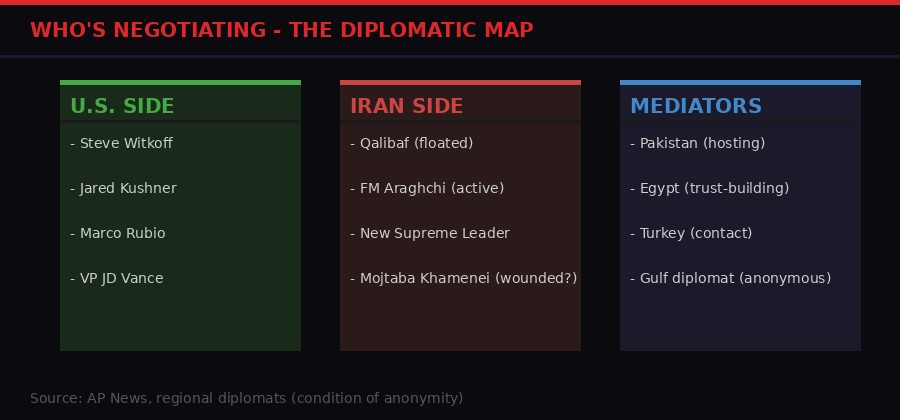
The diplomatic landscape on Day 30: three distinct power blocs with incompatible positions and opaque internal decision-making. (BLACKWIRE)
Who Speaks for Iran?

Iran's leadership structure was shattered on February 28 when Supreme Leader Ali Khamenei was killed in the opening U.S.-Israeli strikes. Who holds real authority now is a live intelligence question. (Pexels)
One of the most dangerous unresolved questions of this war is not military. It is structural: after 30 days of U.S. and Israeli airstrikes that systematically targeted Iran's leadership, who actually speaks for the Islamic Republic?
The opening U.S.-Israeli bombardment on February 28 killed 86-year-old Supreme Leader Ayatollah Ali Khamenei. His son Mojtaba was rapidly named Iran's new supreme leader. But Mojtaba has not been seen publicly since reportedly being wounded in a subsequent strike. His status, health, and actual grip on power remain genuine intelligence uncertainties - not talking points, but real gaps in the assessment of whether Iran can make binding commitments. (AP News)
Into that vacuum, Mohammad Bagher Qalibaf has emerged as the most visible political figure still operating in Iran's government. He was the one denying talks on X. He was the one floated - by unnamed officials - as a potential U.S. negotiating contact. He is a pragmatist by the standards of Iran's theocracy, a former Revolutionary Guard commander who spent nearly two decades telling Western audiences he was "someone you could do business with." He has also been repeatedly passed over for the presidency and linked to corruption allegations.
Analyst Michael Rubin offered a concise read: "Many Iranians despise Ghalibaf; diplomats see him as pragmatic. Those diplomats confuse pragmatism with opportunism. Ghalibaf is a survivor. He sees in Trump someone who can help him achieve what the late Supreme Leader denied him: the presidency or some equivalent interim leadership role."
That framing suggests Qalibaf may be playing his own game inside Iran's fractured politics while simultaneously engaging - at some level - with Washington. His very public denials of talks could be domestic performance, protecting himself from charges of capitulation in a political environment where any hint of concession to America is dangerous. His private posture may be different. That ambiguity is either the seedling of a negotiation or a fatal trap for U.S. planners who mistake opportunism for authority.
Iranian Foreign Minister Abbas Araghchi's office confirmed he was "discussing the war this week with several counterparts" - a quieter acknowledgment of diplomatic activity that stopped well short of confirming direct U.S. contact. The IRGC's Maj. Gen. Ali Abdollahi Aliabadi issued a separately defiant statement: "Iran's powerful armed forces are proud, victorious and steadfast in defending Iran's integrity, and this path will continue until complete victory." He pointedly did not define what victory looks like - a gap that either leaves room for negotiation or signals that the military leadership has not yet been told to stand down.
The Nuclear Wildcard

The IAEA estimates 970 pounds of highly enriched uranium remain unverified in Iran - enough material for up to 10 nuclear weapons. Inspectors have been locked out since the war began. (Pexels)
Every diplomatic framework being floated in Islamabad and Cairo has to reckon with a fact that makes clean resolution nearly impossible: 970 pounds of Iran's highly enriched uranium - 440.9 kilograms enriched to 60% purity, one technical step from weapons-grade - remains buried under rubble at damaged nuclear facilities, unverified and unaccounted for. (AP News)
The International Atomic Energy Agency issued a confidential report, seen by AP, stating bluntly: it "cannot verify whether Iran has suspended all enrichment-related activities," and cannot determine "the size of Iran's uranium stockpile at the affected nuclear facilities." Iran has refused inspectors access since the war began, telling the agency in a February 2 letter that normal safeguards were "legally untenable and materially impracticable" given the ongoing strikes. The IAEA said this "loss of continuity of knowledge needs to be addressed with the utmost urgency."
Robert Goldston, a Princeton University professor researching arms control and fusion energy, confirmed that Iran had already "performed 99% of the centrifuge work required to produce weapons-grade uranium for nine nuclear weapons." IAEA Director General Rafael Grossi has warned the stockpile could allow Iran to build as many as 10 nuclear bombs - not that it has done so, but that the physical capability exists at a level that is not fully visible to the international community.
Trump has made eliminating that capability one of his stated war objectives. He claimed Tuesday that if a deal is reached, "we would move to take Iran's enriched uranium." Iran has refused such demands historically, insisting on its sovereign right to enrich for peaceful purposes. The gap between those two positions - U.S. seizure vs. Iranian sovereignty - is not a negotiating gap that narrows with trust-building. It is a structural contradiction that requires one side to give up something it considers fundamental.
That is why analysts say Trump would "strain credulity" if he ended the war now without definitively resolving the nuclear question. The military campaign has degraded Iran's missile capability and defense industrial base. It has not eliminated the nuclear material. Any deal that leaves those 970 pounds unverified is, by Washington's own stated logic, an incomplete victory.
The Oil Economy on Fire
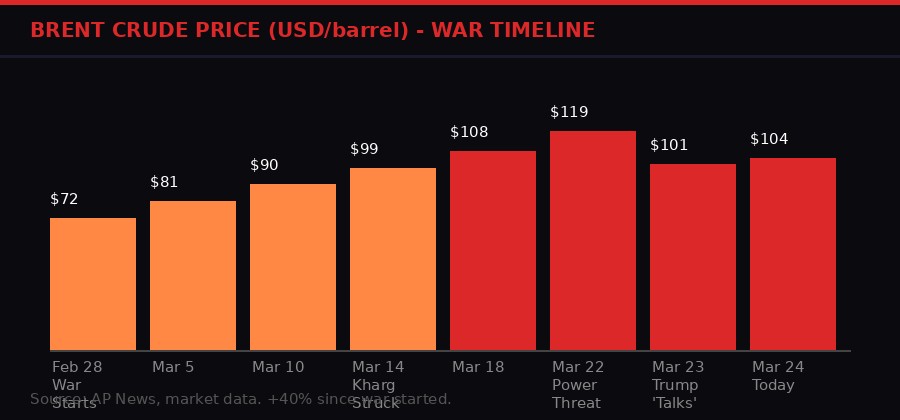
Brent crude's trajectory over 30 days of war. Prices surged from $72 to a peak near $120, briefly dipped on Trump's "talks" announcement, then recovered to $104 by Tuesday close. (BLACKWIRE)
Tuesday's oil market was a textbook illustration of how completely the Iran war now drives global economic conditions. When Trump posted about negotiations before markets opened, Brent crude slumped 9.7% to $101.26 - its largest single-session drop in years. By close, after Iran denied talks and missiles continued falling, Brent had clawed back to $104.49, up 4.6% on the day. In 24 hours, the market had swung nearly 15 points on the words of politicians who cannot agree on whether they are talking at all. (AP News)
Brent is now up nearly 40% since the war started on February 28. Before the conflict, the Strait of Hormuz carried approximately 20% of all globally traded crude. That flow has been "effectively shuttered," in AP's phrasing, since day one. The supply shock is compounding across the global economy in ways that take weeks to fully transmit from wellheads to gas stations, from tanker terminals to airline fuel depots.
The human cost of that transmission is already visible. In Buenos Aires, taxi driver Luis Catalano says he does not know "for how long" he can keep managing. In Cologne, Kevin Plucken, a 35-year-old janitor, puts 20 euros of gas in his car at a time - not enough for a full tank - and cancels weekend drives with his children. In Manila, jeepney driver Johnny Pagnado has cut his nightly bedtime beer and worries about college fees for four children. In Lagos, Felicia Iwasa's summary: "Everything is going up. The economy is not easy for us." (AP News)
The S&P 500 spent Tuesday yo-yoing between gains and losses before settling at a 0.1% dip. The Dow added 55 points. The Nasdaq fell 0.6%. Treasury yields climbed again, pressuring mortgages and corporate borrowing costs worldwide. Gold fell to $4,402 per ounce, down roughly $1,000 from its early-month peak. The market is not in collapse - but it is performing the arithmetic of a protracted war, not a short one.
The specific threat that keeps energy traders awake is not current damage to Kharg Island. It is the scenario where Washington orders full destruction of Kharg's oil terminals - cutting off Iran's primary revenue source - and Tehran retaliates by mining the Strait of Hormuz or striking Gulf Arab desalination plants that provide drinking water to millions of desert-dwellers. That scenario does not just spike oil prices. It triggers a food and water security crisis across the Arabian Peninsula simultaneously.
Lebanon Breaks From Iran

Beirut has declared Iran's ambassador persona non grata as Lebanon strains under more than 1,000 dead and 1 million displaced. The rupture marks a historic shift in Iran's regional influence architecture. (Pexels)
One of Tuesday's most structurally significant developments was also one of the most overlooked: Lebanon declared Iran's ambassador persona non grata and ordered him out of the country by Sunday. Iranian flights are already banned from landing in Beirut, and top Lebanese government officials have publicly accused Iran of "dragging Lebanon into another war with Israel." (AP News)
This is not a minor diplomatic spat. Lebanon expelling Iran's ambassador is a rupture with profound implications for Tehran's regional architecture. Hezbollah - the Iranian proxy force that has operated as a de facto state-within-a-state in Lebanon for decades - derives its political protection, weapons supply, and financial lifelines from that bilateral relationship. Lebanon's government is now formally, publicly distancing itself from the patron that funds the militia operating on its own soil.
Israeli strikes have killed more than 1,000 people in Lebanon and displaced more than one million. The Lebanese government, which has long maintained studied ambiguity about Hezbollah, has apparently decided that the political cost of continued complicity has finally exceeded the cost of a rupture with Tehran. A woman was killed by shrapnel from a Lebanon-originating attack in northern Israel on Tuesday, the same day a 3-year-old girl died in a Beirut-area strike. Both deaths illustrate why Lebanon's patience ran out.
The practical question is what expelling the Iranian ambassador actually achieves. Hezbollah does not receive its marching orders through official diplomatic channels. The weapons supply runs through routes that do not require ambassadorial cover. But the symbolic impact - a formal Lebanese government rejection of Iranian involvement - removes one layer of political legitimacy from Hezbollah's operations and hands Israel a propaganda and legal argument it did not previously have in quite the same form.
The Objectives That Remain Unmet

Trump's stated war objectives - degrading Iran's missile capability, eliminating the nuclear threat, reopening Hormuz - remain only partially achieved after 30 days of sustained bombardment. (Pexels)
Trump entered this war with a list of objectives he has publicly committed to. After 30 days, the scorecard is mixed in ways that complicate any exit. (AP News)
Degrading Iran's missile capability: Partial. The U.S.-Israeli bombardment has damaged launch infrastructure and taken out missile production sites. But Iran continued firing at least ten waves of missiles at Israel on Tuesday alone. The capability has been degraded. It has not been eliminated.
Destroying Iran's defense industrial base: Substantial progress. Iranian air defenses have been significantly weakened, as evidenced by how freely U.S. and Israeli aircraft operate in Iranian airspace compared to the war's opening days. The hovercraft base and radar installations on Kharg were taken out last Friday with minimal reported resistance.
Eliminating the Iranian navy: Largely achieved for surface assets. Iran's conventional naval capacity in the Gulf has been reduced sharply. Submarine activity and asymmetric coastal defense capabilities remain.
Preventing Iran from acquiring nuclear weapons: Unresolved and arguably more dangerous than on Day 1. The 970-pound HEU stockpile is unverified, inspectors are locked out, and the physical infrastructure to resume enrichment once the bombing stops exists under rubble that can be cleared. Trump says Iran agreed to surrender its uranium as part of any deal. Tehran has never confirmed this. Robert Goldston's assessment - that Iran has already done 99% of the centrifuge work for nine bombs' worth of material - means the only missing step is political will.
Reopening the Strait of Hormuz: Not achieved. The strait remains effectively closed. Twenty percent of global crude that once moved through it is still being rerouted or simply not moving. The entire global economic strain of this war flows from this single failure.
Regional analysts have noted that Trump would "strain credulity" to claim victory at this point. The political cost of an incomplete resolution - one that leaves the nuclear question open, the strait closed, and Iran's missile capability degraded but intact - would be attacked by Democrats and skeptics as a waste of American blood and treasure. The military logic for continuing, and especially for the Kharg operation, is precisely this: Washington cannot exit without something to show that justifies the economic pain it has inflicted on the entire world.
What Comes Next

The next 72 hours will determine whether Pakistan's mediation track produces a ceasefire framework - or whether the Marine deployment signals a new phase of escalation. (Pexels)
The next 72 hours carry more weight than any comparable window since the war began. Pakistan says talks could happen this week or early next. The Egyptian-led trust-building track is focused narrowly on preventing attacks on energy infrastructure and creating a mechanism for Hormuz to reopen. If those talks materialize, the Marine buildup provides Washington with visible escalation leverage to bring Iran to a deal - a classic coercive diplomacy play.
If those talks fail - or if Iran refuses to come to Islamabad at all - the Marine deployment shifts from leverage to operational preparation. Kharg Island would move from implicit threat to explicit target. The consequences of that move extend far beyond Iran's oil revenue: they include Iranian promises to "irreversibly destroy" desalination plants across the Gulf, escalated Hezbollah operations in Lebanon and potentially further afield, and a Strait of Hormuz closure that becomes permanent rather than tactical.
Key Events - Day 30 Timeline
The question that none of Tuesday's developments answered is the one that will determine the shape of the next phase: does Iran have a leadership structure capable of making a binding agreement? Mojtaba Khamenei has not been seen since reportedly being wounded. Qalibaf is publicly denying talks while being privately floated as a negotiating contact. The IRGC's military spokesmen are issuing defiant statements that may not reflect their actual orders. Multiple power centers are competing in a system shattered by 30 days of precision strikes on its highest-value targets.
Washington is trying to negotiate with a black box. The Marines sailing toward Kharg Island are, in one reading, the physical manifestation of that frustration. If you cannot find the person with authority to make a deal, you take away the leverage that makes a deal worth refusing.
The risk is that taking Kharg away does not produce a negotiating partner. It produces a cornered regime with 970 pounds of enriched uranium, intact ballistic missile batteries, and nothing left to lose.
Get BLACKWIRE reports first.
Breaking news, investigations, and analysis - straight to your phone.
Join @blackwirenews on TelegramSources & References
- AP News - "Airstrikes batter Iran as it attacks Israel and Gulf states" - March 24, 2026
- AP News - "Trump says there are talks with Iran. Tehran says he's buying time" - March 24, 2026
- AP News - "Iran's Kharg Island is key to its economy and security" - March 24, 2026
- AP News - "Iran's parliament speaker Qalibaf floated as US contact" - March 24, 2026
- AP News - "Small comforts fade and big worries grow as fuel prices surge globally" - March 24, 2026
- AP News - "US stocks swing between losses and gains on uncertainty over Iran war" - March 24, 2026
- AP News - "Iran has not given IAEA access to nuclear facilities" - March 2026
- AP News - "Trump says Iran eager for a deal to end the war" - March 23, 2026
- JPMorgan Global Commodity Research - Kharg Island strike note - March 2026
- Royal United Services Institute - Petras Katinas on Kharg Island strategy
- Princeton University - Robert Goldston on HEU enrichment status
- International Atomic Energy Agency - Confidential safeguards report, March 2026
- Institute for the Study of War / AEI Critical Threats Project - Kharg satellite analysis