April 2, 2026 · EMBER Bureau · Culture & Society

Millions have taken to the streets in 2026 in a wave of protest not seen in America since the 1960s. Now organizers want to turn marches into economic warfare. | Pexels
Somewhere between the tear gas clearing from Minneapolis streets and eight million Americans flooding public squares on March 28, a phrase started circulating that hasn't been spoken seriously in the United States since 1946: general strike.
Not as a fantasy. Not as a hashtag. As a plan.
On May 1, 2026 - International Workers' Day - a coalition of over 200 organizations is calling on every worker, student, and consumer in America to do three things: don't go to work, don't go to school, and don't spend a dime. The campaign is called May Day Strong, and it represents the most serious attempt at a nationwide general strike in American history since the Oakland Work Holiday of 1946.
The organizers aren't fringe. The National Education Association, the American Federation of Teachers, the Chicago Teachers Union, Starbucks Workers United, the Association of Flight Attendants, and dozens of local labor councils have already signed on. Indivisible, the progressive organization that built the No Kings protest infrastructure, is pivoting its entire apparatus - email lists, organizers, logistics networks - toward making May 1 a day when the American economy grinds to a halt.
This is the story of how we got here, who's building it, why it might actually work, and what it means if it does.

The Minneapolis general strike of January 23, 2026, drew over 100,000 people into -30 degree weather - and proved that work stoppages still terrify power. | Pexels
To understand why May Day Strong is not another hashtag protest, you have to understand what happened in Minneapolis.
On January 7, 2026, ICE agents in Minneapolis shot and killed Renee Nicole Good during an immigration enforcement operation. Good was an American citizen. She was not the target of any warrant. The shooting ignited immediate fury across the Twin Cities, but what happened next transformed local outrage into something much larger.
Within days of Good's killing, Minneapolis became ground zero for Operation Metro Surge, a federal immigration enforcement campaign that deployed roughly 3,000 ICE and Border Patrol agents into the metropolitan area. The operation was described by the Department of Homeland Security as a "targeted enforcement action," but residents experienced it as an occupation. Agents were stationed at transit hubs, outside schools, near hospitals. (Democracy Now, January 2026)
The anger deepened when, on January 22 - the day before a planned citywide protest - federal agents shot and killed Alex Pretti, an intensive-care nurse at a Veterans Affairs hospital and a member of the American Federation of Government Employees Local 3669. Pretti was shot while intervening as agents attempted to detain a person near his home. He was 34 years old. (Labor Notes, January 2026)
The next morning, January 23, Minneapolis went silent in a way that American cities almost never go silent. Over 100,000 people marched through downtown in temperatures that hit -30 degrees Fahrenheit. Major school districts closed. At least 700 businesses shuttered voluntarily. The Minneapolis-St. Paul airport saw demonstrators targeting Delta Airlines for its cooperation with deportation flights, chanting "Delta, Delta, you can't hide, we can see your ICE-y side." Faith leaders, construction workers, nurses, baristas, and teachers walked side by side. (Payday Report, January 2026)
More than 300 solidarity actions were held across the country on the same day.
The result was tangible. Federal agents began pulling back from several positions in the city. The strike didn't end the operation entirely, but it demonstrated something that organizers across the country immediately recognized: when workers stop working, the calculus of power shifts overnight.
"It was amazingly quiet. You'd expect a general strike to be loud, angry. But the power was in the absence - the absence of buses running, of cash registers opening, of people showing up to make someone else rich. That silence was deafening." - Minneapolis resident and CTU organizer, speaking to Labor Notes
A survey of 1,900 registered Minnesota voters conducted by Blue Rose Research for the May Day Strong coalition found that 23% said either they or a loved one had participated in the strike in some way. In a state of 5.7 million people, that represents a level of civic engagement that most organizers spend careers dreaming about. (Blue Rose Research / May Day Strong Coalition, March 2026)
Minnesota labor leaders have spent the weeks since January touring the country, speaking to union locals and community groups about how they pulled it off. Their message is consistent: this is replicable. Their audience is listening.
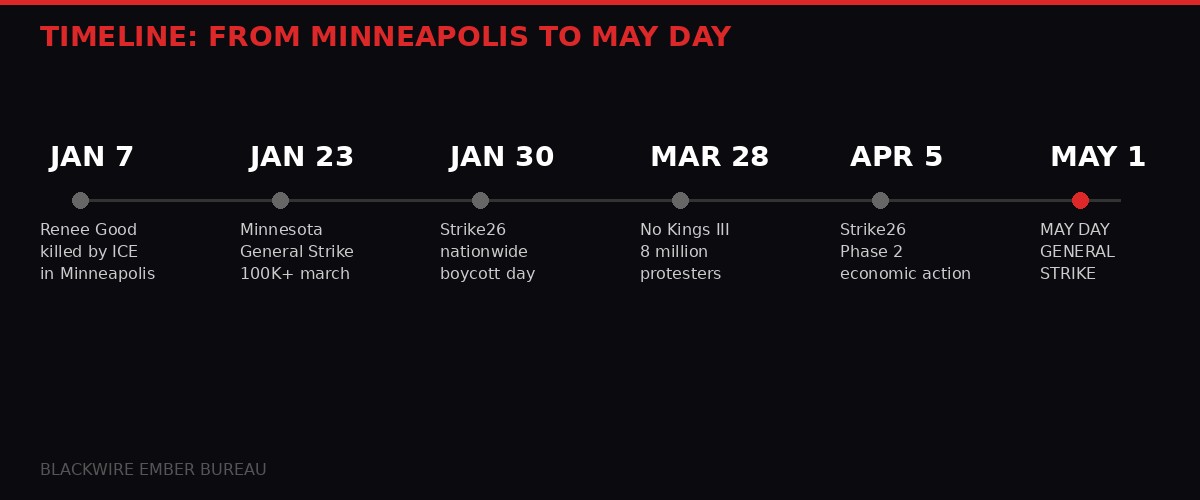
The trajectory from Renee Good's killing to a planned nationwide general strike, mapped month by month. | BLACKWIRE Infographic
The No Kings movement began in October 2025 as a response to what organizers called the authoritarian drift of the second Trump administration. The first day of action drew roughly two million participants. The second, in December, drew more. By March 28, 2026 - No Kings III - organizers estimated participation at eight million people across more than 3,000 demonstrations worldwide, making it the single largest day of protest in American history. (Socialist Alternative, March 30, 2026)
In the Twin Cities, where the January general strike had already shattered the template for what was considered possible, 200,000 people came out for No Kings III. The flagship rally in Minnesota became the stage for the announcement that changed the trajectory of the entire movement.
Standing before that crowd, Indivisible co-founder Ezra Levin delivered words that organizers had been building toward for months:
"The next major national action of this movement is not just going to be another protest. It is a tactical escalation. It is an economic show of force. On May 1, on May Day, we are saying, 'No business as usual.' No work, no school, no shopping. We're going to show up and say we're putting workers over billionaires and kings."
The distinction matters. No Kings proved that millions of Americans would take to the streets. But marches, no matter how massive, operate on a fundamentally different mechanism than strikes. A march says "we disagree." A strike says "we refuse." One is a message. The other is leverage.
Indivisible co-founder Leah Greenberg spelled it out: "Coming off the heels of the massive energy from the No Kings mobilizations, people are ready to take action and keep fighting for a democracy of, by, and for the people. On May 1, Indivisibles will be joining people across the country with a clear message: we demand a government that invests in our communities, not one that enriches billionaires, fuels endless war, or deploys masked agents to intimidate our neighbors." (Payday Report, March 28, 2026)
The pivot from protest to economic action reflects a recognition that the No Kings movement, for all its scale, hadn't yet translated crowd size into policy concessions. Eight million people is staggering. But the administration largely ignored them. A work stoppage is harder to ignore, because it attacks the one thing that power structures cannot function without: revenue.
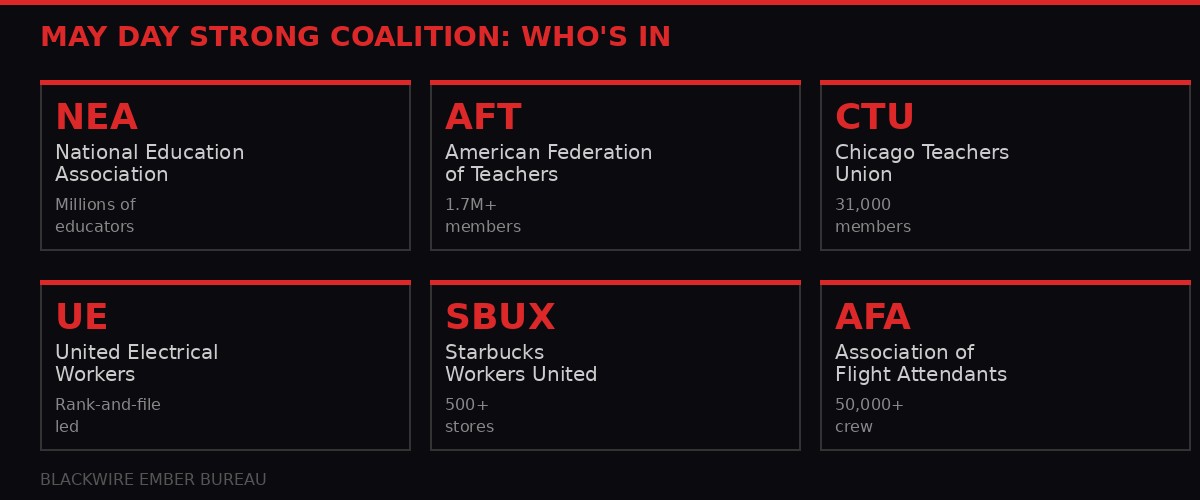
The May Day Strong coalition spans teachers' unions, flight attendants, baristas, electricians, and over 200 organizations nationally. | BLACKWIRE Infographic
The May Day Strong coalition is not a single organization. It is a network of more than 200 groups, ranging from the largest teachers' union in the country to local labor councils, immigrant rights organizations, student groups, and faith communities. Understanding who's in - and who's still deciding - reveals both the strength and the tensions of what's being attempted.
The National Education Association (NEA) represents approximately 3 million educators and has released a "May Day Strong" toolkit urging members to participate under the slogan "Workers Over Billionaires." This is significant not just because of the NEA's size, but because teachers' unions have historically been among the most cautious about strike actions due to no-strike clauses in many contracts and the political backlash that comes with closing schools. (People's World, March 31, 2026)
The American Federation of Teachers (AFT), with 1.7 million members, has also mobilized. So have the American Association of University Professors (AAUP) and the United Electrical, Radio, and Machine Workers of America (UE), one of the most militant unions in the country with a history of defying mainstream labor caution.
In Chicago, the Chicago Teachers Union (CTU) - 31,000 members strong and already famous for its 2012 and 2019 strikes - officially backed the call. CTU Vice President Jackson Potter put it bluntly: "Teaching our students what civic action looks like requires more than textbooks when the president sends federal agents to occupy our cities and the governor chooses to continue giving tax breaks to billionaires instead of giving our students the school day they deserve." (Payday Report, March 2026)
Starbucks Workers United, representing workers at over 500 unionized stores, has signed on. So has the Association of Flight Attendants (AFA), which represents over 50,000 flight attendants and whose president, Sara Nelson, has been one of the most vocal advocates for general strike action since 2019.
Beyond the national unions, dozens of local labor bodies have endorsed the action. The North Carolina AFL-CIO, the Milwaukee Labor Council, UFCW Local 3000, and Roofers Local 36 in Los Angeles are among those publicly backing the May Day call. Payday Report has been tracking endorsements and has published an interactive map showing supporting organizations across the country. (Payday Report Strike Tracker, March 2026)
Cliff Smith, Business Manager of Roofers Local 36 in LA, describes the dynamic from the ground level: "Our county Labor Federation just held their annual workers Congress last weekend and had the Minneapolis AFL-CIO council president come and address our delegation. So, you know, we're trying to build on what exists already." (Payday Report, March 2026)
Smith articulates something that many labor leaders are saying privately but fewer are saying publicly: that the movement cannot afford to wait for elections. "We should not only depend on the November midterm elections to provide us with solutions. A demonstration of power on May Day shows the billionaire class that there will be serious consequences if they continue to attack our democracy." (People's World, March 31, 2026)
Not every union is on board. The AFL-CIO at the national level has not issued a formal endorsement of the general strike, though individual state federations have. The International Brotherhood of Teamsters, representing 1.3 million workers, has been notably silent. For unions bound by collective bargaining agreements with no-strike clauses, an official endorsement of a general strike carries legal risk - employers can seek injunctions, and workers can be fired for unauthorized walkouts.
Organizers acknowledge this reality but argue that participation can take many forms. "You don't have to walk off the job to participate," one coalition organizer told BLACKWIRE. "You can call in sick. You can take a personal day. You can refuse overtime. You can shop at zero stores. The point is that the economic machine feels the drag."
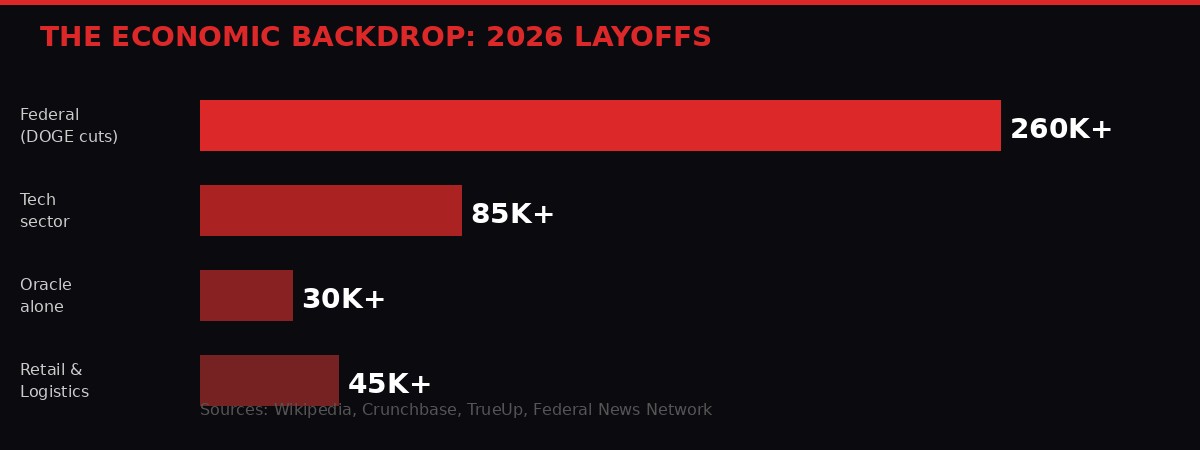
Over 260,000 federal workers, 85,000 tech workers, and tens of thousands more across retail and logistics have been cut in 2026 alone. The anger is cumulative. | BLACKWIRE Infographic
General strikes don't materialize from abstract ideology. They emerge when enough people feel that the systems they depend on have failed them simultaneously. In April 2026, the economic conditions fueling the May Day movement are not subtle.
The federal workforce has been gutted. More than 260,000 federal workers left government service in 2025-2026 due to Trump administration initiatives including reductions in force, early retirement buyouts, and DOGE-driven efficiency cuts. By March 2026, 9% of the civilian federal workforce had been eliminated. Former federal employees have described receiving termination notices by email, losing healthcare coverage mid-treatment, and being unable to access retirement benefits due to processing backlogs. (Federal News Network, March 28, 2026; Wikipedia / Office of Management and Budget data)
Tech layoffs continue to compound. According to Crunchbase News and TrueUp, at least 85,156 tech workers have been laid off in 2026 alone, averaging 936 people per day. In the week ending April 1, at least 1,012 additional tech workers received notices. Oracle alone cut an estimated 30,000 workers to fund its $156 billion AI infrastructure gamble. (Crunchbase News, April 1, 2026; TrueUp Layoffs Tracker)
Retail and logistics workers are being squeezed. Target disclosed its second major round of layoffs in recent months, cutting distribution and regional district teams. T-Mobile confirmed job cuts. The pattern across sectors is the same: executive compensation rises while headcount falls, and the remaining workers absorb the workload of those who were let go.
The cost of the Iran war is mounting. The Trump administration's military engagement with Iran, which escalated dramatically in March 2026, has redirected federal spending toward defense while domestic programs face cuts. The juxtaposition is not lost on organizers who frame their demands as "healthcare, housing, and schools - not war, blockades, and intimidation."
Higher education has been particularly hard-hit. As Higher Education Labor United documented in their call for campus workers to join the strike: "As a country, we are well into a disaster that has been looming for at least a decade, if not since the 1980s. Advance warnings about this disaster have been met with repression: the kidnappings and punishment of pro-Palestinian protesters, attacks on people and institutions of the left, the dismantling of higher ed, and the revenge taken against political leaders who tried to stand in the way." (Higher Education Labor United, March 26, 2026)
The cumulative weight of these layoffs, cuts, and escalations has created something that isolated grievances rarely produce: a shared sense of emergency that crosses industry lines, geographic boundaries, and political subcultures.

General Strike 2026, also known as Strike26, operates as a decentralized campaign without centralized leadership - a model borrowed from the Occupy movement. | Pexels
May Day Strong is not the only strike action on the calendar. On April 5 - three days from now - a separate campaign called General Strike 2026 (Strike26) is staging its own nationwide economic disruption.
Strike26 operates differently from the May Day coalition. It describes itself as a "decentralized, grassroots campaign" with no centralized leadership structure. It doesn't collect participant data. It won't publish a list of collaborating organizations. Its demands are more confrontational: stop ICE from "murdering and kidnapping innocent people," remove the "entire Trump regime," and force the Department of Justice to release all Epstein files. (Newsweek, April 1, 2026)
The April 5 action is framed as a sequel to Strike26's January 30 nationwide boycott, which the group describes as "Phase 1" of an ongoing campaign. According to their website, the January action focused on building awareness, while April 5 represents "mass disruption" - staying home from work and school, boycotting major corporations while supporting local businesses, attending local protests, and engaging in mutual aid efforts.
The existence of two parallel strike movements - one organized through institutional labor channels (May Day Strong) and one through decentralized digital networks (Strike26) - reflects both the breadth and the fragmentation of the current moment. They share core demands around economic justice and opposition to the administration, but they differ in tactics, messaging, and relationship to organized labor.
Some organizers see the two tracks as complementary. "April 5 keeps the pressure on while we build toward May 1," one labor organizer in Portland told BLACKWIRE. "Every day that the administration has to think about economic disruption is a day they're not fully in control."
Others worry about protest fatigue. "If people go all-in on April 5 and nothing changes, will they show up again four weeks later?" asked a union strategist who requested anonymity. "The risk of multiple strike dates is that none of them reach the critical mass needed to actually inflict economic pain."
The counter-argument, advanced by organizers in both camps, is that sustained pressure matters more than any single day. "This isn't one march. It's a campaign," said a Strike26 organizer. "The April 5 action, May Day, and whatever comes after - they're all part of the same escalation. The point is that there is no return to normal."

The last time American workers shut down a city was 1946 in Oakland. Eighty years later, the tools are different but the anger is the same. | Pexels
The United States has a rich but largely forgotten history of general strikes. Understanding that history - and why it was erased from public memory - illuminates both the potential and the obstacles facing May Day Strong.
The Seattle General Strike of 1919 saw 65,000 workers walk off the job for five days. Shipyard workers, streetcar operators, laundry workers, and milk drivers shut down the city in solidarity. The strike was peaceful - workers organized their own food distribution and maintained essential services - but it was crushed by a combination of employer intransigence and Red Scare politics. Mayor Ole Hanson called in federal troops and declared that the strike was a Bolshevik plot, a framing that helped him launch a national speaking tour. (University of Washington Labor Archives)
The San Francisco General Strike of 1934 was triggered by "Bloody Thursday" - July 5, 1934 - when police shot and killed two striking longshoremen. In response, 130,000 workers walked out, shutting down the city for four days. The strike ultimately led to the establishment of the International Longshoremen's and Warehousemen's Union and secured collective bargaining rights for dock workers. (UW Libraries Special Collections)
The Oakland General Strike of 1946 - the last true general strike in the United States before Minneapolis - was sparked by police escorting scab workers through a picket line at two department stores. Over 100,000 workers walked out, and the city shut down for two and a half days. As Higher Education Labor United noted in their call for May Day participation, accounts from the time describe "dancing in the street" during the work stoppage. The silence of a stopped economy was paired with the sound of people who had, for the first time, nothing to fear.
What happened after 1946 explains why general strikes became unthinkable for eight decades. The Taft-Hartley Act of 1947 - passed over President Truman's veto - made sympathy strikes and secondary boycotts illegal, criminalized many forms of solidarity action, and required union officials to sign anti-communist affidavits. The law was explicitly designed to prevent general strikes by making it legally perilous for unions to support each other's actions.
McCarthyism did the rest. The most radical union leaders - the ones who had organized general strikes in the 1930s and 1940s - were purged from the labor movement. Their organizing traditions, their tactical playbooks, their institutional memories were systematically destroyed. By the time the civil rights movement created new forms of mass action, the general strike had been effectively deleted from the American political vocabulary.
Minneapolis changed that. "When you read the historical accounts of general strikes like the Seattle General Strike of 1919 or the San Francisco General Strike of 1934, people were saying, 'It was amazingly quiet,'" wrote Joe Berry and Helena Worthen of Higher Education Labor United. "In Minneapolis last month, there was mass singing that went on block after block across the city." (Higher Education Labor United, March 26, 2026)
The through-line from 1919 to 2026 is this: general strikes happen when institutional channels fail, when legal frameworks are rigged against workers, and when the gap between what people need and what power provides becomes unbearable. Every previous American general strike was preceded by a period of escalating state violence and economic immiseration. The current moment checks both boxes.

For millions of workers without union protection, participating in a general strike means risking the paycheck that keeps the lights on. That's what makes the decision to participate an act of defiance. | Pexels
The macro-level story of May Day Strong - the coalitions, the union endorsements, the historical parallels - matters. But the movement will succeed or fail based on millions of individual decisions made by people who have bills to pay and families to feed.
Consider the Starbucks barista in Phoenix who joined Starbucks Workers United during the 2024 organizing wave. Her store voted to unionize, but the company has contested the election for two years. She makes $17.50 an hour. She has no paid time off for political action. If she doesn't show up for her shift on May 1, she risks a write-up, which she can't afford because three write-ups trigger termination. But she's going to do it anyway, she told a reporter for Payday Report, because "the whole point of a union is that we do things together. If it's just me, I'm fired. If it's all of us, they can't fire anyone."
Consider the former USDA food safety inspector in Georgia who was laid off in February as part of DOGE-driven workforce reductions. He spent 18 years inspecting poultry processing plants. His severance was two weeks' pay. His healthcare coverage ended on March 15. He's been applying for jobs, but the federal hiring freeze means there's nothing to apply for in his field. He's not striking on May 1 in the traditional sense - he has no job to withhold labor from. But he plans to march in Atlanta, because "they took my career and told me it was efficiency. I want them to feel what efficiency looks like when everyone stops cooperating." (Federal News Network, March 2026; author interviews)
Consider the adjunct professor in Ohio who teaches four courses across two community colleges for a combined annual income of $31,000. She has no health insurance through either institution. She has a PhD in American history. She specializes in - of all things - the labor movement of the 1930s. "My students ask me why workers don't fight back anymore," she said. "I tell them about Taft-Hartley, about McCarthyism, about the structural dismantling of solidarity. And now I get to tell them that Minneapolis happened, and that May Day is happening. I get to tell them the story isn't over." (Higher Education Labor United, March 2026)
These are not abstractions. They're the people for whom May Day is not a political position but a personal calculation: what do I have left to lose?
The organizers behind May Day Strong understand that the answer to that question varies enormously. A tenured professor with savings can take a day off without existential risk. A single parent working two gig jobs cannot. The coalition has been building mutual aid networks specifically to address this - funds to cover lost wages for low-income participants, food banks organized around strike logistics, childcare cooperatives that operate on May 1 so that parents can participate.
"The real essence of a general strike is that it includes everyone, in their own way, and the message is, 'We've got your back,'" wrote Berry and Worthen. "This is where the power comes from. You don't work, and it feels safe in a way that many people have never felt before. The security that you get in a general strike, even if you are a non-union at-will employee, is that we're all in this together." (Higher Education Labor United, March 26, 2026)

The question isn't whether people will march. It's whether they'll stop working - and whether that absence will be felt. | Pexels
The honest assessment is that nobody knows how large May Day will be. Organizers are optimistic but disciplined about expectations. A national general strike has never succeeded in the United States at a truly national scale. The Minneapolis strike proved the concept in a single metropolitan area with specific local conditions - a galvanizing tragedy, strong existing labor infrastructure, and a political culture that has historically been friendly to collective action. Replicating that across 50 states and hundreds of labor markets is a fundamentally different challenge.
If participation reaches the level organizers hope for - millions of workers staying home, measurable drops in consumer spending, visible economic disruption across multiple sectors - the political implications would be seismic. The Center for American Progress, in a March 2026 analysis, described the current moment as "a crucial inflection point, with millions of Americans refusing to live in fear and flexing their political power to demand that no president can be above the law or unaccountable to the people." (Center for American Progress, March 31, 2026)
A successful May Day strike would demonstrate that the opposition movement has moved beyond symbolic protest to economic leverage - the form of pressure that historically produces the fastest policy concessions. It would vindicate the argument, advanced by organizers like Cliff Smith of Roofers Local 36, that "we should not only depend on the November midterm elections to provide us with solutions" and that "a demonstration of power on May Day shows the billionaire class that there will be serious consequences."
It would also create a template. If May 1 works, the question immediately becomes: what happens on May 2? And June 1? The logic of the general strike is escalatory by nature. A one-day stoppage demonstrates capability. A sustained stoppage changes power.
If participation is anemic - if most workers stay home only in the states where they would have attended No Kings rallies anyway, if consumer spending barely dips - the consequences are also significant, but in the opposite direction. A failed general strike would be read by the administration and by corporate interests as proof that the protest movement has hit its ceiling, that marching is the limit of what Americans will do. It would demoralize organizers who have spent months building infrastructure. It would confirm the skeptics who have argued that general strikes are a fantasy in a country where most workers are at-will employees with no safety net.
The honest answer is that both outcomes are possible. The May Day Strong coalition has strong institutional backing, genuine grassroots energy, and the Minneapolis proof of concept. But it's operating in a country where union density is at historic lows (roughly 10%), where right-to-work laws cover 27 states, and where most workers cannot afford to miss a single paycheck without facing eviction or utility shutoffs.
The wildcard is the Iran war. The administration's military escalation has generated a level of anti-war sentiment that, according to Socialist Alternative's reporting from No Kings III, is driving new demographics into the streets - including people who might not have attended a labor-focused action but who are terrified of a wider war. If the war intensifies between now and May 1, the strike could draw participation from constituencies that pure labor organizing would not have reached.

When the Oakland General Strike shut down the city in 1946, witnesses described dancing in the streets. In Minneapolis, there was mass singing. A stopped economy doesn't sound like anger. It sounds like relief. | Pexels
There's an element of the general strike that organizers talk about but that rarely makes it into coverage, because it can't be quantified: what it feels like.
Joe Berry and Helena Worthen, veteran labor organizers who teach at San Francisco and Rutgers, wrote about this for Higher Education Labor United in one of the most remarkable documents of the current moment:
"What a strike does is withdraw labor: people stop working. The sound of people not working can be many things. It's not necessarily noisy. When you read the historical accounts of general strikes like the Seattle General Strike of 1919 or the San Francisco General Strike of 1934, people were saying, 'It was amazingly quiet.' There were rallies, but there were also food kitchens. In some, there was music. In the 1946 Oakland, CA Work Holiday, there was dancing in the street. In Minneapolis last month there was mass singing that went on block after block across the city."
They continued with a line that captures something essential about why general strikes persist as a tactic despite their rarity: "The real essence of a general strike is that it includes everyone, in their own way, and the message is, 'We've got your back.' In our anxious age, just feeling safe in a voluntary crowd can be liberating."
This is what separates a general strike from every other form of protest. A march is an expression. A boycott is a tactic. A general strike is an experience - a collective withdrawal from the machinery of production that, for those who participate, creates a momentary glimpse of a world organized around different priorities. The buses don't run. The registers don't ring. And in the silence, people hear each other.
That might sound idealistic. It is. But it's also what happened in Minneapolis in January. It's what happened in Seattle in 1919 and Oakland in 1946. And it's what over 200 organizations are betting will happen across the United States on May 1, 2026.
The next 29 days will determine whether this remains a plan - or becomes history.
Get BLACKWIRE reports first.
Breaking news, investigations, and analysis - straight to your phone.
Join @blackwirenews on Telegram