Six Days Adrift: 22 Dead Off Greece as Smugglers Threw Bodies Overboard
A rubber dinghy left the Libyan port of Tobruk on March 21 carrying at least 48 people. It never reached land. Six days without food or water, 22 people died at sea. Their bodies were thrown overboard on the orders of the people smugglers running the boat. Twenty-six survivors were pulled from the water by a Frontex vessel on Friday. Europe's response: tighter laws, more blockades, the same route stays open.
Lost at Sea: The Final Six Days
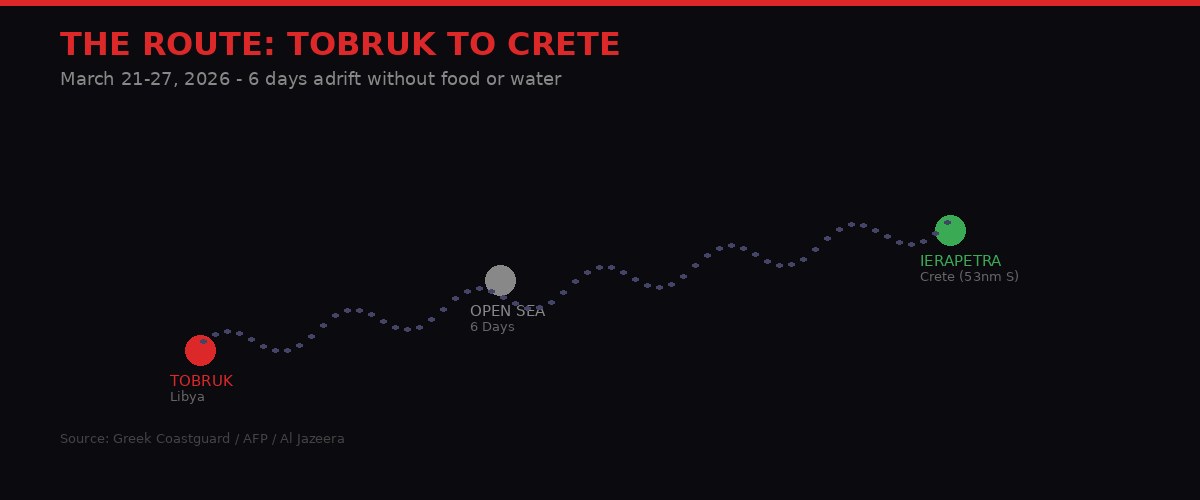
The Greek Coastguard released its statement on Friday, March 28. The facts it contained were stark and largely procedural. A rubber boat had left Tobruk in eastern Libya on March 21, 2026, bound for Greece. At some point during the six-day crossing, the passengers lost their bearings. They ran out of food. They ran out of water. People began to die.
According to survivor accounts relayed by the coastguard, as passengers died, their bodies were thrown overboard on the orders of one of the smugglers running the operation. The coastguard's statement does not elaborate on who gave the order, what resistance there was, or how many were still alive when the decision was made. It states the facts.
Twenty-two people did not survive. Twenty-six did - including one woman and one child. A vessel operated by Frontex, the European Union's border and coast guard agency, intercepted the dinghy approximately 53 nautical miles south of Ierapetra, a city on Crete's southern coast. Two of the survivors were in serious enough condition to be transferred to hospital in Heraklion. [Source: Greek Coastguard / AFP]
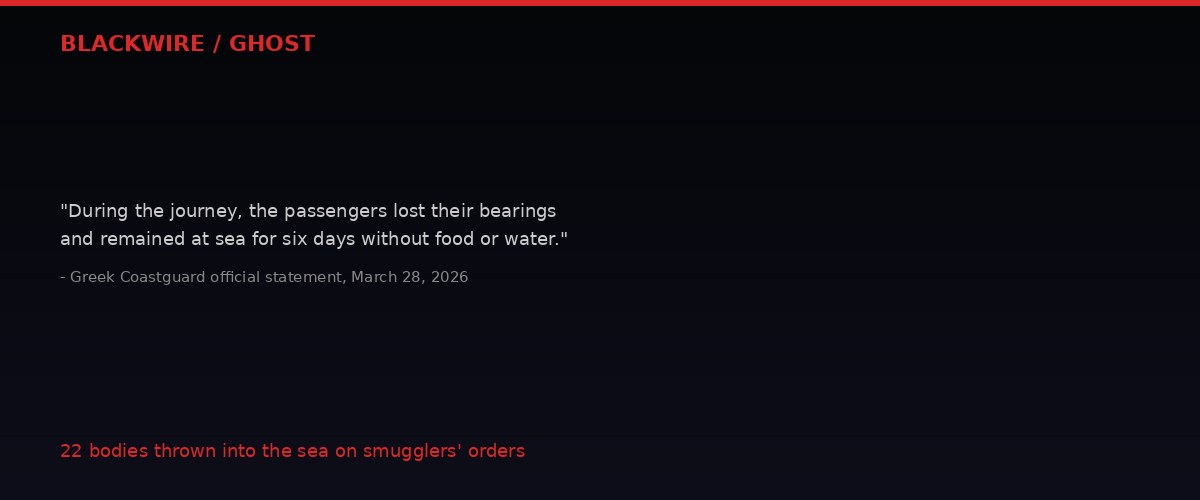
"During the journey, the passengers lost their bearings and remained at sea for six days without food or water." - Greek Coastguard official statement, March 28, 2026
The bodies that were thrown overboard will not be counted in official tallies. They are gone. The sea does not file reports.
Two South Sudanese men - aged 19 and 22 - were arrested and placed under investigation on suspicion of people trafficking, illegal entry, and negligent homicide. Greek authorities say they were among the smugglers operating the boat. Both men are now in custody on Crete, facing charges that carry serious prison terms under Greek law. How much they knew about the route they were running - and how much they themselves were coerced into the role - has not been established.
Who Was on That Boat
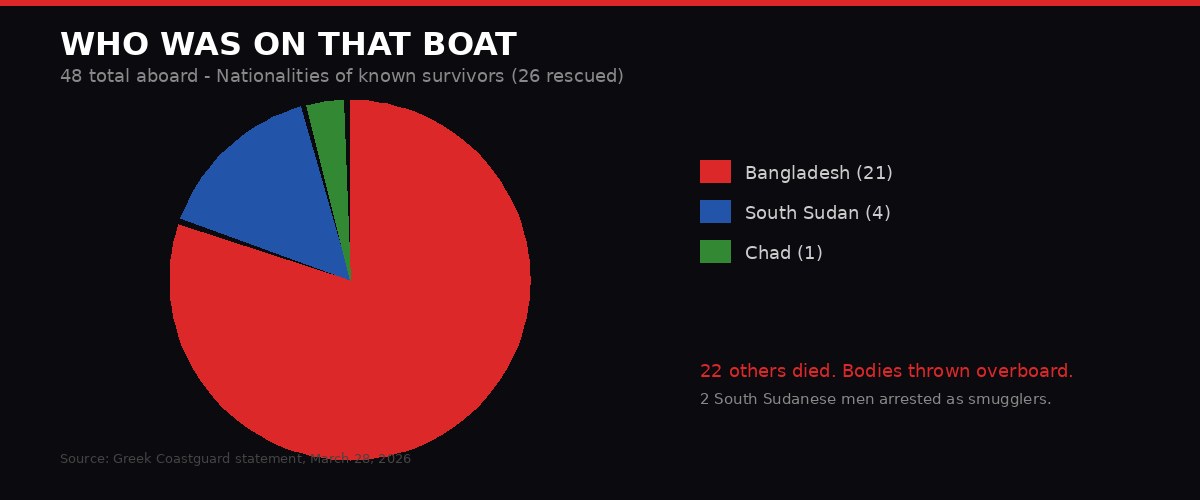
The coastguard identified the nationalities of the 26 survivors: 21 from Bangladesh, four from South Sudan, and one from Chad. The nationalities of the 22 who died have not been disclosed publicly - in part because the bodies were disposed of at sea before any formal identification could be made.
Bangladesh is not a country at war. It is a country of 170 million people facing rising sea levels, recurring cyclones, a garment industry that employs millions at poverty wages, and a political environment that has seen mass protests and violent crackdowns. The people who take this route from Bangladesh are not, by the EU's legal classifications, automatically entitled to refugee status. They are often classified as "economic migrants." The distinction determines whether they receive protection or deportation.
South Sudan, by contrast, has been in a state of near-continuous civil war since 2013. Its people are, on paper, entitled to asylum consideration. Chad has hosted more than a million refugees itself, largely from Sudan's Darfur region, for over two decades. Someone from Chad who boards a rubber dinghy in Tobruk has likely already crossed multiple countries, survived multiple detentions, and exhausted most alternatives.
None of these individuals' individual stories are known. The coastguard classified them by nationality and survival status. That is the data that exists. [Source: Greek Coastguard, AFP, Al Jazeera]
What brought each of them to that port on March 21 - whether it was war, climate, poverty, persecution, family separation, or some combination - is not in the official record. It rarely is.
The Libya Corridor: A System That Profits From Suffering
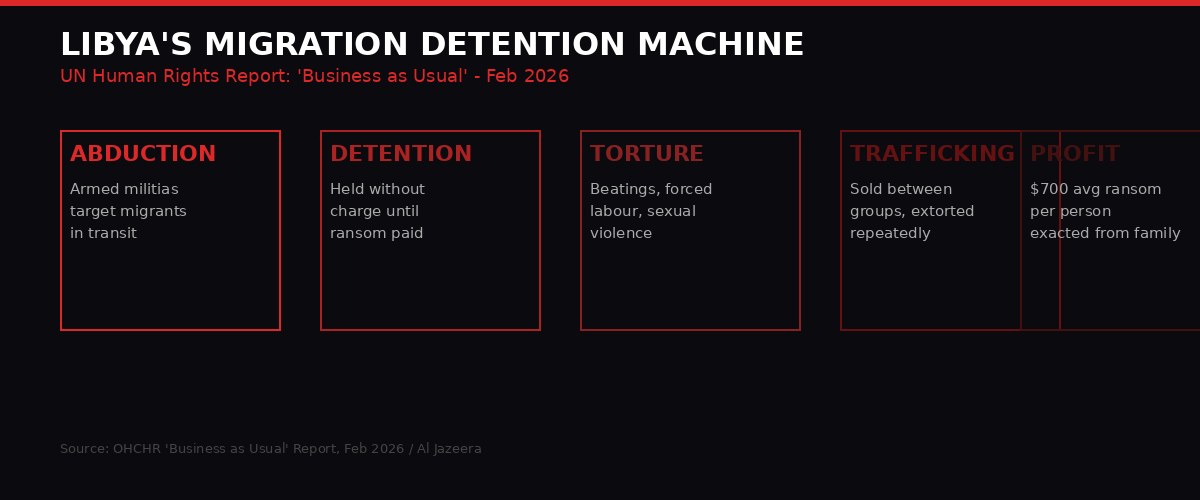
To understand how 48 people ended up on a rubber boat that cost many of them their lives, you have to understand what Libya has become since 2011.
When NATO-backed forces killed Muammar Gaddafi, the country fractured into rival factions. Two governments - one in Tripoli, one in Benghazi - claim legitimate authority. Neither controls the country's territory effectively. Armed militias fill the gaps, and some of those militias have built their entire business model around migrant exploitation.
A report released by the UN Human Rights Office in February 2026, titled "Business as Usual," documented the system in clinical detail. Between August and October 2025 alone, at least 928,000 migrants were identified in Libya. They arrive overland from sub-Saharan Africa, from Sudan, from East Africa. They arrive from South Asia through transit countries. They come with the intention of eventually crossing to Europe.
What they find in Libya is a gauntlet.
"These violations are executed through a business model - one that turns human mobility into a supply chain and human suffering into profit. Detention has become a revenue stream within an exploitative, profit-driven system. Survival depends on payment. Those without money are passed along, sold, or erased." - UN Human Rights Office, "Business as Usual" Report, February 2026
The UN report described a system of abduction, detention, extortion, forced labour, and sexual violence. Armed groups operate with near-total impunity. A 25-year-old from Sierra Leone named Ola told Al Jazeera he spent three months in militia detention in Zuwara after being beaten with an iron bar. His family paid $700 to secure his release. His hand had still not healed when he spoke to reporters.
An Eritrean woman described being held in a trafficking house in Tobruk - the same city from which Friday's boat departed - where men raped her repeatedly. "Girls as young as 14 were raped daily," she said. She was released after her family paid a ransom. She did not give her name.
A Sudanese man named Mubarak told reporters he had fled fighting near Nyala in Darfur in 2023. He had been detained and beaten in Libya. When asked whether he was afraid of the Mediterranean crossing, he laughed. "I know the crossing is dangerous. It's just the money that's stopping me. I know in my soul that Libya is just as dangerous as Sudan, but where will I go?" [Sources: Al Jazeera / UN OHCHR]
The people on that rubber boat from Tobruk - at whatever price they paid - had already survived a journey that most people in Europe will never have to imagine.
Europe Responds: More Laws, Fewer Rescues, the Same Death Toll
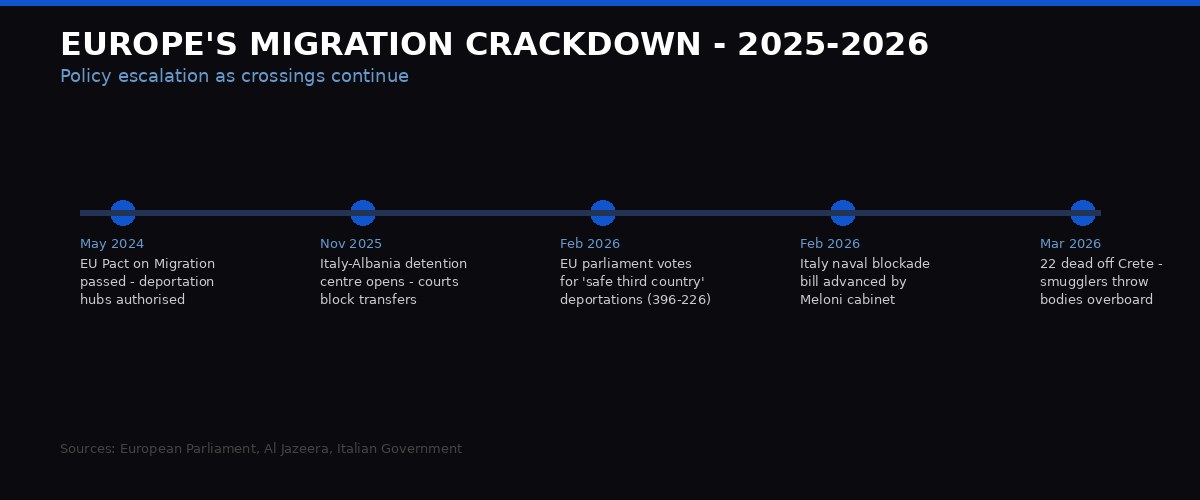
In the weeks before this boat left Tobruk, European institutions were busy.
On February 10, the European Parliament voted 396-226 to approve legislation allowing EU member states to deport asylum seekers to "safe third countries" - including countries those migrants have no connection to whatsoever, provided they merely transited through them. The legislation designated Bangladesh, Morocco, Tunisia, Egypt, India, Colombia, Kosovo, and others as "safe countries of origin." Human rights groups noted that migrants in Morocco and Tunisia have reportedly faced expulsion into desert zones and other documented abuse. [Source: Al Jazeera / European Parliament]
One day later, the Italian cabinet of Prime Minister Giorgia Meloni advanced a migration bill that would allow the Italian navy to impose 30-day blockades on sea arrivals in cases of "exceptional migratory pressure." The bill includes fines of up to 50,000 euros on vessels - targeting humanitarian rescue ships operating in the Mediterranean - and expands the grounds on which foreigners can be expelled from Italy. It also revives Italy's beleaguered Albanian detention centre scheme, which courts have repeatedly blocked.
"The new 'safe third country' rules are likely to force people to countries they may never have set foot in - places where they have no community, do not speak the language, and face a very real risk of abuse and exploitation." - Meron Ameha Knikman, Senior Adviser, International Rescue Committee
The EU has spent the better part of a decade trying to reduce Mediterranean crossings through supply-side suppression: funding the Libyan Coast Guard to intercept and return migrants at sea, outsourcing detention to Tunisia and Algeria through financial agreements, and tightening legal routes to the continent.
The Libyan Coast Guard - the entity EU states have funded and trained to intercept these crossings - has been implicated in its own abuse scandals. Rights groups have documented Libyan Coast Guard vessels firing warning shots at migrant boats, returning people to the detention system that the UN has called a "ruthless and violent business model."
Arrivals to Italy by sea have fallen from 4,400 in the same period last year to 2,000 in early 2026, Italian government figures show. But the dead keep accumulating. In January 2026, the IOM estimated at least 375 migrants died or went missing in a single extreme weather event in the Mediterranean. In February, 53 were dead or missing after a capsizing off Zuwara. In December 2025, 17 were found dead in a partially submerged boat near Crete.
Each policy tightening has reduced official crossings. It has not reduced the smugglers' business. It has simply pushed them onto longer, more dangerous routes and older, less seaworthy vessels. [Sources: Al Jazeera, Italian government, IOM]
The Smuggling Economy: Who Profits, Who Pays
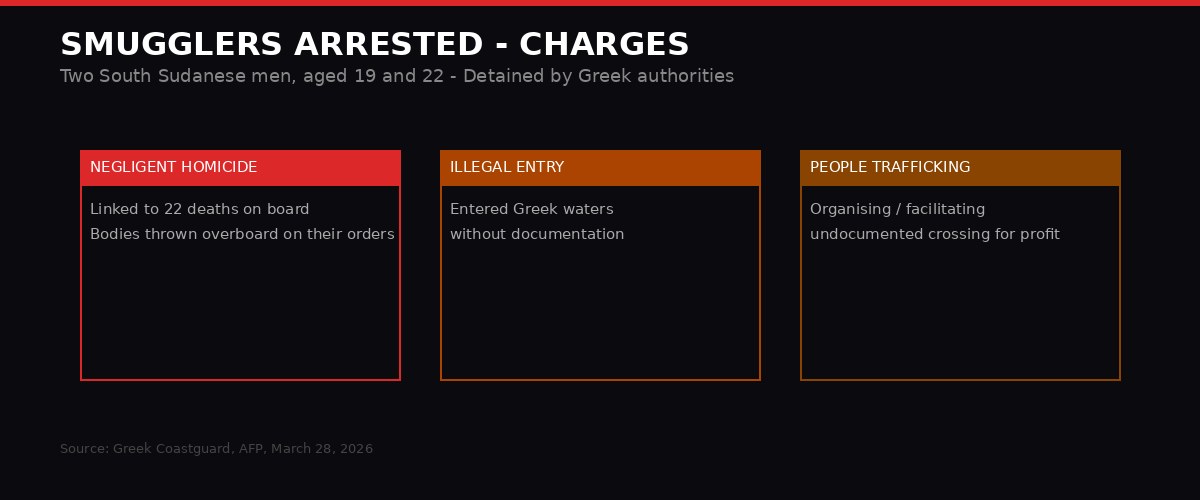
The two men arrested off Crete - a 19-year-old and a 22-year-old from South Sudan - are not the architects of the system that killed 22 people on that boat. They are its bottom rung.
People smuggling networks operating through Libya function as tiered criminal enterprises. At the top are organisers who collect payment from migrants at origin - often $1,000 to $3,000 per person for the full Libya-to-Europe package, though prices vary widely by route and timing. Below them are the fixers who manage movement between waypoints across sub-Saharan Africa or through the Sahara. Below them are the Libyan militias who run the coastal access and the rubber boat operations. And at the very bottom are the boat minders - often migrants themselves who have been coerced or offered passage in exchange for managing the boat during the crossing.
It is not clear whether the two arrested men were paid operatives or migrants-turned-crew. Greek investigators have not publicly stated this. What is clear is that the order to throw bodies overboard - if it came from them, and the coastguard's statement implies it did - was the decision of people operating without any oversight, on the open sea, with no rescue assets nearby and no accountability mechanism.
Why would bodies be thrown overboard? There are practical explanations. A dead body on an overloaded rubber dinghy can capsize the vessel as the weight distribution shifts. In a situation of extreme desperation, the living may prioritise the living. The smugglers may have ordered it to prevent panic, or to free space, or out of simple callousness. The survivors have not publicly described what they saw. The investigation is ongoing.
What can be said is that this incident is not unprecedented. In 2015, at the height of the refugee crisis, similar accounts emerged from Mediterranean crossings. The structural conditions that created those tragedies - armed conflict, poverty, climate displacement, legal barriers to migration, and a profitable criminal market to serve the demand for movement - have not changed. [Sources: OHCHR, IOM, Greek Coastguard]
The Numbers Behind the Disaster
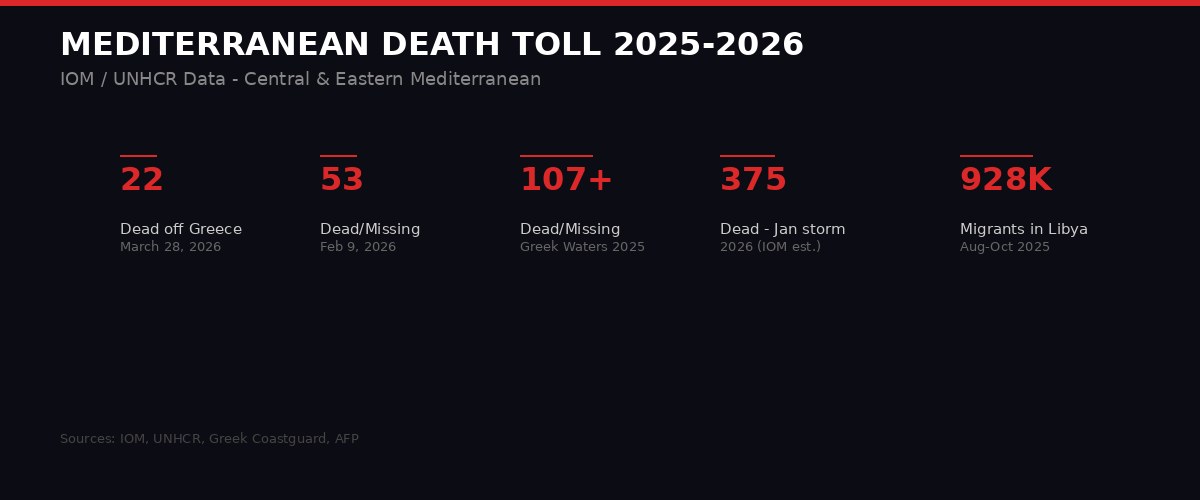
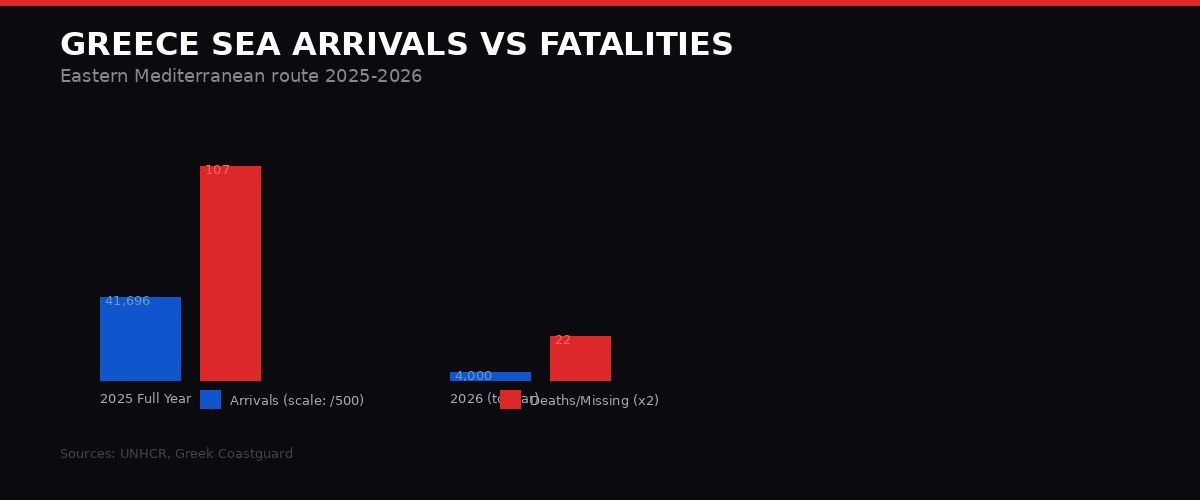
The Greek Coastguard's data for 2025 recorded at least 41,696 arrivals by sea in Greece - and at least 107 people dead or missing in Greek waters during the same period. By early 2026, more than 4,000 people had arrived via sea routes to Greece, according to UNHCR figures.
These are official numbers. The IOM and UNHCR consistently note that official tallies undercount actual deaths, because many drownings occur out of sight of rescue assets, many bodies are never recovered, and many boats simply disappear without a mayday call or a survivor to report them.
In January 2026, the IOM reported that at least 375 migrants died or went missing in the Mediterranean during a period of extreme weather. The qualifier "at least" is doing heavy work in that sentence. Estimates of unrecorded deaths often run two to three times higher than confirmed figures.
The central Mediterranean - the Libya-to-Italy and Libya-to-Greece corridor - has been designated by the IOM as the world's most dangerous migration route for over a decade. It has held that status through policy shifts, political upheavals, and the rise and fall of multiple European migration frameworks.
In Crete specifically, the UNHCR recorded 16,770 people arriving in 2025. Greece suspended asylum processing for three months during that year in response to pressure from arrivals, particularly for those coming from Libya. The suspension did not stop arrivals. It added legal limbo to physical danger.
The Frontex Response and the Question of Rescue
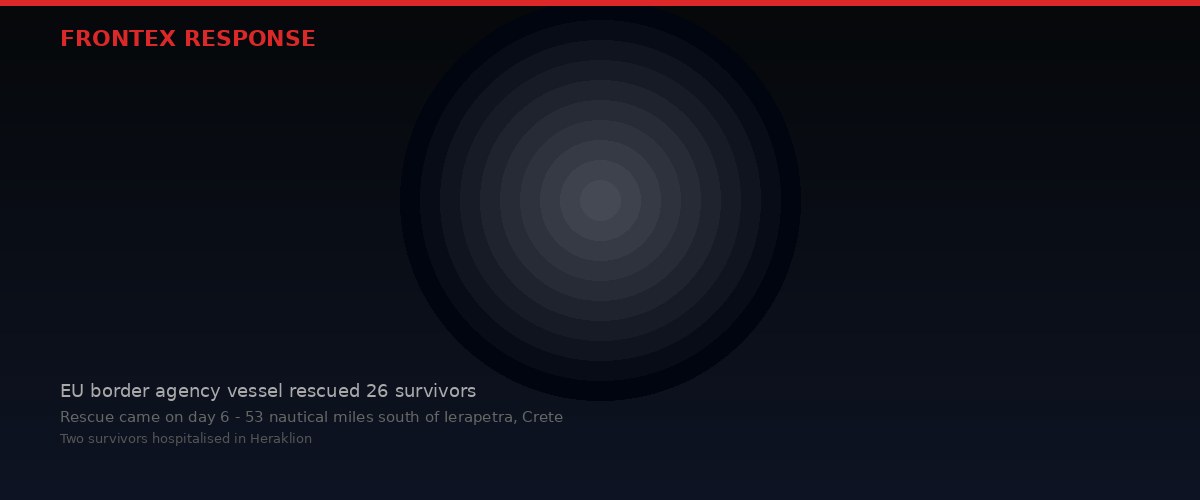
Frontex, the EU's border agency, receives regular criticism from refugee rights organisations. Its mandate sits at the collision point between two incompatible imperatives: border enforcement and search-and-rescue. Its vessels are required by maritime law to rescue people in distress at sea. They are also the operational arm of a union that has spent years trying to prevent those same people from reaching Europe in the first place.
In this case, a Frontex vessel found the boat on day six and rescued 26 people. Without that vessel, the survivors would likely also be dead. That is not nothing. It also doesn't explain the days before the rescue, when the dinghy was somewhere between Tobruk and Crete, losing passengers one by one, with no monitoring system close enough to matter.
In 2025, European search-and-rescue bodies suspended contacts with the Libyan Coastguard counterpart following documented incidents of Libyan authorities interfering with or obstructing rescue operations. The coordination mechanisms that are supposed to cover the Central Mediterranean corridor are, by the assessment of the organisations operating within them, broken.
Italy's new naval blockade proposals - which would allow authorities to forbid vessels, including humanitarian rescue ships, from entering Italian waters for 30 days - would, if passed and enforced, further constrain the rescue infrastructure that caught these 26 survivors. Fines of 50,000 euros per violation are aimed directly at the NGO vessels that patrol the corridor specifically because state assets are insufficient. [Sources: Al Jazeera, Italian government, UNHCR]
Timeline of the Tobruk Crossing
Timeline - March 21-28, 2026
What Does Not Change
The incident off Crete on March 28 is the latest entry in a ledger that stretches back to before 2015 and that shows no sign of ending. The specific mechanisms shift - rubber dinghies replace wooden vessels, Libya replaces Turkey as the main departure point, new EU policies replace old ones - but the core dynamic remains: desperate people, criminal networks willing to profit from their desperation, and a destination continent that would rather they didn't exist.
The EU's "safe third country" legislation, the Italian naval blockade bill, the Albania detention scheme, the Libya Coast Guard funding - these are all attempts to move the problem upstream, to intercept the symptom before it reaches European territory. None of them address what drives people onto rubber boats in Tobruk at dawn on a March morning.
The wars in Sudan, Somalia, South Sudan, and Afghanistan have not ended. The economic collapse in Bangladesh, Pakistan, and West Africa has not reversed. The climate changes driving displacement in the Sahel and coastal South Asia have not stopped. The militias running extortion camps in Libya are, as the UN described in February 2026, operating a "business as usual" profit machine that has survived every European diplomatic effort to dismantle it.
According to the IOM, more than 560 people had gone missing in the Mediterranean in the first two months of 2026 alone - putting the year on course to be among the deadliest on record. The 22 who died off Crete are now part of that count. The 22 whose bodies were thrown into the sea and never recovered may or may not make it into the official statistics.
Two young men from South Sudan - 19 and 22 - are in Greek custody facing negligent homicide charges. The organisations that put them on that boat, and the systems that made Libya the only viable transit point for people fleeing some of the worst conditions on earth, are not in custody. They are not facing charges. They are, by every available measure, still open for business. [Sources: BBC, Al Jazeera, Greek Coastguard, IOM, OHCHR]
Get BLACKWIRE reports first.
Breaking news, investigations, and analysis - straight to your phone.
Join @blackwirenews on Telegram