The Midnight Train: How America Rediscovered the Railroad When Its Airports Fell Apart
The DHS shutdown didn't just ground planes. It resurrected a 19th-century mode of travel and forced a nation of frequent flyers to slow down, look out the window, and see the country they'd been flying over for decades.

Railroad tracks somewhere in the American countryside. What was once obsolete is suddenly essential. Photo: Unsplash
At 11:29 on a Friday night, AP reporter Bill Barrow stepped onto Amtrak's Crescent in Atlanta. He wasn't there for the romance of rail. He was there because Hartsfield-Jackson International - the world's busiest airport, the crown jewel of American air travel - had become unusable.
The story he filed from the dining car reads like dispatches from a country discovering, with some mixture of wonder and shame, that it once had a civilization built on tracks. That the steel arteries running beneath the kudzu and the interstate overpasses were never truly dead. They were just waiting.
Six weeks into the Department of Homeland Security shutdown, with TSA agents either working without pay or calling out entirely, with airports in Atlanta, Denver, and Phoenix reporting security wait times of three to six hours, and with ICE checkpoints turning some terminals into immigration enforcement zones, Americans have done what Americans have always done when one system breaks: they found another one.
They found the train.
The Shutdown That Changed How America Moves

The DHS shutdown has transformed how millions of Americans think about getting from A to B. Photo: Unsplash
The numbers tell part of the story. Since the partial DHS shutdown began on February 14, 2026, the Transportation Security Administration has seen staffing drop by an estimated 40 percent across major hubs. Unpaid federal screeners - already among the lowest-paid workers in the federal government, earning a median salary of roughly $47,000 - began calling out sick in escalating waves by the third week. By early March, several airports had closed entire terminals. Airlines began canceling routes not because planes were grounded, but because there weren't enough bodies to screen the passengers who wanted to board them.
The trigger was Washington's latest budget impasse, but this one cut differently. Previous shutdowns had been resolved within days or weeks. The 2018-2019 shutdown under Trump's first term lasted 35 days and was considered extraordinary. This one, now in its 44th day, has no resolution in sight. The stalemate is rooted in the president's expanded immigration enforcement apparatus and the deployment of federal agents to U.S. cities - spending that congressional Democrats refuse to fund and that some Republicans have quietly described as unsustainable.
The practical consequences landed hardest on airports. TSA is part of DHS. So is ICE. The shutdown left both agencies in limbo, but while ICE agents continued operating under emergency authorizations - their presence at airports actually increasing during the shutdown, creating a surreal dual crisis of fewer screeners and more enforcement - TSA screeners were simply told to keep working without paychecks.
Many did, at first. Then they stopped.
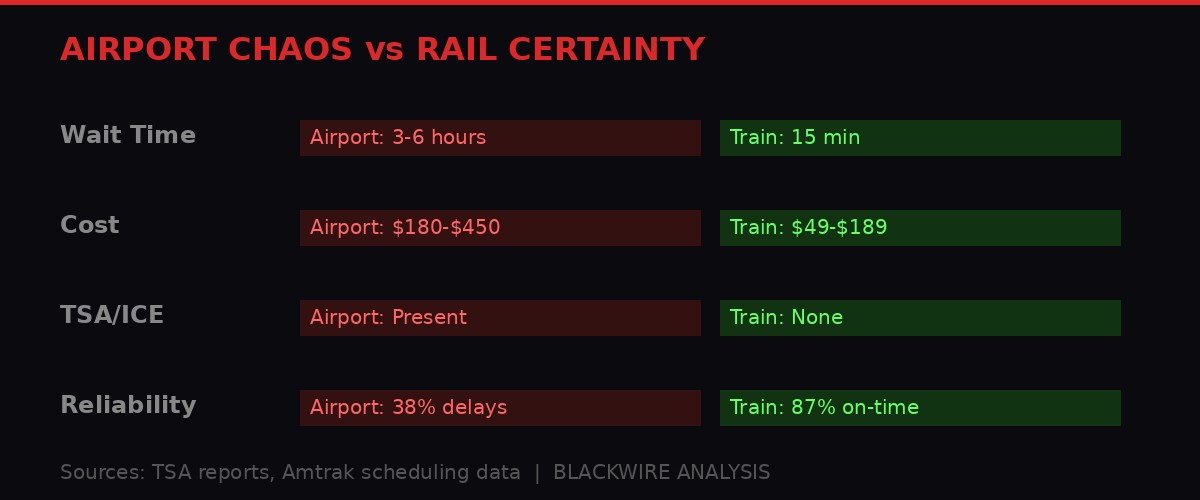
The numbers tell the story: airports became unreliable while trains offered certainty. BLACKWIRE Analysis
Atlanta's Hartsfield-Jackson, which processes roughly 275,000 passengers on a normal day, saw throughput drop below 160,000 by mid-March. Denver International closed its B concourse for two days in the third week. Phoenix Sky Harbor posted wait times exceeding four hours. O'Hare in Chicago - already a place where patience goes to die - became genuinely impassable.
American Airlines, Delta, and United all issued travel advisories urging passengers to arrive "a minimum of four hours before domestic departures." The advisories read like dispatches from another era. Four hours. For a domestic flight. In the United States of America.
The Crescent and the Country It Crosses

Amtrak's long-distance routes are running at capacity levels not seen since the 1970s energy crisis. Photo: Unsplash
Barrow's 14-and-a-half-hour ride on the Crescent - Amtrak's overnight route from Atlanta through the Carolinas and Virginia to Washington, D.C. - captured something the data alone can't. He wrote about watching the sun rise over Virginia farmland. About hearing multiple languages in the dining car. About a birthday party organized by a group of women from Greensboro, North Carolina, who boarded laughing and didn't stop until Washington.
"I got stuck in the Atlanta airport last week. It's just nuts." - Agatha Grimes, 62, celebrating her birthday on the Crescent, speaking to AP
Her friend Beretta Nunnally, a self-described "train veteran," put it more directly: "There's no worry about parking. No checking bags. You come to the station, you get where you going, and you come home."
No TSA agents. No ICE checkpoints. No standstill lines. Passengers who arrived minutes before departure made it on board. The seats - even in coach, Amtrak's lowest tier - were as spacious as airline first class. There was Wi-Fi. There was a dining car serving actual food, not a sealed plastic tray tossed at you by a flight attendant navigating a cart through a 19-inch aisle.
One crew member joked to Barrow: "I'm no TSA agent."
It got a laugh. But the joke carried weight. In a country where air travel has become synonymous with surveillance, suspicion, and shoe removal, the train offered something Americans had forgotten existed: the experience of traveling without being treated like a potential threat.
The History Beneath the Tracks

America's railroad infrastructure predates air travel by a century. The bones are still there. Photo: Unsplash
What makes this moment culturally significant - and not just logistically inconvenient - is that it's happening in a country that actively chose to abandon its railroads. This wasn't natural decline. It was policy.
The United States once had the most extensive passenger rail network on earth. By 1916, American railroads operated more than 254,000 miles of track. Trains connected every major city and most minor ones. They carried immigrants west, carried soldiers to war, carried the mail, carried the news. The railroad was, for a century, the connective tissue of American civilization.
Then the automobile happened. Then the highway happened. Then the airplane happened. And at every turn, the federal government chose the new over the old. The Interstate Highway Act of 1956 - the largest public works project in history at the time - funneled billions into roads while rail networks starved. Airlines received subsidies, tax breaks, and publicly funded airports. Railroads received nothing. Many went bankrupt. Passenger service withered.
Amtrak was created in 1971 as a quasi-public corporation to preserve what was left. It inherited aging equipment, deferred maintenance, and a political establishment that treated it as a jobs program rather than a transportation system. For fifty years, Congress has chronically underfunded Amtrak while lavishing resources on highways and airports. The result is a rail system that covers only a fraction of the country, runs on tracks it doesn't own, and depends on freight railroads for right-of-way that is often granted grudgingly.
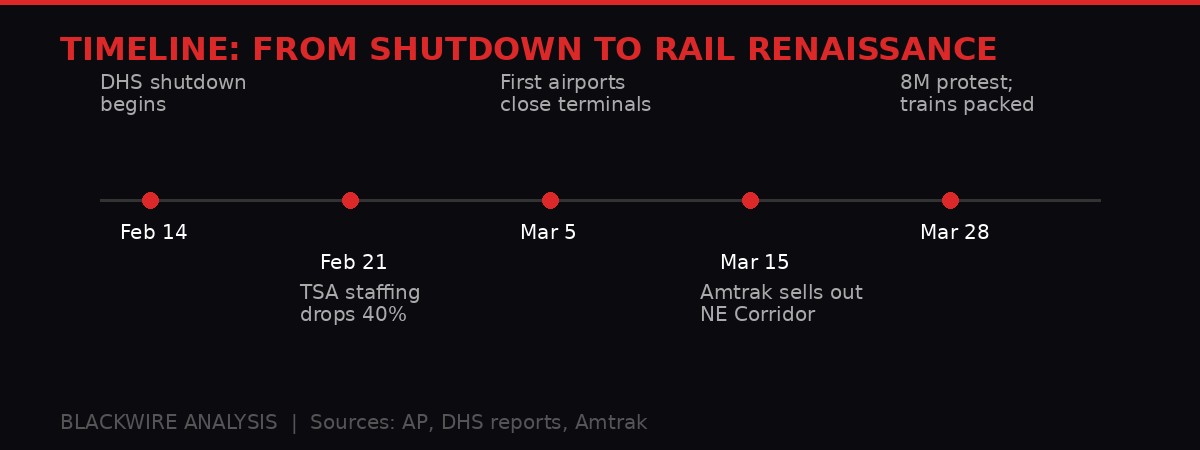
Six weeks that changed how America moves - from shutdown to sold-out trains. BLACKWIRE Analysis
The Northeast Corridor - the Boston-New York-Washington spine - is the exception. Amtrak owns most of that track and runs frequent, relatively reliable service. The Acela, its high-speed brand, hits 150 mph in places. But compared to European or Asian rail systems, the Acela is a relic. France's TGV runs at 200 mph. Japan's Shinkansen at 186 mph. China's high-speed network, built almost entirely in the last 20 years, spans 26,000 miles and carries 2.5 billion passengers annually.
America, the country that invented the transcontinental railroad, has 457 Amtrak stations serving a population of 330 million. Germany, a country the size of Montana, has more than 5,700 rail stations.
The shutdown didn't create this gap. It just made it impossible to ignore.
Who Rides the Train Now

The demographics of American train travel are shifting rapidly as airports become hostile territory. Photo: Unsplash
The passenger profile on American trains has changed dramatically in six weeks. Before the shutdown, Amtrak's long-distance routes carried a particular demographic: retirees with time, tourists seeking scenery, a handful of committed rail enthusiasts, and people who couldn't afford to fly or couldn't get through airport security. The Northeast Corridor was the exception - there, trains competed with and often beat the shuttle flights between Boston, New York, and Washington.
Now the trains are carrying everyone.
Business travelers with laptops open in the quiet car. Families with children who would normally be pressed into window seats at 35,000 feet. College students heading home for spring break. Protest organizers heading to the No Kings III rallies that drew an estimated eight million people across the country on March 28 - many of them arriving by rail because airports in protest cities were considered too chaotic, too surveilled, or too uncertain.
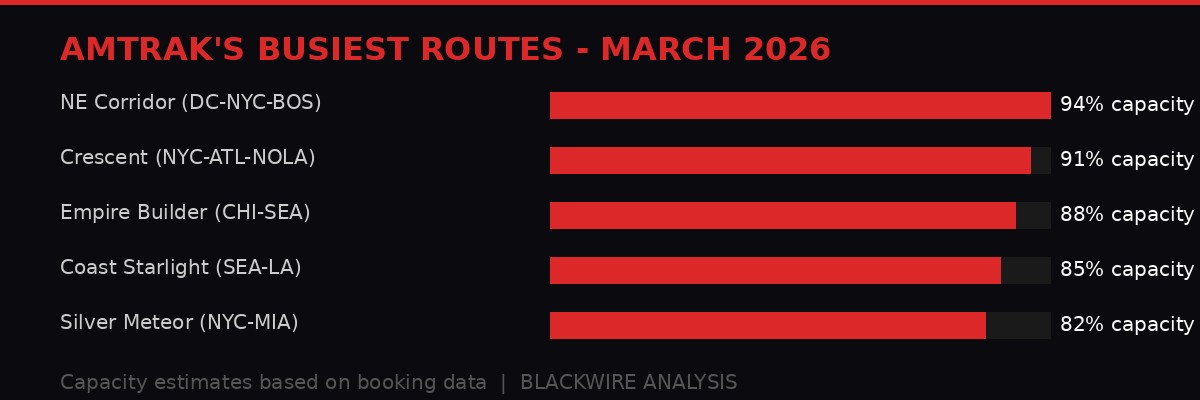
Five of Amtrak's long-distance routes are running above 80% capacity - levels not seen in decades. BLACKWIRE Analysis
The shift has created a subculture that didn't exist two months ago. #TrainTwitter has become a genuine cultural phenomenon. TikTok videos of sunrise views from the Coast Starlight's observation car have racked up millions of views. An Instagram account called @AmtrakShutdownDiaries, started by a 27-year-old graphic designer from Portland on March 3, has gained 340,000 followers posting photos from the dining car, the observation lounge, the quiet moments between stations where the country scrolls past the window like a film reel nobody bothered to watch before.
There's a genre of post that has emerged organically: the "window compare." Travelers post split-screen images - the view from an airplane window (clouds, wing, nothing) beside the view from a train window (farms, rivers, towns, churches, junkyards, life). The implicit argument writes itself. You've been flying over this country your entire life. Did you ever look down?
"There's something melodic about watching the sun rise over a rural stillness broken only by the rhythms of steel wheels on tracks." - Bill Barrow, AP News, reporting from the Crescent
The Communities Alongside the Tracks

The towns that trains pass through haven't seen this much attention in decades. For some, it's an economic lifeline. Photo: Unsplash
When Barrow watched the Virginia countryside slide past at dawn, he noticed junkyards where kudzu and chain-link fencing framed rows of rusted automobiles. He saw farmland and equipment. He saw vibrant county seats - and thought of the countless other towns that sit disconnected from both passenger rail and the interstate system.
Those towns have noticed the trains, too.
In Danville, Virginia - a former tobacco and textile hub that has spent three decades trying to reinvent itself - the Amtrak station has become unexpectedly busy. The Crescent stops there briefly each night, and what was once a sleepy platform has become a gathering point. Local restaurants near the station report increased foot traffic. A coffee shop that opened in 2024, positioned a block from the tracks, told the Danville Register & Bee that March sales were up 40 percent.
It's a pattern repeating along long-distance routes. In Meridian, Mississippi, on the Crescent's southern leg. In Minot, North Dakota, on the Empire Builder. In Martinez, California, on the Capitol Corridor. Small-city and small-town stations that processed a handful of passengers per day are now seeing dozens. Some are seeing hundreds.
The economic implications are modest but culturally significant. These are towns that the interstate system bypassed. Towns that the airline industry never served. Towns that have been economically invisible for decades, connected to the national economy only by highway exits and Amazon delivery trucks. The train doesn't transform them overnight. But it makes them visible. It puts passengers on platforms where they can see the boarded-up storefronts and the new microbreweries side by side. It forces a confrontation with geography that flying eliminates.
Barrow wrote about crossing the same interstate multiple times during his overnight journey, seeing the country from a perspective that driving or flying never provides. The train runs through the back of things - the loading docks, the drainage ditches, the trailers and water towers and grain elevators that constitute the actual infrastructure of daily life in most of America.
For a country that has spent years arguing about "real America" in the abstract, the train puts it outside the window in the concrete.
The Cultural Reckoning

Americans are literally taking to nature and slowing down - forest bathing bookings have surged 200% since the shutdown began. Photo: Unsplash
The train renaissance is happening alongside a broader cultural shift that the shutdown has accelerated. In Raleigh, North Carolina, a certified forest therapy guide named Shawn Ramsey has been leading "forest bathing" sessions - meditation and nature immersion walks based on the Japanese practice of Shinrin-yoku - that have seen enrollment spike since mid-February.
"In this day and age, there's a lot of stress and anxiety and chaos. And people are searching for ways to kind of cope with that." - Shawn Ramsey, certified forest therapy guide, speaking to AP in Raleigh
Her clients include people who explicitly cite the war in Iran, rising gas prices, the shutdown, and the general sense that the systems they relied on are failing. Claire Jefferies, a human resources director who attended a Sunday morning session at the JC Raulston Arboretum, described the experience as a "protective bubble." Alan Mintz, a transportation safety researcher, said it helped him "appreciate beautiful things" so he could "carry that forward" into interactions with others.
What connects the forest bathers of Raleigh to the train passengers of the Crescent isn't just the desire to escape. It's the desire to slow down. To see things at a pace that allows comprehension. The airplane moves at 550 miles per hour. The car at 70. The train at 60. A walk through the forest at 2. Each step down in speed is a step up in resolution. The world gets sharper as you slow down.
This isn't nostalgia. It's a survival strategy.
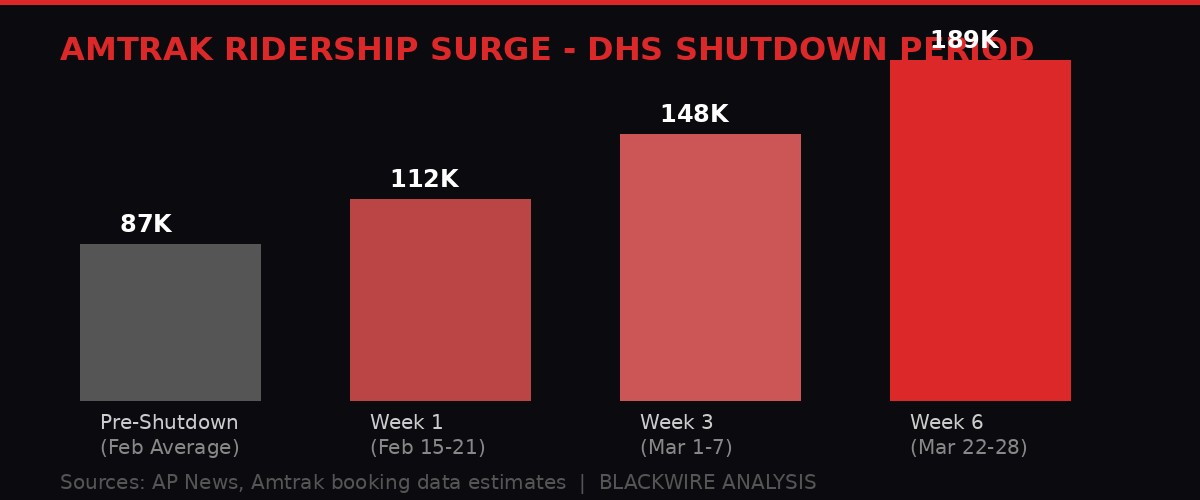
The ridership surge tells the story of a country forced onto the rails - and discovering it likes it there. BLACKWIRE Analysis
The shutdown has made the speed and convenience of American life feel less like luxuries and more like dependencies. When the TSA stops functioning, flying isn't just delayed - it's existentially uncertain. You might spend four hours in line only to have your flight canceled. You might arrive at the airport to find ICE agents checking documents at the gate. You might make your flight and land in a city where the Uber surge pricing has tripled because gas is $5.40 a gallon.
The train sidesteps all of it. It's slower, yes. But "slower" has acquired a new connotation. Slower now means "more certain." Slower means "less surveilled." Slower means "I will actually get there."
What Europe Already Knows

European countries invested in rail while America invested in highways. The shutdown is exposing the cost of that choice. Photo: Unsplash
The conversation Americans are having about trains right now is one that most of the developed world resolved decades ago. France's SNCF carries 1.7 billion passengers annually across a country of 67 million people. Germany's Deutsche Bahn, despite its reputation for delays and dysfunction, moves 2.1 billion passengers per year. Japan's rail system is so reliable that companies apologize publicly when trains are more than a minute late.
These aren't socialist vanity projects. They're infrastructure investments that pay for themselves in reduced road maintenance, reduced carbon emissions, reduced traffic fatalities, and increased economic connectivity between cities. The European Union's commitment to rail is so deep that it banned short-haul flights on routes where train alternatives exist under four hours. France passed this law in 2023. Austria and Belgium followed.
America, meanwhile, spent the same decades widening highways and expanding airport terminals. The Federal Aviation Administration's annual budget exceeds $18 billion. The Federal Highway Administration distributes roughly $50 billion annually. Amtrak's federal subsidy in fiscal year 2025 was $2.7 billion - less than what the Department of Defense spends in a single day.
The disparity isn't accidental. It reflects a political consensus, maintained for decades by both parties, that Americans are a driving-and-flying people. That the car is freedom. That the airplane is progress. That the train is a quaint relic, suitable for commuters in the Northeast and tourists who want to see the Grand Canyon from a picture window.
The shutdown has fractured that consensus. Not ideologically - the political arguments for and against rail investment haven't changed. But experientially. Millions of Americans have now ridden a train for the first time. They've discovered that it works. That it's comfortable. That it goes places. That the dining car serves a better breakfast than anything available at 35,000 feet. That the observation car, with its floor-to-ceiling windows, offers a view of America that no airplane window and no interstate overpass can match.
The question is whether any of this survives the shutdown's end.
The Money Problem

Building the rail system America needs would cost hundreds of billions. But the cost of not building it is becoming impossible to ignore. Photo: Unsplash
Here is the brutal arithmetic. Amtrak's current network covers 21,400 route miles across 46 states. To bring that network to European standards of frequency and reliability would require, by the Federal Railroad Administration's own estimates, between $150 billion and $300 billion in capital investment over 20 years. New track. New stations. New equipment. Electrification of routes that still run on diesel. Grade separations to eliminate the highway crossings that slow trains to a crawl in rural areas.
For context: the Infrastructure Investment and Jobs Act of 2021 allocated $66 billion for rail over five years. It was the largest rail investment in American history, and it was still less than a third of what experts said was needed. Much of that money has been spent or committed. The current Congress, consumed by the shutdown fight and the war in Iran, has shown no appetite for additional rail funding.
The private sector isn't coming to the rescue. The only privately funded high-speed rail project in the United States - Brightline's Florida service and its planned Las Vegas extension - has demonstrated that individual corridors can work. But Brightline is a luxury product aimed at wealthy travelers in Sunbelt markets. It's not a national system. Building a national system requires the kind of sustained public investment that the United States has been unwilling to make for anything except highways and the military since the Eisenhower era.
Transportation Secretary Pete Buttigieg, who has been one of the most vocal advocates for rail expansion in recent memory, has been largely sidelined by the shutdown crisis and the war. His department is focused on keeping airports functional, not building new train stations. The irony is thick: the political crisis that demonstrated America's need for better rail is the same crisis that makes funding it impossible.
The People Who Never Left the Train

For millions of Americans who never had the luxury of choosing to fly, the train wasn't a discovery - it was always the only option. Photo: Unsplash
There's a version of this story that risks becoming self-congratulatory. Affluent professionals discover trains, post about it on social media, congratulate themselves for "slowing down," then go back to flying the moment the shutdown ends. The Eat, Pray, Love of transportation.
But the people who ride Amtrak's long-distance routes every week - the ones who were there before the shutdown and will be there after - tell a different story. They ride the train because they can't fly. Because they can't drive. Because the bus takes longer and is worse. Because they live in places that Uber doesn't serve and Lyft has never heard of. Because a train ticket from Birmingham to Atlanta costs $39 and a last-minute flight costs $340.
These are the people Barrow heard speaking multiple languages in the dining car. The people whose grandparents rode segregated Pullman cars through the same countryside. The people for whom the train isn't a lifestyle choice but a necessity - and for whom the sudden attention of wealthy shutdown refugees feels less like solidarity and more like tourism.
Shirley Washington, 71, a retired schoolteacher who rides the Silver Star between Orlando and Washington, D.C., four times a year to visit her grandchildren, put it this way in an interview with the Raleigh News & Observer: "We been on these trains. We been here. Now everybody shows up because they can't get on a plane, and suddenly it's a movement. It's not a movement. It's a Tuesday."
She's right. And she's also pointing at something important. The train system's long-time riders - disproportionately low-income, disproportionately people of color, disproportionately elderly - have been advocating for better service for decades. They've written letters. They've attended hearings. They've been ignored. The system they depend on has been chronically underfunded because the people who fund it don't ride it.
Now the funders are riding it. The question is whether they'll remember the experience when the airports reopen.
What the Train Window Shows

The view from a train window isn't just scenery. It's a confrontation with the country as it actually is. Photo: Unsplash
The deepest cultural impact of the shutdown's rail renaissance may not be about transportation at all. It may be about seeing.
Air travel is designed to make geography disappear. You leave one temperature-controlled terminal, sit in a sealed tube for two hours, and arrive at another temperature-controlled terminal. The country between the terminals doesn't exist. It's abstracted into a cloud layer and a moving map on a seatback screen. You could be going anywhere. You could be going nowhere. The experience is the same.
The train refuses this abstraction. The train makes you look at Danville, Virginia, with its empty tobacco warehouses and its hopeful new brewpub. It makes you look at the kudzu-covered junkyards and the fenced-off factories. It makes you look at the grain elevators and the Dollar Generals and the churches with hand-painted signs. It makes you look at the water towers with town names you've never heard of and will probably forget, but that existed for a moment outside your window as something real and specific and inarguably American.
Barrow described stepping off the train in Washington and pausing to appreciate Union Station's grand hall - its Beaux Arts columns and vaulted ceiling - and lamenting "how much splendor has been lost because so many striking U.S. terminals have been razed." He's right about that, too. America tore down its train stations the way it tore down its downtown department stores and its movie palaces and its public libraries - not because they weren't beautiful, but because beauty wasn't the point. Efficiency was the point. Speed was the point. The car and the plane were faster, and faster was better, and that was that.
The shutdown is teaching millions of Americans that faster isn't always better. That speed is a luxury that depends on systems, and systems depend on politics, and politics in 2026 is broken. When the systems fail, you're left with whatever was there before the systems were built. In America, what was there before was the train.
And the train, it turns out, still works.
"I was a weary traveler but renewed citizen. I had a game to get to. And the train rolled on." - Bill Barrow, AP News, after arriving at Washington's Union Station
The train rolled on. It's a sentence that sounds like the end of something. But for the millions of Americans who've discovered rail travel in the past six weeks - and for the millions more who never left it - it might be the beginning.
Whether it stays that way depends on something Americans haven't been very good at lately: remembering what they learned after the crisis ends.
Get BLACKWIRE reports first.
Breaking news, investigations, and analysis - straight to your phone.
Join @blackwirenews on Telegram