Robot Umpires Take the Field: How MLB's AI Strike System Changes Everything
The New York Yankees played the San Francisco Giants Wednesday night under the watchful eye of twelve cameras that don't blink, don't tire, and don't argue with managers. Major League Baseball's Automated Ball/Strike system - seven years in development, tested across thousands of minor league games - made its regular-season debut. It's a bigger moment than most people realize.
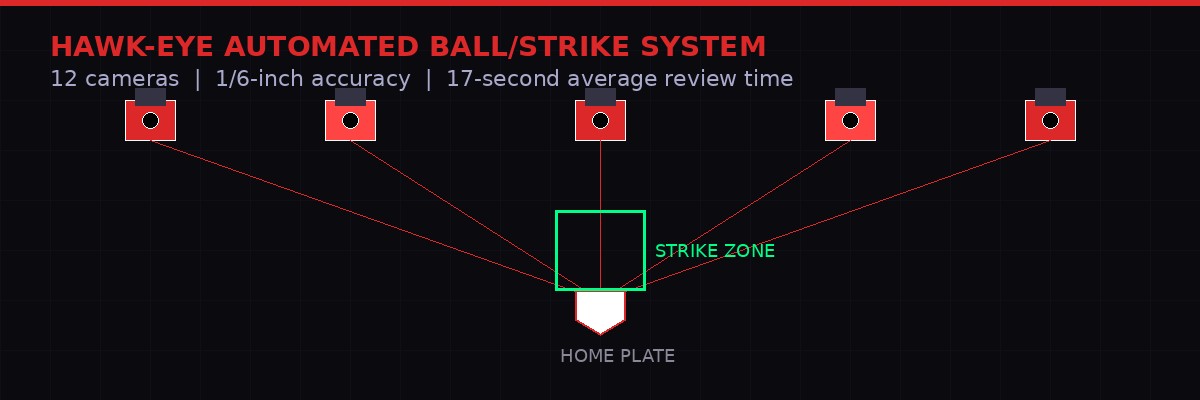
The Hawk-Eye ABS system uses 12 cameras around the stadium to measure each pitch to one-sixth of an inch accuracy. Reviews average 17 seconds.
The system doesn't replace umpires outright. Human plate umpires still call every pitch. But each team gets two challenges per game - tap your helmet within two seconds, the scoreboard fills with a digital graphic, and the machine's ruling stands final. The umpire announces the update. No argument is possible because there is no one to argue with.
That last detail is the structural shift worth understanding. For 150 years, baseball's human element extended directly to the officiating layer. You could work the ump. You could wear him down. Veteran catchers built careers on "pitch framing" - the subtle art of receiving a pitch in a way that nudges borderline calls toward strikes. Certain pitchers lived on the black, coaxing called strikes a half-inch outside the zone because they'd earned that real estate through years of command and consistency.
That relationship - between player craft and officiating subjectivity - is now conditional. The machine is watching. It will be called upon when it matters most.
Seven Years in the Making: How ABS Became Reality
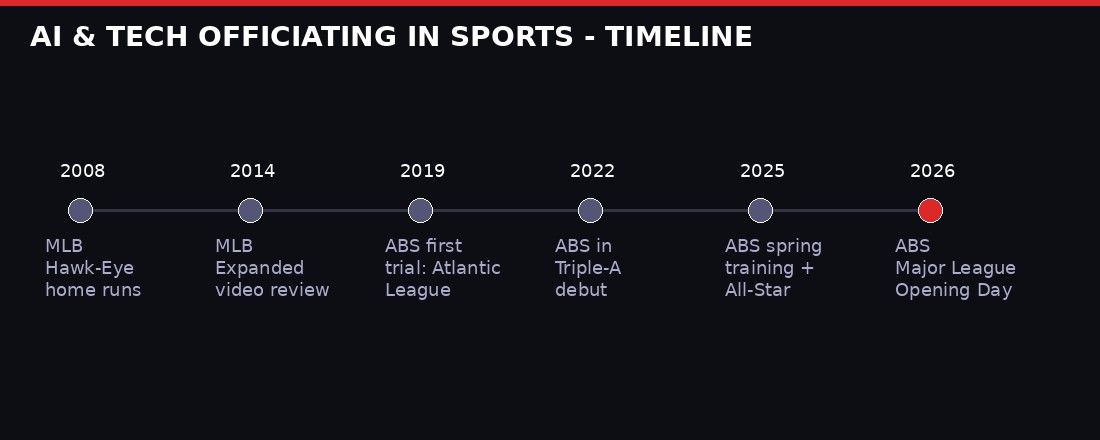
From 2008 Hawk-Eye home run calls to Opening Day 2026 ABS deployment - the 18-year arc of AI taking the field in Major League Baseball.
The road to robot umpires runs through an obscure independent league in New Jersey. The Atlantic League - a non-affiliated minor league outside the MLB ecosystem - agreed in 2019 to be the testing ground for the Automated Ball/Strike system. It was a smart strategic move by MLB: trial the tech where the stakes were low, learn fast, and let players, managers, and broadcasters adjust before the pressure of a pennant race.
The Atlantic League's All-Star Game that July became the first professional game in history where a computer called balls and strikes in real time. Umpires wore earbuds. The system spoke. They relayed. Players found it strange. Managers found it strange. Then they got used to it.
MLB pushed ABS into Low-A competition in 2021, testing it at eight of nine Southeast League ballparks. The following year, 2022, it moved up to Triple-A - the final development tier before the majors. For the first two years at Triple-A, half the games ran ABS and half ran human umps subject to appeals, creating a controlled A/B test at scale. [AP News, MLB Competition Committee Statement]
On June 26, 2024, MLB switched all Triple-A games to the challenge format. Then came the 2025 spring training pilot at 13 ballparks hosting 19 teams - 288 exhibition games, nearly 50,000 pitches processed. Teams won 52.2% of their 1,182 challenges, averaging 13.8 seconds per review. The data was clean. The system was ready.
The competition committee - a mix of players, management, and league officials - voted to adopt ABS for the 2026 regular season. The player contingent voted 3-1 in favor. Twenty-two of 30 teams backed it. Commissioner Rob Manfred cited the "strong preference from players for the challenge format over using the technology to call every pitch" as the decisive factor in design choices.
"I think with any sort of technology, there's not 100% certainty of the accurateness of the system. The same can be said of umpires. It's just coming to grips with the impact that technology is going to have." - Austin Slater, Yankees outfielder and player representative on the competition committee
The deliberate, incremental rollout reflects something important about how transformative technologies succeed in established institutions: they don't arrive with fanfare and force change. They prove themselves quietly, accumulate evidence, and then become inevitable.
How the Technology Actually Works
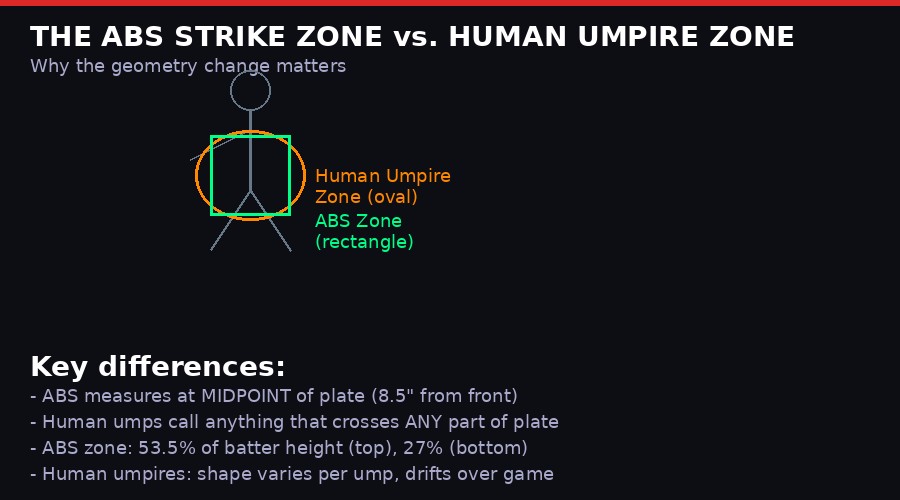
The geometric difference between how human umpires and ABS define the strike zone. The rectangle vs. the oval has real consequences for pitchers who live on the corners.
The Hawk-Eye system powering ABS is the same underlying technology used in tennis, cricket, Premier League football, and Formula 1. Hawk-Eye was originally developed in the UK by Paul Hawkins in 2001 and acquired by Sony in 2011. It processes multiple camera feeds simultaneously to reconstruct the three-dimensional trajectory of a moving object in real time.
In baseball configuration, twelve cameras are positioned around each stadium at calibrated angles. Every pitch is tracked from release point through its full trajectory to where it crosses home plate. The system measures crossing position to approximately one-sixth of an inch - finer than any human sensory apparatus could detect. [AP News, ABS How It Works]
The ABS strike zone is strictly rectangular, defined by the rulebook. The top sits at 53.5% of a batter's height, the bottom at 27%. Width follows home plate at 17 inches. Critically, the system measures at the midpoint of the plate - 8.5 inches from front and back - rather than the rulebook's "any part" standard used by human umpires.
That midpoint measurement matters. Human umpires, calling anything that crosses any part of the plate, can award strikes on pitches that barely nick the front edge. ABS evaluates the ball's position at the plate's center. This alone shifts the effective zone. Some pitches that were strikes are now balls. Some borderline cutters that used to be called out are now judged by pure geometry.
Each batter is measured individually - height data collected during spring training, computed by the Southwest Research Institute for verification, stored per player. Strike zones are not universal. A 6-foot-7 Aaron Judge faces a different vertical zone than a 5-foot-9 Jose Altuve. The machine accounts for this. Human umpires approximate it inconsistently.
ABS Technical Specs
- 12 Hawk-Eye cameras per stadium, calibrated angles
- Pitch trajectory reconstructed in 3D in real time
- Strike zone top: 53.5% of batter height
- Strike zone bottom: 27% of batter height
- Measurement point: midpoint of plate (8.5" from front)
- Accuracy: approximately 1/6 of an inch
- Average review time: 17 seconds
- Zone shape: strict rectangle (vs. human umpire oval)
- Each player individually measured without shoes
Winners and Losers: The Career Implications
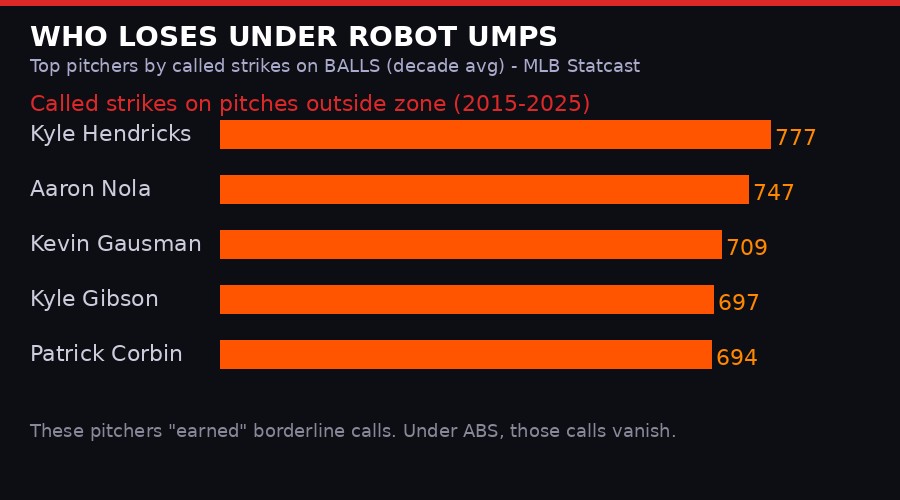
MLB Statcast data showing which pitchers accumulated the most called strikes on pitches outside the zone over the last decade. Under ABS, those gifts disappear.
MLB Statcast has been quietly cataloguing every pitch for over a decade. When you run the numbers on which pitchers got the most favorable treatment from human umpires - called strikes on balls - the results are striking, if uncomfortable.
Kyle Hendricks leads all pitchers with 777 called strikes on out-of-zone pitches over the past decade. Aaron Nola sits second at 747. Kevin Gausman and Zach Davies share third at 709. Patrick Corbin, Kyle Gibson, Marcus Stroman, Zack Greinke - the list reads like a Hall of Fame nomination committee for the art of working an umpire. [AP News / MLB Statcast decade data]
These aren't pitchers who were getting away with cheating. They were doing exactly what pitcher development programs teach: command the corners, trust your catcher's framing, establish trust with the home plate umpire early in the game. These are skills, real skills, refined over thousands of innings. Under ABS challenge scenarios, those skills still matter on non-challenged pitches - but in critical moments, anyone can flip the challenge switch.
Gausman told AP: "I guess the book is kind of still out. We'll see what happens and how we have to adjust." He'd been top-five in favorable calls without realizing it. A lot of pitchers probably feel the same way.
The impact flows in the other direction too. Batters who get squeezed will see relief. Mookie Betts of the Dodgers led all batters with 714 called strikes on pitches out of the zone over the past decade. His manager, Dave Roberts, said: "He knows the strike zone as well as anyone and it does seem that he gets the short end of a lot of calls." ABS erases that disadvantage in key moments.
Carlos Santana received the most balls-that-should-have-been-strikes: 636 pitches that crossed the zone but were called balls. His at-bats were extended, his walk numbers inflated, by human imprecision. Under ABS, pitchers can reclaim those called strikes with a challenge.
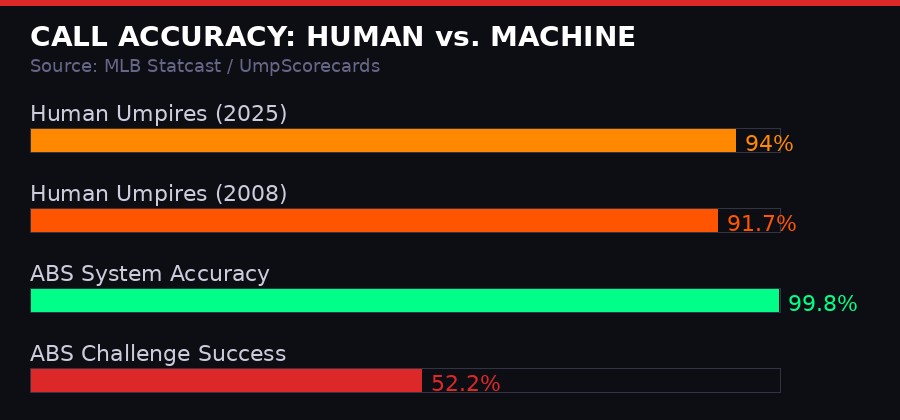
Human MLB umpires improved their accuracy from 91.7% in 2008 to 94% in 2025. ABS operates at near-perfect accuracy for pitch location - but "accuracy" isn't the only thing that matters.
Catchers face the most complex recalibration. Pitch framing - receiving a pitch with a subtle glove movement to make a borderline ball look like a strike - has been one of the most valued defensive skills in modern baseball. Advanced metrics quantify framing ability in runs saved per season. Elite framers like Jose Trevino or Tucker Barnhart have been worth millions in contract value specifically because of their ability to steal strikes for their pitchers.
The challenge system doesn't eliminate framing. Human umpires still call every pitch, and only two challenges exist per game. Catchers retain significant influence on the ~300 non-challenged calls. But the threat of machine correction changes the psychology. Umpires, knowing their calls can be checked, may be less susceptible to framing pressure. The invisible art of presenting a pitch beautifully has a ceiling now.
The Challenge Game: Strategy at the Margins
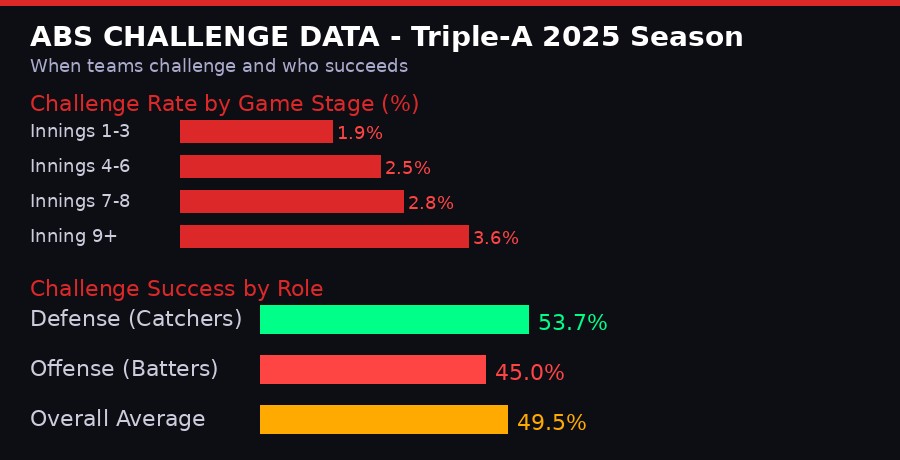
Challenge data from Triple-A 2025: success rates increase as games progress into high-leverage innings. Catchers succeed at 53.7% vs. 45% for batters.
With only two challenges per game, how teams deploy them is itself a strategic decision. The data from Triple-A suggests the optimal approach: hold them deep.
Challenge rates at Triple-A run 1.9% of pitches in innings one through three, rising to 3.6% in the ninth inning and beyond. Teams are more trigger-happy late, when individual pitches carry more weight. The machine knows this. Players know this. Entire new categories of game theory emerge around challenge management.
Arizona Diamondbacks manager Torey Lovullo captured the strategic psychology: "You want to have one late in the game, just in case. The top of the first inning on a 0-0 fastball, I don't want to challenge and lose." Challenge conservation becomes as important as challenge deployment. Burning a challenge on a borderline 0-0 pitch in the first is poor bankroll management.
Colorado Rockies manager Warren Schaeffer, who managed in Triple-A when ABS debuted there in 2022, warned about the emotional dimension: "I've seen challenges lost in the first inning. That's not good. Emotion is a big key to this." The hitter who challenges a 2-2 pitch on pure gut frustration, loses, and hands away the team's challenge reserve has committed a kind of capital destruction. Organizations will coach challenge discipline the same way they coach pitch selection.
"Unless you have a really good eye, only getting two challenges, I think a lot of the borderline ones are going to stay the same. It keeps some of the human element in the game." - Kyle Higashioka, Rangers catcher
The challenge-success rate hovering around 50% creates an interesting equilibrium. Teams win slightly more than half their challenges, which means the machine and the umpire disagree meaningfully often enough to make challenging worthwhile, but not so often that the umpire is rendered irrelevant. The 94% human accuracy rate against near-perfect machine accuracy leaves a 6% gap - roughly 18 pitch calls per game where the umpire might be wrong. With 4.2 average challenges per game in Triple-A, teams are correctly identifying the most consequential of those misses.
Defense challenges - typically catchers disputing ball calls - succeed at 53.7%. Offensive challenges - batters contesting called strikes - succeed at only 45%. The interpretation is straightforward: catchers see the pitch from a better angle, have more experience reading spin and trajectory, and are more disciplined under pressure than hitters reacting in the moment to 95-mph deliveries.
What Machine Officiating Means for Human Officials
The implementation choice - challenge system rather than full automation - was deliberate and politically necessary. Umpires have a union. They negotiate contracts with MLB. Replacing them outright with machines would require collective bargaining, legal challenge, and significant public relations work. The challenge system threads the needle: machines exist, but so do umpires. The human calls every pitch. The machine is available on appeal.
It's also intellectually honest. ABS measures pitch location with extraordinary precision. But umpiring involves more than pitch location. Interference calls, tag plays, foul tips, balk violations, obstruction - these remain human judgment calls. The strike zone is the narrow slice of officiating that can be fully mechanized because it has a precise geometric definition. Everything else is contextual in ways current computer vision and AI cannot cleanly resolve.
The NFL's replay review system offers a cautionary precedent. Replay was introduced in 1986, expanded multiple times, and now covers everything from touchdown rulings to pass interference, with mixed results. Some plays are genuinely reviewable and produce more accurate outcomes. Others introduce lengthy delays and paradoxical rulings - the "process of the catch" debate consumed years of fan patience and regulatory revision. MLB designed ABS narrowly to avoid scope creep.
Texas Rangers president Chris Young, who previously worked in MLB's umpire oversight office, said: "They do a phenomenal job, but the stuff in today's game is better than ever. Umpiring is harder than ever. If there's the ability to use technology to add a level of consistency, that's great for everybody."
Guardians manager Stephen Vogt was more direct: "You can like it, dislike it, it doesn't matter. It's coming. It's going to change the game forever." The fatalism carries accuracy. Once a sport incorporates precision measurement technology, the baseline for what counts as "acceptable human error" shifts permanently downward. The 94% accuracy umpires achieve today was a high mark a generation ago. What feels adequate changes when the alternative is 99.9%.
The Broader Arc: AI as Arbiter of Competitive Sport
Baseball is not alone, and 2026 is not a starting point. Hawk-Eye first entered tennis at Wimbledon in 2007 with the Hawkeye Challenge system - the same architectural model MLB just adopted. Players get three incorrect challenges per set. Success rate across Grand Slam history runs around 30%, meaning machine overrules human about 30% of the time humans are challenged. Tennis officiating accuracy hasn't dramatically degraded because of it; players simply use challenges strategically on the most consequential calls.
Cricket adopted the Decision Review System in 2009. Football's Premier League uses VAR - Video Assistant Referee - since 2019. Formula 1 has used sensors and telemetry to supplement stewards' race incident decisions since the 1990s. Rugby uses the Television Match Official for try and yellow/red card calls. The common pattern: precision measurement technology enters, human officials are augmented rather than replaced, and new forms of strategic gaming emerge around the review system itself.
The second-order effect that most sports didn't fully anticipate: machine officiating changes training. Tennis players now explicitly train their serve placement against the Hawk-Eye zone boundary, knowing the machine will resolve borderline calls exactly on the line rather than interpreting generously. Cricket batsmen study DRS data on how their technique interacts with LBW predictions. MLB players will increasingly use ABS data to understand their individual strike zone and which pitch locations are genuinely contestable versus which ones are definitively in or out.
This shifts baseball coaching toward data precision. A pitching coach telling a starter to "work the corners" needs to know exactly where those corners are under ABS - not the rough approximation a human umpire accepts, but the specific geometry calibrated to the batter at the plate. Minor league development, already data-saturated, will build ABS simulation into every pitcher's preparation. The ghost of every umpire who gave a particular pitcher "that outside corner" has been exorcised. There is only the zone now.
There's a philosophical undercurrent worth naming. Sports work partly because they create conditions for human excellence to be tested against neutral standards. The pitcher's goal is to create a strike. The batter's goal is to avoid it. When the standard itself is inconsistently applied - when the strike zone shifts with the umpire, the inning, the scoreline, the pitcher's reputation - the game is measuring something other than pure skill. ABS makes the standard constant. Some argue this removes something essential about baseball's contested reality. Others argue it finally delivers the sport its own principles always promised.
Aaron Boone, the Yankees manager who leads the American League in ejections for the fifth consecutive year and who built a career on disputing umpire calls with theatrical precision, said ABS was "inevitable." He's right, and not just for baseball. Once measurement technology exists that objectively evaluates what a rule defines precisely, the case for human judgment over machine judgment becomes increasingly about tradition rather than accuracy. Tradition matters - but it doesn't win the argument forever.
What Happens Next: The Technology's Logical Endpoints
The challenge system is not the destination. It's a step. MLB's competition committee approved it knowing it will work, knowing the data will accumulate, and knowing future negotiations can expand scope or shift to full automation if both sides agree. Commissioner Manfred noted player preference for challenges over full automation as the design driver - but player preferences can change when the challenge system demonstrates, over a full season, just how often umpires are wrong.
The current 6% human error rate - roughly 18 pitch misclassifications per game - means the average game contains nearly three innings worth of incorrect ball-strike calls. Most of those misses are inconsequential. But some - the 2-2 curveball in the seventh inning of a one-run game - are not. As challenge data accumulates across 2,430 regular-season games, the statistical picture of where human officiating most frequently fails will become undeniable. That data will be used in CBA negotiations. It will be cited in player grievances. It will influence public pressure.
Full ABS - the machine calling every pitch with no human override - remains technically feasible with the existing infrastructure. The transition would be clean from a measurement standpoint. The political, cultural, and employment obstacles are the actual barriers. Umpires would need different roles, or fewer of them. The Players Association would need to accept a shift in which skills the game rewards. Fans would need to accept that a computer, not a person in blue, determined the outcome of crucial at-bats.
All three of those barriers erode with time and data. The technology is ready now. The human systems surrounding it are catching up.
Beyond baseball, the trajectory bends toward a world where AI precision systems audit human judgment calls in real time across competitive contexts. The difference between an ABS system calling baseball strikes and an AI system scoring figure skating, judging boxing, or evaluating gymnastics is primarily technical complexity - not conceptual difference. When the machine can measure what the rule defines, the machine becomes the standard. Baseball just made this concrete and real for the first time in a major American professional sport.
The game that opens Wednesday night is the same game it was on Tuesday. But something fundamental shifted. When Gerrit Cole delivers a 97-mph four-seam fastball that clips the outside corner at the knees in a 3-2 count, and the umpire calls it a ball, and the catcher taps his helmet - for the first time in the sport's 150-year history, a machine will tell you definitively whether the call was right. No appeal to tradition. No benefit of the doubt. No negotiated reality between pitcher, catcher, and the person behind the plate.
Just twelve cameras and a geometric truth.
Get BLACKWIRE reports first.
Breaking news, investigations, and analysis - straight to your phone.
Join @blackwirenews on TelegramKey Facts at a Glance
- ABS debuts MLB regular season March 26, 2026 - NY Yankees vs SF Giants
- Teams get 2 challenges per game; retain challenge if successful
- Hawk-Eye cameras measure pitch to 1/6" accuracy across 12 angles
- Seven years of minor league testing: Low-A (2021), Triple-A (2022-present)
- Spring 2025 trial: 288 games, 52.2% challenge success rate
- Human umpires call 94% of pitches correctly (down from 91.7% in 2008)
- Only batter, pitcher, or catcher may challenge - no dugout assistance
- Challenge must be signaled within 2 seconds of the call
- Kyle Hendricks led MLB with 777 called strikes on balls over past decade
- ABS strike zone: rectangle, not oval; measured at plate midpoint
Sources: AP News (Ronald Blum, Janie McCauley reporting), MLB Competition Committee statements, MLB Statcast database, UmpScorecards historical accuracy data, Hawk-Eye official specifications.