
For two years, he was just "Mr. X." A unnamed Chinese national whose 85 luxury London apartments had been frozen by Britain's Crown Prosecution Service. The announcement, made on March 24, 2026, offered few details: a Chinese national, associated UK companies, Unexplained Wealth Orders, an Interim Freezing Order covering more than £81 million worth of central and south London property. No name. No face. No story.
OCCRP and the Sunday Times have now filled in the blanks. Mr. X is Su Jiangbo, a 40-year-old Chinese national who appears on an arrest warrant published by a court in Fujian province, China, as a fugitive suspect wanted for illegal gambling, fraud, and cybercrime. He is also, according to UK corporate registry records, the beneficial owner of at least 12 British shell companies through which he purchased his way into London's most exclusive new-build developments - spending an estimated $108 million on apartments he apparently never visited.
The story of Su Jiangbo and his London property empire is not just about one man's audacity. It is a forensic map of how Britain's anti-money-laundering architecture fails at its most critical point: when the money arrives clean enough to look legitimate, moves fast enough to avoid scrutiny, and hides behind a passport that costs $270,000 and asks no questions.
KEY FACTS AT A GLANCE
- Subject: Su Jiangbo, 40, Chinese national, wanted by Datian County Court (Fujian province) for illegal gambling, fraud, and cybercrime
- Property frozen: 85 flats in central and south London, valued at £81M+ ($108M+)
- Method: St. Kitts and Nevis "golden passport" used to open 12 UK shell companies
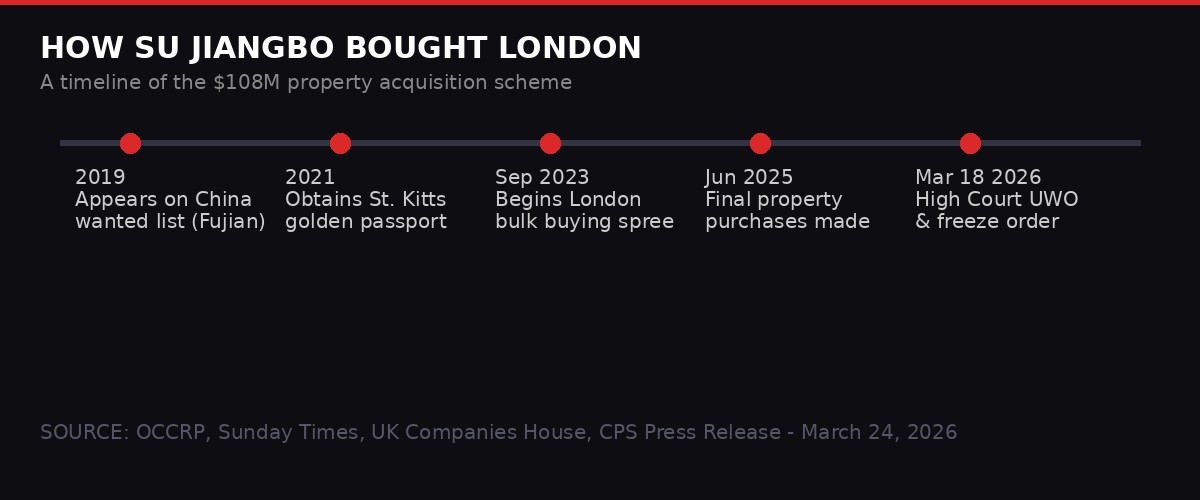
- Legal action: UK High Court issued UWO and Interim Freezing Order, March 18, 2026
- Timeline: Su Jiangbo began London purchases weeks after appearing on China wanted list (September 2023)
- Key development: Triptych Bankside - 15 flats including £10M+ penthouse overlooking St. Paul's Cathedral
The Fugitive Who Went Shopping in London

The arrest warrant from Datian County Court in China's Fujian province was published on September 15, 2023. It listed 38 individuals as fugitive criminal suspects, complete with photographs, home addresses, and a police hotline number. Su Jiangbo was among them, accused of involvement in illegal gambling, fraud, and cybercrime.
The warrant was re-published in both mainland Chinese and Taiwanese media. It was not exactly obscure.
Within weeks of that publication, Su Jiangbo began buying London real estate.
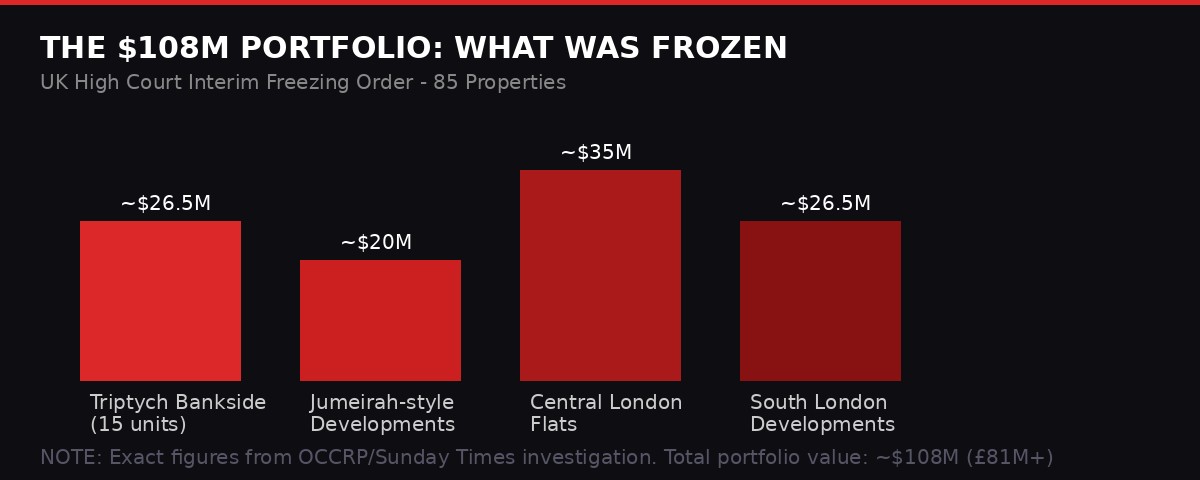
According to property records reviewed by OCCRP, his companies continued purchasing London apartments through at least June 2025 - a 21-month buying spree that accumulated 85 properties across central and south London's most prestigious new developments. The total value: approximately £81 million, or just over $108 million at current exchange rates.
He never appeared to visit the properties in person. A source involved in one of the sales told OCCRP that Su Jiangbo never came to the Triptych Bankside development, a luxury 169-apartment tower on London's South Bank with panoramic views of the Thames, St. Paul's Cathedral, and the Tate Modern.
"He had a certain amount of money he wanted to spend and he wanted a certain number of units," the source said, requesting anonymity. "There was an opportunity to do a bulk deal, which obviously when you're selling 169 apartments is very attractive, to say the least."
That "bulk deal" cost approximately $26.5 million. The centrepiece was an 18th-floor penthouse with unobstructed views of central London - a property worth around $13 million on its own.
The Golden Passport Machine

The mechanism by which Su Jiangbo appears to have constructed his London empire runs through a tiny Caribbean nation most people can barely locate on a map.
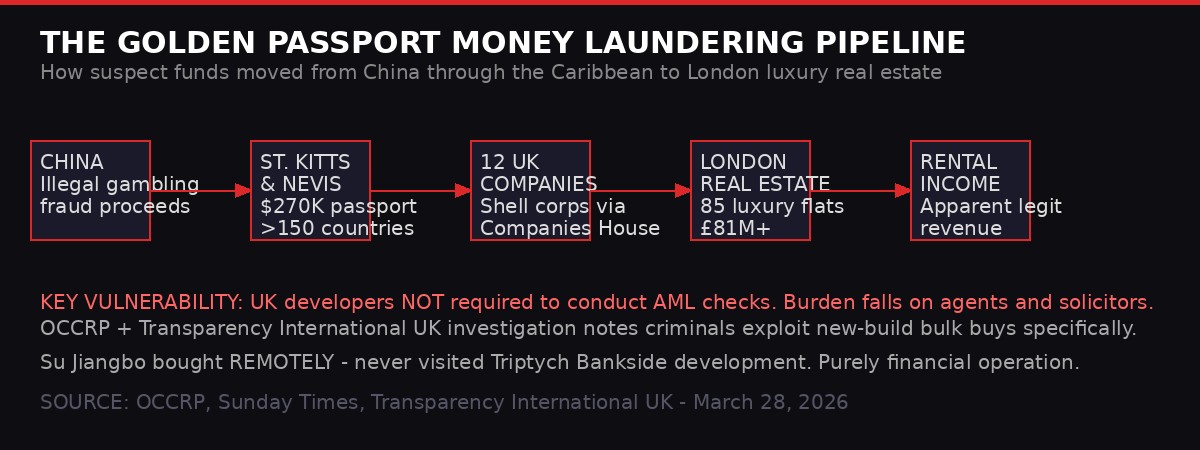
St. Kitts and Nevis, a federation of two islands with a population of around 50,000, operates one of the oldest and most established citizenship-by-investment programs in the world. For approximately $270,000 - paid to the government's Sustainable Growth Fund or invested in approved real estate - applicants can obtain a full passport within months. That passport grants visa-free or visa-on-arrival access to more than 150 countries, including the entire European Union and the United Kingdom.
Questions about identity, criminal history, or the source of funds are officially required, but enforcement varies enormously. The program has been flagged repeatedly by international anti-corruption bodies for providing cover to sanctioned individuals and those under criminal investigation in their home jurisdictions.
Records from the UK Companies House registry, as well as filings in Hong Kong and Singapore, show that Su Jiangbo holds a St. Kitts and Nevis passport. He also holds Cambodian citizenship. Neither of these identities would necessarily appear connected to the Chinese fugitive on Fujian's wanted list without specific cross-referencing.
Using his St. Kitts passport, Su Jiangbo created at least 12 companies through the UK's Companies House - the same corporate registry open to any individual globally with a passport and a filing fee. At least 10 of those 12 companies were subsequently used to purchase London real estate.
UK Money Laundering, Terrorist Financing and Transfer of Funds Regulations explicitly identify golden passport holders as a category requiring "enhanced due diligence." The same regulations flag "unusually complex or unusually large" transactions as red flags. Purchasing 15 apartments worth £20 million-plus in a single development, through a newly formed shell company, using a passport from a country with no apparent connection to the buyer's stated background, ticks every box.
None of these flags appear to have triggered meaningful scrutiny.
The System That Failed to Stop Him

The Triptych Bankside developer, JTRE London, told OCCRP that it "complied with all applicable legal and regulatory requirements." A person involved in the sales said the transactions went through "relatively straightforwardly" and raised no red flags.
That claim is not necessarily dishonest. It simply reveals the depth of the problem.
Under UK law, property developers are not required to conduct anti-money laundering checks on buyers. The obligation rests with estate agents and conveyancing solicitors. The developer's job is to sell apartments. The lawyers' job is to check the money. When those two functions are handled by different firms with different incentives and different risk tolerances, the gaps between them become potential entry points for illicit capital.
"If you don't ask the right questions - about multiple nationalities for instance - people aren't necessarily going to volunteer that info, particularly if they're malevolent." - Source involved in Su Jiangbo's Triptych Bankside purchases, speaking to OCCRP
Three law firms represented Su Jiangbo's companies in the conveyancing of his apartment purchases: Zhong Lun Law Firm, Riseam Sharples, and Ackroyd Legal LLP. OCCRP noted that none of these firms responded to requests for comment, while clarifying there is no suggestion they failed to conduct required AML checks.
Ben Cowdock of Transparency International's UK chapter, which assisted OCCRP in acquiring conveyancing documents, explained the structural vulnerability that makes new-build developments particularly attractive to money launderers.
"Criminals can buy from developers off-plan and in bulk, often with fewer questions asked than in the resale market, and then generate apparently legitimate rental income." - Ben Cowdock, Transparency International UK
The pattern is almost elegant in its simplicity. A criminal entity acquires a foreign passport, uses it to form shell companies in a jurisdiction with minimal scrutiny, uses those companies to purchase multiple units in a new development offering bulk discounts, and then generates rental income from the properties - income that, on paper, appears entirely legitimate. The dirty money has been laundered through bricks and mortar, and the ongoing returns are clean.
Cowdock called for "a targeted programme of enhanced guidance and enforcement to ensure that solicitors handling new-build sales are conducting robust checks." That guidance has been called for repeatedly over the past decade. The Su Jiangbo case suggests it has not arrived in any effective form.
Unexplained Wealth Orders: Powerful on Paper, Slow in Practice

The UK's Unexplained Wealth Orders were introduced through the Criminal Finances Act 2017 and came into force in January 2018. The legislation was championed, in part, as a weapon against the "Londongrad" phenomenon - the influx of money from Russian oligarchs, Central Asian kleptocrats, and other post-Soviet elites who had turned London property into a preferred parking spot for questionable wealth.
Conservative MP Alicia Kearns, now in opposition, said the orders were designed to "target and hunt down criminal money launderers and protect our markets." She described the Su Jiangbo case as an example of the powers being used to their full extent, while calling for assets to be seized if the subject cannot provide satisfactory explanations.
The mechanics work like this: under the Proceeds of Crime Act 2002, the Director of Public Prosecutions can apply to the High Court for an Unexplained Wealth Order against any person believed to hold assets disproportionate to their known income. Crucially, the order reverses the normal burden of proof. Instead of prosecutors having to prove money is dirty, the asset holder must prove where the money came from and that it was lawfully obtained.
If the holder fails to provide a satisfactory explanation within three months - the window Su Jiangbo now faces - the CPS can apply for a Civil Recovery Order, potentially seizing the assets without any criminal conviction.
That sounds powerful. In practice, the tool has been used sparingly and with mixed results.
Since the orders were introduced, the CPS Proceeds of Crime Division has obtained confiscation orders recovering £478 million over five years - a significant sum, but concentrated in criminal conviction cases. In the civil recovery space, the division has obtained just nine Civil Recovery Orders in three years, covering approximately £6.2 million in property. Compared to the estimated hundreds of billions of pounds in illicit money believed to flow through the UK financial system annually, these numbers are modest.
The Su Jiangbo case is notable for its scale: £81 million, 85 properties, one subject. It may represent the largest single UWO enforcement action against an individual in British legal history. That distinction, however, raises a troubling counterpoint. If this operation - conducted openly, over two years, through easily traceable companies, using a passport from a highly flagged jurisdiction - went undetected until 2026, what else is sitting undisturbed in London's property market?
The Companies House Loophole That Enabled Everything

Central to Su Jiangbo's operation was his systematic use of UK Companies House - the public registry through which any individual can form a British limited company.
For years, Companies House operated essentially on trust. Applicants submitted information; the registry recorded it. There was minimal verification. A person could list a false name, a foreign address, and a passport from a country with loose identity standards, and walk away with a British company number. That company could then open bank accounts, hold assets, and conduct business - including purchasing real estate - with a veneer of legitimacy that few would think to challenge.
The Economic Crime and Corporate Transparency Act 2023 introduced new verification requirements at Companies House, requiring directors to verify their identities before incorporating companies. The changes were intended precisely to address the kind of operation described in the Su Jiangbo case.
But implementation has been gradual, and the vast majority of the approximately 5 million companies already registered on Companies House predate the verification requirements. The window during which Su Jiangbo formed his 12 companies - beginning in late 2023 - overlapped with the transition period. Whether the new rules would have caught his use of a Caribbean passport tied to an alias is unclear.
What is clear is that the 12 companies used to purchase the 85 properties were registered without meaningful scrutiny of their beneficial owner's background. Su Jiangbo's name appears in the filings alongside a St. Kitts and Nevis passport number. No cross-reference to Chinese law enforcement records. No flag from the Datian County Court warrant. The system simply recorded what it was given.
Transparency International UK has documented hundreds of similar cases over the past decade - foreign nationals using UK companies to purchase British real estate while simultaneously evading scrutiny in their home jurisdictions. The OCCRP investigation, drawing on Transparency International's assistance in acquiring conveyancing documents, adds Su Jiangbo to that catalogue with exceptional specificity.
A Wanted Man in Plain Sight

The geographic and jurisdictional complexity of Su Jiangbo's corporate structure - entities in the UK, Singapore, Cambodia, Hong Kong - is not accidental. It is the deliberate architecture of evasion.
Su Jiangbo holds at least two passports beyond his Chinese citizenship: a St. Kitts and Nevis document and a Cambodian one. He appears in Singapore company filings, Hong Kong filings, and Cambodian company records. Each jurisdiction has its own corporate registry, its own beneficial ownership standards, and its own law enforcement infrastructure. Cross-referencing them requires either a targeted investigative operation or the kind of international journalism OCCRP specializes in.
Local law enforcement agencies rarely pursue leads across four or five jurisdictions without strong signals. Those signals - the Datian County Court warrant, the bulk property purchases, the Caribbean passport - were, individually, each a red flag. Together, they form a picture that should have been obvious. But siloed enforcement meant each institution saw only its own piece.
The Metropolitan Police Service's involvement in the CPS investigation - referenced in the official statement as providing "support" to the UWO application - suggests that at some point, the dots were connected. How long that took, and how the investigation was triggered, has not been made public. The CPS declined to comment further on the case beyond its initial press release.
What is documented in company records is that Su Jiangbo continued purchasing properties through at least June 2025 - more than 18 months after the Chinese wanted list was published. He was, in effect, a wanted fugitive actively buying London real estate in the period immediately following his public identification as a criminal suspect. That he was able to do so without triggering enforcement action for nearly two years is the most damning indictment of all.
His response to OCCRP's inquiries? Silence. Emails to his personal address and to addresses associated with his companies in Singapore, Cambodia, the UK, and Hong Kong received no reply. Phone numbers listed in company registries went unanswered or were denied.
What Happens Now - and What the Case Reveals

As of March 18, 2026, Su Jiangbo - or the entities acting on his behalf - has three months to respond to the UK High Court's Unexplained Wealth Order. He must explain, to the court's satisfaction, how he lawfully obtained the funds used to purchase 85 London properties worth over £81 million.
If he fails to do so, or fails to respond at all, the CPS can apply for a Civil Recovery Order - the mechanism that could see the properties forfeited to the British state without a criminal conviction. That process, however, is not automatic. It requires a further application, potential High Court litigation, and the possibility of appeals. Asset recovery timelines in cases of this complexity can stretch to years.
The Unexplained Wealth Order has been described by critics as toothless precisely because of this procedural distance between freezing assets and actually seizing them. The National Crime Agency's early use of UWOs - which resulted in several high-profile cases collapsing or settling for amounts well below the asset values - produced what anti-corruption advocates described as a chilling effect on enforcement agencies reluctant to expend resources on lengthy, expensive litigation.
The Su Jiangbo case will test whether that dynamic has changed.
For the broader picture, the case adds another data point to an increasingly well-documented problem. A 2022 report by Transparency International UK found that more than £1.5 billion worth of UK property had been purchased since 2016 by individuals accused of corruption or with links to corrupt regimes. The actual figure is almost certainly larger - the report was limited by the opacity of shell company ownership, which the Su Jiangbo case illustrates with brutal clarity.
The UK government's Register of Overseas Entities, introduced in 2022 and requiring foreign owners of UK property to disclose their beneficial ownership, was specifically designed to address this gap. Its implementation has been criticized for significant compliance gaps: analysis by Global Witness found that tens of thousands of overseas entities failed to register, or registered with incomplete information, in the scheme's first year.
The Su Jiangbo operation predates and postdates the register's introduction. Whether his shell companies properly disclosed his beneficial ownership under the new regime - and whether that information, if disclosed, triggered any enforcement action - remains unclear from public records.
"A targeted programme of enhanced guidance and enforcement is needed to ensure that solicitors handling new-build sales are conducting robust checks." - Ben Cowdock, Transparency International UK, speaking to OCCRP
What is unambiguous is the systemic diagnosis this case provides. A man publicly identified as a fugitive criminal suspect in China - for offenses including illegal gambling, fraud, and cybercrime - was able to purchase £81 million worth of luxury London real estate using a Caribbean passport, a dozen shell companies, and a set of legal and regulatory systems that failed to communicate with each other at every stage. He did this openly. He did it in bulk. He apparently never visited the properties he was buying.
The penthouse overlooking St. Paul's Cathedral is now frozen. The money trail is being traced. Su Jiangbo's three months have begun.
But the next Su Jiangbo is already shopping.
Primary reporting: OCCRP and Sunday Times, "Mr. X Revealed: U.K. Freezes $108M in Properties Purchased by Wanted Chinese National" (March 28, 2026).
Official documents: UK Crown Prosecution Service press release, March 24, 2026; UK Companies House corporate registry; Datian County Court arrest warrant list, September 15, 2023.
Expert testimony: Ben Cowdock (Transparency International UK), Alicia Kearns MP (Conservative Party); anonymous source involved in Triptych Bankside sales.
Developer statement: JTRE London spokesperson to OCCRP.
Zhong Lun Law Firm, Riseam Sharples, and Ackroyd Legal LLP did not respond to multiple requests for comment. Su Jiangbo did not respond to any inquiries. The CPS declined to comment further beyond its initial press release. Datian County Court did not respond to a request for comment.
Get BLACKWIRE reports first.
Breaking news, investigations, and analysis - straight to your phone.
Join @blackwirenews on Telegram