Myanmar's Coup Leader Just Became President. The War Goes On.
General Min Aung Hlaing promised elections within one year of his 2021 coup. It took five years, a civil war, millions displaced, and a parliament packed with loyalists to deliver the result he wanted all along: himself, wearing a suit instead of a uniform, sitting in the president's chair.

Shwedagon Pagoda, Yangon. Myanmar's spiritual heart stands over a nation shattered by five years of military violence. Photo: Pixabay
On the morning of April 3, 2026, Myanmar's newly elected parliament convened for the first time since the February 2021 coup and performed the one task it was assembled to execute: selecting Min Aung Hlaing as the nation's next president. It was not an election. It was a coronation. The general had already stepped down as armed forces commander - a constitutional requirement before taking the civilian title. His replacement at the head of the military, General Ye Win Oo, is a loyal hardliner whose family has personal ties to Min Aung Hlaing's own. Nothing about the chain of command has actually changed. The man at the top merely swapped his fatigues for a suit.
The move completes a five-year arc that began with a predawn raid on lawmakers, continued through the bloodiest internal conflict in Myanmar's modern history, and now arrives at a destination so absurd it would be satirical if it were not so devastating. Roughly 16 million people in Myanmar need emergency humanitarian assistance, according to the United Nations Office for the Coordination of Humanitarian Affairs (OCHA). Nearly four million are internally displaced. The economy has contracted by roughly 18 percent since the coup. Electricity in Yangon runs for a few hours a day. Fuel is being rationed.
And the man who caused all of it just gave himself the presidency.
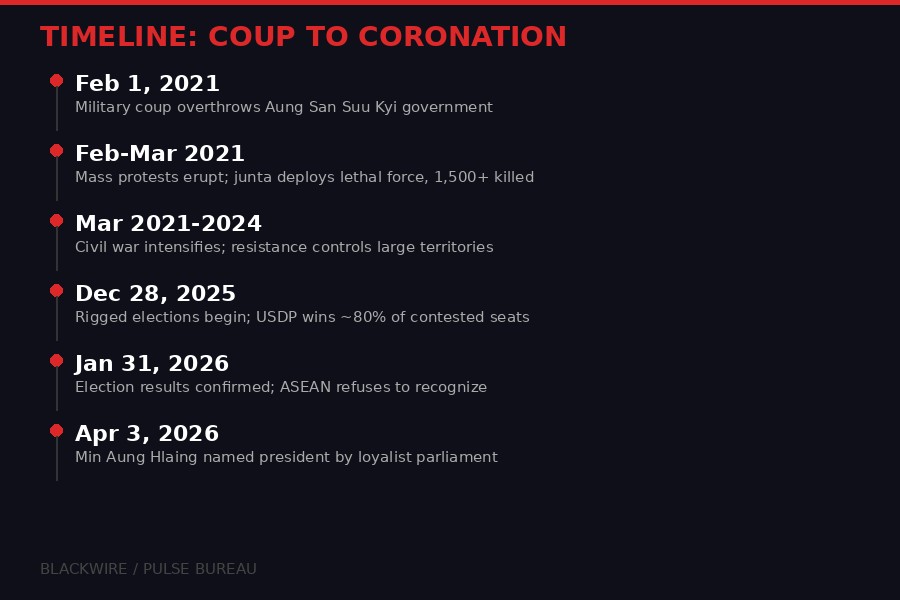
Five years of escalating violence compressed into a single, predetermined outcome. Infographic: BLACKWIRE
I. The Coup That Started Everything

Mass protests erupted across Myanmar in the weeks following the February 2021 coup. Photo: Pixabay
At 4 a.m. on February 1, 2021, soldiers detained State Counsellor Aung San Suu Kyi, President Win Myint, and dozens of National League for Democracy (NLD) lawmakers just hours before a new parliamentary session was set to confirm the party's landslide November 2020 election victory. Min Aung Hlaing declared a one-year state of emergency, citing unsubstantiated claims of voter fraud. He promised fresh elections within twelve months and a swift return to civilian governance.
That promise was a lie, and the evidence was immediate. Within days, the military - known in Myanmar as the Tatmadaw - deployed riot police, water cannons, and eventually live ammunition against peaceful protesters. The first confirmed killing came on February 9, when a 20-year-old student named Mya Thwate Thwate Khaing was shot in the head during a demonstration in Nay Pyi Taw. She died on February 19. Her shooting was broadcast across social media and ignited rage that transformed scattered protests into a nationwide uprising.
The Civil Disobedience Movement (CDM) brought hundreds of thousands of civil servants, doctors, teachers, and bank workers into the streets and off the job. The economy seized. Banks closed. Hospitals emptied of staff. The Tatmadaw responded with escalating brutality - nighttime raids, mass arrests, torture in military interrogation centers, and the systematic use of snipers against unarmed civilians.
By March 2021, the death toll had crossed 500. By the end of that year, it exceeded 1,500, according to the Assistance Association for Political Prisoners (AAPP). Thousands more were detained. The military's ferocity achieved one thing Min Aung Hlaing almost certainly did not intend: it pushed large segments of the population toward armed resistance.
Ethnic armed organizations (EAOs) that had fought the Tatmadaw for decades saw an influx of recruits - young, urban, educated people who had never held a weapon in their lives but decided that peaceful protest was no longer enough. People's Defence Forces (PDFs) sprang up across the country, loosely coordinated by the National Unity Government (NUG), a shadow administration formed by ousted lawmakers operating from resistance-held territory near the Thai border.
What Min Aung Hlaing triggered was not a political crisis he could manage. It was a full-blown civil war.
II. Five Years of Blood: The Civil War's Toll
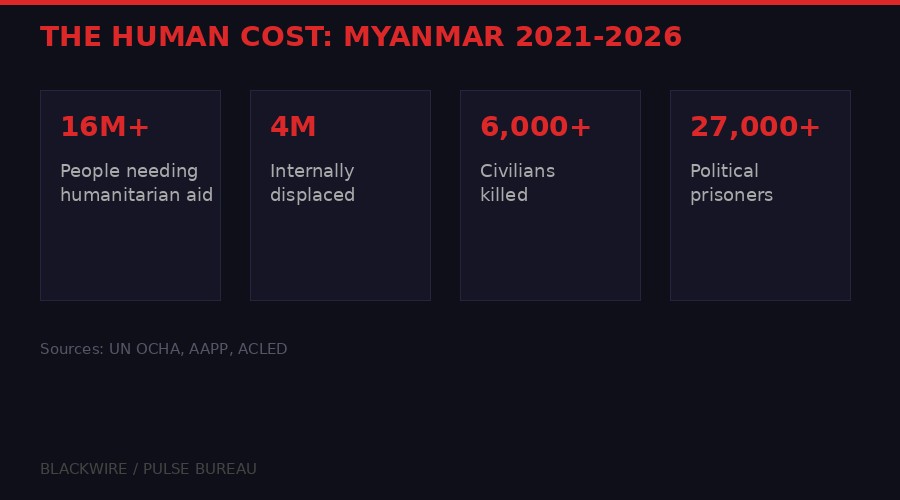
The numbers behind five years of military violence. Sources: UN OCHA, AAPP, ACLED. Infographic: BLACKWIRE
The scale of suffering in Myanmar since 2021 is staggering and largely invisible to the outside world. The Iran war, the ongoing conflict in Ukraine, and domestic political crises in the United States and Europe have consumed the attention of governments and media organizations alike. Myanmar has become what aid workers call a "forgotten emergency" - one of the worst humanitarian disasters on the planet, unfolding with minimal international coverage.
The Assistance Association for Political Prisoners tracks documented killings by the military regime. Their figure exceeds 6,000 confirmed deaths, though the actual number is believed to be far higher - verification in a country where internet access has been severely restricted and entire regions are under military siege is nearly impossible. ACLED, the Armed Conflict Location and Event Data Project, recorded over 30,000 political violence events in Myanmar between 2021 and early 2026.
More than 27,000 people have been detained for political reasons since the coup, according to AAPP. Conditions in military prisons are notorious. Kyaw Win, a student arrested for participating in a flash mob protest in 2022, described his experience to the BBC:
"They beat me on my back with an iron rod. They burned me with cigarettes, and slashed my thigh with a knife. Then they stripped my underwear and sexually assaulted me. They interrogated me, but it was never clear what they wanted me to say." - Kyaw Win (pseudonym), former political prisoner, speaking to BBC, April 2026
His testimony is not exceptional. Human Rights Watch, Amnesty International, and the UN Special Rapporteur on Myanmar have all documented systematic torture, sexual violence, extrajudicial execution, and enforced disappearances in military custody. The UN Human Rights Council established an Independent Investigative Mechanism for Myanmar (IIMM) that continues to collect evidence for potential future prosecutions.
The internal displacement crisis is among the largest in Asia. OCHA estimates that 3.8 million people have been forced from their homes since the coup - added to roughly 600,000 who were already displaced before 2021, including hundreds of thousands of Rohingya driven from Rakhine State in the 2017 genocide. Total displacement now approaches 4.4 million in a country of roughly 55 million people.
The military's strategy has been consistent and documented: the "four cuts" doctrine, a counterinsurgency approach developed decades ago against ethnic armed groups in Myanmar's borderlands. The principle is simple and brutal - cut off food, funds, information, and recruits to insurgent areas by devastating the civilian population living there. Air strikes on villages. Burning of crops. Destruction of schools and clinics. Artillery bombardment of populated areas.
The Tatmadaw now relies heavily on air power - supplied primarily by Russia and China - because it has lost the ability to hold territory through ground forces alone. Su Mon, senior analyst at ACLED, told the BBC that resistance forces still control approximately 90 towns across the country. The military's response: more drone strikes, more air raids, more scorched earth.
III. The Rigged Election Nobody Recognizes
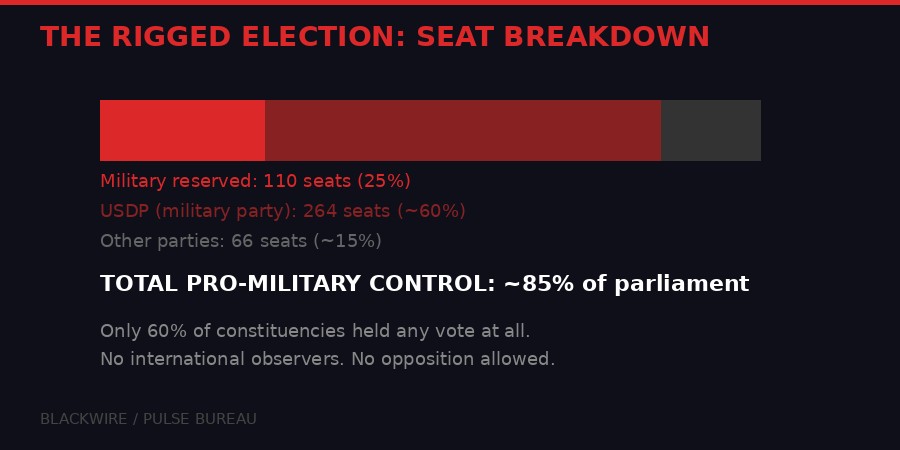
The math was predetermined before a single ballot was cast. Infographic: BLACKWIRE
The elections that produced this parliament began on December 28, 2025 and stretched into late January 2026. They were held under conditions that made a free or fair outcome structurally impossible.
Myanmar's 2008 constitution - drafted by the military itself - reserves 25 percent of all parliamentary seats for serving military officers. No election needed. No civilian can contest those seats. This means that any military-aligned party needs to win only one-third of the remaining seats to secure a parliamentary majority. The Union Solidarity and Development Party (USDP), the military's political vehicle, won approximately 80 percent of the contested seats.
The result: roughly 85 percent of the new parliament is directly controlled by or aligned with Min Aung Hlaing's regime.
How did the USDP manage such a landslide? The methods were blunt. The NLD - which won 83 percent of contested seats in the 2020 election - was dissolved by military order in 2023. Its leaders were jailed. Aung San Suu Kyi herself has been held in military custody since the morning of the coup, convicted in a series of trials widely condemned as politically motivated. At 80 years old, her son has publicly stated her health is deteriorating. She has been sentenced to a combined 27 years in prison on charges ranging from corruption to violating COVID-19 protocols.
Other opposition parties were barred from registering or had their candidates rejected. Voting took place in only about 60 percent of the country's constituencies - the areas still under military control. The remaining 40 percent, held by resistance forces, simply did not participate. There were no international observers. ASEAN, the regional bloc of which Myanmar is a member, explicitly refused to recognize the results. The Philippine foreign secretary stated that member states had "not endorsed" the vote.
The UN described the process as "illegitimate." At least 170 people were killed during the election period alone, according to UN reporting, many of them targeted for attempting to enforce boycotts or disrupting military logistics.
This is the body that convened on April 3 to name Min Aung Hlaing president. The outcome was never in doubt. It was written into the architecture of the process before the first ballot was printed.
IV. The New Power Structure: Trading Fatigues for a Suit
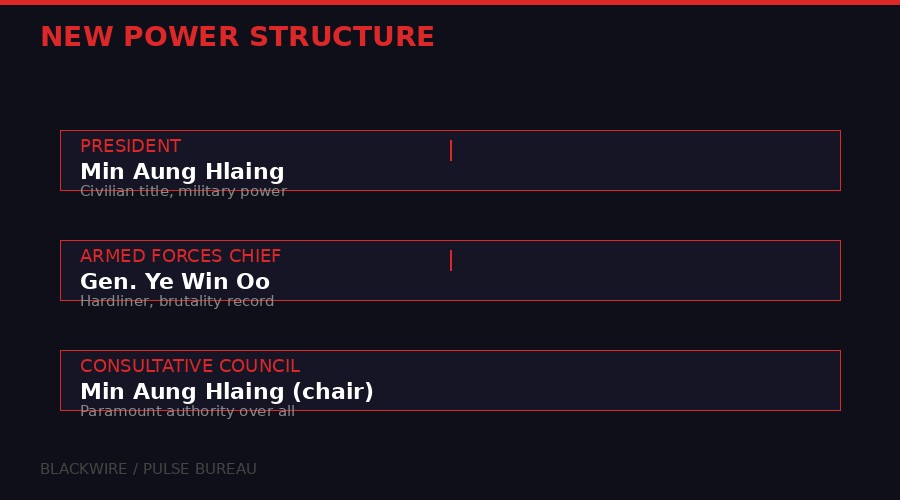
Different titles, same chain of command. Min Aung Hlaing retains paramount authority. Infographic: BLACKWIRE
Min Aung Hlaing's transition to president is not a transfer of power. It is a reorganization of labels. Understanding this requires understanding the specific mechanisms he has put in place to ensure that removing his uniform does not dilute his authority by a single degree.
First, the armed forces. The new commander-in-chief, General Ye Win Oo, is not a successor in any meaningful sense. He is a subordinate operating with Min Aung Hlaing's explicit mandate. His family has deep personal connections to Min Aung Hlaing's clan. ACLED's Su Mon assessed that Ye Win Oo is "a loyalist whose family has a close relationship with that of Min Aung Hlaing" and predicted he would "follow in his footsteps, first and foremost to regain control of lost territory."
Ye Win Oo has a reputation for hardline tactics. Military analysts familiar with Myanmar's internal dynamics describe him as more aggressive than his predecessor, not less. His appointment signals that the Tatmadaw's campaign against resistance-held territory - the air strikes, the four cuts, the scorched earth - will intensify rather than moderate under the new arrangement.
Second, Min Aung Hlaing has created a new Consultative Council - a body with no constitutional precedent - that will exercise what his administration describes as "paramount authority over civilian and military affairs." He chairs it. This council sits above both the civilian government and the military command structure, giving Min Aung Hlaing direct control over both domains simultaneously. It is, in effect, a formalization of the dictatorial power he has exercised since 2021, wrapped in new institutional language.
Third, the parliament itself. With 85 percent of seats held by military officers or USDP loyalists, the legislature functions as a rubber stamp. Any legislation Min Aung Hlaing wants will pass. Any legislation he opposes will die. Constitutional amendments require a 75 percent supermajority - and the military bloc alone holds 25 percent, giving it an automatic veto over any structural change.
The BBC's Jonathan Head, reporting from Nay Pyi Taw, attended Min Aung Hlaing's final Armed Forces Day parade before his transition. He listened for any hint of reflection or acknowledgment of the devastation the coup had caused. There was none.
"Instead, we were treated to the same unapologetic justifications for military intervention we have heard so many times before. The soldiers had a constitutional mandate for 'constructive engagement in national politics,' he said. It was they who had upheld multi-party democracy. Those opposing military rule were 'armed terrorist factions,' supported by 'foreign aggressors and self-serving political opportunists.'" - Jonathan Head, BBC South East Asia correspondent, reporting from Nay Pyi Taw, April 2026
Nothing in the speech suggested that the transition from general to president would change anything about how Myanmar is governed.
V. Economic Collapse and the Iran War's Shadow
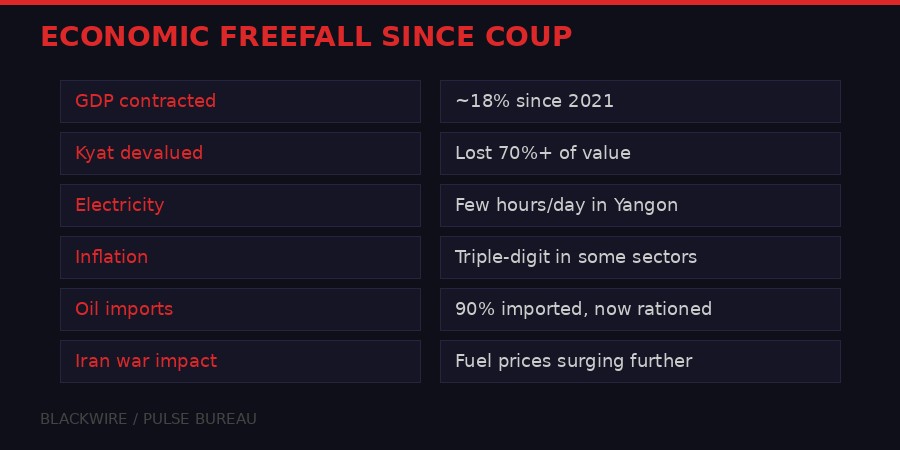
Five years of military rule have gutted Myanmar's economy. The Iran war makes everything worse. Infographic: BLACKWIRE
The coup did not just kill people. It killed an economy. Myanmar's GDP has contracted by roughly 18 percent since 2021, according to World Bank estimates. The Myanmar kyat has lost more than 70 percent of its value against the US dollar. Inflation has hit triple digits in some sectors, particularly food and fuel. The banking system, crippled by the CDM walkouts in 2021, never fully recovered.
For ordinary people in Yangon, the country's commercial capital, daily life is defined by scarcity. The electricity grid provides power for only a few hours each day. Businesses rely on diesel generators - but diesel is now being rationed as fuel supplies dwindle. The public transportation network has deteriorated. Medical facilities are understaffed and undersupplied.
Tin Oo, a motorbike taxi driver in Yangon's industrial Hlaing Tharyar district, described the reality to the BBC:
"The difference between now and 10 years ago is like night and day. We cannot earn enough even to cover our rent and food. They won't care about us. We will still have to depend on ourselves. These days if you try to make a simple honest living, it is difficult to survive, but if you are dishonest, you can become rich." - Tin Oo, motorbike taxi driver, Yangon, speaking to BBC, April 2026
Into this already catastrophic economic situation, the Iran war has driven a spike of additional pain. Myanmar imports roughly 90 percent of its oil and petroleum products. Much of it comes from neighboring countries that are themselves dealing with supply disruptions caused by the conflict in the Persian Gulf and the effective closure of the Strait of Hormuz.
Oil prices have surged globally. Brent crude has jumped from $73 per barrel before the Iran conflict to well over $100. For Myanmar, which was already struggling to secure fuel imports under Western sanctions and with a collapsing currency, the price spike is devastating. Petrol and diesel prices in Myanmar are now significantly higher than in neighboring Thailand. Rationing has become the norm.
The BBC reported that the Iran war's fuel impact on Myanmar is deepening an already severe hunger crisis. The UN World Food Programme has warned that rising transport costs - driven by fuel shortages - are making food distribution in conflict-affected areas increasingly difficult. The areas most in need of humanitarian supplies are precisely the areas hardest to reach: resistance-held territories where roads are poor, bridges have been destroyed, and military checkpoints control movement.
Min Aung Hlaing's new government inherits an economy that was broken before he took the presidential title. His five years of military rule created the conditions for collapse. The Iran war is accelerating it. And there is no policy framework, no international support, and no political will within his regime to reverse the trajectory.
VI. The Resistance: Unbowed, Uncoordinated, Undefeated

Myanmar's rugged terrain has become the operational theater of a fragmented but resilient resistance. Photo: Pixabay
The National Unity Government does not recognize Min Aung Hlaing's presidency. It does not recognize the parliament. It does not recognize the election. And it has no intention of stopping the fight.
"This is not the time to compromise," NUG spokesman Nay Phone Latt stated. "If the military cannot accept our objectives, our revolution will go on. We have to go on. If we give up now, the next generation, our people, will suffer more and more."
The resistance's strength is real. Approximately 90 towns across Myanmar remain under the control of ethnic armed organizations and People's Defence Forces. In some regions - particularly along the borders with China, Thailand, and India - the Tatmadaw has lost effective sovereignty. Local governance structures have emerged, run by resistance-aligned administrators who collect taxes, maintain roads, and operate schools and clinics in the absence of central government services.
But the resistance also faces serious structural challenges. The NUG has struggled to impose unified command over the sprawling network of armed groups operating across the country. Many of the ethnic armed organizations - the Kachin Independence Army (KIA), the Karen National Union (KNU), the Karenni Nationalities Defense Force (KNDF), the Arakan Army, and dozens of smaller groups - have their own histories, grievances, territorial ambitions, and chain of command. The NUG is nominally their ally, but operational coordination is often ad hoc.
In October 2023, the Three Brotherhood Alliance - a coalition of the Myanmar National Democratic Alliance Army (MNDAA), the Ta'ang National Liberation Army (TNLA), and the Arakan Army - launched Operation 1027 in northern Shan State, seizing dozens of towns and military bases in a rapid offensive that stunned the Tatmadaw. It was the most significant military setback for the junta since the coup. But the momentum was uneven, and a China-brokered ceasefire in January 2024 partially froze the situation in the north while fighting continued elsewhere.
The resistance controls territory. It does not control a state. Without international recognition, it cannot access formal financial systems, import weapons through legal channels, or participate in diplomatic processes. The NUG operates from border areas, dependent on donations and informal networks. Its legitimacy is moral, not institutional.
Meanwhile, the Tatmadaw has been quietly rebuilding with help from its most reliable patrons. China supplies weapons, equipment, and political cover at the United Nations Security Council, where it has consistently blocked resolutions on Myanmar. Russia has provided fighter jets, attack helicopters, and air defense systems. Both countries have economic interests in Myanmar - pipeline projects, mining concessions, port access - that align them with whoever controls the state apparatus, regardless of how they came to power.
VII. Aung San Suu Kyi: The Prisoner Who Could Still Matter

Myanmar's ancient temples stand as monuments to a civilization now governed by force. Photo: Pixabay
There is one variable in Myanmar's political equation that remains genuinely unpredictable: Aung San Suu Kyi.
The 80-year-old Nobel Peace Prize laureate has been held in military custody since the morning of the coup. She has been convicted in multiple trials on charges widely regarded as politically manufactured - corruption, election fraud, violating the Official Secrets Act, breaking COVID-19 protocols. Her combined sentences total 27 years. She is being held in solitary confinement at an undisclosed location, reportedly in Nay Pyi Taw.
Her son, Kim Aris, has publicly stated that her health is declining and that she needs medical attention for heart-related issues. The International Committee of the Red Cross has not been granted access. Her lawyers have been restricted from communicating with the press. She has effectively vanished from public life.
Yet Suu Kyi's political significance has not vanished. She remains the single most recognizable figure in Myanmar's democracy movement. Her NLD won landslide victories in 2015 and 2020. Her imprisonment is one of the primary grievances fueling resistance recruitment. And there is persistent speculation - fueled by statements from political figures close to Min Aung Hlaing - that she could be released sometime in 2026, now that the general has achieved his presidential ambition.
Mya Aye, a veteran political activist who has spent years in military prisons himself, told the BBC he believes Suu Kyi's release could open a path to dialogue:
"This election is not the solution. It is a game played by Min Aung Hlaing on his people. Nor can we progress with the current constitution. But the public is tired of the situation. If we cannot find a way out, the country will collapse. In fact it is already in a state of collapse." - Mya Aye, political activist, speaking to BBC, April 2026
Mya Aye has formed a new council bringing together political figures willing to explore compromise between the military and the resistance. He argues that Suu Kyi, even at 80, could play a decisive mediating role if freed. The premise is that Min Aung Hlaing, having secured his presidency, might now have the political space to make a concession that would have been impossible while he still wore his uniform.
It is a fragile theory. The NUG has explicitly rejected the legitimacy of anything Min Aung Hlaing's government does. The ethnic armed organizations have their own agendas. And the military has shown zero inclination toward genuine negotiation throughout the five years of conflict. The path to peace, as the BBC's Jonathan Head wrote, "is certainly a very narrow one, and for now it is not a path the country's military rulers seem inclined to follow."
VIII. The World Looks Away

The ancient temples of Bagan - UNESCO heritage in a nation the world has abandoned. Photo: Pixabay
Myanmar is one of the worst humanitarian crises in the world, and it receives a fraction of the attention and funding directed toward comparable disasters.
The reasons are structural. Myanmar has no oil. It occupies no geopolitically critical shipping lane. It does not threaten Western economies. It does not border a NATO member. It does not produce nuclear weapons. It has no capacity to project military force beyond its borders. In the cold calculus of international attention, Myanmar fails every test that would make powerful countries care.
The Iran war has absorbed whatever bandwidth might have existed. The Strait of Hormuz crisis directly affects energy prices in every developed economy on earth. The Artemis II moon mission captures the aspirational imagination. Trump's firing of his attorney general dominates American news cycles. Myanmar, where a general just crowned himself president over the ruins of a democracy, barely registers.
ASEAN, the regional body that should theoretically exert the most pressure, has been functionally useless. Its "Five-Point Consensus" on Myanmar, agreed in April 2021, called for an immediate end to violence, constructive dialogue, appointment of a special envoy, humanitarian access, and a visit by the envoy to meet all parties. Five years later, not a single point has been meaningfully implemented. The junta has ignored every ASEAN statement, refused access to the special envoy, and continued military operations without interruption.
Western sanctions exist but have been limited in scope and impact. The United States, European Union, United Kingdom, and Canada have imposed targeted sanctions on military leaders and military-owned enterprises. But the junta's primary economic lifelines run through China and Russia - neither of which participates in the sanctions regime. Myanmar's military earns revenue through natural gas exports (primarily to Thailand), gems and jade mining (much of it flowing to China), and timber extraction. These revenue streams have been reduced but not severed by Western measures.
The International Court of Justice (ICJ) continues to hear a genocide case brought by The Gambia against Myanmar related to the 2017 Rohingya crisis. Myanmar's representatives - now speaking on behalf of Min Aung Hlaing's government - have called the case "flawed, unfounded." The proceedings move at judicial pace while the humanitarian emergency accelerates at crisis pace.
Arms transfers to the junta continue. A UN Special Rapporteur report documented that Myanmar received over $1 billion worth of arms and military equipment from foreign suppliers between 2021 and 2024, with Russia, China, India, and Singapore among the primary sources. Attempts to impose a comprehensive UN arms embargo have been vetoed by China and Russia at the Security Council.
IX. What Happens Next: Three Scenarios

For millions of ordinary people in Myanmar, the political calculations of generals and diplomats translate into hunger, displacement, and fear. Photo: Pixabay
Myanmar's trajectory is grim but not predetermined. Three broad scenarios describe the likely paths forward from Min Aung Hlaing's coronation.
Scenario 1: Frozen Conflict (Most Likely)
The current situation stabilizes into a long-term partition. The military controls the cities, the central plains, and the major economic infrastructure. Resistance forces hold the periphery - mountainous border regions, ethnic homelands, rural areas. Neither side can achieve a decisive military victory. The conflict grinds on at a lower intensity, punctuated by periodic offensives and counteroffensives. International attention continues to wane. The humanitarian crisis becomes permanent and normalized. This is the trajectory Myanmar is already on, and Min Aung Hlaing's presidency does nothing to change it.
Scenario 2: Negotiated Settlement (Possible but Unlikely)
Min Aung Hlaing, having secured his presidential title, makes a calculated decision to release Aung San Suu Kyi and open dialogue with the NUG and ethnic armed organizations. A ceasefire is negotiated. A process toward genuine constitutional reform begins. This scenario requires Min Aung Hlaing to accept that his military cannot win the civil war outright - and to value stability over control. It also requires the resistance to accept some form of engagement with a government they have spent five years fighting. External pressure from China - which has economic interests in a stable Myanmar and has periodically brokered local ceasefires - could be the catalyst. But the odds remain low. Nothing in Min Aung Hlaing's behavior or rhetoric suggests he is moving in this direction.
Scenario 3: Collapse (Low Probability, High Impact)
The military's ability to hold its core territories erodes due to a combination of economic failure, fuel shortages exacerbated by the Iran war, internal fractures within the officer corps, and sustained pressure from resistance forces. The Tatmadaw fragments regionally. Min Aung Hlaing loses effective control. The country devolves into a failed state with multiple competing authorities. This scenario has been discussed by analysts since the October 2023 resistance offensives, which exposed genuine vulnerabilities in the military's capacity. But the Tatmadaw has shown resilience, and its Chinese and Russian patrons have invested enough in the current order to prevent total collapse.
The Key Numbers
- 5 years since the February 2021 coup
- 6,000+ confirmed civilian deaths (actual toll likely far higher)
- 27,000+ political detainees since the coup
- 3.8 million internally displaced people
- 16 million in need of humanitarian assistance
- ~18% GDP contraction since 2021
- 70%+ devaluation of the Myanmar kyat
- 90 towns still held by resistance forces
- 85% of parliamentary seats controlled by military/allies
- 60% of constituencies where voting actually occurred
- 0 international observers at the election
- 0 ASEAN Five-Point Consensus items implemented
X. A Coronation Built on Corpses
General Min Aung Hlaing is now President Min Aung Hlaing. The title is new. Everything else is the same. The civil war will continue. The air strikes will continue. The displacement will continue. The torture in military prisons will continue. The economic freefall will continue.
He promised elections within a year. He delivered them in five, after engineering every variable to guarantee the result. He promised a return to civilian rule. He delivered a system where the civilian president, the military commander, and the paramount consultative authority are all under the same man's control. He promised democracy. He delivered a parliament where 85 percent of the seats belong to his allies and the largest opposition party has been dissolved and its leader imprisoned.
The world has other things to pay attention to. Iran. Artemis. Tariffs. Epstein files. The news cycle churns. Myanmar sinks further from view.
But 55 million people live there. Sixteen million of them need help. Four million have been driven from their homes. Thousands have been killed by the army of the man who just became president. Their crisis is not less real because it is less visible. Their suffering does not diminish because it fails to trend.
Min Aung Hlaing got what he wanted. The cost was borne by everyone else.
This story is developing. BLACKWIRE will continue to monitor Myanmar's political and humanitarian situation.
Get BLACKWIRE reports first.
Breaking news, investigations, and analysis - straight to your phone.
Join @blackwirenews on Telegram