
NASA Kills Lunar Gateway, Unveils Moon Base Plan and Nuclear Mars Mission
At a high-stakes event called "Ignition," NASA Administrator Jared Isaacman announced the cancellation of the Lunar Gateway space station, a three-phase plan to build a permanent Moon base by 2036, and the launch of the first nuclear-powered interplanetary spacecraft to Mars before 2028. The space agency has bet everything on the surface.
For years, critics of NASA's lunar strategy asked a version of the same question: why build a station in orbit around the Moon when humans need to be on it? On Tuesday in Washington, the answer finally changed. NASA's "Ignition" event - a sweeping presentation of the agency's restructured vision - delivered the most consequential shift in American space policy since the original Artemis program was announced under the Obama administration.
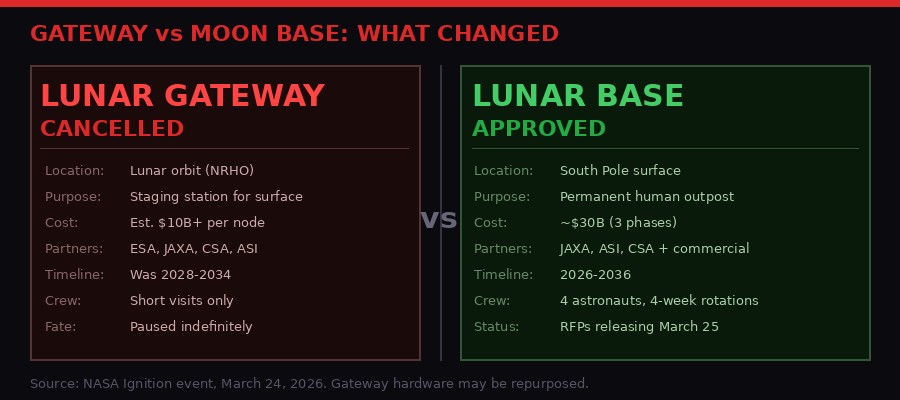
The Lunar Gateway is gone. In its place: a permanent base on the lunar surface, supported by 76 robotic landings across a decade, powered eventually by nuclear fission, and anchored by international partners who will deliver pressurized rovers, multi-purpose habitats, and utility vehicles. Meanwhile, a nuclear-electric spacecraft will carry three helicopters to Mars before the end of 2028.
This is not incremental adjustment. This is a full architectural pivot - and it comes with explicit framing as a geopolitical contest. "The clock is running in this great-power competition, and success or failure will be measured in months, not years," Isaacman said, according to the official NASA press release.

What the Gateway Actually Was - and Why It Got Killed
The Lunar Gateway was conceived in 2018 as a small orbital outpost in a Near Rectilinear Halo Orbit around the Moon - an unusual, elliptical path that swings within 1,500 km of the lunar surface at closest approach and out to 70,000 km at its farthest. The idea was that astronauts would travel to Gateway from Earth, live there temporarily, then descend to the surface in a separate landing vehicle.
On paper, Gateway offered flexibility: a staging post, a refueling point, a platform for science instruments that didn't require a surface landing. NASA secured commitments from the European Space Agency, JAXA (Japan), the Canadian Space Agency, and the Italian Space Agency, all of whom were building specific modules or systems for Gateway. The project had real political weight - canceling it meant renegotiating international agreements that had been years in the making.
But Gateway was fundamentally an overhead cost on top of what everyone actually wanted to do: land on the Moon. Every dollar spent building and maintaining an orbital outpost was a dollar not going to the surface. It added complexity to every crewed mission. Critics - including some inside NASA - had long argued it was a solution looking for a problem, a way to keep legacy contractors and international partners busy without a compelling operational rationale.
The final nail came from public pressure, budget reality, and the China factor. The Chinese National Space Administration has explicitly stated plans to establish a permanent lunar base by 2035-2040, with crewed landings before 2030. In the framing NASA is now using, Gateway wasn't just inefficient - it was a distraction from a race that has a finite time window. As NASA's associate administrator Amit Kshatriya put it at the Ignition event: "It's very clear that we need to be focused on one thing, not 10 things."
The agency stressed that Gateway hardware won't simply be scrapped - applicable equipment will be repurposed, and international partner commitments will be folded into the Moon base architecture where possible. JAXA's pressurized rover, for example, appears prominently in Phase Two plans. ASI's Multi-purpose Habitats get listed in Phase Three. The partnerships survive in new form; the space station does not.
The Three-Phase Moon Base Architecture: Numbers Behind the Vision
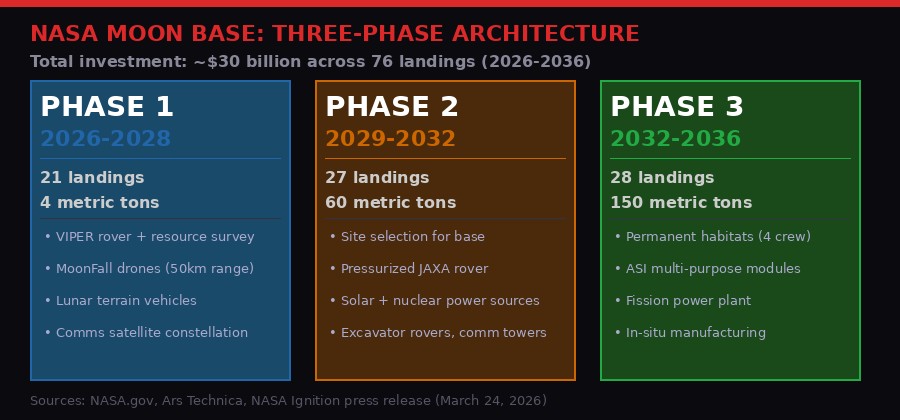
NASA laid out a detailed, phased plan that is notable for its specificity. This isn't a political speech with vague aspirations - it comes with landing counts, mass estimates, and named hardware. Whether those timelines survive contact with budget cycles and technical reality is a separate question, but the plan is real and it's been formally announced.
Phase One (2026-2028): Build, Test, Learn. Twenty-one landings. Four metric tons of total payload. The emphasis is on tempo and learning rather than infrastructure. The CLPS (Commercial Lunar Payload Services) program - which has already contracted with companies like Astrobotic, Intuitive Machines, and others - gets scaled up to handle more frequent, larger cargo deliveries. Hardware in this phase includes the VIPER rover for water ice prospecting, "MoonFall" drones capable of traveling up to 50 km across the surface, early versions of a lunar terrain vehicle rated for 150 hours of operation without sunlight, and the LuSEE-Night experiment to test radio astronomy from the lunar far side. Two orbital communications satellite constellations also get established during this window - critical infrastructure for surface operations that can't depend on Earth's line of sight alone.
Phase Two (2029-2032): Establish Early Infrastructure. Twenty-seven landings. Sixty metric tons. This is where semi-permanent hardware starts going down. A site is selected for the permanent base - almost certainly near the lunar south pole, where permanently shadowed craters hold water ice and high ridgelines receive near-constant sunlight for solar power. Phase Two deploys larger pressurized rovers (JAXA's contribution), solar and nuclear power sources, communications towers, and excavator rovers that will begin moving regolith for construction and in-situ resource utilization experiments. Astronauts start operating regularly on the surface under this phase, though not in permanent habitats yet.
Phase Three (2032-2036): Enable Long-Duration Human Presence. Twenty-eight landings. One hundred and fifty metric tons. This is where "Moon base" stops being a concept and becomes a place. Permanent habitats arrive - including ASI's Multi-purpose Habitats - capable of supporting four crew members on four-week rotation missions. Fission power goes online. The Canadian Space Agency's Lunar Utility Vehicle deploys. An "industrial neighborhood" takes shape to support in-situ manufacturing - the ability to fabricate simple components from lunar materials, reducing the logistical tail from Earth. By the end of Phase Three, NASA envisions a facility capable of returning hundreds of kilograms to Earth per mission: scientific samples, experiments, and potentially materials with applications NASA hasn't fully articulated yet.

SR-1 Freedom: Nuclear Power Goes to Deep Space
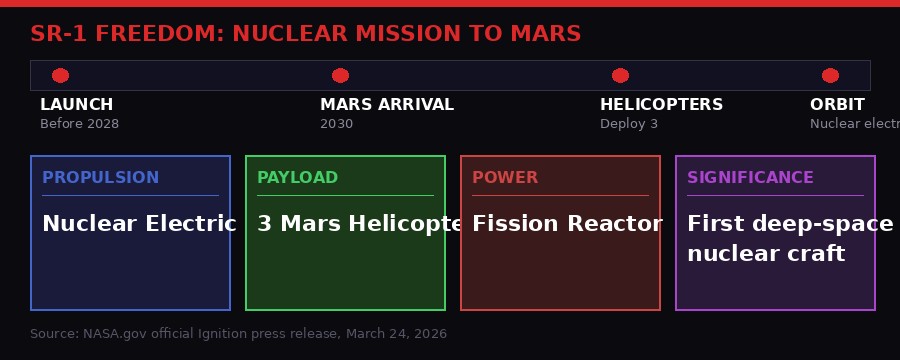
Buried in the Moon base announcements but arguably as significant in the long run: NASA confirmed it will launch the Space Reactor-1 Freedom, the first nuclear-powered interplanetary spacecraft the United States has ever flown, before the end of 2028.
Nuclear electric propulsion works differently from chemical rockets. Instead of a single high-thrust burn, a nuclear reactor generates sustained electrical power, which drives an ion thruster or similar system for low-thrust-but-extremely-efficient propulsion over months and years. The efficiency advantage - measured in specific impulse - is dramatic. Where a chemical rocket might achieve specific impulse values of 300-450 seconds, nuclear electric systems can reach 3,000-10,000 seconds. That means far more mass can be moved per unit of propellant, or missions can carry far more science payload per given launch mass.
The constraint has always been solar power. Beyond the asteroid belt, solar panels become progressively less useful as sunlight intensity drops with the square of distance from the Sun. Jupiter gets roughly 4% of Earth's solar irradiance. Saturn gets about 1%. For missions to the outer solar system, nuclear has always been the only viable power source - which is why the Cassini, Voyager, and New Horizons missions all ran on radioisotope thermoelectric generators (RTGs). But RTGs are passive - they generate electricity from the decay heat of radioactive material, not from controlled nuclear fission. SR-1 Freedom takes the next step: an actual reactor.
The Mars mission profile gives SR-1 Freedom a specific task: enter Mars orbit and deploy three helicopters to the surface. NASA has demonstrated that rotorcraft can fly in Mars's thin atmosphere - the Ingenuity helicopter proved that in 2021, surviving far beyond its planned 30-day mission and ultimately logging over 70 flights. Three helicopters simultaneously operating from an orbital mothership represents a genuine step-change in surface coverage. The SR-1 Freedom mission also serves as a technology demonstration for the nuclear propulsion systems that future crewed Mars missions would rely on.
The Dragonfly mission - a separate nuclear-powered octocopter headed to Saturn's moon Titan in 2028, arriving 2034 - is also referenced in the Ignition announcements, alongside the Rosalind Franklin rover to Mars in 2028 and the Nancy Grace Roman Space Telescope launching this fall. The picture NASA is painting is one of a diversified portfolio of deep space science missions running in parallel with the Moon base construction effort, many of them nuclear-powered.
"NASA is committed to achieving the near-impossible once again, to return to the Moon before the end of President Trump's term, build a Moon base, establish an enduring presence, and do the other things needed to ensure American leadership in space." - Jared Isaacman, NASA Administrator, Ignition event, March 24, 2026
The China Variable: Space as Geopolitical High Ground
Isaacman's "great power competition" framing wasn't rhetorical window dressing - it was the explicit strategic justification for every decision announced at Ignition. Kill Gateway because it distracts. Cancel programs that don't bend toward the surface. Get to the Moon's south pole before China does.
The Chinese National Space Administration (CNSA) and Russia's Roscosmos formalized the International Lunar Research Station (ILRS) partnership in 2021. That program targets robotic base construction between 2026-2035, with crewed missions in the 2030s. China's Chang'e program has steadily advanced: Chang'e-5 returned lunar samples in 2020, Chang'e-6 retrieved samples from the far side in 2024, and Chang'e-7 is targeting the south pole for water ice detection. The trajectory is clear.
Whoever establishes permanent infrastructure at the lunar south pole first gains significant advantages. Water ice in permanently shadowed craters at the poles can be electrolyzed into hydrogen and oxygen - rocket propellant. Whoever controls a fueling depot on the Moon's surface effectively has a logistics advantage for every subsequent mission: to the Moon, to the asteroids, or to Mars. The Moon's south pole isn't just scientifically interesting; it's strategically valuable in a way that no other location in cislunar space quite matches.
Beyond the resource question, there's the Outer Space Treaty regime to consider. The 1967 Outer Space Treaty prohibits national sovereignty claims on celestial bodies, but it says nothing about operational control of a given location. Establishing a permanent base - with communication networks, power infrastructure, mobility assets - creates a de facto zone of operational control even without a legal sovereignty claim. Both the U.S. and China understand this. The Artemis Accords, which NASA has used to build a coalition of partner nations (35 signatory countries as of 2026), can be read partly as a legal and diplomatic framework to cement American operational norms on the Moon before Chinese infrastructure is in place.
The timing pressure Isaacman described is real. If China lands at the south pole before American hardware is established there, Washington's leverage in shaping lunar norms diminishes. The Gateway's cancellation - painful as it is for the international partners who invested in it - reflects a judgment that getting to the surface faster is worth more than maintaining a complex multilateral architecture that slows everything down.

ISS, Low Earth Orbit, and the Commercial Transition Problem
The Moon base announcements overshadowed a significant secondary decision NASA made at Ignition: the agency is rethinking how it transitions away from the International Space Station.
The ISS has been continuously inhabited since November 2000. Its statistics are staggering: 37 shuttle flights to assemble it, 160 spacewalks, more than 4,000 research investigations, over 5,000 researchers involved, visitors from 26 countries, and a total cost exceeding $100 billion across all partners. It cannot operate indefinitely - the structural lifetime has been extended multiple times, and current planning targets 2030 for deorbit.
NASA's original transition plan called for commercial space stations to replace the ISS by 2030, with companies like Axiom Space and Starlab building and operating the replacements while NASA became a customer. The problem: the commercial market for orbital habitation has struggled to materialize at the scale needed. Companies can't build stations if the revenue model doesn't work, and the revenue model doesn't work if there's no proven market for commercial orbital time beyond NASA contracts.
At Ignition, NASA floated a new alternative: a government-owned "Core Module" that attaches to the existing ISS, followed by commercial modules that validate their systems using ISS infrastructure before eventually detaching into free flight as independent stations. This hybrid model - using the ISS as an incubator for commercial orbital capability - is more conservative than the original plan but potentially more viable. An industry RFI opens March 25 to gather input on financing, partnership structures, and risk allocation.
The ISS transition matters beyond just orbital science. If there's a gap in American human presence in low Earth orbit when the station comes down, U.S. leadership in orbital operations weakens at exactly the moment China is scaling Tiangong (its own space station, fully operational since 2022). NASA is trying to prevent a scenario where, between the Moon base construction effort and the ISS deorbit, America briefly steps back from continuous human spaceflight - a symbolic defeat with practical downstream consequences.

What Ignition Actually Changes - and What It Doesn't
The Ignition event generated clear strategic direction where NASA previously had an excess of overlapping programs and unclear priorities. That's genuinely significant. But the practical implications take time to materialize, and several second-order effects deserve attention.
For international partners, the Gateway cancellation is a real problem. ESA, JAXA, CSA, and ASI all committed hardware, funding, and political capital to Gateway. Some of that hardware was already being built - the ESA-built ESPRIT refueling module and the JAXA-built pressurized rover were funded and in development. NASA says it will "repurpose applicable equipment" and "leverage international partner commitments," but that's diplomatic language for a negotiation that hasn't been finished yet. Partners who built components specific to Gateway's orbital design can't simply drop them on the lunar surface. Expect months of renegotiation.
The budget question hangs over everything. Three phases at roughly $10 billion each comes to $30 billion over a decade, on top of existing Artemis costs, the SR-1 Freedom nuclear mission, Dragonfly, Roman Space Telescope, and maintaining the ISS through the transition. NASA's 2025 budget was approximately $25 billion. The current political environment - with federal spending under scrutiny and DOGE-style efficiency pressure applied across agencies - creates genuine uncertainty about whether the Ignition architecture can be funded at the scale described. Isaacman's vision is ambitious precisely because it requires sustained political commitment across multiple administrations.
The commercial sector faces expanded opportunity and expanded risk simultaneously. Scaled-up CLPS means more launch contracts for commercial lunar delivery companies. But delivering 21 payloads to the Moon in two years is an aggressive cadence that several companies in the CLPS program have struggled to meet even for individual missions. Astrobotic's Peregrine mission in January 2024 failed to reach the lunar surface due to a propellant leak. Intuitive Machines' IM-1 tipped over on landing in February 2024. The technical bar for reliable lunar delivery is higher than for Earth orbit, and scaling up volume before reliability is proven creates the risk of cascading failures that set the entire Phase One timeline back.
The nuclear propulsion announcement has arms-control dimensions that weren't addressed at Ignition. Flying a nuclear reactor in space requires compliance with UN guidelines on nuclear-powered objects in outer space, and it raises questions about escalation dynamics if other spacefaring nations - particularly China - interpret American nuclear propulsion capability as dual-use technology. The SR-1 Freedom mission is explicitly peaceful and scientifically oriented, but the technology that drives an interplanetary spacecraft could, in principle, power other kinds of payloads. Expect this to surface in diplomatic channels as the launch date approaches.
For NASA's workforce, the "Ignition" framing signals a culture shift. Kshatriya explicitly said at the event that bringing critical skills back into the agency and putting teams "where the machines are being built" is a priority. This is a subtle criticism of the management-at-a-distance model NASA has operated under for years, where agency personnel coordinate with contractors rather than doing technical work themselves. Whether that culture shift happens fast enough to support the Phase One timeline is an open question.
Key Dates and Milestones from NASA Ignition
- March 24, 2026: Ignition event - Gateway paused, Moon base architecture announced, SR-1 Freedom confirmed
- March 25, 2026: Industry RFIs released for LEO Core Module and lunar payloads
- 2027: Artemis III - integrated systems test in Earth orbit; first CLPS landings at accelerated cadence
- Before 2028: SR-1 Freedom nuclear spacecraft launches for Mars
- 2028: Dragonfly octocopter launches to Titan; Phase One Moon landings peak
- 2029-2032: Phase Two - site selection, pressurized rovers, semi-permanent infrastructure
- 2030: SR-1 Freedom arrives at Mars, deploys three helicopters
- By 2030: ISS deorbit target - commercial station transition must be complete
- 2032-2036: Phase Three - permanent habitats, fission power, in-situ manufacturing
The Bigger Picture: What a Moon Base Actually Enables
The direct value of a lunar base tends to get framed in terms of scientific discovery and national prestige. Both are real. But the second-order effects are where the strategic picture gets genuinely interesting.
In-situ resource utilization (ISRU) changes the economics of space entirely. Every kilogram of rocket propellant produced on the Moon from water ice is a kilogram that doesn't need to be launched from Earth at a cost of roughly $1,000-$10,000 per kg (depending on the launch provider and destination orbit). A functioning lunar propellant depot makes deep space missions dramatically cheaper and extends the operational range of cislunar vehicles. The Phase One VIPER rover mission - prospecting for water ice - is directly foundational to this. How much ice is actually accessible, and in what concentrations, will determine whether ISRU is economically viable within the 10-year window NASA has set.
Lunar manufacturing, even at small scale, creates compounding capability. Phase Three's "industrial neighborhood" could start with simple things: sintering lunar regolith into building blocks, extracting oxygen from ilmenite for life support, producing basic structural components. None of these are revolutionary in isolation. But the ability to fabricate things on-site rather than shipping them from Earth fundamentally changes the logistics calculus for any expansion beyond the initial base footprint.
The communications infrastructure NASA is building serves dual purposes. Two orbital communications satellite constellations around the Moon - announced as part of Phase One - are nominally for coordinating lunar surface operations. They also provide coverage for any other nation's or company's lunar activities. This positions NASA (and by extension the U.S. government) as an infrastructure provider, which creates leverage over lunar activities by entities that depend on that communications layer. It's not unlike GPS: built for military navigation, became foundational infrastructure for the entire global economy.
The nuclear propulsion precedent matters for the outer solar system. If SR-1 Freedom performs as planned, it validates a propulsion architecture that makes missions to Jupiter's moons, Saturn's moons, Neptune, and beyond both faster and more capable. The outer solar system has remained the hardest part of space exploration not just because of distance but because chemical rockets can't efficiently carry the power and mass required for serious science at those ranges. Nuclear electric propulsion breaks that constraint.
The Ignition event was, in essence, NASA communicating to the world - and to China specifically - that the United States is done hedging. Gateway was the hedge: a complex architecture that kept options open without committing fully to any one thing. Killing it is a declaration of intent. The Moon base plan that replaced it is more demanding, more expensive, and more politically exposed if it fails. But it's also, for the first time in years, an honest statement of what NASA is actually trying to do.

How NASA Got Here: The Road to Ignition

What Happens Next
The immediate next step is the RFI and RFP release on March 25. These solicitations will shape which commercial providers get the expanded CLPS contracts, who builds the Core Module for the ISS transition strategy, and which payloads ship in the first wave of Phase One landings. The response from industry will be a leading indicator of how realistic the Phase One timeline actually is - if the commercial sector can't commit to the cadence required, NASA will need to either slow Phase One or find additional funding to support more providers.
International partner negotiations will run in parallel. JAXA, ESA, CSA, and ASI all need new agreements that account for the Gateway cancellation and define their roles in the surface architecture. Japan's pressurized rover is a known Phase Two asset. Italy's Multi-purpose Habitats are in Phase Three. But the European contributions - several of which were specifically designed for Gateway's orbital environment - need complete reassessment.
The budget fight is coming. The Ignition architecture will need to survive the 2027 appropriations cycle and every cycle thereafter. Isaacman's explicit invocation of great-power competition and the Trump administration's National Space Policy gives the plan political cover in the current environment. Whether that cover holds through multiple budget cycles, with the demands of the lunar surface program competing against other federal priorities, is the central uncertainty.
And then there's the technology. CLPS providers need to nail their lunar deliveries. VIPER needs to find usable water ice. Nuclear electric propulsion needs to work. Phase Two infrastructure needs to operate reliably in an environment with 14-day nights, temperature swings of 300 degrees Celsius, vacuum, radiation, and micrometeorite bombardment. The Moon is harder than Earth orbit in almost every engineering dimension.
But NASA showed its hand on Tuesday. The strategic intention is clear, the architecture is real, and the timeline has been committed to publicly. After years of incremental planning and institutional hedging, that clarity itself is significant. Whether Ignition lives up to its name depends on what happens in the 12 months after the spark.
Get BLACKWIRE reports first.
Breaking news, investigations, and analysis - straight to your phone.
Join @blackwirenews on TelegramSources
- NASA Official Press Release: "NASA Unveils Initiatives to Achieve America's National Space Policy" - March 24, 2026
- Ars Technica: "NASA kills lunar space station to focus on ambitious Moon base" - Eric Berger, March 24, 2026
- NASA Administrator Jared Isaacman, direct quotes from Ignition event, March 24, 2026
- NASA Associate Administrator Amit Kshatriya, direct quotes from Ignition event, March 24, 2026
- NASA Associate Administrator for Exploration Systems Development Jim Garcia-Galan, Ignition event briefing
- NASA Ignition architecture briefing documents - Phase One, Two, Three cost and payload estimates
- Outer Space Treaty, 1967 - background context on lunar sovereignty provisions
- UN guidelines on nuclear-powered objects in outer space - context for SR-1 Freedom