Nashville's Secret: AI Is Writing Your Favorite Country Songs
Sunday, March 29, 2026 • Music • Artificial Intelligence • Digital Rights

Nashville's recording studios are quietly being replaced - one Suno prompt at a time. Photo: Pexels
Patrick Irwin came to Nashville to write songs the old way. He found something else entirely.
Sitting in a session with cowriters Sam Fink and Duane Deerweater, Irwin watched one of them open a laptop, type a prompt into Suno - an AI music platform - and upload a voice memo with just guitar and vocals. The prompt read: "traditional country, male vocal, folk country, story telling, 90s country, rhythmic." Thirty seconds later, the room had two fully produced demos. Drums. Electric guitars. Bass. Backing harmonies. No studio musicians. No invoices. No waiting.
"You tell it the genre and it totally does the whole thing, it's insane," Irwin told The Verge. He was as astonished as he was disturbed. This was not the Nashville of his imagination - the city with a 200-year history of producing America's greatest music through human craft, late nights, and the sacred grind of the 10-year-town.
That Nashville still exists on the surface. But underneath, something has shifted permanently. AI hasn't just entered the music industry. In the writing rooms and producer suites of Music City, it has become the default tool - and nobody is supposed to talk about it.
The Suno Numbers
The "Don't Ask, Don't Tell" Era Arrives

The mixing board is still there. But increasingly, the AI did half the work before the session even started. Photo: Pexels
"People don't really admit to what extent they're using it," songwriter Michelle Lewis - who has written songs for Cher and Hillary Duff, and co-founded the advocacy organization Songwriters of North America - told Rolling Stone. She described the atmosphere around AI among her peers as: "Don't ask, don't tell."
David Baron, producer for The Lumineers, put it more bluntly: "It's a really bad word in some circles. I know people who hate AI with a passion, but wouldn't say it out loud."
The CEO of Suno himself, Mikey Shulman, recently described AI use as "the Ozempic of the music industry - everybody is on it and nobody wants to talk about it." The comparison is deliberately clinical. Like the weight-loss drug that transformed bodies while everyone pretended otherwise, AI has transformed music production while an industry built on authenticity mythology carefully avoids the conversation.
Trannie Anderson, who has written for Lainey Wilson, Dan + Shay, and Reba McEntire, says the tech is ubiquitous. She doesn't use it herself, but sees it deployed "from entry-level songwriters to the top dogs." She isn't exaggerating. Multiple sources confirm that even stars like Dustin Lynch and Jelly Roll are receiving demos with their own voices artificially generated through AI voice transfer - pitches where AI has convincingly cloned the artist before the artist has even heard the song. Lynch's manager Brad Belanger confirmed this to The Verge, adding: "What a world we're moving into."
Jelly Roll's representatives declined to comment.
How the Demo Machine Actually Works

The voice memo plus a Suno prompt has replaced the traditional demo process that once took days and cost thousands. Photo: Pexels
To understand why AI has colonized Nashville so completely, you have to understand the traditional demo economy first.
Nashville is known as a "10-year town" - a place where you grind for a decade before getting a break. Each day, hundreds of writing sessions take place where songwriters create demos to pitch to publishers, who pitch to labels, who pitch to artists. Even when a major country star "cuts" a song by recording it, it can take another two years to make it to radio. "Two years is the fastest I've seen," says Jon Sherwood, a UMPG writer who co-wrote the Bailey Zimmerman and Luke Combs hit "Backup Plan."
The traditional demo process had real costs. After writing a song, a writer would pay a "track guy" - a studio musician or producer - $500 to $1,000 to record a polished demo. For a writer like Maggie Reaves, who produces around 200 songs per year and is signed to publishers Dream 3 and Kobalt, demoing every song could theoretically cost up to $200,000 annually. Very few songwriters can afford that. Most wrote far fewer songs or demoed only their best work.
Suno collapsed that math entirely. At $96 per year for a subscription, Reaves can now demo every song she writes, unlimited attempts, in any genre, in under a minute. The workflow: record a voice memo on your phone, upload it to Suno, type a style prompt, and within 30 seconds receive multiple fully-arranged productions. Drums, bass, electric guitars, backing harmonies - everything a traditional demo would require a full band to record.
"I immediately saw this could replace that. For a lot of songwriters it's been very empowering. You don't have to split your copyright, you can write by yourself, and you don't have to pay a producer."
- Maggie Reaves, songwriter signed to Dream 3 and Kobalt
When Reaves had a one-day turnaround assignment for a major artist, she wrote the song and "threw it in Suno." Her publisher's response: "This is perfect. This is going straight to her."
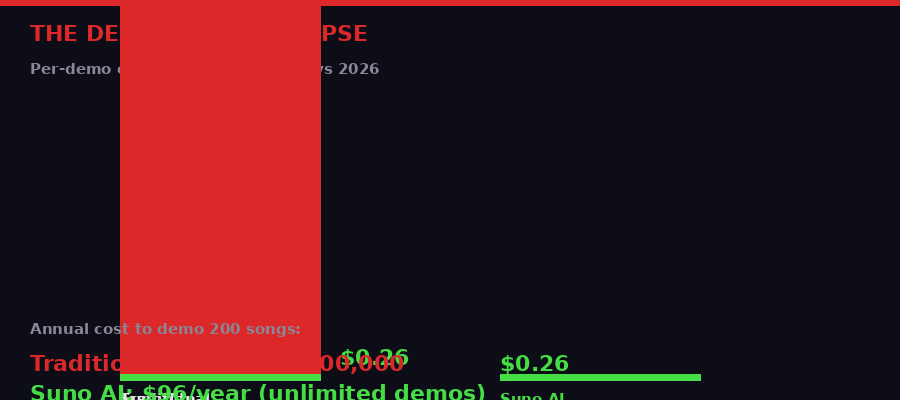
The economics of demo production have been permanently rewritten. A $96/year Suno subscription replaces what once cost $100,000+ annually for a prolific songwriter.
Publishers have noticed. Some are now running entire back catalogs through Suno to find new angles on forgotten tracks - essentially strip-mining old song archives with AI to discover commercial potential that was previously buried under production costs.
What the AI Actually Sounds Like - and Why It Doesn't Matter

AI-generated demos have specific sonic tells - but labels can't detect them, and in a moving car, nobody notices. Photo: Pexels
The Suno output isn't indistinguishable from human performance. Not yet. The sound has specific tells: slightly lo-fi, over-compressed, low sample rate and bit depth. The vocal quality is uncanny - overly pitch-corrected, with inflections that one source described as "borderline Cylon." The audio resembles a slightly degraded MP3 from the early-streaming era.
But here's the thing about demo recordings: they don't need to sound perfect. They need to communicate a song's potential. Reaves says 70 percent of Suno's output is solid enough to play in a car - and traffic noise masks the quality issues that would be obvious in a studio. A demo's job is to let an artist or label executive hear what the song could be. Suno does that job at 99.95% cost reduction.
Jacob Durrett, a producer at Big Loud Records, uses Suno to rapidly prototype alternative versions and "vibes" for songs. A half-formed guitar idea becomes multiple fully-arranged versions in different genres within minutes. "I'm in awe of it sometimes, how good it can be," he told The Verge. For skilled producers like Durrett, AI delivers what he calls "a productivity boost more than a creative boost" - handling rapid iteration so humans can focus on refinement and feel.
The tools have evolved far beyond simple generation. Grammy-winning producer Ian Fitchuk describes stem separation as "phenomenal": AI can now isolate vocals from a recording so cleanly it sounds as if the vocalist recorded in a pristine studio environment alone. Matching the sonic profile of a reference track - something that once took hours of manual EQ work - now takes minutes. Jay-Z's longtime producer and engineer Young Guru now routinely instructs AI to match specific sonic fingerprints: "Give me the mix tone from Dr. Dre's 2001, track four."
- Lauren Christy, songwriter for Avril Lavigne, Britney Spears, Liz Phair
The Invisible Casualties: Demo Musicians and the Farm Team

Nashville's demo musician class - session players who once earned six figures recording in writing rooms - is being eliminated. Photo: Pexels
Most people in Nashville wear multiple hats: songwriter by day, session musician by night, touring guitarist on weekends. The demo economy sustained an entire class of working musicians. "There used to be a whole world where musicians were making six figures only playing demo scale," says Ian Fitchuk, who produced Kacey Musgraves' Grammy-winning Golden Hour album. He has steered clear of Suno and is watching the fallout closely.
Trannie Anderson calls AI's arrival "the final nail in the coffin" for the demo studio system. The people displaced aren't the stars - they're the invisible infrastructure. The drummer who played on 200 demos a year. The bassist who built a career on being the best $50-an-hour track layer in the city. The "track guy" who turned rough voice memos into polished productions and built relationships with songwriters over decades of sessions together.
These workers aren't in the headlines. They're the farm team - the musicians who kept Nashville's ecosystem alive and grew into the session musicians and producers who would eventually work on major records. Anderson's concern is structural: if the farm team disappears, where do the next generation of session musicians come from? "There's an element missing," she says. "Humanity and a soul. The Holy Spirit doesn't live in AI."
The math is brutal. In a city where hundreds of demo sessions happen per day, if even 50 percent of those sessions now use AI for production, that's thousands of paid musician hours per week that have simply evaporated. The money doesn't go to different musicians. It goes to Suno, a VC-backed startup in Cambridge, Massachusetts.
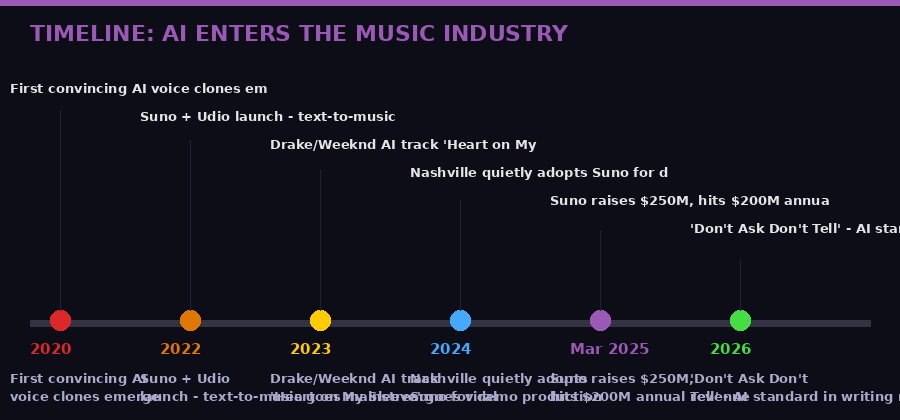
AI's takeover of music production didn't happen overnight - but the Nashville inflection point in late 2024 marked the shift from experiment to standard practice.
Music publisher Eric Olson frames it differently. He sees Suno as "an unlimited co-writer in the room" - a tool that generates samples without clearance headaches, rapidly explores creative directions, and buys back time. "If I can give Suno the last 20 percent and spend more time with my kids, that's huge," he told The Verge. For him, the calculus is personal efficiency, not industry ecology.
Both views are correct. That's the problem with genuinely disruptive technology. It creates real value for the adopters while imposing real costs on those who can't adapt or who never had the option to.
The Legal Black Hole: Copyright, Training Data, and the AI Demo Gray Area

The US Copyright Office does not protect AI-generated work - creating a legal gray zone for every hybrid human-AI song produced in Nashville. Photo: Pexels
The legal structure of AI-assisted music is, to put it charitably, a complete mess.
Suno is currently fighting a major lawsuit from major record labels including Universal Music Group, Sony Music, and Warner Music Group, who filed suit in 2024 alleging that Suno trained its models on copyrighted recordings without licensing them. This is not a minor dispute. It goes to the core question of whether AI music tools are legally built on stolen creative work.
Suno raised $250 million in November 2025 at a $2.45 billion valuation despite - or arguably because of - this ongoing litigation. Investors are betting that either the lawsuit fails, a settlement is reached, or that Suno becomes too entrenched to shut down regardless of the outcome. The company's $200 million in annual revenue suggests the market has already decided.
Meanwhile, the US Copyright Office has made clear that it will not grant copyright protection to purely AI-generated content. This creates a peculiar situation for songwriters using Suno. If songwriter Maggie Reaves writes the lyrics and melody but uses Suno to create the production, which elements are protectable? The lyrics, almost certainly. The melody she hummed on the voice memo, probably. But the AI-generated guitar arrangement that publishers are now sending to major artists? Legally ambiguous at best.
"If Suno spits out a lead line an artist uses, what's the protocol? AI learns from my songs, my friends' songs. We aren't being compensated."
- Maggie Reaves, songwriter
Jacob Durrett raises the eerie problem of voice cloning: the AI outputs voices that sometimes sound disturbingly like specific human musicians. "It's happened many times," he told The Verge. When AI generates what sounds like a specific guitarist's style or a specific vocalist's timbre, the line between inspiration and reproduction gets dangerously blurred.
The detection problem compounds everything. "We don't have the detection software, really, that's effective yet," Lewis told Rolling Stone. "So if you can't tell, then how can you enforce it?" The industry is operating on the honor system at a moment when economic pressure is pushing everyone toward AI adoption. In a survey of more than 1,100 producers, engineers, and songwriters conducted by audio-tech company Sonarworks, seven out of 10 respondents said they were at least occasionally experimenting with AI tools, and one in five were regular users. The CEO of Sonarworks reported "many anecdotes about artists submitting AI-generated songs as their own, and labels not being able to detect them."
Young Guru estimates that "more than half" of sample-based hip-hop is now being made using AI-generated samples rather than licensed original music or hired musicians. That's not a small statistical footnote. If accurate, it means the majority of a major genre's foundational element - the sample - has been quietly replaced by AI-generated approximations, with no compensation flowing to the original artists and musicians whose recorded performances trained the model.
The Backchannel Conversation: What Nashville Insiders Actually Think

Country music's audience has no idea how many of the demos that became their favorite songs were produced by AI. Photo: Pexels
The "Don't Ask, Don't Tell" dynamic operates on multiple levels simultaneously. There's the public-facing resistance - artists who built their brand on authenticity cannot be seen embracing AI without fan backlash. Teddy Swims experienced a version of this in late 2024 when he called AI music tools "truly amazing" and faced immediate online criticism. The message was received. Public enthusiasm for AI is now carefully muted.
But privately, the conversation is different. "In private, songwriters are saying, 'It's kind of awesome,'" Lewis told Rolling Stone. The enthusiasm is real - for speed, for creative flexibility, for economic democratization. Songwriter Charlie Puth described using Replay to prototype choir arrangements: "There's a setting that makes a mono vocal sound like eight to 10 people singing. I'm gonna use that to see if I even want the choir sound on there. And then we take it off and replace it with a real choir." This is AI as sketch pad, not replacement - a way to cheaply test expensive ideas before committing budget.
Not everyone draws the same line. Producer Nathan Chapman - who has worked with Taylor Swift, Keith Urban, and many others - has received requests to change lyrics using AI and said no. But he acknowledged: "It's the artist's call." The lack of industry-wide standards means every session involves a fresh negotiation over what AI use is acceptable and what crosses an undefined line.
Lauren Christy of the Matrix, who has written for Avril Lavigne, Britney Spears, and Liz Phair across decades of hits, was recently texted by a "big star" asking if she had any songs. Christy was able to reply immediately with a demo built using AI production. The artist wanted to record it on the spot. "I was like, 'Whoa - that just saved me days,'" she said. The AI production was a conduit for human creativity - but it was also an invisible layer in the creative chain that the eventual fans would never know existed.
The generational split is real. Older musicians with established careers and the income to absorb demo costs are more likely to avoid AI out of principle. Younger, less-established songwriters facing brutal economics are more likely to adopt it as a survival tool. "No one wants to be left behind, or come across as old-school," says Lewis. Economic necessity plus social permission equals rapid adoption - and the economic necessity in Nashville is acute.
The AI Country Chart Game and the Question of Detection

An AI song topped a Billboard chart - but the real AI infiltration isn't on the charts yet. It's in the writing rooms where tomorrow's hits are born. Photo: Pexels
In early 2026, "Walk My Walk" by Breaking Rust - a fully AI-generated song - topped the Billboard Country Digital Song Sales chart. The story generated significant media coverage framing it as a threshold moment. But industry insiders pushed back: that chart is a holdover from the pre-streaming era and easily gamed by coordinated purchases. Topping it requires no real listener engagement.
The more significant development isn't AI songs charting. It's AI production becoming standard in the pipeline that produces charted human songs. When a major country star records a hit that was demoed using Suno, the AI is invisible to the listener, to the publication reporting the chart position, and - critically - to the other songwriters whose voices got cloned into that demo without consent or compensation.
The detection question is an emerging technical battlefield. Major labels would theoretically want to know if submitted demos use AI production - both for legal reasons related to the ongoing Suno lawsuit and for their own internal policies around AI content. But no reliable detection tool currently exists for AI-generated music the way watermarking exists for AI-generated images in some contexts.
The CEO of Sonarworks noted that labels are "relying on the honor system." That's a remarkable admission for an industry in the middle of billion-dollar copyright litigation against the very AI company whose tool everyone is using.
The second-order implication: every royalty dispute, every publishing contract, every sync licensing deal for the next decade will be shadowed by the question of how much AI contributed to the underlying work and whether the contracts governing those deals account for that reality. They mostly don't.
Where This Goes From Here

Nashville's stages will still be filled with human performers. But the songs they're singing increasingly have an AI fingerprint in their DNA. Photo: Pexels
Suno's commercial trajectory is unambiguous. From a few users in 2023 to $200 million in annual revenue in 2025, with $250 million in fresh capital to accelerate product development. The current uncanny valley in AI vocals will close. The sonic tells that allow experienced ears to identify AI production will diminish. The legal uncertainty that currently makes some publishers cautious will resolve - one way or another, through lawsuits, legislation, or simple normalization through industry-wide adoption.
The structural question is whether Nashville's talent pipeline survives the transition. The demo musician ecosystem served as a training ground - the place where Nashville's best session players learned their craft through repetition, collaboration, and commercial feedback. If that ecosystem is eliminated in five years by AI cost compression, the musicians who would have gone through that pipeline simply don't emerge. The consequences show up a decade later when the supply of elite session musicians and producers contracts.
This is the pattern with technological disruption: the costs are diffuse, delayed, and invisible until they're acute. The benefits are immediate, concentrated, and loudly celebrated. Right now, Maggie Reaves is saving $100,000 per year on demo production. Her fans won't notice any difference. The drummer who used to play on her demos is finding other work or leaving Nashville. That displacement is real but happens below the headline.
"Wait around two years and you're going to hear songs made with the help of Suno all over country radio."
- Charlie Harding, The Verge
The publishing and copyright infrastructure is ill-equipped for what's coming. The Music Modernization Act of 2018 created blanket licensing structures for the streaming era. It was already struggling to handle edge cases. AI-generated samples, AI-assisted composition, AI voice cloning used in demo pitches - none of these fit cleanly into the existing framework. The legislative update required to address them is probably five to eight years away, given how long music industry copyright reform typically takes to navigate Congress.
In the meantime, Nashville has made its choice. Adoption is accelerating, not slowing. The "Don't Ask, Don't Tell" policy is a coping mechanism - a way for an industry built on stories of human authenticity to incorporate a tool that challenges that story without confronting the contradiction directly. Eventually, the pretense will become impossible to maintain.
The Holy Spirit may not live in AI, as Trannie Anderson insists. But the royalties increasingly do.
Key Timeline
Industry Survey Data (Sonarworks, 2026)
Sources: The Verge (Charlie Harding reporting), Rolling Stone, Billboard, TechCrunch, Sonarworks Industry Survey 2026, AP, Reuters.
Get BLACKWIRE reports first.
Breaking news, investigations, and analysis - straight to your phone.
Join @blackwirenews on Telegram