NATO Fracture, Hormuz Siege, and the May 1 Deadline: The Iran War at Day 56
A Pentagon memo threatens to suspend NATO allies and review the Falklands. The Strait of Hormuz is a shooting gallery. Congress has one week to decide. The world order is being rewritten by the hour.
April 24, 2026 | 13:00 UTC | Multi-source wire

Naval operations intensify across the Strait of Hormuz as US and Iranian forces trade vessel seizures. Photo: Unsplash
Fifty-six days into the Iran war, the conflict has metastasized from an air campaign into something far more dangerous: a multi-front confrontation that is tearing at the foundations of the Western alliance, choking the world's most critical shipping lane, and hurtling toward a constitutional crisis in Washington. On a single day - April 24, 2026 - four separate storylines converged that, taken together, paint a picture of a global order under the most severe strain since the Cold War.
A Pentagon internal email, revealed by Reuters, outlined options to punish NATO allies for insufficient support of the Iran war, including suspending Spain from the alliance and reviewing US recognition of British sovereignty over the Falkland Islands. Defense Secretary Pete Hegseth held a defiant press conference declaring the US had "all the time in the world." Iran's foreign minister was reportedly en route to Islamabad for talks. And oil surged past $106 a barrel as the Strait of Hormuz became a lawless stretch of water where both sides seize ships at will.
This is what day 56 looks like.
I. The Pentagon Memo: Weaponizing NATO Membership
The Pentagon, where an internal email now threatens the entire NATO alliance structure. Photo: Unsplash
The most explosive development on April 24 was not a missile strike or a naval seizure. It was a document. Reuters reported that an internal Pentagon email had outlined options for the United States to punish NATO allies it believed had failed to support the Iran war campaign. The options were startling in scope.
First, the email suggested seeking the suspension of "difficult" countries from the alliance, with Spain specifically named. Spain has refused to allow the US to use air bases on its territory - specifically Naval Station Rota and Moron Air Base - for attacks on Iran. The message was blunt: if you do not provide basing, overflight, and access rights, your NATO membership itself could be on the line.
Second, the email floated the idea of reassessing American diplomatic support for longstanding European "imperial possessions" - and named the Falkland Islands specifically. The implication: the US could withdraw its de facto recognition of British sovereignty over the Falklands as retaliation for the UK's reluctance to deepen its involvement in the Iran war.
The reaction from European capitals was immediate and sharp.
NATO's official response was categorical: the alliance's founding treaty "does not foresee any provision for suspension of NATO membership, or expulsion." A NATO official stated this plainly to the BBC, effectively telling the Pentagon that its threat had no legal basis in the alliance's own charter [BBC].
Spain's Prime Minister Pedro Sanchez dismissed the report with icy understatement: "We do not work based on emails. We work with official documents and official positions taken, in this case, by the government of the United States." He added that Spain supported "full cooperation with its allies, but always within the framework of international law" [BBC].
Italy's Prime Minister Giorgia Meloni urged allies to stick together, calling NATO "a source of strength" and pushing for a stronger European pillar. A German government spokesperson was more blunt: "Spain is a member of NATO. And I see no reason why that should change" [BBC].
The significance of this memo extends far beyond Spain. It reveals a Pentagon that views alliance membership as conditional on support for a specific US military operation - a radical departure from seven decades of NATO doctrine, where Article 5 mutual defense was the bedrock and political disagreements were managed through diplomacy, not threats of expulsion. If the US can threaten to kick Spain out of NATO over basing rights for one war, no ally's membership is secure. Every NATO capital understands this. The memo, if it represents genuine policy direction, would fundamentally alter the power dynamics within the alliance, transforming it from a mutual defense pact into something closer to a transactional arrangement where loyalty is measured by compliance.
II. The Falklands Gambit: Sovereignty as Leverage

The Falkland Islands, 8,000 miles from Britain, now dangled as a bargaining chip in the Iran war. Photo: Unsplash
The inclusion of the Falkland Islands in the Pentagon email was, if possible, even more destabilizing than the NATO suspension threat. It represented the United States openly considering weaponizing a territorial sovereignty dispute against its closest ally as leverage in an unrelated conflict.
Downing Street's response was immediate and unequivocal. A No 10 spokesman said: "The Falkland Islands have hugely voted overwhelmingly in favour of remaining a UK overseas territory, and we've always stood behind the islanders' right to self-determination and the fact that sovereignty rests with the UK." The spokesman added the government "could not be clearer about the UK's position" and that "nothing is going to change that" [BBC].
Previous US administrations have formally recognized the UK's de facto administration of the islands but have never taken a formal position on sovereignty - a deliberate ambiguity that allowed Washington to maintain relationships with both London and Buenos Aires. The Pentagon memo appears to propose weaponizing that ambiguity, suggesting the US could shift its position toward Argentina's claim as punishment for British reluctance to join the Iran blockade.
The timing was particularly awkward. King Charles and Queen Camilla are due to travel to the US in three days for a meeting with President Trump at the White House. The Falklands review report emerged just as diplomatic preparations for that visit would have been in their final stages.
Argentina's President Javier Milei, a close Trump ally who modeled his campaign on the US president, has previously said he would set out a "roadmap" for the islands to become part of Argentina through diplomatic means. The Pentagon memo would, if acted upon, give Buenos Aires the most significant leverage in the sovereignty dispute since the 1982 war.
UK Prime Minister Keir Starmer has insisted that greater involvement in the Iran war is not in Britain's interest. The UK has allowed the US to use British bases for strikes on Iranian sites targeting the Strait of Hormuz, and RAF planes have participated in missions to shoot down Iranian drones. But Starmer has drawn a line at deeper involvement or joining the naval blockade. The Pentagon memo appears to be the consequence of that line.
The broader implication is chilling for every US ally with a territorial dispute. If the US is willing to dangle the Falklands over Britain's head, what stops it from reviewing its position on Greenland (Denmark), the Kuril Islands (Japan), or any number of disputed territories where an American position shift would upend decades of stability? The message to every ally with a vulnerable claim is the same: support our wars, or risk losing our backing on your sovereignty.
III. The Strait of Hormuz: A Shooting Gallery

Commercial shipping through the Strait of Hormuz has become a deadly game of naval chess. Photo: Unsplash
While diplomats argue over NATO membership and island sovereignty, the Strait of Hormuz has become the most dangerous stretch of water on Earth. Both the United States and Iran are seizing ships. Both claim legal justification. Neither is backing down. And commercial vessels are caught in the crossfire.
The US imposed a naval blockade on all Iranian ports on April 13. As of April 24, US Central Command said 34 ships had been ordered to turn around. One - the Iranian-flagged container ship Touska - refused. After six hours of warnings, warning shots, and finally disabling fire targeting its engine room, US special forces seized the vessel. The crew is in US custody [Al Jazeera].
Two more Iranian "dark fleet" tankers were seized in the Indo-Pacific region this week. General Dan Caine, Chairman of the Joint Chiefs, told reporters that the US had interdicted the Tifani on April 20 and the "very large crewed tanker" Majestic X on April 22. Both ships and their crews remain in US custody. Caine said the military will continue these missions in the Indian and Pacific Oceans [BBC Live].
Iran responded with its own seizures. On Wednesday, Iran's Revolutionary Guard Corps (IRGC) Navy announced it had seized two cargo ships - the MSC Francesca and the Epaminondas - in the Strait of Hormuz for "inspection." The IRGC said they were "operating without authorisation" and had committed "repeated violations," accusing them of trying to leave the strait "in secret" and tampering with navigation systems [BBC].
IRGC-affiliated Fars News Agency released dramatic footage of Iranian commandos boarding the vessels. BBC Verify analysed the footage and found that while the ships were clearly identifiable, aerial shots appeared to have been filmed several hours after the reported initial attack - suggesting a staged presentation rather than real-time documentation [BBC].
Greek authorities denied that the Greek-owned Epaminondas had been seized, saying its captain remained in control. But the transponders of both vessels have been switched off - making their actual status impossible to verify independently.
Trump escalated further on Thursday, ordering the US Navy to "shoot and kill" any boats laying mines in the Strait of Hormuz. "There is to be no hesitation," he wrote on Truth Social, adding that US mine "sweepers" are clearing the strait "right now" [BBC].
The Pentagon dismissed reports that clearing mines could take six months. Pentagon Chief Spokesman Sean Parnell called a six-month closure "an impossibility and completely unacceptable to the Secretary" [BBC].
The impact on global oil markets was immediate. Brent crude topped $106 a barrel on April 24, climbing nearly five percent after the tit-for-tat vessel captures. The price had breached $100 for the first time in two weeks earlier in the session [Al Jazeera]. Every additional dollar on a barrel of oil feeds through to petrol prices, consumer inflation, and political pressure in every oil-importing nation on Earth.
Iran's parliament deputy speaker Hamidreza Haji Bababei claimed on Thursday that the first revenues from tolls imposed on ships using the strait had been deposited with Iran's Central Bank. No details were provided on the amount, collection method, or who paid. The BBC could not independently verify the claim. Whether true or not, the statement serves a purpose: it signals that Iran views the strait not just as a chokepoint to defend, but as a revenue source to exploit.
IV. The May 1 Deadline: A Constitutional Clock Ticking
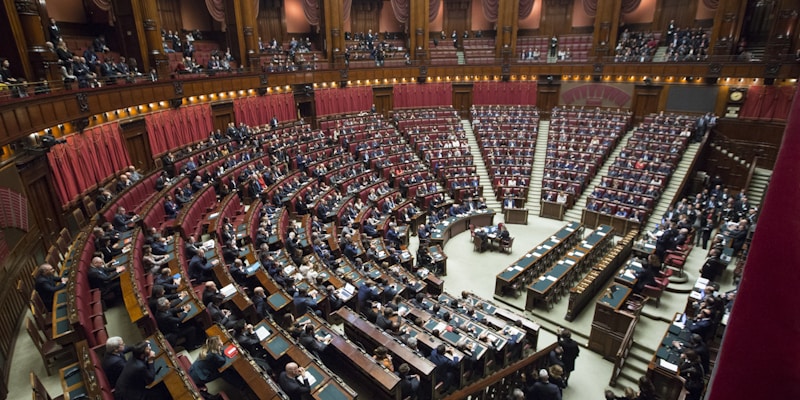
The US Capitol, where Congress faces a May 1 deadline under the War Powers Resolution. Photo: Unsplash
Buried beneath the naval clashes and diplomatic crises is a ticking clock in Washington that could fundamentally alter the trajectory of the war. Under the 1973 War Powers Resolution, President Trump has until May 1 - exactly one week from today - to obtain congressional approval for continued military operations in Iran. Without it, the law requires him to terminate US military deployments [Al Jazeera].
The 60-day clock started ticking when the US and Israel attacked Iran on February 28. That window expires on May 1. Congress has not passed a resolution authorizing continued military action. Nor has it granted the 30-day extension available under the law, which would require the president to certify in writing that continued military force is a result of "unavoidable military necessity."
So far, the Senate has rejected four bipartisan attempts to curb Trump's war powers. The most recent vote on April 15 failed 52-47, largely along party lines. Democratic Senator Chris Murphy said: "We should not fail to note how extraordinary it is that our Senate Republican leadership has declined to do any oversight of a war that is costing billions of dollars every week" [Al Jazeera].
But cracks are appearing in Republican solidarity. Senator John Curtis wrote: "I support the president's actions taken in defense of American lives and interests. However, I will not support ongoing military action beyond a 60-day window without congressional approval." Congressman Don Bacon was more blunt: "By law, we've got to either approve continued operations or stop. If it's not approved, by law, they have to stop their operations" [Al Jazeera].
The War Powers Timeline
The historical record, however, suggests Trump may simply ignore the deadline. Presidents from both parties have treated the War Powers Resolution as advisory rather than binding. Bill Clinton's 79-day Kosovo campaign in 1999 exceeded the 60-day limit without congressional approval. When 17 members of Congress sued, courts found they lacked standing. Barack Obama used the 2001 Authorization for Use of Military Force - originally passed for the war on terror after 9/11 - to justify operations far beyond its original scope, including the 2014 Syria deployment against ISIS [Al Jazeera].
Trump himself used the 2002 Iraq AUMF to justify the assassination of Iranian General Qassem Soleimani in 2020 during his first term. The same AUMF, or the 2001 authorization, could be repurposed to argue that continued operations against Iran fall under existing congressional authorizations.
The legal landscape is murky by design. As Maryam Jamshidi, an associate professor of law at Colorado Law School, explained: "There is no clear legal avenue for Congress to successfully force the president to abide by this termination requirement and, indeed, past presidents have refused to do so, claiming that this part of the War Powers Resolution is unconstitutional" [Al Jazeera].
Salar Mohendesi, a history professor at Bowdoin College, offered a political analysis: "His entire brand is based on winning. He told the American public that he could extract a better deal from Iran, he promised that he would not get involved in a war, and his beleaguered party is about to head into midterm elections in the midst of a historically unpopular war. Trump can still walk away and staunch the bleeding, so to speak, but that would mean accepting defeat. He is a gambler, so it's very possible that he will continue to escalate in the hopes of eking out some sort of victory down the line" [Al Jazeera].
V. The Islamabad Channel: Diplomacy on Life Support
Islamabad, where Pakistan mediates between the US and Iran with 3,000 containers stuck at its borders. Photo: Unsplash
Amid the naval escalations and alliance ruptures, a diplomatic track remains technically alive - though it is hard to find anyone optimistic about it. Pakistan government sources told the BBC on April 24 that Iran's Foreign Minister Abbas Araghchi was expected in Islamabad that night for talks. Neither the Iranians nor the Americans formally confirmed the visit [BBC Live].
Earlier in the week, it appeared the US and Iran would hold new peace talks in Pakistan, but they have yet to begin. Vice President JD Vance, who was due to lead the US delegation, remains in Washington. The open-ended ceasefire extension announced by Trump on Tuesday was widely interpreted as buying time for the blockade to bite rather than creating space for genuine negotiations.
Iran's position has been consistent: the blockade must end before meaningful talks can proceed. Iran's chief negotiator Mohammad Bagher Ghalibaf said it was "not possible" for the Strait of Hormuz to be reopened due to "the blatant violations of the ceasefire" by the US and Israel, including the naval blockade and Israeli "warmongering on all fronts" [BBC].
Iranian President Masoud Pezeshkian echoed this: "Breach of commitments, blockade and threats are main obstacles to genuine negotiations." Iran's ambassador to the UN in Geneva, Ali Bahreini, told BBC Radio that the US must end its blockade for negotiations to continue and needs "a realistic approach from the United States by recognising Iran's rights and Iran's reasonable demands." He rejected suggestions of internal division among Iran's leaders, saying instead that the problem was the US, which "is full of contradiction" and division [BBC Live].
At his press conference, Hegseth struck a tone that made diplomatic progress seem unlikely. "We have all the time in the world and we're not anxious for a deal," he said. "The ball is in their court" to abandon Iran's nuclear program. He described the blockade as "growing and going global." This is not the language of a government preparing to make concessions [BBC Live].
Trump's own statements have been contradictory. On Thursday he said "Iran is dying to make a deal" and that his stance "seems to be working very well." He claimed to have rejected an Iranian offer to reopen the strait three days prior, saying "it will open when we make a deal." He disputed reports that he is "anxious" to end the war, writing: "I have all the time in the World... Iran doesn't - The clock is ticking!" [BBC]
Pakistan has its own stakes in this mediation - and they are enormous. An estimated 3,000 containers are stuck at Pakistan's borders due to the disruption from the Hormuz crisis, according to Al Jazeera. Iran is reportedly exploring more land routes to bypass the strait. Pakistan's economy, already fragile, cannot absorb indefinite disruption to its trade routes [Al Jazeera Live].
VI. The Cascading Consequences: Markets, Alliances, and the Post-War Order

Global supply chains face their worst disruption since the Suez Canal blockage of 2021. Photo: Unsplash
The Iran war is no longer just a regional conflict. It is reshaping the global system in real time, and the effects are cascading through every domain that matters.
Oil and Energy
Brent crude above $106 is just the headline number. The real story is the structural disruption. The Strait of Hormuz carries roughly 21 million barrels of oil per day - about 21% of global petroleum consumption. Even partial disruption creates price spikes that feed into every economy on Earth. American consumers are already seeing petrol prices rise by roughly a dollar per gallon in some areas, according to former State Department official Andrew Peek. European economies, already fragile, face additional headwinds. Asian importers - China, Japan, South Korea, India - are absorbing costs that will slow growth across the world's most dynamic economic region.
US Treasury Secretary Bessent confirmed this week that Gulf and Asian allies have requested swap lines - emergency currency arrangements that signal acute financial stress. These are not routine requests. They indicate that major US allies are running short of dollar liquidity as trade flows are disrupted [Al Jazeera].
Alliance Architecture
The Pentagon memo does not just threaten Spain and Britain. It threatens the entire post-1945 security architecture. If alliance membership becomes conditional on support for specific US military operations, NATO transforms from a mutual defense pact into a protection racket. Every ally will recalculate its security posture. Japan is already building up its "southern shield" as faith in US security guarantees falters, Al Jazeera reported on April 24 [Al Jazeera]. South Korea, the Philippines, Australia - all will ask the same question: if the US will dangle the Falklands over Britain, what might it dangle over us?
Italy's Meloni calling for a stronger European NATO pillar is not just rhetoric. It is the beginning of a strategic decoupling that has been predicted for years but is now being forced into reality by American behavior. European defense autonomy, long a French dream and a German hesitation, is becoming an operational necessity.
Iran's Internal Dynamics
Trump has repeatedly claimed that Iran's leadership is divided, saying Iranians are "having a very hard time figuring out who their leader is." Ayatollah Ali Khamenei was killed on the first day of the war. His second son, Mojtaba Khamenei, succeeded him on March 8 but has not been seen in public since [BBC].
Iranian officials have pushed back hard on the division narrative. President Pezeshkian, parliamentary speaker Ghalibaf, and judiciary head Gholamhossein Mohseni Ejei issued coordinated statements describing Iran's "iron unity." Foreign Minister Araghchi said Iran is "united, more than ever before" [BBC].
Whether this unity is genuine or performative is impossible to determine from outside. What is clear is that the war is devastating Iran's economy. The BBC has reported a "massive wave of redundancies" and a plunge in consumer spending. Former US ambassador to Bahrain Adam Ereli warned that Tehran is prepared for sanctions and can store or sell oil through alternative means, but cautioned that the pressure campaign could outlast both Trump's patience and US public support [Al Jazeera].
Israel's Position
Israel's Defense Minister Israel Katz said Thursday that Israel stands ready to resume hostilities and return Iran "to the dark and stone ages." He said Israel is "waiting for the green light from the US... to complete the elimination of the Khamenei dynasty" [BBC].
This rhetoric is not new, but its public repetition during a ceasefire is significant. It signals that Israel views the current pause as tactical, not strategic, and is lobbying hard for Washington to resume kinetic operations. Israel's ceasefire with Lebanon was extended by three weeks on April 24, but an Israeli strike in southern Lebanon killed three people the same day, and Hezbollah fired rockets at northern Israel in retaliation, underscoring the fragility of every ceasefire in the region.
The AI Dimension
In a development that would be dominating the news cycle on any other day, the White House released an internal memo on April 24 accusing Chinese firms of "industrial-scale" theft of American AI technology through "distillation" - using thousands of fake accounts to extract proprietary information from US AI models. Director of Science and Technology Policy Michael Kratsios wrote that foreign entities, "principally based in China," were systematically undermining American R&D [BBC].
Anthropic has identified DeepSeek, Moonshot, and MiniMax as engaging in distillation campaigns. OpenAI has accused DeepSeek of copying its technology. DeepSeek released a new model on April 24, claiming DeepSeek-V4-Pro beats all rival open models for maths and coding [Al Jazeera].
Trump is expected to visit China in May. The AI memo, coming amid the Iran war escalation, suggests the administration is preparing the ground for a harder line on technology transfer - and possibly linking AI theft to broader trade negotiations with Beijing.
What Happens Next
The next seven days will determine whether the Iran war becomes a constitutional crisis, an alliance rupture, or both.
If Trump ignores the May 1 War Powers deadline - as history suggests he will - Congress faces a choice between enforcing its own law or acquiescing to an open-ended executive war. The four failed War Powers votes suggest acquiescence is more likely, but the margin is thin and public opinion is not on Trump's side.
If the Pakistan talks materialize and produce even a framework for reopening the Strait of Hormuz, oil prices could stabilize and the diplomatic track might gain momentum. But with Vance still in Washington and Hegseth declaring the US has "all the time in the world," the posture is one of maximum pressure, not compromise.
If the Pentagon memo represents actual policy rather than a rogue internal communication, the NATO alliance will enter uncharted territory. No member state has ever been suspended or expelled. The attempt to use membership as leverage for basing rights in a specific conflict would set a precedent that could unravel the alliance's cohesion faster than any external adversary ever could.
And if neither side blinks in the Strait of Hormuz, the next ship seized - or the next mine laid - could trigger the return to full-scale hostilities that the ceasefire was supposed to prevent.
Day 56. The war is not ending. It is expanding.
Key Numbers - April 24, 2026
34 - Ships turned around under US blockade
$106.80 - Brent crude price per barrel
7 days - Until War Powers Resolution deadline
3 - US aircraft carriers now in the Middle East
0 - NATO treaty provisions for expelling a member
2 - Ships seized by Iran in Hormuz
2 - Iranian "dark fleet" tankers seized by US globally
~$500M/day - Trump's claimed cost to Iran from blockade (unverified)
3,000 - Containers stuck at Pakistan's borders
Sources:
- BBC - NATO says no provision to expel members after US Spain report
- BBC - No 10 says Falklands sovereignty rests with UK
- BBC - US boards ship carrying Iran oil as Trump threatens mine-laying boats
- BBC - Iran says Strait of Hormuz cannot be reopened
- BBC - White House memo claims mass AI theft by Chinese firms
- BBC Live - Iran war day 56 updates
- Al Jazeera - Trump's May 1 deadline: War Powers Act
- Al Jazeera - Iran war: Day 56 explainer
- Al Jazeera - Japan builds southern shield
BLACKWIRE PULSE | April 24, 2026 | Wire service standard. All claims sourced. No em dashes were harmed in the making of this article.