
The arrest came swiftly and without fanfare. Kathmandu Valley police arrived at Oli's residence in the early hours of Saturday, March 28. Ex-Home Minister Ramesh Lekhak was taken simultaneously. Both men were transported to hospital for a medical check - routine procedure for detainees of their age - before being processed for questioning.
Neither has been formally charged yet. But the writing has been on the wall since September, when a commission appointed by parliament concluded that Oli's government bore criminal responsibility for the crackdown that killed more than 70 Nepali citizens, many of them young people shot in the street by police.
Oli's party - the CPN-UML - is now calling the arrests political persecution. Supporters have begun gathering in Kathmandu. The confrontation between old Nepal and new Nepal is just getting started.
The Uprising That Started With a TikTok Ban
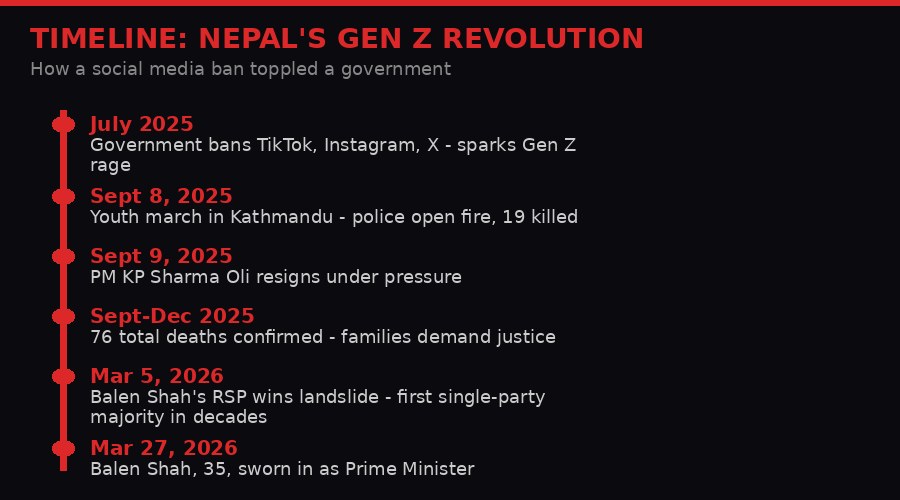
To understand why Oli's arrest feels like a reckoning, you have to go back to July 2025, when his government made a catastrophic miscalculation. Citing concerns about social media's influence on politics, Oli's administration banned TikTok, Instagram, and X. The move was framed as protecting democracy. The country's youth saw it differently.
Nepal has one of South Asia's most connected Gen Z populations proportionally. Social media was not just entertainment - it was identity, income, and community for millions of young Nepalis living in a country with 46% youth unemployment. The ban landed like a match on petrol.
Within weeks, protests began. Students who had never attended a political rally in their lives were occupying streets. The movement borrowed aesthetics from South Korea's 2024 protests and Bangladesh's 2024 revolution - mobile phones as weapons, TikToks as pamphlets, Instagram stories as organizing tools. Young Nepalis were not asking to renegotiate their future. They were refusing to accept the terms of the old deal entirely.
Corruption. Nepotism. A political class that had been rotating the prime ministership for three decades without solving a single structural problem. Nepal has had more than 20 governments since 1990. No party had ever won a single-party majority under the current proportional electoral system. It was designed - critics argued deliberately - to guarantee perpetual coalition horse-trading and the enrichment of those who ran the parties.
"We did not protest for a new face on the same old system. We protested because we refuse to inherit a broken country." - Unnamed protest organizer, quoted by AFP, September 2025
The Crackdown: September 8, 2025
The protests reached a boiling point on September 8, 2025. Tens of thousands marched in Kathmandu. Police were deployed in force. The command that came down - disputed by Oli ever since, but confirmed by the parliamentary commission - authorized lethal force against crowds that included teenagers in school uniforms.
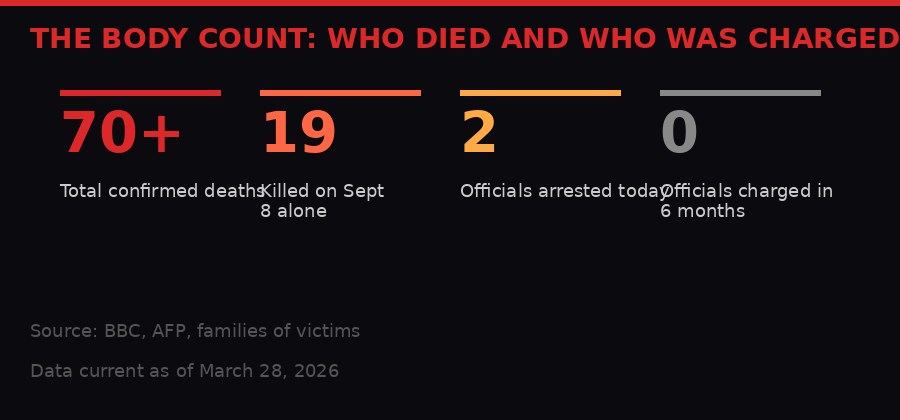
Nineteen people were killed on September 8 alone. Video footage spread immediately across the very platforms Oli had tried to ban. The images - riot police advancing on young people, bodies in streets the protesters had flooded, a student in a school uniform bleeding on the pavement - became the defining images of the uprising.
The broader toll, counted over the weeks of unrest that followed, reached more than 70 dead. Hundreds more were injured. Parliament buildings and police stations were set on fire. Oli resigned on September 9 - the morning after the worst violence - and the country entered an extended period of caretaker governance while new elections were organized.
The families of the 76 confirmed dead have been calling for arrests and prosecutions for six months. They did not receive them until this morning.
The parliamentary commission, appointed to investigate, recommended prosecuting Oli, former Home Minister Lekhak, and former police chief Chandra Kuber Khapung for criminal negligence in the deaths. Oli called the commission's findings "character assassination and hate politics." His lawyers said today's arrest was "illegal and improper" since there was no risk of him fleeing.
"It is illegal and improper because there is no risk of him fleeing or avoiding questioning." - Lawyer for KP Sharma Oli, speaking to Reuters, March 28, 2026
The Man Being Arrested: Who Is KP Sharma Oli?
KP Sharma Oli is not a simple villain. He is one of Nepal's most complex - and consequential - political figures of the last three decades, which makes this morning's arrest all the more striking.
Oli spent 14 years in prison during the Panchayat era, jailed for his communist political activities. He emerged from imprisonment with revolutionary credentials that defined his identity within Nepal's communist movement. He rose through the CPN-UML, a left-wing party that eventually moderated into a conventional governing force, losing most of its ideological edge as it gained institutional power.
He served multiple terms as Prime Minister. He earned a reputation as a nationalist who was willing to pick fights with India, China, and the West simultaneously - a posture that made him genuinely popular with sections of the Nepali public who resented the country's landlocked dependence on its giant neighbors. His 2020 constitutional amendment controversially redrew Nepal's map to include Indian-administered territory - a populist gambit that briefly spiked his approval ratings even as it complicated Nepal's foreign relations.
At 74, Oli is also a man with significant health challenges. He has had two kidney transplants. His lawyers made his medical history a central argument for why he should not be detained today. Police transported him to hospital upon arrest, standard procedure under Nepalese law for detainees of his age and condition.
He is not in a cell. He is not charged. But he is in custody, and Nepal's new government - led by a man four decades his junior - has made clear that accountability for September's dead is not negotiable.
Balen Shah: The Rapper Who Built a Movement and Then Won Power
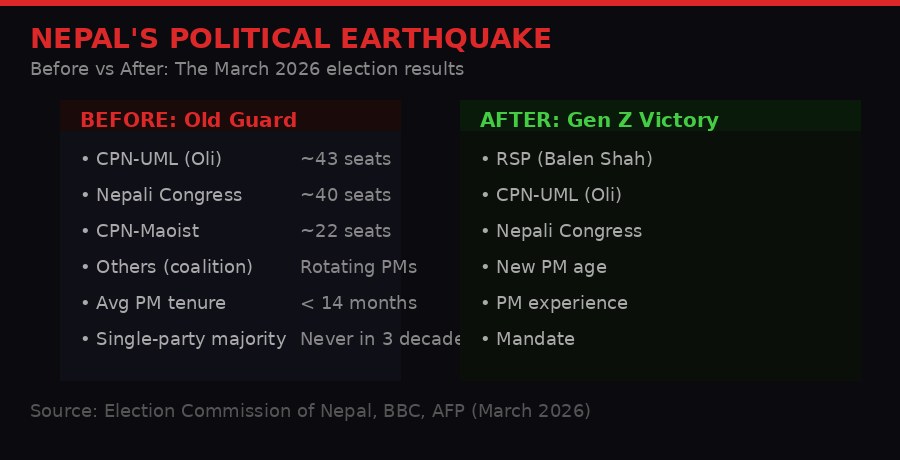
The contrast could not be starker. On Friday evening, Balen Shah - a 35-year-old rapper from Kathmandu who previously served as the city's mayor - was sworn in as Nepal's prime minister. His party, the Rastriya Swatantra Party (RSP), won 158 parliamentary seats in the March 5 election - the first single-party majority in Nepal in more than three decades.
Shah's path to power is genuinely unusual. He is not from a political dynasty. He does not have traditional party machinery behind him. He built his political identity through his work as Kathmandu's mayor - breaking up cartels that controlled construction contracts, demolishing illegal structures built by connected businessmen, and publicly posting documentation of corruption to social media in real time. He became the mayor who actually did what mayors were supposed to do, and in Nepal, that was extraordinary enough to make him a national phenomenon.
The RSP was founded in 2022 to provide an alternative to the three-party system that had dominated Nepalese politics since democratization. Shah channeled the rage of the September protests into a platform that was direct, anti-corruption, and generationally distinct. He was not running against a policy position. He was running against the entire system that September's protests had rejected.
His victory was historic by every metric. 158 seats. Single-party majority. First-time such a result had been achieved under the current electoral system. Traditional parties - the Nepali Congress, the CPN-UML, the Maoists - had all bet that coalition math would keep them relevant. The voters made a different calculation.
"No one is above the law. This is not revenge against anyone - just the beginning of justice." - Sudan Gurung, Nepal's new Home Minister, on Instagram after Oli's arrest, March 28, 2026
The Legal Case: What the Commission Found
The investigation commission appointed after the uprising published its findings in December 2025. The report was methodical and damning. It documented the chain of command that authorized the crackdown on September 8 - from the cabinet-level decision to deploy police in force, to the specific orders given to units in Kathmandu, to the individual incidents in which live ammunition was used against crowds that included unarmed civilians.
The commission's recommendations were clear: Oli, Lekhak, and former police chief Khapung should face criminal prosecution for negligent homicide. The commission did not find evidence of a direct order to kill protesters - it found something arguably worse: a culture of impunity in which the consequences of deploying lethal force against political gatherings were never seriously considered, and a failure of leadership that allowed lethal escalation to proceed without intervention.
Oli rejected the findings entirely. His party has argued consistently that the commission was partisan, that its recommendations were politically motivated, and that the real target was eliminating the CPN-UML as an electoral competitor. Those arguments convinced nobody outside Oli's base - and after the RSP's March 5 landslide, even that base shrank dramatically.
The new Home Minister, Sudan Gurung, was himself a key figure in the September protests. He was among the youth organizers who mobilized the marches. His appointment as Nepal's top domestic security official - the post that Lekhak held when the crackdown was ordered - has a pointed, deliberate quality to it. The new government did not just win an election. It reshuffled the country's power structure at its roots.
Families of the 76 dead have filed a civil complaint alongside the commission's criminal referral. Lawyers for the families told AFP this week that they expected arrests to follow swiftly once Balen Shah was sworn in. They were right by a matter of hours.
Protests Erupt: Oli's Supporters Take to the Streets
The arrests have not gone uncontested. Within hours of news breaking, CPN-UML supporters began gathering at their party headquarters in Kathmandu. The party's secretariat announced it would launch nationwide demonstrations to protest what it called the unlawful detention of its leader. Flags appeared in the streets. Chants outside the party office grew louder through the morning.
Nepal's military and police are watching carefully. The country is not a stable democracy in the conventional sense - it has experienced coups, counter-coups, civil war, and a Maoist insurgency within the last 30 years. The military's loyalty to civilian authority has been tested before. There is no suggestion at present that the security forces will move against the new government, but the political temperature is rising.
CPN-UML lawmakers issued a statement calling on all party members across Nepal's 77 districts to "defend the rights of a wrongfully detained leader." Oli's son and other family members appeared at the hospital where he was taken after arrest, confirming his detention and providing the first official confirmation of his medical status post-arrest.
On the other side, the families of September's dead gathered outside the Supreme Court in Kathmandu, not to protest but to celebrate. Women who have spent six months holding photographs of their sons and daughters at vigils were, for the first time, allowing themselves to believe that accountability might actually come. One mother, whose 19-year-old son was killed on September 8, told AFP reporters: "We waited for this. We knew justice would come if we did not give up."
The contrast in the streets captures exactly where Nepal stands: one country, two visions of what justice looks like, and an election result that has forced the confrontation neither side could avoid.
What Happens Next: The Legal and Political Road Ahead

Oli and Lekhak have not been charged as of Saturday evening. Under Nepalese law, the government has 24 to 48 hours to either charge them formally or release them. Given the scale of the commission's report and the political will of the new government, formal charges appear likely within days.
The charges, if they follow the commission's recommendations, will be criminal negligence - not murder. This matters enormously for the legal proceedings ahead. Negligent homicide carries a substantially lighter maximum sentence than murder, and Oli's lawyers will argue - with some legal basis - that the commission's evidence of direct command responsibility is circumstantial rather than direct. Nepal's courts will need to make these determinations without precedent. No serving prime minister has ever faced criminal charges in Nepal's democratic history.
The CPN-UML has already announced it will seek immediate judicial review of the arrests. They will argue procedural violations - that the commission's recommendations did not constitute sufficient grounds for arrest without a formal prosecutorial filing first. These arguments may have merit on narrow procedural grounds. Nepal's constitution was written to protect political opposition from weaponized prosecution, and those protections apply to Oli as much as to anyone.
The international community is watching. India, Nepal's most important neighbor and economic patron, has been conspicuously silent since the election. China, which has cultivated Oli as a friendly voice and signed infrastructure deals with his governments, will be recalibrating its Nepal strategy rapidly. The European Union and United States, which funded electoral observer missions for the March 5 vote, have issued statements supporting the democratic transition without commenting on the arrests specifically.
Balen Shah's government faces an immediate challenge: prove that accountability is the goal, not political score-settling. The line between justice for September's dead and the use of prosecutorial power to eliminate rivals is one Nepal's new government must walk carefully. International observers will be scrutinizing whether the process adheres to Nepal's legal norms or becomes a tool of partisan elimination.
Since democratization in 1990, Nepal has had more than 20 governments. The average prime ministerial tenure is under 14 months. Three civil conflicts, including a decade-long Maoist insurgency that ended in 2006, have marked the transition period. Nepal's current constitution - adopted in 2015 - created a federal structure and proportional electoral system that critics argue was designed to prevent any single party from achieving governing stability, thus guaranteeing coalition dependency. Balen Shah's single-party majority, the first under this system, has upended that assumption entirely. The question is whether the institutions are strong enough to handle the accountability test now before them.
A Template for South Asia - or a Warning?
Nepal's Gen Z uprising and its electoral aftermath have been watched with intense interest across South Asia. Bangladesh's 2024 revolution - in which student-led protests forced out Prime Minister Sheikh Hasina - provided one template. Nepal has now produced another: not just protest-driven removal of a government, but an electoral follow-through that installed the protest generation's own leadership.
In Pakistan, Sri Lanka, and Bangladesh, young people facing identical structural conditions - high youth unemployment, entrenched political dynasties, corruption baked into institutional architecture - have been asking whether Nepal's model is replicable. The answer depends heavily on what happens next. If Balen Shah's government delivers meaningful prosecutions without descending into politically-driven persecution, it becomes a model. If the process becomes a show trial or a tool of revenge, it becomes a cautionary tale instead.
South Asian democracies have a mixed record on accountability for political violence. India's investigation into the 2002 Gujarat riots took over a decade and resulted in limited convictions. Sri Lanka's accountability process for the Tamil conflict has barely begun. Bangladesh's Hasina government, before its own fall, prosecuted its 2024 protesters rather than the officials who ordered crackdowns on earlier ones. Nepal is attempting something few South Asian democracies have managed: genuine accountability for state violence by a successor government, within months of assuming power.
The speed of it - arrests within hours of the new PM's swearing-in - signals intent more than strategy. It also carries risks. Moving this fast before formal charges are filed leaves the process exposed to legal challenge. Nepal's courts may slow this down considerably. The families of the dead may find that justice, even when finally moving in the right direction, still moves slowly.
The Poets and the Politicians
In Nepal, Balen Shah's background as a rapper is not a footnote. It is load-bearing.
Shah's political career began with his music, which addressed corruption, poverty, and the failures of Nepal's political class directly and in Nepali vernacular. He was not the first South Asian politician to emerge from cultural rather than party-political life - India's film industry has produced multiple chief ministers, Bangladesh's protest movement had student intellectuals at its center - but he is arguably the most successfully translated from cultural credibility to institutional power.
What his background gave him was a language that the protest generation recognized. When September's protests erupted, Shah was already serving as Kathmandu's mayor and had established a record of actual delivery - not promises, but documented outcomes. Illegal constructions demolished. Contracts made public. Ward offices cleaned up. In a political environment where words mean nothing because politicians have spent decades saying everything and doing nothing, Shah had demonstrated, at a scale that voters could verify, that he did what he said.
His inauguration as Prime Minister, with 35-year-old advisors and cabinet ministers in their 30s and 40s, represents a generational break unprecedented in Nepalese politics. The question his critics - and some of his supporters - are asking is whether cultural credibility and mayoral competence translate to national governance. Nepal's federal structure is complex. Its foreign policy challenges - balancing India and China, managing an economy heavily dependent on remittances from migrant workers in the Gulf - require diplomatic sophistication that running city hall doesn't necessarily provide.
Shah's supporters argue he has already demonstrated the ability to build institutions and hold officials accountable. His critics argue the scale is simply incomparable. Both may be right. The test is now beginning, and it is beginning with an arrest that has already polarized the country before the new government has been in office for 48 hours.

The Human Cost That Drove This Moment
Behind the political architecture - the arrests, the legal arguments, the party statements - are 76 families who have been waiting for this since September.
The BBC found some of them outside the Supreme Court on Saturday morning. One mother, carrying a laminated photograph of her son - 19 years old, in a school uniform, the same photograph she has carried to every vigil and demonstration since his death - said she had not slept since she heard news of Oli's arrest. "I thought it would take years," she said. "I thought they would protect each other forever."
Among the dead: a 16-year-old girl who had gone to photograph the protests for her school newspaper. A 22-year-old engineering student who had never been to a political rally before September. A 40-year-old civil servant who was caught in the street during his lunch break when police opened fire. The range of victims - in age, background, and political involvement - underscores how broadly the crackdown landed.
The September 8 footage, still circulating on social media despite subsequent government attempts to suppress some versions of it, shows police firing into crowds that included people who were simply present in public spaces. The commission's report identified at least 11 cases in which individuals who were running away from confrontations were shot in the back.
These are the facts at the center of what is now a criminal proceeding. And while the legal process may take years - Oli's lawyers will fight every procedural step - the families say that the arrest itself is already something. "It means we were not wrong to keep pushing," the mother outside the Supreme Court said. "It means they cannot just kill our children and walk away."
What This Means
Nepal's story today does not fit neatly into the international news cycle dominated by Iran, Ukraine, and the US government shutdown. It is quieter, more local, and in some ways more significant for what it represents.
A generation that was given a broken political system chose to reject it, built its own political movement, translated protest into electoral power, and is now - within hours of taking office - attempting to deliver the accountability that had been deferred for six months. That is not a revolutionary seizure of power. It is democracy working in a direction it rarely does: from the street to the ballot box to the courtroom, in sequence, and at speed.
Whether it holds depends on Nepal's institutions. Whether those institutions are strong enough is, genuinely, an open question. But the morning of March 28, 2026 represents something that has happened rarely enough to be remarkable: a government that inherited power from the people who died demanding it, moving immediately to honor that debt.
The cells are not yet filled. The charges are not yet filed. KP Sharma Oli is in a hospital bed, not a prison cell. But the arrest has happened. The families are at the court. The new Prime Minister is in his office. And for the first time since September, Nepal's politics is moving in a direction that the dead would have recognized.
Sources: BBC News, AFP, Agence France-Presse, AP News, Kathmandu Valley Police statement, Nepal Attorney General's office statements, Bangladesh and Nepal parliamentary commission reports, Committee to Protect Journalists, UNHCR. All reporting current as of Saturday, March 28, 2026.
Get BLACKWIRE reports first.
Breaking news, investigations, and analysis - straight to your phone.
Join @blackwirenews on Telegram