
Two stories. Two continents. One week. In Nigeria, videos of young men attacking women at a fertility festival lit social media on fire and forced a government response within 48 hours. In California, an 84-year-old former waitress named Donna Motsinger sat in a Santa Monica courtroom and heard a jury award her $19.25 million for something that happened to her when she was 30. The two cases share nothing except the question that always gets asked first, and asked too loudly: did this really happen?
The Alue-Do festival in Ozoro is a fertility rite tied to the Isoko people of Delta State, southern Nigeria. It is supposed to celebrate life - abundance, community, the rhythms of the harvest. What the videos showed last week was something different.
Clips circulating on Nigerian social media showed groups of young men chasing women through public spaces, stripping them, grabbing them, and groping them. In several videos, bystanders are visible - some filming, some watching. None intervening. According to BBC Pidgin reporters Karina Igonikon and Chris Ewokor, the women targeted appeared to be those who were alone or separated from groups.
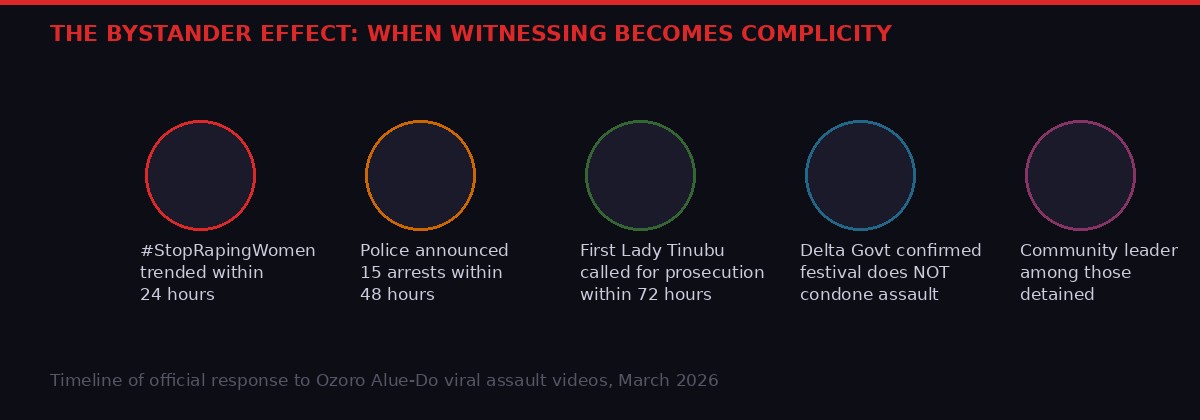
The videos did not require interpretation. They showed what they showed. Within hours, the hashtag #StopRapingWomen was trending across Nigeria. Women's rights organizations demanded arrests. The Delta State Criminal Investigation Department began reviewing the footage to identify suspects. By the time police spokesman Edafe briefed Channels Television, 15 people were in custody - including a community leader widely named as the event organizer.
"The scenes are alarming, disgusting and embarrassing." - Delta State Police Spokesman Edafe, speaking to Channels Television, March 2026
That acknowledgment matters. Nigerian police forces are not known for reflexive sympathy toward GBV complaints. The speed of these arrests - driven directly by the viral visibility of the footage - signals something: when the evidence is incontrovertible and the public pressure is immediate, institutions can move. The question advocates are asking is why that pressure should be necessary at all.
The community's official response moved quickly to limit the damage. The King of Ozoro issued a statement saying the Alue-Do festival is a fertility rite that was "misinterpreted and abused by some youths." The Delta State government confirmed that no officially recognized festival in the state condones sexual violence. Nigeria's First Lady Oluremi Tinubu - who has roots in Delta State - released a signed statement calling the assaults unacceptable and urging prosecutors to pursue every case.
The language was carefully chosen. The violence was real. But the tradition was not the violence. The violence was individuals using a tradition as cover - and that distinction, however important legally, does not change what happened to the women in those videos.
Delta State police spokesman Edafe made a point of telling reporters that police had spoken to four women and "all of them said nobody raped them." The statement was immediately seized on by those seeking to minimize what happened.
Rights organizations pushed back fast and pushed back hard. The documented acts - public stripping, forced grabbing, physical humiliation - constitute gender-based violence under Nigerian law regardless of whether penetrative rape occurred. Nigeria's Violence Against Persons (Prohibition) Act, passed in 2015 and adopted in Delta State, criminalizes sexual harassment, assault, and dehumanizing acts against women. It does not require rape as a threshold for prosecution.
There is also the question of what it means to "speak to four women" hours after a violent public incident in a community where the alleged perpetrators and their families live. Trauma responses vary. Social pressure to minimize is real. Shame operates in these situations in ways that formal police questioning cannot fully account for in a 24-hour window.
"Even if it is not clear whether anyone was raped, the documented acts constitute serious gender-based violence under Nigerian law," Nigerian women's rights groups told media in the immediate aftermath. This is not a semantic argument. It is the difference between a system that asks "how bad was it?" and one that asks "was it wrong?"
"No culture justifies violating women and girls. I urge victims to seek medical and psychological support, and I call on security agencies to prosecute all offenders." - Nigeria's First Lady Oluremi Tinubu, signed statement, March 2026
Witnesses and residents told journalists that women had been warned in advance not to go out during certain parts of the festival. That warning - however well-intentioned - places the burden of safety on potential victims rather than on would-be perpetrators. It normalizes risk for women as a feature of public space. Some activists pointed to this as evidence that what happened in Ozoro was not spontaneous but anticipated, and that the community structure had absorbed it as routine.
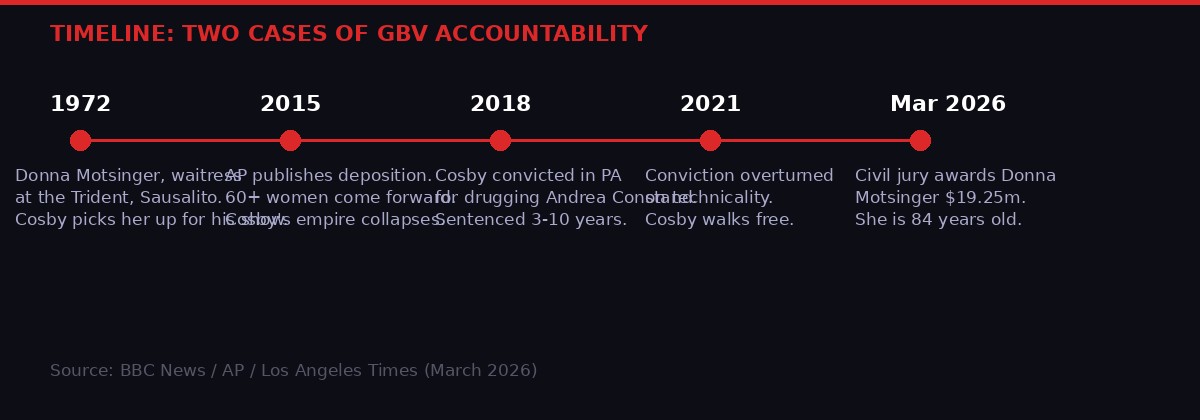
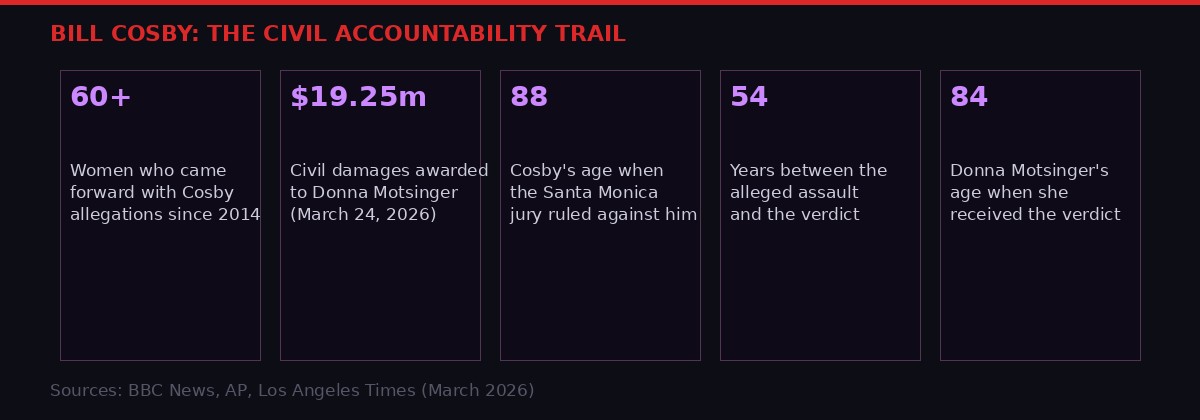
The distance between 1972 and 2026 is 54 years. Donna Motsinger was 30 when Bill Cosby allegedly picked her up in a limousine to take her to one of his stand-up comedy shows. She was 84 when a California jury awarded her $19.25 million and told her - in the language the legal system has - that they believed her.
Motsinger worked as a waitress at the Trident, a restaurant in Sausalito near San Francisco that attracted celebrities in the early 1970s. Cosby was a regular. He invited her to his show. He picked her up personally. He gave her something she thought was aspirin. According to her lawsuit, the next thing she recalls are flashes of light. She woke up at home, naked except for her underwear. She knew, according to the court filing, "she had been drugged and raped by Bill Cosby."
Cosby's lawyers rejected the allegation, arguing in court filings that Motsinger "freely admits she has no idea what happened." That defense strategy - turning the absence of consciousness into a credibility problem - is one that GBV advocates have documented as a recurring feature of assault cases involving drugs or alcohol. The victim cannot remember, therefore the victim cannot be believed. The jury in Santa Monica rejected it.
Cosby, now 88, has denied Motsinger's allegations. He has denied all the allegations - more than 60 women have come forward with accounts of rape, drugging, or sexual misconduct spanning from the 1960s onward. He was convicted in Pennsylvania in 2018 for the assault of Andrea Constand, sentenced to 3-10 years in prison, and released in 2021 when his conviction was overturned on a technicality involving a prior immunity agreement. He has not served prison time for any other case. Civil courts operate under different rules.
The Motsinger verdict is a civil one, not a criminal one. No one goes to prison. Cosby's lawyer has already said he will appeal. The award may be reduced. It may never be collected. What the verdict represents is something more procedural but not therefore less meaningful: a fact-finder, operating within the rules of evidence, listened to Donna Motsinger's account and said, in the legal equivalent of a public record, that it happened.
Civil courts have long been the mechanism by which survivors of sexual violence - particularly older cases predating modern forensic standards - have sought any form of official acknowledgment. They require a lower standard of proof than criminal courts (preponderance of evidence rather than beyond reasonable doubt) and can proceed even when criminal statutes of limitation have expired. California's AB 2777, the Sexual Abuse and Cover Up Accountability Act, opened a window in 2023 allowing survivors of childhood sexual abuse to file civil suits regardless of when the abuse occurred. Motsinger's case is not a childhood case, but it reflects the same legislative shift: a recognition that formal legal accountability for sexual violence has historically lagged behind both the harm and the evidence.
The punitive damages phase was still ongoing at time of publication. If the jury decides additional punitive damages are warranted, the total could rise significantly. Cosby's lawyers have indicated they will challenge the verdict on appeal.
"Next thing she knew, she was going in and out of consciousness. The last thing Ms Motsinger recalls were flashes of light." - Court filing describing Donna Motsinger's account, as reported by the Los Angeles Times (BBC News, March 2026)
Cosby's attorney Jennifer Bonjean told US media her client would appeal the verdict. Bonjean has been an effective appellate lawyer - she successfully overturned Cosby's Pennsylvania criminal conviction. But appellate courts do not typically re-examine factual findings, only legal process. The jury's factual conclusion stands unless a procedural error is found.
The two cases collided in public consciousness this week because they share a structural feature: the invocation of something other than accountability as a first response.
In Ozoro, that something was tradition. The festival is a fertility rite. The community leader said the violence was not sanctioned by custom. The king said it was misinterpretation. The state government confirmed no official festival permits assault. All of that may be true. But the effect of leading with tradition, rather than with the victims, is to create a frame in which the cultural institution must be protected first and the harmed women must wait.
In the Cosby case, the equivalent framing has been reputation. He was America's Dad. The Cosby Show was a cultural institution. His philanthropy was real. These things were used - for years, explicitly - to create a credibility asymmetry between Cosby and dozens of women who came forward at significant personal and professional cost. The AP's publication of a 2005 deposition in 2015 broke the dam not because the information was new, but because the accumulated weight of consistent accounts had finally become impossible to explain away.
What changed in both cases was visibility. The Ozoro videos removed the word of women against the word of community. The deposition removed the curated public image and replaced it with Cosby's own admissions about obtaining quaaludes. Viral distribution is not a justice system. But it has repeatedly functioned as the catalyst that forces justice systems to act when they otherwise would not.
"Women were warned not to go out during parts of the festival. Those seen outside were deliberately targeted."
Donna Motsinger was 30 in 1972. She is 84 now. The gap between assault and verdict is 54 years. That number sits uncomfortably with anyone who wants to believe accountability is timely.
Multiple factors create that gap. Legal statutes of limitation have historically been short for civil cases and shorter still for cases involving assault between adults. Social stigma around coming forward - particularly when the accused is powerful, beloved, or wealthy - operates as a practical deterrent. The evidentiary standards for sexual assault cases have long disfavored survivors, particularly in cases where the assault involved incapacitation, occurred without witnesses, and left no physical trace. And the accused have resources to litigate indefinitely.
The women who eventually brought Cosby to civil and criminal accountability did so against all of these headwinds. They were not believed when they first came forward. Several told interviewers they were advised not to report. Others did report and saw nothing happen. The turning point was not a new piece of evidence but a critical mass of consistent accounts that became, collectively, impossible to dismiss.
In Nigeria, the speed of the Ozoro response illustrates what happens when that critical mass is already visible. The videos existed. The evidence was not someone's word against someone else's word. It was timestamped footage, distributed across millions of phones, undeniable. The 15 arrests happened in 48 hours. Whether convictions follow - whether the legal process delivers accountability proportional to the documented harm - remains to be seen. But the initial response was faster than almost any comparable GBV case in Nigeria's recent history.
The Ozoro incident is not an anomaly. It is a visible instance of a systemic problem with deep structural roots in Nigeria's legal and cultural landscape.
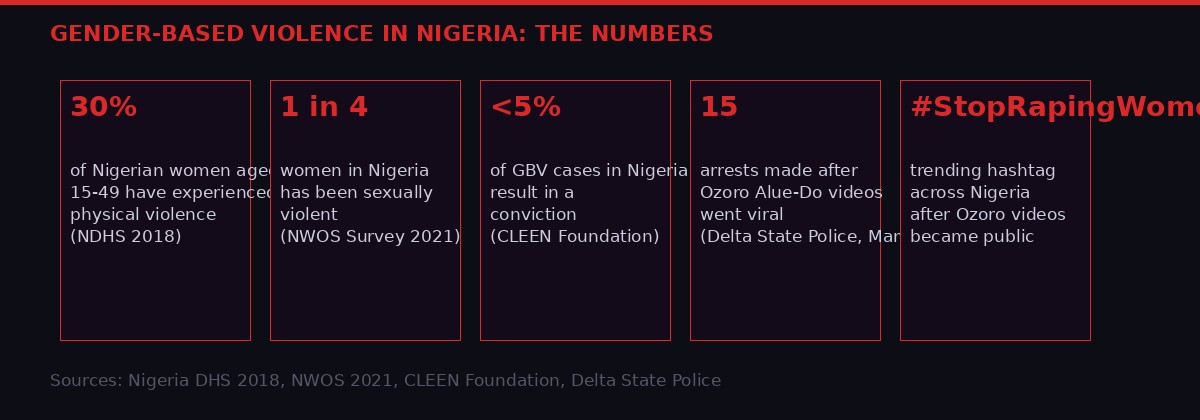
The Nigerian Demographic and Health Survey (NDHS) from 2018, the most recent comprehensive study, found that 30% of Nigerian women aged 15-49 had experienced physical violence. The National Women Opinion Survey found that approximately one in four Nigerian women had experienced sexual violence. The CLEEN Foundation, a Nigerian NGO focused on justice sector reform, has documented conviction rates below 5% for reported GBV cases across the country.
Those numbers reflect a system in which reporting is deterred by stigma, prosecutions are resource-limited, and convictions are rare enough that many survivors do not see formal justice as a realistic outcome. The Violence Against Persons (Prohibition) Act, passed by the National Assembly in 2015 and adopted by several state governments, represented significant legislative progress - it criminalized marital rape for the first time, expanded the definition of sexual violence, and provided for restraining orders and victim protection measures. But legislation and enforcement are not the same thing.
Women's rights organizations in Nigeria - including Spaces for Change, Women's Rights Advancement and Protection Alternative, and the Gender Mobile Initiative - have documented the gap between law on paper and accountability in practice. The Ozoro case, because of its visibility, may become a reference point. If the 15 arrested suspects are tried and convicted, it will demonstrate that the system can deliver. If charges are quietly reduced, dropped, or delayed, it will demonstrate something else.
The Cosby verdict and the Ozoro arrests happened in the same week. That is coincidence. But the questions they raise are not separate questions.
Both cases raise the issue of how long accountability takes when the accused has social standing, community backing, or institutional protection. Both cases show that visibility - whether viral video footage or a published legal deposition - can override the credibility asymmetries that normally operate against survivors. Both cases ended with at least partial official acknowledgment that the documented harm was real.
But partial acknowledgment is not justice. Donna Motsinger's $19.25 million, assuming the verdict survives appeal and is ever collected, does not restore what was taken from her at 30. The 15 arrests in Ozoro do not undo what the women in those videos experienced in public, on camera, while bystanders filmed. The system, when it works, delivers acknowledgment - sometimes decades later, sometimes after pressure that ordinary survivors cannot generate.
The women who were not filmed. The women who did not have an attorney willing to pursue a 54-year-old case. The women for whom there was no viral moment, no celebrity defendant, no critical mass that finally forced official action. They are the majority of GBV survivors in every country. They are the people the system was designed, in theory, to serve first.
This week offered two data points showing that accountability, at extraordinary cost and under extraordinary conditions, is possible. It has not shown that the system reliably delivers it for everyone. That gap - between the extraordinary case and the ordinary one - is where most of the work remains.
"No culture justifies violating women and girls." - Nigeria's First Lady Oluremi Tinubu, signed statement, March 24, 2026
In Santa Monica, the jury was still deliberating over punitive damages at the time of publication. Cosby's lawyer Jennifer Bonjean has confirmed an appeal is planned. The appellate process could take years. Even if the verdict stands, collection of damages from an 88-year-old man involves complications that civil attorneys understand well. What Donna Motsinger has, definitively and on the public record, is a jury's verdict.
In Ozoro, Delta State, the Criminal Investigation Department is processing 15 arrests. Among those detained is a community leader identified as an organizer of the event. The King of Ozoro and the state government have both condemned the violence publicly. Nigeria's First Lady has urged prosecution. The question now is whether prosecutorial machinery, historically slow and under-resourced in Nigeria's GBV cases, will convert arrests into charges and charges into convictions.
Women's rights activists in both countries are watching. They have watched before. They know that the first 72 hours after a viral event generate responses that subsequent months can quietly reverse. They are not naive about the distance between public condemnation and structural change.
What they have is what they had before the videos, before the verdict, before any of this week's noise: each other, the documentation of what happens, and the refusal to accept a world in which this is ordinary. The footage from Ozoro will be used as evidence. Donna Motsinger's verdict will be cited in future civil cases. These things accumulate.
The question this week forced into open air is not whether violence against women exists. That has never been in serious dispute among people who have looked. The question is how long institutions wait before responding - and what it takes to make them move. The answer, across both cases, is the same: visibility. The harder work is building systems that do not require it.
Get BLACKWIRE reports first.
Breaking news, investigations, and analysis - straight to your phone.
Join @blackwirenews on Telegram