#StopRapingWomen: Nigeria's Ozoro Festival, the Viral Videos, and a Nation Demanding Answers
Women were chased, stripped, and publicly humiliated in broad daylight in Ozoro, Nigeria. Someone filmed it. The videos went viral. Within 72 hours, a country erupted - and now 15 men are in custody, government ministers are issuing orders, and women's groups are demanding a reckoning that goes far beyond one festival.
BLACKWIRE / Generated graphic depicting the Ozoro incident context. March 2026.
On Thursday, March 19, 2026, a woman in Ozoro - a city in Isoko North Local Government Area of Delta State in southern Nigeria - walked outside. That decision, in the wrong quarter at the wrong time, put her in front of a mob of men.
Video footage that circulated widely on X (formerly Twitter) shows what happened next: groups of young men running through the streets, chasing lone women, grabbing them, tearing at their clothing. The clips showed forced stripping in public spaces. Some bystanders filmed. Few intervened.
The hashtag #StopRapingWomen began trending across Nigeria before nightfall. By Friday, the federal government had weighed in. By Saturday, a community leader had been arrested. By Sunday, the total arrest count stood at 15. The story had gone international - BBC News, Premium Times, and news outlets across the continent covering what has become one of the most charged gender-based violence stories in Nigeria in years.
But to understand why this erupted the way it did - and what it means - you have to understand the Alue-Do festival. And to understand that, you have to sit with a question Nigeria has long struggled to answer: when does tradition become a shield for violence?
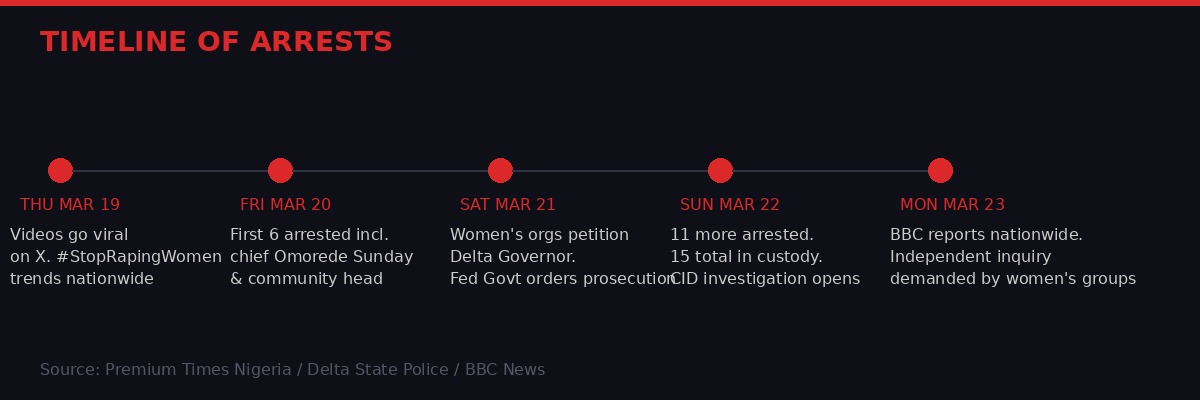
Timeline: from viral video to 15 arrests in 96 hours. BLACKWIRE infographic.
The Alue-Do Festival: What it is, and What it Became
The Alue-Do festival is a traditional ceremony in the Ozoro Kingdom, tied to a local deity and described by community leaders as a fertility rite. Multiple sources, including X users in the Ozoro community who spoke to Premium Times, describe it as a seven-day event with ancient roots. The King of Ozoro, in a statement after the videos went viral, called it a "fertility rite" that had been "misinterpreted and abused by some youths."
But other accounts - from witnesses, longtime residents, and women's rights activists who spoke to Nigerian media - paint a grimmer picture. They say the festival has a specific component where women are warned to stay indoors. Those who venture outside during certain hours are - by informal community understanding - considered "fair game."
"Apparently, this is a tradition that has been going on for decades, and it's a feast of a particular deity which lasts for seven days. In these seven days, women are not supposed to be outside, and if found, men have free rein to molest and sexually assault them." - X user Veronica Park (@Tegsmamaa), citing multiple community sources, March 19, 2026
The community organiser of the event - a local chief named Omorede Sunday - was among the first six people arrested, according to Delta State Police spokesperson Bright Edafe. The community head was also detained. Their arrest signals that authorities are not treating this as the spontaneous misconduct of "some youths." Someone organised it. Someone ran it.
Traditional leaders have pushed back hard on the framing. The King of Ozoro denied that the festival condones assault. The Delta State government, through Information Commissioner Charles Aniagwu, said "no recognised festival in the state permits sexual assault" and called the conduct "barbaric." But activists say the key question isn't whether the festival officially sanctions violence - it's whether the community structure enables and protects it.
For women's rights groups, the police response to witnesses is itself revealing. Police spokesperson Edafe told Channels Television: "We have spoken to four girls and all of them said nobody raped them." That statement - offered as evidence of limited harm - drew immediate pushback from legal experts and rights advocates, who noted that the documented acts of forced stripping, public grabbing, and humiliation constitute serious gender-based violence under Nigerian law, regardless of whether full rape occurred.
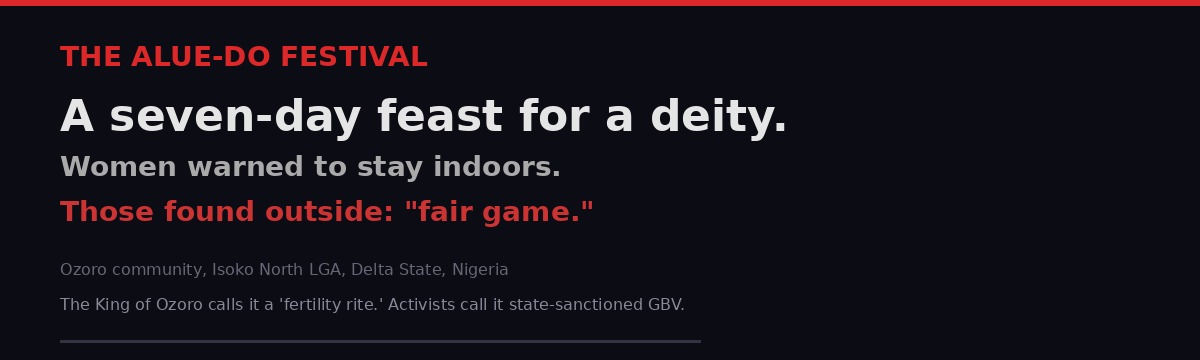
The festival's informal rules: women stay indoors. Those who don't, risk assault. BLACKWIRE graphic.
The Videos: How a Local Crime Became a National Reckoning
The footage did what footage does in 2026: it stripped away deniability. An X user posting under the handle @Teeniiola shared one of the first widely circulated clips on March 19. The video showed a crowd of men chasing a young woman in Oramudu Quarters, Ozoro. Her clothing had already been torn. Other men filmed on their phones.
More videos followed. The clips showed it wasn't an isolated incident. It was systematic - multiple women, multiple locations, over the course of the day. The hashtag #StopRapingWomen began accumulating posts not just from Nigerians outraged by Ozoro, but from people across the continent sharing their own experiences and demanding accountability.
Nigerian pastor Fisayo Adeniyi posted on X: "What kind of evil in the name of festival is this?" He called on police to arrest not just community leaders but every person whose face could be identified in the clips. The post was shared thousands of times.
What made this moment different from previous viral GBV incidents in Nigeria - and there have been many - is the combination of factors. The videos were clear. The location was identified. The perpetrators were often visible. And critically, the incident occurred within an identifiable traditional structure with named organisers. That gave activists and investigators something concrete to go after.
By Friday morning, the Commissioner of Police for Delta State, CP Aina Adeshina, had directed a Special Assignment Team to open a formal investigation. By Friday evening, six people were in custody. The message from the state was clear - at least in terms of speed.
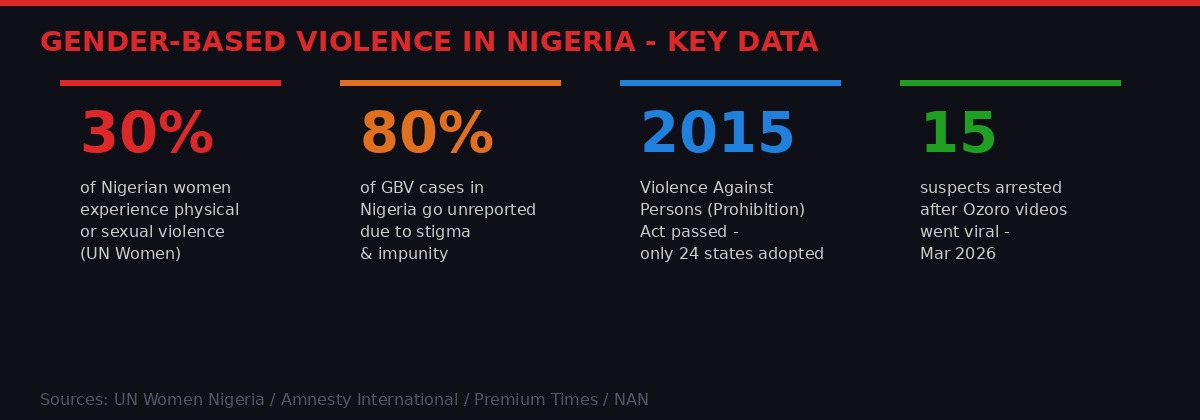
The Ozoro incident exists within a broader crisis. GBV in Nigeria: key data. BLACKWIRE infographic. Sources: UN Women, Amnesty International, NAN.
The Women Targeted: Lives Behind the Statistics
Police have been careful to avoid confirming the worst. Their statement that "no complaints of rape were made" has been presented as exculpatory. But the experiences of women in Ozoro on March 19 - and in prior years, if accounts are accurate - are not captured by criminal complaint statistics.
Women's rights groups who spoke to Premium Times noted that in communities where gender-based violence has been normalised or tied to tradition, the barriers to making formal complaints are enormous. Stigma, fear of community retaliation, distrust of police, and uncertainty about being believed all suppress reporting. The Violence Against Persons (Prohibition) Act 2015 - Nigeria's landmark GBV legislation - criminalises not just rape but also "forceful stripping," "public humiliation," and "psychological violence." Under VAPP, what happened in Ozoro is already criminal. The question of whether full rape occurred is separate from the question of whether serious crimes were committed.
The Nigeria Federation of Business and Professional Women (BPW-Nigeria), in their petition to Delta Governor Sheriff Oborevwori, put it bluntly:
"What happened to women at a recent festival in Delta State was not a cultural practice; it was a crime. No society should condone practices that degrade human dignity. This is bigger than one festival. It is about whether Nigerian women can move freely, participate in public life, and trust that the law will protect them." - BPW-Nigeria open petition to Governor Sheriff Oborevwori, dated March 21, 2026, signed by National President Ojobo Atuluku
Behind the hashtag and the statistics are real women who live in Ozoro - who have to return to those streets, those neighbourhoods, those community structures. Some of them may have been assaulted. Some of them may have stayed home that day after seeing what happened to others. Some of them are mothers warning daughters, neighbours warning neighbours.
The immediate harm is documented. The longer harm - the chilling effect on women's freedom of movement, the reinforcement of the idea that public space belongs to men on certain days - is harder to quantify but no less real.
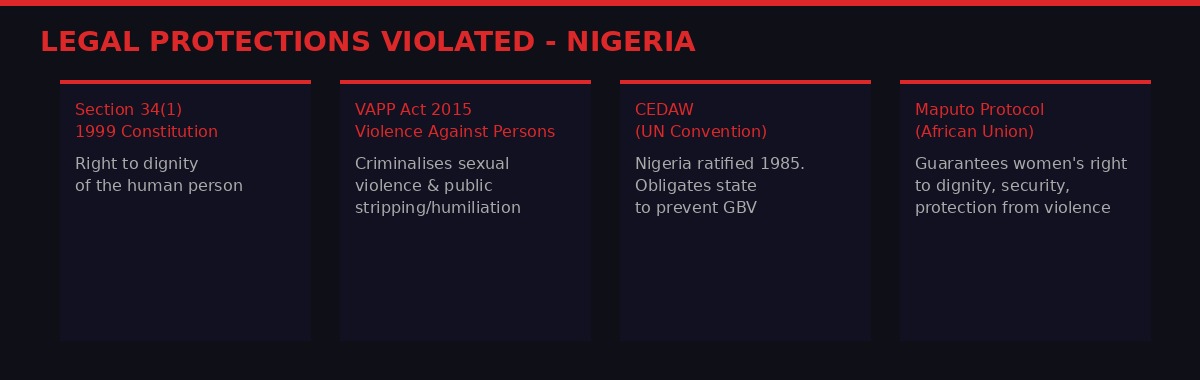
Nigeria's legal obligations: what the law says, and what was violated. BLACKWIRE infographic.
The Government Response: Speed, Statements, and Substance
The official response moved fast by Nigerian government standards. That speed is itself significant - a reflection of how explosive the public reaction was.
By Friday, March 20, Minister of Women Affairs Imaan Sulaiman-Ibrahim had issued a formal statement through her ministry's press office, calling the incidents "disturbing, unacceptable and contrary to human dignity, public safety and the rule of law." She praised Delta police for their response and called for a "transparent, thorough, and accelerated investigation."
"No cultural or traditional practice can justify or excuse sexual violence in any form. Sexual assault is a serious criminal offence, and all allegations must be thoroughly investigated, with perpetrators held fully accountable under the law." - Minister Imaan Sulaiman-Ibrahim, Ministry of Women Affairs and Social Development, March 20, 2026
First Lady Oluremi Tinubu - who has roots in Delta State - also issued a signed statement condemning the alleged assaults and urging security agencies to prosecute all offenders. She said no culture justified violating women and girls, praised police for the arrests, and encouraged victims to seek medical and psychological support. Her intervention was notable given her personal ties to the region - it framed the response not just as government policy but as personal condemnation.
The Delta State government condemned the incident through Information Commissioner Charles Aniagwu, calling it "barbaric" and stating: "No individual or group should be allowed to hide under the guise of a festival to perpetrate criminal activities."
The federal government committed to collaborating with Delta State to support victims. The police transferred the 15 arrested suspects to the State Criminal Investigation Department (CID) for deeper investigation. Commissioner Adeshina was quoted saying all involved would be identified, arrested and prosecuted.
Critically, among those arrested was the local chief widely named as the festival organiser. The community head was also detained. These weren't just foot soldiers - these were the people who structured the event. That distinction matters enormously for any hope of accountability that goes beyond symbolic arrests.

Responses to the Ozoro incident from government and civil society. BLACKWIRE graphic.
Civil Society's Six Demands - and Why They Matter
The Nigeria Federation of Business and Professional Women didn't just condemn the incident. They petitioned the Delta Governor with six specific, concrete demands. That specificity matters. It's the difference between moral outrage and institutional accountability.
The demands:
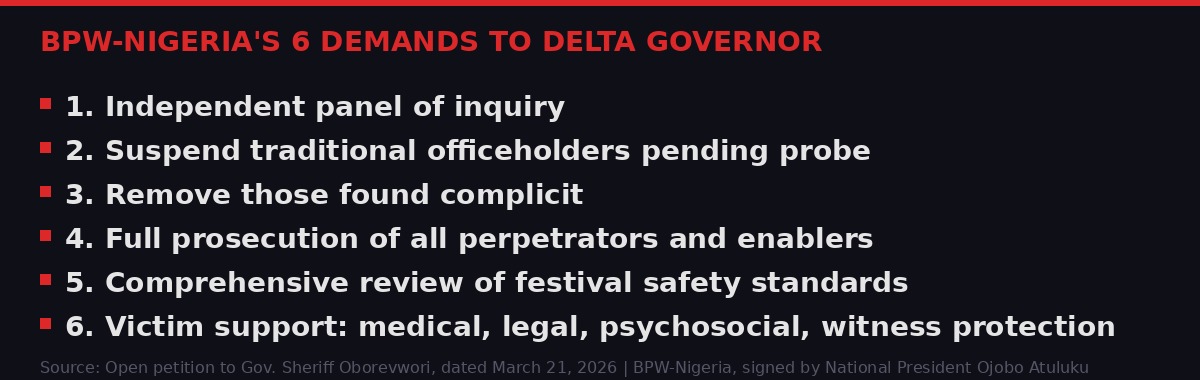
BPW-Nigeria's formal demands to Governor Sheriff Oborevwori, dated March 21, 2026.
The demand for an independent panel of inquiry - separate from the police investigation already underway - reflects a fundamental distrust of the institutions that were already operating in Ozoro when women were being assaulted. Police, traditional leaders, local government: all these structures existed before the Alue-Do festival. None of them prevented what happened. An independent panel would examine not just the acts but the system that enabled them.
The demand to suspend traditional officeholders pending investigation is the sharpest. The BPW-Nigeria petition cites Section 34(1) of the Nigerian Constitution and makes clear that traditional rulers are "custodians of order and protectors of their people" - not ceremonial figureheads immune to accountability. If the King of Ozoro and his council knew the festival carried a risk of violence against women - and the evidence suggests this tradition has existed for decades - then their role in enabling it needs to be examined.
The demand for a "comprehensive review of safety and human rights compliance standards for cultural festivals across the state" is the longest-term ask. It acknowledges that Ozoro may not be alone. There may be other communities with similar practices that haven't gone viral yet, where women have been quietly managing the same threat for years.
BPW-Nigeria also signalled they would pursue legal action if necessary. That's not boilerplate language. It's a notice to the governor: respond substantively, or face the courts.
Tradition, Impunity, and the Viral Moment as Turning Point
Nigeria has had viral GBV moments before. The Vera Uwaila Omozuwa case in 2020 - a University of Benin student raped and murdered in a church - generated a wave of protest and hashtag activism. The reforms promised in the aftermath were partial and uneven. The VAPP Act, passed in 2015, still has not been adopted by all 36 Nigerian states as of 2026. Enforcement remains inconsistent even where the law exists.
What distinguishes the Ozoro case is the explicit cultural framing. In most GBV cases, perpetrators are individuals committing acts that even their communities officially condemn. In Ozoro, the violence was allegedly embedded in a communal event - organised, timed, and in some accounts anticipated by residents who warned women to stay home. That makes it a test of something specific: can the Nigerian state hold traditional institutions accountable for harm they enable?
The answer will come not from statements but from outcomes. Whether the 15 men arrested are actually prosecuted. Whether the community leader and the organiser face charges that stick. Whether an independent inquiry is convened. Whether the Alue-Do festival, if it continues, does so with enforceable safeguards - or whether this incident is quietly absorbed, the sentences reduced, the inquiry shelved, the women of Ozoro left to manage another year of fear.
Women's rights advocates across Nigeria are watching the case closely. So are diaspora communities - Nigerians in the UK, North America, and Europe who amplified #StopRapingWomen on social media and are now tracking whether the government follows through. The BBC's coverage of the story, reaching an international audience, has added external scrutiny that wasn't present in earlier domestic GBV cases.
"This is bigger than one festival. It is about whether Nigerian women can move freely, participate in public life, and trust that the law will protect them." - BPW-Nigeria petition, March 21, 2026
That framing - freedom of movement, public participation, legal protection - is the core of what gender equality actually means in practice. Not abstract rights but the ability to walk outside during a community event without being attacked. Nigeria's constitution guarantees it. Nigeria's VAPP Act criminalises the violations. Whether those guarantees mean anything in Isoko North Local Government Area is what the next few weeks will reveal.
What Comes Next
As of Monday, March 23, 2026, 15 suspects are in the custody of the Delta State CID. Investigation is ongoing. BPW-Nigeria's petition to the governor is on record. The federal government has committed to victim support collaboration with the state.
The immediate horizon involves several specific markers that will indicate whether this is a substantive response or managed optics:
Prosecution progress. Will the 15 detained men be formally charged? Will charges include the relevant provisions of the VAPP Act - not just minor public order offences? Will the community leader and organiser face charges that reflect the gravity of their alleged enabling role?
Victim support access. Minister Sulaiman-Ibrahim promised medical, psychosocial and legal assistance for victims. Will that support actually reach women in Ozoro - a community where many may be reluctant to identify themselves publicly as victims?
The inquiry question. Governor Oborevwori has not yet publicly responded to BPW-Nigeria's petition. If he declines to establish an independent panel, activists have indicated they may pursue legal routes. Whether courts will compel government action is uncertain, but the threat of litigation puts legal pressure behind the moral argument.
Traditional leadership reform. The King of Ozoro's claim that the festival was "misinterpreted" is unlikely to satisfy activists. The longer-term question is whether Delta State will use this moment to formally revise how traditional festivals are permitted to operate - and what accountability mechanisms exist when they cause harm.
For the women of Ozoro, what happens in the courts and corridors of Asaba matters enormously. But it doesn't fully address the immediate reality: that they live in a community where, apparently for decades, the annual festival was a day to stay indoors or risk assault. Arrests remove individuals from the streets. They don't, by themselves, change the structural permission that made those men believe they could act that way in the first place.
That structural change - the harder, longer work - is what the hashtag is ultimately demanding. Not just punishment after the fact. Prevention before it happens again. The conviction that women's bodies belong to them, that public space is not a zone of danger for women alone, and that tradition cannot be a legal shield for violence.
Nigeria has the laws. It has the international commitments. The Ozoro case is a live test of whether those commitments have teeth - or whether they remain, as they have in too many prior cases, words that don't reach the streets of Isoko North when the festival starts.
Get BLACKWIRE reports first.
Breaking news, investigations, and analysis - straight to your phone.
Join @blackwirenews on TelegramKey Facts
- Incident: Alue-Do fertility festival, Ozoro community, Isoko North LGA, Delta State, Nigeria - March 19, 2026
- 15 suspects arrested and transferred to State CID as of March 22, 2026 (Premium Times / NAN)
- Among those arrested: chief Omorede Sunday (named festival organiser) and the community head
- Delta State Police spokesperson Bright Edafe confirmed arrests; Commissioner CP Aina Adeshina ordered investigation
- Nigeria's Violence Against Persons (Prohibition) Act 2015 criminalises forceful stripping and public humiliation
- BPW-Nigeria petitioned Delta Governor Sheriff Oborevwori with 6 specific demands, March 21, 2026
- Federal govt statement by Minister Imaan Sulaiman-Ibrahim ordered arrest and prosecution of all perpetrators
- First Lady Oluremi Tinubu condemned assaults and urged prosecution and victim support
- BBC News, Premium Times, Channels TV and international outlets covering the story
- #StopRapingWomen trended nationally on Nigerian social media following viral videos
Sources: BBC News (March 23, 2026); Premium Times Nigeria (March 19-23, 2026); Nigeria News Agency (NAN); Delta State Police Command statements via Bright Edafe; BPW-Nigeria open petition to Governor Sheriff Oborevwori (March 21, 2026); Federal Ministry of Women Affairs statement (March 20, 2026); X posts cited by Premium Times reporting.