Eight Million in the Streets: No Kings III Becomes the Largest Protest in American History
BLACKWIRE infographic - No Kings III at a glance
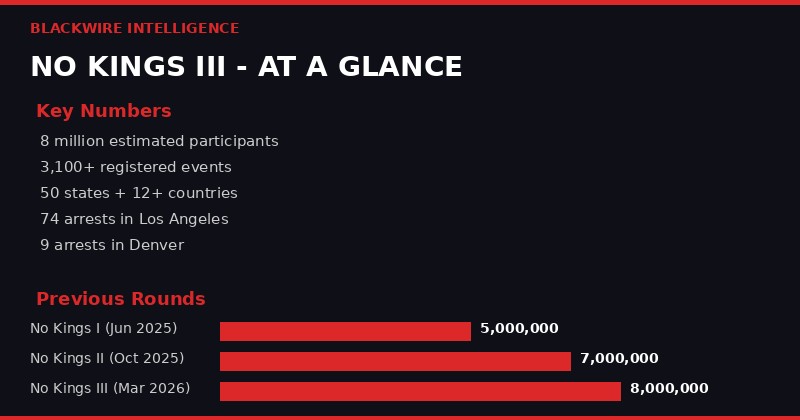
They came from every zip code in the country. From Manhattan's canyons to a town of fewer than 2,000 people in eastern Idaho. From the Minnesota Capitol steps where Bruce Springsteen sang for the dead, to a federal detention center in downtown Los Angeles where tear gas turned a spring evening into something that looked like a war zone. An estimated 8 million people - 8 million - walked out of their homes on Saturday, March 28, 2026, and planted themselves in the streets of more than 3,100 cities, towns, and crossroads across all 50 states and a dozen countries overseas.
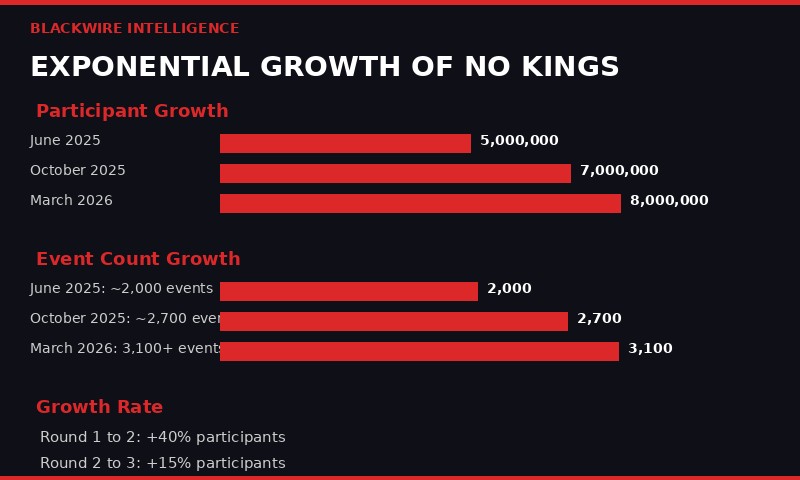
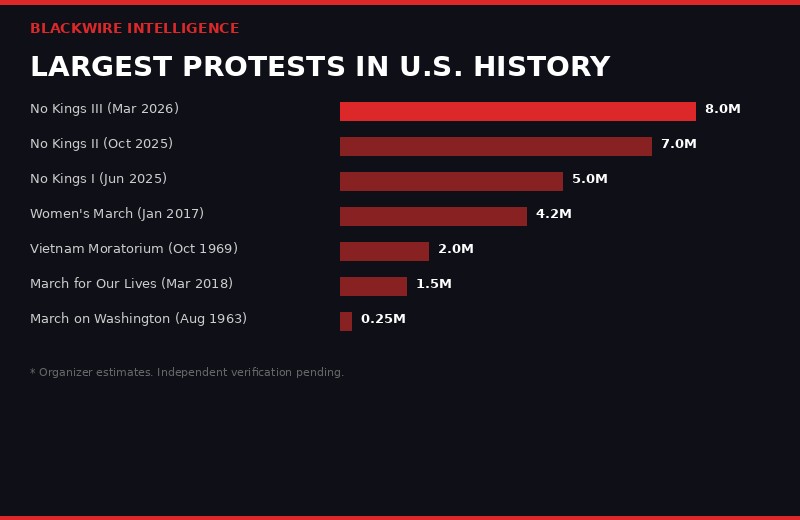
No Kings III is now the largest single-day protest in the history of the United States. It surpasses the Women's March of January 2017, which drew between 3.3 and 5.2 million participants, according to crowd scientists at the time. It dwarfs the previous No Kings rallies - 5 million in June 2025, 7 million in October 2025 - and it leaves the anti-Vietnam War moratoriums, the March on Washington, and every other mass demonstration in American memory behind. The number is an organizer estimate from Indivisible, the nonprofit that spearheaded the events, and independent verification will take weeks. But even discounted heavily, the scale is unprecedented.
The trigger was not a single policy or a single death. It was an accumulation. A monthlong war in Iran with over 3,000 dead and no exit strategy. A government shutdown - now the longest in American history - that has collapsed air travel and left federal workers unpaid for weeks. The fatal shooting of ICU nurse Alex Pretti by a Border Patrol agent on a Minneapolis street. The killing of Renee Good under similar circumstances. The rollback of transgender rights, the restriction of press freedoms, the deployment of federal forces to American cities. All of it compressed into a single Saturday, a single demand: No Kings.
BLACKWIRE infographic - The exponential growth of No Kings protests
The Minneapolis Flagship: Springsteen Sings for the Dead

BLACKWIRE infographic - Minnesota flagship event
Organizers designated the rally at the Minnesota State Capitol in St. Paul as the national flagship event, and the choice was deliberate. Minneapolis has become the epicenter of America's immigration enforcement crisis. In recent weeks, federal agents from U.S. Customs and Border Protection shot and killed Alex Pretti, a 28-year-old ICU nurse, and Renee Good, another local resident, during enforcement operations in the city. The killings drew bipartisan condemnation and turned Minnesota into a symbol of resistance to what opponents describe as a federal occupation of American cities.
Thousands stood shoulder-to-shoulder on the Capitol lawn, filling the steps and spilling onto surrounding streets. Before the headliner took the stage, organizers played a video message from actor Robert De Niro. He said he wakes up every morning depressed because of the Trump administration but was happier on Saturday because millions of people were protesting. He congratulated Minnesotans specifically for what he described as "running ICE out of town."
Then Bruce Springsteen performed "Streets of Minneapolis," the song he wrote in response to the Good and Pretti killings. The performance was not a concert. It was a eulogy, a rallying cry, and a benediction, all compressed into a few minutes of electric guitar and a voice that has been the soundtrack of American discontent for half a century.
"Your strength and your commitment told us that this was still America. And this reactionary nightmare, and these invasions of American cities, will not stand."
- Bruce Springsteen, No Kings III rally, St. Paul, Minnesota (AP)
The bill also included singer Joan Baez, actor Jane Fonda, Vermont Senator Bernie Sanders, and a roster of activists, labor leaders, and elected officials. Randi Weingarten, president of the American Federation of Teachers, addressed the crowd directly: "Donald Trump may pretend that he's not listening, but he can't ignore the millions in the streets today." Protesters held up a massive banner on the Capitol steps reading, "We had whistles, they had guns. The revolution starts in Minneapolis."
The phrase references the confrontations between Minneapolis residents armed with whistles and pots and federal agents carrying firearms during the ICE raids. It has become the defining slogan of the movement's third iteration, appearing on T-shirts, stickers, and social media profiles from coast to coast. The protest was, by all accounts, entirely peaceful in Minnesota. Police reported no arrests and no incidents at the flagship event.
Senator Bernie Sanders, who has recently introduced legislation to impose a moratorium on new AI data centers in the United States, used his platform to broaden the critique beyond immigration. He attacked the concentration of wealth among billionaires, the ongoing war in Iran, and what he called the administration's "contempt for working people." His presence connected the protest to an older strain of American populism - one rooted in economic justice rather than cultural grievance.
Los Angeles Burns: Tear Gas at the Federal Detention Center
BLACKWIRE infographic - LA confrontation breakdown
Not every city stayed peaceful. In Los Angeles, the day began with thousands marching through downtown streets. A band played Spanish-language music. People danced. Children carried handmade signs. For hours, it looked like every other mass demonstration the city has hosted over the decades - exuberant, loud, and fundamentally festive.
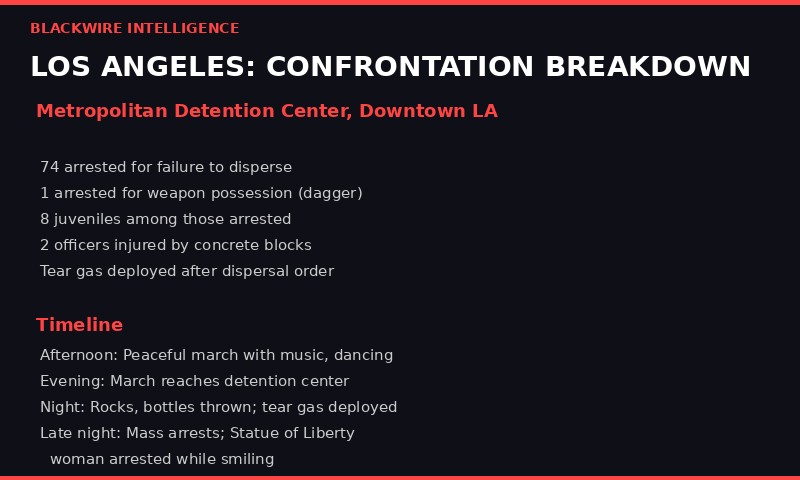
Then the march reached the Metropolitan Detention Center, a federal facility in downtown LA. As hundreds of protesters surrounded the complex, the mood shifted. According to the Department of Homeland Security, some demonstrators threw rocks, bottles, and broken concrete blocks at officers stationed behind fencing around the facility. Two officers were struck by concrete blocks and sustained injuries requiring medical attention.
Authorities issued a dispersal order. When protesters did not comply, law enforcement deployed tear-gas canisters into the crowd. Some protesters, wearing shields and gas masks, picked up the canisters and threw them back at police. Others smashed concrete barriers into smaller pieces and hurled them over the fence. The confrontation lasted into the night.
The Los Angeles Police Department arrested 74 people for failing to heed the dispersal order. An additional person was taken into custody on suspicion of possessing a weapon police described as a dagger. Eight of those arrested were juveniles. In one of the night's more surreal images, a woman dressed as the Statue of Liberty was led away smiling, chatting amiably with the officer who arrested her. The photograph went viral within hours.
"Does it make L.A. look bad? No. They're bad actors causing problems, for sure. The peaceful protest was good for the cause. You have the right to do that. But the other people, they were definitely causing problems."
- Andre Andrews Jr., Navy veteran and independent journalist who walked the entire rally route (AP)
In Denver, the police department declared an unlawful assembly after a small group of protesters blocked a road and refused to disperse. Officers deployed smoke canisters. At least nine people were arrested. The Denver incidents, like those in Los Angeles, were outliers. In the vast majority of the 3,100 registered events across the country, the demonstrations proceeded without incident, without arrests, and without confrontation. But it is the outliers that dominate the news cycle, and the administration was quick to seize on them.
The tear gas in Los Angeles also carried an uncomfortable echo. The Metropolitan Detention Center houses immigration detainees. Protesters chose that location precisely because of its symbolic connection to the administration's deportation campaign. For opponents of the protest, the choice of target vindicated their claim that the movement is fundamentally anti-enforcement rather than pro-democracy. For supporters, gassing peaceful protesters outside a facility where immigrants are held in indefinite detention proved the point they came to make.
From Driggs, Idaho to the Bastille: The Geography of Dissent
BLACKWIRE infographic - No Kings III geographic spread
The scale of No Kings III is not captured by the flagship events alone. Two-thirds of the RSVPs came from outside major urban centers, according to Indivisible's data. That includes communities in deep-red states - Idaho, Wyoming, Montana, Utah, South Dakota, Louisiana - as well as suburban precincts in the swing states of Pennsylvania, Georgia, and Arizona that will determine the 2026 midterm elections and the 2028 presidential race.
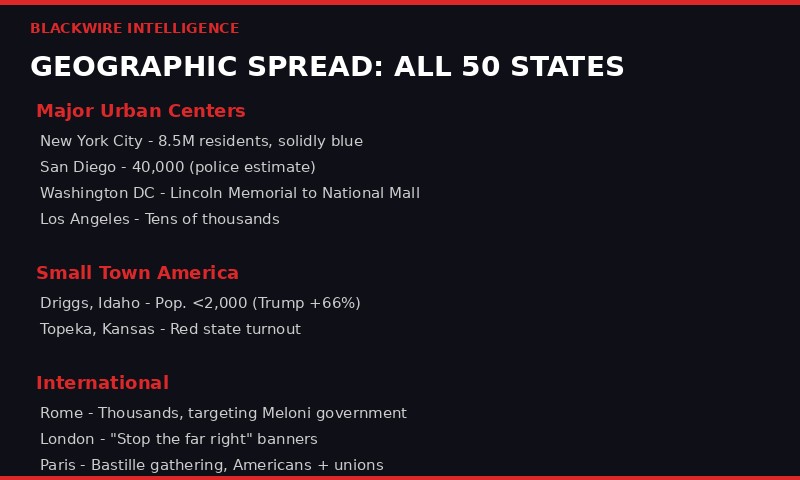
In Driggs, Idaho, a town of fewer than 2,000 people in a state Trump carried with 66% of the vote in 2024, residents organized a demonstration. In Topeka, Kansas, a protester dressed in an inflatable frog costume and a baby version of Trump. Wendy Wyatt showed up with a "Cats Against Trump" sign. Many things upset her about the administration, she told the Associated Press, but the rallies are "very hopeful to me."
In San Diego, police estimated 40,000 marchers. In New York, Donna Lieberman, executive director of the New York Civil Liberties Union, told a press conference that the administration "wants us to be afraid that there's nothing we can do to stop them. But you know what? They are wrong - dead wrong." In Washington, D.C., hundreds marched past the Lincoln Memorial and into the National Mall, holding signs reading "Put down the crown, clown" and "Regime change begins at home."
Bill Jarcho traveled from Seattle with six people dressed as insects wearing tactical vests labeled "LICE" - spoofing ICE - as part of what he called a "mock and awe" tour. "What we provide is mockery to the king," Jarcho said. "It's about taking authoritarianism and making fun of it, which they hate." The costumes were absurd by design. In Nashville, protesters carried inflatable crowns. In Boston, someone built a papier-mache throne and set it on fire. The humor was deliberate - a tactic borrowed from protest traditions around the world, where ridicule is a weapon against the powerful precisely because it cannot be countered with force.
The movement also jumped national borders. Demonstrations were held in more than a dozen countries, according to Indivisible's Ezra Levin. In Rome, thousands marched with chants aimed at Premier Giorgia Meloni, whose conservative government saw its referendum for streamlining Italy's judiciary fail badly the same week. Protesters waved banners against Israeli and American attacks on Iran. In London, demonstrators held signs reading "Stop the far right" and "Stand up to Racism." In Paris, several hundred people - mostly Americans living in France, joined by labor unions and human rights organizations - gathered at the Bastille. "I protest all of Trump's illegal, immoral, reckless and feckless, endless wars," organizer Ada Shen told the Associated Press.
The international dimension matters because it situates No Kings III within a global wave of anti-authoritarian sentiment that extends far beyond American domestic politics. From Paris to Rome to London, the protests connected Trump's immigration enforcement to the war in Iran, to the erosion of civil liberties in Europe, and to a broader anxiety about democratic backsliding across the Western world. The movement's organizers understood this. The choice of the Bastille as a rally site in Paris was not accidental.
The Administration Responds: "Hate America Rallies"
BLACKWIRE infographic - The political response
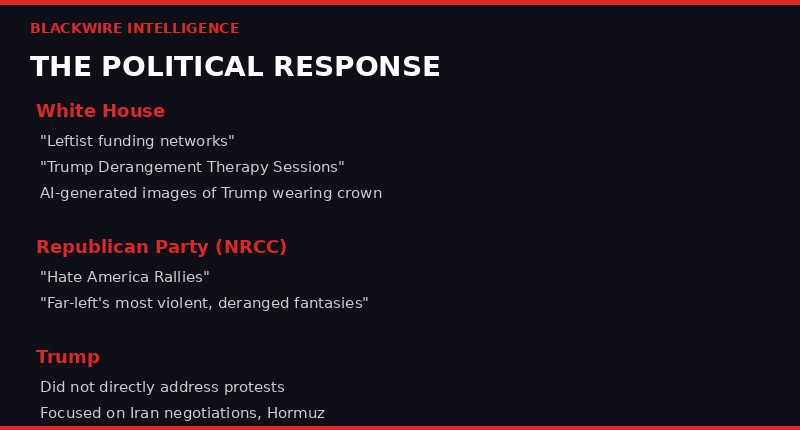
The White House and Republican leadership responded to No Kings III with a strategy that has been consistent since the movement's first iteration in June 2025: dismissal, mockery, and counter-narrative framing. White House spokesperson Abigail Jackson called the protests the product of "leftist funding networks" with little real public support. "The only people who care about these Trump Derangement Therapy Sessions are the reporters who are paid to cover them," Jackson said in a statement.
The National Republican Congressional Committee was more aggressive. "These Hate America Rallies are where the far-left's most violent, deranged fantasies get a microphone," spokesperson Maureen O'Toole said. The framing was identical to the language used after the first No Kings rallies in June, when conservative politicians labeled the demonstrations as "Hate America" events. On social media, both Trump's personal account and the official White House account posted AI-generated images of the president wearing a crown, leaning into the "king" framing as a badge of honor rather than a critique.
Trump himself did not directly address the protests on Saturday. He was focused instead on the Iran war and the government shutdown. Aboard Air Force One on Sunday, he said Iran had agreed to allow 20 ships carrying oil through the Strait of Hormuz starting Monday "out of a sign of respect," and claimed negotiations were going "extremely well." The juxtaposition was telling: 8 million Americans in the streets demanding accountability, and the president talking about ship passages.
The dismissal strategy has a clear logic. Acknowledging the protests' scale would legitimize them. But the strategy also carries risk. Last year, Trump said he felt attendees were "not representative of the people of our country" and insisted, "I'm not a king." The protests grew by 40% between the first and second iterations, and by another 15% or more between the second and third. At some point, dismissal stops working - not because the administration cares about the protesters, but because the midterm electorate does.
Republican strategists have privately expressed concern about the movement's penetration into suburban and exurban areas that delivered Trump his margins in 2024. When two-thirds of RSVPs come from outside major cities, the "coastal elite" dismissal falls apart. When Driggs, Idaho, and Topeka, Kansas, are hosting events alongside New York and San Francisco, the map tells a story that no spokesperson can spin away.
The Grievances: War, Shutdown, and Death in Minneapolis
BLACKWIRE infographic - The converging crises driving No Kings III
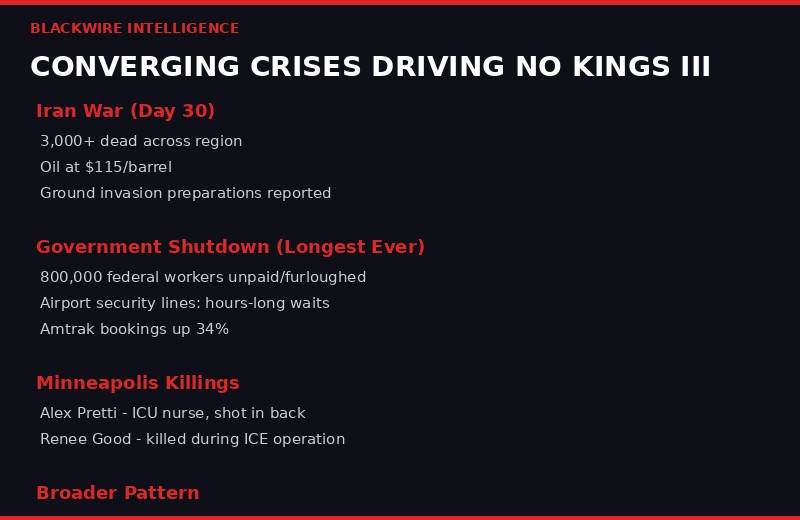
No Kings III is not a single-issue movement. Its power derives from the convergence of multiple crises, each of which would be sufficient to generate mass protest on its own. Together, they have created something qualitatively different from any previous American protest movement - a multi-front opposition that draws people into the streets for different reasons but unites them under a single banner.
The Iran War. The U.S. and Israeli strikes on Iran began on February 28, 2026. One month in, over 3,000 people are dead - more than 1,900 in Iran, over 1,200 in Lebanon, 19 in Israel, 80 Iraqi security forces, 20 in Gulf states, 4 in the occupied West Bank, and 13 American service members. Oil has surged past $115 a barrel, the highest in over a decade. Iran-backed Houthi rebels in Yemen have opened a third front by striking Israel. The Strait of Hormuz remains partially blockaded. Trump is openly discussing seizing Iran's Kharg Island, the terminal through which 90% of Iran's crude oil exports flow. Pentagon officials have made detailed preparations to deploy ground forces. Iran's parliament speaker has warned that Iranian forces are "waiting for American troops on the ground to set them on fire." There is no ceasefire. There is no credible diplomatic track. Pakistan has announced it will host U.S.-Iran talks, but there is no confirmation from Washington or Tehran that direct negotiations will occur.
The Government Shutdown. The partial federal government shutdown, now the longest in American history, has upended air travel across the country. Unpaid TSA agents are calling out from work. Security lines at major airports stretch for hours. ICE agents have been deployed as stand-in screeners at some facilities - a development that raises questions about mission creep and competence. The stalemate is rooted in a budget dispute over immigration enforcement funding. Congress and the White House have failed to reach agreement. A bipartisan Senate deal to fund the Department of Homeland Security, minus immigration enforcement, was rejected by House Republican leaders while millions of Americans were in the streets.
The Minneapolis Killings. The deaths of Alex Pretti and Renee Good at the hands of federal agents during immigration enforcement operations in Minneapolis have become the movement's martyrs. Pretti, a 28-year-old ICU nurse, was shot in the back. The killings drew bipartisan condemnation. Trump himself signaled a shift in tone after the Pretti shooting, though his administration has not charged any federal agent or announced a policy change. Minneapolis residents confronted ICE agents with whistles and pots during raids, creating scenes of civilian resistance that spread across social media and became the symbolic core of No Kings III.
The Broader Pattern. Beyond these headline crises, protesters cited the rollback of transgender rights, restrictions on press freedom, the use of federal power to influence midterm elections, retribution against political opponents, and what organizers describe as a comprehensive assault on constitutional rights. Ezra Levin, co-executive director of Indivisible, framed the stakes explicitly: "This isn't about Democrats versus Republicans. This is about do we have a democracy at all, and what are we going to tell our kids and our grandkids about what we did in this moment?"
The Numbers in Context: Comparing No Kings III to History
BLACKWIRE infographic - Largest protests in U.S. history
Crowd counting is an imprecise science. The 8 million figure comes from Indivisible, which has obvious incentive to maximize its estimate. Independent verification through satellite imagery, cell phone data, and transit ridership figures will take weeks. Even the Women's March of 2017, which is the most studied mass demonstration in American history, has crowd estimates that range from 3.3 million to 5.2 million depending on the methodology.
But even conservative estimates place No Kings III in unprecedented territory. The movement's infrastructure is well-documented: 3,100 registered events across all 50 states, with organizer counts, police estimates, and transit data available for the largest gatherings. The 40,000 police estimate in San Diego alone represents a significant data point. The tens of thousands at the Minnesota flagship, combined with the hundreds of thousands across New York, Washington, Los Angeles, and other major cities, make it difficult to argue the total was less than 5 million even under the most skeptical analysis.
For historical context, consider the largest known protests in American history before No Kings:
- Women's March, January 21, 2017: 3.3-5.2 million across 680 cities. The previous record holder for largest single-day protest in U.S. history.
- George Floyd protests, June 6, 2020: An estimated 500,000 on the single largest day, though the multi-week movement drew an estimated 15-26 million participants total over several months.
- March for Our Lives, March 24, 2018: Approximately 1.2-2 million across 800 events nationwide.
- Vietnam Moratorium, October 15, 1969: An estimated 2 million across the country.
- March on Washington, August 28, 1963: 250,000 at the National Mall for Martin Luther King Jr.'s "I Have a Dream" speech.
- No Kings I, June 2025: An estimated 5 million across nearly 2,000 locations.
- No Kings II, October 2025: An estimated 7 million across 2,700 locations.
The trajectory is the striking thing. Each iteration of No Kings has grown - from 5 million to 7 million to 8 million, from 2,000 events to 2,700 to 3,100. The growth rate has slowed, from 40% between the first and second to roughly 15% between the second and third. That deceleration could reflect either saturation or fatigue. But the absolute numbers remain staggering. For reference, 8 million people represent roughly 2.4% of the total U.S. population - a mobilization rate that exceeds any single-day political event in the nation's history by a significant margin.
The international spread adds another dimension. While crowd counts from overseas events are less reliable, demonstrations in Rome, London, Paris, Berlin, and other European capitals represent something new - an American domestic protest movement that has generated genuine solidarity abroad. The anti-Vietnam War movement achieved this to some degree, but the speed and scale of No Kings' international adoption, facilitated by social media coordination, is without modern precedent.
The Leaderless Problem: Can a Movement This Big Sustain Itself?
BLACKWIRE infographic - The decentralized No Kings infrastructure
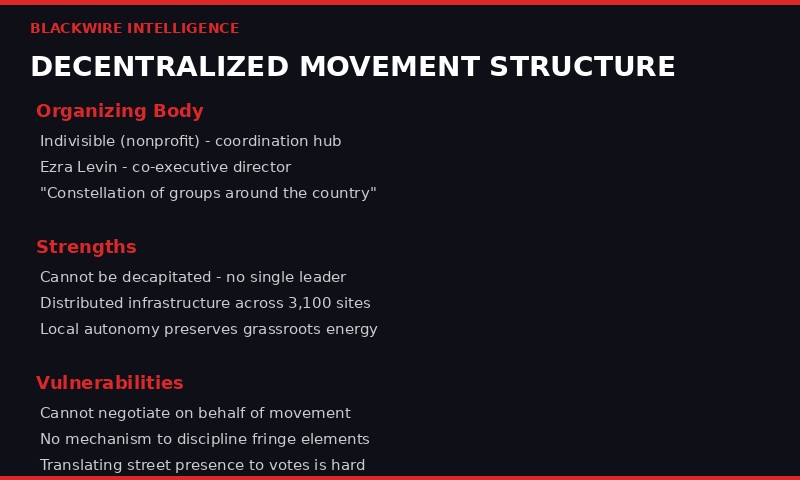
No Kings is organized by what Indivisible calls a "constellation of groups around the country." There is no single leader, no Martin Luther King Jr. or Susan B. Anthony, no charismatic figurehead who embodies the cause. Ezra Levin is the most visible coordinator, but he is an organizer, not a leader. Springsteen is a performer, not a strategist. Sanders is a senator with his own legislative agenda. The movement's decentralization is both its greatest strength and its most significant vulnerability.
The strength is obvious: a decentralized movement cannot be decapitated. There is no single arrest, no single scandal, no single co-optation that can destroy it. When two-thirds of events are organized by local groups outside major cities, the infrastructure is distributed in a way that makes it resilient to suppression. The federal government cannot raid every small-town church and community center that hosted a No Kings event.
The vulnerability is equally obvious: a decentralized movement cannot negotiate. It cannot make demands that can be met, because there is no one authorized to accept a deal. It cannot discipline its own members - the rock-throwers in Los Angeles and the road-blockers in Denver operated outside any command structure, and the movement has no mechanism to prevent similar incidents in the future. And it cannot translate street presence into legislative outcomes without a political apparatus that connects protest to power.
Levin and Indivisible have been explicit about their strategy for addressing this gap. "The big protest days are headline-grabbing moments," Levin has said, "but groups like his are determined to keep up steady trainings and intermediate-level organizing in hopes of growing sustainable resistance." The model is borrowed from the Tea Party movement of 2009-2010, which translated grassroots energy into electoral victories by running candidates in Republican primaries and holding elected officials accountable at town halls. Indivisible, in fact, was founded in 2016 by former congressional staffers who studied the Tea Party's tactics and sought to replicate them from the left.
The 2026 midterm elections, now seven months away, will be the first major test of whether No Kings can convert bodies in the streets into votes at the ballot box. The movement's penetration into swing-state suburbs - Pennsylvania, Georgia, Arizona - suggests the potential is there. But potential is not performance. The Women's March of 2017 drew millions and generated enormous energy, but Democrats lost Senate seats in 2018's midterms even as they gained House seats. The relationship between protest and electoral outcome is not linear.
There is also the question of what happens if the war ends, the shutdown resolves, and the immediate crises that fuel the movement dissipate. The anti-Vietnam War movement collapsed once the draft ended and troops came home. The George Floyd protests subsided once the immediate shock faded. Movements built on crisis are inherently fragile because crises are, by definition, temporary. No Kings' organizers seem to understand this - hence their emphasis on "persistent engagement" and year-round organizing. Whether 8 million people share that commitment remains to be seen.
The Shutdown Factor: Why Airports Are Fueling the Fire
BLACKWIRE infographic - The shutdown's cascading effects
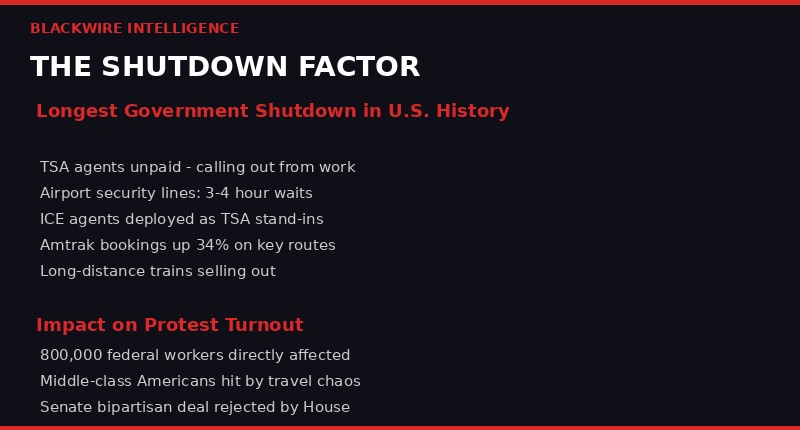
One factor that distinguishes No Kings III from its predecessors is the government shutdown. The partial federal government shutdown - now the longest in U.S. history - has disrupted a foundational constant of American life: easy air travel. Unpaid TSA agents are calling out from work in increasing numbers. Security lines at major airports, including Atlanta's Hartsfield-Jackson, the world's busiest, have stretched to hours-long waits. Flights are being missed. Business travel is grinding to a halt. Leisure travel has become a gamble.
The shutdown has done something that immigration policy and foreign wars often fail to do: it has made the political crisis tangible to middle-class Americans who might otherwise be insulated from it. You can ignore a war happening 6,000 miles away. You can ignore immigration enforcement that targets other people's neighborhoods. You cannot ignore a four-hour security line when you need to catch a flight for work.
AP reporter Bill Barrow captured this dynamic in a dispatch from aboard Amtrak's Crescent train, which he boarded in Atlanta after the city's airport "descended into organized chaos." The 14-hour overnight train ride from Atlanta to Washington - a journey that normally takes 2 hours by air - became a meditation on how politics disrupts the basic mechanics of daily life. Passengers who arrived mere minutes before departure made it onboard with no lines, no TSA agents, no ICE agents as stand-ins. "I'm no TSA agent," one crew member joked.
The Amtrak ridership data tells the story. Train bookings on Northeast Corridor routes are up 34% compared to the same period last year, according to Amtrak figures cited by multiple outlets. Long-distance routes like the Crescent, the Southwest Chief, and the Empire Builder are selling out for the first time in years. Americans are not just protesting the shutdown - they are routing around it, rediscovering a 19th-century transportation network because 21st-century infrastructure has been sabotaged by political dysfunction.
The shutdown also created a specific grievance for federal workers - roughly 800,000 of them - who have been working without pay or furloughed entirely. Many of those workers are concentrated in the Washington, D.C., metropolitan area, Northern Virginia, and Maryland - precisely the regions where No Kings III drew large crowds. The protest was not abstract for them. It was about their rent, their mortgage, their ability to feed their families. That kind of personal stake produces a different quality of anger than ideological opposition alone.
Congress managed a brief flicker of bipartisanship during the protest weekend. The Senate produced a deal to fund all of the Department of Homeland Security except immigration enforcement. House Republican leaders rejected it. The stalemate continued. For the 8 million people in the streets, the timing was confirmation of everything they came to say.
What Comes Next: Midterms, Escalation, and the Question of Violence
BLACKWIRE infographic - What lies ahead for the No Kings movement
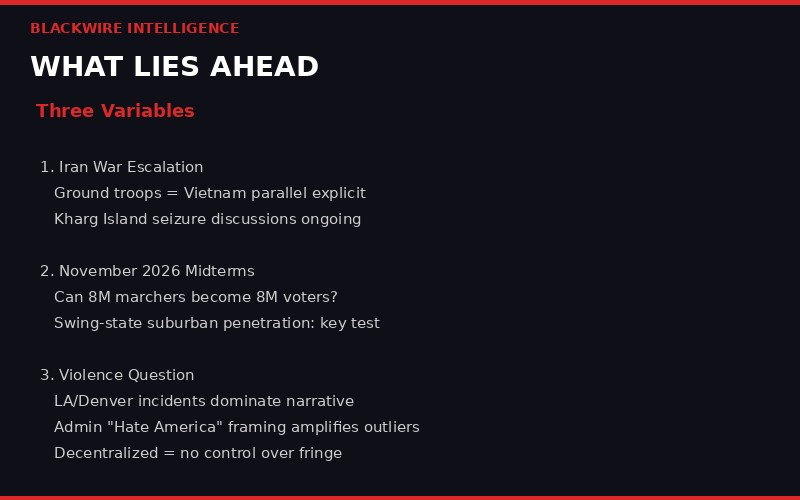
The trajectory of No Kings now depends on three variables: the Iran war, the midterm elections, and whether the movement can maintain its overwhelmingly nonviolent character in the face of provocations from both the state and its own fringe elements.
The war is the wild card. If ground troops deploy to Iran - Pentagon preparations are reportedly underway - the anti-war component of the movement will intensify dramatically. The Vietnam parallel becomes explicit rather than implied. Draft-age Americans, who currently have no personal stake in the conflict beyond its economic effects, would suddenly face the specter of conscription, even if the administration insists it has no such plans. The mere discussion of ground operations at Kharg Island or elsewhere inside Iranian territory changes the political calculus for millions of families.
The midterms are the scheduled test. November 2026 will determine whether No Kings translates to No Seats - whether the millions who march also vote, donate, volunteer, and organize in the ways that actually change the composition of Congress. History is not encouraging on this front. Large protests generate media coverage and emotional momentum, but the political science literature consistently shows that protest participation and voter turnout are only loosely correlated. The Tea Party succeeded because it was explicitly electoral from day one. No Kings has been explicitly anti-authoritarian, which is a more diffuse orientation.
The violence question is the most dangerous variable. Saturday's events in Los Angeles and Denver were minor - 74 arrests in a city of 4 million, 9 in Denver - but they dominate the narrative. The administration's "Hate America Rallies" framing is designed to amplify every thrown rock and every tear-gas canister into evidence that the movement is fundamentally destructive. If a future No Kings event produces a serious injury or a death, the political consequences would be severe. The movement's organizers know this, which is why they have emphasized nonviolence at every turn. But in a decentralized movement with no command structure, "emphasis" is not the same as "control."
Levin has said that Indivisible plans a fourth round of protests, though no date has been announced. The growth curve suggests diminishing returns - each round draws more people, but the percentage increase is shrinking. At some point, the movement hits a ceiling defined by the number of Americans willing to spend a Saturday in the streets rather than at the grocery store, the soccer field, or the couch. Eight million may already be near that ceiling, or it may be a waypoint on the way to something larger. No one knows.
What is certain is that the United States has never seen anything like this. Eight million people, 3,100 events, 50 states, a dozen countries. Springsteen singing for the dead in Minnesota. Tear gas outside a detention center in Los Angeles. A woman dressed as the Statue of Liberty, smiling as she's arrested. A frog costume in Kansas. A papier-mache throne burning in Boston. The absurd and the deadly, the joyful and the furious, all compressed into a single day that the country will be processing for years.
Saturday was not the end of anything. It was a benchmark. The question is not whether No Kings IV will happen. It is whether 8 million people will still be marching when marching alone is not enough.
Get BLACKWIRE reports first.
Breaking news, investigations, and analysis - straight to your phone.
Join @blackwirenews on Telegram