9 Million Americans Expected Saturday. The No Kings Movement Has Its Martyr.

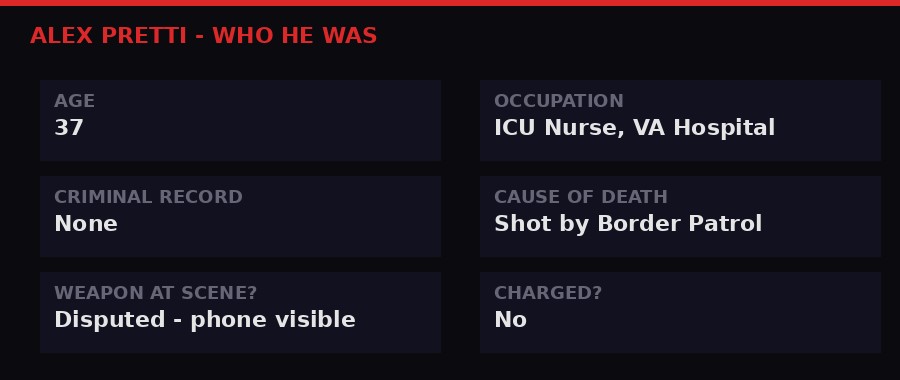
Alex Pretti was holding his phone. Every bystander video that has surfaced since his January 24 killing shows the same thing: a 37-year-old ICU nurse at a VA hospital, shielding a woman being pepper-sprayed, phone in hand. Within hours of his death, the Department of Homeland Security posted on X that he was a threat who "approached" officers with a firearm. Deputy White House chief of staff Stephen Miller called him "a would-be assassin."
Then the videos got out. And nothing in them matched the federal government's account.
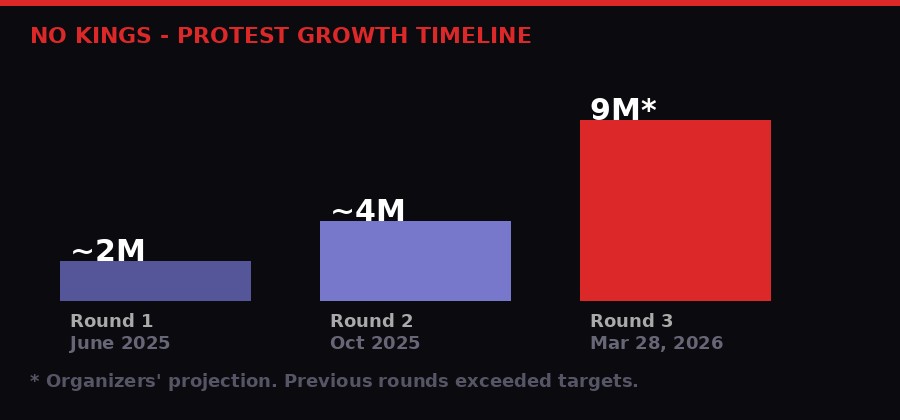
Now, less than three days before the largest planned day of protest in American history, Pretti's name has become a rallying cry for a movement that was already building toward something enormous. Indivisible, the nonprofit coordinating the third round of No Kings demonstrations, says more than 9 million people are expected to show up Saturday at over 3,000 locations nationwide. If those numbers hold, it will exceed anything the United States has seen in organized street protest - bigger than the Women's March of 2017, bigger than the George Floyd protests of 2020, bigger than either of the two previous No Kings rounds that already drew millions.
The question going into Friday night is no longer whether No Kings III will be large. The question is what comes after it.
Who Alex Pretti Was

Alex Jeffrey Pretti grew up in Green Bay, Wisconsin - played football, baseball, ran track at Preble High School. Eagle Scout. Boy choir. The kind of background that runs through a community obituary in a midwestern city and means nothing to anyone except the people who knew him, which is to say it means everything.
He went to the University of Minnesota, graduated in 2011 with a degree in biology, society and environment. Worked as a research scientist. Then went back to school and became a registered nurse. By the time federal agents shot him on a Minneapolis street, he was working intensive care at a VA hospital - keeping veterans alive in the hardest moments of their lives.
He had no criminal record. No prior run-ins with law enforcement beyond traffic tickets. He was a licensed concealed-carry holder in Minnesota, which his family says he rarely exercised. He had a dog named Joule, a Catahoula Leopard who recently died. His parents, reached by the Associated Press after a reporter found them because no federal agency had bothered to call them, said they had told him two weeks earlier to be careful at protests.
"We had this discussion with him two weeks ago or so - go ahead and protest, but do not engage, do not do anything stupid, basically. And he said he knows that. He knew that." - Michael Pretti, Alex's father, speaking to the Associated Press
He was not a political operative. He was not a professional agitator. He was a nurse who watched ICE agents grab people in his city and decided, like millions of other Americans, that it was worth showing up. He showed up. Two Border Patrol officers - confirmed by DHS in a notification to Congress - fired Glock pistols at him. He died.
The Federal Account Fell Apart in Hours
The Department of Homeland Security moved fast. Before Pretti's parents had even been notified, DHS posted a photograph on X of a 9mm Sig Sauer semiautomatic handgun and declared it justification for the killing. The post said Pretti also had "2 magazines and no ID" and described the situation as looking "like one where an individual wanted to do maximum damage."
The photograph showed a single loaded magazine lying next to an emptied pistol on the seat of a vehicle. Minnesota state officials later said Border Patrol officers had likely mishandled evidence by removing the weapon from the scene. The discrepancy between the DHS post - claiming two magazines - and the photograph - showing one - became one of dozens of points of contention the family and civil rights attorneys raised in the days following.
None of the six bystander videos that surfaced show Pretti brandishing a weapon. In the videos, he is visible with a phone in one hand, the other extended toward a woman being pepper-sprayed. Use-of-force experts hired by the AP described the federal government's justification as unsupported by public evidence.
"In a country that has more guns than people, the mere possession of a weapon does not establish an imminent threat to officers - and neither does having a weapon and approaching officers. I don't think there's any evidence to confirm the official narrative at all." - Seth Stoughton, former police officer and use-of-force expert, University of South Carolina
Minnesota authorities obtained a search warrant to access the shooting scene. They were blocked. The state's Bureau of Criminal Apprehension said federal agents prevented their investigators from entering. A federal judge later issued an emergency order barring officials from "destroying or altering evidence related to the fatal shooting involving federal officers." The order itself was a signal: someone had reason to worry the scene would be tampered with.
Trump, in a Fox News interview, said they were going to "de-escalate a little bit" in Minnesota and sent border czar Tom Homan to take over operations from Border Patrol commander Gregory Bovino. It was an unusual move that acknowledged, without saying so directly, that something had gone wrong.
This Is Not the First Time

Pretti was not the first person killed by federal immigration enforcement in Minneapolis this year. On January 7, Renee Good was shot and killed by an ICE officer in the city. A week later, in a separate incident, a federal officer shot a man in the leg after he attacked agents with a shovel while they attempted to arrest a Venezuelan national.
Three officer-involved shootings in three weeks in a single American city. Chuck Wexler, executive director of the Police Executive Research Forum, put it directly to the AP: "If a police chief had three officer-involved shootings in three weeks, they would be stepping back and asking, 'What does our training look like? What does our policy look like?'"
The International Association of Chiefs of Police - not an organization known for challenging federal authority - called on the White House to convene discussions "as soon as practicable" among federal, state and local law enforcement. That is a polite way of saying: this is out of control.
The shooting also drew international attention in a way that irritated the administration. Ecuadorian consulate staff in Minneapolis turned away ICE officers who attempted to enter without permission. A video shows the confrontation, with a consulate staffer telling agents "this is the Ecuadorian consulate, you're not allowed to enter" while an ICE officer threatens to "grab" him. Ecuador filed a formal diplomatic protest with the U.S. Embassy, citing violations of international law governing consular premises.
The Movement That Was Already Building
The No Kings protests did not start with Alex Pretti. They started a year ago, when Trump deployed the National Guard and Marines to Los Angeles during immigration enforcement operations, and protesters blocked a freeway and set vehicles on fire. Organizers called the response to Trump's military birthday parade - with tanks rolling through Washington on June 14, 2025 - a "coronation," and built the first coordinated protest around that symbolism.
That first round drew nearly 2 million people across roughly 2,000 locations. The White House mocked it. Trump posted AI-generated images of himself wearing a crown. The movement noticed.
Round two came in October 2025, bigger: around 4 million across 2,700 cities and towns. Organizers cited Trump's immigration crackdown, his stated plans to use federal power to influence 2026 midterm elections, and his rollback of press access and press protections.
Now comes round three. Ezra Levin, co-executive director of Indivisible, told the AP he expects 9 million people at more than 3,000 locations on Saturday. Two-thirds of those locations will be outside major urban centers - suburbs, small towns, places that in previous cycles barely registered politically. That geographic spread is, in many ways, the more significant story than the raw number.
"This is in large part a response to a combination of the heinous attacks on our democracy and communities coming from the regime, and a sense that nobody's coming to save us." - Ezra Levin, co-executive director, Indivisible
The Suburbs Are Radicalized

Allison Posner is 42, a mother of two in Maplewood, New Jersey. A few years ago she was barely involved in politics. Now she hands out food and diapers to immigrant families outside a nearby detention center, waves signs from a highway overpass between school pickups and orthodontist appointments, and on Saturday she will lead a No Kings march through Montclair, New Jersey - alongside her husband, her children, and thousands of others.
Her district, New Jersey's 11th, was a Republican stronghold for decades. College-educated suburban voters began shifting in 2018, continued in 2020, continued again in 2022 and 2024. Democrats recently chose Analilia Mejia - a former political director for Bernie Sanders, endorsed by Sanders and Alexandria Ocasio-Cortez - as their candidate for a special election on April 16. Mejia calls for abolishing ICE, supports Medicare for All, and uses the word "authoritarian" without hedging.
Jeff Naiman, a radiologist who leads his local chapter of Indivisible in Summit, New Jersey - one of the nation's wealthiest suburbs - told the AP: "It's like our hair is on fire. Our country's being torn apart."
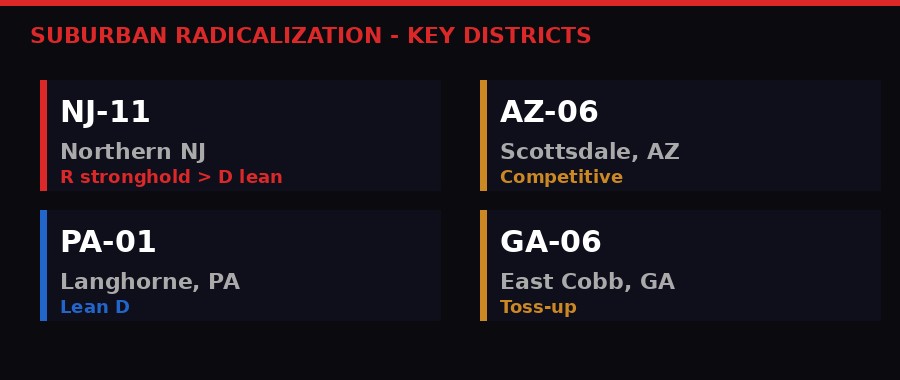
The political implications are significant. Republicans hold the House by a narrow margin. If the suburbs hold as Democratic-trending into November 2026, the arithmetic gets very difficult for the GOP. Historically, the party of a president in his second term loses seats at midterm. In a year defined by a war 59% of Americans (per AP-NORC polling) say has gone too far, a government shutdown affecting airports, and now a nurse shot dead on video while holding a phone, that historical pattern could become a wave.
Organizers say this is not a partisan calculation. Levin: "This isn't about Democrats versus Republicans. This is about do we have a democracy at all."
Minneapolis as the Flashpoint

Minnesota was not a random choice by the Trump administration for its most aggressive immigration operations. The state has a large Somali and East African immigrant community, particularly in Minneapolis - a high-visibility target for an administration that wanted to demonstrate maximum enforcement in a city that had become a liberal cultural touchstone after the 2020 killing of George Floyd.
The political calculus appeared straightforward on paper: flood the zone, make arrests, force Democratic leadership to either support or oppose visibly. What the administration did not fully calculate was the response from people like Pretti - U.S. citizens with legal carry permits and nursing jobs - who decided to show up and watch. To observe. To document.
Georgia Savageford, who witnessed Pretti's death from inside a federal agent's vehicle, testified at a press conference organized by civil rights attorney John Burris. Savageford said she had been legally monitoring federal operations ever since Renee Good's killing in January. On the day Pretti died, she said agents pushed her, causing her to fall, then tackled her, dragged her face-down into the street, handcuffed her so tightly she suffered temporary nerve damage, and held her in a cold ICE cell for 12 hours without charge.
"That day has changed me forever. The trauma will haunt me for the rest of my life, and I will never be the same. I did not know him, but I knew he had my back. I know the kind of heart he had. One that loves and protects without limits." - Georgia Savageford, witness to Alex Pretti's killing, speaking at a press conference
Burris, who won an $11 million settlement against the Oakland Police Department in 2003 and helped win the Rodney King civil verdict, said he has filed complaints with federal agencies on behalf of 10 people, including Savageford, as the first step toward a class-action lawsuit. He described it as putting the government "on notice."
Minnesota Attorney General Keith Ellison sued the Trump administration for access to evidence in both the Pretti and Good cases. The federal government's resistance to state oversight of incidents in which federal agents killed U.S. citizens on U.S. soil has become a constitutional flashpoint in its own right.
What Saturday Means - and What Comes After

Every large protest movement confronts the same structural problem: the moment passes, the crowd goes home, and nothing changes. Organizers are aware of this. Levin talks about "persistent engagement" and "sustainable resistance." The test is whether the energy generated this Saturday converts into anything structural - voter registration, candidate recruitment, sustained local organizing - by the time November 2026 arrives.
There are signs it might. New Jersey's 11th District special election on April 16 will be the first electoral test of whether anti-Trump suburban mobilization translates to votes. The candidate is openly progressive, openly anti-ICE, openly anti-Trump. Naiman, the radiologist from Summit, says he has "no doubt" she will win - and win again in November. That certainty may or may not prove accurate, but it reflects a mood in places that once sent Republicans to Congress as a matter of routine.
The political stakes are national. Republicans currently control the House by a margin thin enough that flipping a handful of suburban seats would shift the balance of power for the final two years of Trump's second term. A Congress that flips Democratic in 2026 means investigation subpoenas, budget fights, and potential oversight of federal law enforcement operations in places like Minneapolis. That prospect is not lost on anyone on either side of the current standoff.
Saturday is a referendum on something beyond policy. It is an argument about the character of the country - about whether citizens can legally watch their government enforce its laws, whether federal agents can kill people and control the narrative about what happened, and whether the suburbs of a nation that has more guns than people will keep the peace or not.
Timeline: From the First Killing to the March
The Legal Reckoning Building

The legal fight over what happened in Minneapolis is running parallel to the political one. Minnesota Attorney General Ellison and Governor Tim Walz have pressed for independent state access to the evidence in both shooting cases, filing suit when the federal government refused. A federal judge has already intervened once to protect evidence from being destroyed. That is not a standard procedure. That is a signal that the judiciary shares at least some of the concern about what was or is being concealed.
Burris and his colleagues have filed administrative complaints on behalf of ten individuals as the preliminary step to a class-action lawsuit that could encompass dozens of people who claim excessive force was used against them during Minneapolis enforcement operations in January. The complaints name the Department of Homeland Security, Customs and Border Protection, and Immigration and Customs Enforcement. The legal strategy mirrors approaches used successfully in past police misconduct cases - build the complaint record, then file for a broader class of plaintiffs.
At the congressional level, oversight hearings have been requested. Senator Mark Kelly, Democrat from Arizona, told reporters bluntly: "They didn't have a plan. They have no timeline. And because of that, they have no exit strategy." He was talking about the Iran war, but the comment applied equally to the Minneapolis situation - a federal enforcement surge that generated enormous political heat without a clear framework for what success looked like or how to wind it down without losing face.
The Immigration and Customs Enforcement agency did not respond to multiple AP requests for comment on the various Minneapolis incidents. The State Department did not respond to questions about the Ecuador consulate situation. The pattern of non-response is itself part of the legal strategy: say nothing, contest nothing publicly, and force plaintiffs to extract information through subpoena and litigation.
That strategy may work in court, at least for a while. On the street Saturday, it will not matter at all.
Nine million people do not need a response from ICE to show up and march. They just need a reason. Alex Pretti - the nurse with the phone, who his father described as someone who cared about people deeply and thought it was wrong to kidnap children off the street - gave them one. The question now is what they do with it when the marching is over.
Get BLACKWIRE reports first.
Breaking news, investigations, and analysis - straight to your phone.
Join @blackwirenews on Telegram