
The number organizers claimed - 9 million people - may or may not be precise. But the images don't lie. From St. Paul's Capitol lawn to Driggs, Idaho (population: under 2,000), from the Lincoln Memorial in Washington to a highway overpass in suburban New Jersey, March 28 produced something the United States has not seen in modern times: a mass protest that reached everywhere, simultaneously, with a single message.
No Kings.
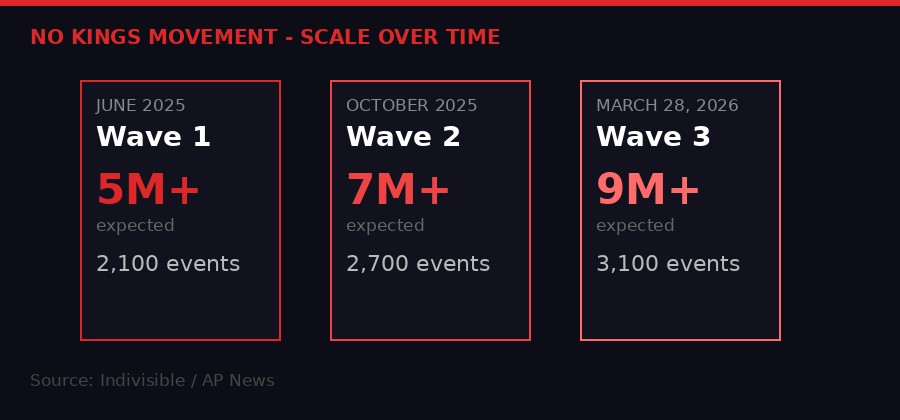
The third wave of protests organized by Indivisible and a constellation of allied groups eclipsed both predecessors in raw numbers. Wave one, in June 2025, drew an estimated 5 million across 2,100 events. Wave two, in October, pulled 7 million across 2,700 events. Wave three, on March 28, 2026, registered more than 3,100 events - 500 more than October - and drew its momentum from an act of federal violence that has changed the emotional temperature of American politics.
Two people are dead in Minneapolis. Federal immigration agents shot Renee Good and Alex Pretti in separate incidents during ICE enforcement operations. Their deaths became the fuel for a movement that was already burning. Bruce Springsteen wrote a song. The streets answered.

Minnesota at the Center
The national flagship event was the rally at the Minnesota State Capitol in St. Paul - a deliberate choice. Minnesota had been subject to what Indivisible co-executive director Ezra Levin called "some of the most horrific, sadistic behavior you can imagine" from the Trump administration. It also produced, in Levin's words, "some of the most inspiring, neighborly, brave organizing" seen anywhere in the country.
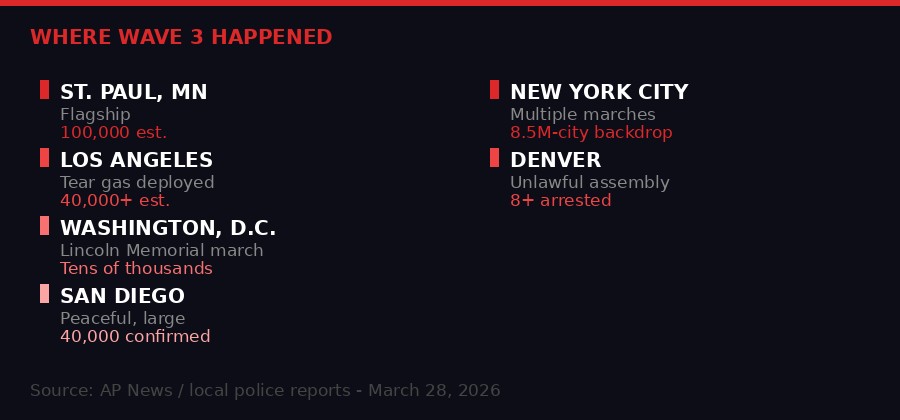
Organizers told state officials that 100,000 people could converge on the Capitol complex. The June 2025 event at the same location drew an estimated 80,000. Attendance on Saturday appeared to match or exceed that figure.
Before Bruce Springsteen took the stage, actor Robert DeNiro delivered a video message saying he wakes up "depressed" every morning because of Trump but found Saturday hopeful. He congratulated Minnesotans specifically for what he described as "running ICE out of town."
The lineup also included singer Joan Baez, actor Jane Fonda - both veterans of Vietnam-era protests - and Vermont Senator Bernie Sanders. Labor leaders, elected officials, and activists from across the state filled the bill alongside them. But Springsteen was the moment everyone waited for.
"Your strength and your commitment told us that this was still America. And this reactionary nightmare, and these invasions of American cities, will not stand." - Bruce Springsteen, St. Paul, Minnesota, March 28, 2026 (AP News)
Springsteen performed "Streets of Minneapolis," the song he wrote and recorded over a single weekend after Alex Pretti's killing. The track builds from acoustic guitar and voice to a full band arrangement with harmonica, and ends with chants of "ICE Out!" Its title consciously echoes "Streets of Philadelphia," his 1993 song written for the Tom Hanks film about AIDS. In both cases, the song arrived precisely when a crisis needed a voice.
Protesters held a massive sign on the Capitol steps that read: "We had whistles, they had guns. The revolution starts in Minneapolis." Randi Weingarten, president of the American Federation of Teachers, told the crowd: "Donald Trump may pretend that he's not listening, but he can't ignore the millions in the streets today."

Los Angeles: Tear Gas and Arrests
The contrast in Los Angeles was stark. The formal event had a festival quality - a band playing, people dancing to Spanish-language music, families arriving. Then it ended, and things shifted.
Near the Metropolitan Detention Center in downtown Los Angeles, police deployed tear gas after a crowd refused to disperse. One man used a leaf blower to clear smoke from protesters. The Los Angeles Police Department arrested multiple people on charges of failing to disperse following what officers described as an unlawful assembly near the federal facility.
AP photographers captured images of police detaining a protester dressed as the Statue of Liberty - an image that circulated rapidly across social platforms. About 40,000 people had marched in San Diego earlier in the day without significant incident.
The LA confrontation followed a pattern established in June 2025, when the first No Kings protests saw police use tear gas and crowd-control munitions in both Los Angeles and Portland after events near ICE facilities ran long into the evening. For many organizers, the detention center became a focal point not by coincidence but by design - a physical symbol of the enforcement apparatus they came to oppose.

Denver, Washington, and the National Picture
Denver followed a similar script on a smaller scale. The Denver Police Department declared an unlawful assembly after a group blocked a road and declined to leave. When officers deployed smoke canisters, some protesters threw them back. At least nine people were arrested, including one later charged with throwing objects at officers.
In Washington, hundreds marched past the Lincoln Memorial and through the National Mall. Signs read "Put down the crown, clown" and "Regime change begins at home." Bill Jarcho had come from Seattle with six companions dressed as insects wearing tactical vests labeled "LICE" - a spoof of ICE. He described it as a "mock and awe" campaign.
"What we provide is mockery to the king," Jarcho told AP. "It's about taking authoritarianism and making fun of it, which they hate."
In New York, the New York Civil Liberties Union's executive director Donna Lieberman addressed a news conference: "They want us to be afraid that there's nothing we can do to stop them. But you know what? They are wrong - dead wrong."
The geographic reach was notable. Organizers said two-thirds of RSVPs came from outside major urban centers - communities in conservative-leaning states including Idaho, Wyoming, Montana, Utah, South Dakota and Louisiana, alongside suburbs in battleground states Pennsylvania, Georgia and Arizona. In Topeka, Kansas, someone arrived in an inflatable frog costume with a baby Trump figure. In Lexington, Massachusetts, protesters gathered directly across from the Lexington Battle Green - where the first battle of the American Revolution was fought in 1775.
The Suburbs Radicalize
One of the more consequential stories running beneath the surface of Wave 3 is a geographic and demographic shift in the resistance movement. The anti-Trump coalition built around urban cores - New York, Chicago, Los Angeles, Portland - is no longer doing this alone.
In Montclair, New Jersey, 42-year-old Allison Posner - a mother of two, a freelance actor - has transformed her life around the resistance. She hands out food and diapers to immigrant families outside a detention facility. She waves signs on highway overpasses between school pickups. She led her own march Saturday through Montclair with her husband, her children, and thousands of others.
"The people in the suburbs are definitely radicalizing." - Allison Posner, Maplewood, New Jersey (AP News, March 28, 2026)
The political stakes are concrete. New Jersey's 11th congressional district, once a Republican stronghold and now a politically transformed suburb, holds a special election on April 16. Democratic voters chose Analilia Mejia - a former political director for Bernie Sanders - as their candidate, reflecting the leftward momentum of the base. Indivisible says sign-ups were particularly intense in Scottsdale, Arizona; Langhorne, Pennsylvania; East Cobb, Georgia; and northern New Jersey.
In Summit, New Jersey, one of the nation's wealthiest suburbs, radiologist Jeff Naiman leads his local Indivisible chapter. "It's like our hair is on fire," he said. "Our country's being torn apart."
Organizers say the shift matters for 2026 midterms. If suburbs - which flipped sharply away from Republicans in 2018 and again in subsequent cycles - continue moving, the Democratic Party may be positioned to recapture the House majority and constrain the White House agenda. For now, those voters are in the streets. The question is whether they stay engaged through November.
The Minneapolis Deaths That Changed Everything
Wave 3 was announced in January, shortly after Renee Good and Alex Pretti were killed by federal agents during ICE operations in Minneapolis. Both deaths became flashpoints. Their names now appear in Springsteen lyrics. They are invoked at every rally. They transformed a movement already focused on immigration enforcement into something with specific human faces and a specific city at its center.
Pretti's killing in particular attracted national scrutiny after videos emerged of the incident. In the weeks after his death, Trump signaled a shift in posture - suggesting the optics had become a political liability even within his own coalition. But no charges have been filed against any federal agents involved.
The deaths also occurred against a backdrop of sustained federal pressure on Minneapolis. ICE operations there had generated city-wide resistance, with residents forming informal networks to warn neighbors and document enforcement activity. Organizers described it as a community that had taken collective action to shield its neighbors - "running ICE out of town," in Robert DeNiro's formulation. Whether or not that framing is accurate, it became the movement's defining narrative.
The wave of protests in January, following the deaths, drew enormous crowds in Minnesota and solidarity marches nationally. What Wave 3 did was take that energy - raw, specific, local - and scale it to a national event backed by a year's worth of movement infrastructure.

White House and Republicans Dismiss the Movement
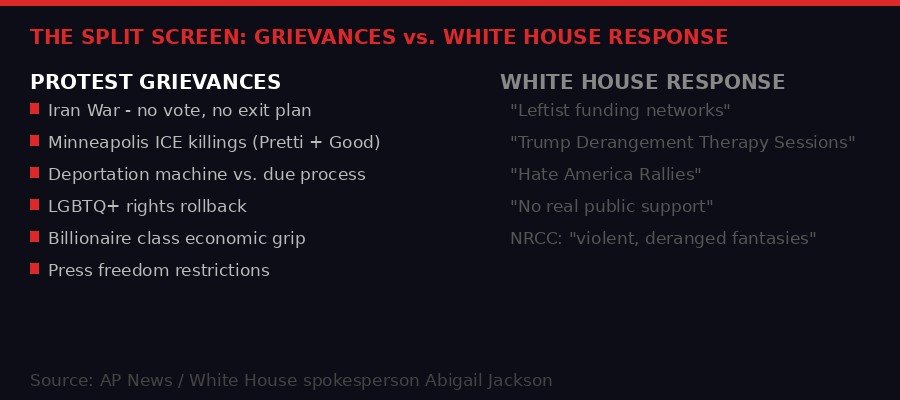
The Republican response was swift and consistent. White House spokesperson Abigail Jackson called Wave 3 the product of "leftist funding networks" with little real public support.
"The only people who care about these Trump Derangement Therapy Sessions are the reporters who are paid to cover them." - Abigail Jackson, White House spokesperson (AP News, March 28, 2026)
The National Republican Congressional Committee was sharper: "These Hate America Rallies are where the far-left's most violent, deranged fantasies get a microphone," said spokesperson Maureen O'Toole.
The framing follows a pattern Trump has used since the first wave in June 2025. After that protest, Trump said attendees were "not representative of the people of our country" and reiterated: "I'm not a king." Both statements were widely circulated by protesters as unintentional humor, given the movement's name is a direct response to his consolidation of executive power.
The White House dismissal strategy carries a specific risk. Every wave has been larger than the last. Calling wave one fringe, then wave two fringe, then wave three fringe - while the numbers climb from 5 million to 7 million to a claimed 9 million - creates a credibility problem. At some point, the scale becomes impossible to wave away as astroturfing.
Conservative politicians have condemned the protests as "Hate America rallies," but some protesters explicitly invoke constitutional rights and American revolutionary imagery. Lexington, Massachusetts - ground zero of the American Revolution - hosting a No Kings rally is not an accident. Organizers built the movement's branding around the premise that opposition to a would-be king is itself the American tradition.
International Spread: "No Tyrants" Goes Global
Wave 3 crossed national borders in a way the previous rounds had not. Rallies were reported in more than a dozen countries, organized according to Ezra Levin under the "No Tyrants" banner in nations with constitutional monarchies.
In Rome, thousands marched with chants targeting both Premier Giorgia Meloni - whose government had just seen a judicial reform referendum fail badly - and Israeli and U.S. attacks on Iran. In London, demonstrators carried banners reading "Stop the far right" and "Stand up to Racism." In Paris, several hundred people - many of them Americans living in France, alongside local labor unions and human rights organizations - gathered at the Bastille. "I protest all of Trump's illegal, immoral, reckless and feckless, endless wars," said organizer Ada Shen.
The countries joining protests include Canada, Germany, France, the United Kingdom, Spain, Portugal, Switzerland, Italy, Greece, the Netherlands, Ireland, Sweden, Mexico, and Australia, according to Indivisible's international outreach team.
The global spread matters for a specific reason: it signals that the movement has reframed itself not merely as domestic American opposition politics, but as something broader - a referendum on the political direction of the world's leading power, and by extension the global order it shapes. The Iran war, now entering its second month, is part of that. Houthi missiles entering the Red Sea, Iranian ballistic missiles hitting Saudi Arabia, 13 American troops dead and 300+ wounded - all of it feeds the energy that fills these streets.
For many international participants, the question is not just what Trump does to Americans. It is what a Trump-led America does to the world.

What Comes Next: The Political Arithmetic
The movement's leaders have been explicit about the downstream goal: political mobilization, not just protest. Ezra Levin, co-founder of Indivisible, has said the organization will consider Wave 3 a success primarily if it converts participants into ongoing activists - door-knockers, canvassers, donors, candidates.
The 2026 midterms are the target. Democrats need to flip the House to constrain the White House's agenda. That requires winning in exactly the kinds of places - suburban districts in Pennsylvania, Georgia, Arizona, and New Jersey - where the resistance is currently most visible. The special election in New Jersey's 11th district on April 16 functions as an early test.
Indivisible says two-thirds of Wave 3's 3,100+ events took place outside major urban centers - a deliberate strategic choice. Urban turnout is reliable but insufficient. It wins cities Democrats already hold. The suburban radicalization that Allison Posner describes from Maplewood, New Jersey, and the protests in conservative-leaning states like Idaho and Wyoming, represent a potentially new map for Democratic electoral competitiveness.
The Iran war adds a complicating variable. Anti-war sentiment runs across traditional political lines. The protest in Rome mixed anti-Meloni activists with demonstrators opposed to U.S. military operations. In the United States, signs opposing the Iran war appeared alongside immigration-focused messaging at nearly every major rally. If the war drags on, expands to Lebanon, or produces significant American casualties, the anti-war wing of the No Kings movement could pull the coalition in directions that don't neatly serve Democratic electoral strategy.
For now, the coalition holds. The dead in Minneapolis are its emotional center. The Iran war is its foreign policy backdrop. The 2026 elections are its practical goal. And the numbers - 5 million, then 7 million, now 9 million claimed - are its argument that something real is happening in the country, whether the White House acknowledges it or not.
No Kings Movement Timeline
Dissent at Scale: What History Says
The 9 million figure - if accurate - would place Wave 3 among the largest single-day protest events in American history. The Women's March in January 2017, long cited as the largest single-day protest in U.S. history, drew estimates of 3 to 5 million people nationwide. The climate strikes organized by Greta Thunberg's Fridays for Future movement in September 2019 drew an estimated 4 million in the U.S. and perhaps 7.6 million globally.
The No Kings movement, if organizers' numbers are correct, has now surpassed both - not once, but three times in succession, each larger than the last.
Protest scale does not automatically translate to political change. The global anti-Iraq War protests in February 2003 drew an estimated 10 to 15 million people worldwide - still the largest coordinated global protest in history - and the war began three weeks later regardless. The Obama administration largely ignored Occupy Wall Street. Demonstrations are not votes.
But the context here is different. The No Kings protests are explicitly built around an electoral infrastructure. Indivisible was founded specifically as a political organizing tool. The protests function as recruitment mechanisms - funneling participants into local chapters, voter registration drives, and candidate support networks. The question is not whether marching stops Trump. The question is whether marching builds the machinery that changes the 2026 congressional map.
The suburbs say yes. The numbers say growing. The calendar says the test comes in November.
Saturday's events showed both the movement's strength and its limits. Millions in the streets signal genuine, broad-based discontent. The arrests in Los Angeles and Denver signal that some participants, and some police forces, are operating near the edge of what peaceful protest looks like. The rally's ability to spread from St. Paul to Driggs, Idaho - a town of fewer than 2,000 people in a state Trump won with 66% of the vote - suggests penetration into territory the Democratic coalition rarely touches.
The movement's opponents call it funded radical theater. Its participants call it the most American thing they've ever done - gathering in public, invoking constitutional rights, demanding accountability from elected officials. The debate over which framing is accurate will be settled, as most political questions ultimately are, by what happens in the voting booth.
For now: 9 million people say they showed up. Springsteen played in St. Paul. The tear gas cleared. And the next No Kings rally, wherever it happens, will be announced with a number.
Watch for a 4.
Get BLACKWIRE reports first.
Breaking news, investigations, and analysis - straight to your phone.
Join @blackwirenews on TelegramSources: AP News (multiple reports, March 28-29, 2026) - Indivisible press statements - White House spokesperson Abigail Jackson - NRCC spokesperson Maureen O'Toole - AP photographer pool reports (Jill Connelly, Tom Brenner, Jose Luis Magana, Adam Gray) - Bruce Springsteen statement (AP) - Ezra Levin, Indivisible co-executive director.