She Asked to Die. Her Father Said No. Spain Had to Decide.
Noelia Castillo was 25 years old. She had been in a wheelchair for four years. She had spent most of her childhood in care. She had been assaulted twice. She had tried to end her life before, and those attempts had left her paralyzed. She asked the state for help dying with dignity. Then her father sued her. And all of Spain watched.
Barcelona, Spain - March 27, 2026. Noelia Castillo died Thursday evening at a clinic in the Catalan capital, following a two-year legal battle her father fought until the last possible moment. [BLACKWIRE Illustration]
On Thursday evening in a clinic in Barcelona, a young Spanish woman named Noelia Castillo died. She was 25. A doctor administered the life-ending medication. Her mother was in the room. Her father was not. He had spent 18 months trying to stop it.
Her last television interview, broadcast on Spanish channel Antena 3 the day before she died, was watched by millions. She sat in her wheelchair, her voice calm and tired at once, and said: "At last, I've managed it, so let's see if I can finally rest now. I just cannot go on anymore."
She waited four years for this. Not a dramatic countdown - four grinding years of psychiatric illness, physical pain, courtrooms, appeals, a Catholic lobby organization, and a father who insisted the state was murdering his daughter. Four years that had already been preceded by a childhood spent largely in care, a sexual assault, a second assault, a second suicide attempt, and the spinal injuries that left her unable to walk.
Noelia Castillo's case is now the most significant test Spain's five-year-old euthanasia law has ever faced. The first ever court case in the law's history. And it broke wide open a debate this country thought it had settled.
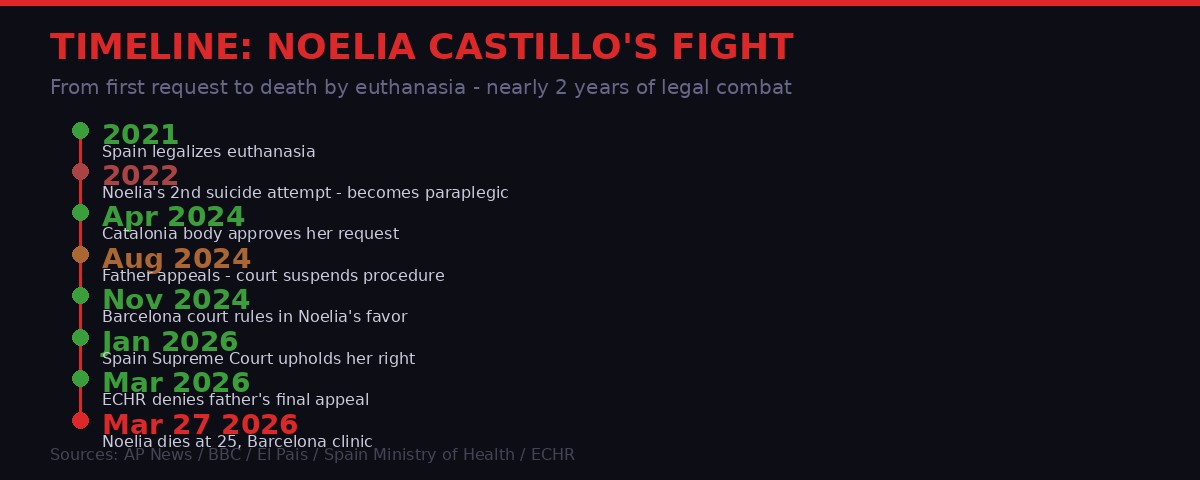
Timeline of Noelia Castillo's legal battle from her initial request in 2024 to her death on March 27, 2026. Her father's legal challenges added nearly two years of waiting to her suffering. [BLACKWIRE Infographic]
Who Was Noelia Castillo?
The facts of Noelia Castillo's life, as she herself has told them in multiple interviews, are layered in a way that resists reduction. She grew up in care homes, spending much of her childhood separated from her family. By her own account, her father had serious problems with alcohol. She spoke publicly about two assaults - one by an ex-boyfriend, one by multiple men in a nightclub - and said neither had ever been properly reckoned with. She had struggled with psychiatric illness since adolescence.
In 2022, she attempted to take her life for the second time. The attempt left her paraplegic. She has been in a wheelchair ever since, unable to use her legs.
What followed was not a simple turn toward death - it was, by her own description, a careful decision made over months. In April 2024, more than two years after her accident, she submitted a formal request for euthanasia to the Guarantee and Evaluation Commission in Catalonia. This is the independent body of doctors, lawyers, and bioethicists mandated under Spain's 2021 law to evaluate every request.
Nineteen doctors reviewed her case. The commission, after full evaluation, approved her application. It found that her condition met the threshold under Spain's law: a serious, chronic, and debilitating condition with unbearable suffering that could not be adequately treated.
That should have been the end of the legal process. It was not.
"I want to go in peace now and stop suffering. None of my family is in favor of euthanasia. But what about the pain that I've suffered all of these years?"
- Noelia Castillo, Antena 3 television, March 26, 2026
Castillo was unflinching in her public statements. She was also clear-eyed about the politics of her situation - that her case had become a proxy for ideological battles she never asked to represent. She wanted to die. The Catholic lobby was determined to make her want to live. The courts were caught in between.
The Father, the Church, and the Legal Crusade
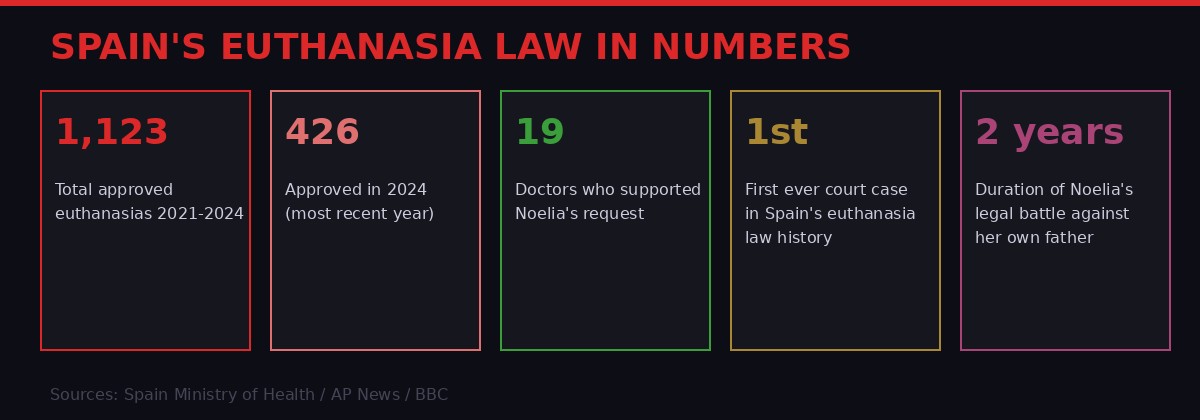
Spain's euthanasia law has been applied 1,123 times since 2021. Noelia Castillo's case was the first to ever reach the courts. [BLACKWIRE Infographic]
When the Catalan commission approved Noelia's request in 2024, her father moved quickly. He hired representation from Abogados Cristianos - Christian Lawyers - a conservative Catholic organization that has campaigned against Spain's euthanasia law since it was passed and has lobbied for its repeal ever since.
His legal argument was specific: that his daughter's psychiatric illness rendered her incapable of making an informed, autonomous decision to end her life. That she was, in effect, not truly choosing death but being consumed by an illness that the state was facilitating instead of treating.
This is not a frivolous argument in the abstract. The intersection of mental illness and requests for euthanasia is one of the most contested areas in medical ethics globally. Several countries that allow assisted dying draw a hard line at psychiatric-only conditions. Spain's law does not explicitly exclude psychiatric illness - the commission evaluates whether suffering is unbearable and incurable regardless of its nature.
But the specific application to Noelia's case was contested by virtually every medical professional who reviewed it. Nineteen doctors, per AP News reporting, concluded she met the criteria. The commission - which includes bioethicists - approved her request. The courts, up to and including Spain's Supreme Court in January 2026, found no legal basis to block her right.
Still, her father's lawyers pursued every available avenue. When the Barcelona court upheld her right in late 2024, they appealed. When the Supreme Court affirmed it in January 2026, they went to the European Court of Human Rights in Strasbourg. Earlier this month, the ECHR rejected that final attempt.
Each step added months. Castillo, by her own description, spent those months waiting - enduring not just her physical condition but the ongoing knowledge that external parties were extending her suffering to make a political point.
"For a girl who obviously has had a very tough life, which we all regret, the only thing that could be offered to her by the healthcare system is death."
- Jose Maria Fernandez, Christian Lawyers, quoted by BBC News
That statement - intended as condemnation of the healthcare system - was read very differently by those who had followed Noelia's case. She had received extensive psychiatric care. She had been evaluated repeatedly. She had the support of nearly two dozen medical professionals. What she had not received was a timely right to act on a legally protected decision.
Polonia Castellanos, president of Christian Lawyers, said after her death that Castillo's case was "proof of the failure of the law." She called for its urgent repeal.
Left-wing newspaper El Pais published an editorial that cut in the opposite direction entirely. Castillo's wish to end her suffering, it wrote, "was sabotaged by a legal crusade that added nearly two years of pain to her existence." (Quoted in BBC News, March 27, 2026)
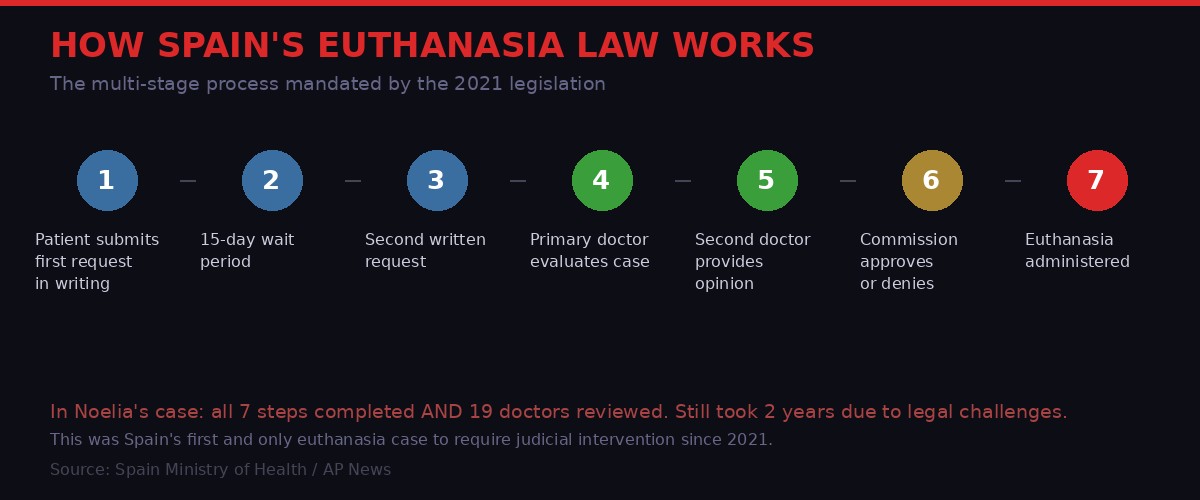
Spain's 2021 euthanasia law mandates a rigorous 7-step process. Noelia Castillo completed every step - and had 19 doctors review her case. It still took two years. [BLACKWIRE Infographic]
What Spain's Euthanasia Law Actually Says
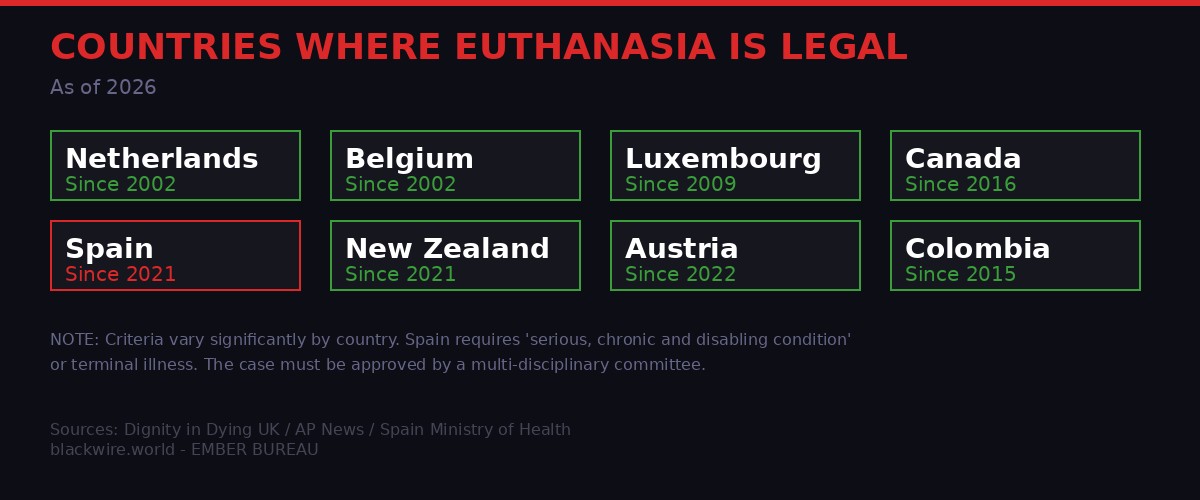
As of 2026, eight countries including Spain permit euthanasia under specific conditions. The thresholds and processes vary significantly. [BLACKWIRE Infographic]
Spain legalized physician-assisted dying in June 2021 - a landmark moment in a country where the Catholic Church has historically wielded significant political influence. The legislation passed over fierce opposition from the conservative People's Party (PP) and repeated lobbying from Church institutions.
Under the law, any Spanish adult over 18 can request euthanasia if they meet two conditions: they must be suffering from a terminal illness, or they must have a serious, chronic, and disabling condition that causes unbearable physical or psychological suffering. The request must be made twice, in writing, at least 15 days apart. Two separate doctors must evaluate the case. The request then goes to the regional Guarantee and Evaluation Commission.
The process is deliberately layered - it was designed to guard against impulsive or coerced requests while still respecting patient autonomy. When working as intended, it functions as a multi-stage filter that takes months even for straightforward cases.
According to Spain's Ministry of Health, 1,123 people have been administered life-ending medicine under the law through the end of 2024. In 2024 alone, 426 requests were granted - the highest annual figure since the law came into force. Every single one of those cases was processed without judicial intervention.
Noelia Castillo's case was the first in the law's entire history to reach the courts. That distinction carries weight. It means that until her case, the system functioned as designed - disagreements were handled within the medical and administrative framework. Her father's legal challenge introduced something new: the possibility that a family member could use the courts to override a patient's legally approved right to die.
The Supreme Court's January 2026 ruling, and the ECHR's subsequent rejection of the appeal, closed that door firmly. But the case exposed how much of the law depends on courts choosing to defend patient autonomy over family objection - a question that may return in future cases.
The Disability Rights Angle
Not all the criticism of the outcome came from the religious right. A disability rights group in Madrid - the Federation of Associations of People with Physical and Organic Disabilities - called for a review of the euthanasia law after Castillo's death.
Their concern was different from Christian Lawyers'. The federation was not arguing that Noelia's choice was invalid. They were arguing that the conditions which led her to make that choice should never have been allowed to persist.
"Before facilitating death, the system must effectively guarantee the conditions for living with dignity."
- Javier Font, Federation of Associations of People with Physical and Organic Disabilities of Madrid
This is a harder argument to dismiss - and it maps onto a global debate within disability rights movements about assisted dying. One camp holds that euthanasia laws, however well-intentioned, risk communicating a societal message that disabled lives are less worth living and that the state would rather help people die than fund adequate care. Another camp holds that opposing euthanasia in the name of disability rights denies autonomy to disabled people making informed choices.
In Noelia's specific case, the material facts are stark. She grew up in state care. She experienced institutional neglect. She was assaulted and, according to her own statements, received inadequate support in the aftermath. She developed a psychiatric illness that was treated but never resolved. And she became paraplegic as a consequence of an attempt on her own life.
Whether the Spanish state did enough for Noelia Castillo before she reached the point of asking to die is a question that demands a harder look at the care system than most of the public debate has provided. The courtroom drama around her father was gripping television. The long, less dramatic failures that preceded it have received less attention.
A member of Congress from the left-wing Sumar platform, Alberto Ibanez, described the case as "deeply complex" while stressing that nineteen doctors had supported her decision. He argued the decision must be respected. That captures something real: the case is both deeply complex in its causes and, in its legal resolution, clear-cut in its outcome.
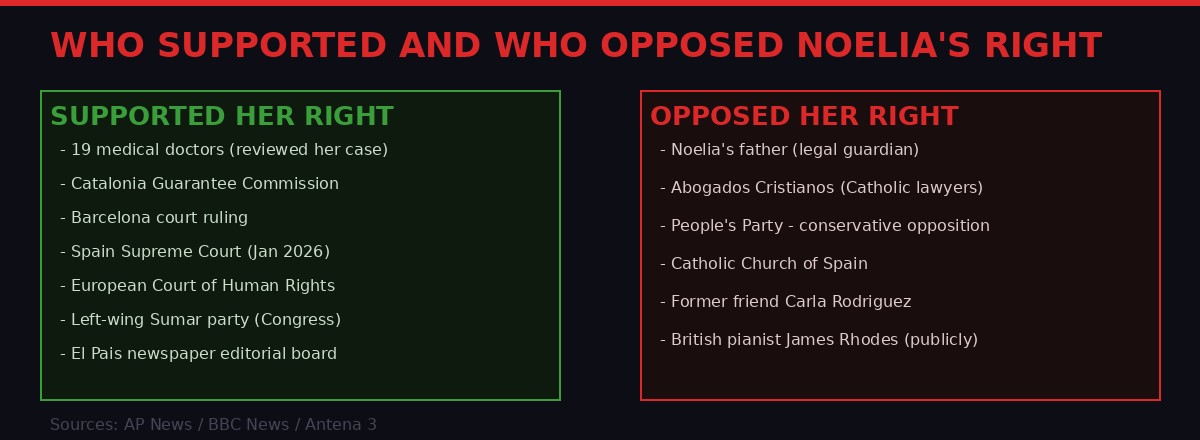
A clear majority of legal and medical institutions supported Noelia's right. Those opposing her were a coalition of family, religious lobby, and conservative political opposition. [BLACKWIRE Infographic]
Conservative Backlash and the Law's Survival
The People's Party, Spain's main conservative opposition, has never stopped opposing the euthanasia law. Thursday's events gave its leader, Alberto Nunez Feijoo, a platform to restate that opposition in the language of care rather than religion - which is, politically speaking, more effective.
"The institutions that should have protected Noelia failed her. I refuse to believe that the state did not have the tools to give her care."
- Alberto Nunez Feijoo, PP leader, via social media
The Catholic Church echoed this framing, describing Castillo's story as reflecting "an accumulation of personal suffering and institutional failures." The implication in both cases is that the failure was not euthanasia per se, but the absence of adequate alternatives - with the solution being not to improve alternatives, but to remove euthanasia as an option.
This framing has political resonance. It does not require anyone to admit religious motivation. It presents opposition to assisted dying as an argument for better care rather than an argument from doctrine. And it deliberately conflates two separate questions: whether the state failed Noelia before she asked to die, and whether she had the right to make the choice she made once she had reached that point.
Supporters of the law - and of Noelia's decision - are adamant these are separate questions. The Spanish government has not moved to repeal or restrict the legislation. The ruling coalition, which includes the left-wing Sumar and various regional parties, remains committed to the law.
But Christian Lawyers has already indicated it will continue using the courts to challenge future cases. The precedent set by Noelia's case is double-edged: it confirms that courts will ultimately protect patient rights, but it also demonstrates that a determined campaign can extend a patient's waiting period by 18 months or more, adding legal suffering to physical suffering.
Europe's Fault Line Over the Right to Die
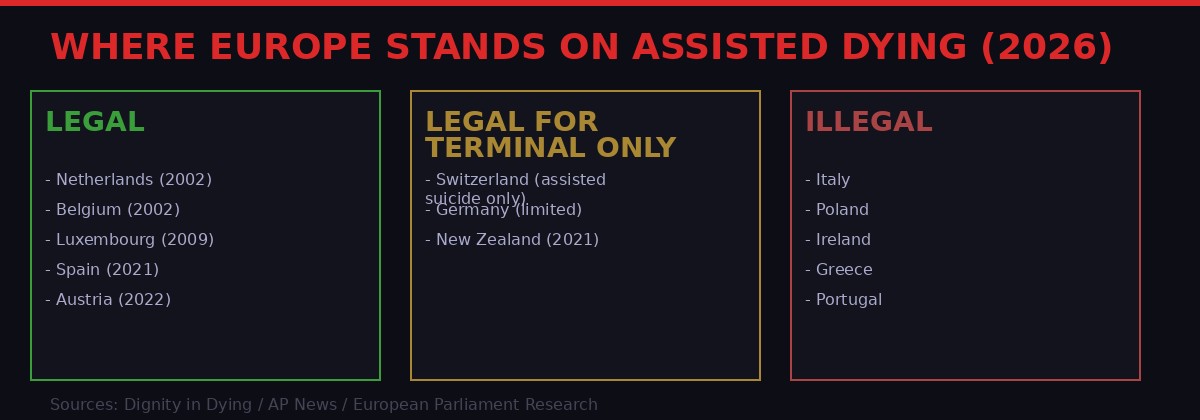
Europe remains split on the right to die. Spain legalized euthanasia in 2021. Italy, Ireland, and Poland have no such legislation. [BLACKWIRE Infographic]
Noelia Castillo died in the same week that the International Olympic Committee announced a blanket ban on transgender women competing in female athletic events. Both stories prompted France and Germany to push back. Both stories sparked a collision between individual rights, institutional authority, and powerful lobbying interests. Neither was resolved cleanly.
According to the UK-based advocacy organization Dignity in Dying, nine European countries now have some form of legal assisted dying - either full euthanasia or physician-assisted suicide. They include the Netherlands (the first, since 2002), Belgium, Luxembourg, Spain, and Austria. Switzerland permits assisted suicide through private organizations but has no formal state law.
The United Kingdom is actively debating a terminally ill adults bill that would allow assisted dying under strict conditions. The debate has been shaped in large part by cases similar to Noelia's - people making long, painful public arguments for the right to control the circumstances of their own deaths.
Italy has seen repeated cases reach the Constitutional Court, which has nudged toward a limited right to assisted suicide without parliament acting. Ireland is in consultation. Poland remains firmly opposed, as does most of Eastern Europe.
What makes Noelia's case different from most European right-to-die cases is the involvement of family opposition backed by an organized legal and religious campaign. Most countries that have legalized assisted dying have built safeguards that are designed to prevent external coercion - to ensure no one is pushed toward euthanasia against their will. What few systems anticipated was the reverse: organized campaigns to prevent a patient from accessing a legal right by using courts as instruments of delay.
The European Court of Human Rights had to decide, effectively, whether a father's grief and a religious organization's ideology constituted grounds to override an adult's legal rights. It decided they did not. But the fact that the question reached Strasbourg is itself a warning about what comes next.
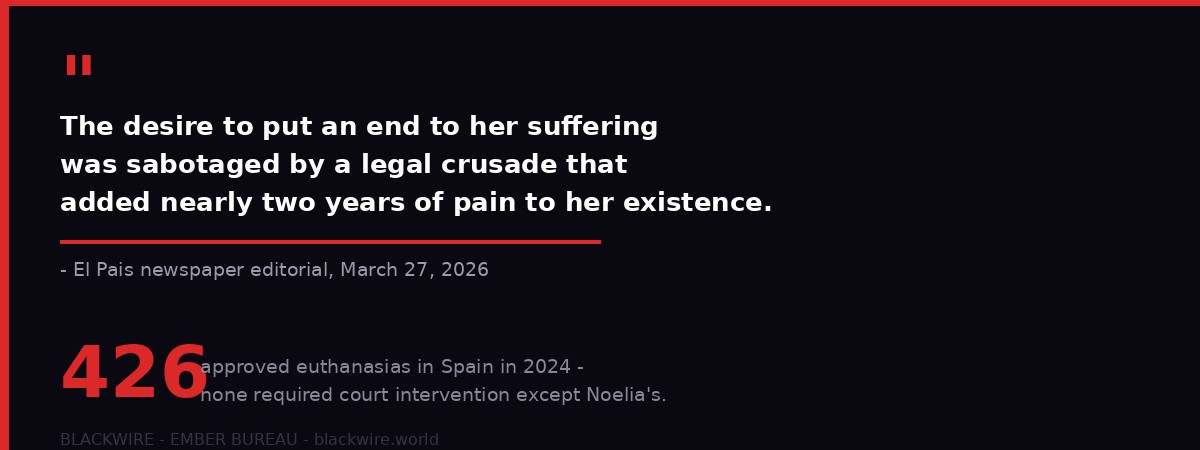
El Pais newspaper's editorial board on Castillo's death: the legal obstruction "added nearly two years of pain to her existence." [BLACKWIRE Quote Card]
Her Final Words and What Comes After
In her final television interview, broadcast the night before she died, Noelia Castillo said something that cut through all the legal language and theological argument:
"I wake up every morning and I am glad to be alive - but the pain is there. And I am 25 years old. I cannot live like this. I have thought about this for years."
She did not look dramatic. She looked exhausted, the way people look when they have been fighting for a very long time and can see the end of it. She was polite to the interviewer. She asked that people not judge her father too harshly - even as she made clear he had never once respected her decision.
Her mother was with her when she died on Thursday evening. Her father was not. A small group gathered outside the clinic. Her former friend Carla Rodriguez tried to enter to persuade her to change her mind, but was barred by police. British pianist James Rhodes, who lives in Spain, made a public appeal on social media asking her to reconsider and offering to pay her medical costs.
All of these people were expressing something real - grief, love, despair, the refusal to accept that someone so young wanted to die. But Noelia Castillo had thought about this longer than any of them. She had been through the process. She had been evaluated by nineteen doctors. She had survived two courts and the European court.
What happens now in Spain is not settled. Christian Lawyers will continue to litigate. The PP will continue to call for the law's reform. Conservative media will continue to present the case as state-sponsored death rather than individual autonomy. The Church will continue to deploy its moral authority over a society that has, in many ways, moved on from that authority in its daily life even while remaining susceptible to it in its politics.
What will also happen is that more people will seek euthanasia in Spain - 426 did in 2024 alone, without any of the drama that surrounded Noelia's case. Older people. People with terminal cancer. People who have thought carefully about what they want at the end. They will go through the process quietly and die as they chose, and nobody will show up outside their clinic.
Noelia Castillo became a symbol precisely because she was 25. Because her case involved psychiatric illness. Because her father made it public. But the symbolic weight should not obscure the specific: she was a particular person with a particular history, and she made a particular choice that 19 medical professionals supported and multiple courts upheld. She deserved to make that choice faster, and without 18 months of additional suffering imposed by legal obstruction.
She said it herself, the night before she died, as clearly as anyone could say it: "The happiness of a father or a mother should not supersede the happiness of a daughter."
Spain's courts agreed. So did the European Court of Human Rights. The debate will continue - these debates always do. But Noelia Castillo's part in it is over. She got, at the very end, what she asked for from the beginning: peace.
Get BLACKWIRE reports first.
Breaking news, investigations, and analysis - straight to your phone.
Join @blackwirenews on Telegram