The Women China Won't Count: North Korea's Forced Brides and a Son's Race to Save His Mother
A woman sold herself into a Chinese marriage so her teenage son could escape North Korea. Now he lives free in Seoul, and she sits in a Chinese prison. Beijing says she's an illegal immigrant. Her son says sending her home is a death sentence. He's right.

On Christmas Eve 2020, a teenager named Geumseong answered his phone with shaking hands. For a year and a half he had lived in Seoul - free, safe, enrolled in school. But the call he had been waiting for since crossing the Yalu River in the dead of night had never come. Until now.
His mother Eunhee's voice came through the speaker, barely words at first. Just sobs.
"Geumseong, Geumseong, can you see me?" - Eunhee, speaking to her son via video call for the first time in 18 months
He showed her his acne, lifted his hair to make her laugh. He was taller now. He took her on a tour of his new home - three floors, a piano. "Wow!" she said. Then the call ended, and they went back to being separated by 1,000 kilometres of enforced invisibility.
That conversation is now six years old. And this week, Eunhee's situation has gone from agonizing to urgent. She's in a prison in northeastern China after an attempt to reach South Korea, and the South Sudanese-born human rights legal theory that has protected tens of thousands of North Korean women in China for three decades may be about to fail her. Beijing has signalled it could send her back. Back to North Korea. Where two women who were repatriated in October 2023 were subsequently executed, according to UN human rights experts.
Geumseong is 21 now. He's doing everything he can think of. He's sent letters to South Korea's foreign minister. He's travelled to China to try to visit his mother in prison - turned away at the gate. He's spoken at Amnesty International events. He's going to keep trying, he says, because stopping means accepting she is already dead.
His story is one story. But it is also the story of a system - a machinery of desperation, exploitation, and geopolitical indifference that has swallowed tens of thousands of North Korean women and produced almost no accountability from the countries most responsible for it.
How a Mother Becomes Merchandise

To understand why Eunhee sold herself into a marriage, you need to understand what North Korea does to women who stay.
The DPRK's public distribution system - the state mechanism for allocating food and goods - has been effectively broken since the 1990s famine that killed an estimated 600,000 to 1 million people, according to academic research compiled by the UN Panel of Experts. Women, particularly those in rural areas near the Chinese border, bear the sharpest edge of this deprivation. They are the ones who haul goods to black markets, who bribe officials for travel permits, who hold families together through systems of informal labour the state pretends does not exist.
Crossing the Yalu or Tumen rivers into China is not a decision made lightly. The border is militarised - electrified fences, CCTV systems installed with Chinese technical assistance, guard posts every few hundred metres. Those caught in the water are shot. Those caught on the other side are handed back. (Human Rights Watch, "These Crimes Against Humanity", 2023)
Yet tens of thousands of women have crossed anyway, because the alternative is starvation or worse. And on the Chinese side, waiting for them, is a market.
China's one-child policy, implemented aggressively from 1980 to 2015, produced a demographic catastrophe: sex-selective abortions and female infanticide driven by cultural preference for boys left the country with an estimated 34 million more men than women. (Reuters, 2021) The deficit is felt most sharply in rural farming communities - the exact communities near the North Korean border. The result is a black-market for brides. North Korean women, desperate and undocumented, are sold into marriages with Chinese men who cannot find wives through legitimate means.
The price, historically, has ranged from a few hundred to a few thousand dollars. The woman receives nothing. The broker who arranged the crossing takes a cut. The men who purchase them are rarely prosecuted. The Chinese government, which knows exactly where many of these women live - because it checks on them regularly - treats them as an administrative inconvenience rather than a population of trafficking victims.
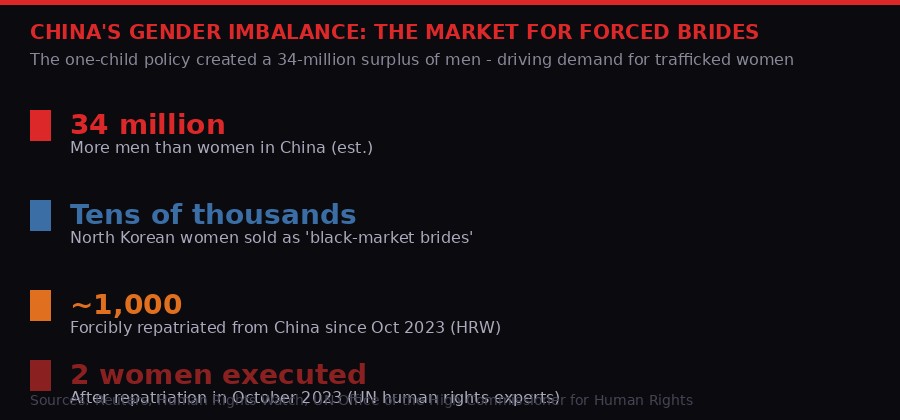
This is the world Eunhee chose - knowingly, strategically, with brutal clarity - to give her son a chance at a different one. At the Yalu riverbank in June 2019, she told Geumseong the plan. She would be sold as a bride. The broker would use the money to fund his 4,000-kilometre journey through China, into Southeast Asia, eventually to Thailand, then South Korea.
He was 14 years old. He was horrified. They parted in minutes, before the border guards could spot them.
The Long Walk Through China
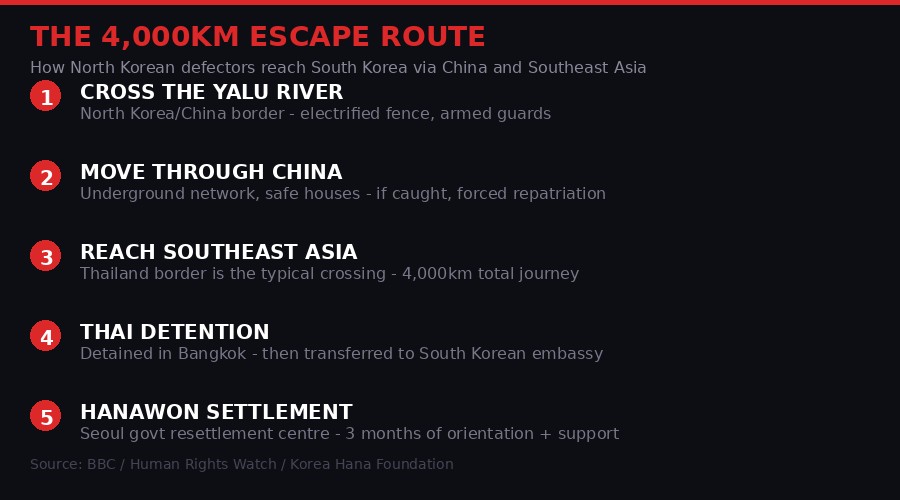
The route Geumseong travelled is one of the most documented secrets in Asia. Human rights organisations have mapped it for decades. Governments know it exists. Brokers charge for it. Safe houses along the way are maintained by a combination of Korean diaspora churches, activist networks, and paid intermediaries whose motivations range from genuine humanitarian commitment to profit.
The underground railroad's core logic depends on China not cracking down too hard. For most of the 2000s and 2010s, Beijing tolerated the movement as long as it was quiet - a calculated look-away at a problem it did not want to solve but also did not want to publicise. Catching too many defectors meant processing them, which meant deportations, which meant international attention.
Geumseong's journey nearly killed him. Somewhere in the middle - he won't say exactly where - he collapsed with what was believed to be tuberculosis. He was so dizzy he could not stand. Other people in his group carried him on their backs across a border crossing into Thailand.
"I was so dizzy I couldn't even stand up. When we finally crossed into Thailand some people carried me on their backs." - Geumseong, speaking to the BBC, March 2026
Thai authorities typically detain North Korean defectors who reach their territory. But Seoul has a standing arrangement: South Korea considers all North Koreans to be citizens under its constitution, and Thai detention is usually followed by transfer to the South Korean embassy and eventual resettlement. It is a bureaucratic process, not a welcoming one - but it works. Geumseong spent three months in Hanawon, the government's dedicated resettlement centre in Seoul, before being placed with a foster family. He enrolled in school. He got taller. He learned to laugh again.
Numbers tell the broader story of how this route has changed. Before 2020, roughly 1,000 North Koreans arrived in South Korea annually. In 2020, after COVID-19 gave both North Korea and China cover to massively reinforce the border - double-layered fences, expanded CCTV, harsher punishments - arrivals collapsed to 229. In 2021 it fell further to 63. Last year, 2025, only 223 defectors made it through. (Korea Hana Foundation, 2026)
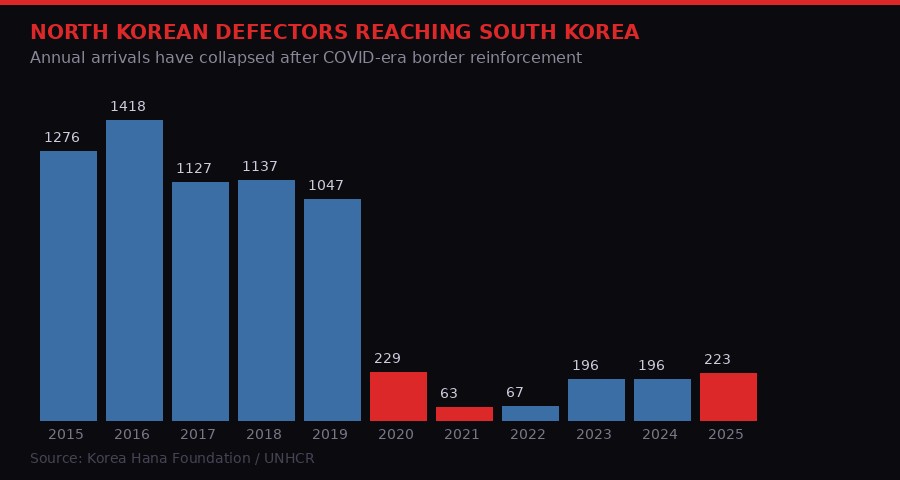
The border did not become impassable for everyone at once. Women already in China - already sold, already married, already invisible - were trapped in place. The route that had allowed some of them to eventually make it to South Korea, or at least to safety, was sealed. The window that Geumseong slipped through had effectively closed.
Sold, Monitored, Forgotten

After Geumseong reached Seoul, Eunhee settled in northeastern China with the man to whom she had been sold. By some measures, she was fortunate. Her husband turned out to be kind. She was not physically abused. She was not locked inside.
But she had no legal status. No documents. No right to work, travel, or seek medical care as herself. She was, in the eyes of Chinese law, a person who did not exist.
The BBC, investigating this story, exchanged messages through an intermediary with four North Korean women currently living in similar circumstances in rural China. Their accounts are consistent with hundreds of testimonies collected by human rights organisations over two decades. The picture they describe is one of profound, structural isolation:
One woman told the BBC she was 16 when sold to a Chinese husband nearly twice her age. He kept her in a barn next to the house and raped her before announcing her as his fiancee to his family. She has been in China for 15 years and has two children who are Chinese citizens. She is not.
The Chinese authorities know where these women are. Police check on them regularly. They collect biometric data - saliva samples, fingerprints, photographs for facial recognition. They warn husbands to keep their wives "in check" and prevent them from leaving the province. (BBC, March 2026)
"They are never legal, never safe - stuck somewhere between being tolerated and controlled. The detention of Geumseong's mother, a woman who gave up her own freedom so her son could reach safety, shows you what happens to those who try to break free of this system." - Lina Yoon, Human Rights Watch
What Beijing gets from this arrangement is essentially free surveillance. It has a database of undocumented North Korean women who cannot protest, cannot organise, and whose exposure would require China to acknowledge it has been running an open-air detention system for trafficking victims for three decades. The incentive to change it is minimal. The cost of changing it - diplomatically, practically - is high.
Eunhee made it through this system for five years. She communicated with her son via WeChat. She worried about whether he was eating. She teased him about his hair. Then in December 2024, she decided enough was enough. She was going to try.
For one month and a half, Geumseong heard nothing. Then came the call he had been dreading.
On January 2, 2025, Eunhee was caught near the Chinese border with Myanmar, attempting to make the first leg of the route south. She was moved to a prison in northeastern China. Geumseong found out from an intermediary. He has been fighting for her ever since.
Repatriation Means Death

This is the part that cannot be softened. When China sends a North Korean defector home, they are not returning them to uncertainty. They are returning them to a system whose treatment of repatriated defectors is thoroughly documented and consistently lethal.
North Korea classifies people who fled the country as traitors. The severity of punishment depends on what they did while abroad. Those who made contact with South Koreans, spent time in churches run by Korean activists, or tried to reach the South face the harshest consequences: interrogation, torture, forced labour in political prison camps, or execution. (UN Commission of Inquiry on Human Rights in the DPRK, 2014 - findings remain current)
Women who were sold to Chinese men are treated as having "gone voluntarily" and having "consorted with foreigners" - a double betrayal in the regime's accounting. The fact that many were trafficked, that they had no agency in crossing the border, does not enter the DPRK's legal calculation.
In October 2023, UN human rights experts cited reports that two women who had been repatriated from China were executed after arriving back in North Korea. Rights groups estimate that as many as 1,000 people have been forcibly returned from China to North Korea since then. (Human Rights Watch, 2025)
Geumseong knows what this means. He has been explicit about it in his advocacy work.
"I just want to ask them to please give her one more chance to live a normal life. I am simply begging China not to send her back to North Korea." - Geumseong, March 2026
Beijing's response to BBC inquiries was bureaucratic: China is "a country ruled by law" and "handles these matters appropriately in the spirit of humanitarianism." The statement explicitly called undocumented North Koreans "illegal immigrants" rather than refugees or trafficking victims - a classification that matters because it removes any obligation under international refugee law.
China is a signatory to the 1951 Refugee Convention. The convention prohibits refoulement - the forced return of people to places where they face serious threat to their life or freedom. Rights groups argue that North Korean defectors clearly meet this standard. Beijing argues they are economic migrants. The argument has been ongoing for 30 years, and China has not moved.
A Cruel Paradox Hiding in Plain Sight

The cruelty at the core of this system is that it works. Not for the women inside it. But for every other party involved.
North Korea maintains control by making the consequences of escape severe enough to deter most people. China gets a buffer of undocumented, exploitable labour that also happens to serve as a migration pressure valve - women who might otherwise fuel further instability in the DPRK get absorbed quietly into rural Chinese communities. Chinese farming families who struggle to find wives get partners who cannot leave, cannot demand rights, cannot organise.
The market operates because it serves multiple interests simultaneously. And because it operates in the gap between two countries that have no interest in it being described clearly.
Lina Yoon of Human Rights Watch describes it as a "cruel paradox": women who are never legal, never safe - tolerated enough to be useful, controlled enough to be silent. They exist in a state of managed invisibility that requires active maintenance from both Beijing and Pyongyang.
The human cost of this invisibility is not abstract. It is a woman in a Chinese prison whose son cannot reach her. It is the 16-year-old sold to a man twice her age who lives in a barn. It is the woman who wrote to the BBC - after 15 years - "I am almost happy."
Almost. That "almost" is doing extraordinary work. It is the distance between a life and something less than one.
Human rights groups have been documenting this system since the 1990s famine first sent women across the border in large numbers. The documentation is extensive. The political will to act on it has never materialised. The diplomatic calculus - China as indispensable trading partner, North Korea as nuclear-armed buffer state - consistently outweighs the rights of undocumented women in rural Jilin province.
The Numbers Behind the Silence

The scale is genuinely difficult to comprehend.
Since the 1990s famine, an estimated 30,000 North Koreans have made it all the way to South Korea. But that is only the ones who got through. The number who remain stranded in China - alive, documented nowhere, embedded in marriages they did not choose - is far larger. Rights groups estimate "tens of thousands" but acknowledge the number is essentially unverifiable. China does not count them. North Korea does not acknowledge them. South Korea has limited leverage to advocate for them.
The 34 million gender gap that drives demand for these women is itself a consequence of state policy - China's one-child system, which produced its demographic imbalance through sex-selective abortion and infanticide over 35 years. That policy ended officially in 2015, but its consequences will shape Chinese demographics for another generation. The surplus of unmarried men in rural areas - estimated at 34 million by 2020, according to Reuters - is not going to resolve itself quickly. The market for trafficked brides will persist.
In South Korea, the 30,000 who made it form a distinct diaspora community: the Saeteomin, "new settlers." They face significant social challenges - discrimination, difficulty finding employment commensurate with their skills (which were developed in a completely different economic system), and psychological trauma from the experiences that brought them there. Mental health support for defectors has improved since Hanawon opened, but it remains inadequate for the depth of what many of them have survived.
For every person in Seoul trying to build a new life, there are unknown numbers who did not make it. Who are still in rural China. Or who were sent back. Or who are in North Korean prison camps right now for having tried.
By the Numbers: The Defector Crisis
Sources: Korea Hana Foundation, Human Rights Watch, Reuters, UN OHCHR
Geumseong's Fight and What It Exposes

What makes Geumseong's case unusual is not its horror. The horror is entirely ordinary. It is the visibility he has managed to create around it.
Most of the women in his mother's situation have no one on the outside with the freedom, the language skills, the connections to human rights organisations, and the sheer relentless energy to draw attention to them. They have family members still inside North Korea who cannot speak. They have Chinese husbands who benefit from their silence. They have no legal status that would give an advocacy organisation grounds to act on their behalf.
Eunhee has a son who got out. Who learned Korean civil society. Who speaks to the BBC. Who writes letters on WhatsApp. That is the asymmetry on which his entire campaign depends - and it is an asymmetry most women in this situation will never have.
His campaign has attracted support from Amnesty International, which has called on China to release Eunhee and grant her refugee status rather than deport her. South Korea's government has been more cautious - Seoul's relationship with Beijing is complicated by trade, investment, and the constant shadow of North Korea's nuclear programme. Public advocacy for individual defectors can be done. Structural confrontation with China over its refoulement policy is politically expensive.
The new South Korean government, led by 35-year-old former rapper Balen Shah - no, that is Nepal, apologies - led by new Prime Minister Ha Deok-su's administration, which took office in late 2025, has not significantly changed Seoul's posture on the China defector question. The diplomatic constraints that have always existed remain.
Which means Geumseong is, for now, doing this mostly alone.
"I can't sit still. I don't have time. Please help me." - Geumseong, from a letter to South Korea's foreign minister
What Accountability Could Look Like

This week - the same week that Geumseong's story was published by the BBC - the UN General Assembly voted 123 to 3 to declare the transatlantic slave trade "the gravest crime against humanity." Fifty-two countries abstained. The United States, Argentina, and Israel voted against. The UK and EU member states sat on the fence.
The UN Secretary-General said that the wealth of many Western nations was "built on stolen lives and stolen labour." He was talking about a crime that ended 200 years ago. He was also, implicitly, talking about the structure that makes crimes like this possible: the deliberate erasure of certain lives from the accounting of what counts as a crime.
The North Korean women in rural China are not in that accounting. They are too few, too invisible, too entangled in geopolitical relationships that larger powers do not want to disturb. The UN's own Special Rapporteur on the situation of human rights in North Korea has repeatedly called on China to stop forcibly repatriating defectors. The reports go to Geneva. Beijing ignores them.
What accountability might look like, practically, is the subject of much debate in human rights circles. Financial pressure on Chinese companies operating in countries that care about these issues. Sanctions designations on Chinese officials responsible for deportation decisions. Inclusion of North Korean forced bride trafficking in the annual US Trafficking in Persons report - which it has been, in various forms, for years - combined with actual diplomatic consequences rather than just language.
None of these things has happened at the scale required to change Chinese behaviour. The calculation, so far, has been that the relationship with Beijing is worth more than the protection of women who exist nowhere in any official document.
That calculation might change. Crises have a way of forcing reassessments. The Iran war has already reshuffled diplomatic relationships in ways that were unimaginable six months ago. A China that becomes more isolated from the Western-aligned bloc of countries could find itself more susceptible to this kind of pressure.
But that is a geopolitical scenario. Eunhee is in a prison right now. The bureaucratic timeline for repatriation decisions is measured in weeks and months, not geopolitical cycles.
The Christmas Eve Phone Call, Six Years Later

On that Christmas Eve call in 2020, Eunhee told her son she had been worried every day of the journey. Whether he was alive. Whether he was sick. Whether the tuberculosis had killed him or the guards had caught him or the checkpoints had swallowed him.
"Do you know how much I thought about you?" she said. "My heart finally feels at ease now."
She had spent two years not knowing if her sacrifice had worked - if selling herself, if giving up the right to her own life, had bought him the one she wanted for him. The call confirmed it had. He was alive. He was tall. He had acne and a piano.
After that call, they talked regularly. She worried about whether he was eating enough. She teased him about his hair getting long. She made a life in northeastern China with a man who turned out to be kind, in a place where she was technically non-existent but practically present.
Then December 2024. The decision. The silence. January 2, 2025. The arrest.
Now Geumseong waits for a different kind of call - the one from an intermediary telling him which way China has decided. He is trying to make sure that call never comes by making enough noise that Beijing finds the cost of sending Eunhee home higher than the cost of looking away.
He travelled to China to try to see her in prison. He was turned away.
He wrote to South Korea's foreign minister: "I can't sit still. I don't have time. Please help me."
He went to Amnesty International events and said, in front of cameras, what Beijing does with North Korean women and what North Korea does to those who come back.
He is one 21-year-old with a phone and a story and a mother in a prison cell.
He is doing everything right. And it still might not be enough. Because the system that put her there is not a mistake. It is a feature. It runs on the same logic that has always run these arrangements - that some lives are worth counting and some are not, and the ones that are not happen to be the ones least positioned to argue otherwise.
Geumseong is arguing anyway. That is the whole of his power, and he is spending every bit of it.
Timeline: Geumseong and Eunhee
Get BLACKWIRE reports first.
Breaking news, investigations, and analysis - straight to your phone.
Join @blackwirenews on Telegram