The Open Window: Kim Tests New ICBM Engine While America Is Buried in the Iran War
North Korea quietly announced a new solid-fuel ICBM engine test on Sunday - a 27% thrust increase over its previous record. The US has 57,000 troops in the Persian Gulf. The timing is not a coincidence.

Kim Jong Un watched the test personally. That detail, buried in a Sunday morning dispatch from the Korean Central News Agency, matters. Kim does not attend tests that go wrong or tests that do not advance his strategic agenda. He attends milestones.
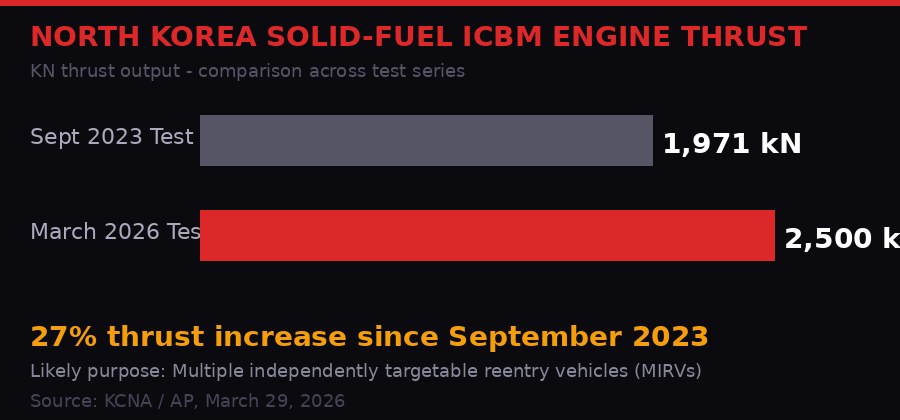
The engine in question: a solid-fuel propulsion unit for a new intercontinental ballistic missile variant. Maximum thrust reported at 2,500 kilotons - up from 1,971 kilotons in the previous benchmark test conducted in September 2023. A 27% increase in raw power. North Korea's state media said the engine uses a composite carbon fiber material in the casing, suggesting reduced weight and improved range. Analysts believe the jump in thrust is specifically designed to push a heavier payload - meaning multiple warheads - to intercontinental ranges while still evading current missile defense architectures.
The announcement arrived at an extraordinarily convenient moment. The United States is 29 days into a hot war against Iran. Its largest military buildup in over two decades is concentrated in one corner of the globe: the Persian Gulf. Two aircraft carrier strike groups, 57,000 troops, 2,500 freshly arrived Marines, and 1,000 paratroopers from the 82nd Airborne Division preparing to deploy. Washington's strategic planners are running the Iran math. Nobody is running the North Korea math. Not publicly, anyway.
This is the story of an open window - and a man who has spent three decades studying exactly when to climb through it.
What the Engine Test Actually Means
To understand why a ground-based jet engine test matters, you need to understand the distinction between liquid-fuel and solid-fuel ballistic missiles. North Korea's older ICBM designs - including the Hwasong-15, which can theoretically reach the continental United States - use liquid propellant. Liquid fuel is dangerous to store, slow to load, and detectable before launch. A liquid-fuel missile must be fueled in the open, giving satellites hours of warning.
Solid-fuel missiles are different. They sit in their silos or road-mobile launchers permanently ready. No fueling window. No warning. You detect the launch, or you do not detect it at all. North Korea's push toward solid-fuel propulsion is not about raw range - it is about survivability and surprise. A solid-fuel ICBM is a first-strike weapon. A second-strike weapon. A weapon you cannot interdict before it leaves the ground.
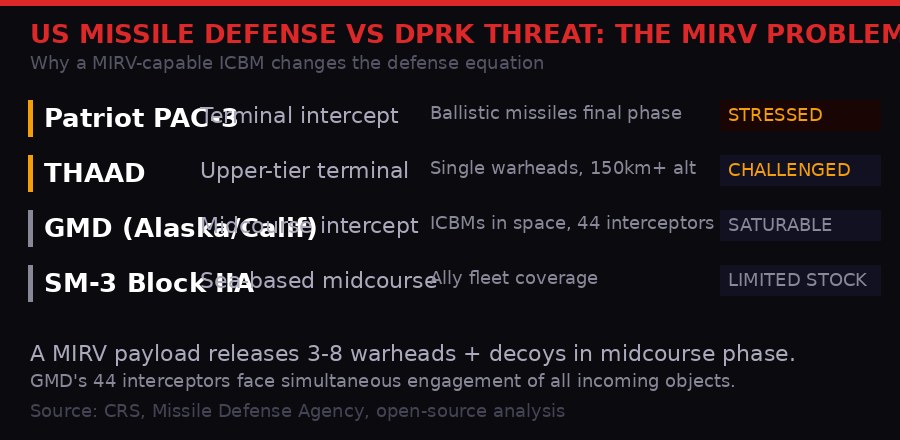
The September 2023 engine test, at 1,971 kilotons of thrust, was already capable of powering a single-warhead missile to US range. The jump to 2,500 kilotons tells analysts something specific: North Korea wants to carry more. Significantly more. The technical path leads toward MIRVing - multiple independently targetable reentry vehicles. A single missile releasing three, four, or more warheads on different trajectories, saturating terminal defenses in ways that even the most advanced Patriot or THAAD batteries cannot fully address.
"A push to increase the engine power is likely associated with efforts to place multiple warheads on a single missile to increase chances of defeating U.S. defenses." - Arms control analysts cited by AP, March 29, 2026
North Korea denies none of this. KCNA said Kim called the test a development of "great significance in putting the country's strategic military muscle on the highest level." It is the most straightforward description of a MIRV program Pyongyang has ever released. They are not hiding the intention. They simply know nobody in Washington can deal with it right now.
Carbon fiber composite materials in the new casing design are another signal. Carbon fiber is lighter than steel. A lighter engine casing means a lighter overall missile weight. Lighter missiles travel farther, or carry heavier payloads at the same range. North Korea is solving for both simultaneously. The five-year military escalation program Kim launched in 2021 is entering its most technically ambitious phase, and it is doing so in the quietest global security environment Pyongyang has seen in years - because every US radar dish that matters is pointed toward Tehran.
Kim's Parliament Speech: The Strategic Doctrine Behind the Test
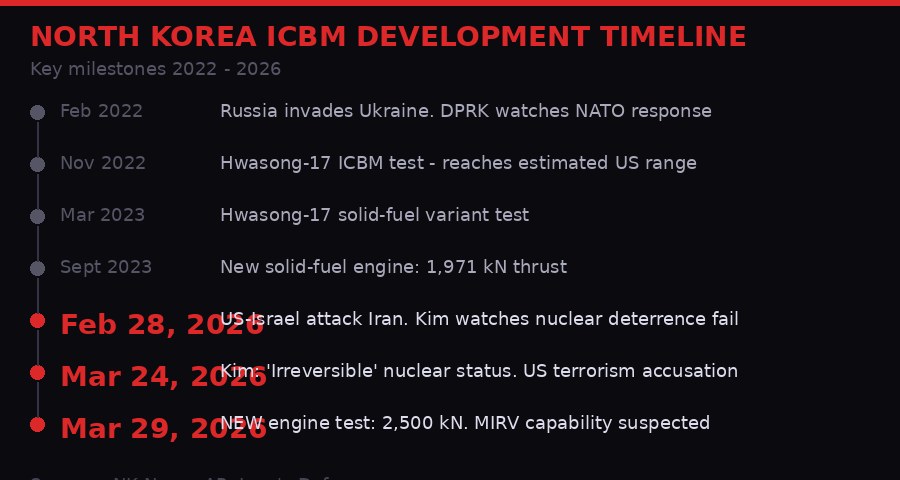
Four days before the engine test, Kim stood before North Korea's Supreme People's Assembly and delivered a speech that read like strategic instructions to his weapons designers. He did not mention Donald Trump by name. He called the United States a practitioner of "state terrorism and aggression" - a reference analysts unanimously read as directed at the US-Israel attack on Iran that began February 28.
The speech was not propaganda for domestic consumption. Domestic propaganda does not contain that level of strategic detail. It was a doctrine statement. Kim was telling his military and his weapons engineers what lessons to draw from watching Iran get bombed. The lesson was simple, and it aligned with every calculation North Korea has made since the 1994 nuclear crisis: only an unambiguous, deliverable nuclear deterrent makes a country immune to US military action.
Iran had enriched uranium for decades. Iran was months away from enough weapons-grade material for a bomb at various points over the past ten years. Iran never built a deliverable warhead. On February 28, 2026, that calculation came due. Kim has been watching. He has been watching since the fall of Muammar Gaddafi, who surrendered his WMD program in 2003 and was dead by 2011. He watched Saddam Hussein. He watched Iranian Supreme Leader Khamenei's 30-year gamble on strategic ambiguity end with B-2s flying over Tehran.
"The dignity of the nation, its national interest and its ultimate victory can only be guaranteed by the strongest of power. The government of our republic will continue to consolidate our absolutely irreversible status as a nuclear power." - Kim Jong Un, address to the Supreme People's Assembly, March 24, 2026 [AP]
The word "irreversible" is deliberate. It appears twice in official translations of the speech. Kim is not making a threat. He is declaring a fact. North Korea's nuclear program is not a bargaining chip. It is the foundation. The engine test four days later is proof-of-concept, not posturing. The doctrine speech came first. The hardware followed.
The revised constitution passed by the assembly - which North Korea's state media announced without specifying the changes - is widely believed to have removed all references to shared Korean nationhood and codified South Korea as a permanent hostile state. That represents a formal end to the political fiction of eventual reunification. The peninsula is not divided temporarily. In Pyongyang's legal framework, it is now divided permanently. That has implications beyond symbolism: it removes any domestic justification for restraint and clears the ideological path for treating South Korean forces as enemy combatants rather than wayward compatriots.
The 57,000-Troop Distraction: How the Iran War Cleared Pyongyang's Sky
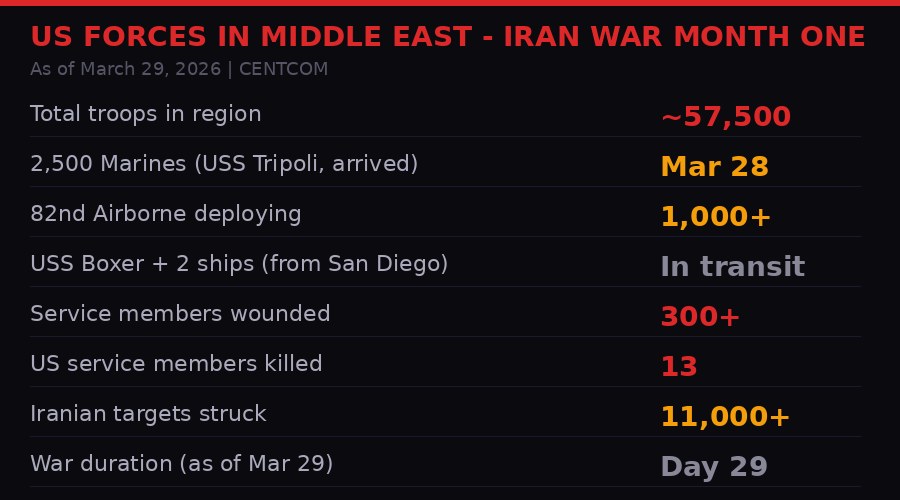
The numbers tell the story. As of March 29, the United States has approximately 57,000 troops in the Middle East for the Iran war. That figure includes two carrier strike groups, elements of the 31st Marine Expeditionary Unit redeployed from exercises near Taiwan, 2,500 Marines aboard the USS Tripoli who arrived in the region Saturday, an 82nd Airborne deployment in progress, and the USS Boxer and two additional vessels inbound from San Diego. The Pentagon's stated posture: give the president "maximum optionality." The actual posture: nearly every rapidly deployable force in the Indo-Pacific has been redirected toward the Persian Gulf.
The USS Tripoli's Japan-based origin is significant. Japan-based US forces exist precisely for rapid response to Korean Peninsula or Taiwan contingencies. The 31st Marine Expeditionary Unit, based at Camp Hansen in Okinawa, is historically the forward rapid reaction force for Pacific crises. It is now in the Gulf. The USS Gerald R. Ford, America's most advanced carrier, is in Croatia for maintenance after a laundry room fire damaged crew quarters. The Pacific thinning is real.
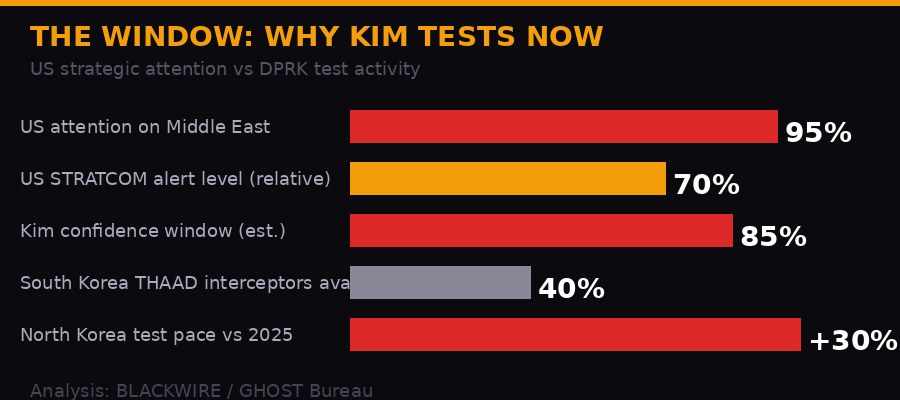
South Korea is not blind to this. In March, Seoul and Washington completed their annual Freedom Shield exercises - but the exercises happened against the backdrop of US assets being stripped from the region. South Korea's THAAD batteries in Seongju are operational, but THAAD is a terminal defense system designed to intercept missiles in their final descent. A MIRV-capable ICBM releasing multiple warheads at different trajectories overwhelms terminal defenses by design. Seoul's vulnerability to a large-scale DPRK missile attack has not decreased. It has potentially increased.
Meanwhile, US Strategic Command - STRATCOM, responsible for nuclear deterrence - is not publicly placing new assets on the Korean Peninsula. Every visible US escalation move is directed toward Iran. Kim can read a map. His intelligence services read it with him. The operational window for testing sensitive capabilities without provoking a US counter-response has rarely been this wide.
North Korea's Belarus Partnership: The Ballistic Missile Technology Pipeline
The engine test does not happen in isolation. Two weeks ago, North Korean diplomatic exchanges with Belarus drew brief attention before being buried under Iran war coverage. The Kim-Lukashenko relationship is not sentimental - it is transactional. Belarus is one of the few remaining states with both Russian-era ballistic missile expertise and a willingness to engage Pyongyang outside international frameworks. Russia's full cooperation pact with North Korea, signed last year and formalized in a sweeping treaty, opened technology transfer channels that now run in both directions.
North Korea sent thousands of troops and large quantities of artillery shells to support Russia's Ukraine war effort. In exchange, Moscow is believed to have provided assistance with ballistic missile guidance systems, submarine technology, and - according to South Korean and Japanese intelligence assessments - elements of solid-fuel propulsion engineering. The 2,500 kiloton engine is not a North Korean invention built in isolation. It is the product of a technology ecosystem that includes Russian aerospace expertise filtered through the cover of a sanctions-evading partnership.
The Belarus angle is a side channel. Kim visited Minsk's figurehead Alexander Lukashenko earlier this year in a diplomatic tour that also emphasized defense cooperation. Lukashenko's military retains institutional knowledge from Soviet-era missile programs, including solid-fuel motor production at facilities that predate the 1991 Soviet collapse. Whatever technical assistance is flowing through Minsk is unlikely to show up in UN sanctions committee reports. The committee is currently spending most of its bandwidth monitoring Iranian sanctions violations related to the ongoing war.
"Kim has recently been prioritizing Russia in his foreign policy, sending thousands of troops and large amounts of military equipment to support Moscow's war in Ukraine, possibly in exchange for aid and military technology." - AP analysis, March 24, 2026
The technology exchange is a long game. North Korea does not need Russian engineers on site. It needs schematics, material specifications, and the occasional private consultation that never appears in official records. Russia has every incentive to provide it: weakening US deterrence posture globally serves Moscow's strategic interest, and the cost is low. An upgraded North Korean ICBM capability does not threaten Russia. It threatens the United States, Japan, South Korea, and Guam. From Moscow's perspective, that is a favorable distribution of risk.
The Patriot Drain: How Iran Already Degraded US Extended Deterrence
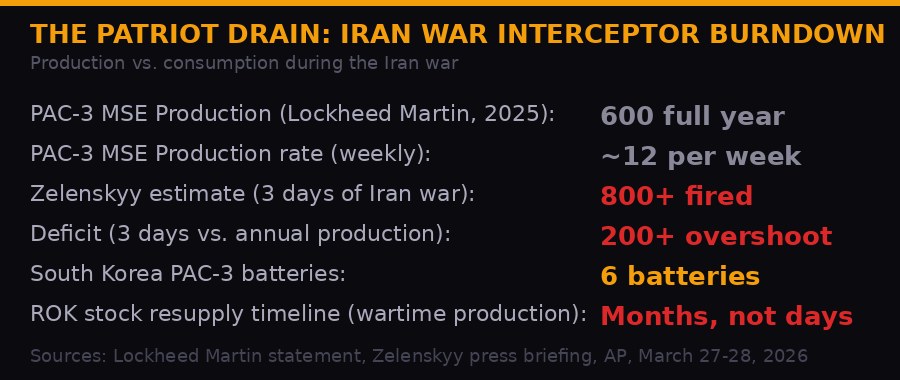
There is another dimension to the distraction calculation, and it is specifically material rather than political. The Iran war has burned through Patriot interceptor stocks at a rate that defense planners describe as alarming. Ukrainian President Volodymyr Zelenskyy, who is now in a diplomatic tour of Gulf states offering Ukrainian drone interceptors in exchange for Patriot missiles, claimed Thursday that Middle Eastern nations expended over 800 PAC-3 MSE interceptors in just three days of the Iran war. For context: Lockheed Martin produced a record 600 such interceptors for the entire year of 2025.
Patriot batteries are the primary US extended deterrence asset for both Gulf Arab states and South Korea. Seoul operates six Patriot PAC-3 batteries. Those batteries are intended to intercept North Korean ballistic missiles. The interceptors they use are drawn from the same production line, the same stockpile, the same global supply chain as the missiles being burned through at Prince Sultan Air Base in Saudi Arabia, at Al Udeid in Qatar, at US facilities across Bahrain and Kuwait.
The math is brutal. If Gulf Patriot batteries are consuming 200-300 interceptors per week against Iranian Shaheds and ballistic missiles, and global production is running at roughly 12 interceptors per week, the stockpile is declining. South Korea's allocation cannot be increased without taking from somewhere else. North Korea knows this. Kim's weapons designers know this. An ICBM that can carry multiple warheads against an adversary whose interceptor stocks are being depleted in real-time by a different war is a dramatically more effective weapon than the same ICBM against a fully stocked, fully focused opponent.
Gen. Dan Caine, chairman of the Joint Chiefs of Staff, said Tuesday that the number of drones launched by Iran had fallen 83% since the war began, as US strikes have taken out manufacturing and storage facilities. The US has struck more than 11,000 Iranian targets in 29 days. Iran fired six ballistic missiles and 29 drones at Prince Sultan Air Base on Friday alone, wounding at least 15 US troops including five seriously. The attrition is real on both sides. The interceptor drain is real. And somewhere in Pyongyang, someone is running those numbers.
Timeline: North Korea's Weapons Program in the Shadow of the Iran War
What Comes After the Test: The MIRV Endgame
North Korea has never successfully tested a multiple independently targetable reentry vehicle. The technology requires precise post-boost control - a bus that carries multiple warheads and releases them on separate trajectories toward separate targets after the boost phase ends. The Soviet Union and the United States both took years to develop working MIRVs. China introduced them on its DF-5 and DF-41 ICBMs over a decade-long development cycle. Pakistan and India are both working toward the capability.
The obstacles are real. Surviving atmospheric reentry remains North Korea's most contested technical challenge - some foreign experts argue Kim's warheads cannot yet reliably survive the thermal and mechanical stress of ICBM reentry. Others dispute that assessment, pointing to the pace of testing and the probability that classified test results exceed what public evidence shows. North Korea has conducted sufficient tests over the past five years that dismissing its capabilities on the basis of assumed failures is increasingly a dangerous assumption.
The new engine changes the equation even before MIRV capability is confirmed. A 2,500 kiloton engine can carry a heavier bus, meaning even a warhead-plus-decoy configuration - one actual warhead surrounded by multiple false targets that look identical to ballistic missile defenses - becomes viable. US THAAD and Ground-Based Midcourse Defense systems, which constitute America's only viable ICBM defense layer, are challenged by decoy saturation. You do not need to detonate six warheads over six cities to defeat US missile defense. You need to release enough objects that the kill vehicles run out of targets before they run out of incoming reentry bodies.
South Korean analysts were studying the Kim parliament speech as recently as Wednesday. Japanese Defense Ministry officials issued a brief statement noting the engine test but offering no specific response. US Pacific Command has not publicly commented. The silence is not necessarily negligence. It may reflect a classified calculus that acknowledges the constraint: Washington cannot simultaneously manage a hot war in the Persian Gulf, sustain a credible deterrence posture on the Korean Peninsula, and conduct aggressive diplomatic signaling toward Pyongyang without risking miscalculation somewhere. Kim is betting on that constraint. Sunday's test is his deposit on that bet.
Analysis: Who Is Watching, and Who Is Not
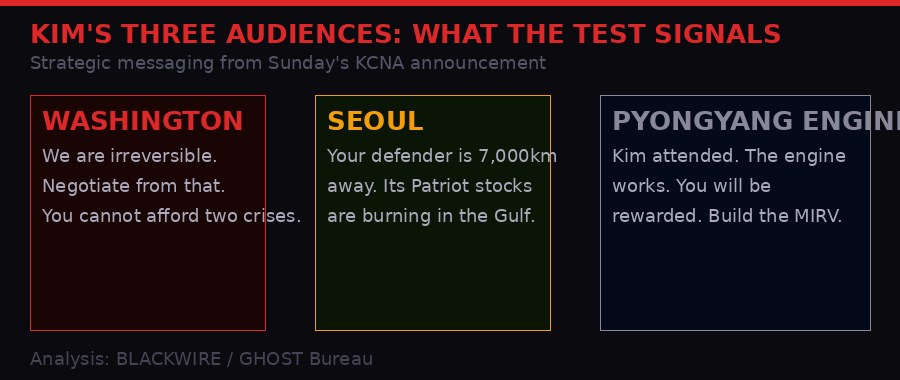
Three audiences received Sunday's KCNA announcement at different levels of intensity.
The first audience is Washington. The message is calibrated: Kim is testing, escalating his technical capability, and doing so publicly enough to register but quietly enough not to demand an immediate US response. He does not want a response right now. A US military response toward North Korea while the Iran war is active is logistically difficult and politically dangerous. Kim is not inviting confrontation. He is inviting recognition - specifically, recognition that his nuclear program is irreversible, that any future negotiations begin from that baseline, and that the US cannot afford a two-front crisis right now. He is right on all three counts.
The second audience is South Korea. Seoul's response to Kim's recent escalation has been measured - its military issued standard monitoring statements and refrained from provocative counter-exercises. The Freedom Shield exercises concluded before the engine test. The message Kim is sending to Seoul is about the futility of the alliance: American forces that protect you are 7,000 kilometers away, bleeding in the Gulf, burning through the Patriot missiles that back up your air defenses. Do the math.
The third audience is Kim's own weapons establishment. State visits and published thrust numbers are how North Korea rewards its scientists and engineers. Kim attended the test personally - that is the highest honor the system can bestow on a technical team. The carbon fiber casing is a significant material science achievement for a country operating under comprehensive sanctions. The engineers who built that casing will receive apartments, food rations, and whatever passes for prestige in Pyongyang. The test is partly a performance management system for a nuclear weapons program that runs on a different kind of incentive structure than anything in the West.
The Iran war will not last forever. Diplomatic channels are open in Islamabad, where Saudi Arabia, Turkey, and Egypt are trying to broker a ceasefire as of Sunday. Trump has given Iran until April 6 to reopen the Strait of Hormuz. Something will break - either the war ends through negotiation, or it escalates in a direction that forces both sides toward terms. When it does, US attention will eventually turn back to the Indo-Pacific. The 31st Marine Expeditionary Unit will return to Okinawa. Some version of normal force posture will reassert itself.
But North Korea will have a new engine. And Pyongyang's engineers will have the data from Sunday's test, feeding directly into the next design iteration. The window Kim is using right now is temporary. The missile he is building is not.
The Broader Pattern: Axis of Opportunity
North Korea is not alone in watching the Iran war create openings. Russia has intensified drone strikes against Ukrainian infrastructure this week, launching what Kyiv described as a massive barrage while US and European attention is pulled toward the Gulf. China has maintained elevated military activity near Taiwan without escalating to crisis level - enough to stress Taiwan's defenses, not enough to trigger a direct US response when Washington's hands are full. Iran's proxies in Lebanon conducted fresh attacks on Israeli positions this week, opening what Israeli military spokesman Brig. Gen. Effie Defrin called preparations for a "multifront war."
The operational pattern across all four cases is consistent. When the dominant global power is fully absorbed by a regional crisis, every revisionist actor in the system takes a measured step forward. Not a sprint that invites immediate retaliation. A step. North Korea's engine test is one step. Russia's stepped-up Ukraine strikes are another. Chinese PLA naval exercises near the Luzon Strait are a third. None of these individually constitute a new crisis. Together, they represent a systematic probe of the limits of US capacity to deter multiple adversaries simultaneously.
Defense Secretary Pete Hegseth said this week that Iran's military has been "so quickly and so effectively neutralized" that it represents a historic achievement. The claim is contested - Iran fired six ballistic missiles and 29 drones at a US base on Friday, wounding 15 Americans. But even if Hegseth's framing is accurate, neutralizing Iran's offensive capacity while 57,000 US troops are committed to that theater does not address what is happening simultaneously in Pyongyang, in Moscow, and in the South China Sea.
The Pax Americana - the idea that US military power is so overwhelming that multiple adversaries cannot simultaneously exploit openings - is being tested in real time. The Iran war is the test. Kim's engine test on Sunday morning is the first graded paper coming back.
Sources: AP (March 29, 2026), KCNA via AP, South Korean defense ministry, US Central Command public statements, Jane's Defence Weekly, NK News, International Crisis Group.
Get BLACKWIRE reports first.
Breaking news, investigations, and analysis - straight to your phone.
Join @blackwirenews on Telegram