Irreversible: Kim Jong Un Just Watched Iran Pay the Price for Not Having the Bomb
Ayatollah Ali Khamenei spent decades enriching uranium and never built a deliverable warhead. On February 28, Israeli intelligence found him through his own city's surveillance cameras and killed him. Kim Jong Un watched all of this happen, and on Monday he stood before North Korea's rubber-stamp parliament and declared that his country's nuclear status would be made "absolutely irreversible." The lesson from Tehran could not have been clearer if someone had written it in the sky over Pyongyang.

North Korea has conducted over 100 missile tests since 2011. The pace has accelerated since the US-Israel attack on Iran. (Photo: Pexels)
The Parliament Speech That Wasn't About Parliament

North Korea's Supreme People's Assembly met for two days starting Sunday. The session passed a revised constitution but did not publicly specify the changes. (Photo: Pexels)
North Korea's Supreme People's Assembly is not a deliberative body. It meets twice a year, votes unanimously on everything, and exists to signal to the outside world what the Kim regime has already decided. When Kim Jong Un appears before it to speak, the words are not spontaneous. They are a broadcast.
Monday's broadcast was targeted directly at Washington. [AP, March 24, 2026]
Kim accused the United States of global "state terrorism and aggression" - a reference so obvious to the Iran war that he did not need to name it. He pledged that North Korea would "continue to consolidate our absolutely irreversible status as a nuclear power" and said the country would "aggressively wage a struggle against hostile forces to crush their provocations and schemes."
He did not call Trump by name. That restraint was deliberate. Analysts in Seoul noted Kim left a sliver of diplomatic daylight open, echoing his February statement at the Workers' Party Congress that Pyongyang was "prepared to respond to any choice" - confrontation or coexistence.
But the strategic core of the message was unambiguous: the bomb stays. The bomb grows. The bomb is the only conversation Kim is willing to have.
"The dignity of the nation, its national interest and its ultimate victory can only be guaranteed by the strongest of power." - Kim Jong Un, addressing North Korea's Supreme People's Assembly, March 23, 2026 (via KCNA state media)
The assembly also passed a revised constitution. The specific changes were not released publicly, but analysts had anticipated the revisions would formally codify South Korea as a "permanent enemy state" and strip language about shared Korean nationhood - completing a legal transformation Kim set in motion in 2024 when he declared reunification was no longer a goal.
What Kim Saw in Tehran: A Case Study in Failed Deterrence
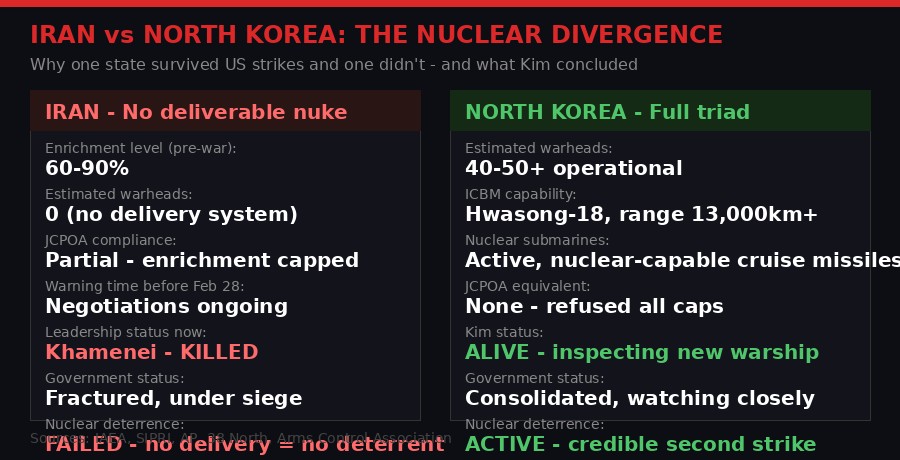
The divergence between Iran's hedging strategy and North Korea's full weapons program - and the consequences of each. (BLACKWIRE Analysis)
Iran had a nuclear program for decades. It enriched uranium to 60 percent, performed centrifuge work equivalent to 99 percent of what is needed for weapons-grade material, and by mid-2025 held 440.9 kilograms of highly enriched uranium according to IAEA estimates - enough theoretically for nine nuclear weapons, according to Robert Goldston of Princeton University's arms control research program.
But Iran never crossed the final threshold. It never weaponized. It never mated a warhead to a delivery system capable of surviving a first strike and threatening a retaliatory second strike. The nuclear program was a pressure tool, a negotiating chip, a deterrent-in-waiting - but not a deterrent in fact.
On February 28, the US and Israel demonstrated exactly how much that distinction matters.
The opening strikes of the Iran war targeted nuclear infrastructure, air defense, command and control, and leadership. They worked. Iran's supreme leader was tracked through his own capital's surveillance network - cameras his security services had installed to monitor dissidents and protesters - and killed. The Iranian government has been fighting for survival on multiple fronts ever since. [AP, March 24, 2026]
North Korea's leadership watched this unfold and drew the obvious conclusion: Tehran's mistake was not building the bomb fast enough, not fortifying enough, not deploying enough. The partial program provided no protection when the adversary decided to act. Every concession Iran made under the JCPOA bought it nothing but time - and ultimately the negotiations themselves became cover for military planning.
"The U.S. military actions on Iran and Venezuela both came despite active negotiations. Analysts have differing views on how that might affect North Korea's desire for diplomacy with the United States." - AP News analysis, March 24, 2026
Kim's February Workers' Party Congress speech came before Khamenei's death. The parliament speech on Monday came after four weeks of war, after the US bombed Kharg Island, after Iran's death toll passed 1,500. The calculus has only hardened.
The Warship and the Cruise Missiles: A Deliberate Message

Kim Jong Un's first public appearance after the Iran war began was an inspection of a new destroyer undergoing sea trials - carrying nuclear-capable cruise missiles. (Photo: Pexels)
Kim's first public appearance after the Iran war erupted was not a speech. It was a show of force.
The North Korean leader inspected the sea trials of a new warship - described by state media as carrying nuclear-capable cruise missiles. The timing was not coincidental. Iran's navy had been decimated by US strikes in the first weeks of the conflict, its vessels sunk or driven into port. Kim was demonstrating, specifically and visibly, that his ships could carry nuclear warheads into combat. Iran's couldn't.
The distinction matters because it defines deterrence. A country that can threaten a nuclear second strike from dispersed platforms - submarines, road-mobile launchers, hardened silos - forces an adversary to solve a nearly impossible targeting problem before any first strike. Iran never achieved that dispersed, survivable capability. North Korea, by most estimates, has.
Hong Min, an analyst at South Korea's Institute for National Unification, told AP that similar strikes to take out North Korea's leadership would be "far riskier and less likely to succeed" than the operation that killed Khamenei. The geography is different. The nuclear arsenal is different. And critically, the early-warning calculus is different: Pyongyang has almost certainly implemented counter-surveillance measures that Tehran neglected after years of warnings about compromised cameras.
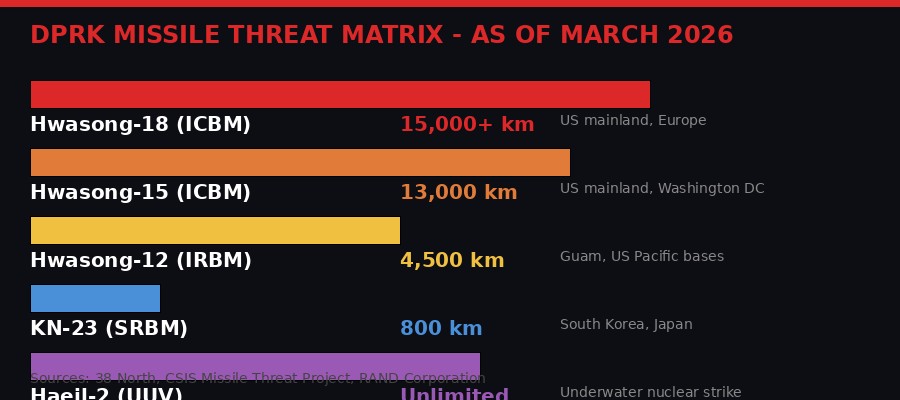
North Korea's missile arsenal threatens targets from Seoul to Washington DC. The Hwasong-18 ICBM, tested in 2023, represents the most advanced land-based nuclear delivery system outside the five permanent UN Security Council members. (BLACKWIRE Analysis / CSIS Missile Threat Project)
Kim's Dilemma: Trump's Window vs. Iran's Warning

Trump met Kim Jong Un three times between 2018 and 2019. Both sides have expressed openness to renewed dialogue - but on radically incompatible terms. (Photo: Pexels)
The North Korean leader is not a monolith. Analysts in Seoul describe a genuine tension inside Pyongyang's strategic thinking - between the deterrence lessons of Tehran and the opportunity costs of permanent isolation.
Park Won Gon, a professor at Seoul's Ewha Womans University, told AP that Kim could feel "greater urgency to seek a deal with Trump" precisely because their unresolved 2019 diplomacy represents a lingering vulnerability. An adversary with no diplomatic channel to Pyongyang is also an adversary with fewer political constraints on military action.
But the Iran precedent cuts directly against compromise. Tehran was in active negotiations with Washington before the February 28 attacks started the war. It had been in negotiations during the 12-day war last year when its nuclear facilities were struck. The pattern is stark: negotiations did not protect Iran. They may have enabled targeting.
Kim Jong Un said as much without saying it. His parliament speech contained an explicit condition for any future dialogue: the United States must drop its demands for nuclear disarmament as a precondition for talks. This is not a new position - Kim has held it since 2019. But the Iran war has transformed it from a bargaining stance into something closer to a blood oath.
South Korean officials have floated the possibility that Trump's expected visit to China in late March or April could open an indirect channel to Pyongyang. Beijing has long-standing leverage with Pyongyang that Washington lacks. Whether that channel produces anything depends heavily on how the Iran war ends - and whether Kim reads the outcome as evidence that adversaries of the US can survive.
"Whether his adversaries choose confrontation or peaceful coexistence is up to them, and we are prepared to respond to any choice." - Kim Jong Un, Supreme People's Assembly, March 23, 2026 (via KCNA)
Japan, South Korea and the Ripple Effects Across Asia

Seoul and Tokyo are watching the Iran war's outcome with specific and acute concern about what it means for their own security architecture. (Photo: Pexels)
North Korea's hardened nuclear posture is not happening in a regional vacuum. Both Japan and South Korea are recalibrating their threat assessments in real time, and the conclusions they are drawing carry long-term consequences for Asian security.
Japan's Prime Minister Sanae Takaichi told Trump during a Washington summit last week that she had a "very strong desire" to meet Kim Jong Un. Kim Yo Jong - Kim's sister and one of the regime's most powerful figures - responded by saying any such summit was off unless Japan dropped its "anachronistic practice and habit." That language almost certainly refers to Japan's historical insistence that North Korea acknowledge and address the abduction of Japanese citizens in the 1970s and 80s, and its refusal to accept North Korea as a de facto nuclear state. [AP, March 24, 2026]
The message from Pyongyang to Tokyo was blunt: drop the preconditions or there is nothing to discuss. Kim Yo Jong did note this was "just my personal position," a rhetorical hedge that signals the door is not permanently bolted - but it is not open either.
South Korea's situation is more acute. Seoul is a metropolitan area of 25 million people within artillery range of North Korean positions. It imports roughly 70 percent of its energy from abroad, much of it through the Gulf shipping lanes now disrupted by Iran's war. The Iran conflict has demonstrated that the United States is willing to take military action without broad coordination with allies - a fact the Trump administration has not tried to obscure.
The US military's extended deterrence guarantee to South Korea has been the foundational assumption of Seoul's security policy for decades. The Iran war has forced South Korean officials to quietly acknowledge that guarantee may not be unconditional - and that an America willing to attack sovereign nations during active negotiations is also an America capable of strategic surprise in Northeast Asia.
China is watching all of this more coolly. Beijing has publicly condemned the US attacks on Iran as "destabilizing" while refraining from any material support that would invite sanctions. But Chinese strategists are drawing the same lesson Kim is - that military capability and deterrence, not diplomatic engagement, are what ultimately protect a state from the kind of pressure Iran has faced.
The Despot's Calculus: Why Iran's Fate Reinforces Every Authoritarian's Instinct
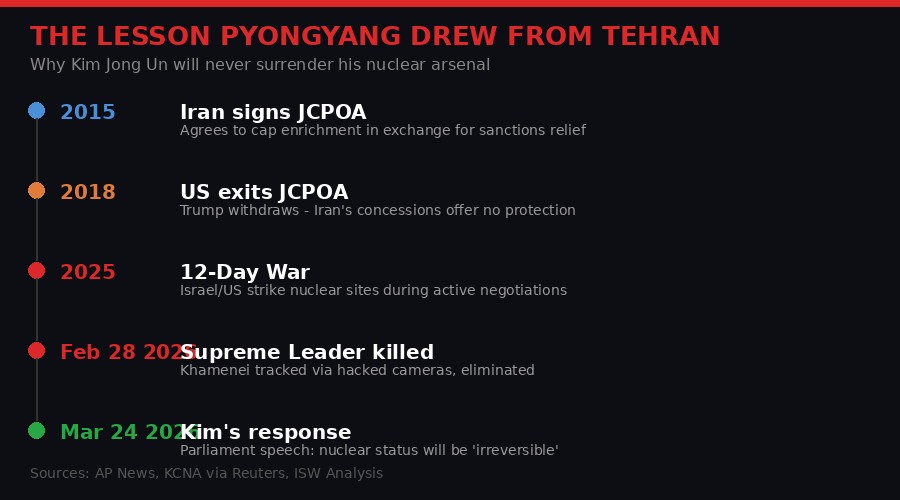
The arc from JCPOA to Khamenei's death is the case study that will define nuclear diplomacy for a generation. (BLACKWIRE Analysis)
There is a broader lesson here that extends well beyond North Korea, and it will reverberate through foreign policy for years.
Iran chose a hedging strategy - build the capability but not the weapon, use the program as leverage rather than deploying it as deterrence. This approach had logic. A country that weaponizes risks preventive war; a country that hedges preserves diplomatic space while maintaining optionality. The JCPOA was the formalization of this logic: Iran traded constraints on its program for sanctions relief and an implicit acknowledgment from the international community that its security concerns were legitimate.
It did not work. The US withdrew from the JCPOA in 2018. The Biden administration's attempts to revive it failed. The 12-day war last year struck Iranian nuclear facilities directly. And on February 28, after years of escalation and hedging, Iran found that partial capability provided no deterrence at all when a willing adversary chose to act.
The lesson authoritarian governments around the world will draw from this is simple and dangerous: go all the way or don't start. A partial program is a target. A complete arsenal with survivable second-strike capability is a deterrent. The middle ground that Iran occupied for decades is the most vulnerable position of all.
Kim Jong Un understood this before the Iran war began. He has spent the past several years building exactly the kind of dispersed, hardened, multiply-redundant nuclear capability that Iran lacked. The warship. The road-mobile ICBMs. The submarine-launched missiles. The hardened tunnels beneath mountains. Each element adds to the targeting problem any adversary must solve before considering a first strike.
In his parliament speech, Kim explicitly connected the nuclear program to regime survival - not as ideology but as practical calculation. "The dignity of the nation, its national interest and its ultimate victory can only be guaranteed by the strongest of power." He has watched a peer regime collapse under military pressure it could not deter. He is not going to repeat that mistake.
The Constitution Change: Making the Hostile State Permanent

North Korea's revised constitution - contents not publicly disclosed - is expected to formalize South Korea's status as a permanent enemy state. (Photo: Pexels)
The constitutional revision passed by the Supreme People's Assembly on Monday deserves more attention than it has received.
North Korea's previous constitution contained language about the eventual peaceful reunification of the Korean peninsula - a rhetorical holdover from decades of official policy that both Koreas would someday merge. Kim effectively killed that policy in 2024 when he declared the North would abandon reunification as a goal and codify South Korea as a separate, hostile foreign country.
The constitutional revision presumably completes that legal transformation. South Korea ceases to be a wayward province to be reunited and becomes a permanent enemy to be deterred. The practical implications for military planning are significant: it removes any political constraint on striking South Korean targets that exists because those targets are theoretically "Korean" territory to be preserved for reunification.
It also signals that Kim has no expectation of détente with Seoul. The Moon Jae-in era of inter-Korean dialogue - the summits, the joint projects, the hotlines - is officially dead, constitutionally interred. Whatever diplomatic maneuvering Kim engages in going forward will be directed at Washington, Beijing, and Moscow - not Seoul.
South Korean officials have largely chosen not to respond publicly to the constitutional change. There is little they can say that helps. But the Lee administration's security planners are fully aware that they are now, by Pyongyang's legal definition, the primary military target in the region.
What Comes Next: Missile Tests, Trump Diplomacy, and the Price of Precedent

US forces in South Korea and Japan maintain one of the densest military deployments in the world - but the Iran war has raised questions about Washington's strategic reliability. (Photo: Pexels)
The trajectory from here is not encouraging for those hoping Kim Jong Un will return to the bargaining table on American terms.
More missile tests are virtually certain. North Korea has used every major geopolitical moment - South Korean elections, US-South Korea military exercises, international condemnation of its weapons program - as an opportunity to demonstrate capability. The Iran war, which has consumed American strategic attention and tied up naval assets in the Persian Gulf, presents exactly the kind of distraction window Pyongyang has historically exploited.
Trump has said he wants to resume dialogue with Kim. He said this in 2018, 2019, and has said it several times since returning to office. But the conditions Pyongyang has set - abandonment of denuclearization as a precondition - are conditions no American president can publicly accept. The domestic political cost of acknowledging North Korea as a permanent nuclear state is enormous. The strategic reality, however, is that it already is one.
The Soufan Center, a New York-based security think tank, noted in analysis published this week that Trump's pattern is to combine military positioning with diplomatic gestures. The Iran war extension of the Hormuz deadline coincided with US Marines heading toward the Persian Gulf. Kim - who watched the Iran negotiations collapse twice while military action proceeded - will be parsing every Trump diplomatic overture through that lens.
Russia remains the wild card. Kim has sent thousands of troops and large amounts of military equipment to support Moscow in Ukraine, deepening ties that provide Pyongyang with both economic relief and technological exchange. Whether Russia is supplying nuclear-relevant technology in return remains a matter of active intelligence debate. What is not in debate is that the Russia relationship insulates North Korea from the kind of total economic isolation that Iran has faced - and makes any "maximum pressure" campaign against Pyongyang substantially harder to execute.
The Iran war will end - by diplomacy, exhaustion, or escalation. When it does, Pyongyang will look at the outcome and make a final calculation. If Iran achieves any meaningful concessions through resistance, Kim will see confirmation that holding firm works. If Iran is crushed or forced into humiliating terms, Kim will see confirmation that only nuclear weapons can prevent that outcome. Either way, the arrow points in the same direction.
The bomb is not going anywhere.
Timeline: Kim Jong Un's Nuclear Doctrine and the Iran Precedent
The Verdict From Pyongyang
Every government in the world is watching the Iran war and drawing lessons. For authoritarian states that have considered or abandoned weapons of mass destruction programs, the lesson is being written in blood and rubble: deterrence that doesn't deter is just provocation with extra steps.
Kim Jong Un did not need the Iran war to convince him that nuclear weapons were existential. He has believed that since before he took power. His father believed it. His grandfather built the ideology of juche - self-reliance - partly around the belief that North Korea could never trust the guarantees of great powers, including the United States and even China.
What the Iran war has done is provide the definitive empirical case study. Tehran made the hedging argument and the diplomatic-concessions argument and the negotiations argument for three decades. It built centrifuges and enriched uranium and signed agreements and made concessions. And when the US and Israel decided to act, all of that bought Iran precisely nothing.
Kim Jong Un stood before his parliament on Monday and called his country's nuclear status "irreversible." He was not making a political speech. He was stating what he believes is a proven fact.
He is probably right.
Get BLACKWIRE reports first.
Breaking news, investigations, and analysis - straight to your phone.
Join @blackwirenews on TelegramSources: AP News (March 23-24, 2026), KCNA via Reuters, South Korea's Institute for National Unification, Ewha Womans University analysis, SIPRI Nuclear Weapons Database, IAEA reports, CSIS Missile Threat Project, 38 North, Arms Control Association, ISW/AEI Critical Threats Project, Soufan Center.