Nuclear Navy: Kim Watches Iran Burn and Accelerates His Fleet
Kim Jong Un stood on the shore at Nampo and watched cruise missiles rise from his new destroyer in plumes of white smoke. Somewhere in the western shipyard behind him, workers were already laying steel for a third warship of the same class. Across the Yellow Sea and far to the southwest, Iran's supreme leader was dead, its navy was at the bottom of the Persian Gulf, and U.S. B-2s were still flying sorties over Tehran. Kim had been watching carefully for thirty days. He did not look alarmed. He looked satisfied.

North Korea in the first months of 2026 has conducted a sprint of military activity that, taken individually, might seem like routine provocation. Read together, and set against the backdrop of an ongoing U.S.-Israeli war against Iran, what emerges is a coherent strategic doctrine: build nuclear deterrence so comprehensive, so layered, and so survivable that no adversary will ever calculate it is worth trying to replicate the Tehran playbook against Pyongyang.
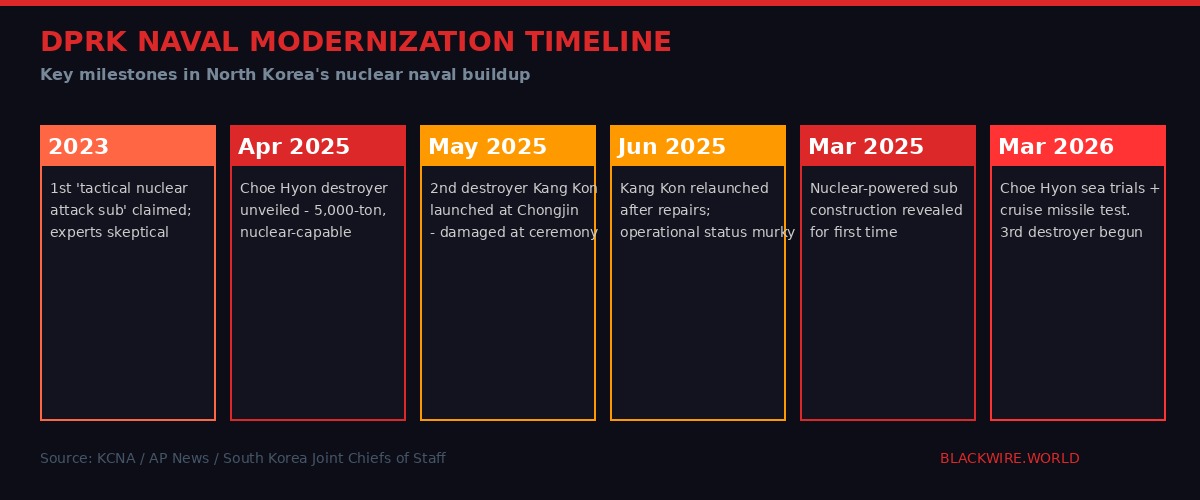
In the past three weeks alone, Kim has overseen sea trials and a live cruise-missile test on the Choe Hyon destroyer, revealed a nuclear-powered submarine under construction at an undisclosed shipyard, ordered construction of a third destroyer, announced an upgraded ICBM solid-fuel engine producing 2,500 kilonewtons of thrust, pledged to build two warships per year for the next five years, and delivered a parliamentary speech calling his nuclear program an "absolutely irreversible" achievement. (AP News, March 2026)
This is not bluster. This is a man who watched what happened when you did not have nuclear weapons and is making sure no one will ever have the same opportunity against him.
DPRK Nuclear Arsenal - Current Estimates (2026)
Sources: South Korea Joint Chiefs of Staff / Arms Control Association / AP News / Seoul National University research
The Ship That Should Not Exist

A 5,000-ton destroyer armed with nuclear-capable cruise and ballistic missiles should not be within the reach of one of the world's most sanctioned economies. North Korea has been cut off from international finance, arms markets, and advanced technology for decades. Its population lives on the edge of famine. Its GDP is measured in the tens of billions - roughly equivalent to a mid-sized American city.
And yet there it was: the Choe Hyon, named after a Korean War-era general, undergoing sea trials at the western port of Nampo while Kim himself watched from the shore. State media showed photographs of the ship at speed, and then footage of cruise missiles - described as "strategic," the DPRK's code word for nuclear-capable - climbing away from the deck in white smoke. (AP News, KCNA / Korea News Service, March 2026)
Kim's response to the sea trials was characteristically grandiose and possibly revealing: he called the development a "radical change in defending our maritime sovereignty, something that we have not achieved for half a century." He did not clarify what he meant by maritime sovereignty. South Korean analysts took note - Kim has repeatedly rejected the Northern Limit Line, the maritime boundary drawn at the end of the Korean War, and his comment may signal an intent to formally contest South Korean-controlled waters using a nuclear-armed surface fleet as leverage.
South Korean military officials and outside experts assessed that the Choe Hyon was likely built with significant Russian assistance. The technical leap from North Korea's previous naval vessels - mostly aging submarines and small patrol craft - to a modern 5,000-ton destroyer carrying anti-air, anti-naval, and nuclear-capable missile systems is not something that happens without outside help. (AP News, citing South Korean military officials)
The Russian connection runs through everything now. North Korea has sent an estimated 15,000 troops to support Putin's war in Ukraine, along with ballistic missiles, artillery shells, and other conventional weapons. In return, Pyongyang has received cash, food aid, energy, and - critically - access to technical expertise that no amount of domestic engineering talent could fully replicate. The Choe Hyon may be one of the most visible products of that exchange.
The Iran Lesson
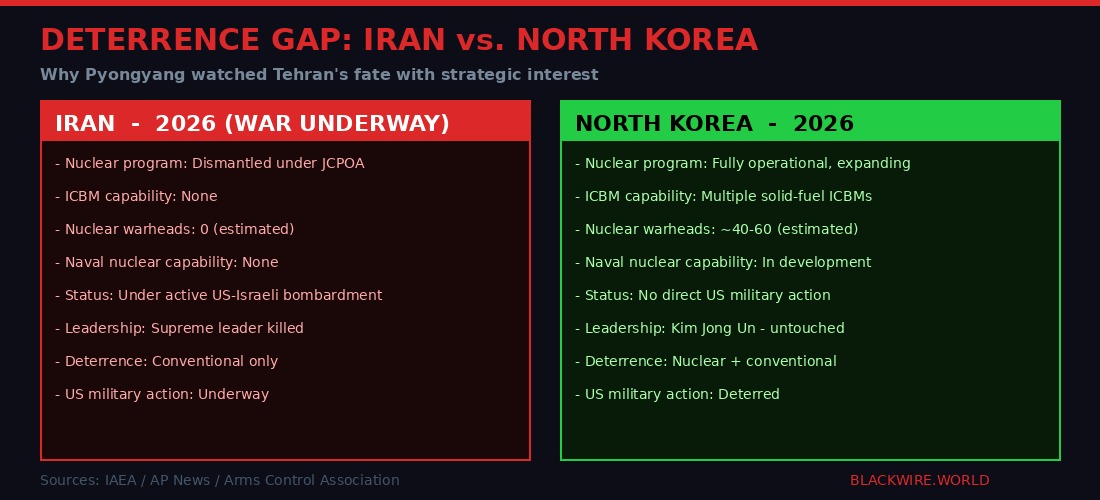
On March 1, 2026, U.S. and Israeli forces launched coordinated strikes on Iranian nuclear facilities and military command infrastructure. Within days, Iran's Supreme Leader Ayatollah Ali Khamenei was dead. Within two weeks, Iran's navy had been largely destroyed and the country's oil infrastructure was under sustained attack. The Islamic Republic, which had projected regional power for four decades, was fighting for survival.
North Korea's Foreign Ministry condemned the attacks as "illegal" and a "most despicable" violation of sovereignty. Notably, observers pointed out, KCNA did not mention Khamenei's death by name. (AP News, March 2026)
The omission was deliberate. Kim did not need to acknowledge the death of a regional power's leader in public. He acknowledged it in the only language that matters to him: he went to Nampo, watched his destroyer fire its missiles, and ordered a third warship started.
Hong Min, an analyst at South Korea's Institute for National Unification, was direct about the implications: "Similar strikes to take out North Korea's leadership would be far riskier and less likely to succeed." The calculation is stark and asymmetric. Iran dismantled parts of its nuclear program under international pressure and diplomatic agreements. North Korea watched that process, concluded it was a trap, and went the opposite direction.
Park Won Gon, a professor at Seoul's Ewha Womans University, argued that Kim might even feel greater urgency to seek some kind of deal with Washington - but not from a position of weakness. The nuclear arsenal, in Kim's framing, is the reason he has the option to negotiate at all. Without it, he calculates he would be Iran. With it, he is untouchable. (AP News, March 2026)
"The dignity of the nation, its national interest and its ultimate victory can only be guaranteed by the strongest of power. The government of our republic will continue to consolidate our absolutely irreversible status as a nuclear power." - Kim Jong Un, speech to Supreme People's Assembly, March 2026 (via KCNA / AP News)
The Submarine Nobody Was Supposed to See

In March 2025, North Korea's state media published photographs of what it described as a nuclear-powered strategic guided missile submarine under construction. The images showed Kim being briefed at an undisclosed shipyard. The vessel appeared to be a 6,000-to-7,000-ton class capable of carrying approximately ten nuclear-capable missiles. (AP News, March 2025)
"It would be absolutely threatening to us and the U.S.," said Moon Keun-sik, a South Korean submarine expert at Hanyang University, when the photos were released.
Moon's assessment went further: Russia likely provided the nuclear reactor technology in exchange for North Korea's weapons transfers. Building a nuclear reactor compact enough and reliable enough for submarine propulsion is among the most demanding engineering challenges in defense technology. North Korea did not develop that capability in isolation. The troops and shells it sent to Ukraine were, in part, paying for this.
The strategic significance of a nuclear-powered submarine is different in kind from anything Kim has fielded before. A nuclear-powered submarine can remain submerged for months. It can operate across the Pacific. It provides what defense analysts call a second-strike capability - the assurance that even if an adversary struck North Korea's land-based missiles and infrastructure in a first strike, survivable weapons on a submarine could still retaliate. That capability, more than any missile test, transforms North Korea's nuclear posture from "threat" to "deterrent."
North Korea currently operates 70 to 90 diesel-powered submarines. Most are aging vessels capable of firing only torpedoes and mines - Cold War relics that could not realistically threaten American carrier groups. The nuclear-powered submarine, when operational, would change that entirely. Moon estimated a possible launch in one to two years for testing, with active deployment to follow. (AP News, citing Moon Keun-sik, Hanyang University)
The U.S. National Security Council responded to the submarine revelation with the blandest possible statement: "We're aware of these claims and do not have additional information to provide at this time." That response, read carefully, is not a denial. It is an acknowledgment wrapped in diplomatic opacity.
The Engine That Changes the Math
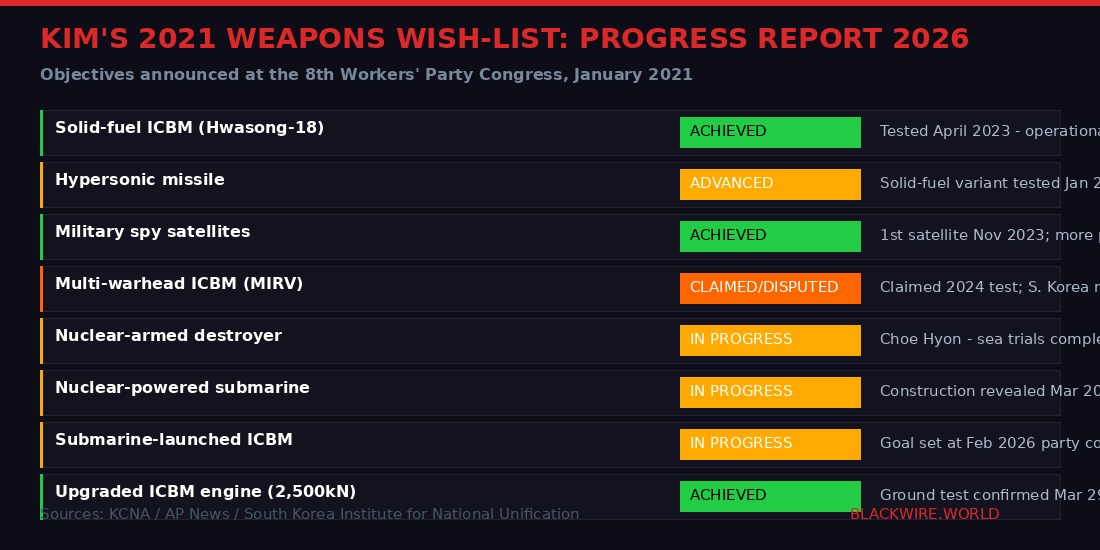
While the Choe Hyon was running sea trials at Nampo, state media also announced that Kim had overseen a ground test of an upgraded solid-fuel engine for intercontinental ballistic missiles. The new engine generates 2,500 kilonewtons of thrust - up from the 1,971 kilonewtons reported in a similar test in September 2024, which itself had been called the "ninth and final" test of that engine series. (AP News, March 29, 2026)
Lee Choon Geun, an honorary research fellow at South Korea's Science and Technology Policy Institute, noted skepticism: KCNA did not disclose total combustion time, a key metric for evaluating an engine's actual capability. North Korea's claim that September 2024 was the "final" test of the previous engine - followed now by this apparently more powerful successor - suggests the program was still developing rather than complete. The delay between the September announcement and the current test indicates either technical setbacks or a deliberate effort to push performance higher, possibly with Russian assistance.
What is not in doubt is the direction of development. A 27 percent thrust increase in the ICBM engine, if real, has significant implications. More thrust means larger payloads. Larger payloads can mean multiple independently targeted reentry vehicles - the MIRV technology Kim specifically called for at the 2021 Workers' Party Congress. A single ICBM that could deliver two, three, or four warheads simultaneously would force any missile defense system to expend multiple interceptors per incoming missile, potentially overwhelming even the most advanced defenses.
Kim told state media the test had "great significance in putting the country's strategic military muscle on the highest level." That phrasing, stripped of its propaganda texture, is technically accurate. Each improvement in solid-fuel propulsion reduces launch preparation time, increases missile survivability, and expands the range of platforms from which an ICBM can be launched - including submarines and mobile road-mobile launchers that are extraordinarily difficult to track and target. (AP News, March 29, 2026)
Kim's Axis: What Russia and Belarus Add

In early March 2026, Belarusian President Alexander Lukashenko flew to Pyongyang and signed a "comprehensive friendship and cooperation treaty" with Kim Jong Un. The two leaders - both Russian allies, both facing Western sanctions, both outside the international order they were once expected to join - found they had much to offer each other. (AP News, March 2026)
Lukashenko gave Kim a Belarusian-manufactured assault rifle as a gift, with a joke that it was "just in case enemies show up." Kim gave Lukashenko a sword and a large vase bearing the Belarusian president's image. The symbolism was heavier than the gift exchange: two pariah governments formalizing a relationship that is militarily and diplomatically useful to both, with Russia in the background of everything.
The treaty followed Kim's September 2025 attendance at a military parade in Beijing marking the 80th anniversary of the end of World War II - the first time Kim, Putin, and Chinese President Xi Jinping had appeared at the same venue. Putin and Kim held bilateral talks at the Diaoyutai state guesthouse, with Putin praising the bravery of North Korean troops in the Kursk border operation and inviting Kim to visit Russia again. (AP News, September 2025)
"If there is more that needs to be done," Kim told Putin publicly, "I will consider it as a fraternal duty...and will be prepared to do everything possible to help."
The Washington interpretation of that alignment was terse. Trump posted on social media to Xi: "Please give my warmest regards to Vladimir Putin, and Kim Jong Un, as you conspire against The United States of America." Putin's foreign affairs adviser called the post ironic and denied any conspiracy. The trilateral relationship is not a conspiracy. It is a transaction, and all three parties are getting something out of it.
For Kim, the transaction is straightforward: troops and weapons for cash, technology, and diplomatic cover. The nuclear submarine likely carries Russian reactor technology. The Choe Hyon likely reflects Russian naval engineering input. The improved ICBM engine may reflect Russian propulsion expertise. Every North Korean soldier who fought in Kursk paid, in some form, for this acceleration of the DPRK's weapons program.
Timeline: The Buildup Since Iran
North Korea Military Activity - March 2026
The American Dilemma

The United States now faces a problem with no clean solution. In the Middle East it is waging active war against a state it judged too dangerous to leave alone. On the Korean Peninsula it is watching another state - far more dangerous, arguably, given the actual nuclear arsenal - accelerate its military capabilities while Washington is operationally distracted.
South Korea is alarmed. Not at North Korea specifically - Seoul has lived with that threat for seven decades. What alarms Seoul's defense establishment is Washington's behavior. The Trump administration launched strikes on Iran while maintaining active diplomatic negotiations. It captured Venezuelan President Nicolas Maduro while talks with Caracas were ongoing. The pattern is clear to U.S. allies who cannot be certain of the rules: the Trump administration will act militarily even when diplomacy is on the table.
"Whether it's Taiwan, North Korea or the U.S.-China competition, there have long been concerns in South Korea that the Trump administration could make overly aggressive decisions without fully considering the potentially serious consequences for its allies," said Hong Min of the Korea Institute for National Unification. "Those concerns are now significant." (AP News, March 2026)
The United States keeps approximately 28,500 troops in South Korea as a deterrent force. That posture has not changed. But Korea watchers in Seoul note that deterrence against North Korea has always rested on two pillars: the nuclear arsenal Kim would face in retaliation, and the certainty of American commitment. The second pillar has developed visible cracks as Washington acts unilaterally in the Middle East while publicly questioning the value of alliance commitments elsewhere.
Trump, at the start of his second term, briefly explored diplomacy with Kim. The February 2026 Workers' Party Congress left the door "open" to talks - but on Pyongyang's terms, which means Washington must first abandon its insistence on denuclearization as a precondition. That is a demand no American administration has formally accepted. And with the Iran war ongoing, the window for focused diplomatic engagement with North Korea is functionally closed for now.
Kim knows this. His parliamentary speech in March was carefully calibrated: harsh enough to maintain domestic nationalist credentials, open enough to preserve the theoretical possibility of future dialogue, and backed by a military sprint that ensures he sits at any future table with maximum leverage. (AP News, March 2026)
What Comes Next: The Five-Year Fleet

Kim's public statements at the Nampo shipyard were unusually specific and unusually ambitious. Two warships per year for five years. A third destroyer already on the hull. A nuclear-powered submarine in active construction. A submarine-launched ICBM as a stated goal for the current planning cycle. (AP News, March 2026)
If even half of that materializes, North Korea's naval posture transforms qualitatively over the next decade. A fleet of nuclear-armed destroyers, backed by a nuclear-powered submarine capable of operating in the Pacific, would give Kim leverage far beyond the Korean Peninsula. It would complicate American carrier group operations in ways that current North Korean naval assets - aging diesel submarines, patrol boats, coastal defense missiles - cannot. It would force any adversary planning a strike against North Korea to account for retaliation from the sea, from assets that may be on the other side of the ocean when the first missiles fly.
The current Choe Hyon likely has meaningful limitations. South Korean experts have questioned whether the second destroyer of the class, Kang Kon, is fully operational after the embarrassing botched launch ceremony in May 2025 - when the ship was damaged and triggered what KCNA described as Kim's "furious" reaction. The Kang Kon was relaunched after repairs in June 2025, but its operational status remains uncertain. (AP News)
But the trajectory is what matters. Every state that has pursued a nuclear naval capability has started with vessels of uncertain reliability and improved with time and resources. If North Korea maintains Russian technical support, if the economic transfers from Ukraine-related weapons deals continue, and if Kim maintains the political will to prioritize military modernization over everything else - all three of which are reasonable assumptions - the fleet he is building will become real and capable within years, not decades.
Some analysts believe the maritime boundary dispute provides the most immediate flashpoint. Kim's claim that nuclear-armed destroyers represent "a radical change in defending our maritime sovereignty" is not subtle. The Northern Limit Line has been the site of multiple deadly naval engagements between South and North Korea. A 5,000-ton destroyer armed with nuclear-capable missiles sitting in disputed waters would be a fundamentally different military and political problem than the aging patrol boats that fought those past skirmishes.
Lee Sung Joon, spokesperson for South Korea's Joint Chiefs of Staff, offered the calibrated response of someone who has learned not to overclaim: "If they complete [a new ICBM], they will test it, and then we will need to make additional assessments of that." The statement applies equally to every development coming out of Nampo and Pyongyang's missile test ranges. They will build it. They will test it. The assessments will trail the capabilities.
The Iran war gave Kim the clearest possible demonstration of what the world looks like for a regional power without a nuclear deterrent. He watched it for thirty days. Then he went to the shipyard and fired his missiles. The lesson was absorbed. The response is already in progress - at Nampo, at an undisclosed submarine yard somewhere on the North Korean coast, and at whatever facility just conducted the 2,500-kilonewton engine test that KCNA announced this Sunday morning.
Get BLACKWIRE reports first.
Breaking news, investigations, and analysis - straight to your phone.
Join @blackwirenews on TelegramSources: AP News, KCNA via Korea News Service, South Korea's Joint Chiefs of Staff, South Korea's Institute for National Unification, Hanyang University submarine expert Moon Keun-sik, South Korea's Science and Technology Policy Institute (Lee Choon Geun), Seoul's Ewha Womans University (Park Won Gon), Korea Institute for National Unification (Hong Min), Arms Control Association estimates.