
The Nostalgia Epidemic: How 2026 Became a Time Loop and Why We Can't Stop Rewinding
Hannah Montana is back. Harry Potter is rebooting. The Devil Wears Prada gets a sequel. The same wars rage in the same deserts. A viral post stripped away twenty years and found nothing underneath.
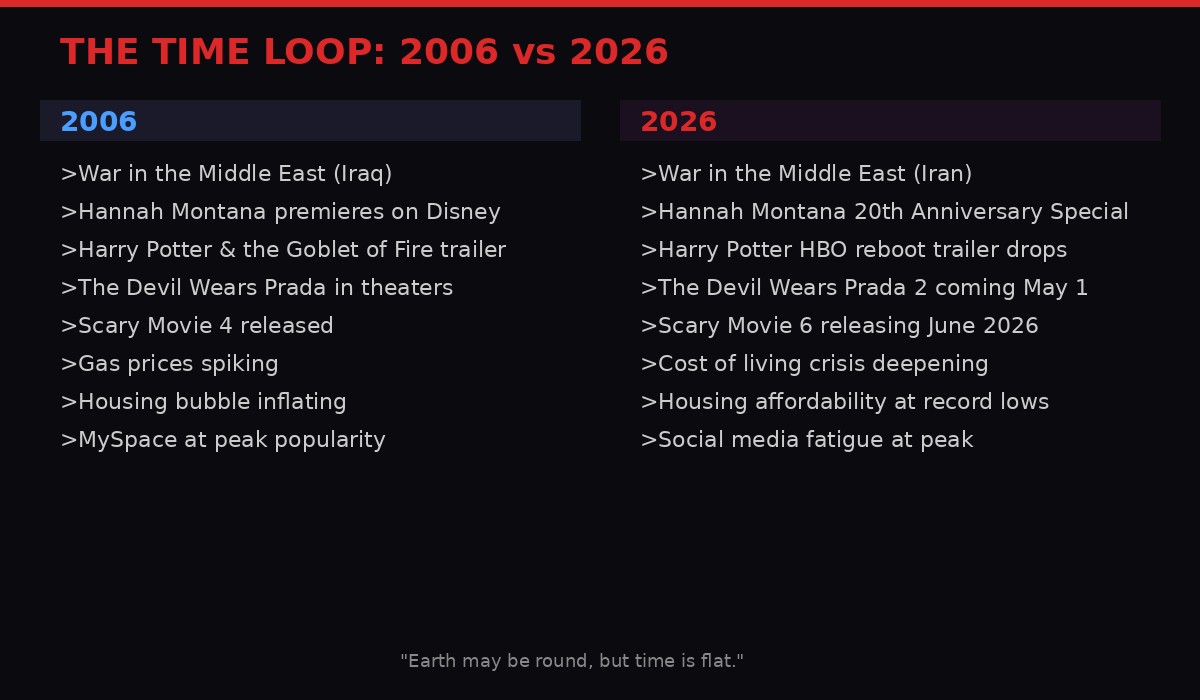
On March 26, a user named @justinaverysmith posted four sentences to Threads that would be liked more than 54,000 times in under a week. The post was brutally simple. No analysis. No argument. Just two parallel blocks of text, one labeled 2006, the other 2026.
"The year is 2006. There's an illegal war in the Middle East. Miley Cyrus is Hannah Montana. A new Harry Potter trailer just dropped. The year is 2026. There's an illegal war in the Middle East. Miley Cyrus is Hannah Montana. A new Harry Potter trailer just dropped."
The comments came in waves. "We've also got a Devil Wears Prada movie coming out like in 2006," one wrote. Another: "Can we get 2006 rent prices please?" And the one that stuck: "Earth may be round, but time is flat."
That post didn't go viral because it was clever. It went viral because it articulated something millions of people had been feeling in their bones but couldn't quite name - the creeping sensation that 2026 isn't a new year so much as a remastered edition of one we already lived through. Same franchise. Different resolution. Higher price tag.
This is a story about what happens when an entire culture decides the past is safer than the present. About how nostalgia stopped being a feeling and became a business model. About the humans caught in the loop - the ones buying tickets, streaming specials, and wondering why nothing feels new anymore even as everything moves faster than ever.
The Hannaversary: When Disney Sold You Your Own Childhood

On March 24, 2026, the "Hannah Montana 20th Anniversary Special" premiered on Disney+. The one-hour retrospective featured Miley Cyrus, now 33, walking through the original set, pulling old costumes from Hannah's iconic rotating closet, and sitting down with podcast host Alex Cooper for an interview that was, by most critical accounts, warm but deliberately shallow.
Cameos came from expected corners - Selena Gomez showed up - and less expected ones. Chappell Roan, a pop star who was three years old when the show premiered, appeared for reasons that confused reviewers at Brown University's student paper and charmed everyone else. There was a new song. There were sequins. There were tears.
Dozens of bars across the United States hosted watch parties. At the Nickel Mine sports bar in Los Angeles, a bartender in a blond wig calling himself "Mannah Gaytana" ran themed trivia rounds. Correct answers earned free shots. The cocktail menu featured "Sweet Niblets Margaritas" and "Rock Star Mocktails." Grown adults who pay rent and file taxes screamed when Cyrus appeared on screen, as reported by NBC News.
Betaneya Tammerat, 23, told NBC she wanted to emulate Hannah's confidence as a child. "This 20th anniversary just reminds me how special that she really was to not just me, but so many other people. She seriously is not just a character, but someone who has helped me grow up as a person."
Angelica Breton, 28, said she still blasts the Hannah Montana soundtrack while driving the Pacific Coast Highway. She attended both the Disney+ premiere and a pop-up event at The Grove mall in LA. Her childhood closet included pieces from the Hannah Montana Walmart fashion line.
Cyrus herself framed the special as an act of personal reclamation. "I used to think of Hannah as something separate from myself," she said during the broadcast. "What I'm loving about this special is that it's my kind of reclaiming, of merging, Hannah and Miley together." It was a genuine moment embedded in what USA Today's columnist called "another attempt from the Mouse to capture the nostalgia of Gen Z for capitalistic gain." The columnist then immediately admitted it worked on her too.
Ashley Spencer, author of "Disney High: The Untold Story of the Rise and Fall of Disney Channel's Tween Empire," offered crucial context. Hannah Montana aired in an era before social media dominated daily life. Kids went to school "knowing everyone else watched Hannah Montana last night," she told NBC. "There's really nothing like it today. And it's hard to think that there could be unless the landscape completely changed again." The show's power came from its monoculture reach - a shared experience that no single streaming show in 2026 can replicate. Disney isn't just selling the show back to you. It's selling the experience of watching something together, which may be more extinct than the show itself.
The special is currently exclusive to Hulu in the US until June, a calculated scarcity play that drives subscriptions. Disney knows exactly what it's doing. It took a show about a teenager with a double life and gave it a third: revenue stream for a company whose stock has been battered by streaming losses.
The Boy Who Lived, Again: HBO's $300 Million Gamble on Familiarity

One day after the Hannah Montana special, HBO dropped the first teaser for its Harry Potter television reboot. The trailer showed what fans both hoped and feared: Hogwarts, Hagrid, Hedwig, a new boy wizard - and virtually identical framing to the 2001 film. Reddit users immediately produced side-by-side comparison videos showing the 2026 trailer matched the original movie shot-for-shot.
"Not adding anything new, just regurgitating nostalgia," read the top comment on the r/television thread, which racked up thousands of upvotes. Forbes contributor Dan Di Placido went further, calling the reboot "the latest symptom of nostalgia culture, another story that has already been told, returning with a near-identical face."
Business Insider's analysis was more sympathetic but arrived at a similar conclusion: "A pure reboot makes sense as a course correction. Returning to the beloved settings, characters, and details from the original books - Hogwarts! Hagrid! Hedwig! - seems like a foolproof way to lure new viewers and nostalgia-bait existing ones." The framing is telling. "Nostalgia-bait" has become an industry term, not an insult.
The numbers behind the reboot tell the corporate story. HBO committed an estimated $300 million to the series, according to World of Reel, with plans for each season to adapt one book from the seven-novel saga - a full decade of content from a single intellectual property. Warner Bros. Discovery needs this to work. The company has staked its streaming future on Max, and Harry Potter is the kind of franchise that sells subscriptions the way Hannah Montana sells themed margaritas - through feelings, not features.
BuzzFeed ran a piece titled "Hollywood's Obsession With Nostalgia Is Stripping Classics Off Their Charm, And We Need To Talk About It," grouping the Harry Potter reboot alongside the announced 13 Going On 30 remake. The article concluded that nostalgia-driven content wouldn't slow down because "given the nature of society, audiences will still want that feeling of comfort films." It was less a prediction than a diagnosis.
Truffle Culture, an editorial platform, framed the question even more sharply: "Are reboots preserving culture or rewriting it?" Their answer was neither. Reboots are freezing culture in place - creating the illusion of newness while ensuring nothing actually changes. The Harry Potter series premieres Christmas 2026, which means for the entire year, the biggest show on the planet's biggest streaming platform will be a story first published in 1997.
The Reboot Assembly Line: What's Coming in 2026
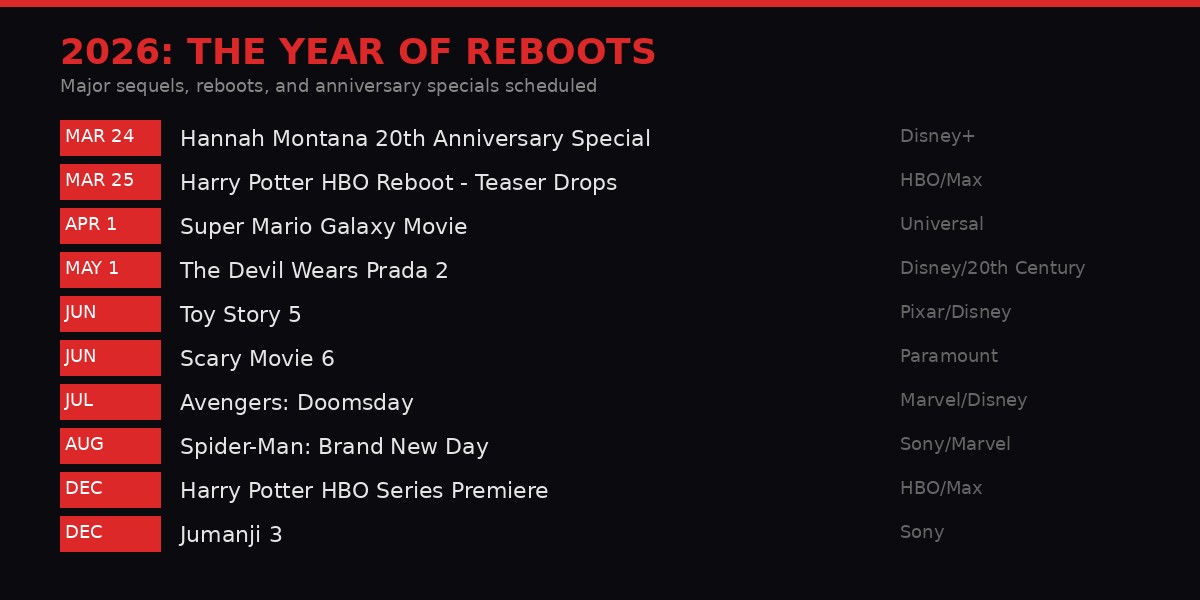
The Hannah Montana special and the Harry Potter reboot aren't outliers. They're the lead cars of a freight train. Here's what 2026's entertainment calendar actually looks like when you strip away the marketing language and count the sequels.
April 1 brings The Super Mario Galaxy Movie, a sequel to the 2023 animated film that grossed $1.36 billion worldwide - the kind of number that makes studio executives physically unable to greenlight original content. Early tracking from SlashFilm suggests the sequel will set 2026's opening weekend record, potentially clearing $200 million domestic. The first film proved that brand recognition plus childhood attachment equals guaranteed returns. The sequel doesn't need to be good. It needs to be Mario.
May 1 brings The Devil Wears Prada 2, with Meryl Streep, Anne Hathaway, Emily Blunt, and Stanley Tucci all returning. The original came out in 2006 - the same year as Hannah Montana's premiere, which makes the timing feel less like coincidence and more like an archaeological dig. Disney's 20th Century Studios label is handling distribution. The sequel reportedly addresses fashion in the social media era, which sounds like a natural evolution until you remember that the original already worked because it wasn't about fashion. It was about a young woman navigating power dynamics. The sequel is reportedly set twenty years later. Twenty years. The math writes itself.
June delivers a double hit: Toy Story 5 from Pixar and Scary Movie 6 from Paramount. The Scary Movie franchise started in 2000. It's now old enough to rent a car. Toy Story began in 1995. It could run for Congress. Both franchises are being revived because they carry built-in audiences measured in billions of tickets sold. Scary Movie 6's official description is almost self-aware: the cast will "slash through reboots, remakes, requels, prequels, sequels, spin-offs, elevated horror, origin stories, anything with the word legacy in it, and every 'final chapter' that absolutely isn't final." A parody franchise mocking the reboot culture it's simultaneously participating in. The serpent is eating its own tail and somehow still selling tickets.
July brings Avengers: Doomsday, the latest chapter in Marvel's sprawling franchise that's been running continuously since 2008. August has Spider-Man: Brand New Day. December stacks Jumanji 3 alongside the Harry Potter series premiere. Shrek 5 is confirmed for June 2027, already casting its shadow backward.
Count the original intellectual properties in 2026's top-grossing projections and you'll need fewer fingers than a mittened hand. The entertainment industry hasn't abandoned new ideas. It's just discovered that old ideas are cheaper, safer, and arrive with pre-built marketing in the form of an entire generation's emotional infrastructure. Every childhood memory is a focus group that already returned positive results.
The Psychology of Rewinding: Why Your Brain Craves 2006
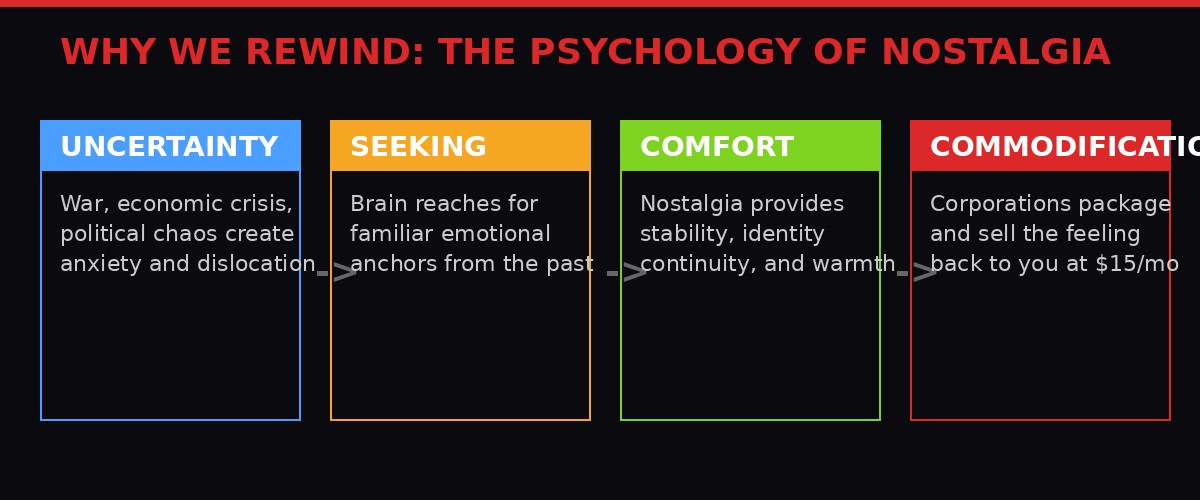
The question isn't really why studios keep making reboots. That answer is money, and money is boring. The more interesting question is why we keep buying. Why does a 28-year-old woman blast Hannah Montana songs on the Pacific Coast Highway? Why did 54,000 people smash the like button on a post that compared two years they've already lived through? Why does the word "Hogwarts" still trigger dopamine in adults who pay mortgages?
The psychological research is clear and, in 2026, feels uncomfortably prescient. A study framework from VWC News summarizes the consensus: "Transitional periods - such as moving to a new city, starting a new job, or navigating adulthood - can lead to a sense of uncertainty and a desire to find stability and comfort. Nostalgia provides a way to reconnect with the familiar, drawing strength and meaning from past experiences."
Now scale that from individual transition to collective crisis. In 2026, the United States is fighting a war with Iran that has shut down the Strait of Hormuz and cratered the Arab world's economy by an estimated $194 billion, according to BLACKWIRE's own reporting. Gas prices are spiking. The cost of living continues to climb. Political polarization has reached a pitch where even protest sign design has become an art form - the No Kings Day demonstrations featured slogans that went viral precisely because they were "engineered," as IBTimes UK noted, with "every word designed to land fast and stick."
This is the soil nostalgia grows in. Not boredom. Fear.
Clay Routledge, a social psychologist who studies nostalgia, told the New York Times that Gen Z's fascination with the 1990s and 2000s stems partly from imagining a life with less technology. The appeal isn't the past itself - it's the simplicity the past represents. A time before doomscrolling. Before AI-generated deepfakes. Before your phone could show you a war in real time while also trying to sell you a mattress.
Advertising Week published a piece in March 2026 that reframed nostalgia not as a consumer quirk but as a "strategic audience insight." The conclusion was blunt: "Your consumers aren't reliving the past. They are remixing it. They crave the emotional familiarity of what they loved before, paired with the freshness of discovery." The industry term for this is "recession pop" - the cultural tendency for nostalgia to spike during economic downturns. It happened in 2008-09. It happened during COVID lockdowns. It's happening now.
The Wikipedia entry on nostalgia, updated in March 2026, includes a section noting that "accelerated change can produce feelings of uncertainty and dislocation, leading individuals and groups to engage nostalgically with the past as a way of restoring a sense of continuity and stability." It reads like a clinical description of the exact feeling that viral Threads post was tapping into.
Anthony Palomba, a University of Virginia assistant professor of business administration, told the Darden School of Business blog that the Hannah Montana resurgence works because "nostalgia functions as both emotional and economic leverage." Both. Not one or the other. The emotion is the product. Disney isn't selling you a TV special. It's selling you the memory of being nine years old and not knowing what a recession was.
The Comfort Trap: When Looking Back Keeps You From Looking Forward

There's a version of this story that ends warmly. Nostalgia heals. It connects generations. It gives people something to share. Angelica Breton finding her tribe at a Hannah Montana watch party is genuinely beautiful. Adults singing "Best of Both Worlds" at a bar in Los Angeles, temporarily free from whatever their Mondays look like - that's real connection, and dismissing it would be dishonest.
But there's a cost to the loop, and it's cultural.
When every major studio release in 2026 is a sequel, reboot, or anniversary special, the industry isn't just serving nostalgia. It's starving originality. Every dollar spent on Harry Potter Season 1 is a dollar not spent on a story that hasn't been told. Every development slot occupied by Scary Movie 6 is a slot unavailable to a first-time screenwriter. The pipeline doesn't just favor familiar IP - it actively penalizes the unfamiliar.
The Brown Daily Herald's review of the Hannah Montana special captured this tension precisely. The reviewer noted that while the special was "only worthwhile for dedicated fans," it was also clearly designed to recruit new ones through influencer guests like Alex Cooper and Chappell Roan. The past is being renovated to look like the present, which creates a strange paradox: the thing that makes nostalgia powerful - its distance from now - is exactly what the industry is trying to collapse.
Variety's take on Cyrus's return was more generous but landed on the same fault line. "If Hannah Montana was murdered way back when," the critic wrote, "Cyrus performed an act of mercy in bringing her back to life in 2026." The metaphor is revealing. A mercy killing reversed. A resurrection nobody asked for but everyone showed up to watch. The question isn't whether Hannah Montana deserved a 20th anniversary special. It's whether a culture that can only celebrate what it already knows is capable of creating what comes next.
Consider the numbers from a different angle. In 2006, the top-grossing films included Cars (Pixar's first original since Finding Nemo), The Departed (Scorsese's crime thriller), and Casino Royale (which reinvented James Bond rather than rehashing him). Original stories competed with franchises and frequently won. In 2026, the top-grossing films are almost exclusively sequels or reboots. The market hasn't just tilted. It's collapsed onto one side.
Her Campus published a piece in March 2026 about the psychology of rewatching comfort shows. The conclusion was gentle but carried an edge: "Rewatching comfort shows is less about wasting time and more about seeking emotional stability. In a fast-paced world full of uncertainty, returning to familiar stories offers reassurance, connection, and calm." Reassurance, connection, and calm. These are things people seek when they're frightened. The comfort show isn't entertainment. It's self-medication.
The War in the Room: Why Politics Makes Nostalgia Dangerous

That viral Threads post wasn't just about pop culture. Its most charged line was its most understated: "There's an illegal war in the Middle East." In 2006, that meant Iraq. In 2026, that means Iran. The parallelism is deliberate. The political implications are enormous.
Newsweek's coverage of the post noted that the creator had liked a comment reading: "Hopefully midterms 2026 go the same way as the midterms in 2006 and is a blowout for Dems." The comparison between years isn't politically neutral. It's an argument dressed as observation - the suggestion that history is repeating, and that the same corrective (a midterm wave) is both possible and necessary.
Social Samosa's cultural recap of March 2026 tied the nostalgia surge directly to political unrest: "The protests brought together people responding to a range of issues: the administration's immigration policies, the war with Iran, the cost of living, and what many described as an authoritarian shift in governance." Nostalgia, in this context, isn't escapism. It's political memory. When people say "I want 2006 back," they're not really asking for flip phones and MySpace. They're asking for a time before the current crisis, which is a way of saying the current crisis isn't normal - even if it feels permanent.
The No Kings protests, which began in October 2025 and have continued into 2026 with plans for a Minnesota general strike, draw explicitly on the language and iconography of earlier movements. IBTimes UK reported that protest signs in 2026 "aren't just written, they're engineered. Every word counts. Every phrase is designed to land fast and stick." The signs reference pop culture. They reference memes. They reference a collective cultural vocabulary that is, itself, built on nostalgia - on shared references that only work if everyone in the crowd watched the same shows, read the same books, grew up in the same media ecosystem.
This is where nostalgia becomes more than an entertainment trend. When a generation's shared cultural reference points are all sequels and reboots, the political imagination contracts too. The past becomes not just comfortable but inevitable. If the same stories keep coming back, maybe the same wars do too. Maybe the same economic cycles. Maybe the same broken systems. Nostalgia whispers that the loop is natural. That history really does repeat. That all you can do is find your favorite seat in the theater and watch it play again.
That whisper is a lie. History doesn't repeat. People repeat. Institutions repeat. Studios greenlight what worked before because it's safer than betting on what hasn't been tried. Governments wage wars in the same regions because the geopolitical interests haven't shifted. Protest movements reach for the same tools because the toolbox hasn't been updated. The loop isn't cosmic. It's structural. And mistaking structure for fate is how you end up twenty years into the future watching the exact same movie.
The Diaspora of Memory: Who Nostalgia Leaves Behind

Here is what the nostalgia conversation almost never addresses: whose nostalgia are we talking about?
The Hannah Montana 20th anniversary was a cultural event primarily for Americans who grew up with cable television in the 2000s. The Harry Potter reboot speaks to English-speaking audiences who discovered Rowling's books in a specific window of childhood. The Devil Wears Prada 2 assumes you care about the original, which means you probably saw it in theaters or on DVD in a country where both were widely available. These properties aren't universal. They're Western, English-language, middle-class memories being treated as global culture.
Rest of World, a publication that covers technology's impact outside Western markets, has documented extensively how global streaming platforms export American nostalgia as default content. When Netflix or Disney+ expands into India, Nigeria, or Indonesia, the homepage doesn't lead with local anniversary specials. It leads with Harry Potter. With Marvel. With properties that carry built-in audiences in the United States but require active cultural adoption everywhere else.
This creates what cultural theorists call "nostalgia colonialism" - the imposition of one culture's memories as everyone's memories. A 23-year-old in Lagos didn't grow up watching Hannah Montana on Disney Channel. She may have encountered it later, secondhand, through social media. Her nostalgia - for Nollywood films, for local music, for the specific texture of her childhood - isn't being packaged, marketed, or celebrated on any global platform. It's invisible to the algorithmic timeline that surfaces the Hannaversary as a trending topic worldwide.
Even within the United States, nostalgia is stratified by class. Ashley Spencer's observation that Hannah Montana worked because "everyone watched it last night" obscures who "everyone" actually was. Cable television in 2006 wasn't free. Disney Channel was a premium tier in many markets. The families who watched Hannah Montana together in real-time tended to be families who could afford cable, who had a TV in the living room, who weren't working second shifts. The nostalgia economy doesn't just sell you your childhood. It sells you a specific childhood - the comfortable one, the suburban one, the one with enough time and money to watch a show about a pop star with a secret identity.
The viral Threads post's most revealing line might be its least discussed: "Can we get 2006 rent prices please?" That comment, which appeared in the flood of responses, cuts through the entire nostalgia discourse with a single economic fact. In 2006, median rent in the United States was approximately $763 per month, according to Census Bureau data. In 2026, that figure has more than doubled in most metro areas. You can reboot Harry Potter. You can bring back Hannah Montana. You cannot reboot a housing market. The thing people actually want from 2006 - affordable shelter - is the one thing no streaming service can provide.
For communities displaced by gentrification, immigration, or conflict, nostalgia isn't a playlist or a watch party. It's a wound. The millions of people fleeing war in the Middle East in 2026 don't have the luxury of comparing 2006 and 2026 from the comfort of a bar stool. Their nostalgia is for specific streets, specific neighbors, specific smells from kitchens that no longer exist. It's the kind of longing that no Disney+ special can touch, and no 54,000 likes can make visible.
Breaking the Loop: What Would It Take?

The nostalgia epidemic of 2026 is not a mystery. It's a response to a world that feels simultaneously fast and stuck. Technology changes weekly. Politics changes hourly. But the emotional infrastructure - the stories we tell ourselves about who we are and what matters - hasn't updated its software since the mid-2000s. We're running 2026 hardware on 2006 firmware.
Breaking the loop would require three things that no one with power currently has incentive to provide.
First, economic stability. People reach for the past when the present is threatening. As long as housing costs climb, wages stagnate relative to inflation, and war disrupts energy markets, nostalgia will remain a coping mechanism. You can't critique someone for wanting to feel nine years old again when being thirty feels like a financial emergency. Nostalgia isn't the disease. It's the symptom. The disease is insecurity - material, political, existential. Treat the disease and the symptom fades on its own.
Second, genuine cultural investment in new stories. Not diversity for diversity's sake - that language has been co-opted so thoroughly it's lost meaning. Actual structural support for original voices. The A24 model proved that audiences will show up for unfamiliar stories told well. Everything Everywhere All At Once wasn't a reboot. Parasite wasn't a sequel. These films worked because they offered something no reboot can: surprise. The studios know this. They also know that surprise is risky, and risk is expensive, and shareholders prefer predictable returns. Until that incentive structure changes, the assembly line will keep producing familiar product.
Third, honesty about what nostalgia actually is. Not just a warm feeling - a political tool. When people compare 2006 and 2026, they're making an argument about progress, or the lack of it. When studios sell you your childhood, they're extracting value from your emotional memory. When algorithms surface Hannah Montana trending topics worldwide, they're flattening cultural diversity into a single American narrative. Nostalgia is never neutral. It always serves someone.
Miley Cyrus said something genuinely profound in her special: "I used to think of Hannah as something separate from myself." She was talking about identity - the challenge of integrating a public persona with a private self. But the line applies to all of us. We used to think of 2006 as something separate from ourselves. Something we watched. Something that happened to us. The loop of 2026 is the discovery that we never actually left. That the same stories, the same wars, the same economic pressures have been running underneath the surface the entire time. The set was always there. We just stopped looking at it.
The antidote to the nostalgia epidemic isn't refusing to enjoy Hannah Montana watch parties or boycotting Harry Potter trailers. It's asking a simple question that nobody with a financial stake in your childhood memories wants you to ask: What would I want 2046 to be nostalgic for?
If the answer is "the same things we're nostalgic for now," then the loop wins. If the answer is something new - something we haven't built yet, something we can't predict, something that might fail - then maybe time isn't flat after all. Maybe it just needs someone to bend it.
We're still waiting.
Get BLACKWIRE reports first.
Breaking news, investigations, and analysis - straight to your phone.
Join @blackwirenews on Telegram