The $115 Barrel: Oil's Biggest Monthly Surge on Record Drags the World Toward Recession
Houthis open a second chokepoint, Asia's markets hemorrhage, fertilizer prices spike 50%, and the IEA calls it the worst supply disruption in oil market history. One month into the Iran war, the economic damage is no longer theoretical.

Global markets opened Monday to a sea of red as oil's relentless climb accelerated. Photo: Unsplash
Brent crude crossed $115 a barrel in Monday morning trading, up more than 3% overnight and on track for its biggest monthly gain in the history of the benchmark. U.S.-traded West Texas Intermediate climbed to $103. The move came as Iran-backed Houthi rebels in Yemen launched their first strikes against Israel over the weekend, threatening to choke a second critical maritime corridor and compounding the already devastating closure of the Strait of Hormuz.
This is not a price spike. It is a structural break. One month ago, before U.S. and Israeli forces struck Iran on February 28, Brent sat around $72 a barrel. It has now gained more than 60% in thirty days. The International Energy Agency has labeled the resulting disruption "the largest supply disruption in the history of the global oil market." Behind the headline number sits a cascade of consequences that are reshaping trade flows, food systems, and the calculus of recession risk across every major economy on Earth.
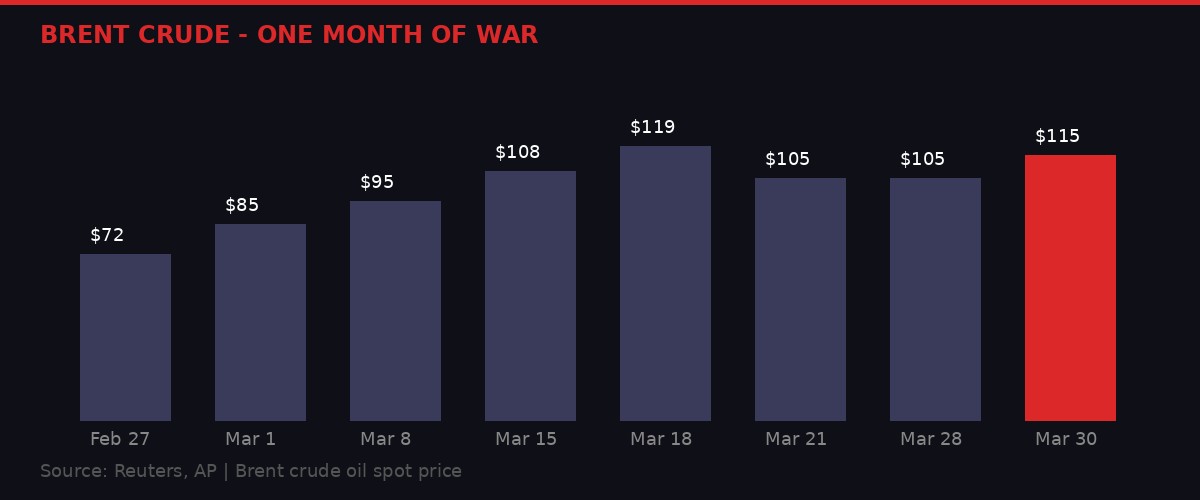
Brent crude oil spot price, February 27 to March 30, 2026. Data: Reuters, AP
Asia Opens to a Bloodbath

Tokyo's Nikkei 225 fell 4.5% in Monday's opening session, its worst single-day drop since the war began. Photo: Unsplash
Asian equity markets opened Monday morning like a trapdoor. Japan's Nikkei 225 plunged 4.5% to 50,979, South Korea's Kospi dropped 3.2% to 5,264, Hong Kong's Hang Seng shed 1.7% to 24,519, Australia's ASX 200 fell 1.2%, and the Shanghai Composite slipped 0.7%. The rout followed Wall Street's fifth consecutive losing week - the S&P 500's longest slide in nearly four years - which ended Friday with the Dow Jones Industrial Average tumbling 793 points.
The sell-off is being driven by a single, unresolved problem: more than 80% of the oil and liquefied natural gas that passes through the Strait of Hormuz is bound for Asia. With the strait effectively closed since Iran's retaliatory threats on February 28, Asian economies are being systematically starved of the energy that powers their factories, transport networks, and power grids. The Houthi entry into the war now threatens a second chokepoint - the Bab al-Mandeb strait near Yemen - potentially cutting off an additional 10% of world oil supply.
"Although we do not expect the conflict to be protracted, we anticipate heightened volatility in the near term."- Xavier Lee, senior equity analyst, Morningstar Research (AP, March 30)
The qualifier "we do not expect the conflict to be protracted" is doing a lot of work in that sentence. Every major broker and institutional desk said the same thing in the war's first week. Four weeks later, the conflict has expanded from a bilateral exchange between the U.S.-Israel coalition and Iran into a multi-front regional war involving Houthi rebels, Lebanese Hezbollah, Iraqi militias, and threats against Gulf Arab states. Markets are pricing in duration, not resolution.
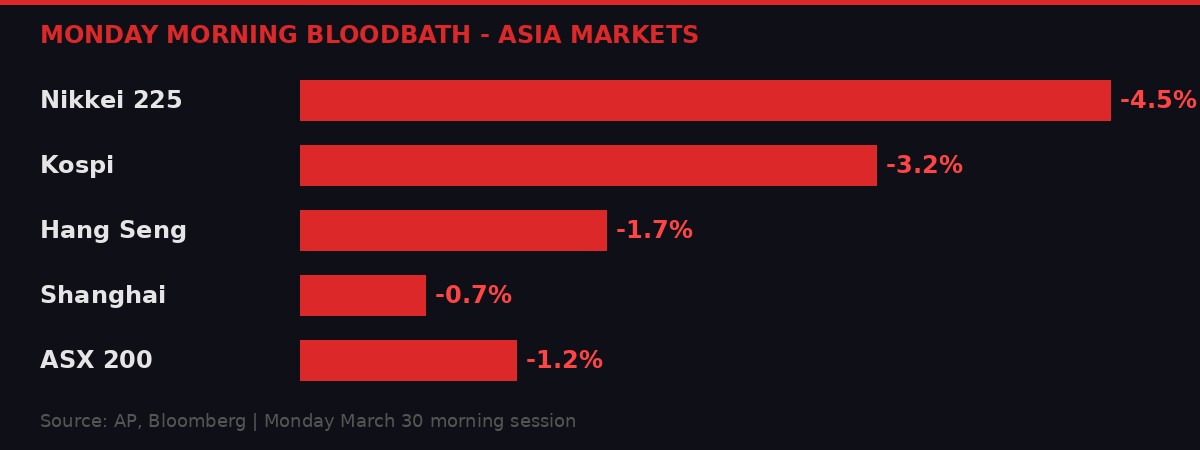
Asian equity indices - Monday March 30 morning session. Data: AP, Bloomberg
The S&P 500 now sits 8.7% below its all-time high set in January. The 10-year Treasury yield has risen to 4.43%, up from 3.97% before the war, reflecting both inflation anxiety and a flight from risk assets. Bond markets are telling the same story as oil: this is not going away quickly.
Hormuz: The Chokepoint That Broke the System

The Strait of Hormuz carries 20 million barrels of oil daily. Iran's de facto blockade has created the worst supply shock since the 1973 Arab oil embargo. Photo: Unsplash
The Strait of Hormuz is 21 miles wide at its narrowest point. Twenty million barrels of oil pass through it every day - roughly 20% of global supply. When Iran responded to the initial U.S.-Israeli strikes by threatening to attack any vessel attempting transit, the world's most critical energy corridor effectively shut down. Gulf oil exporters like Kuwait and Iraq slashed production because there was simply nowhere for their crude to go.
But the Hormuz closure is not just an oil story. Forty percent of global nitrogen fertilizer exports pass through the strait. A third of the world's helium - a critical input for semiconductor manufacturing, medical imaging, and aerospace - transits the same corridor, most of it originating from Qatar's Ras Laffan facility. Twenty percent of global liquefied natural gas moves through Hormuz. The chokepoint's closure has disrupted supply chains that extend from Brazilian soybean farms to Taiwanese chip foundries.
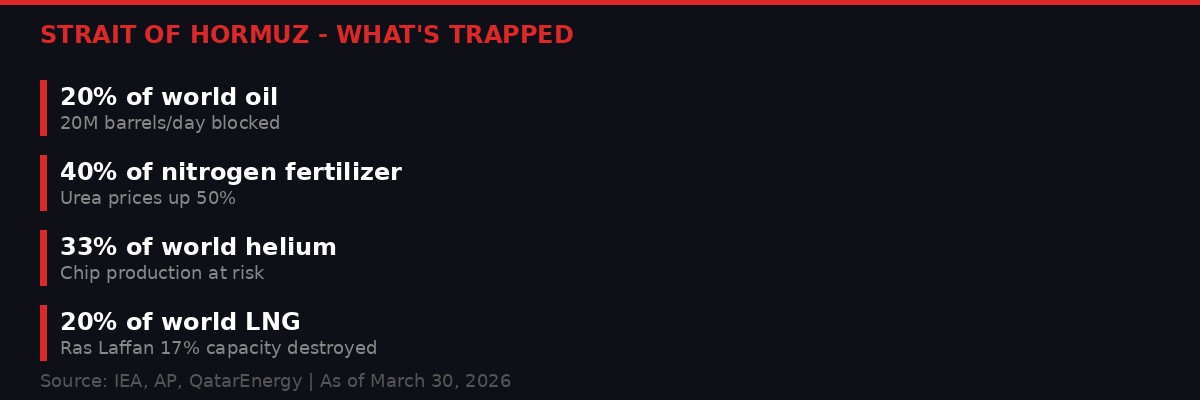
What's trapped behind the Strait of Hormuz: oil, fertilizer, helium, and LNG. Data: IEA, AP, QatarEnergy
Iran allowed 20 Pakistani-flagged vessels to pass through the strait late Saturday, a gesture that Pakistan's former ambassador to Iran, Asif Durrani, described as a signal that "Iran remains open for business with the world, provided the United States abandons coercion." But 20 ships is a symbolic trickle against a daily flow that normally involves hundreds of tankers. The strait remains functionally closed to commercial traffic.
Trump, speaking aboard Air Force One on Sunday, claimed Iran had agreed to let 20 additional ships through "out of a sign of respect" starting Monday morning. He provided no details on what type of vessels, under what flags, or for how long. The Hormuz blockade has now lasted 30 days with no credible mechanism for reopening in sight.
The Houthi Escalation: A Second Chokepoint Under Threat

The Houthi entry into the conflict threatens to block the Bab al-Mandeb strait, cutting an additional 10% of global oil supply. Photo: Unsplash
The weekend's most dangerous escalation was not a missile strike or a drone attack. It was a strategic expansion. Iran-backed Houthi rebels in Yemen launched their first direct attack against Israel in the current war - a missile that was intercepted early Saturday morning. Israel's military said it also intercepted two drones launched from Yemen very early Monday.
The Houthi entry transforms the geography of the conflict. The group controls territory along the Bab al-Mandeb strait, the narrow passage connecting the Red Sea to the Gulf of Aden. An additional 10% of global oil supply passes through this corridor. If the Houthis follow through on their history of attacking commercial shipping - something they did extensively during 2023 and 2024 - the world faces a scenario in which 30% of global oil flows are disrupted simultaneously.
"If they blockade Bab al-Mandeb, that puts significant strain on global supply chains. We're looking at $130 Brent in the coming weeks."- Andrew Lipow, Lipow Oil Associates (BBC, March 30)
Energy markets expert Sean Foley from Macquarie University echoed the warning, telling BBC that he expected oil prices to continue climbing unless the conflict eased. The math is brutal: Hormuz plus Bab al-Mandeb represents nearly a third of global oil transit. No insurance framework, no alternative pipeline network, and no strategic petroleum reserve release can compensate for that kind of sustained disruption.
The Houthi escalation also complicates Washington's military posture. The U.S. already has forces stretched across the Gulf theater, with 2,500 Marines trained in amphibious landings arriving in the region last week. Defending shipping lanes in two separate chokepoints simultaneously would require a naval commitment the Pentagon has not publicly authorized. The U.S. Navy's Fifth Fleet, based in Bahrain, is already operating under Iranian threat conditions. Splitting attention to the Bab al-Mandeb would dilute an already strained force.
Infrastructure Destroyed: Damage That Outlasts Any Ceasefire

Ongoing strikes on Gulf energy infrastructure have caused damage that will take years to repair, regardless of when a ceasefire comes. Photo: Unsplash
The critical shift in the past week has been from price disruption to physical destruction. Early in the war, the oil spike was driven by fear and route closures. Now it is being driven by actual damage to irreplaceable energy infrastructure that will take years to rebuild.
"A week ago or certainly two weeks ago, I would have said: If the war stopped that day, the long-term implications would be pretty small. But what we're seeing is infrastructure actually being destroyed, which means the ramifications of this war are going to be long-lived."- Christopher Knittel, energy economist, MIT (AP, March 29)
Qatar's Ras Laffan natural gas terminal - which produces 20% of the world's liquefied natural gas - took a direct hit from an Iranian strike on March 18. State-owned QatarEnergy confirmed the attack wiped out 17% of Qatar's LNG export capacity. Repairs will take up to five years. That single strike removed a volume of energy from global markets that cannot be replaced by any other facility on Earth in the near term.
Iran struck industrial sites across the Gulf over the weekend, hitting aluminium facilities in the UAE and Bahrain in what BBC described as "the broadest industrial assault" of the war. Iranian forces also targeted refineries and pipeline junctions in Kuwait, and tankers awaiting passage in the Gulf are running low on marine fuel with nowhere to resupply. The logistics chain that supports global energy shipping has been physically degraded.
On the other side of the ledger, Israel launched more than 120 munitions against weapons research and production sites in Tehran over the past 24 hours, according to the Israeli military. The strikes also knocked out electricity in parts of the Iranian capital, though state television reported power had been restored. Universities in Tehran, Isfahan, and other cities have been hit, prompting Iran's Revolutionary Guard to declare American university campuses in the Gulf region "legitimate targets" unless the U.S. condemns the bombing of Iranian universities by midday Monday. U.S. institutions with Gulf campuses - Georgetown, NYU, and Northwestern among them - have moved classes online as a precaution.
Fertilizer, Food, and the Coming Hunger Math

With 40% of nitrogen fertilizer exports blocked at the Strait of Hormuz, the war is now a food security crisis. Photo: Unsplash
Behind the oil headlines is a quieter, more dangerous cascade. The Persian Gulf produces roughly a third of global urea exports and a quarter of ammonia exports - the two foundational nitrogen fertilizers without which modern agriculture collapses. Gulf producers have a structural advantage: cheap natural gas as feedstock. With 40% of world nitrogen fertilizer exports transiting the Strait of Hormuz, the blockade has sent urea prices up 50% and ammonia prices up 20% since the war began.
Brazil, which imports 85% of its fertilizer, is acutely exposed. Alpine Macro commodity strategist Kelly Xu has warned that sustained disruptions will force Brazilian farmers to reduce application rates, lowering yields for soybeans, corn, and sugar that feed global commodity markets. Egypt, a major fertilizer producer in its own right, cannot produce at capacity because it depends on imported natural gas to power its plants. The loop is vicious: the war disrupts gas, which disrupts fertilizer production, which disrupts food production, which disrupts the economies of developing nations that spend the highest share of household income on food.
The helium shortage has received less attention but carries equally severe long-term implications. Qatar's Ras Laffan facility produces a third of the world's helium supply. Helium is not just for party balloons - it is a critical coolant in MRI machines, a process gas in semiconductor fabrication, and a pressurant in rocket propulsion. The strike on Ras Laffan has disrupted helium supply chains that extend directly into hospitals and chip fabs.
The World Food Programme has not yet issued an emergency declaration related to the conflict, but regional food price indices in South and Southeast Asia have risen sharply in the past two weeks. LPG shortages in India have forced some restaurants to shorten hours or close temporarily. Curries, deep-fried snacks, and other energy-intensive dishes are disappearing from menus in smaller establishments that cannot absorb the higher fuel costs. The Indian government is prioritizing household cooking gas over commercial use, but the allocation system is straining under demand that exceeds available supply.
Rationing Across Asia: Four-Day Work Weeks, Elevator Bans, and Fuel Caps

Governments across Asia are implementing emergency energy conservation measures as the oil shock bites. Photo: Unsplash
International Energy Agency head Fatih Birol issued a blunt warning on March 23 that "no country will be immune to the effects of this crisis if it continues in this direction." The Federal Reserve Bank of Dallas's Lutz Kilian added that poorer countries will suffer most because "they will be outbid when competing for the remaining oil and natural gas." One week later, the rationing has begun.
The Philippines has moved government offices to a four-day work week and ordered bureaucrats to limit air conditioning to no cooler than 75 degrees Fahrenheit. Thailand has told public workers to take the stairs instead of elevators. South Korea has restricted car use by public employees and reinstated fuel price caps that had been abandoned in the 1990s. Australia's Victoria and Tasmania states are offering free public transport to discourage driving as petrol prices surge.
India, the world's second-largest importer of liquefied petroleum gas, is managing a supply squeeze that has real consequences at the household level. The government has allocated priority access to residential consumers over commercial users, absorbing most of the price increase to protect low-income families. But the buffer has limits. Small restaurants, street food vendors, and chai stalls that operate on razor-thin margins are already cutting hours or shutting down. The economic ripple runs from the refinery gate to the kitchen stove.
The rationing measures are not symbolic. They reflect a genuine shortage of energy that was previously abundant and affordable. Asia's economies were built on the assumption that Gulf oil and gas would flow uninterrupted through Hormuz. That assumption is now broken, and the structural adjustments required to cope are just beginning.
Wall Street's Five-Week Slide and the Recession Probability

The S&P 500 has posted five consecutive losing weeks, its longest slide in nearly four years. Photo: Unsplash
The damage is not confined to Asia. The S&P 500 fell 1.7% on Friday to close at 6,368.85, marking its fifth straight losing week - the longest such streak since 2022. The Dow dropped to 45,166, now more than 10% below its record set last month, meeting the technical definition of a correction. The Nasdaq shed 2.1%. Big Tech names - Amazon, Nvidia, Meta - have been among the heaviest drags.
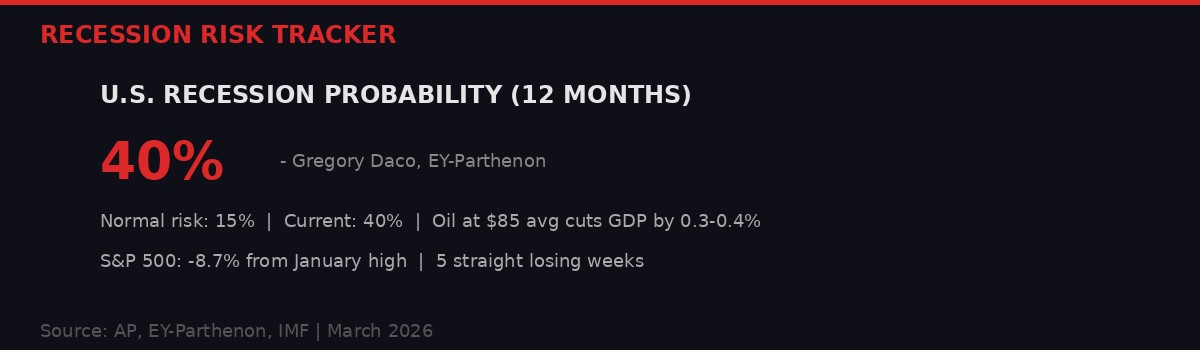
U.S. recession probability has risen to 40%, nearly triple the baseline risk. Data: EY-Parthenon, AP
Gregory Daco, chief economist at EY-Parthenon, has raised the probability of a U.S. recession in the next 12 months to 40%, up from a baseline of 15% in normal conditions. The American economy was already weakening before the war: GDP grew at just 0.7% annualized in Q4 2025, down from 4.4% in Q3. Employers unexpectedly cut 92,000 jobs in February. Monthly job creation in 2025 averaged just 9,700 - the weakest non-recession hiring rate since 2002.
"Nothing weighs more heavily on consumers' collective psyche than having to pay more at the pump."- Mark Zandi, chief economist, Moody's Analytics (AP, March 29)
The average price of a gallon of gasoline in the United States has risen to nearly $4, up from $2.98 just a month ago, according to AAA. That 34% increase in fuel costs hits consumer spending directly, and consumer spending drives roughly 70% of U.S. GDP. Gita Gopinath, former chief economist at the International Monetary Fund, has estimated that if oil averages $85 a barrel in 2026, global growth will be 0.3 to 0.4 percentage points lower than the pre-war forecast of 3.3%. Oil is now trading $30 above that benchmark.
Harvard Kennedy School's Carmen Reinhart, a former World Bank chief economist, has invoked the word that haunted the 1970s: stagflation. "You're raising the risk of higher inflation and lower growth," she told AP. The combination of rising energy costs, supply chain disruptions, and weakening demand creates a policy trap for central banks. Raising rates fights inflation but deepens recession. Cutting rates supports growth but risks runaway prices. There is no good option when the supply shock is physical rather than monetary.
The Diplomacy That Isn't Working

Pakistan announced it would host US-Iran talks, but Tehran dismissed the initiative as cover for military escalation. Photo: Unsplash
Pakistan announced Sunday that it would host talks between the U.S. and Iran, with Foreign Minister Ishaq Dar declaring that "both Iran and the U.S. have expressed their confidence in Pakistan to facilitate the talks." Foreign ministers from Turkey, Egypt, and Saudi Arabia met in Islamabad over the weekend to discuss a framework for direct dialogue. But there was no immediate confirmation from Washington or Tehran, and the diplomats departed for their home countries without a scheduled follow-up.
Trump told reporters aboard Air Force One that the U.S. was "doing extremely well in that negotiation" and claimed Iran had accepted most points of a 15-point ceasefire plan. He did not elaborate. Iranian officials have publicly rejected the U.S. plan and dismissed the Islamabad meetings as diplomatic cover for continued military escalation. Iran's parliament speaker, Mohammad Bagher Qalibaf, said Iranian forces were "waiting for the arrival of American troops on the ground to set them on fire."
Iran has drafted its own five-point counterproposal, reportedly calling for a halt to the killing of Iranian officials, guarantees against future attacks, reparations, and Iran's "exercise of sovereignty over the Strait of Hormuz." The gap between the two frameworks is not a negotiating distance - it is a philosophical chasm. Washington wants denuclearization and freedom of navigation. Tehran wants sovereignty recognition and reparations. Neither side has shown willingness to move toward the other's terms.
Adding to the diplomatic chaos, Trump suggested in a Financial Times interview on Sunday that the U.S. could "take the oil in Iran" and potentially seize Kharg Island, Iran's primary oil export terminal. "I don't think they have any defense. We could take it very easily," Trump said, comparing the potential move to the U.S. seizure of Venezuelan oil operations in January. The comment sent oil prices climbing further in overnight trading and undermined whatever fragile confidence the Pakistan talks might have generated.
An adviser to the UAE, Anwar Gargash, called for any settlement to include "clear guarantees" that Iranian attacks on Gulf neighbors will not be repeated, and demanded compensation for strikes on civilian infrastructure. The UAE, Bahrain, Kuwait, and Qatar have all suffered direct Iranian attacks. Their willingness to participate in any ceasefire framework will depend on security guarantees that neither Washington nor Tehran has offered.
Thirty Days of War: A Timeline of Escalation
KEY EVENTS - IRAN WAR MONTH ONE
- Feb 28: U.S. and Israeli forces strike Iran. Tehran retaliates by threatening vessels in the Strait of Hormuz. Oil jumps from $72 to $85 overnight.
- Mar 1-5: Gulf oil exporters cut production as Hormuz effectively closes. Brent crosses $95.
- Mar 8: Iran strikes Qatar's Ras Laffan LNG terminal, destroying 17% of Qatar's export capacity. Five-year repair timeline.
- Mar 15: Oil hits $108. IEA declares "largest supply disruption in the history of the global oil market."
- Mar 18: Brent touches $119.50 - highest since June 2022. Israeli strikes hit Iranian universities. IRGC threatens U.S. campuses in the Gulf.
- Mar 23: IEA chief Birol warns "no country will be immune." Philippines orders four-day government work week.
- Mar 25: U.S. proposes 15-point ceasefire plan. Iran rejects it publicly.
- Mar 28: 2,500 U.S. Marines with amphibious capability arrive in the Middle East. Iran's parliament speaker says forces are "waiting."
- Mar 29: Houthi rebels launch first strike against Israel. Photos confirm Iranian drone destroyed E-3 AWACS aircraft at Prince Sultan Air Base in Saudi Arabia. S&P 500 posts fifth straight losing week.
- Mar 30: Brent crosses $115. Asian markets crash. Pakistan announces talks. Trump suggests seizing Kharg Island. Iran strikes industrial targets across the Gulf.
What Comes Next

The economic damage from one month of war will persist long after any ceasefire. The question is how much worse it gets first. Photo: Pixabay
The math facing the global economy is stark. Brent at $115 is bad. Brent at $130 - the level Lipow Oil Associates expects in "coming weeks" - would trigger demand destruction across developed economies and energy poverty across developing ones. The IEA's emergency reserves can buffer a short disruption, but not a sustained one. The U.S. Strategic Petroleum Reserve, already depleted by releases during 2022, provides limited cushion.
The American economy is somewhat insulated by its own production capacity. The U.S. is a net oil exporter, and its LNG export terminals are already running at 100% capacity, keeping domestic gas prices relatively stable. But gasoline at $4 a gallon hits consumer psychology hard, and the labor market was already softening before the war added energy inflation to the mix. A consumer-led recession - where households pull back spending because fuel and food eat their budgets - remains the most likely path to contraction.
The Dallas Fed's Kilian has warned that even under "the best circumstances," recovery will be slow. Damaged LNG facilities need years of repair. Refineries need re-provisioning. Tankers stranded in the Gulf need marine fuel. Supply chains built over decades on the assumption of open passage through Hormuz need to be rerouted - and there are not enough alternative routes to absorb the volume.
"There is no economic upside to the conflict with Iran. At this point, the questions are how much longer the hostilities will continue and how much economic damage they will cause."- Mark Zandi and colleagues, Moody's Analytics (AP, March 29)
The war's first month has delivered the worst oil supply shock since 1973, the broadest military conflict in the Middle East since 2003, and a cascade of economic consequences that are only beginning to compound. Houthis have opened a second front. Diplomacy has produced announcements but no agreements. Infrastructure that took decades to build is being destroyed in hours. And Monday morning's market open - with the Nikkei down 4.5% and Brent pushing higher - suggests the world is pricing in more of the same.
The $115 barrel is not the destination. It is the departure point.
Get BLACKWIRE reports first.
Breaking news, investigations, and analysis - straight to your phone.
Join @blackwirenews on Telegram