The Orgasm Trap: How OneTaste Built a Forced Labor Empire Behind a Feminist Mask
Nicole Daedone promised women liberation through orgasm. A federal court just gave her nine years for delivering something else entirely - coercion, exploitation, and the most sophisticated abuse of feminist language this century.
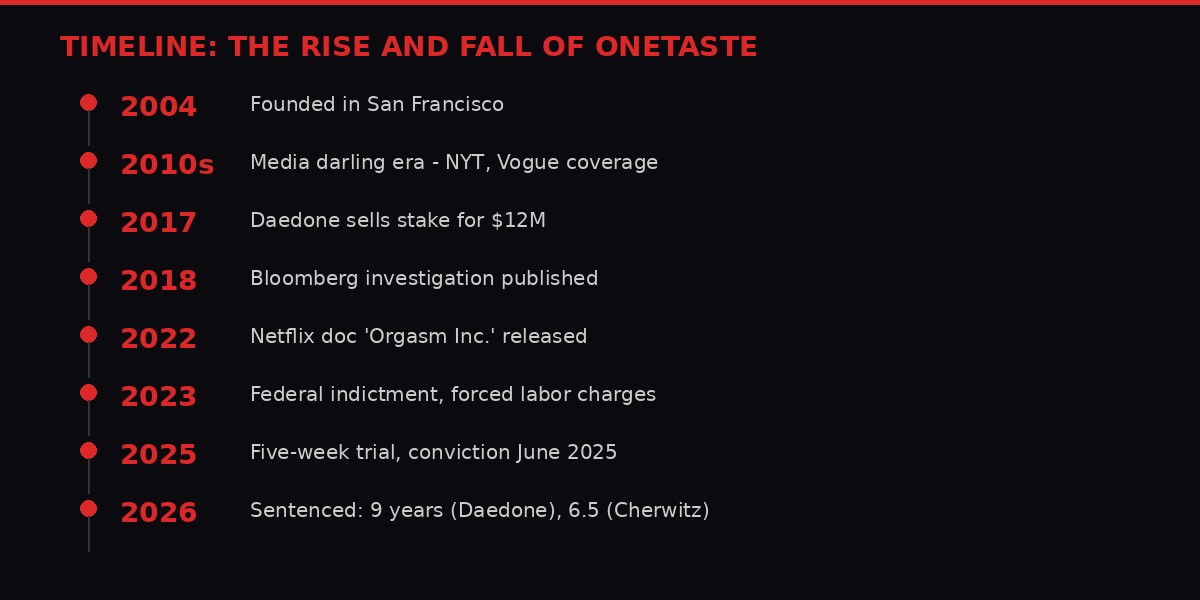
BLACKWIRE infographic: The arc of OneTaste from San Francisco commune to federal conviction
The sentencing hearing in Brooklyn Federal Court on Monday lasted hours. Nicole Daedone, 58, sat in her prison uniform - the judge had denied her request to wear civilian clothes - and listened as victim after victim described what happened when they trusted a woman who said she could heal their deepest wounds through the power of the female orgasm.
When Judge Diane Gujarati asked if she wanted to speak, Daedone had two words: "No, thank you."
Then the judge handed down nine years.
The sentence lands at a strange cultural moment. We are two decades into a wellness revolution that has repackaged everything from crystal healing to cold plunges as feminist self-care. OneTaste was, for years, the most ambitious version of that project - a company that said female pleasure was a political act, that orgasm was medicine, and that any woman who questioned the program just hadn't surrendered deeply enough.
What prosecutors proved over a five-week trial was something darker: that OneTaste was a machine designed to identify vulnerable women - many of them survivors of sexual trauma - and convert their desperation for healing into unpaid labor, sexual compliance, and financial ruin. The feminist language was not incidental to the abuse. It was the abuse's primary weapon.
The Promise: San Francisco, 2004

San Francisco, where OneTaste was born in the post-dot-com spiritual vacuum - Unsplash
Nicole Daedone did not invent the idea that female sexuality was undervalued. She arrived in San Francisco at a time when the city was still processing the collapse of the first dot-com bubble, and a generation of young professionals was looking for meaning beyond stock options. The wellness industry was exploding. Yoga studios were multiplying. Ayahuasca retreats were becoming dinner party conversation. And into this vacuum walked a woman with a startlingly direct pitch: the clitoris was the key to everything.
OneTaste was founded in 2004 as something between a commune and a startup. Its centerpiece was "orgasmic meditation," or OM - a structured practice in which one person strokes the clitoris of another person for exactly 15 minutes. "No goal except to feel," as the company's own materials described it. The practice was conducted in groups. Participants were encouraged to describe their sensations out loud. Privacy was framed as an obstacle to enlightenment.
The early version of OneTaste looked, from the outside, like a Bay Area oddity - the kind of thing journalists profiled with a mix of curiosity and bemusement. But Daedone was shrewd. She understood that the conversation about women's pleasure had shifted. The success of Eve Ensler's "The Vagina Monologues" in the late 1990s, the growing visibility of sex-positive feminism in academia, and the mainstreaming of vibrator culture all created an audience for a product that framed orgasm not as recreation but as radical politics.
"She understood branding before most wellness founders did," said one former OneTaste member who testified during the trial, according to court transcripts. "She didn't just sell orgasms. She sold the idea that having an orgasm was fighting the patriarchy."
The language was carefully constructed. OneTaste materials avoided the clinical vocabulary of sex therapy and the explicit vocabulary of pornography. Instead, the company occupied a rhetorical middle ground - spiritual enough to feel elevated, scientific enough to feel legitimate, feminist enough to feel righteous. Daedone positioned herself not as a sex guru but as a thought leader. She gave TED talks. She wrote for mainstream publications. She appeared on network television.
By the early 2010s, OneTaste had outposts from Los Angeles to London. Its courses cost thousands of dollars. Its residential programs required participants to sign over control of significant portions of their daily lives. And the media - the very same outlets that would later cover the company's downfall - was largely enchanted.
The Machine: How Recruitment Became Coercion
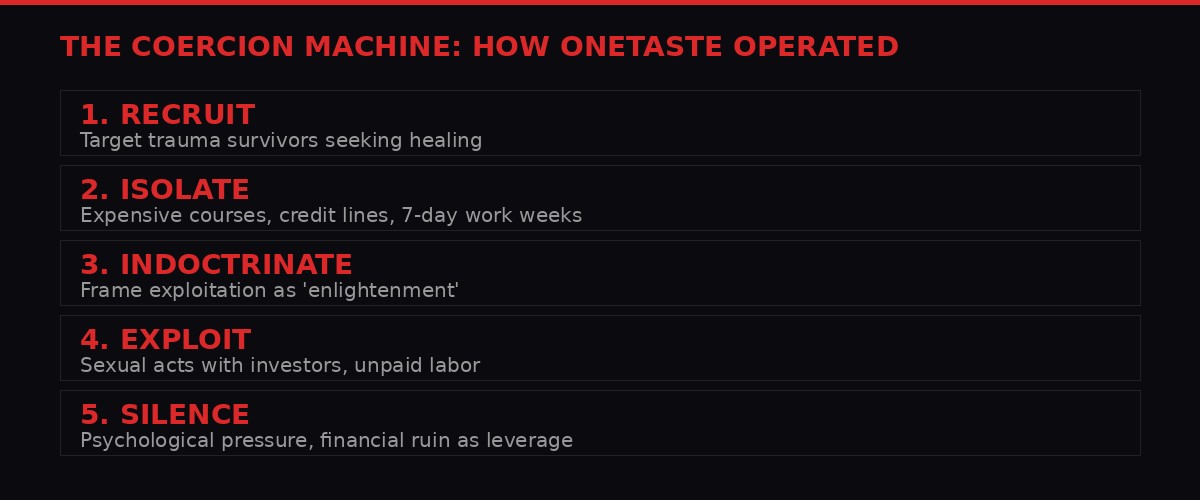
BLACKWIRE infographic: The five stages of OneTaste's exploitation pipeline
Federal prosecutors spent five weeks laying out how OneTaste's operation actually worked behind the Instagram-ready wellness aesthetic. The picture that emerged was methodical.
Step one was identification. OneTaste's recruitment pipeline specifically targeted women with histories of sexual trauma, addiction, or emotional crisis. These were not random customers. They were selected because their vulnerability made them more likely to invest emotionally - and financially - in a program that promised healing. Court testimony from multiple witnesses described intake conversations that functioned less like enrollment and more like psychological assessments, identifying which pressure points could be exploited later.
Step two was financial entanglement. OneTaste's courses were expensive - the introductory workshops started at hundreds of dollars, but the real programs ran into the thousands. Participants were encouraged - sometimes pressured - to open lines of credit to pay. "I maxed out three credit cards in my first year," one witness testified, according to AP reporting on the trial. "They told me it was an investment in my liberation." By the time participants recognized what was happening, they were often too deep in debt to walk away without losing everything they'd put in.
Step three was labor extraction. Participants who couldn't pay were offered "work-study" arrangements - but what the company called work-study, prosecutors called unpaid labor. Witnesses described seven-day work weeks performing everything from administrative tasks to manual cleaning to event management. The hours were long. The compensation was negligible or nonexistent. And the framing was always spiritual: working for OneTaste was presented as a form of practice, a way to deepen one's commitment to the teachings.
Step four was the sexual component. This is where the case crossed from exploitation into the territory of forced labor conspiracy. Prosecutors presented evidence that Daedone and her co-defendant Rachel Cherwitz directed female members to perform sexual acts with the company's investors and clients. This was not optional. Women who resisted were told they were "blocked," that their refusal was evidence of unresolved trauma, that compliance was the path to "freedom" and "enlightenment." Three witnesses described being made to act as "handlers" for OneTaste's original deep-pocketed founder and Daedone's boyfriend - performing sexual acts on him, using sex toys on him, and in one case, walking him on a leash.
Step five was psychological lockdown. By the time participants understood what was happening, they were financially ruined, socially isolated (OneTaste encouraged members to distance themselves from skeptical friends and family), and psychologically dependent on the community's approval. Leaving meant admitting that the thousands of dollars and years of emotional investment had been wasted. It meant losing the only social network that remained. And it meant facing the shame of having participated in acts they found "uncomfortable or repulsive," as the prosecution described it.
"Coercion disguised as wellness or empowerment is still exploitation and it is a crime that causes harm to vulnerable victims." - Joseph Nocella, U.S. Attorney for the Eastern District of New York
The Trial: Five Weeks in Brooklyn

Brooklyn Federal Court, where the five-week trial unfolded in 2025 - Unsplash
The trial of Nicole Daedone and Rachel Cherwitz, 45, began in late April 2025 and lasted roughly five weeks. It was a single-count case - conspiracy to commit forced labor under 18 U.S.C. Section 1589 - but the testimony ranged across more than a decade of alleged abuse, covering OneTaste's operations from its San Francisco origins through its expansion across the United States and into Europe.
Prosecutors called witnesses who described a pattern that combined the tactics of high-pressure sales organizations, multi-level marketing schemes, and abusive intimate relationships. The women who testified were, in many cases, the same women who had once been OneTaste's most enthusiastic evangelists. They had recruited others. They had appeared in promotional materials. They had, for years, believed that what they were experiencing was transformation rather than exploitation.
One witness described how she was drawn to OneTaste after surviving sexual assault. "I was looking for a way to reclaim my body," she testified, according to media reports from inside the courtroom. "They told me OM would give me that. What they actually gave me was a different kind of violation wrapped in the language of consent."
Another described the financial devastation. She had entered OneTaste as a graduate student with modest savings. By the time she left, she owed more than $100,000 in credit card debt - money spent on courses, workshops, residential programs, and the constant upselling that characterized OneTaste's business model. "Every time I said I couldn't afford it, they said I was putting a price on my healing," she told the court.
The defense argued throughout the trial that OneTaste's members were consenting adults who had freely chosen to participate in an unconventional but legal lifestyle. Daedone's attorney, Jennifer Bonjean, cast her client as a "ceiling-shattering feminist entrepreneur" whose only crime was challenging sexual norms in a society that remained uncomfortable with female pleasure.
"We disagree that she targeted vulnerable people," Bonjean said after Monday's sentencing. "The government wants to paint OneTaste, paint Ms. Daedone's work, in one broad stroke. I just don't think that's fair."
The jury disagreed. After deliberating, they convicted both Daedone and Cherwitz on the forced labor conspiracy charge in June 2025.
The Sentencing: "It Was Criminal"
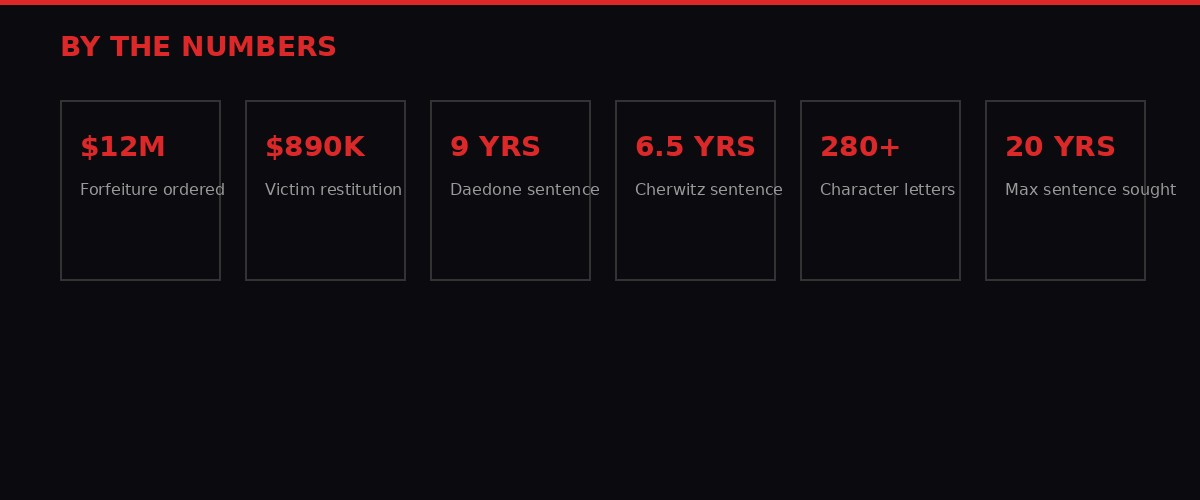
BLACKWIRE infographic: The financial and legal reckoning by the numbers
Monday's sentencing in Brooklyn was a study in contrasts. On one side of the courtroom: more than two dozen OneTaste supporters, there to demonstrate that Daedone's influence had been positive, even life-changing. On the other: victims who described being left "financially, emotionally and psychologically scarred," in the prosecution's language.
Daedone's defense team had submitted more than 280 pages of character letters to the court. The roster of supporters reads like a guest list from a particularly eclectic dinner party. Van Jones, the CNN correspondent and former adviser to President Barack Obama, described Daedone as "a woman of uncommon wisdom, grace and moral courage" who had "dedicated her life to helping others find healing, empowerment and a deeper sense of human connection." Richard Schiff, who played Toby Ziegler on "The West Wing," wrote that Daedone deserved leniency because she had "spent her life trying to bring compassion, awareness, and honesty to a part of human experience that is often shamed or misunderstood."
Her defense team argued that anything close to a lengthy sentence would be "bonkers" and pushed for approximately two years. They noted that the 58-year-old had no prior criminal record. They presented testimony about her character. They described how she had been teaching meditation to fellow inmates at the Metropolitan Detention Center in Brooklyn since her conviction.
Judge Gujarati was unmoved.
She told the courtroom that she had reviewed all 280-plus character letters, more than once, and had watched video submissions from Daedone's supporters. She had also reviewed the trial evidence, the victim impact statements, and the full record of OneTaste's operations.
"Ms. Daedone exploited certain women in a calculated way and made money off of that exploitation. Ms. Daedone is not the victim here. What she was doing was not about enlightenment or operating on a different dimension. It wasn't a game or a show. It wasn't 'Harry Potter' or 'The Matrix.' It was criminal." - Judge Diane Gujarati, U.S. District Court
The sentence: nine years for Daedone. Six and a half years for Cherwitz. Daedone was also ordered to forfeit $12 million - the exact amount she received when she sold her stake in OneTaste in 2017, one year before the company's practices came under public scrutiny. Seven victims were awarded roughly $890,000 in restitution.
One victim addressed the court directly before sentencing. "I trusted Nicole and wanted to be part of her so-called feminist mission," she said, according to the New York Daily News. "In reality, I fell into Nicole's trap. I was the perfect target. I was left with significant financial damages and emotional harm."
The Pardon Play: Dershowitz, Trump, and the Politics of Clemency
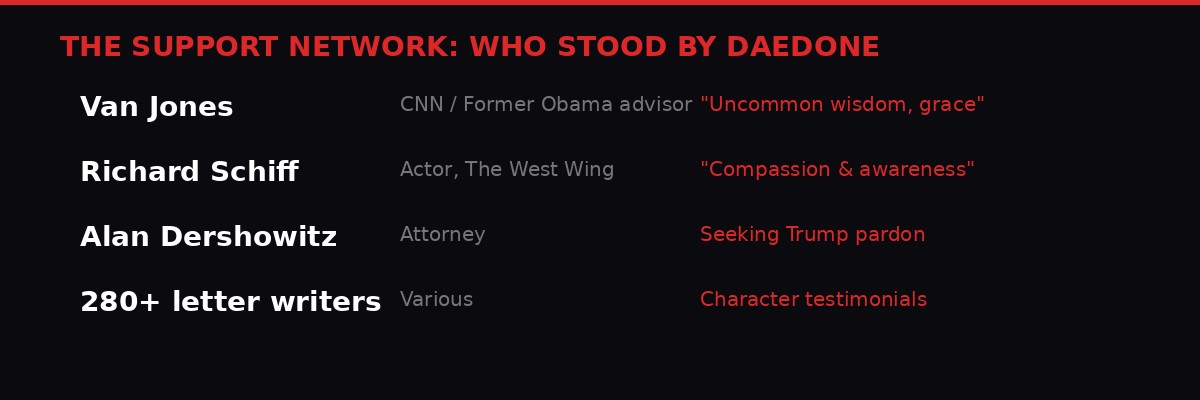
BLACKWIRE infographic: The support network rallying behind Daedone post-conviction
The story does not end with the sentence. Prominent attorney Alan Dershowitz has publicly announced that he plans to seek a presidential pardon from Donald Trump for both Daedone and Cherwitz.
"I believe this is a miscarriage of justice," Dershowitz told NBC News in a recent interview. "I intend to present the case for clemency directly."
Dershowitz's involvement adds a layer of political complexity to an already charged case. The attorney, now 87, has become one of the most prominent advocates for presidential clemency in the Trump era, and his argument in this case extends beyond the specifics of OneTaste. He frames the conviction as a broader threat to religious and ideological freedom.
"As soon as I saw the indictment, I realized that with a few changes of words, this indictment could have been directed against Mormon groups, against Hasidic groups, against various Protestant or Catholic sects," Dershowitz told NBC. "There are so many people who join ideological or religious groups, volunteer their time and later become disillusioned. The idea that prosecutors can later say that voluntary participation must have been coercion is extremely dangerous."
It is a clever reframing - one that shifts the conversation from the specific facts of OneTaste's operations to an abstract principle about prosecutorial overreach. Whether it gains traction with the White House remains to be seen. Dershowitz himself has acknowledged the timing challenge: "The White House has been dealing with enormously serious issues like Iran and other global conflicts. Timing is everything when it comes to bringing a case like this to the president's attention, and we will wait for the appropriate moment."
Daedone's attorney Jennifer Bonjean has called the prosecution "concerning prosecutorial overreach" and noted that the government brought "a conspiracy charge no one has ever seen before, and did so just months after a Netflix film their own FBI participated in was released." The defense team plans to appeal the conviction.
Cherwitz's attorney K Celia Cohen echoed the overreach argument: "This case raises serious concerns about governmental overreach. The novel conspiracy theory rests on events and perceptions from years ago, and its reliance on retrospective interpretations of consent should give pause."
The pardon angle raises uncomfortable questions. Trump has used the pardon power more aggressively than most recent predecessors. Dershowitz has been one of the architects and defenders of that approach. And the case does touch on genuinely complex legal territory about where unconventional lifestyle choices end and coercion begins. But the defense's attempt to reframe a forced labor conviction as a religious liberty case requires ignoring the specific testimony of women who said they were directed to have sex with investors, pressured into financial ruin, and psychologically manipulated into believing that exploitation was enlightenment.
The Wellness Industrial Complex: Why This Keeps Happening

The wellness industry's darker corners continue to shield exploitation behind the language of self-care - Unsplash
OneTaste is not an anomaly. It is the most legally consequential example of a pattern that has repeated across the wellness industry for years - organizations that use the vocabulary of empowerment, healing, and self-actualization to create environments where abuse becomes invisible, or worse, reinterpreted as growth.
The list is long. NXIVM, the "personal development" company whose leader Keith Raniere was sentenced to 120 years for sex trafficking, racketeering, and forced labor. Bikram Choudhury, the hot yoga founder accused by multiple women of rape and sexual assault, who fled the United States after a $7 million judgment against him. Various ayahuasca retreat centers across Central and South America where participants have died or been sexually assaulted during ceremonies. Kundalini yoga communities built around Yogi Bhajan, who was posthumously accused of decades of sexual abuse by multiple women.
What connects these cases is not the specific practice - yoga, meditation, orgasm, self-improvement - but the structural dynamics. In each case, a charismatic leader creates a community that promises transformation. The community develops its own internal logic, its own vocabulary, its own standards for what is normal. Questioning the leader or the practice is reframed as a personal failing - evidence of blockage, resistance, ego, or insufficient commitment. And the more extreme the practice, the more effective this dynamic becomes, because participants who engage in acts they would normally find unacceptable need to believe those acts were meaningful in order to preserve their self-image.
The wellness industry is particularly vulnerable to this pattern because it operates largely outside regulatory oversight. Unlike medicine, where practitioners must be licensed and treatments must be approved, wellness exists in a regulatory gray zone where almost anything can be marketed as a healing modality. The industry's emphasis on subjective experience - "how does this make you feel?" - makes external evaluation difficult. And the cultural prestige now attached to wellness practices provides social cover for organizations that would otherwise face scrutiny.
Dr. Steven Hassan, a cult expert at Harvard Medical School who has studied coercive groups for decades, has written extensively about what he calls the BITE model - Behavior control, Information control, Thought control, and Emotional control. All four elements were present in prosecutors' description of OneTaste. Members' behavior was regulated through work schedules and sexual directives. Information was controlled through isolation from outside relationships. Thought was controlled through the company's proprietary vocabulary and philosophy. And emotion was controlled through the alternating cycle of praise and shame that witnesses described.
What made OneTaste distinctive was its use of feminist language as an additional layer of armor. Criticizing the organization was not just evidence of personal blockage - it was anti-feminist. Questioning whether women were being exploited was itself framed as a denial of women's agency. The language of empowerment became a shield against the very concept of exploitation. It is a rhetorical trick so effective that it persisted even into the sentencing phase, with defense attorneys continuing to describe Daedone as a "ceiling-shattering feminist entrepreneur."
The PR Machine: Books, AI Avatars, and Jailhouse Branding

Even from prison, Daedone continued building her brand through AI avatars and a jailhouse memoir - Unsplash
Perhaps the most remarkable aspect of this case is what Daedone did between her conviction and her sentencing. Rather than retreat into silence, she launched what the New York Daily News described as "a public PR offensive."
She wrote a book. From her cell at the Metropolitan Detention Center in Brooklyn, she produced a work titled "Jailbirds in Flight." The title alone reveals the branding instinct that made OneTaste successful in the first place - the ability to reframe any experience, even incarceration, as part of a larger narrative of transcendence and growth.
She created an AI avatar of herself. A video was produced featuring a digital version of Daedone discussing her time in jail. The decision to use artificial intelligence to maintain a public presence while detained is, as far as BLACKWIRE can determine, unprecedented in the context of a forced labor case. It speaks to a particular kind of Silicon Valley optimism - the belief that technology can solve any problem, including the problem of being convicted of a federal crime.
She also began teaching meditation to fellow inmates - a detail her defense team highlighted in their sentencing memo as evidence of her continued commitment to helping others. Whether the inmates who attended those sessions knew they were being taught by a woman convicted of using spiritual practice as a mechanism of control is unclear from the court record.
The 280-plus pages of character letters submitted to Judge Gujarati represent their own kind of artifact. When Van Jones writes that Daedone has "uncommon wisdom, grace and moral courage," he is not just defending an individual. He is defending his own judgment in associating with her. When Richard Schiff describes her commitment to "compassion, awareness, and honesty," he is doing the same. The letters reveal a network of prominent people who remain invested in the version of Nicole Daedone that existed before the conviction - the version who gave TED talks and appeared on television, who wrote about female empowerment and challenged sexual taboos.
This is how charismatic leaders survive exposure. They do not just attract followers. They attract endorsers - people whose own reputations become entangled with the leader's narrative. Challenging the leader means challenging the endorser's judgment, which is why celebrity support often persists long after the evidence of harm becomes overwhelming.
The Victims: What Remains After the Verdict

For OneTaste's victims, the sentence brings a measure of accountability - but not restoration - Unsplash
The restitution ordered by Judge Gujarati - roughly $890,000 divided among seven victims - is real money. But it is a fraction of the financial damage described during the trial. Witnesses described debts reaching six figures. They described careers abandoned, relationships destroyed, and years of psychological recovery. The math of restitution never equals the math of harm.
And not all the harm is financial. Several witnesses described what experts in cult recovery call "post-cult syndrome" - a cluster of symptoms that can include anxiety, depression, difficulty trusting, identity confusion, and a painful reassessment of years of one's life. When a person has been told that exploitation is empowerment, that abuse is practice, that their own discomfort is evidence of personal inadequacy rather than external harm, the psychological work of recovery requires dismantling not just the cult's influence but the victim's own narrative about what happened to them.
"The hardest part wasn't leaving," one former member told reporters outside the courthouse. "The hardest part was admitting I'd been fooled. I spent years telling myself this was my choice, this was feminist, this was healing. Admitting it was none of those things meant admitting I'd wasted years of my life."
This is the particular cruelty of exploitation that disguises itself as liberation. The victims must contend not only with what was done to them but with their own complicity in recruiting others, in evangelizing for the organization, in defending it to skeptics. Many of the witnesses who testified against Daedone had themselves brought other women into OneTaste. The guilt of that recruitment adds another layer to an already complex recovery process.
OneTaste's current owners have maintained that the company's work "has been misconstrued" and that the charges against its former executives were "unjustified." The company continues to exist, though its operations have been significantly curtailed since the federal investigation became public.
The Bigger Question: When Does Alternative Become Abusive?

The legal boundary between unconventional practice and criminal coercion remains contested territory - Unsplash
Dershowitz's argument - that the OneTaste prosecution sets a dangerous precedent for religious and ideological groups - is not entirely without merit, even if his motivation for making it may be strategic rather than principled. The boundary between an unconventional community and a coercive organization is genuinely difficult to draw in advance. Many practices that mainstream society once considered bizarre or dangerous - from early Christianity to Alcoholics Anonymous to intensive meditation retreats - involve voluntary surrender of autonomy, financial commitment, and social reorganization.
The legal question is not whether a practice is unusual. It is whether participants were coerced. And the OneTaste case, whatever its implications for future prosecutions, rested on specific evidence: women who testified that they were directed to perform sexual acts with investors, pressured into taking on unsustainable debt, subjected to psychological manipulation designed to override their judgment, and kept in the organization through a combination of financial entanglement, social isolation, and emotional dependency.
The defense's characterization of these experiences as "retrospective interpretations of consent" - the idea that participants were consenting at the time and only reframed their experiences as coercive after leaving - is a argument that will recur in every case involving high-control groups. It is also an argument that Judge Gujarati, after a five-week trial and exhaustive review of the evidence, rejected decisively.
What the OneTaste case does establish is that federal forced labor statutes can be applied to organizations that use psychological manipulation rather than physical force to extract labor and sexual compliance. This is significant. Most forced labor prosecutions involve physical restraint, threats of violence, or immigration-related coercion. The OneTaste case demonstrates that the law can reach subtler forms of coercion - the kind that operates through shame, spiritual authority, and the exploitation of trust.
Whether prosecutors will use this precedent to pursue other wellness organizations remains to be seen. The five-year investigation, five-week trial, and extensive appellate process represent an enormous investment of federal resources. Not every questionable wellness organization will receive that level of attention. But the conviction sends a signal that the label "empowerment" is not a legal shield against charges of exploitation.
What Comes Next
Daedone's defense team has announced plans to appeal the conviction. Dershowitz is pursuing the pardon. The appeals process will likely take years and will center on the legal questions about the scope of federal forced labor statutes and the definition of coercion in the context of voluntary communities.
In the meantime, the wellness industry continues to grow. Global wellness tourism alone was valued at over $800 billion in 2025. The demand for transformative experiences - and the vulnerability that drives that demand - shows no signs of decreasing. If anything, the combination of pandemic-era isolation, economic anxiety, and political instability has created a larger population of people searching for communities that promise meaning, belonging, and healing.
Not all of those communities are dangerous. Most are not. But the ones that are have learned from OneTaste's mistakes - and from its successes. The next Daedone will have better legal counsel, more sophisticated branding, and a deeper understanding of how to use the language of empowerment to prevent victims from recognizing themselves as victims.
The sentence on Monday was a single act of accountability in an industry that remains largely unaccountable. Nine years is not nothing. The $12 million forfeiture is not nothing. The precedent is not nothing. But for the women who spent years inside OneTaste's machine - who were told their suffering was growth and their exploitation was freedom - the question of what comes next is not about legal precedent or political pardons.
It is about whether anyone is listening.
Get BLACKWIRE reports first.
Breaking news, investigations, and analysis - straight to your phone.
Join @blackwirenews on Telegram