The 6 AM Email: Oracle Fires 30,000 Workers to Fund Its $156 Billion AI Gamble
The biggest single-day tech layoff in history was delivered by email before dawn. No calls. No HR meetings. Just a message from "Oracle Leadership" telling 30,000 people across five countries that their careers at the company were over - effective immediately.

For 30,000 Oracle employees, this week's commute was their last. Photo: Pexels
On March 31, 2026, at approximately 6 AM local time in each affected time zone, tens of thousands of Oracle Corporation employees across the United States, India, Canada, Mexico, and Uruguay opened their inboxes to find a termination notice. The sender: "Oracle Leadership." The message: their roles had been eliminated as part of a broader organizational restructuring. The effective date: that same day. System access had already been revoked.
No manager called first. No HR representative scheduled a meeting. No transition plan was offered. Workers in India's Bengaluru and Hyderabad development centers received the same impersonal email as engineers in Austin, Texas and project managers in Toronto. The method was uniform, industrial, and brutally efficient - 30,000 human beings processed out of the company before most of them had finished their morning coffee.
Investment bank TD Cowen estimates the cuts represent roughly 18.5% of Oracle's global workforce of approximately 162,000 people. If confirmed at the upper end, this would constitute the largest single-day layoff in the history of the technology industry - surpassing Amazon's 16,000-person reduction in January 2026 and Microsoft's 15,000-person cut in mid-2025.
Oracle has not publicly confirmed the total number. The company did not address the layoffs on its most recent earnings call. As of April 1, Oracle had not responded to press inquiries from multiple major outlets including CNBC, BBC, CX Today, and Business Insider. The silence is itself a statement.
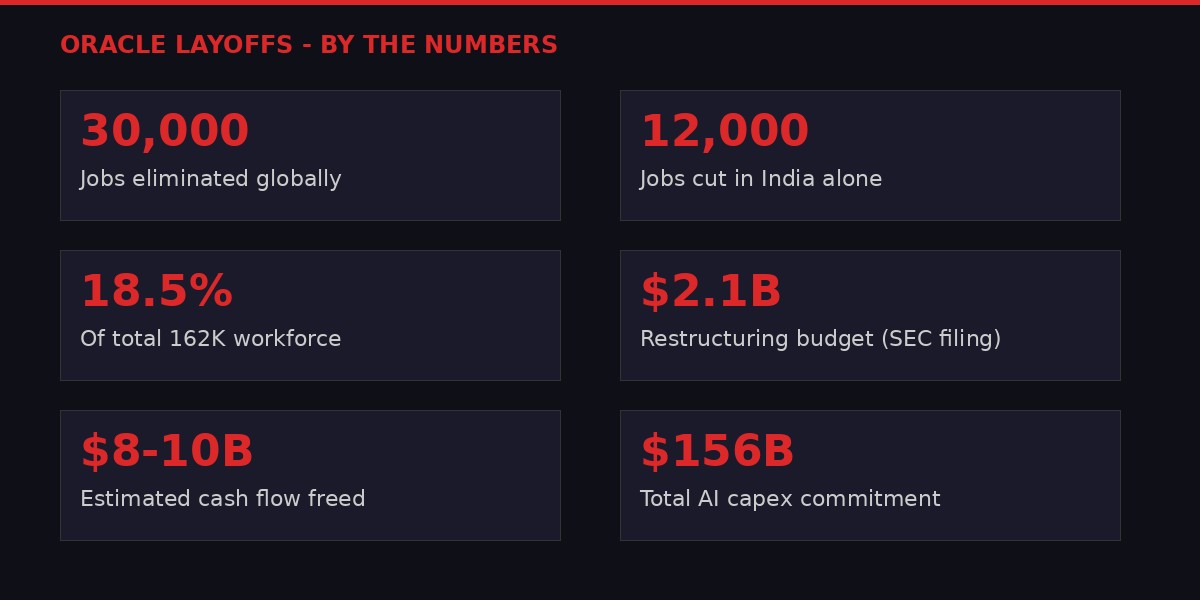
The scale of Oracle's restructuring, visualized. Source: TD Cowen, SEC filings, Bloomberg
How the 6 AM Emails Hit

Employees across five countries woke up to the same message. Photo: Pexels
The first reports surfaced on Reddit's r/employeesOfOracle and the anonymous professional network Blind before 7 AM Eastern on March 31. Workers posted screenshots of the termination email, which several described as identical across divisions and geographies. The email informed recipients that their role had been eliminated as part of a "broader organizational change" and that the date of the email was their final working day.
Canada, Mexico, and Uruguay were hit first, followed by the US wave. In India, approximately 12,000 employees - roughly 40% of the global total - were cut, according to reports from The Hindu, India Today, and The Economic Times. Oracle's Bengaluru and Hyderabad development centers bore the heaviest impact, with entire teams in the Revenue and Health Sciences (RHS) and SaaS and Virtual Operations Services (SVOS) divisions seeing reductions of at least 30%.
One of the affected employees, Venkatraman Raguraman, a Principal Product Manager at Oracle, posted on LinkedIn: "Today, I'm sharing something I didn't expect to say so soon - I've been impacted by a layoff at Oracle. This was honestly a shock. Like many of us, I put in long hours and late nights, believing deeply in the importance of what we were building and the impact it would have."
"Experiences like this are a humbling reminder that there are factors at play far bigger than what we can see day to day - and not everything is within our control." - Venkatraman Raguraman, former Principal Product Manager, Oracle (via LinkedIn, March 31, 2026)
Reports from multiple affected employees indicate that the termination process was entirely automated. There was no opportunity to speak with a manager, no exit interview, no explanation of severance terms in the initial communication. Systems access was cut simultaneously with email delivery. Workers who attempted to log in to internal tools after receiving the notification found their credentials already deactivated.
The Economic Times reported that another round of layoffs is expected within a month, suggesting the March 31 event was not the conclusion of Oracle's restructuring but merely the largest single wave. Between August and September 2025, Oracle had already quietly cut over 3,000 jobs across its US, Canada, and India operations - a prelude that most observers missed at the time.
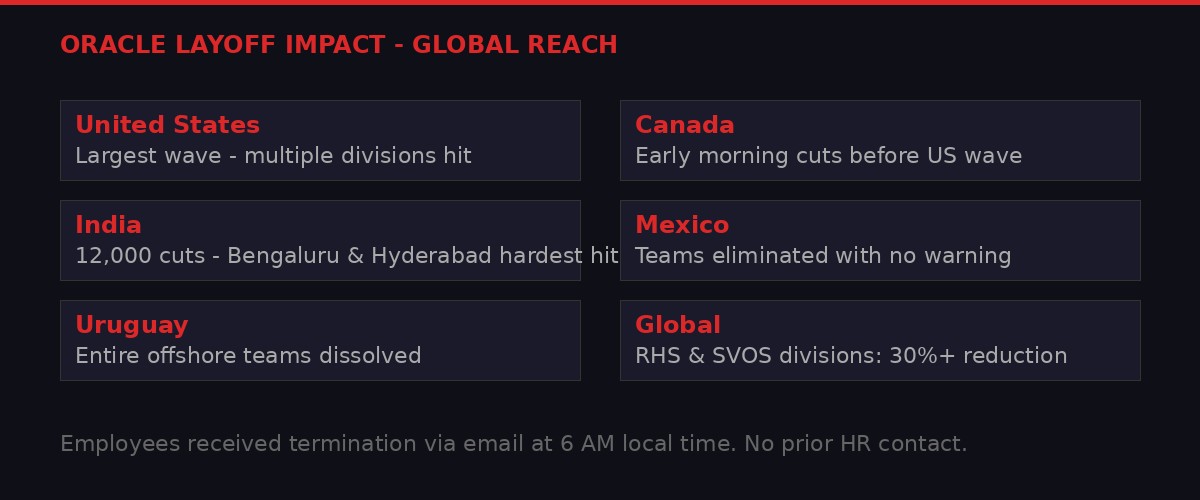
The geographic reach of Oracle's March 31 layoff wave.
The $156 Billion Question: Why Now?

The data centers Oracle is racing to build require a different kind of workforce. Photo: Pexels
The financial logic behind Oracle's decision is both straightforward and deeply unsettling. Oracle has committed to an AI infrastructure buildout that TD Cowen estimates will require approximately $156 billion in total capital expenditure. The company is attempting to transform itself from a legacy database and enterprise software vendor into a hyperscale AI cloud provider - competing directly with Amazon Web Services, Microsoft Azure, and Google Cloud Platform in a market where the infrastructure requirements are measured in gigawatts, not gigabytes.
To fund this transformation, Oracle has taken on a staggering amount of debt. In February 2026 alone, the company raised $50 billion in debt and equity financing for Oracle Cloud Infrastructure. The Telecom Economic Times reported that Oracle has accumulated approximately $58 billion in new debt in just the first two months of 2026. Multiple US banks have reportedly raised lending costs or stepped back entirely from financing certain Oracle data center projects, according to a report from Data Center Dynamics citing TD Cowen analysis.
Oracle's March 2026 10-Q filing with the SEC disclosed a $2.1 billion restructuring plan, with $982 million already recorded in expenses during the first nine months of fiscal year 2026. The remaining $1.1 billion is primarily earmarked for severance payments - the corporate euphemism for the cost of telling 30,000 people their services are no longer required.
TD Cowen estimates the workforce reductions will free up between $8 billion and $10 billion in annual cash flow. That money is being redirected into data center construction, GPU procurement, and the infrastructure required to support Oracle's contractual obligations to its AI customers - most critically, its role in the $500 billion Stargate project.
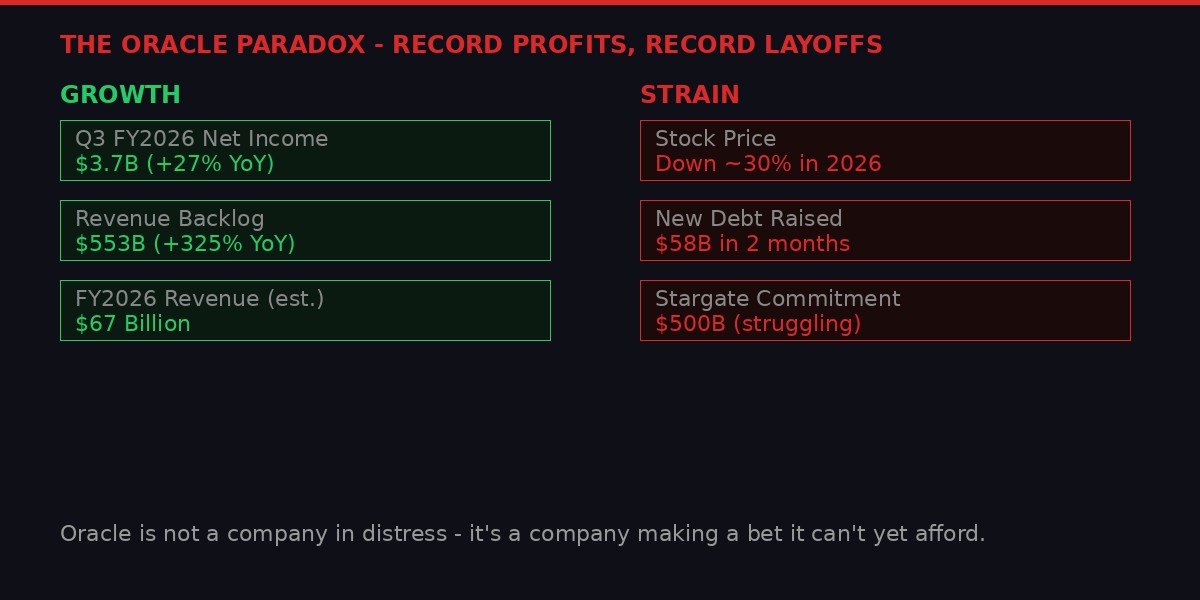
The paradox: Oracle is posting record earnings while executing record layoffs.
The Stargate Problem

Stargate promised $500 billion in AI infrastructure. Delivering it is proving harder than announcing it. Photo: Pexels
In January 2025, Oracle, OpenAI, and SoftBank announced Stargate - a joint venture to invest $500 billion in AI infrastructure across the United States over the following four years. The announcement came directly from the Trump White House, with all the spectacle that implies. Larry Ellison, Oracle's chairman and co-founder, stood alongside Sam Altman and Masayoshi Son to herald a new era of American AI dominance.
Fourteen months later, the project has not materialized in the way it was promised. In January 2026, Business Insider reported that Oracle was struggling to find financing for its Stargate commitments. The gap between announcement-grade ambition and execution-grade capital is enormous. While JPMorgan Chase agreed to lend $2.3 billion for Stargate data center projects in Abilene, Texas, that figure is a rounding error against the $500 billion headline number.
Oracle's solution has been to borrow aggressively, raise capital through convertible preferred stock, and cut operational costs wherever possible. The 30,000 layoffs are the most visible manifestation of that cost-cutting - but they represent a broader strategic bet that the company can pivot fast enough to capture AI cloud market share before its debt obligations become unserviceable.
The company reported remaining performance obligations of $553 billion in its Q3 FY2026 earnings, a figure up 325% year-over-year that reflects committed future revenue from cloud contracts. But committed revenue is not collected revenue, and Oracle's ability to deliver on those contracts depends on infrastructure that doesn't yet exist - infrastructure that requires the very capital the company is struggling to secure.
Forbes reported on April 1 that Oracle's stock has sunk approximately 57% from its recent highs, with the market clearly pricing in skepticism about the company's ability to execute its AI pivot without destroying shareholder value in the process. The company's stock dropped nearly 30% in the first quarter of 2026 alone, reflecting broader investor anxiety about whether massive AI capital expenditure will generate returns commensurate with the investment.
Larry Ellison's "SaaSpocalypse" Theory

Ellison and CEO Sicilia are betting everything on AI replacing traditional SaaS. Photo: Pexels
On Oracle's Q3 FY2026 earnings call in early March, Larry Ellison introduced a concept he called the "SaaSpocalypse" - the idea that artificial intelligence will render traditional Software-as-a-Service products obsolete, devastating companies that fail to embed AI agents directly into their application stacks. His argument: Oracle is the disruptor, not the disrupted.
"That's why we think the SaaSpocalypse applies to others but not to us." - Larry Ellison, Oracle Chairman, Q3 FY2026 Earnings Call, March 2026
Oracle CEO Mike Sicilia reinforced the narrative: "I do think that AI tools and their coding capabilities would be a threat if we weren't adopting them, but we are, and very rapidly. We are building brand new SaaS products using AI and also embedding AI agents right into our existing application suites."
The message is clear. Oracle's leadership believes AI will replace significant portions of human-delivered software services - and they're acting on that belief internally before their competitors can act on it externally. The 30,000 eliminated positions are not, in Ellison's framework, victims of cost-cutting. They're the human-delivered services that AI agents are replacing.
The contradiction embedded in this logic is significant. Oracle is simultaneously telling its enterprise customers that AI-embedded products will make their operations more efficient while using the exact same logic to fire the human talent that currently supports those products. Workers in the SaaS and Virtual Operations Services division - the people who implement, maintain, and support Oracle's cloud products for paying customers - saw 30% or greater reductions.
The question for Oracle's enterprise customers is practical and urgent: will the implementation support, customer success managers, and professional services teams they depend on survive this restructuring intact? If Oracle is cutting the humans who make its products work for paying clients, those clients need to know whether they're about to experience a degradation in service that no AI agent can immediately replace.
Ellison's 81 years have not diminished his appetite for massive bets. His net worth, estimated by Forbes at approximately $152 billion, makes him the world's third-richest person. But personal wealth is not corporate solvency, and Oracle the company is carrying debt loads that would make a leveraged buyout firm nervous.
The Broader Pattern: AI's Body Count
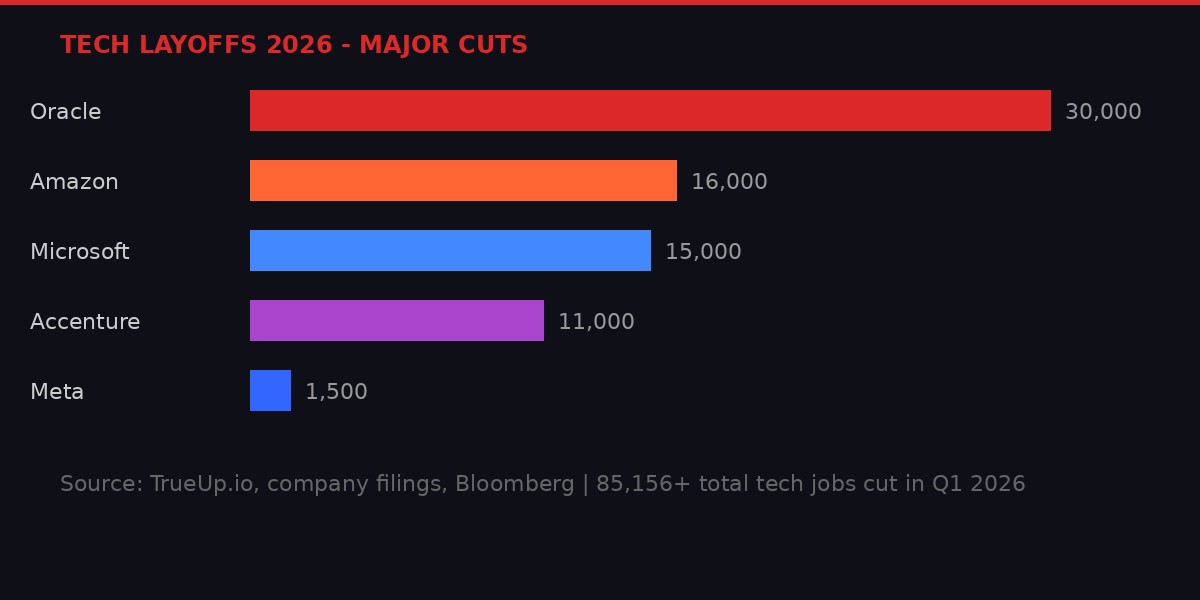
Oracle's 30,000 cuts dwarf other major tech layoffs in 2026.
Oracle's layoffs did not happen in isolation. They are the largest single event in what has become a sustained, industry-wide workforce reduction driven by AI investment. According to tracking data from TrueUp.io, as of April 1, 2026, there have been 208 layoff events at technology companies in the calendar year, affecting at least 85,156 workers - an average of 936 people per day.
The major cuts of 2026 alone tell a story of systematic workforce replacement:
- Oracle: Up to 30,000 (March 31, 2026) - AI infrastructure pivot
- Amazon: ~16,000 corporate roles (January 2026) - efficiency optimization
- Microsoft: ~15,000 positions (July 2025, with continued cuts into 2026) - AI restructuring
- Accenture: 11,000 employees (September 2025) - "AI reskilling strategy"
- Meta: ~1,500 from Reality Labs (January 2026) - VR/metaverse retreat
- Dell: Multiple rounds through 2025-2026 - AI and cloud restructuring
In 2025, at least 127,000 workers at US-based tech companies were laid off in mass job cuts, according to Crunchbase. The 2026 pace, driven largely by Oracle's March 31 event, has already surpassed two-thirds of that total with nine months remaining in the year.
The Seattle metropolitan area has been hit hardest, with approximately 16,590 tech workers affected by Amazon and Microsoft layoffs combined in Q1 2026 alone. San Francisco saw 9,395 tech layoffs across multiple companies. Now, India's tech corridors - Bengaluru, Hyderabad, Pune - can add Oracle's 12,000 to their own tally.
The common thread across every major layoff announcement is AI. Companies are not reporting revenue declines. They're not losing market share to competitors. They're making a collective judgment that AI systems can do work currently performed by humans at lower cost and higher scale - and they're acting on that judgment with a speed and uniformity that suggests coordination through shared consulting advice, shared investor expectations, and shared executive peer networks rather than independent analysis of each company's specific operational needs.

85,156 tech workers have lost their jobs in 2026. The year is barely a quarter old. Photo: Pexels
India's 12,000: The Invisible Half

India's tech hubs absorbed 40% of Oracle's global cuts. Photo: Pexels
Roughly 40% of Oracle's global layoffs fell on India, where approximately 12,000 employees were terminated. The cuts spanned Oracle's major development centers, with Bengaluru and Hyderabad operations bearing the most significant impact, according to reporting from The Hindu and India Today.
India has long served as the operational backbone of Oracle's global enterprise - handling everything from product development and quality assurance to customer support and cloud operations. The roles eliminated were not peripheral. They included engineers, product managers, QA specialists, and operational staff who formed the infrastructure of Oracle's day-to-day product delivery.
The impact on India's technology workforce extends beyond the 12,000 directly affected. Oracle is one of the largest enterprise technology employers in India, and mass layoffs of this scale create downstream effects: contractors who depended on Oracle projects lose work, local businesses that served Oracle campuses see revenue declines, and the broader IT services sector absorbs increased competition for available positions as 12,000 experienced professionals enter the job market simultaneously.
The Human Impact Index, if such a thing existed, would register Oracle's India cuts as particularly severe. India's tech sector lacks the unemployment insurance infrastructure that cushions layoffs in the United States and Canada. Severance standards are often lower. The social safety net for white-collar technology workers who suddenly find themselves without income is thin. Many of the affected employees carried mortgages, school fees, and family obligations calibrated to salaries they no longer receive.
The Hindu reported that another round of layoffs is expected within a month, meaning the 12,000 figure may grow. For India's tech workers, the question is no longer whether their employer might cut jobs to fund AI. The question is when.
The pattern is especially grim because it reveals a structural shift. For two decades, India's tech hubs grew on the promise that western corporations would always need large offshore teams for development, support, and operations. AI is testing that assumption directly. If AI agents can handle tier-one support, if automated testing replaces QA teams, if code generation tools reduce the need for engineering staff - then the economic model that built Bengaluru's tech economy is under existential pressure.
What Oracle's Balance Sheet Actually Says

Record revenue, record backlog, record debt - and record layoffs. Photo: Pexels
Here is the paradox that makes Oracle's situation genuinely unusual in the history of corporate layoffs: the company is not in financial distress. Not by any traditional metric.
Oracle's Q3 FY2026 results, reported in early March, showed GAAP net income of $3.7 billion, up 27% year-over-year. Total revenue reached approximately $16.9 billion for the quarter. Remaining performance obligations stood at $553 billion, a figure that represents committed future revenue from cloud contracts and reflects the explosive demand for AI infrastructure services.
For the full fiscal year 2026, Oracle is projecting approximately $67 billion in revenue, comfortably above the $57.4 billion generated in fiscal year 2025. Analysts project that figure could leap to $90 billion in fiscal year 2027 as new data center capacity comes online.
So why fire 30,000 people when the business is growing faster than at any point in Oracle's 49-year history?
The answer is cash flow timing. Oracle's revenue is booked over multi-year contracts, but its capital expenditure requirements are immediate. Building data centers, procuring NVIDIA GPUs, securing power contracts, and constructing the physical infrastructure for AI workloads requires cash upfront - and Oracle is spending faster than its operations generate free cash flow.
The $58 billion in new debt raised in the first two months of 2026 is a staggering figure for a company of any size. Even with $67 billion in projected annual revenue, Oracle's debt-to-equity ratio has risen sharply, and the interest payments on that debt consume an increasingly large share of operating income.
TD Cowen's estimate that the layoffs will free up $8-10 billion in annual cash flow explains the arithmetic. Those billions are not going to shareholders. They're going directly into data center construction to fulfill contractual obligations that Oracle has already signed. The employees were not eliminated because they were underperforming. They were eliminated because their salaries represent capital that Oracle needs to redirect into infrastructure.
Forbes' Peter Cohan wrote on April 1: "Oracle's stock sinks 57% as the company cuts 30,000 jobs to fund a $10 billion AI push, raising concerns about cash flow, margins and future growth." The market is not rewarding Oracle for this bet. Investors are watching the debt pile grow and asking whether the payoff will arrive before the debt service becomes unmanageable.
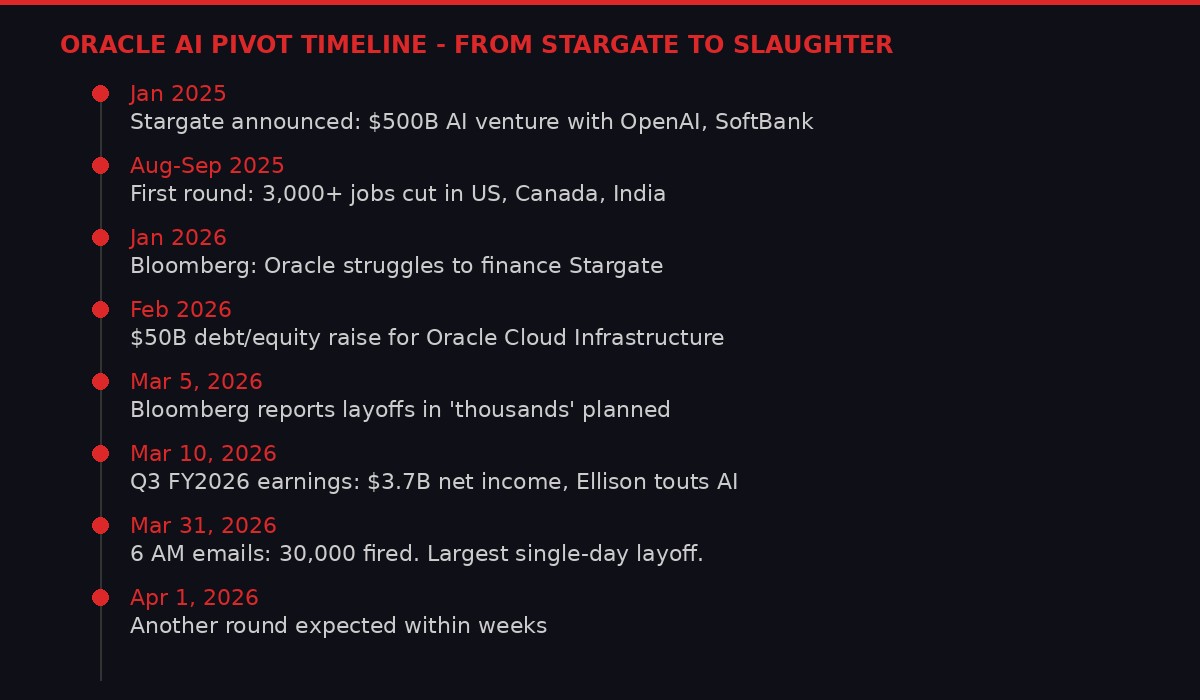
From Stargate announcement to mass layoffs: 14 months of escalation.
The SaaSpocalypse Comes Home

Oracle's future is machines, not people. The question is whether the machines can deliver in time. Photo: Pexels
Larry Ellison's "SaaSpocalypse" framing deserves scrutiny because it reveals the ideological architecture behind the layoffs. Ellison is not merely arguing that Oracle needs to cut costs. He's arguing that the entire category of human-delivered software services is approaching obsolescence - and that the survivors will be companies that replace humans with AI agents fastest.
This is not a novel argument. It's the same logic that drove every major tech layoff of 2025 and 2026. But Oracle's version is more explicit than most. When Ellison says the SaaSpocalypse "applies to others but not to us," he's saying Oracle is accelerating the replacement of human labor with AI systems while positioning itself to sell those AI systems to other companies. Oracle is both the executioner and the arms dealer.
The CX Today analysis of the layoffs identified a specific tension in Oracle's enterprise offerings. Oracle Fusion Service - the company's customer experience platform - depends on human implementation teams, customer success managers, and professional services staff who help enterprise clients deploy and maintain the product. Many of those roles sit in the SVOS division, which saw 30%+ reductions.
For Oracle's paying customers, this creates a practical risk. Enterprise software deployments are complex, long-running projects that depend on institutional knowledge held by specific human beings. When those humans are eliminated, their knowledge goes with them. AI agents may eventually be able to replace some of that expertise, but "eventually" is not "next quarter" - and next quarter is when customers with active deployments will notice that their support contacts no longer exist.
The broader implication extends beyond Oracle. If Ellison is right - if AI agents genuinely can replace the human services layer of enterprise software - then every SaaS company on earth is carrying labor costs that AI will eliminate. The 30,000 jobs Oracle cut are not Oracle's problem alone. They're a preview of what every major software company will do over the next 24 months if the technology delivers on its current trajectory.
The counterargument is that Ellison is wrong about the timeline, if not the direction. Enterprise AI adoption remains uneven. Customer-facing AI agents still struggle with complex, context-dependent support scenarios. The gap between "AI can handle routine queries" and "AI can replace a technical implementation team" is enormous. Oracle may be cutting humans before the AI replacements are ready, creating a service gap that damages customer relationships and opens the door for competitors who maintained their human infrastructure.
What Happens Next

For the 30,000, the job search starts now. For Oracle, the real test is just beginning. Photo: Pexels
Oracle's March 31 event was not the end. Multiple sources, including The Economic Times and affected employees posting on Blind, indicate that another round of layoffs is expected within weeks. The $2.1 billion restructuring budget disclosed in SEC filings has approximately $1.1 billion remaining - enough to fund additional severance for thousands more employees.
For the 30,000 workers already terminated, the immediate future involves navigating a tech job market that has absorbed 85,156 layoffs in three months. In India, where 12,000 Oracle employees were cut, the competition for available roles will be intense. The broader Indian IT services sector - Infosys, TCS, Wipro, HCL - is watching Oracle's cuts closely. If Oracle's AI pivot logic holds, every IT services company faces the same arithmetic: AI reduces headcount requirements, and the companies that cut first gain the cost advantage.
For Oracle's customers, the question is whether the company can maintain service levels with a workforce that is 18.5% smaller. Enterprise contracts typically include SLA commitments for response times, implementation support, and ongoing maintenance. If Oracle cannot meet those commitments because it eliminated the humans responsible for delivering them, customers may have contractual grounds to renegotiate or exit.
For Oracle's competitors - particularly Amazon Web Services, Google Cloud, and Microsoft Azure - the layoffs represent an opportunity. Enterprise customers who lose their Oracle support contacts may begin evaluating alternatives. Cloud migrations are expensive and painful, but they're less painful than operating on a platform where your vendor just fired the team that was supposed to help you.
For the broader technology industry, Oracle's 30,000 layoffs mark a threshold. The AI-driven workforce reduction that began as a theoretical concern in 2023 and escalated through 2024 and 2025 has now reached the point where a single company can eliminate 30,000 jobs in a single morning via email, and the primary market response is a discussion about whether the cost savings will be sufficient to fund AI infrastructure.
The human cost is no longer part of the calculus. It has been abstracted into line items: restructuring charges, severance budgets, cash flow projections. The people behind those line items woke up on March 31 to a 6 AM email that ended their careers. Oracle has not yet acknowledged them publicly. In the logic of the SaaSpocalypse, perhaps it never will.
Get BLACKWIRE reports first.
Breaking news, investigations, and analysis - straight to your phone.
Join @blackwirenews on Telegram