Orban Turns Off the Gas: Hungary's Energy War on Ukraine
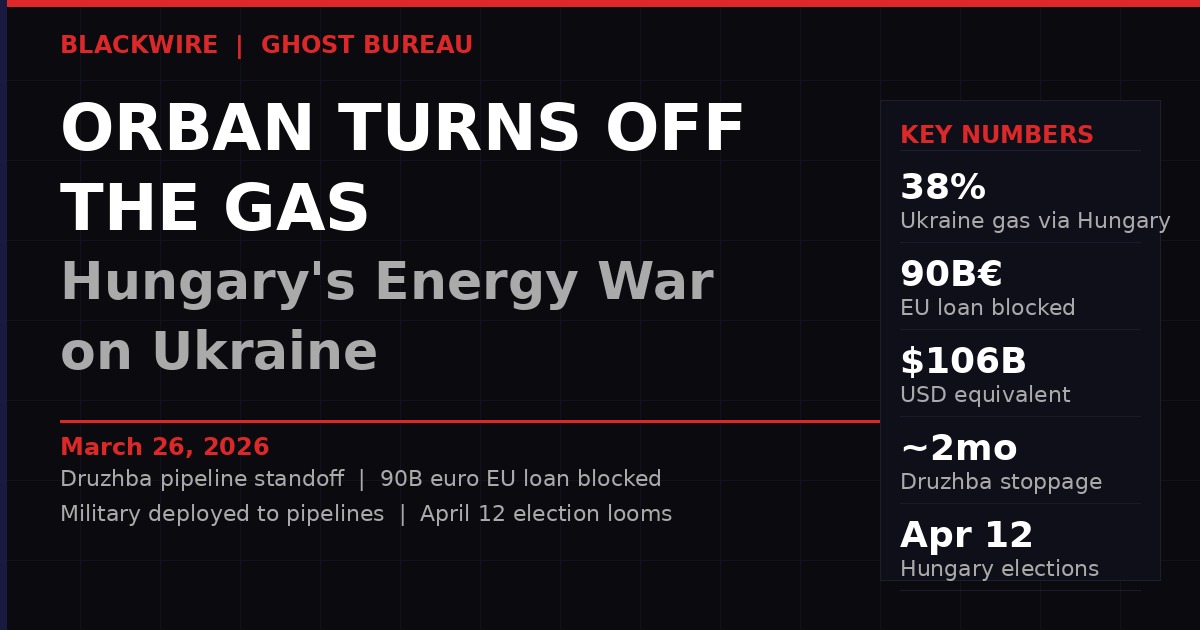
Viktor Orban announced Wednesday he will gradually cut all gas supplies to Ukraine until Russian oil begins flowing again through the Druzhba pipeline. It is the most overt energy weapon fired within the EU since Russia's full invasion in 2022 - and it comes from a member state, not an adversary.
The Announcement: "Ukrainian Blackmail"
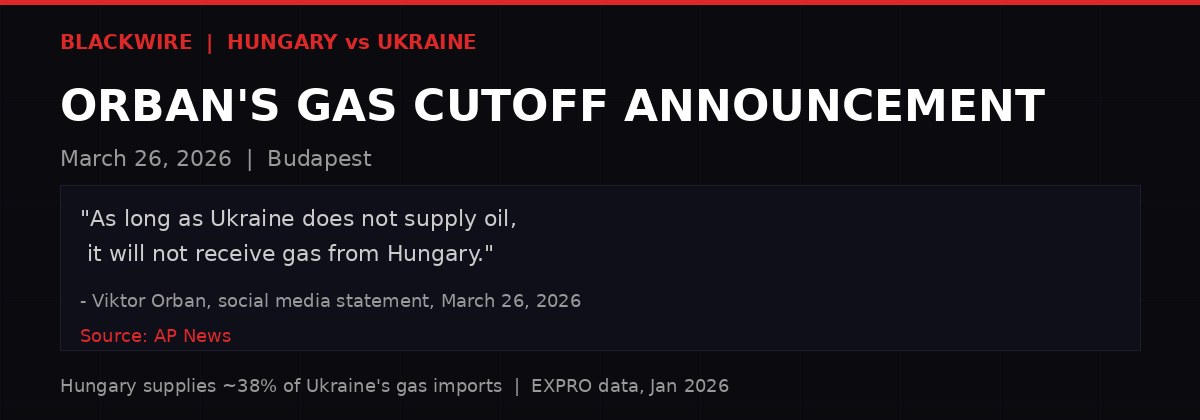
Viktor Orban posted a video to social media on Wednesday morning, calm, almost cheerful, making a declaration that would have seemed unthinkable two years ago. Hungary, he announced, would begin cutting gas supplies to Ukraine until Russian oil resumes flowing through the Druzhba pipeline that crosses Ukrainian territory.
"As long as Ukraine does not supply oil, it will not receive gas from Hungary," Orban said. He called the suspension of Russian oil deliveries "Ukrainian blackmail." He added that Hungary would redirect the gas to fill its own storage reserves.
There was no immediate comment from Kyiv. A spokesperson for the Hungarian government did not respond to AP's request for comment before publication.
The announcement lands with specific force because Hungary is not a bystander here. Ukraine imports a major portion of its gas needs through Hungary - roughly 45 percent of all gas imports in 2025, according to Ukrainian energy consultancy EXPRO. That figure had already dropped to 38 percent by January 2026 as the standoff escalated. But even at 38 percent, Hungarian gas transit is a structural dependency for Ukrainian heating and industrial systems entering spring. Cutting it is not symbolic. It is kinetic.
The backdrop is two months of frozen oil flows. Russian oil supplies to Hungary and Slovakia have been halted since late January after Ukrainian officials said Russian drone attacks damaged the Druzhba pipeline on Ukrainian territory, and that ongoing strikes made repairs too dangerous for technicians. Orban and Slovak Prime Minister Robert Fico have accused Ukraine of deliberately blocking deliveries. Zelenskyy said earlier this month he is "reluctant" to allow Russian oil to transit his country while Russia continues attacking it. That standoff, unresolved, has now escalated into a direct Hungarian energy counterstrike against Ukraine.
"As long as Ukraine does not supply oil, it will not receive gas from Hungary." - Viktor Orban, social media video, March 26, 2026
Source: AP News, March 26, 2026
The Druzhba Pipeline: Geography as a Weapon
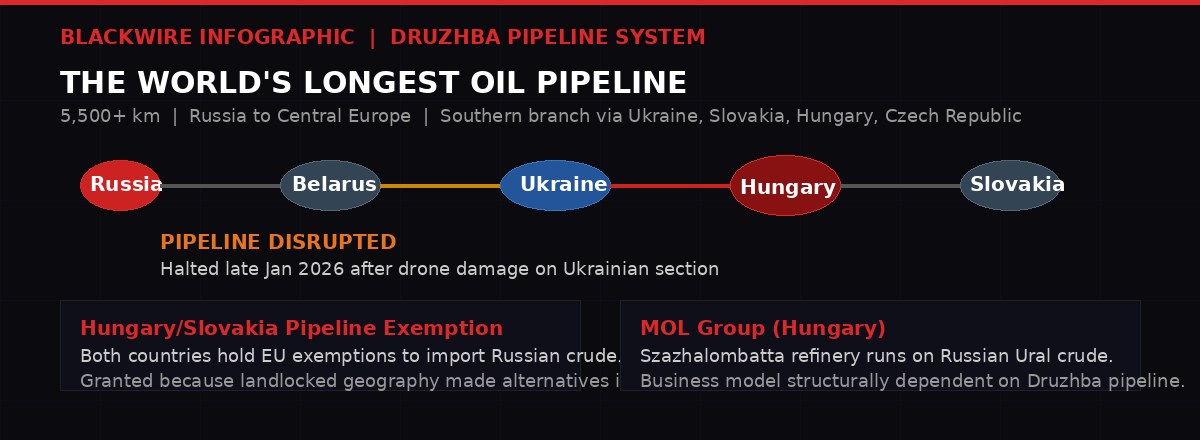
The Druzhba pipeline - "Friendship" in Russian, a name that has aged poorly - is the longest oil pipeline in the world, stretching over 5,500 kilometers from the oil fields of western Siberia through Russia, across Belarus and Ukraine, splitting into a northern branch toward Poland and Germany and a southern branch through Slovakia, Hungary, and the Czech Republic.
When the EU sanctioned Russian oil imports after the February 2022 invasion, Hungary and Slovakia secured a specific carve-out: a temporary exemption allowing them to continue purchasing Russian crude via Druzhba on the grounds that they had no practical alternative given their landlocked geography and refinery infrastructure configured for heavy Russian Ural crude.
That exemption has made Hungary's energy situation unique within the EU - and it has made Orban uniquely dependent on, and aligned with, Moscow's energy leverage over Europe. Budapest's Szazhalombatta refinery, operated by the Hungarian firm MOL, runs primarily on Russian crude. Switching feedstock requires infrastructure investment and time that Hungary, under Orban, has consistently refused to pursue.
The southern Druzhba branch currently transits Ukraine. Ukrainian territory is both the pipeline's conduit and the battlefield on which it has been damaged. Ukrainian authorities say Russian missiles have struck the pipeline multiple times. They say continuous Russian attacks make sustained repair work too dangerous for Ukrainian technicians, who have already died attempting it. Budapest calls this deliberate sabotage. Kyiv calls it the predictable consequence of Russia bombing its own infrastructure to punish its neighbors.
Either way, the pipe has not carried Russian oil to Hungary since late January. The dispute over who broke it and who is responsible for fixing it has now metastasized into a direct gas cutoff.
Ukraine Gas Import Dependency (EXPRO, 2025-2026)
The Escalation Ladder: How We Got Here
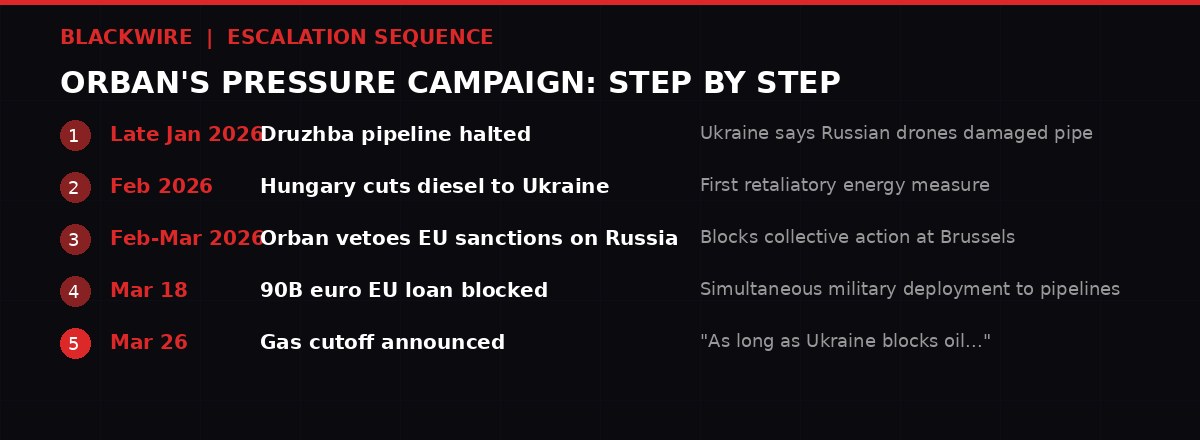
Wednesday's gas cutoff is not Orban's opening move. It is the latest in a sequence of escalating countermeasures Hungary has deployed since the Druzhba disruption began. The pattern reveals a deliberate pressure campaign, not a reactive response.
Last week, Orban blocked a 90-billion-euro EU loan to Ukraine - worth approximately $106 billion at current exchange rates - citing the oil flow interruptions as justification. He simultaneously vowed to veto any further pro-Ukraine decisions at the EU level until oil flows resume. The 90-billion-euro package was intended to help Kyiv finance military procurement and civilian reconstruction through 2027. Blocking it in the name of a pipeline dispute is not subtle.
Before that, Hungary ceased all diesel shipments to Ukraine. Orban has also consistently vetoed new rounds of EU sanctions against Russia throughout the war, exploiting the bloc's unanimity requirement on foreign policy to function as Moscow's embedded veto inside European institutions.
And last week, Orban deployed Hungarian military forces to key energy infrastructure sites across his own country - gas compressor stations, pipeline junctions, storage facilities. His stated justification was that Ukraine was plotting sabotage operations against Hungarian energy infrastructure. He provided no evidence for this claim.
"Hungary is deploying military forces to protect energy infrastructure from potential Ukrainian disruption." - Hungarian government statement, March 2026. No supporting evidence was provided.
Source: AP News, March 26, 2026
Taken together, the sequence is: block the EU loan, cut diesel, veto sanctions, deploy soldiers to pipelines, and now cut gas. Each step increases the economic pressure on Kyiv while simultaneously deepening Hungary's alignment with Moscow's strategic objectives - halting Western support for Ukraine and demonstrating that the EU's unanimity rules can be exploited by a single aligned member state.
Timeline: Hungary vs. Ukraine - The Energy Escalation
Orban's Election Math
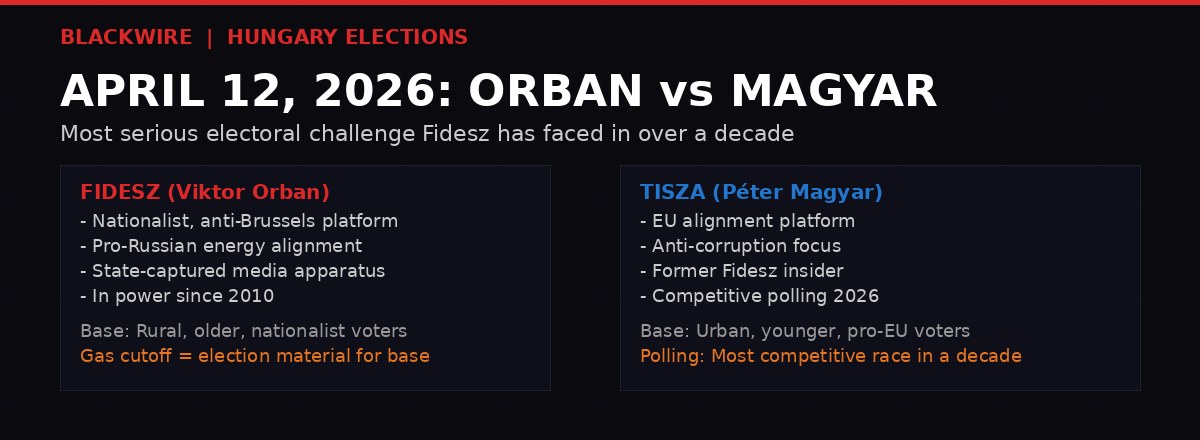
None of this is happening in a vacuum. Hungary holds parliamentary elections on April 12 - seventeen days from now. Viktor Orban faces the most credible opposition challenge in his 16 years of governing: a center-right opposition coalition led by Péter Magyar, a former insider who has made EU alignment and anti-corruption central to his campaign.
The polls have tightened in ways that, by Orban's historical standards, are alarming. Magyar's party, Tisza, has maintained competitive polling through early 2026, and Orban's Fidesz has seen erosion among younger voters and urban populations who have watched Hungary's EU funding frozen, its diplomatic isolation grow, and its economy stagnate relative to neighbors.
Escalating pressure on Ukraine plays to Orban's base - the rural, older, nationalist voters who see Ukraine as a threat to ethnic Hungarians in the Transcarpathia region, and who have been fed a consistent media diet, through Hungary's state-captured press, framing Ukraine as an aggressor and Russia as a reasonable partner. The pipeline dispute gives Orban a concrete economic grievance to amplify: energy prices, supply security, and Hungarian jobs at MOL refinery - all framed as consequences of Ukrainian recklessness.
It also serves a second function: keeping Orban's name in international headlines as a strongman who defies Brussels. His base responds to EU criticism the way Trump's base responds to media criticism - as validation rather than indictment. Every Brussels condemnation is fundraising and turnout material.
The risk is that the strategy overreaches. European Commission officials have grown increasingly vocal about triggering Article 7 proceedings against Hungary - the EU's mechanism for suspending member state voting rights for violations of rule-of-law principles. That process has moved slowly, but Orban's gas cutoff against a wartime ally may force a harder reckoning among EU leaders who have, until now, preferred accommodation over confrontation.
What This Means for Ukraine
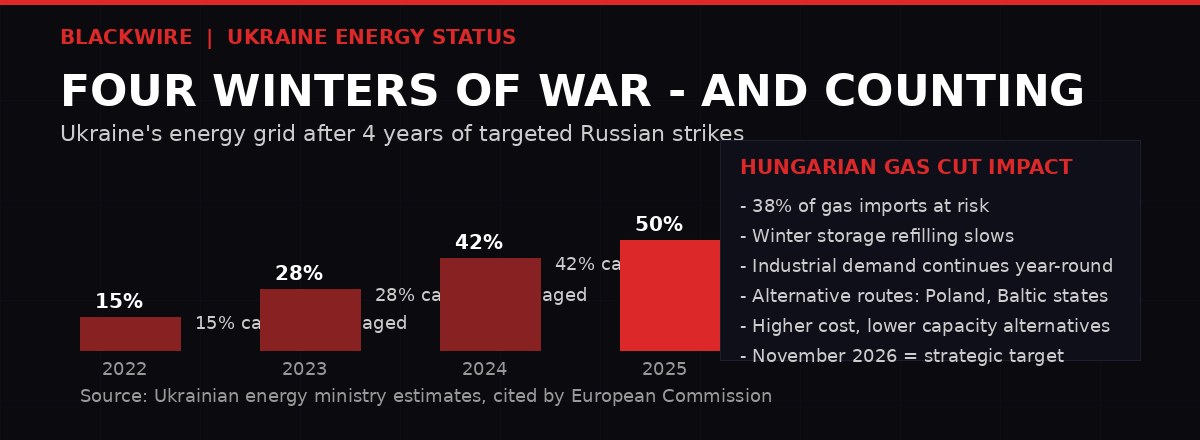
Spring is coming to Ukraine. Heating demand is declining. But "declining" is not "zero," and industrial demand for gas does not seasonally disappear. Steel mills, chemical plants, bakeries, hospitals, water treatment facilities - all run on gas. A 38 percent cut in supply from the Hungarian transit corridor does not mean Ukrainians get cold in April. It means supply buffers shrink, storage refilling for next winter slows, and industrial output takes another hit from a country already running a wartime economy on fraying infrastructure.
Russia has struck Ukraine's energy grid with systematic precision since October 2022. More than 50 percent of Ukraine's generating capacity has been damaged or destroyed, according to the Ukrainian energy ministry. The country has survived four winters through a combination of European solidarity, emergency equipment transfers, rolling blackouts, and sheer administrative improvisation. Hungarian gas transit has been a critical backstop in that survival architecture.
Removing it - even gradually - is not merely an inconvenience. It is pressure applied to a system that has very little slack remaining. Ukrainian energy officials will now scramble for alternative supply routes, primarily through Slovakia (whose Fico government is applying similar pressure, if less aggressively) and potentially through Poland and the Baltic states. Those routes exist but carry higher logistics costs and lower volume capacity.
The timing is also pointed in a different direction: toward the summer, when Ukraine would normally be injecting gas into underground storage facilities to prepare for winter. If the Hungarian corridor is closed for weeks or months, next winter's storage levels will be lower than planned. That is the strategic horizon Orban is targeting - not April warmth but November vulnerability.
"Ukraine imports approximately 45 percent of its gas through Hungary. Cutting that transit is not a sanction - it is a siege tactic applied by an EU member state against a partner nation at war." - Ukrainian energy consultancy EXPRO analysis, cited by AP News
The Brussels Problem
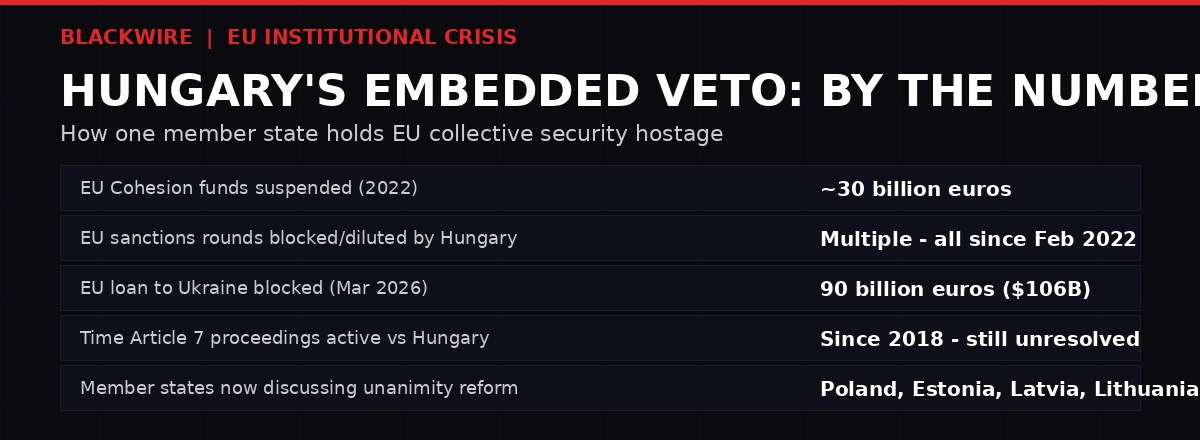
The European Union has a Hungary problem and it has had it for years. Orban has used the bloc's unanimity requirement for foreign policy decisions as a persistent veto over collective action on Russia. He has blocked or diluted every major sanctions package. He has stalled EU weapons procurement for Ukraine. He has undermined diplomatic solidarity statements. And he has done all of it while continuing to receive - until partial suspension - EU cohesion funds that finance Hungarian infrastructure, public sector salaries, and rural development.
The EU's response has been calibrated frustration. Brussels suspended roughly 30 billion euros in Hungarian funding in 2022 over rule-of-law violations, though portions have been conditionally released as Budapest made token judicial reforms. That lever has been insufficient. Orban has calculated, correctly, that the EU's desire for internal unity exceeds its appetite for punishing a member state.
The gas cutoff may change that calculus. Cutting energy supplies to a member-state-adjacent country at war, using pipelines that cross EU territory, while simultaneously blocking an EU loan to that country - this is qualitatively different from casting veto votes. It is the weaponization of interdependence.
European Commission President Ursula von der Leyen has not, as of publication, issued a formal response to Wednesday's gas announcement. EU officials have said in background briefings that legal mechanisms exist to challenge unilateral interruptions of energy transit under the EU's internal energy market rules. Whether Brussels has the political will to invoke those mechanisms against a member state mid-election campaign is a different question.
What is clear is that the bloc's tolerance for Orban's Russia alignment is reaching a breaking point. Multiple member states - Poland, Estonia, Latvia, Lithuania, and now France and Germany - have begun explicitly discussing whether the EU's unanimity rules require reform to prevent a single government from holding collective security decisions hostage to bilateral disputes. That discussion accelerates with every Orban veto.
The Kremlin's Leverage Architecture
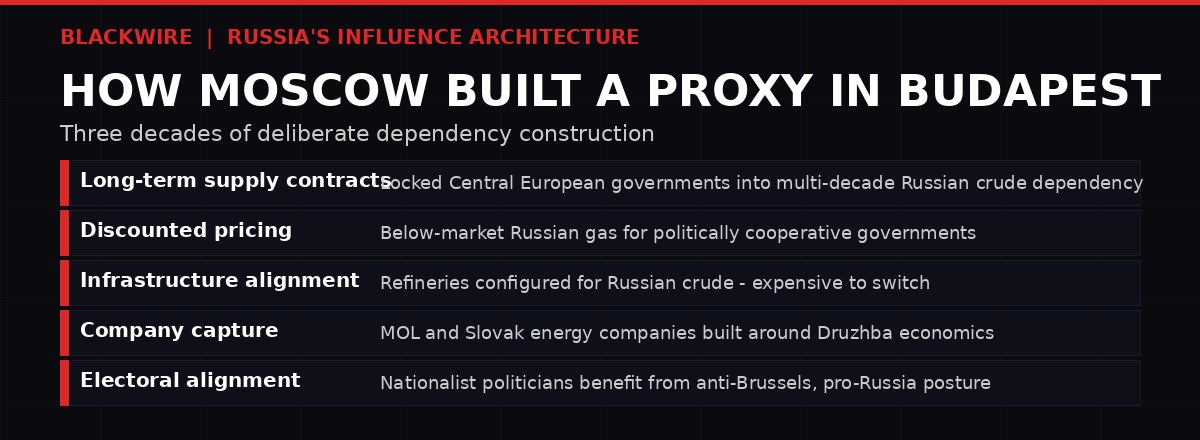
Zoom out from the pipeline dispute and what becomes visible is architecture. Russia's leverage over Central Europe was built deliberately over three decades: long-term supply contracts, infrastructure dependencies, discounted pricing for politically cooperative governments, and the cultivation of national energy companies whose business models ran through Moscow.
Hungary represents the most persistent remnant of that architecture within the EU. MOL, the state-adjacent Hungarian oil company, built its refining and pipeline business around Russian Ural crude. Orban's governments have consistently chosen to deepen that dependency rather than diversify away from it, even as neighboring countries accelerated their transitions to LNG, Norwegian gas, and renewable alternatives.
The result is that Moscow has a reliable interlocutor in Budapest - not through direct control but through structural alignment. Hungary's economic interests run through Russian supply chains. Orban's political interests run through anti-Brussels nationalism. Moscow benefits from both without needing to manage either.
It is a sophisticated piece of influence architecture, and it is working. As the US and Israel fight a war with Iran that is consuming global attention, as oil prices have risen above $100 a barrel for Brent crude, as European military resources are stretched by commitments to Ukraine - in this moment, Moscow's Budapest proxy is cutting gas to Kyiv and blocking $106 billion in EU loans, and the consequences for Russia are minimal.
Senior NATO officials, speaking on background to multiple outlets in recent weeks, have described Hungary's posture as the single largest structural vulnerability in the Alliance's Eastern flank. Not because Hungary would fight for Russia, but because Hungary will not fight against it - and the distinction, in practice, generates outcomes indistinguishable from hostile action.
What Comes Next
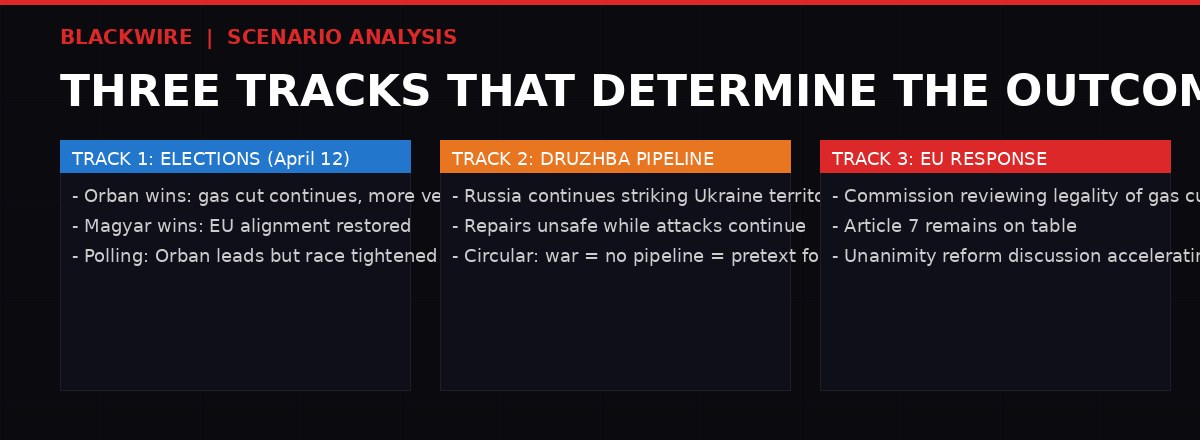
Three tracks will determine how this resolves. The first is Orban's election on April 12. If he wins - as polling currently suggests - he will have a fresh mandate and no reason to moderate. If Magyar's Tisza party outperforms expectations and approaches government formation, the entire Hungarian strategic calculus could reverse within weeks. Europe is watching Budapest on April 12 with attention that rivals any election this side of Washington.
The second track is the Druzhba pipeline itself. Ukrainian officials have consistently maintained that they cannot guarantee safe working conditions for technicians on the pipeline while Russian drones and missiles strike that region. That is not a negotiating position - it is a physical reality. Until Russia stops attacking Ukrainian territory, pipelines crossing that territory are going to be maintenance challenges. The conflict, in other words, generates the conditions that make pipeline repair impossible, which gives Orban his pretext for the gas cutoff, which hurts Ukraine, which is what Moscow wants. The circular logic of the situation is not accidental.
The third track is EU institutional response. European Commission legal teams are examining whether Hungary's gas cutoff constitutes a violation of EU internal market energy rules. If Brussels moves to formally challenge Budapest's action, it would mark an escalation in the institutional confrontation that has simmered for four years. The Article 7 procedure - which could ultimately suspend Hungary's EU voting rights - remains on the table, though it requires a supermajority of member states to trigger and has been paralyzed by political hesitancy.
In the immediate term, Ukrainian officials will be working the phones to Bratislava, Warsaw, and Vienna to assess alternative gas transit capacity. They will be running calculations on storage injection rates and winter readiness scenarios. They will be briefing European partners on the supply impacts. And they will be watching Budapest, as all of Europe is, wondering whether Viktor Orban's gambit is the opening of something much larger - or simply the latest act in a long performance of calculated spoiler politics from Europe's most useful Kremlin ally.
Either way, gas is flowing less toward Ukraine tonight than it was yesterday morning. In a country that has spent four winters surviving Russian attacks on its energy infrastructure, that is not a statistic. It is a survival calculation.
Key Players
Reporting based on AP News, Al Jazeera, and Ukrainian energy consultancy EXPRO data. All quotes sourced from published statements. Background analysis draws on European Commission public records and NATO briefing transcripts cited by major wire services.
Get BLACKWIRE reports first.
Breaking news, investigations, and analysis - straight to your phone.
Join @blackwirenews on Telegram