SNAP: Inside Palantir's $200 Million Machine That Decides Who the IRS Audits Next
A custom AI platform called the Selection and Analytic Platform is mining unstructured documents, gift-tax filings, and clean energy credits to surface the IRS's "highest-value" audit targets. The agency that can't modernize its own computers is handing the keys to Peter Thiel's surveillance company.

The IRS uses more than 700 methods across 100+ legacy systems to decide who gets audited. Palantir wants to replace all of them. Photo: Unsplash
Somewhere inside the Internal Revenue Service, a piece of software is learning to read your tax returns, your gift disclosures, your clean energy credit claims - and deciding whether you're worth investigating. The software is called SNAP - the Selection and Analytic Platform. It was built by Palantir Technologies. And according to documents obtained by WIRED through a Freedom of Information Act request and published on March 30, 2026, the IRS paid $1.8 million last year to make it smarter.
That $1.8 million is a rounding error in a relationship that stretches back over a decade. Since 2014, Palantir has been awarded more than $200 million in contracts and obligated payments with the IRS, according to federal spending records on USAspending.gov. What started as data-analytics work has evolved into something far more ambitious: a pilot program designed to replace the IRS's aging, fragmented case-selection process with an AI-powered targeting system that can mine unstructured documents, cross-reference databases, and surface what the agency calls "highest-value" cases for audits, tax collection, and criminal investigation.
The timing is impossible to ignore. This is happening while the IRS sheds staff by the tens of thousands under DOGE-driven restructuring. While Palantir simultaneously builds a "mega API" to unify all IRS data. While the Trump administration issues executive orders demanding agencies eliminate "information silos." SNAP isn't a standalone product - it's the analytical brain being grafted onto a centralizing body.
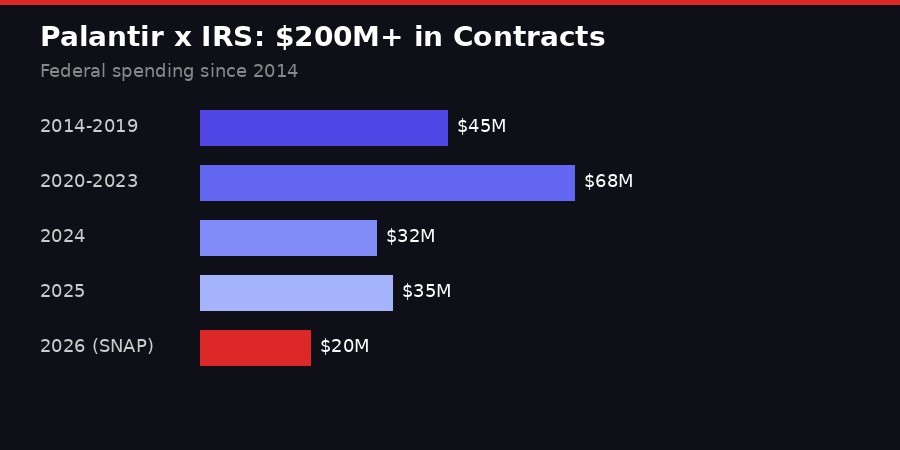
Palantir's contracts with the IRS have grown steadily since 2014, totaling over $200 million. The SNAP pilot represents the latest - and most consequential - expansion.
The Problem SNAP Claims to Solve

The IRS's case-selection process spans more than 100 business systems and 700 methods built over decades. Photo: Unsplash
The IRS is, by any reasonable measure, an institution held together by duct tape and institutional memory. According to the contract documents obtained by WIRED, the agency uses "more than 100 business systems and 700 methods" to select cases for examination. These systems were built over the course of decades. Some of them date to an era when taxpayer records were stored on mainframes the size of refrigerators. Many of them don't talk to each other.
The result is what the IRS itself described as a "fragmented landscape" that produces "duplication of effort and cost, poor understanding of gaps in the coverage, and suboptimal case selection." In plain language: the IRS doesn't always know who to audit, and when it does decide, it often picks the wrong targets - or picks the same targets as three other internal programs.
This fragmentation has real consequences. For years, studies from the Government Accountability Office and academic researchers have documented how the IRS's audit selection tends to skew toward lower-income taxpayers, particularly those claiming the Earned Income Tax Credit, because those cases are simpler to resolve with fewer resources. Meanwhile, complex returns from high-net-worth individuals and corporations - the ones where the actual money is - require more sophisticated analysis than legacy systems can deliver.
"The agency basically never had a full successful modernization since the 1960s." - Erica Neuman, accounting and finance professor at Youngstown State University, speaking to WIRED
The IRS has tried to fix this before. Multiple times. The Business Systems Modernization program, launched in 1999, burned through billions of dollars before being widely considered a failure. The Customer Account Data Engine (CADE) project, meant to replace the Individual Master File system from the 1960s, took over two decades and only partially succeeded. Each attempt was hampered by the same forces: congressional budget cuts, commissioner turnover, and what Neuman describes as the simple political reality that "there's often a lack of political will to die on the hill of the IRS."
Nobody runs for office promising to make the tax agency better at auditing people. Which is precisely why Palantir's approach is different. SNAP doesn't attempt to replace the IRS's legacy systems. It sits on top of them, like Palantir's other government tools, ingesting data from multiple sources and presenting it through a unified analytical layer. It's the same architecture Palantir uses for military intelligence, counterterrorism, and border enforcement - applied to your 1040.
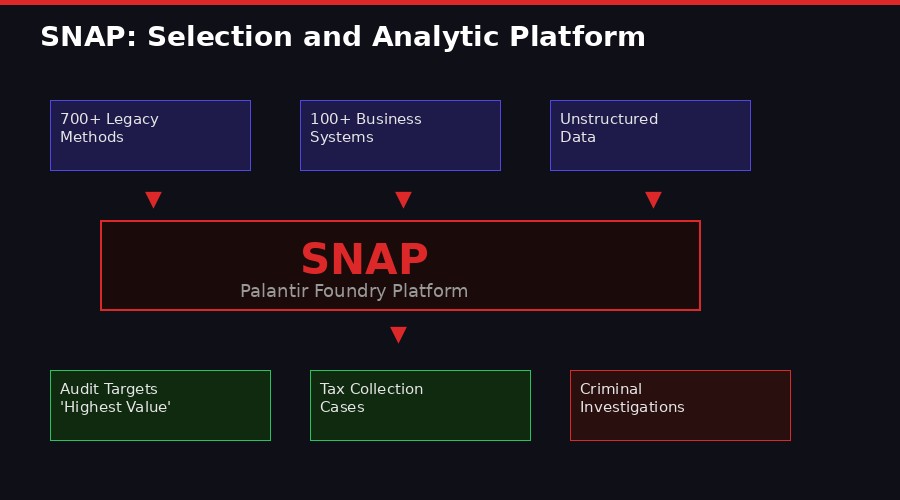
SNAP sits atop the IRS's fragmented legacy infrastructure, using Palantir's Foundry platform to unify data and surface audit targets.
How SNAP Actually Works

SNAP uses Palantir's Foundry platform to analyze both structured tax data and unstructured documents. Photo: Unsplash
The contract documents reveal that SNAP is built on Palantir's Foundry platform - the same software the company deploys across the Pentagon, the CIA, the NHS, and dozens of Fortune 500 corporations. Foundry works by creating an "ontology layer" - a structured map of all the data it ingests - that allows users to build applications, run AI models, and generate APIs for faster connections.
For the IRS pilot, Palantir was asked to build three specific "case selection methods" targeting different areas of the tax code:
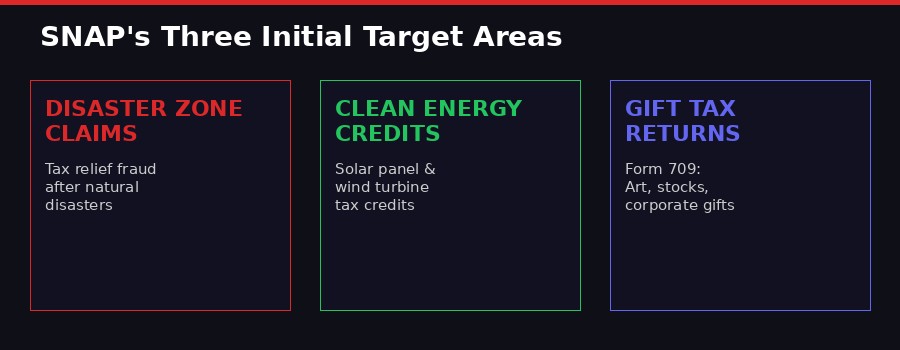
SNAP's initial pilot focuses on three areas where the IRS suspects widespread fraud or misreporting.
Disaster Zone Claims. When natural disasters strike, the IRS offers tax relief to affected residents. These claims have historically been difficult to verify and prone to fraud. SNAP is designed to cross-reference disaster declarations with filing patterns to identify suspicious claims.
Residential Clean Energy Credits. The Inflation Reduction Act massively expanded tax credits for solar panels, wind turbines, battery storage, and other clean energy installations. The IRS needs a way to verify that people actually installed what they claimed. According to experts, the clean energy credit program has become a magnet for scams - from phantom solar installations to inflated equipment costs.
Form 709 Gift Tax Returns. When someone gives away something valuable - artwork, corporate interests, real estate, stock portfolios - they may need to file a gift tax return with "adequate disclosure" of how the gift was valued. Mitchell Gans, a professor at Hofstra University specializing in gift and estate taxes, told WIRED that SNAP may be analyzing the supporting documents attached to these filings, including business appraisals, balance sheets, and statements of net earnings.
What makes SNAP different from the IRS's existing systems is its ability to process what the contract calls "unstructured data from supporting documents." Traditional IRS case selection relies on structured data - the numbers you put in boxes on your tax return. SNAP can read the attached documents: appraisals, receipts, business valuations, descriptions of property. It can surface patterns that a human auditor skimming thousands of filings would miss.
The contract documents specify that SNAP should only use "existing data in SNAP today" - meaning data the IRS already possesses. But Erica Neuman flagged that the agency has, in the past, explored using external data sources including public Venmo transaction logs, Etsy and Depop storefronts, Coinbase cryptocurrency records, and social media posts to supplement its own records. Whether SNAP will eventually be authorized to ingest these external sources is an open question. The architecture certainly supports it.
Key Technical Detail
SNAP uses Palantir's Foundry "ontology layer" to map relationships between taxpayers, transactions, businesses, and filed documents. The same technology powers Palantir's Gotham platform used by intelligence agencies. The ontology allows AI models to query data using natural language, meaning an IRS analyst could theoretically ask SNAP something like: "Show me all gift tax filings over $5 million where the business valuation documents show declining revenue." The system would surface matching cases automatically.
The Death of DIF Scores

The IRS's decades-old DIF scoring system - a statistical black box - may be nearing the end of its useful life. Photo: Unsplash
For decades, the primary way the IRS decided who to audit was through something called a Discriminant Information Function (DIF) score. Every tax return gets one. The IRS says "the higher the score, the greater the audit potential." But nobody outside the agency knows exactly how DIF scores are calculated. It's a genuine black box - one that researchers generally believe works by comparing current filings against historical returns that eventually led to audits.
DIF scores have a significant limitation: they only work with structured data from tax returns themselves. They can't read the lease agreement you attached as supporting documentation for your home office deduction. They can't cross-reference your claimed business expenses with the actual revenue reported by the vendors you paid. They can't look at the appraisal document supporting your charitable donation and flag that the appraiser has been sanctioned by state regulators.
SNAP can. Or at least, it's being designed to.
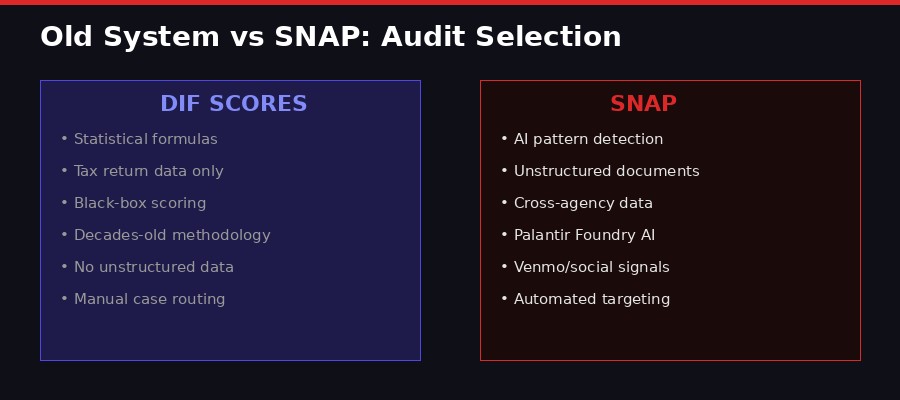
SNAP represents a generational leap from the IRS's decades-old DIF scoring methodology.
The shift from DIF to AI-powered case selection isn't just a technical upgrade. It's a philosophical transformation in how the IRS relates to taxpayers. DIF scores are passive - they wait for returns to come in and then run statistical formulas. SNAP is active - it searches through documents, finds patterns, identifies anomalies. The difference is between a speed trap and a surveillance camera network.
This matters because audit selection has always been political. A 2023 study by the Stanford Tax Policy Center found that Black taxpayers were audited at three to five times the rate of white taxpayers, largely because the IRS disproportionately targeted EITC claims. When the agency announced it would reduce EITC audits and shift focus to high-income returns, it was responding to years of criticism. But SNAP introduces a new variable: algorithmic targeting that nobody fully understands.
Professor Neuman has studied the IRS's experiments with modern analytics extensively. She found that the agency's track record with technology is deeply uneven. Contracting with Coinbase for crypto transaction data produced measurable results in enforcement actions. But attempts to mine social media posts for evidence of unreported income were largely inconclusive and raised serious privacy concerns. The question with SNAP isn't whether it can find audit targets - it's whether the targets it finds are the right ones, or just the easiest ones for an algorithm to flag.
The DOGE Connection

The same company building SNAP is simultaneously helping DOGE construct a unified API for all IRS databases. Photo: Unsplash
SNAP cannot be understood in isolation from the broader Palantir-DOGE-IRS integration happening in parallel. In April 2025, WIRED first reported that Palantir representatives were onsite at an IRS "hackathon" in Washington, DC, helping DOGE build a "mega API" - a single application programming interface that would sit above all IRS databases and allow anyone with access to query, view, and potentially alter all IRS data in one place.
The project was led by Sam Corcos, a health-tech CEO and former SpaceX engineer turned special adviser to Treasury Secretary Scott Bessent. Corcos publicly stated on Fox News that he had "stopped work and cut about $1.5 billion from the modernization budget" at the IRS. He described the existing codebase as a "death spiral of complexity."
DOGE wanted Palantir's Foundry software to become the "read center of all IRS systems," according to sources quoted by WIRED. That's the same Foundry platform powering SNAP. The overlap isn't coincidental - it's architectural. SNAP is the analytical tool that sits on the data layer DOGE is building. One system centralizes the data. The other decides what to do with it.
The implications are staggering. If the mega API project succeeds, SNAP would gain access to an integrated view of every taxpayer in the United States - not just their tax returns, but employment data, banking records, social security numbers, and whatever other datasets the IRS possesses or can obtain through inter-agency agreements. Combined with the executive order Trump signed directing agencies to eliminate "information silos," the potential scope of SNAP's data ingestion is essentially limitless within the federal government.
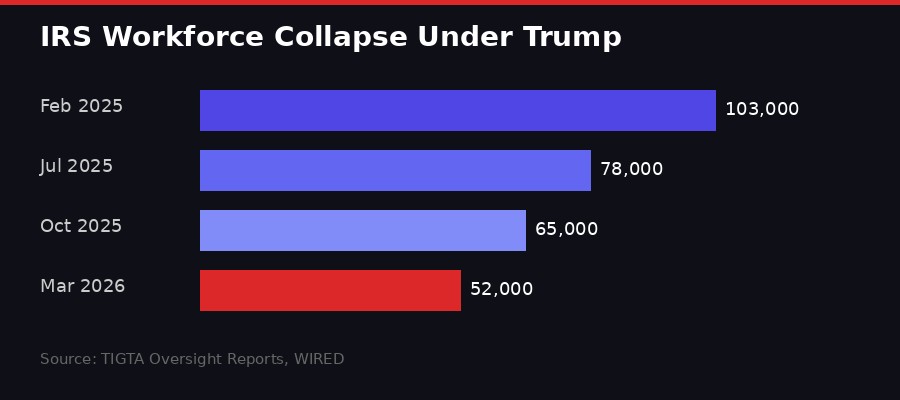
The IRS has lost roughly half its workforce since February 2025, raising questions about who will oversee Palantir's expanding role.
Meanwhile, the humans who would traditionally provide oversight are disappearing. Between February 2025 and July 2025 alone, the IRS lost more than 25,000 employees through resignations, deferred resignation offers, and early retirement packages, according to reports from the Treasury Inspector General for Tax Administration (TIGTA). The hemorrhaging has continued through 2026. Every departing auditor, analyst, and engineer represents institutional knowledge that no Palantir algorithm can replace - and fewer people asking hard questions about what the algorithm is doing.
The Privacy Question Nobody Is Answering

Privacy experts warn that SNAP's ability to mine unstructured documents represents a qualitative shift in government surveillance capacity. Photo: Unsplash
The IRS holds some of the most sensitive personal information in the federal government's possession. Tax returns contain income data, banking information, medical expenses, charitable contributions, business relationships, property ownership, investment portfolios - a comprehensive financial portrait of every American who files. Section 6103 of the Internal Revenue Code imposes strict confidentiality protections on this data, with criminal penalties for unauthorized disclosure.
But Section 6103 was written for a world of paper files and siloed databases, not AI-powered analytics platforms that can cross-reference thousands of data points in seconds. The law restricts who can access tax information and under what circumstances. It says nothing about what an AI system can do with that information once it has access.
This creates a legal gray zone that privacy advocates find deeply troubling. Jay Stanley, a senior policy analyst at the ACLU's Speech, Privacy, and Technology Project, has written extensively about algorithmic decision-making in government. The core concern is that AI systems can identify patterns that are statistically valid but ethically problematic - correlations between audit targets and demographic characteristics that would be illegal if made explicitly but invisible when embedded in algorithmic weights.
Palantir has faced these criticisms before. The company's work with Immigration and Customs Enforcement (ICE), documented in hundreds of pages of government contracts, showed how Foundry could be used to build profiles of individuals by cross-referencing data from multiple agencies. A WIRED analysis found that ICE and CBP have collectively spent at least $515 million on products from Microsoft, Amazon, Google, and Palantir. Privacy advocates argued that this multi-source data fusion effectively created a surveillance capability that Congress never authorized and that no single agency's privacy rules could govern.
The same dynamic applies to SNAP. Even if the platform only uses "existing data in SNAP today," as the contract specifies, the question is what that data includes and how the AI's pattern recognition interacts with existing biases in the tax system. If the training data reflects decades of IRS audit selection that disproportionately targeted low-income and minority taxpayers, the AI may learn to reproduce those patterns in more sophisticated and harder-to-detect ways.
"If you can't tell, then how can you enforce it?" - Michelle Lewis, songwriter and nonprofit advocate, speaking about AI detection in a different context - but the principle applies equally to algorithmic audit selection
The contract documents don't mention any disparate impact analysis, algorithmic bias testing, or external audit mechanism for SNAP's case selection outputs. Palantir and the IRS did not respond to WIRED's requests for comment on these issues.
The Modernization That Wasn't

The IRS's technology infrastructure has been called antiquated since the 1990s. Five major modernization attempts have all fallen short. Photo: Unsplash
To understand why Palantir is building SNAP, you need to understand why the IRS couldn't build it itself. The answer is a decades-long chronicle of institutional failure, political sabotage, and bureaucratic entropy.
The IRS implements its Individual Master File (IMF) system, the backbone of taxpayer records. It runs on mainframes. Parts of it are still running today.
The Business Systems Modernization (BSM) program launches with ambitious goals to replace legacy infrastructure. Initial estimates suggest a 15-year, multi-billion dollar project.
BSM encounters repeated delays, cost overruns, and contractor disputes. GAO reports document systemic project management failures. The Customer Account Data Engine (CADE) project stalls for years.
Palantir's first contracts with the IRS appear in federal spending records. The company begins providing data analytics tools for criminal investigation support.
The IRS completes a partial migration to CADE 2 but acknowledges the project delivered only a fraction of its original vision. Meanwhile, Palantir contracts grow steadily.
The Inflation Reduction Act provides $80 billion for IRS modernization and enforcement. The IRS hires thousands of new employees and begins technology upgrades.
DOGE cuts $1.5 billion from the IRS modernization budget. The "hackathon" project begins. Palantir's SNAP pilot is funded with $1.8 million. Mass layoffs begin.
SNAP documents surface via FOIA. The tool is actively being tested on disaster zone claims, clean energy credits, and gift tax returns.
The pattern is consistent: Congress funds modernization, political winds shift, funding gets cut, progress stalls, and the IRS falls further behind. The Inflation Reduction Act's $80 billion was supposed to break this cycle. Instead, the Trump administration redirected most of the enforcement funding and DOGE slashed the modernization budget. The agency that was supposed to finally upgrade its own systems is now more dependent on Palantir than ever.
This is Palantir's competitive advantage. Not technology - dependency. The company excels at embedding itself so deeply into an organization's data infrastructure that replacing it becomes more expensive and disruptive than continuing to pay. Intelligence agencies learned this. Military commands learned this. Now the IRS is learning it. Palantir didn't win this contract because it had the best technology. It won because after 12 years and $200 million, it's the only company that understands the IRS's data well enough to build on top of it.
Who Gets Flagged

SNAP's audit targeting will affect millions of taxpayers. The question is which millions - and whether they'll ever know why they were selected. Photo: Unsplash
The ultimate question about SNAP isn't technical. It's political. Who gets audited in America is a policy choice disguised as an administrative one. When the IRS disproportionately audited EITC recipients - the poorest taxpayers in the system - it wasn't because an algorithm told them to (although DIF scores contributed). It was because auditing poor people is cheap, fast, and unlikely to generate political blowback. Auditing wealthy taxpayers with armies of lawyers is expensive, slow, and generates very loud complaints to members of Congress.
SNAP could change this dynamic - or reinforce it. The three initial target areas suggest different possibilities. Disaster zone fraud detection might catch genuine scammers exploiting natural disasters. Clean energy credit enforcement might catch phantom solar installations and inflated invoices. Gift tax analysis might finally scrutinize the complex valuation games wealthy families use to transfer wealth tax-free.
But algorithms don't have intentions. They have training data, optimization functions, and the biases of whatever engineers built them. If SNAP is optimized for "highest-value" cases measured by potential tax recovery, it will naturally gravitate toward high-income returns where the dollar amounts are largest. If it's optimized for case volume or success rate, it might reproduce the existing pattern of targeting simpler, lower-income cases that are easier to close.
The contract documents don't specify SNAP's optimization criteria. Neither Palantir nor the IRS has disclosed what metrics the system uses to rank cases, what thresholds trigger referrals, or how false positives are handled. There's no mention of an appeals process for taxpayers flagged by the algorithm. There's no mention of transparency requirements. There's no mention of congressional oversight.
The IRS has faced legal challenges over its audit selection before. In 2019, a ProPublica investigation revealed that Humphreys County, Mississippi - where the population is over 70% Black - had the highest audit rate of any county in America. The finding sparked congressional inquiries and eventually contributed to the IRS's pledge to reduce EITC audits. But that investigation required years of data analysis by journalists. With SNAP, the selection process would be even more opaque - buried inside proprietary Palantir software that the IRS itself may not fully understand.
The Numbers That Matter
- $200M+ - Total Palantir contracts with the IRS since 2014
- $1.8M - The 2025 contract to develop SNAP's case selection methods
- 100+ - Number of business systems SNAP is designed to replace or unify
- 700+ - Number of existing case selection methods across IRS programs
- 25,000+ - IRS employees who left between February and July 2025 alone
- 3 - Initial case selection methods SNAP is testing (disaster claims, clean energy, gift tax)
- 0 - Public disclosures about SNAP's algorithmic bias testing or oversight mechanisms
The Second-Order Effects

As AI audit selection expands, tax professionals are already changing how they advise clients to file. Photo: Unsplash
If SNAP works as designed, its effects will ripple far beyond audit selection. Tax professionals are already adjusting. Attorneys who specialize in gift tax planning told Bloomberg Tax earlier this year that they're advising clients to be more careful with supporting documentation, anticipating that AI systems will scrutinize appraisals and valuations more rigorously. This is the compliance effect - the possibility that better detection technology creates better behavior, even before a single audit begins.
But there's a darker possibility. If SNAP's pattern recognition identifies certain filing characteristics as suspicious, taxpayers who legitimately share those characteristics may face increased scrutiny. A solar installer in a region with historically high rates of clean energy credit fraud might see every customer audited, regardless of the legitimacy of their claims. A small business owner who gifts equity to family members - a perfectly legal estate planning strategy - might be flagged because the AI identifies their filing pattern as similar to known tax evasion schemes.
The chilling effect on legitimate tax behavior could be significant. If taxpayers believe that filing certain types of claims will trigger AI scrutiny, they may avoid claiming deductions and credits they're legally entitled to. This would increase tax revenue through intimidation rather than enforcement - a win for the IRS's bottom line but a loss for taxpayer rights.
There's also the question of what happens when SNAP's reach expands beyond its current three target areas. The contract documents describe a pilot program, but pilots are designed to scale. Palantir's business model depends on expansion - the company generates recurring revenue from ongoing platform access and maintenance. If SNAP demonstrates value in disaster claims, clean energy, and gift tax, the logical next step is applying the same methodology to every area of the tax code: corporate returns, international filings, cryptocurrency transactions, partnership structures, real estate deals.
At scale, SNAP wouldn't just be an audit selection tool. It would be a comprehensive financial surveillance platform operated by a private company on behalf of the government, analyzing the financial lives of every taxpayer in the United States. The difference between that and the IRS's current capabilities isn't one of kind - it's one of magnitude. And in surveillance, magnitude changes everything.
Sam Corcos, the DOGE operative leading IRS restructuring, has been clear about his vision. He wants to eliminate complexity, consolidate systems, and make the IRS "efficient." Palantir's tools are built to deliver exactly that kind of efficiency. The question is whether efficiency in tax enforcement is the same as justice in tax enforcement - and whether anyone in a position to answer that question is still employed at the IRS.
What Comes Next
The SNAP pilot is active. The three case selection methods are being tested. The results will determine whether Palantir's role at the IRS expands further or whether the program is quietly shelved - something that seems unlikely given the depth of Palantir's institutional integration.
Several developments could shape SNAP's future:
Congressional attention. If members of Congress - particularly those on the Senate Finance Committee and House Ways and Means Committee - demand transparency about SNAP's methodology, it could force the IRS to disclose its algorithmic audit selection criteria. So far, no congressional inquiries have been filed. The IRS's unpopularity with voters means few legislators see political upside in defending the agency or questioning its technology choices.
Legal challenges. If SNAP's case selection demonstrably produces disparate impact on any protected class, it could face legal challenges under administrative law. But proving algorithmic discrimination is notoriously difficult - especially when the algorithm is proprietary and the government won't disclose how it works.
DOGE integration. If the mega API project succeeds and Foundry becomes the "read center of all IRS systems," SNAP's data access would expand dramatically. This would make the audit selection tool significantly more powerful and significantly harder to govern.
Inspector General scrutiny. TIGTA has oversight authority over IRS technology programs. Whether the inspector general has the expertise and resources to evaluate an AI-powered audit selection system built on proprietary Palantir infrastructure is an open question. The Government Accountability Office is already probing DOGE's handling of sensitive data at Treasury.
The deeper issue is structural. The IRS has spent decades failing to modernize its own technology. Now a private company - one with $200 million in existing contracts, deep ties to the intelligence community, and a business model built on institutional dependency - is doing the modernizing for them. SNAP isn't just a product. It's the logical endpoint of a government that has systematically defunded its own capacity to function independently.
Peter Thiel cofounded Palantir with the explicit goal of building surveillance tools for the post-9/11 national security state. The company's first major product, Gotham, was designed for the CIA. Its second, Foundry, brought the same technology to the corporate world. Now SNAP brings it to the most universally feared agency in the American government.
The IRS has always had the power to audit anyone. What it lacked was the ability to efficiently decide who. Palantir is solving that problem. Whether that's a modernization success story or a surveillance nightmare depends entirely on who's watching the watchers.
Right now, the answer appears to be: nobody.
Sources: WIRED (FOIA documents), USAspending.gov federal contract records, TIGTA oversight reports, ProPublica IRS audit analysis, Stanford Tax Policy Center, GAO modernization assessments, Fox News (Corcos interview)
Get BLACKWIRE reports first.
Breaking news, investigations, and analysis - straight to your phone.
Join @blackwirenews on Telegram