Paper Tiger: Trump Says NATO Exit Is 'Beyond Reconsideration' as Europe Locks America Out
The 77-year transatlantic alliance faces its gravest existential threat - not from Moscow, but from the Oval Office

The most powerful military alliance in human history is cracking from the inside out. Not from a Russian offensive. Not from a Chinese cyber campaign. From a single interview in a British newspaper.
President Donald Trump told The Telegraph on Wednesday that the United States is "strongly considering" withdrawing from NATO, describing the 77-year-old collective defense organization as a "paper tiger." When pressed on whether he would reconsider America's membership after the Iran conflict concludes, Trump's response cut through decades of diplomatic ambiguity: "Oh yes, I would say [it's] beyond reconsideration."
The statement, published Wednesday morning, represents the most explicit threat any sitting American president has ever made against the alliance that has underwritten European security since 1949. Previous Trump-era grumbling about burden-sharing now looks like gentle diplomatic foreplay. This is something different entirely: a president who appears to mean it.
His words landed less than 24 hours after Secretary of State Marco Rubio told Al Jazeera that Washington would need to "re-examine" its NATO relationship once the Iran war ends, and hours after Italy became the latest European ally to deny American military aircraft access to its bases. (Reuters, CNBC, AP News - April 1, 2026)
The Telegraph Interview: 'Putin Knows It Too'

Trump's full Telegraph interview reads like a diplomatic demolition job. Every sentence is calibrated to humiliate, every aside designed to sting. He did not hedge. He did not leave room for walk-back.
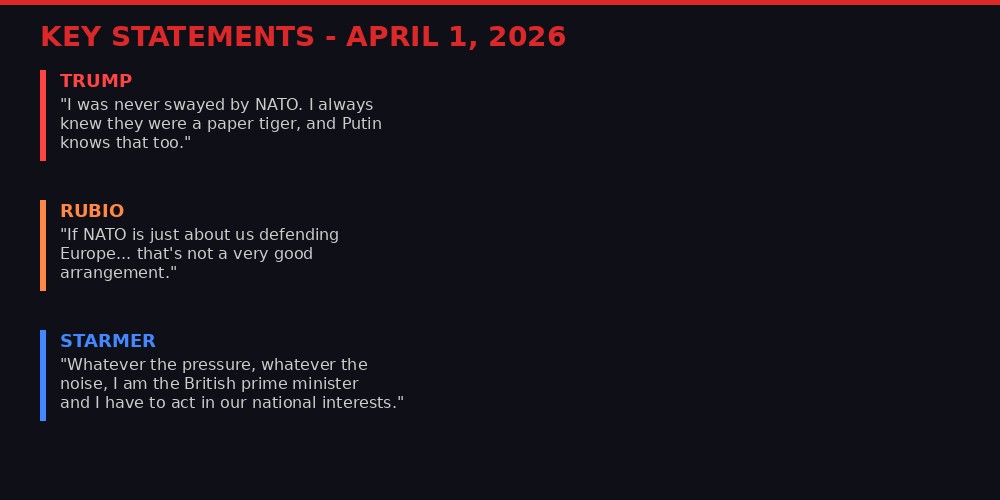
"I was never swayed by NATO. I always knew they were a paper tiger, and Putin knows that too, by the way."- President Donald Trump, The Telegraph, April 1, 2026
The Putin reference is the sharpest blade in the drawer. By invoking the Russian president's name alongside his own NATO critique, Trump effectively validates Moscow's decades-long strategic objective of fracturing the Western alliance. It is the kind of statement that would have been unthinkable from any previous occupant of the Oval Office - Democrat or Republican. Even George W. Bush, who faced fierce European opposition to the Iraq War, never questioned NATO's fundamental legitimacy.
Trump framed Europe's refusal to support the Iran war as a personal and national betrayal. He told the paper he had expected allied compliance to be "automatic," drawing a direct parallel to American support for Ukraine:
"Beyond not being there, it was actually hard to believe. And I didn't do a big sale. I just said, 'Hey', you know, I didn't insist too much. I just think it should be automatic. We've been there automatically, including Ukraine. Ukraine wasn't our problem. It was a test, and we were there for them, and we would always have been there for them. They weren't there for us."- President Donald Trump, The Telegraph, April 1, 2026
The conflation of NATO's collective defense mandate with backing an offensive war of choice in Iran represents either a fundamental misunderstanding of the alliance's charter or a deliberate rhetorical strategy to justify withdrawal. European leaders have been clear that Article 5 - the mutual defense clause - applies to defensive scenarios, not wars initiated unilaterally by a member state. Trump's argument flips this distinction on its head, treating allied reluctance to join an offensive campaign as equivalent to abandoning a defensive obligation. (CNBC, Politico Europe - April 1, 2026)
The president also directed specific fire at the United Kingdom, telling the Telegraph that Britain "doesn't even have a navy" and mocking its aircraft carriers as ones "that didn't work." This is a reference to well-documented mechanical issues with HMS Queen Elizabeth and HMS Prince of Wales, but delivering the criticism through a British newspaper to a British audience is a diplomatic provocation of the highest order.
He went further on British Prime Minister Keir Starmer: "I'm not going to tell him what to do. He can do whatever he wants. It doesn't matter. All Starmer wants is costly windmills that are driving your energy prices through the roof."
The European Revolt: Base by Base, Runway by Runway
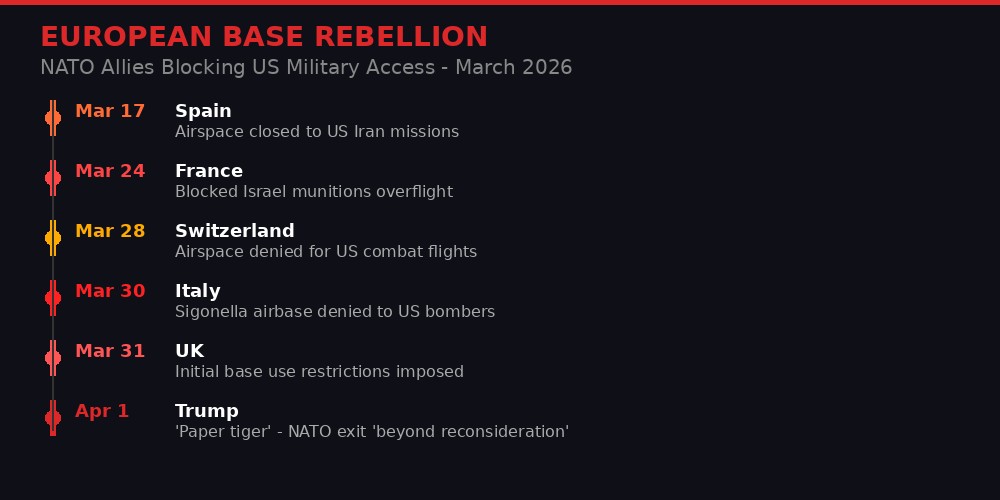
Trump's fury did not emerge in a vacuum. Over the past two weeks, European allies have systematically shut the doors America has walked through for decades. The cascade of base denials and airspace closures represents the most coordinated European resistance to American military operations since France withdrew from NATO's integrated command structure in 1966.
Spain was the first domino. On March 17, Madrid closed its airspace to US military flights connected to the Iran campaign - a dramatic move that forced Pentagon planners to reroute missions over the Atlantic. Spain's Prime Minister Pedro Sanchez called the Iran operation "outside the framework of international law" and invoked sovereign control over Spanish territory. (Bloomberg, Reuters - March 2026)
France followed by blocking Israeli military cargo planes carrying US-supplied munitions from crossing French airspace en route to the Middle East. The denial came despite what the US State Department described as "prior coordination and assurances." Israel responded by cutting all defense procurement from France, though the practical impact was limited given the relatively small scale of Franco-Israeli arms trade. (Reuters - March 31, 2026)
Switzerland - not a NATO member but a critical airspace corridor - denied overflight rights for US combat missions, citing its traditional neutrality. The move forced further routing complications for American logistics chains.
Italy delivered the most politically damaging blow. Defence Minister Guido Crosetto directed that Naval Air Station Sigonella in Sicily - one of the US Navy's most strategically important overseas installations - be denied to American military aircraft heading for the Middle East. Italian media reported that "some US bombers" were turned away mid-route after Washington failed to follow required authorization procedures. Rome framed the decision as procedural rather than political, but Prime Minister Giorgia Meloni separately described the Iran war as "outside the scope of international law." (Reuters, Politico Europe, CNN - March 31, 2026)
Sigonella matters because it is not some backwater facility. It is the logistical spine of American power projection into the Mediterranean, North Africa, and the Middle East. Built in 1959, it hosts the US Navy's largest overseas P-3 Orion and MQ-4C Triton drone fleet. Losing access - even temporarily - forces the US to rely on more distant bases in the Gulf states, increasing fuel costs, response times, and operational complexity.
The United Kingdom initially withheld permission for US forces to use British bases for Iran operations, though the exact nature and scope of restrictions remained classified. Starmer's government has walked a razor-thin line between maintaining the "special relationship" and refusing to be drawn into what British intelligence officials have privately described as a war without clear objectives or an exit strategy.
Rubio's Escalation: 'What's in It for Us?'

If Trump's interview was the grenade, Rubio has spent the past 48 hours pulling pins. The Secretary of State has given a series of interviews that systematically dismantle the diplomatic language that has sustained the transatlantic relationship for three generations.
"If NATO is just about us defending Europe if they're attacked but then denying us basing rights when we need them, that's not a very good arrangement. That's a hard one to stay engaged in and say this is good for the United States. So all of that is going to have to be reexamined."- Secretary of State Marco Rubio, Al Jazeera, March 31, 2026
On Fox News the same day, Rubio went further: "We're going to have to reexamine the value of NATO in that alliance for our country," adding that the decision would "ultimately" rest with President Trump. On April 1, Rubio told Reuters the US could see "the finish line" on the Iran war, but added a pointed caveat about NATO's future:
"But I do think, unfortunately, we are going to have to reexamine whether or not this alliance that has served this country well for a while is still serving that purpose, or has it now become a one-way street where America is simply in a position to defend Europe, but when we need the help of our allies, they're going to deny us basing rights, and they're going to deny us overflight."- Secretary of State Marco Rubio, Reuters, April 1, 2026
The rhetorical strategy is clear: reframe NATO from a collective defense pact into a transactional service agreement, then argue America is not getting its money's worth. This framing deliberately ignores the asymmetric benefit the United States has extracted from NATO for decades - forward-deployed intelligence networks, military interoperability, staging bases for global power projection, and the diplomatic leverage that comes from leading a 32-nation alliance.
Rubio also raised the explosive question of whether American bases on European soil still serve US interests. "What's in it for us?" was the blunt formulation used by Stars and Stripes, the US military's own newspaper, when reporting on his comments. The question sent shockwaves through the 80,000+ American military personnel stationed across Europe, from Ramstein Air Base in Germany to Naval Station Rota in Spain. (Stars and Stripes, Politico Europe, Anadolu Agency - March 31-April 1, 2026)
For European defense planners, the Rubio interviews were arguably more alarming than Trump's Telegraph outburst. Trump's rhetoric is often performative. Rubio's measured, lawyerly escalation suggested this was not theater - it was policy preparation.
The Legal Firewall: Section 1250A and the Constitutional Question
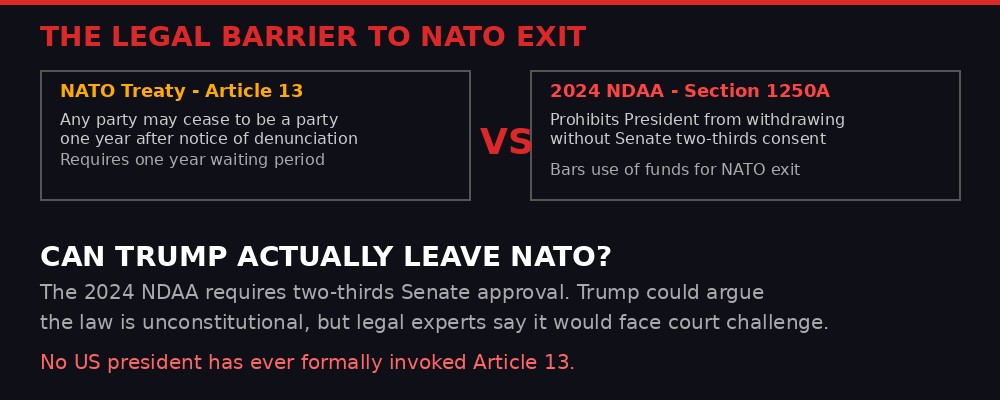
Can Trump actually pull America out of NATO? The answer involves a collision between executive power, congressional authority, and a law specifically designed to prevent this exact scenario.
NATO's own treaty contains an exit clause. Article 13 of the North Atlantic Treaty states that any party may cease membership "one year after its notice of denunciation has been given to the Government of the United States of America." The process is mechanically simple: file the notice, wait twelve months, and you are out. No party has ever invoked Article 13 since the treaty entered force on August 24, 1949.
But Congress anticipated exactly this move. Section 1250A of the 2024 National Defense Authorization Act (NDAA), passed with bipartisan support, explicitly prohibits the president from "suspending, terminating, denouncing, or withdrawing the United States from the North Atlantic Treaty" without either a two-thirds vote in the Senate or an Act of Congress. The law also bars the use of any appropriated funds to carry out a withdrawal. (Congressional Research Service, Lawfare - 2024-2026)
The provision was drafted during Trump's first term after he reportedly told senior advisors he wanted to pull out of NATO. Senator Tim Kaine of Virginia led the bipartisan effort, which passed both chambers with significant Republican support. The message was clear: Congress viewed NATO membership as too important to leave to any single president's judgment.
However, constitutional scholars are divided on whether Section 1250A would survive a legal challenge. The president's authority over foreign affairs and treaty obligations is grounded in Article II of the Constitution, and there is no Supreme Court precedent directly addressing whether Congress can prevent a president from withdrawing from a treaty. A Congressional Research Service report published on February 27, 2026 - just days before the Iran war began - analyzed the separation of powers questions in detail and concluded that the legal landscape remained "unsettled."
In practical terms, even if Trump cannot formally withdraw, he can hollow out American participation. He could reduce troop deployments, cut contributions to NATO's common budget, refuse to participate in joint exercises, withhold intelligence sharing, or simply decline to honor Article 5 commitments. A NATO where the United States is present in name but absent in spirit would be functionally dead - a paper tiger, as Trump himself put it.
The more immediate concern among European capitals is not formal withdrawal but what defense analysts call "passive abandonment" - a gradual disengagement that leaves the alliance intact on paper while emptying it of American commitment. Several former NATO officials, speaking on condition of anonymity, told Reuters this scenario is now viewed as the most likely outcome regardless of legal constraints.
Europe's Response: Defiance, Diplomacy, and the Dawn of Self-Reliance
European leaders responded to Trump's broadside with a mix of defiance and diplomatic caution, each calibrating their words to their domestic audience and their strategic relationship with Washington.
British Prime Minister Keir Starmer, the most directly targeted leader, held a press conference at Downing Street within hours of the Telegraph publication. His response was firm but carefully avoided escalation:
"Whatever the pressure, whatever the noise, I am the British prime minister and I have to act in our national interests. There's been a good deal of pressure on me to change my position in relation to joining the war, and I'm not going to change my position on the war."- PM Keir Starmer, Downing Street press conference, April 1, 2026
Starmer called NATO "the single most effective military alliance the world has ever seen" and said the UK remains "fully committed" to it. But he also signaled a significant pivot, telling reporters: "I do think that when it comes to defense and security, energy emissions and the economy, we need a stronger relationship with Europe." The implication was unmistakable: if Washington walks, London will turn to Brussels and Berlin.
Starmer also announced that the UK would host an international diplomatic conference this week on reopening the Strait of Hormuz, with 35 countries signing a statement committing to work together on maritime security. Foreign Secretary Yvette Cooper will lead the conference, and British military planners are developing contingency plans for post-war Hormuz security. This is Britain doing what it does best: convening a coalition when the previous one falls apart. (AP News, BBC - April 1, 2026)
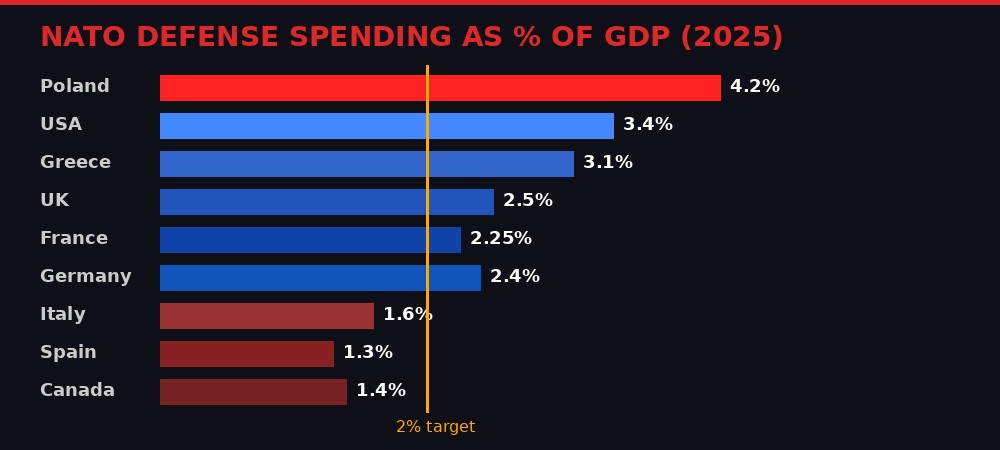
The broader European response has been shaped by a paradox: the continent has never spent more on defense, yet has never felt less secure. NATO's European allies and Canada increased defense spending by 20% in 2025 compared to the previous year in real terms, according to NATO Secretary General Mark Rutte's annual report published March 26. Germany reached 2.4% of GDP, France allocated 68.5 billion euros (2.25% of GDP), and Poland maintained its position as the alliance's most committed spender at 4.2% of GDP. (Reuters, DW, European Parliament - March 2026)
But the spending surge has not translated into the kind of autonomous military capability that would allow Europe to defend itself without American support. The continent lacks strategic airlift capacity, integrated missile defense, sufficient ammunition stockpiles, and - most critically - the nuclear deterrent that the American umbrella provides. France is the only EU nation with nuclear weapons, and its arsenal is dwarfed by both American and Russian capabilities.
European Commission President Ursula von der Leyen has pushed for a massive increase in joint European defense procurement, but the bureaucratic and political obstacles remain enormous. Defense remains a national competence under EU treaties, and the 27 member states maintain separate procurement systems, different equipment standards, and competing industrial interests. The irony is painful: Trump's threat to leave NATO may be the single greatest catalyst for European defense integration, but that integration cannot happen fast enough to fill the gap his departure would create.
The Hormuz Factor: Oil, Leverage, and the Real Cost of Isolation

The NATO crisis cannot be separated from the war that caused it. The Iran conflict - now in its 33rd day - has produced the largest global oil supply disruption since the 1970s energy crisis, according to the International Energy Agency. Iran's closure of the Strait of Hormuz, through which roughly 20% of the world's oil passes daily, has sent Brent crude above $100 per barrel for the first time in four years, with prices hitting $126 at their peak. US gas prices crossed $4 per gallon on Tuesday, the highest since 2022. (IEA, CNBC, AP News - March-April 2026)
Trump's response to the Hormuz crisis has been to externalize the problem. On Truth Social, he wrote: "All of those countries that can't get jet fuel because of the Strait of Hormuz, like the United Kingdom, which refused to get involved in the decapitation of Iran, I have a suggestion for you. Number 1, buy from the U.S., we have plenty, and Number 2, build up some delayed courage, go to the Strait, and just TAKE IT."
The statement reveals the transactional logic driving the NATO threat. In Trump's framing, European dependence on Middle Eastern energy is a leverage point, not a shared vulnerability. By refusing to help reopen Hormuz and simultaneously threatening to leave NATO, Trump is presenting Europe with a choice: join the war or lose American protection entirely.
European leaders view this as a false dilemma constructed around a war they did not choose and were not consulted about before it began on February 28. Multiple European officials have noted that NATO's Article 5 was designed for defensive scenarios - an armed attack against one or more members - not for offensive military campaigns initiated by a single state. The Iran war, in their analysis, does not trigger any collective obligation.
The economic pressure, however, is real and intensifying. The IEA warned on April 1 that the oil supply crunch will worsen this month. Goldman Sachs projects Brent crude averaging $115 per barrel in April before retreating to $80 by year-end - but only if Hormuz reopens within six weeks. South Korea has already implemented an odd-even driving scheme for public employees, and airlines worldwide are rationing fuel. Pakistan managed to receive oil shipments after Iran permitted additional ships through the strait, but global logistics chains remain severely disrupted. (CNBC, Goldman Sachs, AP News - April 1, 2026)
The Bank of England warned Wednesday of a "substantial negative supply shock" from the Hormuz closure, while oil markets briefly tumbled on hopes that Trump's planned national address at 9 PM Eastern could announce a ceasefire. Trump himself fueled those hopes by claiming on Truth Social that "Iran's New Regime President" had requested a ceasefire - though Iran had no immediate response, and Trump appeared confused about Iran's leadership, since the country has the same president it had before the war began.
Historical Parallels: From Suez to Sicily

There is no true precedent for what is happening. The closest historical analog - France's 1966 withdrawal from NATO's integrated military command under President Charles de Gaulle - involved a single nation stepping back from operational integration while remaining a treaty member. De Gaulle expelled NATO headquarters from Paris and removed French forces from joint command, but France never left the alliance itself and eventually returned to full military integration in 2009 under President Nicolas Sarkozy.
The current crisis is categorically different because it involves the alliance's founding member, its largest contributor, and its nuclear guarantor threatening to leave entirely. The United States accounts for roughly 67% of combined NATO defense spending. Its nuclear arsenal provides the extended deterrence that allows most European nations to maintain relatively small conventional forces. Remove America from NATO and you do not get a slightly weaker alliance - you get a fundamentally different security architecture that may not be capable of deterring a major power adversary.
The Suez Crisis of 1956 offers a different kind of parallel. In that episode, the United States forced Britain and France to abandon their military intervention in Egypt by threatening economic sanctions and withdrawing financial support. It was a humiliating demonstration of American power over its closest allies. What is happening now is the inverse: European allies are refusing to follow America into a military adventure, and America is threatening to dissolve the alliance in response.
In 1956, America used its leverage to impose restraint on its allies. In 2026, America is using its leverage to punish allies for exercising restraint. The moral polarity has reversed entirely.
The Iraq War parallel also falls short. In 2003, France and Germany opposed the invasion, with French President Jacques Chirac memorably threatening to veto any UN Security Council resolution authorizing force. Then-Defense Secretary Donald Rumsfeld dismissed the dissenters as "Old Europe." But even at the peak of transatlantic acrimony over Iraq, no senior American official suggested leaving NATO. The alliance strained but held because both sides understood the deeper logic of collective security transcended any single policy disagreement.
That logic appears to have broken down. Trump's "paper tiger" interview suggests he does not believe NATO serves a deeper purpose beyond transactional reciprocity. If allies do not support America's wars, they do not deserve America's protection. It is a worldview that reduces the most successful military alliance in history to a protection racket - and one where the protector has decided the clients are not paying enough.
What Happens Next: The Address, the Alliance, and the Aftermath

Three things will determine whether April 1, 2026, becomes a historical inflection point or a footnote in the fog of wartime rhetoric.
First: Trump's national address. The president is scheduled to address the nation at 9 PM Eastern tonight, with the White House promising "an important update on Iran." If he announces a ceasefire or drawdown, the NATO threat may recede as the underlying irritant - European refusal to support the war - becomes moot. But if Trump uses the address to escalate, either by threatening specific consequences for allies or by formally directing aides to study NATO withdrawal, the crisis will enter a new phase.
Trump's Truth Social post Wednesday morning offers a clue. He claimed Iran's president requested a ceasefire but said it would only happen when the Strait of Hormuz is "open, free, clear," adding: "Until then, we are blasting Iran into oblivion or, as they say, back to the Stone Ages!!!" This does not sound like a man ready to de-escalate. (AP News, Truth Social - April 1, 2026)
Second: the congressional firewall. Section 1250A of the 2024 NDAA was designed precisely for this moment. But its effectiveness depends on political will. Congressional Republicans who voted for the provision before Trump's second term may be reluctant to enforce it against a president of their own party during wartime. The constitutional question of whether Congress can prevent a president from withdrawing from a treaty has never been tested in court, and Trump's legal team would almost certainly challenge the law's constitutionality.
There is also the question of enforcement. Even if Section 1250A is legally sound, its primary mechanism - barring the use of appropriated funds for withdrawal - relies on congressional oversight of the Pentagon's budget. In practice, a president determined to disengage from NATO has countless tools that fall short of formal withdrawal but achieve the same strategic effect: reducing troop levels, canceling exercises, withholding intelligence, and publicly undermining allied confidence.
Third: Europe's capacity to respond. The UK's announcement of a Hormuz conference involving 35 nations is the most tangible sign of European agency in this crisis. If the conference produces a credible maritime security framework independent of Washington, it would demonstrate that European nations can act collectively without American leadership. That demonstration effect would be more important than the specific policy outcome.
NATO Secretary General Mark Rutte faces an impossible diplomatic challenge: holding the alliance together while its most powerful member publicly calls it worthless. Rutte, who met Trump at the World Economic Forum in Davos in January, is understood to be working back channels to find language that allows both sides to claim victory. But back channels require good faith, and the Telegraph interview does not suggest an abundance of that commodity in Washington.
The deeper question is whether the transatlantic alliance, as constructed in 1949 and reinforced through the Cold War, can survive the end of the strategic consensus that created it. NATO was built on the premise that American and European security interests are fundamentally aligned - that a threat to one is a threat to all. Trump's worldview rejects that premise. In his formulation, alliances are contracts, not commitments, and contracts can be terminated when the terms are unsatisfactory.
If that formulation prevails, what replaces NATO will not be another alliance. It will be a series of bilateral arrangements, transactional and impermanent, where American protection is sold to the highest bidder and withdrawn from those who fail to comply. The 77-year experiment in collective security - the longest period of great-power peace in modern European history - will have been concluded not by an enemy's aggression but by a member's indifference.
The paper tiger, it turns out, was the alliance's own faith in permanence.
Get BLACKWIRE reports first.
Breaking news, investigations, and analysis - straight to your phone.
Join @blackwirenews on Telegram