Pentagon Plans Weeks of Ground Operations in Iran: Kharg Island, Special Forces, and the Escalation Cliff
Thirty days into the US-Israel war on Iran, the Pentagon has drafted plans for weeks of limited ground operations inside the country - including potential raids on Kharg Island and coastal chokepoints along the Strait of Hormuz. Three thousand people are dead. Three hundred Americans are wounded. The Houthis just re-entered the war. And diplomats in Islamabad are meeting under conditions that both sides have publicly called pointless.

US military air assets remain the dominant instrument of this war - but ground options are now on the table. (Pexels / Public Domain)
The Washington Post broke the story Saturday evening: the Pentagon has been quietly preparing options for limited ground operations in Iran that could last "weeks, not months." The specific targets under discussion include Kharg Island - Iran's primary oil export hub, which handles around 90% of its crude shipments - and coastal fortifications near the Strait of Hormuz where Iran has positioned the weapons systems used to shut down the waterway. (Al Jazeera, citing Washington Post, March 29)
The plans, which fall short of a full invasion, would deploy special operations forces and conventional infantry in coordinated raids. They would expose US troops to Iranian drones, missiles, ground fire, and improvised explosives. Whether President Donald Trump has approved or even been formally presented with the plans remains unclear.
The White House offered its standard non-denial. "It's the job of the Pentagon to make preparations in order to give the Commander in Chief maximum optionality," spokeswoman Karoline Leavitt said. "It does not mean the president has made a decision."
Iran's parliament speaker, Mohammad Bagher Ghalibaf, did not wait for clarification. "Our men are waiting for the arrival of American soldiers on the ground," he said Sunday, "to set fire to them and punish their regional partners forever." (Tasnim News Agency, via Al Jazeera)
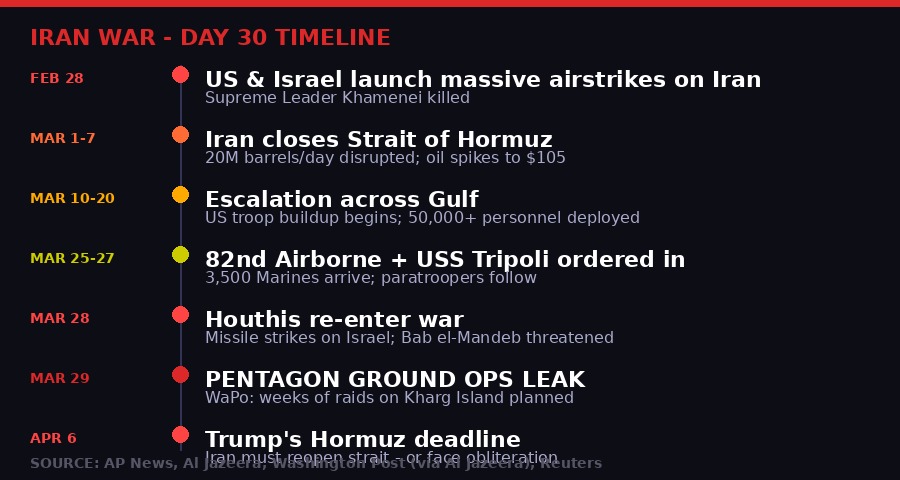
Thirty days from first strike to ground war planning: the Iran conflict's trajectory. (BLACKWIRE / PULSE Bureau)
The Thirty-Day Reckoning

Ground operations would expose US troops to a layered Iranian defense built over decades. (Pexels / Public Domain)
The war began February 28, when US and Israeli warplanes launched coordinated strikes across Iran. Supreme Leader Ayatollah Ali Khamenei was killed in the first hours. Within 48 hours, Iran's Revolutionary Guard had effectively closed the Strait of Hormuz - the narrow passage through which 20% of the world's oil supply normally flows - by threatening and attacking tankers attempting transit. (AP News, March 29)
The decision to choke the strait was Iran's most consequential move. It didn't stop US strikes. It didn't win any battlefield victories. But it immediately transferred the pressure of the war onto the global economy - and by extension, onto the populations of countries far from the fighting. Oil hit $105 per barrel on Friday. Before the war, it was around $70. (AP News, March 29)
The US responded with the most concentrated military buildup in the Middle East in more than two decades. By the end of month one, roughly 50,000 American troops were deployed to the region, supported by two aircraft carrier strike groups, multiple destroyer and cruiser escorts, and a continuous rotation of long-range bombers. The US military has struck more than 11,000 Iranian targets. (AP News, March 29)
The results have been punishing but not decisive. Iran has been hit hard - its nuclear infrastructure, its naval production facilities, its oil refineries. But Tehran has not reopened the strait. It has not accepted any ceasefire framework. And it has continued launching missiles and drones at Israel and Gulf Arab states with remarkable persistence for a country under full-spectrum aerial bombardment.
The death toll stands at over 3,000 people killed throughout the war. Iranian authorities report more than 1,900 killed inside the country. Lebanon has seen over 1,100 deaths since Israel launched operations in its south against Hezbollah. Eighty Iraqi security forces members have died as Iran-backed militias entered the conflict. Twenty Gulf state civilians are dead. Nineteen Israelis have been killed. (Al Jazeera, Day 30 roundup)
The Ground War Question

The 82nd Airborne is trained to seize airfields and key terrain in contested territory - precisely the mission profile now being considered. (Pexels / Public Domain)
The ground operations leak is the most significant development of the war's second month. For the first thirty days, the conflict was fought almost entirely through airpower and naval assets. Trump repeatedly insisted no American boots would hit Iranian soil. Secretary of State Marco Rubio said as recently as Friday that the US "can achieve all of our objectives without ground troops." (AP News, March 29)
The Post report suggests the internal conversation has moved. The objectives under discussion - seizing or destroying Kharg Island's oil facilities, raiding coastal weapons caches near the Hormuz chokepoints - cannot be fully achieved from the air. Iranian weapons systems targeting commercial shipping are hardened, dispersed, and deeply embedded in the coastal terrain around Bandar Abbas and the strait's northern shore. Neutralizing them requires people on the ground.
Kharg Island is the more dramatic target. Located in the Persian Gulf about 25 kilometers off the Iranian coast, it handles the vast majority of Iran's crude oil exports. Destroying or capturing it would simultaneously cut off Iran's primary revenue source and signal an escalation that neither side could easily walk back. The island is defended and any landing operation would face significant resistance.
US officials speaking to the Post put the timeline for the objectives at "weeks, not months" - though another source said "a couple of months." That discrepancy matters. A weeks-long operation keeps diplomatic options alive; a multi-month campaign increasingly resembles the thing the administration has repeatedly said it will not do.
"We have not stopped Iran from its campaign against the Gulf. We have not eliminated all of their missiles. And of course, they still have the 400-plus kilograms of highly enriched uranium. It's buried, but still it's there." - James Jeffrey, former US Deputy National Security Adviser, The Washington Institute for Near East Policy (AP News)
The Force in Place
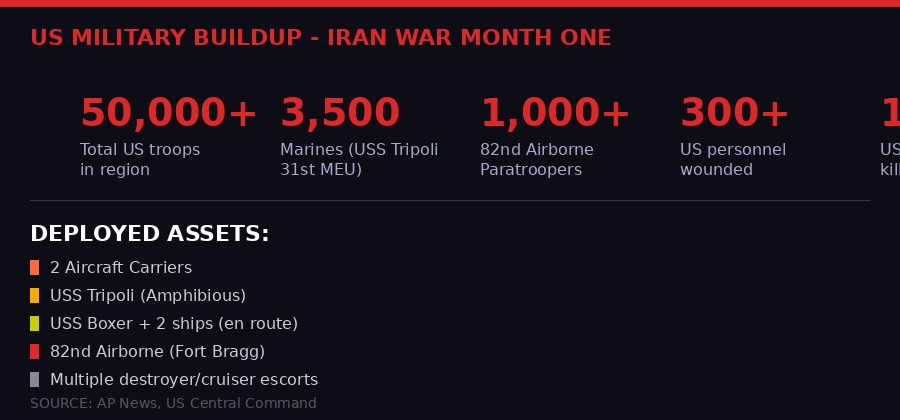
The US has assembled its largest Middle East force in 20+ years. Ground options now being considered for the first time. (BLACKWIRE / PULSE Bureau)
The military assets now in place tell their own story. The USS Tripoli, an amphibious assault ship, arrived in the region Saturday carrying about 2,500 Marines from the Japan-based 31st Marine Expeditionary Unit. Central Command confirmed the ship carries "transport and strike fighter aircraft, as well as amphibious assault and tactical assets." Amphibious assault assets exist for one purpose: landing forces on contested beaches. (AP News, US Central Command, March 29)
The USS Boxer and two additional ships, carrying another Marine Expeditionary Unit from San Diego, have also been ordered to the region. Combined, the two MEUs add approximately 5,000 Marines and thousands of sailors. (AP News, March 29)
Separate from the Marine deployments, at least 1,000 paratroopers from the 82nd Airborne Division at Fort Bragg, North Carolina, have been ordered to the Middle East. The unit is trained specifically to parachute into hostile or contested territory, seize key positions, and hold airfields. The deployment includes Maj. Gen. Brandon Tegtmeier, the division commander, and his full staff. (AP News, March 25)
Taken together - amphibious assault ships, a rapid-reaction airborne division, 50,000 total troops already in-theater - what the administration has assembled is not a force structured purely for airstrikes. The pieces for a ground operation are in place. The question is whether the order comes.
Before month one ended, US aircraft carrier USS Gerald R. Ford left the region for Croatia for repairs after a fire in its laundry room. But the USS Eisenhower and a second carrier remain on station. The carrier gap is not expected to last long, with additional assets already en route.
Iran Threatens American Universities

American universities with campuses in Qatar and the UAE received an explicit threat from the IRGC on Sunday morning. (Pexels / Public Domain)
Iran's Revolutionary Guard escalated its messaging Sunday in a way that lands differently than military communiques. In an official statement carried by Iranian state media, the Guard warned that it would treat Israeli universities and campuses of American universities in the region as "legitimate targets" unless the US condemned Israeli strikes on Iranian universities and research centers by noon Monday, March 30.
"If the U.S. government wants its universities in the region spared, it should condemn the bombardment of Iranian universities by 12 o'clock Monday, March 30, in an official statement," the Guard said. (AP News, via Iranian state media)
The threat covers American institutions with significant Gulf campuses. Georgetown University has a campus in Qatar. New York University operates in Abu Dhabi. Northwestern University runs a journalism school in Doha. These are not military installations. They are civilian educational facilities with thousands of enrolled students. The IRGC is explicitly listing them as potential strike targets in retaliation for US airstrikes on Iranian universities and scientific institutions.
Iranian Foreign Ministry spokesperson Esmaeil Baqaei said last week that dozens of Iranian universities and research centers have been struck by US and Israeli forces, including the Iran University of Science and Technology and Isfahan University of Technology. Israel has argued these institutions conduct nuclear research and development. Iran says they are civilian academic facilities. (AP News)
The threat to American universities in the Gulf puts the administration in an uncomfortable position. Acknowledging it legitimizes the Iranian framing. Ignoring it and having a US-affiliated campus struck would be politically catastrophic at home.
Diplomacy in Islamabad: High Stage, Low Expectations

Regional foreign ministers gathered in Islamabad Sunday for talks - but Iran has publicly dismissed the framework on the table. (Pexels / Public Domain)
Pakistan's government organized the most substantive diplomatic gathering of the war to date for Sunday in Islamabad. Foreign ministers from Saudi Arabia, Turkey, and Egypt arrived for two days of talks aimed at finding a path to end the fighting. Pakistan's Prime Minister Shehbaz Sharif said he held "extensive discussions" with Iranian President Masoud Pezeshkian on regional hostilities. (AP News, March 29)
Egypt's Badr Abdelatty said the meetings were aimed at opening "direct dialogue" between Washington and Tehran. Turkey's Hakan Fidan and Saudi Arabia's Prince Faisal Bin Farhan were part of the talks. The assemblage of foreign ministers from the three most significant Sunni Arab and Turkish regional powers represents genuine diplomatic weight. (AP News, March 29)
But the gap between the parties remains vast. The US delivered a 15-point "action list" to Iran through Pakistan as a ceasefire framework. It included demands to reopen the Strait of Hormuz and restrictions on Iran's nuclear program. Tehran rejected the list entirely and presented its own five-point counter-proposal - which demanded reparations, guarantees against future attacks, and explicit recognition of Iran's "sovereignty over the Strait of Hormuz." (AP News)
Claiming sovereignty over an international waterway is not a negotiating position the US, Israel, or the Gulf states can accept. It's closer to a victory declaration than a peace proposal.
Iranian Foreign Minister Abbas Araghchi told his Turkish counterpart by phone that Tehran was skeptical about diplomatic efforts and accused Washington of making "unreasonable demands" and "contradictory actions." (AP News)
The US and Israel are not participating in the Islamabad talks. Their war continues as diplomats meet. On Sunday morning, powerful explosions were reported across Tehran. Israel's military said it targeted Iran's naval weapons production facilities and stated it would finish attacking "essential weapons production sites within a few days." (AP News, March 29)
The Houthis Return - and the Second Chokepoint
The Bab el-Mandeb strait handles 12% of global trade - and the Houthis have now entered the war threatening to shut it down. (Pexels / Public Domain)
The biggest single tactical development of Saturday was the Houthis' formal re-entry into the conflict. For the entire first month of the Iran war, Yemen's Houthi rebels - who had previously attacked commercial shipping during the Israel-Hamas war - had stayed on the sidelines. On Saturday, that ended. (AP News, March 28)
Houthi Brig. Gen. Yahya Saree announced on the group's Al-Masirah television that they had launched missiles toward "sensitive Israeli military sites" in the south - the first such strikes since the Iran war began. The group said it acted in response to the broader US-Israeli campaign. (AP News)
The significance extends beyond the immediate missiles. The Houthis control the Bab el-Mandeb Strait - the narrow passage between Yemen and Djibouti at the southern tip of the Arabian Peninsula. Roughly 12% of global trade passes through it. More immediately relevant: Saudi Arabia has been rerouting its oil exports through the Bab el-Mandeb specifically because the Strait of Hormuz is blocked. If the Houthis shut down the Red Sea route as well, Saudi Arabia's oil export capacity is effectively pinched at both ends. (AP News, Ahmed Nagi / International Crisis Group)
Between November 2023 and January 2025, Houthi rebels attacked more than 100 merchant vessels, sinking two ships. They demonstrated both the will and the capability to damage international shipping at scale. Their re-entry now introduces the possibility of a genuine two-chokepoint crisis: the Strait of Hormuz effectively closed, the Red Sea threatened. No diversionary route would remain viable at that point. (AP News)
The Houthis' involvement also complicates US carrier positioning. The USS Gerald R. Ford is in Croatia for repairs. Routing it through the Red Sea to support Hormuz operations would expose it to Houthi attacks similar to those that damaged the USS Dwight D. Eisenhower in 2024 and the USS Harry S. Truman in 2025. (AP News)
The Economic Reckoning: Month One's Damage
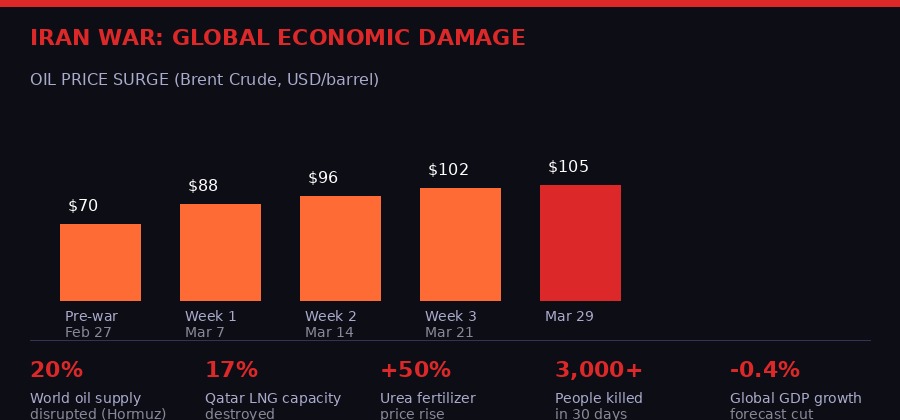
Month one: oil up 50%, fertilizer prices rising, global growth forecasts cut. The economic damage is already structural. (BLACKWIRE / PULSE Bureau)
The economic damage from the war's first thirty days is not temporary disruption. It is structural injury that will take years to repair regardless of when fighting stops.
Iran struck Qatar's Ras Laffan natural gas terminal on March 18. Ras Laffan produces approximately 20% of the world's liquefied natural gas. The strike destroyed 17% of Qatar's LNG export capacity. QatarEnergy has said repairs will take up to five years. Five years. A single missile barrage on a single facility in a single war has reset global LNG supply calculations for half a decade. (AP News, March 29)
Oil prices have climbed from roughly $70 per barrel before the war to $105.32 for Brent crude as of Friday's close - a 50% increase in 30 days. US benchmark crude settled at $99.64. The International Energy Agency has called this the "largest supply disruption in the history of the global oil market." Historically, oil shocks of this magnitude have triggered global recessions. (AP News, citing IEA)
The fertilizer market is fracturing. The Persian Gulf accounts for roughly a third of global urea exports and a quarter of ammonia - two essential nitrogen fertilizers. Both pass primarily through the Strait of Hormuz. Urea prices are up 50% since the war began. Ammonia is up 20%. Brazil, which imports 85% of its fertilizer, is particularly exposed. (AP News, citing Alpine Macro)
Global growth forecasts are being marked down. Gita Gopinath, former IMF chief economist, projected that global GDP growth - already expected at 3.3% for 2026 before the war - would fall by 0.3 to 0.4 percentage points if oil averaged $85 per barrel. It is currently at $105. The actual hit is likely larger than her estimate. (AP News)
In the Philippines, government offices are open four days a week and air conditioning is capped at 75 degrees Fahrenheit. South Korea has reinstated fuel price caps that hadn't been used since the 1990s. India is rationing LPG cooking gas for poor households. Thailand told public workers to take the stairs. These are not dramatic wartime measures. They are quiet daily adjustments to a shock that has already become the background noise of 2026. (AP News)
Trump's Contradictions - and the April 6 Deadline
Trump has set April 6 as the deadline for Iran to reopen the Strait of Hormuz - but he has already extended previous deadlines twice. (Pexels / Public Domain)
Trump has given Iran until April 6 to reopen the Strait of Hormuz. He has also threatened to "obliterate" Iran's energy plants if the deadline passes without compliance. He has twice delayed previous deadlines for the same demand. He has said negotiations are "going very well." Iran says no negotiations are taking place. (AP News, March 29)
The contradictions are not accidental. Trump's approach treats uncertainty as a strategic asset - keeping adversaries off-balance, preventing them from calibrating a response. Former Defense Secretary Leon Panetta, who has served Democratic presidents across multiple administrations, put it bluntly: "It's not the first administration that has not told the truth about war. But the president has made it kind of a very standard approach to almost any question to in one way or another kind of lie about what's really happening." (AP News)
Republican legislators are growing visibly uncomfortable. Sen. John Kennedy of Louisiana said his constituents support what the president has done but are "equally or even more so concerned about cost of living." Rep. Chip Roy of Texas, a member of the Freedom Caucus, told AP he supported "blowing some crap up" but expressed reservations about ground troops and said administration briefings for lawmakers only reveal things "you read in the papers." (AP News)
The April 6 deadline is now eight days away. Trump has extended previous deadlines - once, and then a second time. If he extends again, his credibility as a coercive actor diminishes. If he doesn't extend and Iran has not reopened the strait, the stated consequence is military escalation. The leak about ground operations landing on the same weekend as the April 6 countdown is not coincidental. This is the signaling phase before a decision point.
What Happens Next - Key Watch Points
- April 6: Trump's Hormuz reopening deadline. Third extension, compliance, or escalation order.
- March 30, noon: IRGC deadline for US condemnation of Iranian university strikes. If missed, US university campuses in Gulf become declared targets.
- Islamabad talks (today-tomorrow): Saudi/Turkey/Egypt ministers in Pakistan. Can they bridge the 15-point US list vs. Iran's 5-point counter?
- Houthi posture: Will they begin targeting Red Sea commercial shipping again? That closes the Saudi oil export bypass route.
- 82nd Airborne positioning: 1,000 paratroopers plus two Marine Expeditionary Units - all now in-region. Weeks, not months, per officials.
- Iran NPT withdrawal: Iranian hardliners pushing to exit the Nuclear Non-Proliferation Treaty. If that happens, the strategic calculus of the entire war shifts.
The View From Tehran
Iran's government entered month two in a position it would not have predicted when the first strikes landed. The supreme leader is dead. Major nuclear and military infrastructure has been hit. The economy is under severe pressure. And yet: the government has not collapsed, the IRGC continues to function, the missiles keep flying, and the Strait of Hormuz remains effectively closed.
Al Jazeera's correspondent in Tehran reported Sunday that one month in, Iran has proved its power was underestimated by an enemy who assumed a short campaign and quick capitulation. The Islamic Republic has demonstrated, at great cost to its civilian population, that it can absorb strikes and keep fighting. That assessment is likely accurate as a description of what has happened. Whether it can continue is a different question. (Al Jazeera)
Iranian politicians are now openly pushing for withdrawal from the Nuclear Non-Proliferation Treaty. That would eliminate the formal international framework constraining Iran's nuclear development - and likely trigger a new phase of international isolation on top of existing sanctions and an ongoing air war. It is a sign of domestic political pressure rather than strategic coherence. Extreme positions gain traction when a population is being bombed. (Al Jazeera, March 28)
Iran's five-point ceasefire proposal - demanding reparations, sovereignty over the strait, and guarantees against future attacks - is not a framework that Washington or Jerusalem will accept. But it signals something about where Iranian leaders believe public legitimacy lies domestically. Any deal that looks like surrender risks the government's domestic position. Pezeshkian governs a country under aerial bombardment; he cannot sign anything that looks like submission.
The IRGC's threat against American university campuses in the Gulf is an example of this dynamic in action. It is unlikely to succeed as coercion. But it communicates defiance to an Iranian audience that matters more to the regime's stability than any foreign audience right now.
What Month Two Looks Like
The pattern of this war has been Israeli and US airstrikes degrading Iranian military and economic infrastructure; Iran retaliating with missiles and drones against Israel and Gulf states; American troops absorbing casualties; global markets absorbing the economic shock; diplomatic channels going nowhere. Month two is shaping up to look like month one, but with new pressure points.
The ground operations leak changes the texture. Air campaigns are sustainable indefinitely as long as no major US assets are hit. Ground operations are not. They require force protection, supply lines, extraction plans, and tolerance for casualties in the specific, visceral way that air casualties - which happen thousands of feet up, quickly, and largely out of sight - do not. When American bodies come home from ground combat, the political math in Washington changes faster than any economic indicator.
More than 300 American service members have already been wounded in the war. Thirteen have been killed. Army Sgt. Benjamin N. Pennington, 26, died from wounds sustained in a March 1 attack on Prince Sultan Air Base. Six others died when an Iranian drone struck an operations center at a civilian port in Kuwait. Six more died in a refueling aircraft crash in Iraq. (AP News)
Iran attacked Prince Sultan Air Base multiple times in the past week alone - six ballistic missiles and 29 drones in a single Friday barrage that injured 15 US troops, five seriously. The base is 60 miles from the Saudi capital of Riyadh. It has been targeted almost continuously since the war began. US forces cannot operate from it without accepting regular Iranian attack as a permanent condition of the mission. (AP News)
James Jeffrey, who advised President George W. Bush and later served as US ambassador to Iraq, offered the clearest strategic summary available: "We have not stopped Iran from its campaign against the Gulf. We have not eliminated all of their missiles. And of course, they still have the 400-plus kilograms of highly enriched uranium. It's buried, but still it's there." (AP News)
The war is one month old. The Pentagon has prepared ground operation plans. The Houthis are back. Kharg Island is on the target list. April 6 is eight days away. The diplomats in Islamabad are meeting, but their principals in Washington and Tehran are still bombing each other as the talks begin.
Thirty days in, this war is not winding down. The people making decisions on both sides have convinced themselves - or are trying to convince their domestic audiences - that they are winning. Wars where both sides believe they are winning tend to continue until one side is no longer capable of believing anything.
Get BLACKWIRE reports first.
Breaking news, investigations, and analysis - straight to your phone.
Join @blackwirenews on Telegram