The Pentagon's Open Account: $4 Trillion Unaudited, a War Nobody Voted For, and a $200 Billion Bill Coming Due
The Department of Defense has failed seven consecutive financial audits. It cannot tell Congress where $4 trillion in assets went. Now it wants $200 billion more for a war it launched without authorization - and Hegseth says that number could go higher.

The Pentagon has not passed a single audit since full-scope financial reviews were mandated by Congress in 2017. (Pexels)
The number is $200 billion. That is what the Pentagon told the White House it needs in supplemental funding to cover the costs of Operation Epic Fury - the ongoing U.S. military campaign against Iran. It is four times the figure originally floated by officials just days earlier. Secretary of War Pete Hegseth said, without embarrassment, that the number "could move" higher.
Congress never authorized this war. No Authorization for Use of Military Force was passed. No joint resolution. No debate on the floor. The strikes began on February 28, 2026, and the bills are now landing on the national credit card at a rate of between $1 billion and $2 billion every single day - by the estimates of two anonymous U.S. officials and multiple independent defense analysts.
What makes this story more than a war cost story is what sits beneath it: the institution now demanding $200 billion in emergency funding has never, in seven years of legally mandated audits, been able to account for its own money. The Government Accountability Office confirmed in September 2025 that the Pentagon received a "disclaimer of opinion" - the worst possible rating - on its fiscal year 2024 financial audit. For the seventh year in a row.
The Department of Defense reports $4.1 trillion in assets. It has 28 identified "material weaknesses" in its financial management. It cannot pass an audit. And now it wants two hundred billion dollars more, for a conflict the American public was never asked to approve.
Seven Audits, Seven Failures, Zero Consequences

Seven consecutive audit failures have produced little pressure on Pentagon leadership to reform. (Pexels)
The story of the Pentagon audit is one of the most remarkable financial scandals in American history - and one of the least covered. Congress mandated full-scope financial audits beginning in 2017. For seven consecutive years, those audits have ended in a "disclaimer of opinion," the accounting equivalent of a company so disorganized that its auditors cannot even form an opinion on whether the numbers are real.
The GAO's September 2025 report (GAO-25-108052) laid out the damage in clinical language. Twenty-eight material weaknesses were identified across the department. Those weaknesses directly affected $2.1 trillion of the Pentagon's reported assets - more than half of everything it claims to own. "Pervasive material weaknesses," the GAO noted, "may affect all balance sheet data." That means no number in the Pentagon's financial statements can be trusted.
"We've heard the same platitudes about audit progress for years. They're meaningless, especially since the Pentagon can't even commit to a timeline for achieving a clean audit." - Julia Gledhill, Project on Government Oversight, November 2023
In 2023, after the sixth consecutive failure, Pentagon deputy press secretary Sabrina Singh described the latest audit failure as evidence that the institution was "getting better and better at it." Comptroller Michael McCord acknowledged that the number of disclaimers had increased while claiming, with a straight face, "we still believe that we have seen signs of progress." Asked when the Pentagon expected to pass an audit, Singh said she "can't predict the future."
By 2024, a former Pentagon comptroller had set a public deadline of 2027 for achieving a clean audit - a deadline officials subsequently walked back entirely. The National Defense Authorization Act for Fiscal Year 2024 extended the deadline to 2028. There is no credible mechanism to hold anyone accountable if that deadline is also missed.
William Hartung, a senior research fellow at the Quincy Institute for Responsible Statecraft, diagnosed the structural failure clearly: "As long as the money keeps flowing and there are no consequences for failure, we can expect the Pentagon to fail audits year after year with no end in sight."
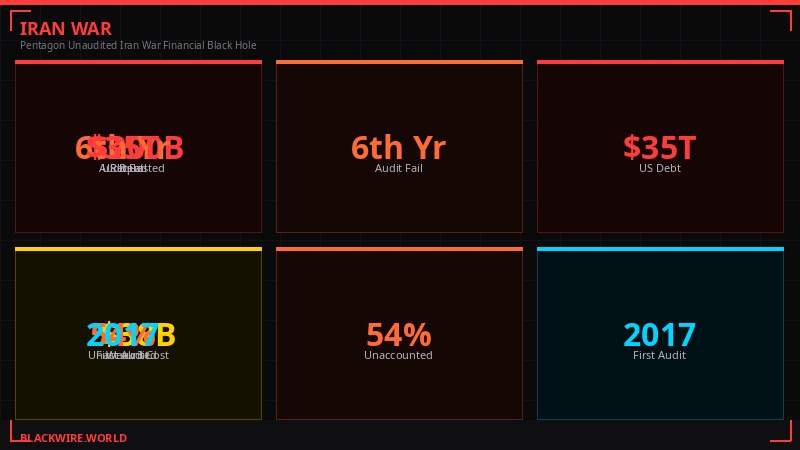
Seven consecutive years of "disclaimer of opinion" - the worst audit rating possible. Congress mandated the audits in 2017. Source: GAO-25-108052.
The audits are conducted by the Pentagon inspector general alongside independent public accounting firms. They cover $3.8 trillion in assets and $4 trillion in liabilities. Only 11 of the 67 DOD components received clean audit opinions in 2024 - and nearly all of those clean opinions related to the Military Retirement Fund, not the Army, Navy, or Air Force.
In plain terms: the people who actually fight wars cannot account for their own money. And Congress keeps funding them anyway.
Operation Epic Fury: The Cost Clock That Won't Stop

The U.S. military deployed more than 200 fighter aircraft for Operation Epic Fury, burning through munitions at a rate that shocked even Pentagon insiders. (Pexels)
Operation Epic Fury began on February 28, 2026, with joint U.S.-Israeli airstrikes on Iranian military and nuclear-adjacent facilities. The Trump administration launched the operation without seeking an Authorization for Use of Military Force from Congress - the constitutional requirement that has been bypassed or creatively interpreted in nearly every American military action since Korea.
The initial financial estimates were almost immediately obsolete. The Center for Strategic and International Studies (CSIS) estimated the first 100 hours cost $3.7 billion - $891 million per day - with $3.5 billion of that unbudgeted. The Pentagon itself later put the six-day cost at $11.3 billion, a figure acting comptroller Jules Hurst III described as a "ballpark number." CSIS then revised upward to $16.5 billion at day twelve.
Two U.S. government officials speaking anonymously to The Intercept put the daily burn rate at between $1 billion and $2 billion - or, as one cost-tracking site calculated, between $11,500 and $23,000 per second. By those estimates, by day 21 of the conflict, American taxpayers had already absorbed somewhere between $21 billion and $42 billion in direct costs.
"$200 billion is 20 percent of the Pentagon's budget this year. This is much more than the direct cost of the war so far, and likely more than will be needed anytime soon. This request begs the question: Is the Pentagon just trying to pad its already-massive budget, or is the administration planning for a protracted war?" - Gabe Murphy, Taxpayers for Common Sense
The $11.3 billion six-day estimate was itself a partial count. Democratic lawmakers noted it excluded the monthslong military buildup preceding the conflict. Former senior Pentagon budget official Elaine McCusker estimated that pre-war repositioning of assets alone cost at least $630 million. That figure - added to two aircraft carrier strike groups, 200-plus fighter aircraft, Patriot and THAAD batteries, B-2 bombers, and a global logistics chain stretched across the Atlantic and Indian Ocean - produced an opening bill the Pentagon's own comptroller could only describe in round numbers.
The CSIS methodology provides the clearest picture of the spending architecture. Operational costs for air operations: at least $30 million per additional day. Naval operations: $15 million per day. Ground forces and logistics: $1.6 million per day. Munitions replacement - the single largest cost category - accounted for $3.1 billion of the first 100 hours alone, none of it currently budgeted. The Pentagon burned through $5.6 billion in munitions in the first two days, according to classified briefings disclosed by unnamed officials.
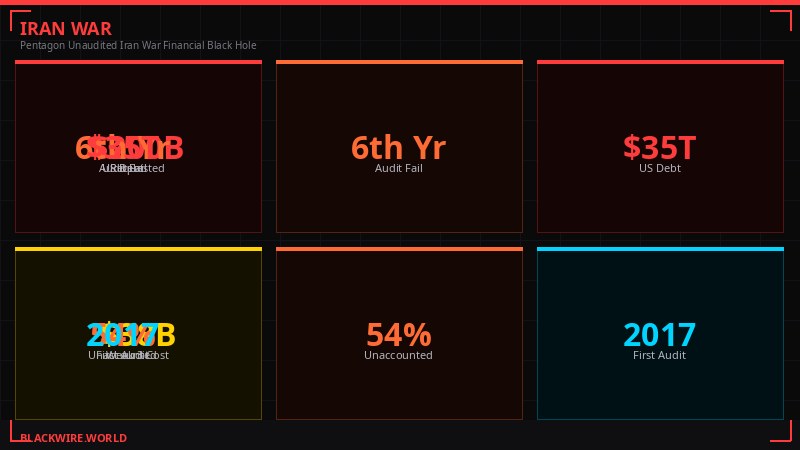
Cost projections from CSIS, Harvard Kennedy School, and anonymous DOD officials. Sources: CSIS analysis, The Intercept reporting, Bilmes/Stiglitz war cost framework.
The $200 Billion Ask - and Why No One Can Verify It

The Pentagon's supplemental request was first reported by the Washington Post and confirmed by an anonymous defense official to The Intercept. (Pexels)
On March 19, 2026, the Pentagon sent to the White House a supplemental budget request for $200 billion to cover Operation Epic Fury costs. The request - first reported by the Washington Post and confirmed to The Intercept by an anonymous defense official - is $200 billion on top of an already record-setting $1.5 trillion War Department budget request for 2027.
The number is extraordinary. Two hundred billion dollars represents approximately 20 percent of the Pentagon's entire annual budget for 2026. It is four times the $50 billion figure Democratic lawmakers expected and had publicly floated as a likely ceiling. It is more than the GDP of Portugal.
At a press conference, Hegseth was asked about the $200 billion request. His answer: "Obviously, it takes money to kill bad guys. As far as the $200 billion, I think that number could move." He did not specify in which direction.
The problem with scrutinizing the $200 billion ask is the same problem that has plagued Pentagon oversight for a decade: the institution asking for the money cannot account for the money it already has. Congress is being asked to appropriate two hundred billion dollars to a department that has received a "disclaimer of opinion" from its auditors for seven consecutive years - meaning auditors cannot determine whether the existing accounts are accurate.
"Taxpayers haven't gotten any clarity from the administration about the goals or costs of this war. To date, all we've seen are ballpark estimates, and lowballed ones at that. Now, Secretary Hegseth wants $200 billion for a war that Congress never authorized?" - Gabe Murphy, Taxpayers for Common Sense
Rep. Sara Jacobs, D-Calif., put the core accountability failure directly: "We haven't gotten sufficient details in public or behind closed doors about the strategy, the objectives, the length of the operation, or how much this will cost taxpayers." Elbridge Colby, the under secretary of war for policy, told the House Armed Services Committee that the campaign had been "scoped out" for up to five weeks - but was unable to tell Jacobs the cost. "I can't give you an answer at this point," he said.
The Office of the Secretary of Defense declined to provide The Intercept with cost details. Pentagon press secretary Kingsley Wilson did not respond to requests for comment. The institutions controlling the spending of hundreds of billions of dollars in public funds are either unable or unwilling to quantify those funds for the public paying them.
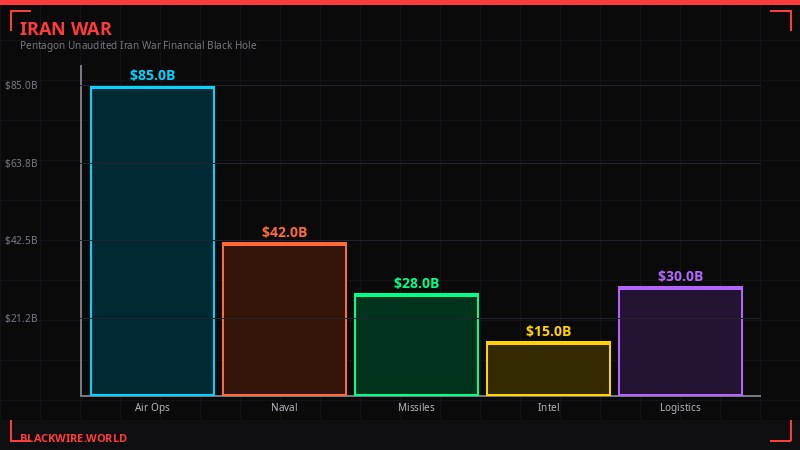
Estimated breakdown of the $200B supplemental request, based on CSIS analysis and the $16.5B Day 12 cost structure. Hegseth declined to provide a breakdown. Sources: CSIS, The Intercept.
The Long Bill: Veterans, Interest, and the Iraq War Template

Veterans' benefits and interest on war debt have historically dwarfed the immediate military costs of major conflicts. (Pexels)
The $200 billion supplemental request is the visible part of the bill. The invisible part is what comes after.
Linda Bilmes, who co-authored "The Three Trillion Dollar War" with Nobel laureate economist Joseph Stiglitz, and who served as assistant secretary and chief financial officer of the Commerce Department under Bill Clinton, offered The Intercept the framework that makes the direct cost figures look modest. Bilmes is now a senior lecturer in public policy at the Harvard Kennedy School.
Short-term expenses - munitions, carrier group deployments, aircraft lost - will be "dwarfed," Bilmes said, by long-term expenditures. Veterans' benefits for personnel exposed to "toxins, contamination, acid rain, dust from infrastructure destruction, and burning oil fumes" cost money for decades. Interest on war debt accumulates for generations. A larger-than-usual baseline Pentagon budget, approved in part to support the conflict, "becomes the base budget and, over a decade, it's another trillion dollars added to the defense budget."
The Iraq War provides the template. In 2003, the Bush administration estimated it would cost under $100 billion. The Bilmes-Stiglitz analysis in 2008 put the true cost at $3 trillion. More recent estimates, accounting for interest and long-term veteran care, push that figure closer to $6 trillion. The war ended combat operations in 2011. The bills are still coming in.
The Iran conflict, if it follows anything like the Iraq trajectory, will not be settled for decades in the federal budget. The 50,000 U.S. troops currently deployed around the Middle East, if they file disability claims at typical rates for toxic exposure, will generate costs the current supplemental does not even attempt to estimate. Bilmes told The Intercept the ultimate price tag "could reach into the trillions of dollars."
Two anonymous officials briefed on the conflict confirmed to The Intercept that the estimates being circulated internally - a quarter trillion dollars at five weeks, $250 billion or more at eight weeks - are themselves acknowledged as "back of the napkin" figures. "They really have no idea of the real cost," one official said. "Bookkeeping is not a Pentagon strong suit."
The Budget That Became a Slush Fund: From Border Security to Iran

Pentagon funds have been redirected multiple times in the Trump second term - first for immigration enforcement, then for an unauthorized war. (Pexels)
The Iran war supplemental request does not exist in isolation. It is the latest chapter in a pattern of Pentagon budget redirection that began the day Trump's second term started.
A December 2025 report by Senate Democrats, titled "Draining Defense," documented that the Trump administration had diverted at least $2 billion from the Pentagon budget for anti-immigration enforcement operations. The Pentagon's own 2026 budget request included at least $5 billion for southern border operations. The allocation broke down as follows: $1.3 billion for troop and resource deployment to the border; $420.9 million for detention of immigrants at military installations; $258 million for troop deployments to American cities including Los Angeles, Portland, and Chicago; and $40.3 million for military deportation flights.
Sen. Elizabeth Warren summarized the legal and strategic problem: "It's an insult to our service members that Pete Hegseth and Kristi Noem are using the defense budget as a slush fund for political stunts. Stripping military resources to promote a wasteful political agenda doesn't make our military stronger or Americans safer."
In March 2026, as the Iran war entered its third week, the Pentagon was simultaneously running a recruitment drive for its civilian employees to volunteer with ICE and CBP. An email from the Office of the Under Secretary of Defense for Personnel and Readiness compared immigration enforcement to "fighting wildfires" and invited employees to "step up for our country's next challenge." Salary: up to $191,900 per year. Duties include "managing the flow of detainees."
The Pentagon claimed more than 900 applications had been submitted. Around 200 civilians had already deployed. The defense budget was funding an immigration enforcement operation at the same time it was burning $2 billion a day in Iran and claiming it needed a $200 billion emergency top-up.
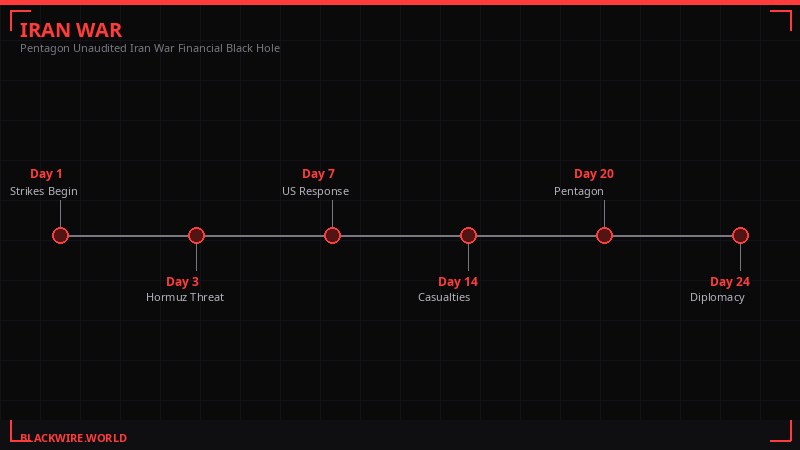
From immigration enforcement to an unauthorized war: how the Pentagon budget became a political instrument. Sources: Senate Democratic Caucus, The Intercept, Pentagon press releases.
The Defectors and the Dissent They Represent

Conscientious objector applications have surged to levels not seen in modern peacetime, driven in part by the Minab school massacre. (Pexels)
Joe Kent resigned on March 18, 2026. His letter, posted to X and viewed nearly 100 million times within days, cut against the official narrative with unusual specificity. Kent was the director of the National Counterterrorism Center, an Army veteran and former CIA officer. He was not a marginal figure.
"I cannot in good conscience support the ongoing war in Iran," he wrote. "Iran posed no imminent threat to our nation, and it is clear that we started this war due to pressure from Israel and its powerful American lobby."
Kent's departure was the first from inside the administration, following a series of defections from MAGA media - most notably Tucker Carlson, who had been openly questioning the logic of the conflict since its early days. Trump called Kent's exit "a good thing." White House spokesperson Karoline Leavitt called the letter "brimming with false claims." The FBI, according to media reports, opened a leak investigation into Kent.
But Kent was not alone in his disillusionment. The Center on Conscience and War reported that in the two weeks following the February 28 start of the conflict, it had started more service members through the conscientious objector process than it typically does in a full year. Mike Prysner, the center's executive director, told The Intercept his phones were ringing around the clock. The ranks filing for CO status ran from privates to majors, including three fighter pilots.
"We've started more people in the CO process in the past two weeks than we typically do over the period of a year," Prysner said. The single most common trigger, he reported: the U.S. airstrike on the Shajarah Tayyebeh elementary school in Minab on February 28, which killed at least 175 people, most of them children. A Pentagon preliminary investigation found the strike resulted from a "targeting error" - the school had been misidentified using outdated coordinates as an IRGC naval facility. The IRGC base had been partitioned from the school building by 2016, according to an investigation by New Lines Magazine.
Trump denied U.S. responsibility, telling reporters: "In my opinion, based on what I've seen, that was done by Iran." The missile was identified by Bellingcat as a U.S. Tomahawk. The U.S. is the only party to the conflict using Tomahawk missiles.
The financial cost of the school strike - one targeting error among what Airwars identified as "a record pace of strikes" - is not counted in any budget line. The moral cost is being counted differently, in the escalating number of service members who want no part of it.
Who Profits: The Defense Industry Windfall Nobody Will Call by Its Name

The direct beneficiaries of the Pentagon's $200B supplemental request are the defense contractors who manufacture the munitions being burned at $5.6 billion in two days. (Pexels)
Follow the money far enough and you find the institutions that benefit from the chaos of unaudited, unauthorized, open-ended conflict.
CSIS estimated that munitions replacement costs represented $3.1 billion of the first 100 hours of Operation Epic Fury - the largest single cost category by far. The Pentagon disclosed that $5.6 billion in munitions alone were consumed in the first two days. The CSIS methodology is explicit about what "replacement" means: like-for-like procurement of SM-3 Block IIA missiles, Tomahawk variants, air defense interceptors, and precision-guided munitions - all manufactured by Raytheon (now RTX), Lockheed Martin, Northrop Grumman, and General Dynamics.
RTX, the parent company of Raytheon Missiles and Defense and the manufacturer of the SM-3, Tomahawk, and AMRAAM missile systems central to Operation Epic Fury, reported record order backlogs prior to the conflict. Lockheed Martin's precision munitions divisions - including the Javelin joint venture with Raytheon and the JASSM cruise missile program - are already operating at capacity constraints. Northrop Grumman's defense electronics division, which supplies components for the B-2 Spirit and F-35 strike packages used in the early days of Epic Fury, was already on a growth trajectory before the war.
The $200 billion supplemental request guarantees that these backlogs will be cleared and expanded. The procurement queue for the munitions expended in three weeks of combat represents multi-year contracts worth billions of dollars to a handful of companies whose lobbying operations are deeply embedded in the congressional appropriations committees that will ultimately approve the supplemental request.
Linda Bilmes identified this dynamic in the Iraq War context and it applies with equal force now: military conflicts create "base budgets" - the expanded defense appropriations that accompany wars tend not to shrink back to pre-war levels once combat operations end. "A new war also makes it more likely for Congress to approve a bigger Pentagon budget going forward," she told The Intercept. "That becomes the base budget and, over a decade, it's another trillion dollars added to the defense budget."
The defense contractors understood this calculus before the first Tomahawk left its launch tube. The American taxpayer is learning it now.
Key Facts: The Pentagon Financial Crisis at a Glance
- The Pentagon has failed 7 consecutive financial audits (2017-2024), each receiving a "disclaimer of opinion" - the worst possible rating
- 28 material weaknesses identified in FY2024, directly affecting $2.1 trillion of reported Pentagon assets
- Operation Epic Fury began Feb 28, 2026 - no Congressional Authorization for Use of Military Force
- CSIS estimates: $3.7B in first 100 hours; $11.3B at Day 6; $16.5B at Day 12
- Pentagon burned $5.6B in munitions in the first 2 days alone (classified briefings, reported by The Intercept)
- Daily burn rate: $1-2B per day, per anonymous DOD officials and CSIS estimates
- $200B supplemental requested - 20% of the entire 2026 Pentagon budget, on top of $1.5T FY2027 request
- At least $2B in Pentagon funds already diverted for immigration enforcement in 2025 alone
- Projected 5-week war cost: $175B in direct costs; 8-week: $250B+ (government officials)
- Long-term cost with veterans' benefits and debt interest: potentially trillions (Bilmes, Harvard)
- 175+ killed in U.S. strike on Minab elementary school - preliminary investigation confirms U.S. "targeting error"
The Accountability Void: What Oversight Looks Like When There Is None

Congress has the power to demand accountability for the Pentagon's finances and for the unauthorized war. It has not yet exercised that power with any consequence. (Pexels)
The accountability question is not abstract. The War Powers Resolution of 1973, passed after Congress was systematically excluded from decisions about Vietnam, requires the president to notify Congress within 48 hours of committing forces to combat and prohibits engagement lasting more than 60 days without Congressional authorization or a declaration of war. The clock on Operation Epic Fury started on February 28. By late April, absent Congressional authorization, the conflict would technically violate the War Powers Resolution.
Rep. Ro Khanna, D-Calif., and Rep. Thomas Massie, R-Ky., attempted to force a War Powers vote in the weeks before the conflict began. Their efforts failed. Once the strikes started, the political momentum shifted to the administration's favor in the short term: opponents of the war were immediately framed as opponents of "finishing the job."
Kent's resignation letter named the mechanism explicitly: "It is clear that we started this war due to pressure from Israel and its powerful American lobby." For naming this pressure - the same pressure identified by critics across the political spectrum from Tucker Carlson to progressive Democrats - Kent became the subject of an FBI leak investigation within days of his resignation.
The oversight machinery is compromised at multiple levels. The Pentagon inspector general, whose office conducts the financial audits, operates inside the same department it is auditing. The congressional appropriations committees that will be asked to approve the $200 billion supplemental are staffed and lobbied by former defense industry executives and will be receiving the request during a shooting war - the least favorable conditions for demanding accountability. The Office of the Secretary of Defense declined to provide cost details to reporters. CENTCOM refused comment on the Minab school preliminary findings because "the incident is under investigation."
The result is a system where $4 trillion in assets cannot be accounted for, a war consuming $2 billion a day was launched without authorization, and the institution responsible for all of this is asking for another $200 billion - while one of the administration's own national security officials is under FBI investigation for questioning why the war started.
"They really have no idea of the real cost. Bookkeeping is not a Pentagon strong suit." - Anonymous U.S. government official briefed on Operation Epic Fury, to The Intercept
The $200 billion number will not be the last number. The Iraq War's true cost was not understood until years after the fighting ended. The Pentagon has no functional financial management system capable of tracking what it spends in real time. The auditors confirmed that in 2017, 2018, 2019, 2020, 2021, 2022, 2023, and 2024. There is no reason to believe 2026 will be different.
What is different in 2026 is the scale and velocity of the spending - and the brazenness of the accounting. Hegseth did not flinch when he said $200 billion "could move." He did not flinch because there is nothing in the current oversight architecture that requires him to.
The money will flow. The audit will fail. The bills from the veterans' hospitals and the interest payments on the war debt will arrive in the 2030s and 2040s and beyond. And somewhere in the $4 trillion maze of Pentagon financial statements that no auditor can fully parse, the true cost of Operation Epic Fury will be recorded - if it is recorded at all.
Get BLACKWIRE reports first.
Breaking news, investigations, and analysis - straight to your phone.
Join @blackwirenews on TelegramSources: The Intercept (Nick Turse, March 17 and March 19, 2026); CSIS analysis "$3.7 Billion: Estimated Cost of Epic Fury's First 100 Hours" and updated "$16.5 Billion at Day 12"; GAO-25-108052 "Insights into the Auditability of DOD's Fiscal Year 2024 Balance Sheet" (Sept 2025); Senate Democratic Caucus "Draining Defense" report (Dec 2025); Taxpayers for Common Sense; Linda Bilmes, Harvard Kennedy School; The Intercept conscientious objectors report (Noah Hurowitz, March 20, 2026); Airwars Iran bombing campaign analysis; New Lines Magazine Minab school investigation; Bellingcat Tomahawk missile identification; Project on Government Oversight (Julia Gledhill); Quincy Institute for Responsible Statecraft (William Hartung); Congressional Budget Office supplemental cost estimates.