Philippines Declares National Energy Emergency as Iran War Starves Asia of Fuel

Long queues at fuel stations have become normal across Asia since Iran shut the Strait of Hormuz. (Reuters/file)
President Ferdinand Marcos Jr. declared a state of national energy emergency in the Philippines on Tuesday - a year-long decree that hands his government emergency powers over fuel distribution and anti-price gouging enforcement. The Philippines is not at war. Nobody attacked it. It is 7,000 kilometers from the bombs falling on Tehran. But the Strait of Hormuz being choked off is doing to Manila what war does: upending everything.
The declaration, announced by the Philippine government late Tuesday and confirmed by AP News, is the most formal acknowledgment yet that the Iran-US-Israel war has transformed from a Middle East conflict into a global economic emergency. The Philippines is simply the first country willing to say so officially.
It will not be the last.
What the Emergency Declaration Actually Means

Philippines transport workers have seen daily earnings collapse as fuel prices spike. (Pexels)
The Marcos decree is not symbolic. It establishes a contingency committee led by the president himself that will directly oversee the availability and distribution of fuel, food, medicines, agricultural products and other basic goods. Authorities have been ordered to move against hoarding, profiteering and price manipulation. The Department of Migrant Workers has been placed on standby alert for possible rescue and evacuation operations for Filipinos in the Middle East.
The order covers everything that keeps a developing economy with 115 million people running - and the government has framed the threat explicitly as stemming from the ongoing war's "imminent danger of a critically low energy supply."
To blunt immediate household pain, the government began distributing 5,000 pesos (approximately $83) cash payments to large numbers of motorcycle taxi drivers and public transport workers nationwide. Free bus rides were extended to students and workers in selected cities.
"Our situation now is worse than during the pandemic. The fuel subsidy from the government isn't enough. It's for a two-day drive. So what happens after two days?" - Carlos Bragal Jr., jeepney driver, Manila (via BBC)
Carlos drove 12-hour shifts that used to earn him 1,000 to 1,200 pesos per day. Now he takes home between 200 and 500 pesos - when he can work at all. Some of his colleagues are earning zero. Carlos has daughters in school. He doesn't know what happens to them in the next few weeks.
The Philippines is a high-exposure country in this crisis for two reinforcing reasons. First, it is heavily dependent on Gulf oil imports routed through the strait. Second, it has the largest labor diaspora in the Middle East of any Southeast Asian nation - approximately 2.4 million Filipinos work and live in the region, according to Philippine government data cited in the AP report. About 31,000 are in Israel. Around 800 are in Iran itself. A Filipino caregiver, Mary Ann de Vera, was already killed in Tel Aviv on February 28 - the same day the war began - when an Iranian missile struck as she was helping her elderly charge to a bomb shelter.
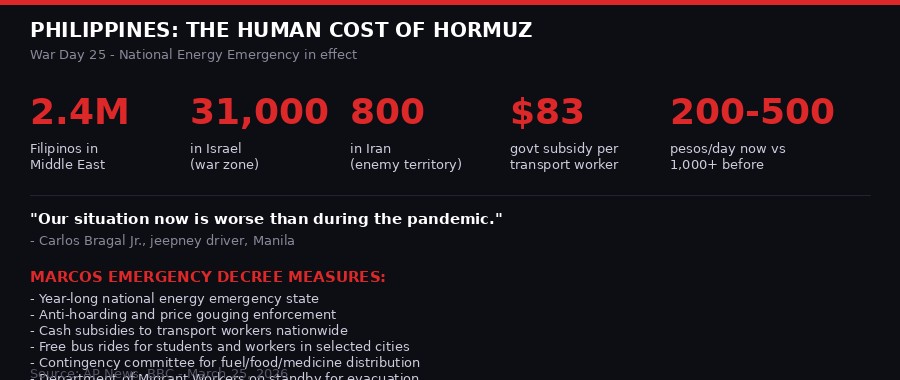
BLACKWIRE infographic: Key numbers behind the Philippines energy emergency declaration.
Asia is Running Out of Time - Not Just Fuel

Across Asia, governments are deploying increasingly desperate conservation measures as Gulf oil fails to arrive. (Pexels)
The Philippines declaration is the most dramatic step taken yet, but it sits inside a broader pattern of Asian governments scrambling for emergency energy policy at a speed they haven't managed since the 1970s oil shocks.
The BBC documented the regional situation on Wednesday in a report that mapped country-by-country responses. The picture is consistent: governments that normally compete for Gulf oil imports are all finding the same thing. The ships that used to come don't come anymore, or come in far smaller numbers. The Strait of Hormuz, the 33-kilometer-wide chokepoint through which roughly 20 million barrels per day used to flow, is effectively closed. Only a handful of vessels make it through each day now, according to BBC reporting.
Nearly 90% of the oil and gas passing through the strait is destined for Asia - a figure that explains why the conflict's energy fallout has landed hardest east of the Arabian Peninsula, not west of it. Europe is under strain. America is politically toxic over gas prices. But Asia is closest to the edge.
In Thailand, public broadcaster Thai PBS news presenters removed their suit jackets on air - a deliberate signal from the government asking citizens to dress appropriately in the heat and ease air conditioning loads. It's not a trivial gesture. The Thai government has ordered all government agencies to work from home and directed citizens to keep air conditioning set no lower than 26-27 degrees Celsius. Presenter Sirima Songklin described the war's reach as "unbelievable."
"Taking off the suit isn't the whole solution for energy conservation, but what we did is to show that we're not ignoring what's happening." - Sirima Songklin, Thai PBS news presenter (via BBC)
In Sri Lanka - a country that just clawed its way back from a catastrophic sovereign debt crisis in 2022 - the government declared Wednesdays a public holiday to reduce fuel consumption. Fuel rationing is back. Long queues at petrol stations mean workers are missing hours of paid employment just to fill their tanks, then arriving too late to their jobs and finding they've been replaced for the day. A lawnmower operator named Nimal told the BBC he couldn't go to work because of the queuing time.
"By the time I get back to work after getting fuel, someone else may be there as a replacement for the job," he said.
In Myanmar, still mired in civil war since the 2021 coup, the military-backed junta implemented alternate-day fuel restrictions. In India, which sources a substantial share of its LPG from Gulf suppliers routed through the strait, the import crisis is deepening. China - which is thought to hold reserves equivalent to approximately three months of imports - has brought in fuel price caps and is drawing down strategic stocks at a pace that analysts describe as unsustainable if the war extends another quarter.
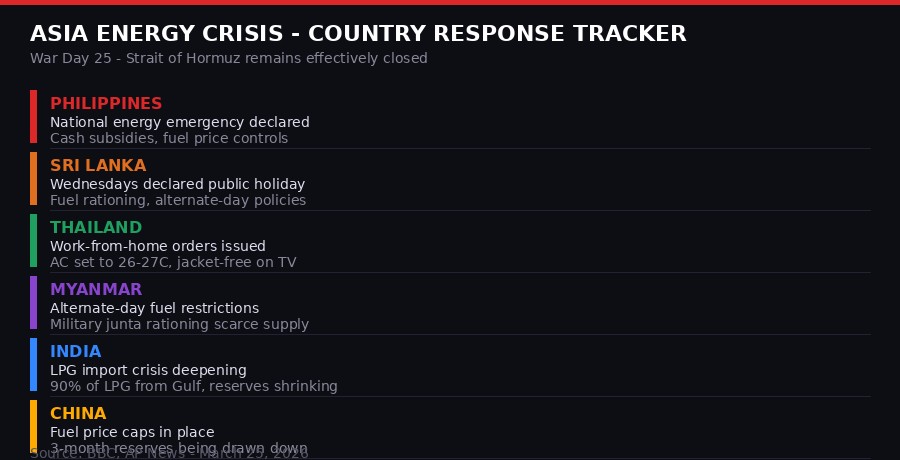
BLACKWIRE tracker: Emergency measures declared across six Asian nations as Hormuz closure bites into fuel supply chains.
The Strait That Controls the World

Oil tankers that once transited the Strait of Hormuz freely are now rerouting or stranded. (Pexels)
The Strait of Hormuz is 54 kilometers wide at its narrowest point with shipping lanes only 3 kilometers wide in each direction. For decades it has been described as the world's most important oil chokepoint - a claim that previously felt theoretical. It no longer does.
When Iran effectively blockaded the strait following the start of the US-Israel air war on February 28, the first response from markets was disbelief. Brent crude was trading around $74 per barrel before the war started. By the end of week one it had spiked above $86. By week two, oil crossed $100 per barrel for the first time since 2022. By week three it was trading at approximately $115. Current prices sit around $119 per barrel and market analysts at JPMorgan have warned that any sustained attack on Kharg Island - Iran's primary oil export terminal - could push the price higher still with severe global recession implications.
According to analysis cited by AP, Iran has exported 13.7 million barrels since the war started - meaning its own oil exports have not fully stopped, but the commercial shipping that moves other nations' oil through the strait has been severely disrupted by the threat environment and Iranian interdiction.
The US struck Kharg Island on March 21, hitting its defenses, a radar site, the airport and a hovercraft base, according to satellite analysis by the Institute for the Study of War and American Enterprise Institute's Critical Threats Project. The oil infrastructure was left intact - a deliberate choice. US Senator Lindsey Graham, a close Trump ally, was direct about the logic: "He who controls Kharg Island, controls the destiny of this war," Graham posted on social media.
Energy researcher Petras Katinas of the Royal United Services Institute (RUSI) told AP that Kharg is critical to funding Iran's government and military. Losing control of it would make it difficult for the country to function - not just the current government, but any successor regime. JPMorgan's global commodity research team warned that even a strike on the island's oil infrastructure "would immediately halt the bulk of Iran's crude exports, likely triggering severe retaliation in the Strait of Hormuz or against regional energy infrastructure."
That retaliation threat is precisely why Asian governments are hedging now, before any such escalation occurs. The Philippines energy emergency was declared in anticipation of worse - not in response to the worst already happening.
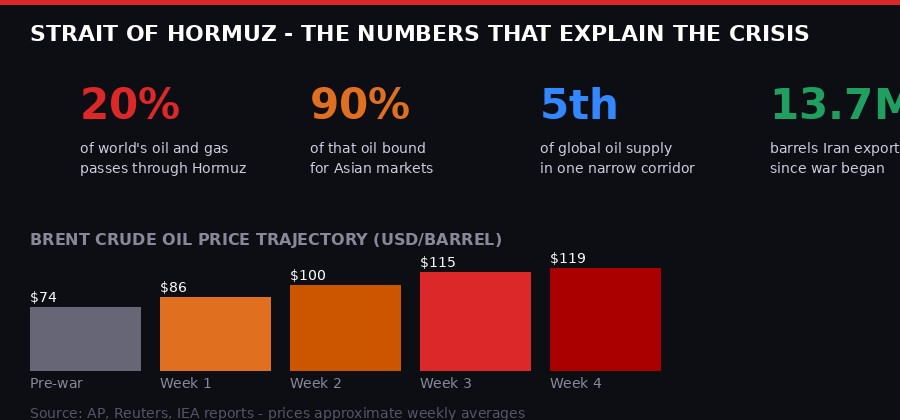
BLACKWIRE data: Oil price trajectory week-by-week since the US-Israel-Iran war began February 28, 2026.
Iran Rejects the Peace Plan - War Continues Into Week Four

Diplomatic efforts are ongoing but Iran and the US are not in direct contact, according to Tehran. (Pexels)
The backdrop to the Philippines emergency and Asia's fuel crisis is a war that shows no signs of stopping on Wednesday. Iran's state television, through its hardliner-controlled Press TV service, issued a formal rejection of the 15-point ceasefire plan the Trump administration submitted via Pakistani intermediaries on Tuesday, according to AP. An unnamed Iranian senior political-security official laid out Tehran's counter-demands: a halt to "aggression and assassinations," concrete guarantees against future wars, war reparations, an end to attacks on Iranian regional allies, and continued Iranian "exercise of sovereignty" over the Strait of Hormuz.
Those terms are incompatible with the US plan at nearly every point. Washington's 15-point proposal, first reported by the New York Times and confirmed by officials briefed on its contents, asks Iran to commit to never building nuclear weapons, to dismantle nuclear facilities, to hand enriched uranium to the IAEA, to limit ballistic missile range and numbers, to stop funding Hezbollah, Hamas and the Houthis, and to reopen the strait as a free maritime corridor. In exchange, all international sanctions would be lifted.
Iran's counter-demand that it retain sovereignty over the Strait of Hormuz is not a negotiating position - it is the central reason the war has global economic consequences. The US and international law regard the strait's shipping lanes as international waters that all vessels may transit. Tehran views control of the strait as its primary strategic leverage. Giving it up in exchange for sanctions relief is not a trade Iran's surviving hardliner leadership will accept.
Iran's parliament speaker Mohammad Bagher Qalibaf was blunter than that on Wednesday, dismissing even the premise of negotiations. He wrote on X: "No negotiations have been held with the US, and fakenews [sic] is used to manipulate the financial and oil markets and escape the quagmire in which the US and Israel are trapped."
Israeli Economy Minister Nir Barkat told the BBC that Iran agreeing to Trump's terms was unlikely. "I believe at the end of this round, we will accomplish the goals, with or without a deal," Barkat said.
Meanwhile Israeli air strikes continued in Tehran on Wednesday. The Israeli military said it completed multiple waves of strikes in the Iranian capital and also reported targeting a submarine development center in Isfahan during operations a day earlier. Iran simultaneously kept up its missile and drone campaigns against Israel and Gulf Arab neighbors. Saudi Arabia's Defense Ministry confirmed intercepts. Kuwait's airport was struck in Tuesday's attack wave. Hezbollah continued firing into northern Israel, with missile alert sirens sounding multiple times across the country on Wednesday.
Trump said Tuesday he was talking to the "right people" in Iran and that Tehran had given the US a "present" - something related to oil and gas - without specifying further. By Wednesday that framing had evaporated as Iran's flat rejection of the peace plan landed on wire services.
82nd Airborne Heading In - The Diplomatic and Military Contradiction

The US is sending thousands more troops to the Middle East even as it pursues ceasefire talks. (Pexels)
The Trump administration is simultaneously pursuing diplomacy and military buildup - a combination that analysts at the Soufan Center describe as Trump seeking "max flexibility" and possibly an "offramp."
Three people with knowledge of the plans told AP that at least 1,000 soldiers from the 82nd Airborne Division will deploy to the Middle East in the coming days. The 82nd Airborne is the US Army's emergency response force - trained to parachute into hostile or contested territory to seize airfields and key positions on short notice. Their deployment does not signal a diplomatic mission.
The Pentagon is also completing the deployment of approximately 5,000 Marines and thousands of sailors to the region, bringing total US military presence in the theater to over 55,000 personnel. The Marine deployments have fueled speculation about a possible amphibious operation against Kharg Island - Iran's oil export hub. Iran has threatened to mine the Persian Gulf if a US landing appears imminent.
The Soufan Center analysis notes that Trump delayed a threat to bomb Iran's power stations while ceasefire discussions unfold - which could be buying time for the Marines to arrive in position, or could reflect a genuine search for an exit. Either interpretation is plausible given the mixed signals coming from the White House this week.
A new AP-NORC poll published Wednesday paints the domestic political context in unambiguous terms. About 59% of Americans say US military action against Iran has been excessive. Some 45% say they are "extremely" or "very" concerned about being able to afford gasoline in the coming months - up sharply from 30% before the war. Trump's overall approval rating remains at roughly 40%, holding steady for now. But the poll suggests the conflict is fast becoming a major political liability for the administration.
"There is significant support for at least one of the president's objectives, which is preventing Iran from obtaining a nuclear weapon. About two-thirds of Americans say that should be an 'extremely' or 'very' important foreign policy goal. However, they are just as likely to say it's important to keep U.S. oil and gas prices from rising." - AP-NORC Center for Public Affairs Research, March 25, 2026
That juxtaposition - stopping Iran's nuclear program versus keeping gas affordable - captures precisely why the administration has no clean exit. Achieving the nuclear objective likely requires a sustained war that will keep oil prices elevated indefinitely. Ending the war quickly enough to bring gas prices down may require accepting an Iran that retains meaningful nuclear capability.
Pakistan Offers a Table, But Who Sits at It?

Pakistan has offered to host US-Iran negotiations - but Iran's position on Wednesday makes the prospect of talks remote. (Pexels)
Pakistan's Prime Minister Shehbaz Sharif wrote on X on Tuesday that Pakistan is ready to "facilitate meaningful and conclusive talks" to end the Iran war. Three Pakistani officials, one Egyptian official and a Gulf diplomat told AP that the US has agreed in principle to participate in talks on Pakistani soil. A regional diplomat said the talks could happen by early next week, with Trump envoy Steve Witkoff and Jared Kushner expected to represent the US.
The challenge is that nobody knows who speaks for Iran. Supreme Leader Ali Khamenei was killed in the opening wave of Israeli air strikes on February 28. His son Mojtaba Khamenei has emerged in Iranian state media statements but has not formally been invested as Supreme Leader, and the chain of command within the Islamic Revolutionary Guard Corps - which controls the actual military levers - remains opaque to outside observers.
Israel has vowed to continue targeting Iranian leadership. An Egyptian official involved in mediation told AP that talks are centered on "trust-building" - which is diplomatic language for the fact that neither side is close to substantive compromise. The priority, the official said, is to prevent attacks on regional energy infrastructure and to work on a "mechanism" for Iran to reopen the Strait of Hormuz.
The Strait of Hormuz is both the reason a deal is necessary and the reason a deal is nearly impossible. Iran's leverage in any negotiation is the strait. Giving it up is giving up its leverage. That is a trade Iran's hardliners - now firmly in control after the deaths of more pragmatic figures in the early days of the conflict - will not make for anything less than a complete end to the war and reparations for the damage already done.
Israel is not at the table and has not been asked to be. Israeli officials were reportedly surprised by the US ceasefire submission - a sign that the Netanyahu government and the Trump administration are not entirely aligned on pace or objectives.
From Manila to Colombo: The Human Price of a Geopolitical Failure

Ordinary people across Asia are absorbing the costs of a war they had no part in starting. (Pexels)
Pull the camera back from the diplomatic communiques and the strike maps and you find the people who do not appear on televised press conferences but who are absorbing the actual costs of this war.
Carlos in Manila used to support two daughters through school. Now he makes a few hundred pesos on a good day and doesn't know how to pay the next tuition bill. Sri Lankan lawnmower operator Nimal loses work to fuel queues. Thai farmers are reducing irrigation because diesel is priced beyond their margin. Jeepney operators in the Philippines who already faced excise tax headaches and frozen fare hikes have hit a wall they cannot climb over.
These are not victims of a stray missile or a bomb dropped in the wrong grid square. They are victims of a geopolitical architecture that depends on one 33-kilometer-wide chokepoint for the movement of a fifth of the world's energy - and the decision of two of the most powerful governments on Earth to start shooting through it.
The Philippines government is distributing 5,000 pesos per worker - roughly $83 - as its initial response. That covers, by Carlos's estimate, two days of driving. After that, Marcos's contingency committee will need more answers than the ceasefire diplomats in Islamabad currently have available to give.
For now, Asia waits. The Strait of Hormuz stays choked. The 82nd Airborne loads its gear. Iran says no. And the oil price, which was $74 per barrel when this war started twenty-five days ago, sits above $119 and climbing.
Get BLACKWIRE reports first.
Breaking news, investigations, and analysis - straight to your phone.
Join @blackwirenews on Telegram