Eyes Off: Planet Labs Blacks Out the Gulf War as Iran Cuts Its Own Internet
APRIL 5, 2026 - 12:21 CET | GULF THEATER
The California satellite company Planet Labs has imposed an indefinite blackout on imagery of Iran and the surrounding war zone, complying with a US government request to blind the world's eyes. Simultaneously, Iran has plunged its own population into the worst internet shutdown ever recorded by any nation at any time. The Gulf war - now in its 35th day - is becoming the least visible major conflict since the age of smartphones began.

Commercial satellite imagery of the Middle East - now blocked by US government request. Source: Pexels/NASA
The convergence of these two information blackouts - one corporate, one governmental, one externally imposed, one self-inflicted - is not coincidental. Both are direct products of the same war. Together, they are reshaping how conflict is documented, understood, and ultimately judged by history.
Meanwhile, the military situation on the ground is anything but dark. A US F-15E Strike Eagle crew member was rescued Sunday from deep inside Iranian mountain terrain after a harrowing search-and-rescue operation. Iran claimed to have shot down a C-130 transport and two Black Hawk helicopters involved in the extraction. A US intelligence official told AP that the two aircraft were actually destroyed by the US military itself due to technical malfunction - but the fog of competing claims is now the baseline condition of this war.
Iranian drones struck infrastructure across Kuwait, Bahrain, and the UAE on Saturday and Sunday. The Strait of Hormuz remains blockaded. Oil sits above $109 a barrel. Pakistan, Turkey, and Egypt are working back-channels toward a ceasefire. And Trump has threatened "all hell" if Hormuz is not reopened by Monday.
What almost nobody can verify independently anymore is what is actually burning, what is actually surviving, and who is actually winning.
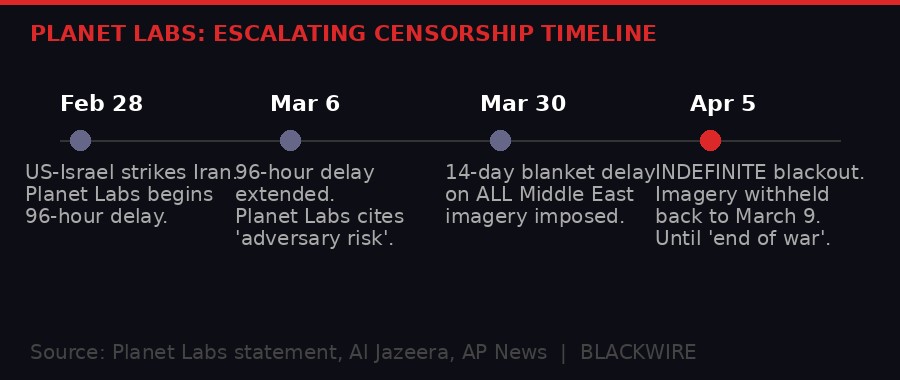
Planet Labs imagery restrictions - from 96-hour delay to indefinite blackout in 35 days. Source: BLACKWIRE
The Satellite Blackout - A Commercial Company Becomes a Wartime Censor

Commercial satellite infrastructure - now operating under wartime censorship protocols. Source: Pexels
Planet Labs was founded in 2010 by former NASA scientists with a stated mission of democratizing access to Earth imagery. It operates over 200 satellites in low-Earth orbit - the largest such constellation in the world - and sells imagery subscriptions to governments, NGOs, journalists, researchers, and private companies. The company has been publicly traded since 2021 and positions itself as an open, transparent alternative to classified government satellite programs.
That positioning is now in direct conflict with what Planet Labs announced Saturday in an email to its customers. The company confirmed it would comply with a US government request for an "indefinite withhold of imagery" covering Iran and the surrounding conflict zone. The restriction covers all imagery dating back to March 9 - retroactively locking away weeks of documentation that customers had already purchased access to.
"These are extraordinary circumstances, and we are doing all we can to balance the needs of all our stakeholders." - Planet Labs customer notification, April 5, 2026 (via AP News, Al Jazeera)
This is the third escalation in Planet Labs' imagery restrictions since the war began. When the US and Israel launched their aerial campaign against Iran on February 28, Planet Labs initially imposed a 96-hour delay on Middle East imagery. When that proved insufficient from a government perspective, the delay was extended. On March 30, the company shifted to a 14-day blanket delay across the entire region. Now, as of Saturday, the delay is indefinite and extends backward to remove imagery already released.
The stated rationale is preventing adversaries from using commercial satellite imagery to identify US and Israeli targets, track military movements, or calibrate weapons guidance. Military satellite specialists say this concern has merit. Iran's intelligence services, despite domestic degradation from US and Israeli strikes, retain significant analytical capabilities. Russia and China - which both maintain covert intelligence cooperation with Tehran - could serve as pass-through recipients for commercially available imagery.
"Satellite images help journalists and academics studying hard-to-reach places," noted Al Jazeera in its reporting on the Planet Labs blackout - underscoring the secondary casualty of the policy. The images that help armies target also help reporters document. There is no technical mechanism to offer one without the other.
Under the new system, Planet Labs says it will release imagery on a "case-by-case basis for urgent, mission-critical requirements or in the public interest." Who makes those determinations, on what timeline, and with what appeals process - none of this is specified in the customer notification. The company did not respond to requests for further clarification by publication time.
Planet Labs is not the only commercial imagery provider operating in the region, but it is the largest and most widely used. Maxar Technologies, which operates the WorldView satellite constellation and provides imagery to the US government under long-standing contracts, has been operating under different restrictions since the war's start. The net effect is that independent verification of military strikes, civilian casualties, and infrastructure damage in Iran is now almost entirely dependent on what the US government and its allies choose to release - or what Iranian state media claims.
Iran's Internet Blackout - The Largest in History

Iran's internet blackout now exceeds any nation-scale shutdown ever recorded. Source: Pexels
Al Jazeera's live war coverage reported Sunday morning that Iran's internet shutdown has now become "record-breaking, exceeding any nation-scale shutdowns" previously documented in the global record. The NetBlocks and OONI observatory networks, which track internet disruptions worldwide, confirmed that Iran's current shutdown duration and depth surpasses previous records set during Ethiopia's Tigray conflict, Sudan's multiple internet kills, and even Iran's own previous blackout during the 2019 fuel subsidy protests.
The scope of the current shutdown is qualitatively different from previous Iranian internet restrictions. During the 2019 protests, Iran shut down international internet access while maintaining internal connectivity - allowing the government to communicate internally while blocking the outside world from seeing what was happening. The current shutdown is far more comprehensive.
Mobile data networks have been severely degraded since the early days of the war. International connections have been intermittently severed at the infrastructure level. VPN usage initially surged but has been subject to active blocking. Satellite internet access through providers like Starlink - never legally available in Iran - has seen some uptake in border regions, but is being actively jammed in areas of military significance.
The effect on Iranians themselves is severe and multi-dimensional. Economically, businesses that depend on international commerce, payment processing, and logistics coordination have been further paralyzed on top of the physical disruption from airstrikes. Medically, hospitals that had integrated remote consultations, supply chain management systems, and electronic records face cascading failures as connectivity drops. Personally, families separated by the war - many with relatives in diaspora communities in Europe and North America - are losing contact.
The shutdown also serves a strategic purpose for the Iranian government. Controlling the information environment inside the country shapes public perception of how the war is going. Footage of civilian casualties from US and Israeli airstrikes cannot circulate virally when the population lacks reliable internet. Organized protest, which might challenge the government's management of the crisis, becomes logistically harder without coordination platforms. The historical record Iran leaves for future accountability - the documentation that might someday be used in war crimes investigations - is being systematically degraded in real time.
"The war on Iran and disruption to the Strait of Hormuz risk pushing humanitarian operations beyond their limits." - Madiha Raza, International Rescue Committee, via AP News
The irony is not lost on observers that the United States and Iran have arrived at complementary information strategies through entirely different means. Washington pressures commercial satellite providers to restrict imagery access. Tehran kills its own internet. The result in both cases is a war zone that is increasingly opaque to outside scrutiny - and to accountability.
The Pilot Rescue and the Competing Narratives

US search-and-rescue operations extracted the F-15E crew member from Iranian mountain terrain Sunday. Source: Pexels
The most dramatic event of Sunday morning was the confirmed rescue of the US service member who had been missing inside Iranian territory since his F-15E Strike Eagle was shot down Friday. It was the first American aircraft to crash inside Iranian territory since the war began on February 28.
President Trump announced the rescue on social media in characteristically combative terms.
"This brave Warrior was behind enemy lines in the treacherous mountains of Iran, being hunted down by our enemies, who were getting closer and closer by the hour." - President Donald Trump, social media post, April 5, 2026 (via AP News)
Trump confirmed the aviator was injured but in stable condition - "will be just fine," in the president's phrasing. A second crew member had been recovered earlier in a separate operation. The details of how the rescue was executed, what assets were used, and what routes were taken remain classified.
What is not classified is Iran's counter-narrative, which runs directly against the US account. Iranian state television aired video claiming to show parts of American aircraft shot down by Iranian forces, alongside photographs of heavy black smoke. Tehran's military command announced that Iranian forces had destroyed a C-130 transport aircraft and two Black Hawk helicopters involved in the rescue operation - a significant escalation of losses if true.
The actual explanation, according to a regional intelligence official who spoke to AP on condition of anonymity, is more mundane but no less revealing: the US military destroyed the two transport aircraft itself after mechanical failures made them inoperable in hostile territory. Standard procedure to prevent capture of sensitive equipment. Iran's claim of shooting them down was false. But in an information environment where satellite imagery is blacked out and Iranian internet is severed, false claims survive far longer than they would under normal verification conditions.
The same intelligence official's account cannot be independently verified through commercial imagery - because Planet Labs has blacked out the region and Maxar operates under government contract restrictions. The mountains of northwestern Iran where the rescue took place are now, effectively, a documentation black hole.
Separately, Iran's state TV reported that Iranian forces shot down an American A-10 Warthog attack aircraft on Saturday or Sunday. The status of the crew and the precise location of the crash were not immediately confirmed by US Central Command. The A-10 is a ground-attack aircraft optimized for close air support - not a mission profile typically associated with operations deep inside Iran. If the report is accurate, it would suggest a significant expansion of US air operations inside Iranian territory, or a shootdown near the Iranian border while conducting operations against targets in neighboring countries.
The Gulf Burns - Infrastructure Strikes Multiply
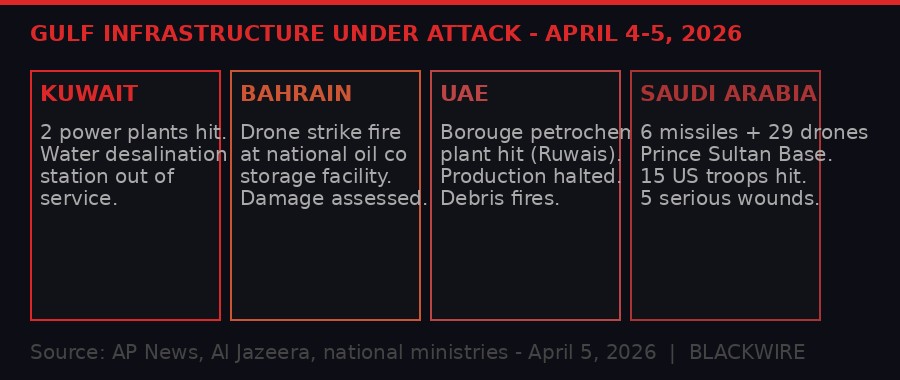
Iranian drone and missile strikes on Gulf infrastructure - April 4-5, 2026. Source: BLACKWIRE / AP News / national ministries
While the rescue operation dominated US headlines, Iran's drone and missile campaign against Gulf Arab state infrastructure continued without pause through Saturday and into Sunday morning. The scope of the attacks on April 4-5 represents one of the most geographically diffuse Iranian strike packages since the war began.
In Kuwait, Iranian drones struck two power plants and put a water desalination station out of service, according to Kuwait's Ministry of Electricity. The ministry reported no injuries, but the strategic significance is considerable. Kuwait depends almost entirely on desalination for its freshwater supply. Removing desalination capacity even temporarily creates cascading civilian effects that extend far beyond immediate infrastructure damage.
In Bahrain, the national oil company reported a drone attack caused a fire at one of its petroleum storage facilities. The fire was extinguished and no injuries were reported, but Bahrain hosts the US Navy's Fifth Fleet headquarters at Naval Support Activity Bahrain. Any degradation of Bahraini energy infrastructure carries direct implications for US naval operations that depend on local fuel and logistics networks.
In the United Arab Emirates, authorities reported multiple fires at the Borouge petrochemicals plant in Ruwais - a sprawling industrial complex near the UAE's western border with Saudi Arabia that represents one of the largest petrochemical manufacturing facilities in the world. Production was halted. UAE authorities attributed the fires to debris from intercepted drones rather than direct hits, but the result was the same: a major production facility went offline.
The most militarily significant strike came Friday, hitting Saudi Arabia's Prince Sultan Air Base with a combination of six ballistic missiles and 29 drones. The attack injured 15 US service members, five of them seriously, according to sources briefed on the matter who spoke to AP. The base, approximately 60 miles from Riyadh, has been targeted repeatedly since the war's beginning - but Friday's attack was the largest single strike on the installation to date.
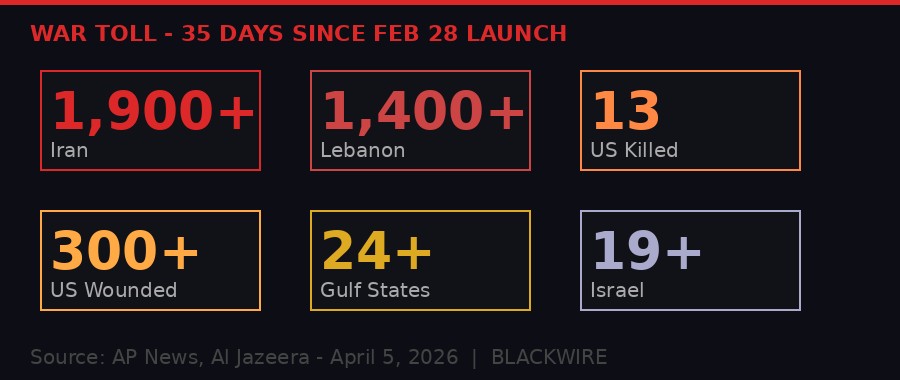
War toll at 35 days - across all parties to the conflict. Source: BLACKWIRE / AP News / Al Jazeera
The total US casualty count has now passed 300 wounded service members, with 13 dead since February 28. The dead include Army Sgt. Benjamin N. Pennington, 26, who died days after being wounded in a March 1 attack on Prince Sultan base - the first day of the war. Six of the fallen were killed in a single Iranian drone strike on an operations center at a civilian port in Kuwait. Another six died when their aerial refueling aircraft crashed in Iraq following an incident with another plane.
Iran's casualty figures are harder to verify precisely because of the internet blackout and the absence of independent monitoring organizations inside the country. AP News and Al Jazeera cite more than 1,900 killed in Iran since the war began. In Lebanon, which has been subject to resumed Israeli airstrikes targeting Hezbollah infrastructure, more than 1,400 people have been killed and more than one million displaced. More than two dozen civilians have died in Gulf Arab states and the occupied West Bank. Israel has reported 19 killed.
The Hormuz Chokepoint - Selective Exemptions and Escalating Threats
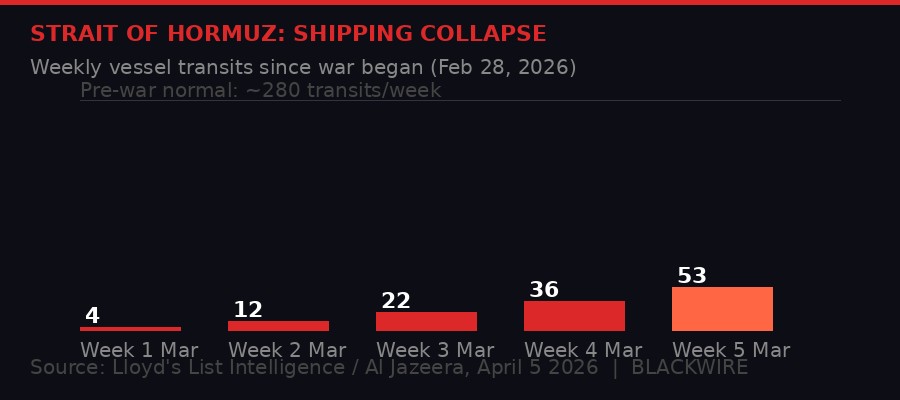
Strait of Hormuz vessel transits - from near-zero to 53 per week, still 81% below pre-war levels. Source: BLACKWIRE / Lloyd's List Intelligence
The strategic center of gravity in this conflict remains the Strait of Hormuz - the 21-mile chokepoint through which one-fifth of global oil supplies normally passes. Iran has maintained an effective blockade since February 28, and the consequences are now visible in commodity markets, energy policy, and humanitarian logistics worldwide.
The blockade is not total. Tehran has been operating what observers describe as a "de facto toll booth system" - selectively allowing certain vessels to transit while blocking or threatening others. On Saturday, Iran's Khatam al-Anbiya Central Headquarters announced that Iraqi ships would face no restrictions in the strait. The announcement praised Iraq's "struggle" against US influence and cited respect for Iraqi "national sovereignty" - language that reveals the geopolitical logic underneath the military action.
"We hold profound respect for Iraq's national sovereignty. You are a nation that bears the scars of American occupation, and your struggle against the US is worthy of praise and admiration." - Iran's Khatam al-Anbiya Central Headquarters, via Tasnim news agency (Al Jazeera)
Iran is using Hormuz access as leverage. Iraq, which has tried to stay neutral despite hosting US forces, gets a pass. Countries deemed "enemy" - effectively any nation participating in or supporting US-Israeli military operations - do not.
The numbers from Lloyd's List Intelligence show a war of attrition playing out in ship traffic. In the first week of the war, only four vessels transited the strait. By last week, that number had risen to 53 - the highest since the war began. But 53 transits per week against a pre-war baseline of approximately 280 means traffic is still running at less than 20 percent of normal. For reference, even at 53 weekly transits, a French container ship and a Japanese-owned tanker made the first apparent crossings linked to either country since February 28 - suggesting that the passage of time and commercial pressure is slowly forcing some recalibration.
Iraq's exemption is strategically significant beyond shipping. Iraq was the world's sixth-biggest oil producer in 2023, accounting for 4 percent of global supply. Iraq's Ministry of Oil announced last month that production had collapsed from 4.3 million barrels per day to 1.2 million barrels - a devastating blow to a country that depends on oil revenues for the bulk of its government budget. The Hormuz exemption, if operationally real, could begin to restore some of that capacity. Whether Iran has the practical ability to enforce a selective exemption - allowing Iraqi-flagged vessels through while blocking others in a 21-mile-wide waterway - is a separate question.
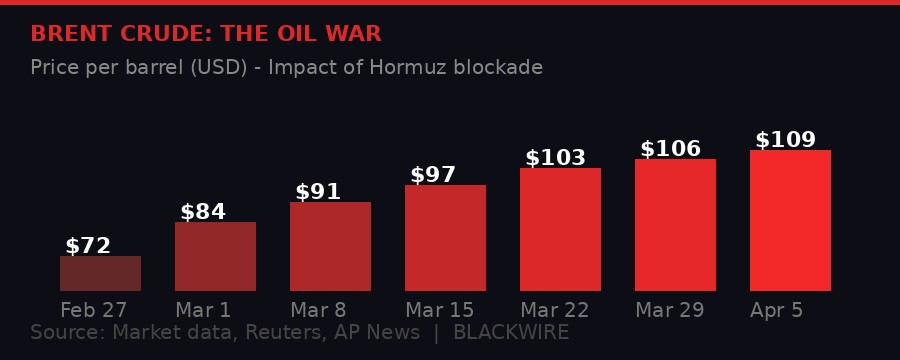
Brent crude has risen 51% since the war's first day - from $72 to $109 per barrel. Source: BLACKWIRE / Reuters / AP News
Brent crude, which sat at approximately $72 per barrel before the war, has pushed past $109 per barrel. European ministers are calling for profit caps on energy companies as fuel prices drive inflation across the continent, according to AP News. The Brent price trajectory - essentially vertical from February 28 through mid-March, then plateauing as markets priced in the "new normal" - suggests that markets have accepted $100+ oil as the equilibrium price for a war-on state.
Trump's response to Iran's Hormuz management has been a series of escalating ultimatums. Last week, he announced a 10-day deadline for Iran to either make a deal or open the strait. On Saturday, he extended and sharpened the threat.
"Remember when I gave Iran ten days to MAKE A DEAL or OPEN UP THE HORMUZ STRAIT. Time is running out - 48 hours before all Hell will reign down on them." - President Donald Trump, social media post, Saturday, via AP News
Iran's military command responded in kind. Gen. Ali Abdollahi Aliabadi threatened that "the doors of hell will be opened" if Iranian infrastructure is attacked further - and warned that all US military infrastructure in the region would be targeted in retaliation. Iran's Khatam al-Anbiya headquarters called Trump's threat a "helpless, nervous, unbalanced and stupid action."
Iran's parliamentary speaker, Mohammad Bagher Qalibaf, issued a veiled threat to disrupt the Bab el-Mandeb strait - the 20-mile chokepoint linking the Red Sea to the Gulf of Aden and the Indian Ocean. More than a tenth of seaborne global oil and a quarter of container ships pass through it. The threat may be tactical posturing - Iran's capacity to physically control a second strait simultaneously is limited - but the signal is clear: Tehran is willing to expand the economic warfare dimension of this conflict.
The US Military Buildup - Marines Arrive, More Coming
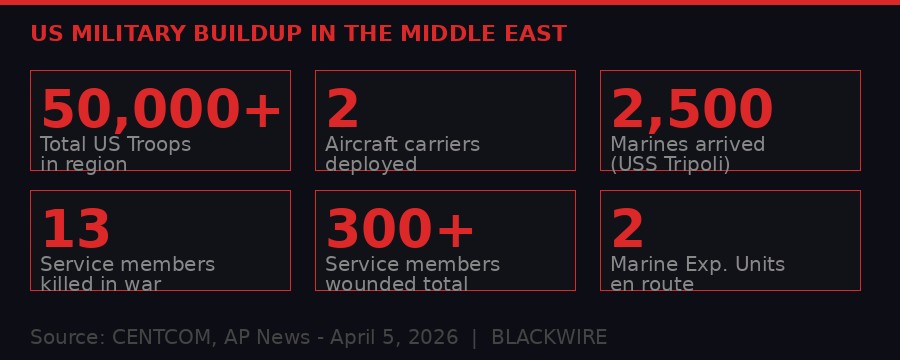
US force posture in the Middle East - the largest American military concentration in the region in over 20 years. Source: BLACKWIRE / CENTCOM / AP News
US Central Command announced Saturday that the USS Tripoli, an amphibious assault ship, has now arrived in the Middle East theater along with elements of the 31st Marine Expeditionary Unit - approximately 2,500 Marines. The Tripoli, homeported in Japan, was conducting exercises near Taiwan when the deployment order came roughly two weeks ago. The ship also carries transport and strike fighter aircraft and amphibious assault assets.
Two additional warships - the USS Boxer and companions - have been ordered to the region from San Diego along with another Marine Expeditionary Unit. When they arrive, the US Marine presence in the Middle East will represent one of the largest concentrations of amphibious assault capability in the region since the 2003 invasion of Iraq.
Secretary of State Marco Rubio insisted Friday that the United States can achieve its objectives "without any ground troops." But he simultaneously confirmed that Trump "has to be prepared for multiple contingencies" and that available forces give the president "maximum optionality" to respond to developments. The language is deliberate - hedged enough to avoid triggering domestic political opposition to a ground war, specific enough to signal to Iran that the option exists.
Before the Marine arrival, the US already had the largest military presence in the region in more than 20 years - including two aircraft carriers, several warships, and approximately 50,000 troops. The USS Gerald R. Ford, the nation's newest carrier, recently left the theater for repairs in Europe after a fire damaged sleeping quarters. Its temporary absence created a window of reduced carrier strike group coverage that CENTCOM moved to fill with the Tripoli's strike aircraft capability.
The military posture tells a story that Rubio's public statements are designed to obscure. You do not deploy 2,500 Marines on an amphibious assault ship to conduct air operations. Amphibious assault capability exists for one purpose: putting large numbers of armed people on beaches. The buildup is consistent with preparation for contingencies that extend well beyond the current air campaign - even if those contingencies are never executed.
The Humanitarian Catastrophe Nobody Can Reach
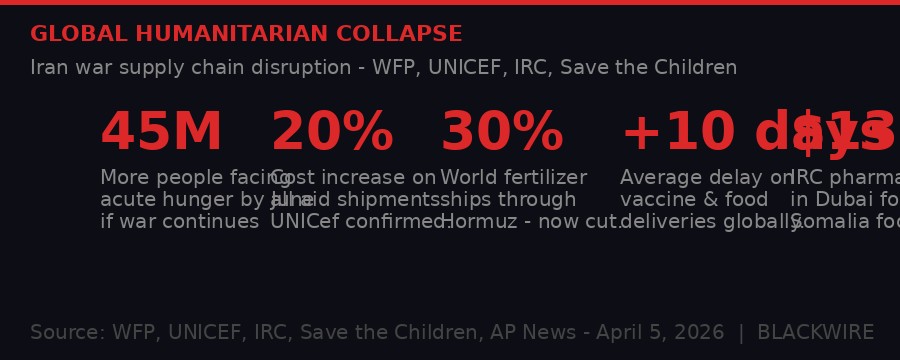
The Iran war's humanitarian shockwave - from Sudan to Somalia, 45 million more people face hunger by June. Source: BLACKWIRE / WFP / UNICEF / IRC
The Iran war's most expansive consequences are humanitarian - and they extend far beyond the borders of the conflict itself. Aid organizations operating globally are warning that the disruption to shipping routes through the Strait of Hormuz and the associated spike in fuel, insurance, and logistics costs have effectively broken the global humanitarian supply chain.
The World Food Program has tens of thousands of metric tons of food in delayed transit. The International Rescue Committee has $130,000 worth of pharmaceuticals intended for war-torn Sudan stranded in Dubai - purchased, paid for, documented, and sitting on a loading dock because the logistics chain that would normally move them no longer functions reliably. Nearly 670 boxes of therapeutic food for severely malnourished children in Somalia are stuck in India. The UN Population Fund has delayed sending equipment to 16 countries.
The United Nations describes this as the most significant supply chain disruption since COVID-19. Shipping costs have risen an average of 20 percent on affected routes. Deliveries are being rerouted around Africa's Cape of Good Hope, adding weeks to transit times. UNICEF is flying vaccines to Turkey and driving them into Iran overland - a rerouting that adds 10 days and increases costs by 20 percent.
Jean-Cedric Meeus, UNICEF's chief of global transport and logistics, told AP that before the war, UNICEF flew vaccines to Iran directly from vendors worldwide. That route no longer exists. The Turkey-to-Iran overland option is slower, more expensive, and vulnerable to the same security deterioration affecting everything else in the region.
Save the Children International, which normally ships supplies by ocean freight from Dubai to Port Sudan, now has to truck goods through Saudi Arabia and barge them across the Red Sea - adding 10 days and increasing costs by 25 percent. Over 90 primary health care facilities across Sudan risk running out of essential medicines as a direct result of these delays.
WFP's projections are stark: if the war continues through June, 45 million more people will face acute hunger - on top of the nearly 320 million already experiencing hunger worldwide. Thirty percent of global fertilizer production transits the Strait of Hormuz. With planting seasons underway across parts of Africa and South Asia, the fertilizer disruption has agricultural implications that will compound food insecurity for months after any ceasefire.
"In the end, you sacrifice either the number of children that you serve... or you sacrifice the number of items that you can afford to buy." - Janti Soeripto, President of Save the Children US, via AP News
In Nigeria, the IRC reports fuel prices surging 50 percent - with clinics struggling to power generators and mobile health teams scaling back operations. In Somalia, where 6.5 million people experience acute food insecurity, Doctors Without Borders says rising fuel costs are making it harder for people to travel to seek care. None of these are war zones. None of them are combatants. All of them are paying a price determined by decisions made in Washington, Tehran, and Tel Aviv.
The Diplomacy Track - Pakistan, Turkey, and Egypt Working Quiet Channels

Back-channel diplomacy via Pakistan, Turkey, and Egypt continues while the bombing does not pause. Source: Pexels
Behind the escalating military rhetoric, a diplomatic track is running in parallel. Pakistan's Foreign Ministry spokesperson Tahir Andrabi told AP on Sunday that Islamabad's efforts to broker a ceasefire are "right on track" - a formulation that is either reassuring or meaningless depending on your confidence in Pakistani mediation capacity.
Two regional officials confirmed to AP that mediators from Pakistan, Turkey, and Egypt are working to bring the US and Iran to the negotiating table. The proposed framework includes a cessation of hostilities that would allow a diplomatic settlement - effectively a ceasefire that neither side has to call a ceasefire, giving both governments the domestic political cover to step back from active military operations without appearing to surrender.
A Gulf diplomat briefed on the discussions told AP that the Hormuz question is central to any framework - not because it is militarily decisive, but because it provides Trump with a visible, concrete "win" that can be packaged for domestic consumption. If Iran agrees to reopen the strait as part of a ceasefire package, Trump can claim he forced Iran's hand. Iran can claim it chose to de-escalate from a position of military strength. Both governments would be lying, and both would be able to live with that lie.
China and Pakistan have also been working in parallel on diplomatic channels. Beijing's approach has been quieter but no less active, leveraging its significant economic relationship with Tehran to explore pathways to de-escalation. The multi-track nature of the diplomacy - Pakistan-led, Turkey-involved, Egypt-brokered, China-adjacent - creates both redundancy and complexity. Multiple mediators can mean multiple conflicting proposals, each reflecting different regional interests.
The practical obstacle is timing. Trump has set a 48-hour deadline that expires Monday. The Pakistani-led mediation track does not operate on 48-hour timelines. The gap between the president's social media ultimatums and the actual pace of diplomatic progress creates a structural tension: either Trump blinks on his deadline (again), or the military situation escalates before diplomacy catches up.
Previous deadlines have come and gone without the threatened military escalation materializing at the announced moment. Iran's military establishment has made similar calculations. Both sides have incentive to avoid a catastrophic escalation while maintaining the domestic appearance of resolve. The diplomatic track exists precisely because both sides are looking for a face-saving exit that doesn't require admitting they need one.
TIMELINE: 35 Days of War
What Comes Next - Escalation Mathematics and the Bab el-Mandeb Threat
The 48-hour deadline Trump has issued expires Monday morning, European time - which is also early morning Washington time and mid-afternoon in the Gulf. The question is not whether Trump will carry through on his threat in its most maximalist form - the weight of evidence from six weeks of ultimatums suggests he will not without diplomatic cover. The question is whether some intermediate escalation is now baked in to maintain credibility.
Options available to US military planners that do not constitute a full-scale naval assault on Iranian positions in the strait include: expanded strikes on Iranian missile and drone production facilities to degrade the weapons being used against Gulf infrastructure; targeted strikes on Iranian naval assets that enforce the Hormuz blockade; or a dramatic expansion of electronic warfare operations to disrupt Iranian command and control of maritime operations.
Each of these escalatory options carries Iranian counter-escalation risk. Tehran's parliamentary speaker's veiled threat against the Bab el-Mandeb is not idle posturing if read against the military logic of mutual economic destruction. Iran has fewer military assets to lose at this point than it did on February 28 - but it also has less to lose strategically. A government that has already absorbed 35 days of US and Israeli airstrikes, watched its internet get cut, and is managing an active blockade of the world's most important energy chokepoint is not in a position to back down from confrontation without a deal that preserves some form of face.
The humanitarian mathematics make this reality urgent in a way that geopolitical analysis often obscures. Every additional week of war means millions more facing hunger, thousands more displaced in Lebanon, billions in economic activity disrupted globally. The WFP's 45-million-person hunger projection assumes the war continues through June - a number that will continue to climb if fighting continues into the summer.
Against this backdrop, the information blackout - Planet Labs' satellite restrictions combined with Iran's record internet shutdown - represents more than a communications problem. It represents the systematic destruction of the evidentiary record that future accountability mechanisms will need to function. War crimes investigations require documentation. Historical understanding requires records. The decisions being made right now to blind the cameras and kill the internet will echo in legal proceedings and historical assessments for decades.
There are eyes on this war - American military satellites, Israeli intelligence systems, Iranian surveillance infrastructure, and the private information networks of Gulf states. None of those eyes are open to the public. What is burning in Iran's mountains, what is actually sinking in the Gulf, who is actually being killed and where - the definitive answers to those questions are currently locked away in classified servers accessible to governments that have strong incentives to shape whatever narrative eventually emerges.
For everyone else, this is a war you are being told about. Not shown.
Get BLACKWIRE reports first.
Breaking news, investigations, and analysis - straight to your phone.
Join @blackwirenews on TelegramSources: AP News (April 5, 2026: US aviator rescued; Iranian attack on Saudi base; Iran war humanitarian aid); Al Jazeera (April 5, 2026: Planet Labs blackout; Iran-Iraq Hormuz exemption; war liveblog); Lloyd's List Intelligence (Hormuz transit data); CENTCOM official statements; Pakistan Foreign Ministry spokesperson Tahir Andrabi; WFP, UNICEF, IRC, Save the Children humanitarian reports; regional intelligence official speaking to AP on condition of anonymity.