Phantom Contracts and Kickbacks: Inside Poland's 25-Year Court Corruption Machine
They ran it from inside a courthouse. For fifteen years, the directors, accountants, and IT heads of Poland's Krakow Court of Appeal used the machinery of justice to launder state money through shell companies and phantom IT contracts - then funneled the proceeds back to themselves as kickbacks. The final tally: 35 million zloty ($9.32 million USD) looted from a public institution whose entire purpose is to uphold the law.

The scheme ran from 2001 to 2016. It survived changes of government, EU accession, financial audits, and years of routine oversight. It was sophisticated enough to generate a paper trail, yet brazen enough to employ family members and social connections as the contractors receiving state payments. When it finally unraveled, investigators found more than 300 volumes of evidence.
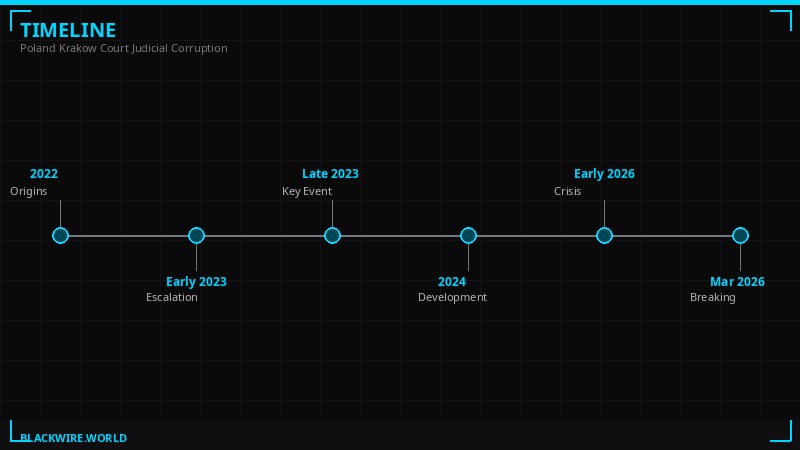
As of March 19, 2026, five more court officials were detained by Poland's Central Anti-Corruption Bureau (CBA), the latest wave in a rolling crackdown that has now yielded arrests in December 2025, February 2026, and this month. The arrests signal something prosecutors have been at pains to establish: this was not a small ring of opportunists. It was a deeply entrenched, multi-layered criminal organization embedded inside one of Poland's most important judicial institutions.
The main trial, which opened in April 2025 in the city of Rzeszow, involves 43 defendants facing 146 charges. Hearings are scheduled monthly through January 2027. It is one of the most complex criminal proceedings in Polish legal history - and it still isn't over.
KEY FACTS
- 35 million zloty ($9.32M) in estimated total losses from embezzlement scheme at Krakow Court of Appeal
- 16.5 million zloty ($4.4M) confirmed laundered through shell companies
- 57 defendants initially indicted across multiple related cases; 43 in main trial
- 146 charges including organized crime, embezzlement, money laundering, and bribery
- Scheme ran from 2001 to 2016 - spanning 15 years and multiple Polish governments
- 5 new arrests in March 2026; prior waves in December 2025 and February 2026
- 300+ volumes of evidence compiled by prosecutors
- Trial hearings scheduled monthly through January 2027
The Machine Inside the Machine
To understand how this worked, you have to understand how public procurement functions inside a large institutional bureaucracy. A court of appeal is a complex organization. It requires IT systems, consultants, maintenance contractors, administrative services. Contracts for these services flow through procurement departments. And procurement departments, in a country with imperfect oversight, are goldmines for anyone with the right access and the right connections.
According to Poland's Central Anti-Corruption Bureau, the fraud at the Krakow Court of Appeal relied on a network of fictitious consulting and IT contracts. Shell companies - entities bound to court insiders by family, social, and financial ties - were awarded regular contracts to produce analyses, studies, and IT services. The catch: the services were never actually performed.
To create the illusion of legitimate work and establish a paper trail that would survive routine inspection, the supposed tasks were reassigned to existing court employees. The state paid the outside contractors. The contractors then secretly funneled portions of that money back to the court officials who had arranged the contracts in the first place. Prosecutors call it a kickback pipeline. In practice, it was organized theft from the Polish state, run by the very officials responsible for maintaining the integrity of the justice system.
"The investigation centers on allegations of bribery, fraud, and money laundering used to siphon off public funds. The total losses linked to the broader Kraków court scandal are estimated at nearly 35 million zloty, or about $9 million." - Poland's Central Anti-Corruption Bureau (CBA), March 2026
The latest arrests - made on March 19, 2026 - targeted a deputy director, the head of the court's IT department, a chief procurement specialist, an acting deputy chief accountant, and an IT specialist. Every one of them is accused of operating as part of the same organized criminal group. This was not a lone corrupt official cutting corners. This was an institution that had been hollowed out from the inside.
The Anatomy of a Phantom Contract
The mechanics of the scheme are worth examining in detail, because they reveal a level of operational sophistication that distinguishes this from ordinary corruption. This was not officials simply siphoning money into personal accounts. It was a structured system designed to withstand scrutiny.
Step one: a shell company is created or identified, linked to the court official through family ties, friendship networks, or financial arrangements that are deliberately obscured. The company exists on paper, often with minimal activity outside its relationship to the court.
Step two: the court official in a position to authorize procurement awards the company a contract. The contract is for IT consulting, software analysis, administrative studies - services that are inherently difficult to audit because they produce intangible outputs. A document or a report is easy to fabricate. A road is not.
Step three: state funds flow from the court's budget to the shell company. The payments are logged correctly, match the contract, and pass initial financial controls.
Step four - the critical layer - existing court employees are quietly assigned to produce the actual deliverables that the shell company is supposed to provide. This is the paper trail. If an auditor asks for the consulting report, there is one. The work was done. By a salaried court employee, not the contractor, but that detail is buried.
Step five: the shell company receives the state payment, deducts its cut, and routes the remainder back to the court officials who arranged the contract. The kickback is the profit margin on a service that was never delivered by the supposed vendor.
Run this system for fifteen years, across hundreds of contracts, and the sums accumulate into millions. The CBA estimates 35 million zloty in total losses. Prosecutors have confirmed 16.5 million zloty in laundered funds - money that moved through these shell structures with deliberate intent to obscure its origin.
Who They Were: The Accused
The scale of the indictments tells its own story. When prosecutors filed the main indictment in April 2020, 57 individuals had been charged across several related cases. The defendants are not low-level functionaries. They include the Court of Appeal's former president, the former chief accountant, and a former deputy director of the Ministry of Justice's Budget Department.
That last detail is significant. The Ministry of Justice connection means the scheme extended beyond the Krakow Court of Appeal itself. A deputy director from the ministry's own budget oversight function was allegedly part of the criminal organization. The entity nominally responsible for financial control over the courts had an insider helping protect the racket.
Several private contractors are also among the accused - the owners or controllers of the shell companies who received public funds and routed kickbacks back to the officials. The prosecution presents this as a coordinated criminal enterprise spanning both the public institution and its supposed external vendors.
In a separate strand of the investigation, ten former directors of courts in Krakow and Wroclaw face charges of accepting bribes totaling 867,000 zloty ($230,826). This parallel track suggests the culture of institutional corruption was not confined to the Court of Appeal alone. It appears to have been endemic across multiple courts in the region.
"The accused include the Court of Appeal's former president, former chief accountant, and a former deputy director of the Ministry of Justice's Budget Department. Several private contractors are also among those charged." - OCCRP, reporting on the April 2025 trial opening in Rzeszow
Since the trial began in April 2025, the proceedings have already yielded a significant development: several defendants, including the judicial procurement head, have accepted plea deals. These guilty pleas do not end the main trial - they complicate it, requiring new judges to review extensive case files whenever a defendant's status changes. But they also represent the scheme's unraveling from within. People who helped build the machine are now testifying against it.

The Financial Scale: $9 Million Doesn't Sound Like Much. It Should.
By the standards of international corruption investigations - billion-dollar money laundering operations, sanctioned oligarchs moving stablecoins through crypto exchanges, sovereign wealth funds carved up by political elites - 35 million zloty might seem modest. It is not modest. It is devastating, for reasons that have nothing to do with the raw number.
This money was stolen from the operating budget of a court of appeal - a public institution that processes criminal appeals, civil disputes, and constitutional matters for millions of Polish citizens. Every zloty looted through a phantom IT contract was a zloty not spent on legitimate court operations: staffing, technology, infrastructure, legal assistance for people who cannot afford private counsel.
Courts in Poland, as in many European countries, face chronic underfunding. Backlogs are serious. Delays are routine. When OCCRP reported in April 2025 that the main Krakow trial had itself been delayed five years by pandemic restrictions and case complexity, the irony was not subtle: the judicial system was struggling to process a case about the judicial system looting itself.
The 16.5 million zloty confirmed as laundered represents money that moved through fictitious entities specifically to obscure its criminal origin. That is not administrative fraud. That is money laundering by statutory definition - a separate charge on top of the base embezzlement. The prosecution treats it as such, and the penalties reflect it.
The 867,000 zloty in bribes paid to court directors in Krakow and Wroclaw represents yet another layer. The cash reached people whose job was to supervise procurement integrity across multiple courts. Once the supervisors are compromised, the oversight function collapses. There is no backstop. The corruption self-reinforces.
How It Survived for 25 Years: The Systemic Failures
The most important question this scandal raises is not who did it, but how it ran undetected - or at least unpunished - for so long. The scheme allegedly began in 2001 and ran until 2016. That is fifteen years of active looting. The investigation that followed took another four years to produce an indictment (2020). The trial did not start until April 2025. New arrests are still happening in March 2026. The full arc of this story stretches across a quarter century.
Several systemic failures enabled this. The first is the absence of separation of duties. In the Krakow scheme, the officials awarding contracts appear to have had significant influence over the officials processing payments. When the same network controls both ends of the procurement pipeline, the internal control mechanism fails. There is no one at the payment end who is genuinely independent of the person who authorized the spending.
The second failure is the paper trail problem. The scheme was explicitly designed to generate documentation. The phantom contracts produced deliverables - because existing court employees were quietly redirected to produce them. This means routine audits, which check whether payments match contracts and whether contracts have outputs, would pass. The fraud only becomes visible when investigators look beyond the paper and ask whether the supposed contractor actually performed the work - a question that requires active investigation, not passive compliance checking.
The third failure is the contractor vetting problem. Shell companies connected to court officials by family and social ties were registered and awarded public contracts. In a well-functioning procurement system, conflict-of-interest declarations are mandatory and verifiable. The relationships in this case - family ties, social networks - suggest those declarations were either absent, incomplete, or ignored. Nobody checked whether the IT consulting firm submitting a bid was owned by the procurement director's brother-in-law.
The fourth failure is political. This scheme ran through multiple Polish governments: post-communist coalitions, Law and Justice (PiS) administrations, and Civic Platform governments. It crossed ideological lines. This was not a partisan conspiracy - it was an institutional one. The criminal organization adapted to whoever was nominally in charge by making itself invisible to the oversight mechanisms that successive governments nominally maintained.
The fifth failure is cultural. Prosecutors allege that multiple courts in the region - not just the Krakow Court of Appeal - had directors accepting bribes. When corruption is distributed across institutions, it creates mutual protection dynamics. Officials who know about each other's schemes are invested in each other's silence. Whistleblowing becomes existential risk. The culture of impunity becomes self-reinforcing.
The Trial and What Comes Next
The main trial, which opened in April 2025 in Rzeszow, now involves 43 defendants facing 146 charges. The venue change - from Krakow, where the crimes occurred, to Rzeszow - reflects the practical impossibility of holding a fair trial in the same jurisdiction whose institutions are implicated. The Polish Supreme Court declined a request to relocate the case further, but the Rzeszow setting puts physical distance between the court and the network of relationships the defendants allegedly exploited.
The three-judge panel was finalized in early 2024, following multiple reassignments necessitated by defendants pleading guilty and requiring different judicial configurations. Judge Tomasz Mucha has stated publicly that hearings are scheduled monthly through January 2027. Given that 300 volumes of evidence must be processed and 43 defendants have legal representation, that timeline may slip further.
The case has already produced guilty pleas - including from the judicial procurement head, one of the central figures in the contracting fraud. Plea deals typically come with cooperation agreements, meaning prosecutors now have insider testimony about how the scheme operated, who knew what, and where money moved. That cooperation likely underpins the continuing wave of arrests: the December 2025, February 2026, and March 2026 detentions suggest investigators are working through a list derived in part from cooperating witnesses.
The five people arrested in March 2026 - a deputy director, the IT department head, a chief procurement specialist, an acting deputy chief accountant, and an IT specialist - represent a middle layer of the organization. They are not the top-line defendants already in the main trial. They are the operational infrastructure: the people who implemented the scheme day-to-day, awarded the specific contracts, managed the fake deliverables, and processed the payments. Their arrests suggest the CBA is confident in its evidence and is working methodically through every layer of the organization.
"Thursday's detentions are not an isolated crackdown. The CBA noted that this specific investigative strand has already yielded a steady drumbeat of arrests in December, February, and March." - OCCRP, March 19, 2026
The separate proceedings against ten former directors of courts in Krakow and Wroclaw run parallel to the main trial. Those defendants face charges of accepting bribes totaling 867,000 zloty. If convicted, they would face sentences for bribery and abuse of public office - lesser charges than the organized crime counts in the main case, but still significant for individuals who held positions of institutional trust.
Why This Matters Beyond Poland
The Krakow court corruption scandal is a Polish story, but its implications reach further. It demonstrates with forensic clarity how public procurement fraud operates inside institutions that are supposed to be beyond reproach - and what it takes for that fraud to finally reach accountability.
The pattern is replicable anywhere that procurement systems lack genuine separation of duties, where contractor vetting is performative rather than substantive, and where the officials who award contracts also influence the officials who process payments. Shell companies, fake consulting contracts, phantom IT deliverables, and kickback pipelines are not uniquely Polish innovations. They are standard tools of institutional corruption worldwide.
What is unusual about the Krakow case is the scale of the eventual legal response. Fifty-seven defendants. One hundred forty-six charges. Proceedings running from 2020 through at least 2027. This is not a case that was quietly settled or prosecuted selectively. It is a comprehensive attempt to dismantle a criminal organization root and branch - including the people who built it, the people who ran it, and the people who facilitated it one phantom invoice at a time.
Poland's anti-corruption bureau (CBA) was established in 2006, five years after this scheme began. Its creation was partly a response to exactly this kind of embedded institutional fraud. The fact that the Krakow scheme ran for another decade after the CBA's founding, before investigators finally unraveled it, is a reminder that institutional anti-corruption bodies are necessary but not sufficient. The fraud had already adapted to survive a more alert environment by the time the CBA came into existence.
The scheme's longevity also forces a question about systemic integrity that goes beyond any individual institution. If a court of appeal - the specific kind of institution whose purpose is to review decisions for procedural and legal correctness - can host a decade-and-a-half criminal enterprise without detection, then the oversight mechanisms that are supposed to prevent exactly this kind of abuse need to be re-examined from the ground up.
The European Union has placed increasing pressure on Poland over the past decade regarding judicial independence and rule of law. The Krakow corruption scandal adds a different dimension to that conversation: not just whether courts are politically independent, but whether they are internally honest. An independent court that is simultaneously running a kickback scheme is not delivering justice. It is delivering the appearance of justice while looting the public it is supposed to serve.
As the trial grinds through its monthly hearings toward a projected conclusion in early 2027, Poland's judiciary has a rare opportunity to demonstrate that accountability applies to itself. The early guilty pleas and the continuing arrests suggest the prosecution is serious. What remains to be seen is whether the sentences, when they come, match the severity of crimes committed by people who spent fifteen years using the prestige and authority of the justice system as cover for organized theft.
The defendants had access to something most criminal organizations never get: the institutional credibility of the courts themselves. They used it to sanitize fraud, generate paper trails, and evade detection. The reckoning now unfolding in Rzeszow is, among other things, an attempt to remove that credibility advantage permanently - and to establish that the courts belong to the people they serve, not to the officials who happen to run them.
Get BLACKWIRE reports first.
Breaking news, investigations, and analysis - straight to your phone.
Join @blackwirenews on TelegramSources: OCCRP (March 19, 2026 and April 24, 2025 reporting); Poland's Central Anti-Corruption Bureau (CBA), March 2026 press release; Rzeszow District Prosecutors Office; Polish news outlet Rzeczpospolita; Polish Supreme Court records (III KO 95-24); CBA English-language release on court director bribes (2024); U.S. Treasury OFAC sanction on Babak Zanjani (January 2026, for comparative sanctions context). All financial figures converted from zloty at approximate USD rate of 0.267.