Besieged: Nevada Bans Coinbase, Washington Sues Kalshi, and the Industry Raises $2 Billion Anyway
Three states attacked prediction markets this week. Two got injunctions. Kalshi is worth $22 billion, just cleared margin trading, and is filing to move every case to federal court. The Supreme Court is coming.

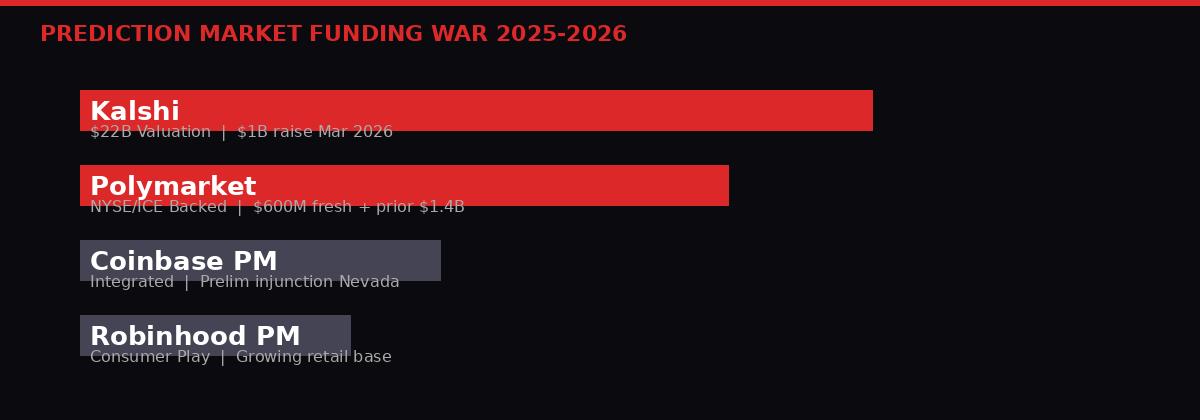
The week ending March 28, 2026 was supposed to be a triumph for prediction markets. Kalshi closed a $1 billion funding round at a $22 billion valuation. The Intercontinental Exchange - the company that owns the New York Stock Exchange - pumped another $600 million into rival Polymarket, bringing its total commitment to nearly $2 billion. A federal affiliate of Kalshi secured a futures commission merchant license, clearing the runway for margin trading aimed at institutional clients.
Then the states showed up.
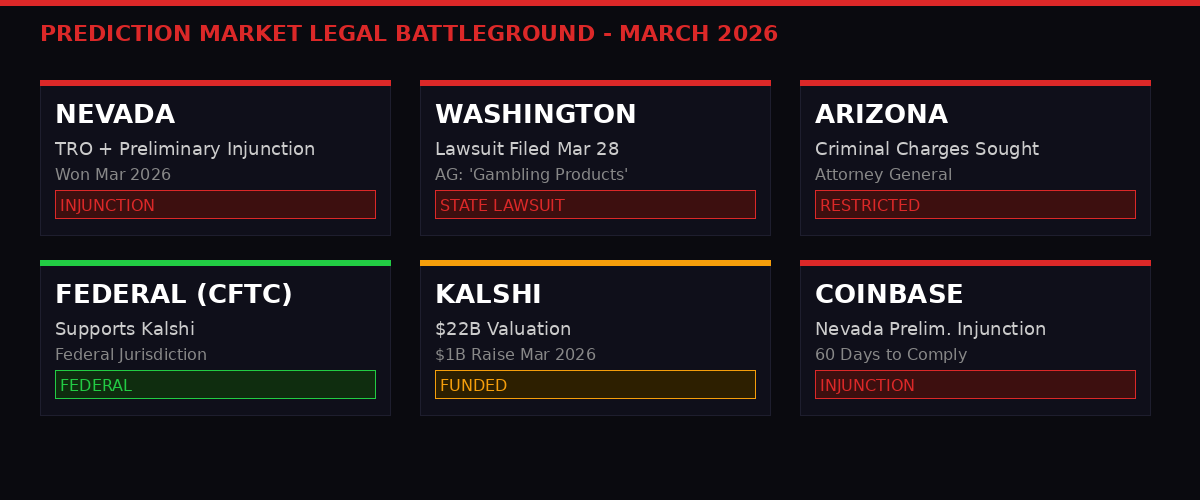
Nevada secured a preliminary injunction against Coinbase on Thursday, forcing the company to stop offering sports, election and entertainment prediction contracts - the exact same products it runs through its Kalshi partnership. Washington state filed a full lawsuit against Kalshi on Friday, with Attorney General Nicholas Brown calling the platform's products gambling dressed in financial terminology. That brings the active state legal assault to at least three jurisdictions in under two weeks.
Both companies are fighting back the same way: filing immediately to move every case to federal court, where the Commodity Futures Trading Commission has staked out a clear position that these are regulated derivatives, not gambling. That fight - state gambling law versus federal commodities jurisdiction - is almost certainly headed to the U.S. Supreme Court. The only question is how much capital Kalshi burns getting there.
Washington's Friday Lawsuit: Gambling in a Suit and Tie

Washington Attorney General Nicholas Brown did not send a warning letter. He filed a complaint directly, and the framing was brutal. "Kalshi's website and app show consumers a range of events that they can bet on and the odds for those various events, which dictate how much the bettor will be paid out if the event occurs," the state's press release read. "This is exactly how sportsbooks and other gambling operations function."
The 30-page complaint alleges that Kalshi's activities meet state definitions of "gambling," "professional gambling," and "bookmaking." It includes a count claiming the platform promoted gambling addiction and specifically targeted college students. Washington bans online gambling in full - no carve-outs, no gray zone. In the AG's reading, Kalshi is a sportsbook that learned to speak derivative.
Kalshi's response was sharp. The company's head of communications, Elisabeth Diana, told CoinDesk that if the AG "hadn't sued us ahead of our scheduled meeting with him, he would have known better than to say we offer war markets. We don't." The complaint referenced Iran War event contracts; Kalshi says that specific product does not exist on its platform. The only Iran-adjacent contract it offers relates to when the country's former Supreme Leader exits office - a political transition bet, not a military prediction.
"As other courts have recognized, Kalshi is a regulated, nationwide exchange for real-world events, and it is subject to exclusive federal jurisdiction. It's very different from what state-regulated sportsbooks and casinos offer their customers." - Elisabeth Diana, Head of Communications, Kalshi (CoinDesk, March 28, 2026)
Kalshi filed to move the Washington case to federal court the same day it was served, citing ongoing federal litigation in other jurisdictions. The argument is straightforward: if the CFTC regulates event contracts as derivatives, states cannot simultaneously criminalize them as gambling. One regulatory regime must win. Kalshi is betting on federal supremacy.
Washington and Nevada are both in the Ninth Circuit Court of Appeals. That means whatever happens in those districts will be heard by the same appellate court, and both cases could arrive at the Supreme Court bundled together. For Kalshi's lawyers, the legal geography is actually favorable. A single circuit split on whether event contracts are federally preempted derivatives or state-regulated gambling resolves faster than a patchwork of fifty individual state battles.
Nevada's Second Strike: Coinbase Gets the Injunction

Nevada had already won a temporary restraining order against Kalshi in late March, forcing the company to remove sports, entertainment and election contracts from its Nevada user base for at least two weeks. On Thursday, March 26, the same state secured a second preliminary injunction - this time against Coinbase.
Nevada District Judge Kristin Luis wrote that Coinbase did not dispute it offered "event-based contracts" that relate to sporting and other events including college basketball games, college and professional football games, and elections. That language meets Nevada's definition of "sports pools," which the state regulates under its gaming commission framework. The judge gave Coinbase 60 days to "make technological enhancements" to comply.
The Coinbase case is structurally important because it reveals the Kalshi partnership's vulnerability. Coinbase is not operating its own prediction market - it is running Kalshi's event contracts through its interface as part of a distribution deal. Nevada's injunction against Coinbase is therefore a second bite at the same apple: if you cannot stop Kalshi directly due to federal preemption arguments, you target its distribution partners.
Kalshi's Nevada hearing on its own restraining order is set for April 3 - six days away. A Nevada state judge will decide whether to extend or lift the restriction. Trade publication Gambling Insider reported that some Kalshi users in Nevada were still accessing the platform after the restraining order went into effect, suggesting either a technical compliance lag or deliberate non-enforcement. That detail is likely to come up at the April 3 hearing.
The Institutional Counteroffensive: Margin, $22 Billion, and NYSE Money
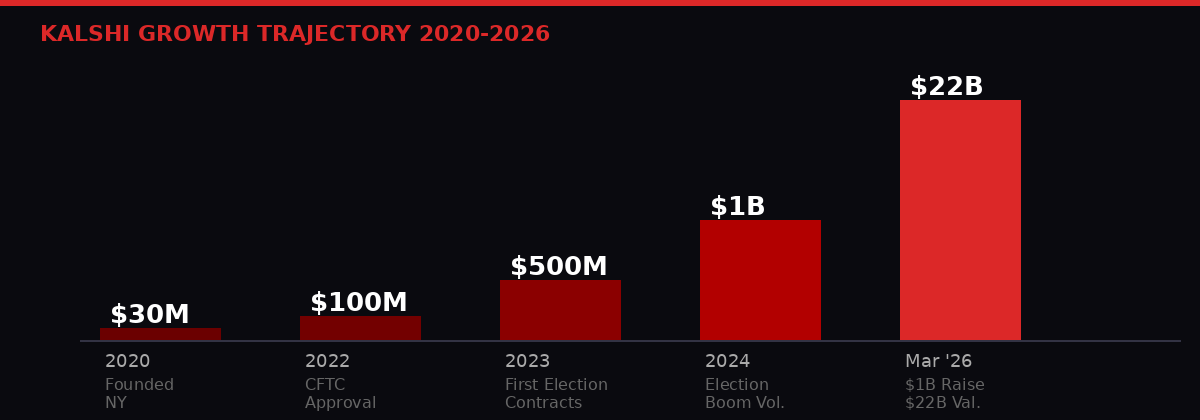
While state regulators filed paperwork, the capital markets were sending a different signal. Kalshi's $1 billion raise, announced March 12, valued the company at $22 billion - double its previous valuation. That is not the fundraise of a company retreating. That is the fundraise of a company that believes it is about to win the largest regulatory arbitrage bet in modern financial history.
On the same Friday that Washington filed its lawsuit, a Kalshi affiliate called Kinetic Markets received NFA registration as a futures commission merchant - the license class that allows offering margin trading to institutional clients. Traditional prediction markets require fully collateralized positions: you put up $100 to win $200. Margin changes that. Institutional players could open positions with far less upfront capital, accessing prediction market liquidity the way hedge funds access commodity futures.
Before margin goes live, Kalshi still needs CFTC sign-off on rule changes enabling undercollateralized positions. But securing the NFA registration is step one in a process that, if completed, transforms Kalshi from a retail prediction platform into an institutional derivatives venue. That is a different business entirely, and it is the business that justifies a $22 billion valuation when the company is being sued in three states simultaneously.
The Intercontinental Exchange is running a parallel play through Polymarket. ICE owns the New York Stock Exchange and operates global futures and commodities markets. Its initial Polymarket investment was $1.4 billion. The $600 million top-up announced March 27 brings the total to approximately $2 billion. ICE does not make $2 billion bets on gambling platforms. It makes them on financial infrastructure that it believes will eventually clear through regulated derivatives frameworks it already operates.
"If AG Brown hadn't sued us ahead of our scheduled meeting with him, he would have known better than to say we offer war markets. We don't." - Elisabeth Diana, Kalshi Communications (March 28, 2026)
The combined institutional signal - $22B Kalshi valuation, $2B ICE into Polymarket, NFA margin license - is telling a story that directly contradicts the state-level narrative. Gambling regulators are saying "this is sports betting in a spreadsheet." The market is saying "this is the next futures exchange and we are paying accordingly."
The Federal vs. State Framework Clash: How This Gets Resolved

The legal architecture here matters, and it is worth laying out precisely.
Kalshi operates as a Designated Contract Market under the Commodity Exchange Act - the same regulatory category as the Chicago Mercantile Exchange. CFTC Chair Mike Selig has publicly stated that event contracts listed on DCMs are federally regulated derivatives and subject to exclusive federal jurisdiction. Under the Supremacy Clause of the U.S. Constitution, federal law preempts state law when the two conflict.
State gambling regulators disagree. Their argument: the Commodity Exchange Act's preemption provisions cover financial derivatives, not bets on whether a football team covers the spread or whether an incumbent wins an election. The economic form of a prediction market contract - binary outcome, odds-based payoff, real-world event trigger - is functionally identical to a sports bet. Calling it a "derivative" does not change what it is.
Both sides have a point. The CFTC's DCM designation was built for contracts on commodity prices, interest rates, and currency exchange rates - instruments with clear economic hedging value. Whether a contract on "when Iran's Supreme Leader leaves office" constitutes a commodity derivative that deserves federal preemption protection is genuinely unclear. No court has definitively answered it.
That ambiguity is exactly why multiple federal judges have let state restraining orders proceed. A temporary restraining order is not a merits ruling. It is a finding that states have raised questions serious enough that status quo should be preserved while the legal argument plays out. But as those cases escalate toward circuit court review, the constitutional question gets forced. Can a state ban a CFTC-regulated instrument? If the Ninth Circuit says yes, prediction markets have fifty different regulatory regimes to navigate. If it says no, Nevada and Washington lose their entire enforcement framework.
Legal experts who spoke to CoinDesk estimate the Supreme Court path is likely. The revenue at stake - Polymarket alone did over $10 billion in trading volume during the 2024 election cycle - makes this worth litigating all the way up. Kalshi and Polymarket have the capital to do it. The states have the political will. The only institution that can end the standoff is one that neither side controls.
The David Sacks Exit: Who Owns Crypto Policy Now?

The same week the prediction market war escalated, the man most responsible for the Trump administration's crypto policy direction quietly changed titles.
David Sacks, designated White House AI and Crypto Czar before Trump took office in January 2025, announced Thursday he was joining the President's Council of Advisors on Science and Technology as co-chair. The Czar role is gone. He told Bloomberg the technical reason: his position was classified as a "special government employee," legally limited to 130 working days. Democrats had raised concerns last fall that he had already exceeded that limit.
PCAST's mandate is broader - recommendations on AI, quantum computing, nuclear power. Sacks notably did not mention crypto in his Bloomberg interview when describing the council's focus areas. That silence matters at a moment when the GENIUS Act stablecoin legislation is moving through Congress, the crypto market structure bill is in process, and three states are litigating whether prediction markets can exist at all.
The practical power shift is significant. The Czar role gave Sacks direct White House convening authority to push crypto legislation and coordinate regulatory agencies. PCAST is an advisory body. It publishes recommendations. It does not direct the CFTC to issue position papers on DCM preemption or call Senators to move market structure bills out of committee.
The PCAST roster does signal something about where White House tech priorities are clustering. Members include Marc Andreessen, Sergey Brin, Michael Dell, Jensen Huang, Lisa Su, Mark Zuckerberg, and Fred Ehrsam (early Coinbase backer). That is one of the highest-density collections of private sector technology power ever assembled in a formal government advisory role. Whether it translates into concrete crypto regulatory outcomes in the next 12 months is the open question.
For prediction markets specifically, the Sacks exit creates a potential leadership vacuum. His office had been the clearest voice inside the administration for treating crypto-native financial products as legitimate derivatives rather than gambling. Without that voice in a direct operational role, the state attorneys general have slightly more room to run. Not unlimited room - the CFTC's position has not changed - but a quieter White House is a different environment than an active one.

Bitcoin's Macro Context: The Rate Cut Collapse
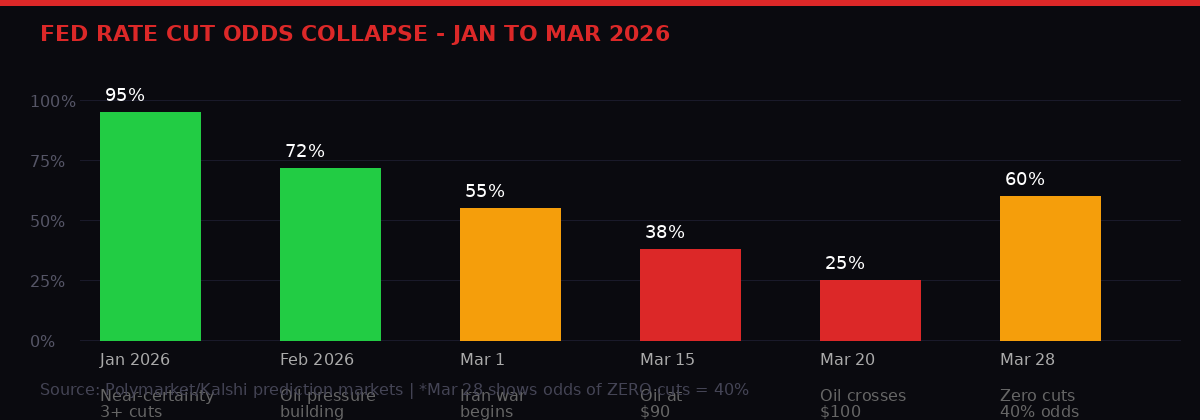
All of this plays out against a crypto market that has been unwinding for months. Bitcoin is at $66,369 as of Friday, down 23.7% year-to-date. The macro kill shot was a double hit: oil crossed $100 per barrel on the back of U.S.-Iran conflict choking Hormuz shipping lanes, and the inflation expectations surge that followed knocked the legs out of the Federal Reserve rate cut narrative.
In January 2026, prediction markets priced Federal Reserve rate cuts as near-certainty - over 95% odds of at least one cut by year end. As of March 28, traders are now pricing a nearly 40% probability of zero cuts. That is a complete reversal of the monetary policy environment that fueled the 2024-2025 crypto bull run.
Asset manager Bitwise published analysis Friday arguing that bitcoin has actually already absorbed this repricing. Luke Deans, senior research associate, noted that the Mayer Multiple - which compares spot price to the 200-day moving average - has been sitting in the lower percentiles of its historical range since January. Bitcoin, unlike equities, began repricing tighter monetary conditions before the macro catalysts hit. S&P 500 is only down 8% from its highs. Bitcoin is down nearly 24% from its late-2025 peak.
"Bitcoin, a highly reflexive and liquidity-sensitive asset, typically responds earlier to shifts in risk appetite. This suggests that digital assets began reflecting tighter financial conditions ahead of many traditional risk assets." - Luke Deans, Senior Research Associate, Bitwise (CoinDesk, March 28, 2026)
The implication, if Bitwise is right, is that the downside from here is more limited for bitcoin than for stocks. Equities entered 2026 at elevated valuations and are only beginning to reprice. Bitcoin entered 2026 already in a compression regime. Whether that compression turns into a bounce depends on one variable the market cannot control: whether oil stays above $100, and whether that price persists long enough to make zero Fed cuts the base case rather than the tail risk.
For prediction markets, the macro environment is actually an argument for their utility. When nobody knows what the Fed does next, when oil price trajectories depend on military outcomes, when election results reshape trade policy overnight - the case for event-based derivatives strengthens. The question of "who gets to run them" is getting answered in courtrooms across America right now.
Canada Closes the Loop: Crypto Banned From Elections Globally
While the U.S. prediction market war dominated the week's financial policy headlines, a quieter regulatory move in Canada signals a separate front in the global crypto-elections intersection.
Ottawa introduced Bill C-25, the Strong and Free Elections Act, on March 26. The bill would ban cryptocurrency donations to political parties, candidates, riding associations, and third-party advertisers. It follows a near-identical UK announcement the same week, where Prime Minister Keir Starmer's government issued an immediate moratorium on crypto donations to political parties, citing foreign money laundering risks.
Canada's bill is not responding to a documented abuse. No major federal party has publicly accepted crypto donations since they were technically permitted under a 2019 administrative framework. No crypto contributions appeared in the 2021 or 2025 elections. But Canada's Chief Electoral Officer had been pushing for an outright ban since November 2024, after years of recommending "tighter regulation" had not resolved concerns about crypto's pseudo-anonymity in contribution tracking.
The bill is the second attempt. Its predecessor, Bill C-65, contained identical provisions but died when Parliament prorogued in January 2025. Bill C-25 is now at first reading in the House of Commons. Recipients who receive prohibited crypto contributions get 30 days to return, destroy, or convert them. Maximum penalties reach double the contribution value plus a $100,000 corporate fine.
The UK-Canada coordination is not coincidental. Both governments are allied in the broader push to regulate digital asset flows in democratic political systems, and both cited similar concerns - the difficulty of verifying the origin of pseudonymous blockchain transactions in contexts where foreign influence is illegal. The U.S. remains an outlier: crypto donations to federal campaigns have been permitted since 2014 under FEC guidance.
The irony in timing is sharp. Canada and the UK move to ban crypto from elections. The U.S. runs a functioning prediction market on elections that is simultaneously being sued as illegal gambling. The same underlying technology - blockchain-based value transfers and event contracts - faces radically different regulatory treatment within the same 30-day window.
What Happens Next: The Four Scenarios

The prediction market war is not resolving this week or next month. It resolves through one of four paths, and each has a different winner.
Scenario A: Federal Courts Win Fast. Kalshi and Coinbase successfully remove all state cases to federal court. District courts rule that the Commodity Exchange Act preempts state gambling laws for CFTC-regulated DCMs. States appeal to the Ninth Circuit, lose, and the Supreme Court declines to hear the case, letting the federal preemption precedent stand. Prediction markets operate nationally. Kalshi's margin trading expansion proceeds. This is Kalshi's preferred path and the most capital-efficient outcome.
Scenario B: States Win in the Ninth Circuit. Federal district courts allow state regulations to stand, finding that the Commodity Exchange Act's preemption scope does not extend to sports and election contracts. Kalshi operates only where state gambling frameworks permit event contracts. That may mean operation in thirty states and prohibition in twenty. A messy but survivable outcome that forces state-by-state licensing and product restriction - adding significant compliance cost but not eliminating the business.
Scenario C: Congress Acts First. The Trump administration, with or without Sacks in the Czar role, moves a narrow federal preemption provision through the crypto market structure legislation currently in process. This explicitly codifies prediction market federal jurisdiction and strips states of authority to ban CFTC-regulated event contracts. The political coalition for this exists - crypto donors, tech VCs, libertarian-leaning Republicans. Whether it survives the legislative calendar with a DHS shutdown in its 44th day and a partial Iran war consuming bandwidth is the constraint.
Scenario D: Supreme Court Decides. Circuit splits develop between the Ninth Circuit and another appeals court. The Supreme Court accepts a petition and rules definitively. This is the longest timeline - two to four years minimum - but also the most permanent resolution. Given the stakes ($22 billion valuation, $2 billion NYSE-parent capital commitment, multi-billion-dollar tax revenue potential), every actor has the incentive to litigate all the way.
The probability market on this conflict - if one existed in a jurisdiction where it was legal - would likely price Scenario D as the base case with about 50-55% probability. A near-term federal court victory for Kalshi gets maybe 25%. Congressional action gets 15%. States winning cleanly gets 10% and mostly reflects a failure of Kalshi's legal strategy rather than regulatory merit.
For traders, the near-term read is simpler than the legal architecture. Prediction market volume does not stop during litigation. Polymarket processed tens of billions in contracts during the 2024 election cycle regardless of regulatory uncertainty. Kalshi's core user base does not monitor NFA filings. The platform keeps running, the legal fees keep accumulating, and the institutional backers keep writing checks - because the alternative, letting state gambling commissions define the future of financial derivatives, is a price worth fighting.
Bitcoin at $66,000 with the Fed trapped between $100 oil and a slowing economy, prediction markets generating billions in volume on the exact same variables, and the regulatory framework governing both still undecided - that is the market structure you are navigating right now. The outcome of the April 3 Nevada hearing will say more about the next twelve months than any Fed statement.
Get BLACKWIRE reports first.
Breaking news, investigations, and analysis - straight to your phone.
Join @blackwirenews on TelegramSources
CoinDesk - "Washington sues Kalshi as states ramp up legal pressure against prediction markets" (March 28, 2026)
CoinDesk - "Kalshi secures license to offer margin trading to institutional investors" (March 28, 2026)
CoinDesk - "Why bitcoin's 'compressed' valuation offers reduced downside risk versus stocks" (March 28, 2026)
CoinDesk - "Canada moves to ban crypto donations for election campaigns following UK" (March 28, 2026)
CoinDesk - "White House crypto czar David Sacks transfers to presidential advisory committee role" (March 26, 2026)
CoinDesk - "NYSE owner doubles down on Polymarket with fresh $600 million investment" (March 27, 2026)
Washington AG Office - Complaint against Kalshi (March 28, 2026)
National Futures Association - Kinetic Markets FCM registration filing
Nevada First Judicial District Court - Coinbase preliminary injunction order (March 26, 2026)
Parliament of Canada - Bill C-25 Strong and Free Elections Act (March 26, 2026)
Polymarket / Kalshi - Prediction market rate cut probability data (March 2026)
Bitwise - Rate cut and bitcoin valuation research note (March 28, 2026)