America's Newest Missile Made Its Combat Debut at a Sports Hall Full of Teenagers

A New York Times investigation, corroborated by Middle East Eye and BBC Verify analysis, has confirmed that the weapon system responsible for the Lamerd sports hall strike was the PrSM - a short-range ballistic missile built by Lockheed Martin to replace the aging ATACMS system that has been in service since the first Gulf War. The PrSM was designed to detonate above its target and blast thousands of small tungsten pellets outward in a lethal cone of fragmentation. Photographs from the scene show the sports hall's playground surface peppered with the distinctive pockmark pattern this warhead produces.
The confirmation, published March 30, represents a significant development in the accountability questions surrounding the opening hours of the US-Israeli war on Iran. It marks the first time the United States has used the PrSM in any combat environment - and the first confirmed civilian mass casualty event directly attributable to the weapon system.
Iran's representative to the United Nations, Amir Saeid Iravani, told the General Assembly that the sports hall was hosting a girls' volleyball training session when the missile struck. Dropsite News separately reported "chaos" at the facility, where young girls had been attending athletic training. Iran's state news agency IRNA placed the death toll at 21.

What Is the Precision Strike Missile
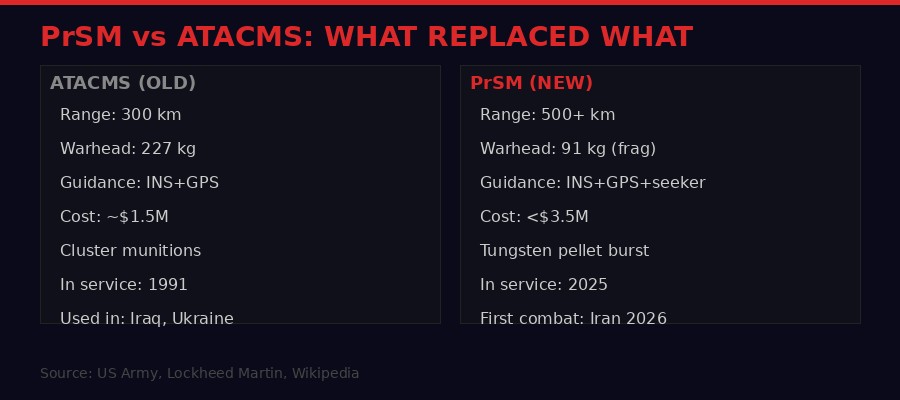
The PrSM is the US Army's next-generation tactical ballistic missile, developed by Lockheed Martin Missiles and Fire Control to replace the MGM-140 Army Tactical Missile System (ATACMS) that has been the backbone of American long-range precision fires since 1991. The program began in 2016 when Lockheed Martin, Boeing, and Raytheon competed for the Long Range Precision Fires contract. Boeing and Raytheon dropped out by 2020, leaving Lockheed as the sole developer.
The missile is 4 meters long, 430 millimeters in diameter, and carries a 200-pound high-explosive fragmentation warhead. Its guidance system combines inertial navigation with GPS. It launches from the M142 HIMARS and M270 MLRS platforms - the same launchers that became household names during Ukraine's 2022-2023 counteroffensive. The key difference from its predecessor: the PrSM is thinner and sleeker, allowing two missiles per pod instead of one, effectively doubling the firepower of each launcher.
The weapon's range exceeds 500 kilometers (310 miles), a significant improvement over the ATACMS. Following the US withdrawal from the Intermediate-Range Nuclear Forces Treaty, plans are underway to extend the PrSM's reach to 1,000 kilometers using ramjet technology. Australia signed on as a development partner in 2021, contributing $54 million to the Increment 2 program, which adds anti-ship targeting capability through a multi-mode seeker.
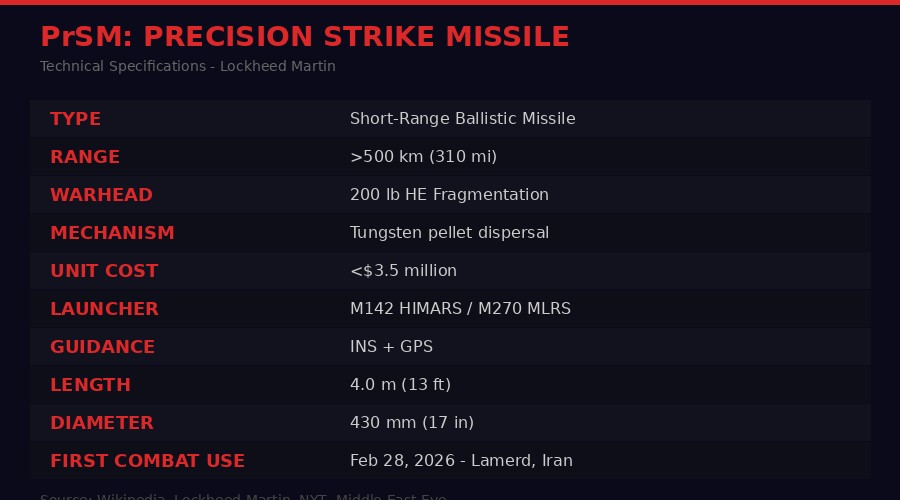
The warhead is the critical detail in the Lamerd context. Unlike conventional blast warheads that destroy through concussive force, the PrSM's fragmentation warhead is designed to detonate just above its target - an airburst detonation - and spray thousands of small tungsten pellets outward in a lethal cone. Against military vehicles, radar installations, or air defense batteries, this mechanism is devastatingly effective. Against a sports hall full of teenagers, it produces a very specific kind of carnage.
The first production batch was delivered in December 2023. The missile's first confirmed combat use came on February 28, 2026 - the opening day of the US-Israeli war on Iran. US Central Command subsequently released images showing M142 HIMARS launchers employing PrSM against Iranian targets, confirming operational deployment. The weapon had never been tested in combat before Lamerd.
The Lamerd Strike: What Happened on February 28
Lamerd is a city in Fars Province, southern Iran, with a population of roughly 55,000. It sits approximately 200 kilometers southeast of Shiraz and is nowhere near the major military-industrial targets that dominated the opening wave of US-Israeli strikes - the nuclear facilities at Natanz and Isfahan, the IRGC command centers in Tehran, the oil terminal at Kharg Island. Lamerd's military significance, to the extent it has any, derives from the presence of an IRGC base in the area.
On the evening of February 28, 2026 - the first day of the US-Israeli war - at least two strikes hit the Lamerd area. Video footage verified by the New York Times shows explosions consistent with PrSM detonations. The first strike hit the IRGC base. The second struck a sports hall adjacent to an elementary school, where a girls' volleyball training session was in progress.
Iran's state media reported 21 dead. Iran's UN representative specified that the sports hall was being used by a girls' volleyball team at the time of impact. The playground outside the facility was photographed extensively in the aftermath, showing a surface covered in small, regular impact marks - the signature of a tungsten pellet warhead detonating at altitude and spraying fragments downward.

The New York Times investigation, published on March 30, brought together military weapons experts who analyzed the damage patterns, the video footage, and the physical evidence. Their conclusion: the damage was consistent with the Precision Strike Missile, and specifically with its tungsten pellet fragmentation warhead. No other weapon in the US arsenal produces the same damage signature.
The NYT report did not determine whether the strike on the sports hall was intentional, the result of targeting error, or caused by a design flaw. The newspaper noted that the sports hall is clearly identifiable as a civilian structure on both Google Maps and Apple Maps. It sits next to an elementary school. The IRGC base is nearby, but distinct and separately identifiable on satellite imagery.
The US military has not issued a specific response to the PrSM identification. The broader Lamerd-area strikes were previously characterized by US officials as targeting IRGC infrastructure. The Pentagon did not address why a fragmentation warhead designed for area-effect kills was employed in proximity to a civilian athletic facility.
Pattern of Civilian Strikes: Lamerd in Context
The Lamerd sports hall strike was not an isolated incident on February 28. On the same day, at roughly the same time, a separate US strike hit a girls' school in Minab, a city approximately 500 kilometers to the east in Hormozgan Province. That strike killed at least 165 people - the majority of them girls between seven and twelve years old. BBC Verify's expert video analysis later confirmed that a US Tomahawk cruise missile hit a military base adjacent to the school, with the school itself sustaining catastrophic blast damage.
The Pentagon investigated the Minab strike and concluded that the US military was responsible. The weapon used was a Tomahawk - a very different system from the PrSM, but the tactical scenario was strikingly similar: a military target adjacent to a civilian facility, struck with insufficient regard for the proximity of children.
President Trump attempted to deflect responsibility for the Minab strike by falsely claiming that Iran also uses Tomahawk missiles. Iran does not possess Tomahawk missiles. The weapon is manufactured exclusively by Raytheon for the US Navy and Royal Navy. Trump's claim was widely debunked within hours.

The pattern is relevant. Two strikes on the same day. Two facilities serving children. Two different weapon systems - Tomahawk and PrSM. Two different provinces. The Minab strike killed 165. The Lamerd strike killed 21. Combined: 186 people, the vast majority of them children, killed within hours of the war's first shots in strikes on or adjacent to facilities that were identifiable as civilian on commercial mapping services.
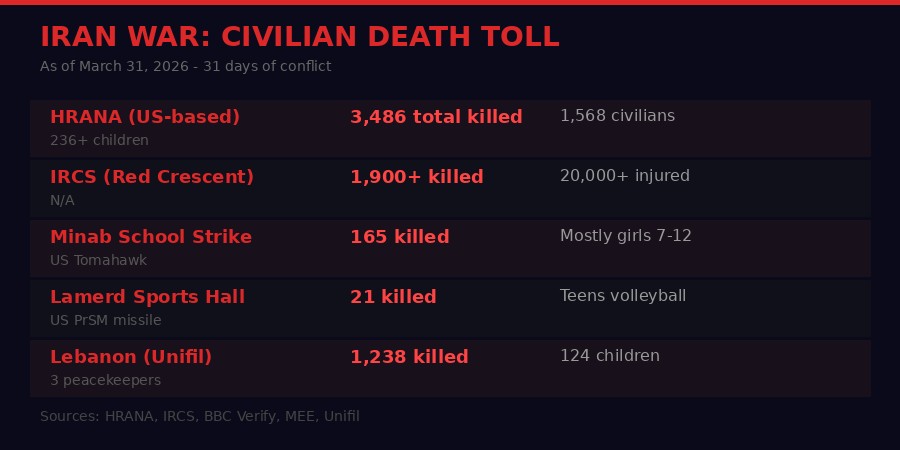
As of March 29, the US-based Human Rights Activists in Iran (HRANA) reported 3,486 people killed in Iran since the war began, including 1,568 civilians, of whom at least 236 were children. The International Federation of Red Cross and Red Crescent Societies cited Iranian Red Crescent figures of more than 1,900 killed and 20,000 injured. The discrepancy between these figures reflects the difficulty of conducting casualty counts in an active war zone with severely restricted internet connectivity and limited access for international journalists.
In Lebanon, where Israel opened a separate front against Hezbollah on March 2, the health ministry reported 1,238 people killed including 124 children as of March 29. Three UN peacekeepers from Indonesia were killed in southern Lebanon on March 29-31 in two separate incidents that Unifil said it was investigating. Four Israeli soldiers were also killed in combat in southern Lebanon on March 31.
The Weapons Forensics: How the PrSM Was Identified
Weapons forensics in modern warfare relies on a combination of debris analysis, damage pattern recognition, video signature matching, and open-source intelligence. The PrSM identification at Lamerd followed this methodology precisely.
The tungsten pellet warhead produces a distinctive impact pattern when it detonates at altitude. Unlike a unitary blast warhead, which creates a single crater and radiating blast damage, the PrSM's fragmentation mechanism sprays pellets downward and outward in a cone. When these pellets strike flat surfaces - concrete, asphalt, packed earth - they create hundreds of small, uniformly-sized impact marks arranged in a roughly circular pattern. This is the pattern photographed at the Lamerd sports hall's playground.

The video evidence provided a second confirmation vector. PrSM launches and detonations produce a specific visual signature that is distinct from Tomahawk cruise missiles, JDAM-guided bombs, or standard artillery. The missile's terminal velocity and airburst detonation create a flash pattern that military analysts can distinguish from other weapons. Two separate strike videos from Lamerd, verified by the New York Times, showed detonation signatures consistent with PrSM employment.
A third confirmation came from US Central Command itself. In March 2026, CENTCOM released operational imagery showing M142 HIMARS launchers employing PrSM missiles against Iranian targets. This confirmed that PrSM was operationally deployed in the theater from the war's outset, placing the weapon system in the geographic and temporal window of the Lamerd strike.
The combination of damage pattern analysis, video signature matching, and confirmed operational deployment created what weapons forensics experts describe as a high-confidence identification. The PrSM at Lamerd is not speculation. It is the assessed conclusion of multiple independent analytical teams reviewing physical and visual evidence.
This matters beyond the immediate tragedy because it establishes a precedent. The PrSM's first combat employment resulted in a confirmed civilian mass casualty event. Every subsequent sale, export, and deployment of the weapon system will carry this fact in its operational history. For Lockheed Martin, for the US Army, and for Australia - the only other nation currently operating PrSM - the Lamerd sports hall is now part of the missile's permanent record.
The Accountability Gap: Who Answers for Lamerd
Thirty-one days into the Iran war, no individual, institution, or government entity has accepted responsibility for the Lamerd sports hall strike. The accountability gap mirrors the broader pattern of the conflict, where civilian casualties have been acknowledged in aggregate but responsibility for specific incidents remains contested, deflected, or simply unaddressed.
The US military's standard response to civilian casualty allegations follows a predictable arc. First, the allegation is "noted" and marked for investigation. Then, the investigation enters an indefinite review period. Eventually, findings are released - sometimes months or years later - in redacted form that acknowledges the incident while distributing blame across factors like "incomplete intelligence," "fog of war," and "the enemy's use of civilian infrastructure."
In the Minab school strike - the parallel February 28 incident - this process moved unusually fast. The Pentagon acknowledged US responsibility within weeks, likely because BBC Verify's forensic analysis left no room for plausible deniability. A US Tomahawk hit near a school full of children. The debris was American. The weapon was identifiable. The Pentagon confirmed it.

The Lamerd PrSM strike has followed a slower trajectory. The weapon identification only became public on March 30 - a full month after the strike. The specific nature of the PrSM's fragmentation warhead raises questions that the Tomahawk-Minab scenario does not. A Tomahawk is a cruise missile designed for precision strikes on specific structures. Its blast damage to adjacent buildings can be characterized as collateral. A PrSM fragmentation warhead, by contrast, is an area-effect weapon. It is designed to kill across a wide zone. Employing it near a sports hall and elementary school raises questions about targeting methodology that go beyond "imprecise intelligence."
International humanitarian law requires distinction (between military and civilian targets), proportionality (military advantage must outweigh expected civilian harm), and precaution (feasible steps to minimize civilian casualties). The Lamerd strike raises questions on all three counts. Was distinction maintained when a fragmentation weapon was employed near identifiable civilian facilities? Was proportionality assessed when the nearby IRGC base - the presumed target - could have been struck with precision munitions that would not spray pellets across a school playground? Were precautionary measures taken to verify the absence of civilians at the adjacent sports hall?
These questions have not been answered. The Pentagon has not publicly acknowledged the PrSM identification. No investigation into the specific Lamerd sports hall strike has been announced. The New York Times report that confirmed the weapon identification noted that the report "did not conclude whether the strike was intentional, the result of improper targeting, or a design flaw attributable to the weapons' first appearance on the battlefield."
That last phrase deserves attention. "A design flaw attributable to the weapons' first appearance on the battlefield." The PrSM had never been used in combat before February 28. The Lamerd strike was, in a literal sense, the weapon's beta test. And the test subjects were teenagers playing volleyball.
The Arms Industry Dimension: What PrSM Means for Lockheed Martin
Lockheed Martin's Precision Strike Missile program is worth billions of dollars over its projected lifecycle. The missile is the centerpiece of the US Army's Long Range Precision Fires modernization priority - ranked by Army leadership as their number-one modernization effort. Production is ramping up at Lockheed's facility in Camden, Arkansas, with plans for additional manufacturing capacity in Australia as part of the bilateral development partnership.
Each PrSM unit costs less than $3.5 million, according to Lockheed Martin's published figures. That is more expensive than the ATACMS it replaces (approximately $1.5 million per unit) but significantly cheaper than cruise missiles like the Tomahawk ($2-3 million per unit depending on variant) while offering comparable or superior range with a different kill mechanism.

The PrSM program has four planned "increments" of increasing capability. Increment 1 - the version used at Lamerd - is the baseline land-attack missile with INS/GPS guidance. Increment 2, the Land Based Anti-Ship Missile (LBASM), adds a multi-mode seeker for maritime targets. Increment 3 extends range beyond 1,000 kilometers. Increment 4 may incorporate submunition payloads including Coyote drones and Hatchet miniature glide bombs from Northrop Grumman.
Norway's request to purchase PrSM was denied by the US, indicating the weapon's sensitive technology status. The United Kingdom is considering acquisition as part of its M270 MLRS modernization. The Baltic States - Estonia, Latvia, and Lithuania - signed a joint statement of interest in January 2025. If these sales proceed, Lamerd will be part of every briefing, every export review, and every parliamentary debate about the weapon's acquisition.
For the defense industry, a weapon's first combat use is both a marketing event and a risk moment. Successful combat debut validates years of development and testing, confirming that the weapon performs as advertised under real battlefield conditions. A combat debut that kills children creates a different kind of record. The PrSM's tungsten pellet warhead worked exactly as designed at Lamerd. It dispersed fragmentation across a wide area. The area happened to include a sports hall full of teenagers. That is not a malfunction. It is a consequence of employing an area-effect weapon near civilian infrastructure.
Lockheed Martin has not issued any public statement regarding the Lamerd strike or the NYT's weapon identification. The company's communications on PrSM have been limited to technical capability statements and production milestone announcements. This silence is standard defense industry practice. Weapons manufacturers do not comment on specific combat incidents. But the silence creates its own record.
The Broader War: 31 Days and Counting
The Lamerd sports hall strike exists within the larger context of a war that has now entered its second month with no clear end in sight. Since the US and Israel launched strikes on Iran on February 28, 2026, the conflict has expanded in every measurable dimension - geographic scope, casualty count, economic impact, and the number of nations directly affected.
Timeline: Key Events - Iran War (Feb 28 - Mar 31, 2026)
The Strait of Hormuz remains effectively closed, cutting off approximately 20 percent of global oil supply. Iran has attacked oil and gas facilities, shipping, and military bases in Qatar, Bahrain, Jordan, the UAE, Kuwait, Oman, and Saudi Arabia. At least 24 people have been killed across the Gulf states, most of them security personnel or foreign workers. A British military base in Cyprus was struck by a drone. Turkey's NATO air defenses shot down three Iranian missiles over its airspace. Azerbaijan accused Iran of attacking an airport with drones.
Trump postponed his threat to strike Iranian power plants, citing "productive talks" with Iran. Iran denies any such talks. White House press secretary Karoline Leavitt suggested the war could last "up to six weeks." The six-week mark falls on April 11. As of March 31, there is no ceasefire framework, no negotiation channel that both sides acknowledge, and no mechanism for de-escalation.
The economic consequences are already severe. Oil prices have spiked. Global shipping routes through the Gulf are disrupted. Airlines have suspended or limited flights across the Middle East in what is being described as the worst disruption to international travel since COVID-19. Saudi Arabia has been forced to reroute oil exports through Red Sea pipelines - a route that now faces its own threat from Houthi militias in Yemen who have the capacity to attack shipping in the Bab al-Mandab strait.

BBC International Editor Jeremy Bowen observed that Trump "is waging war based on instinct and it isn't working." He compared the situation to Prussian strategist Helmuth von Moltke's axiom that no plan survives first contact with the enemy, noting that Trump appeared to have been hoping for a repeat of the Venezuelan operation - a quick regime decapitation followed by capitulation. Iran, unlike Venezuela, is "an obdurate, ruthless, well-organized adversary" forged in the eight-year war with Iraq and built on institutions rather than individuals.
The killing of Ayatollah Khamenei - intended as a war-ending blow - instead triggered a succession (his son Mojtaba), a retaliatory campaign across the Gulf, the closure of the world's most important oil chokepoint, and the entry of Hezbollah and the Houthis into active hostilities against Israel. Former NATO deputy commander General Sir Richard Shirreff observed that "any war game" would have predicted Iran's closure of the Strait of Hormuz as a response to attack. The implication: either the US did not war-game the scenario, or it war-gamed it and proceeded anyway.
Lamerd and the Laws of War
The legal framework governing armed conflict - the Geneva Conventions, their Additional Protocols, and customary international humanitarian law - places specific obligations on attacking forces regarding the protection of civilians. Three principles are directly relevant to the Lamerd strike.
Distinction. Attackers must distinguish between military objectives and civilian objects at all times. A sports hall hosting a girls' volleyball team is a civilian object. An IRGC base is a military objective. When both exist in proximity, the attacking force must select weapons and methods that minimize risk to civilian objects. The PrSM's fragmentation warhead is, by design, an area-effect weapon. Its tungsten pellet dispersal pattern covers a wide zone. Selecting this weapon for a strike near civilian facilities raises questions about whether the principle of distinction was adequately applied in target planning.
Proportionality. Even when a military objective is legitimate, the expected civilian harm must not be "excessive in relation to the concrete and direct military advantage anticipated." The Lamerd IRGC base was a legitimate target. But the anticipated military advantage of destroying it must be weighed against the known presence of civilian facilities in the immediate area. If the attacking force knew - or should have known - that a sports hall and elementary school were adjacent to the base, the proportionality calculation demands that civilian risk be factored into weapon selection and timing.
Precaution. Attackers must take all feasible precautions to minimize civilian casualties. This includes choosing weapons that limit collateral damage, timing strikes to avoid civilian presence, and providing warnings where possible. On the first night of a surprise war, warnings were obviously not given. But weapon selection remained a choice. The US arsenal includes precision-guided munitions with minimal collateral profiles - small-diameter bombs, guided missiles with unitary warheads, even the ATACMS that PrSM was designed to replace, which despite being less advanced, does not employ a tungsten pellet fragmentation mechanism.
The choice to deploy the PrSM - a weapon making its combat debut, with an area-effect warhead, against a target adjacent to a sports hall and school - raises every one of these legal questions simultaneously. And none of them have been answered.
What We Know vs. What Remains Unanswered
Confirmed: PrSM missile struck Lamerd sports hall area on Feb 28 (NYT, weapons forensics experts). 21 people killed (IRNA). Girls' volleyball team was present (Iran UN representative). Damage pattern consistent with PrSM tungsten pellet warhead (NYT analysis). PrSM operationally deployed in theater from Day 1 (CENTCOM imagery). The facility is identifiable as civilian on commercial mapping services (NYT).
Unanswered: Was the sports hall the intended target or collateral? What intelligence was available about civilian presence? Why was a fragmentation warhead selected near civilian infrastructure? Was the strike reviewed under collateral damage estimation methodology? Has any investigation been opened? Will there be accountability?
The Cost of Being First
Every weapon system carries the story of its first combat use. The atomic bomb's story begins at Hiroshima. The Predator drone's story includes a 2002 strike in Yemen that killed six people the CIA believed included an al-Qaeda leader. The MOAB - the Massive Ordnance Air Blast bomb - was first dropped on an ISIS tunnel complex in Afghanistan in 2017. Each of these weapons acquired a narrative through first use that shaped public perception, policy debate, and export decisions for decades.
The PrSM's story now begins at a sports hall in Lamerd where girls were playing volleyball.
This is not merely a moral or rhetorical point. It has practical consequences. Export decisions for precision munitions are influenced by use-case history. Parliamentary debates in potential buyer nations - the UK, the Baltic States, and others - will reference Lamerd. Human rights organizations tracking the weapon's global proliferation will cite the civilian casualty record from its first deployment. Legal challenges to PrSM exports will use the Lamerd evidence as Exhibit A.

Lockheed Martin's shareholders and board of directors will factor Lamerd into risk assessments for the program's future revenue. If the weapon's first-use narrative becomes a liability in export markets, the financial impact could reach hundreds of millions of dollars. Defense procurement is a reputation-sensitive market. Countries buying weapons want systems with clean operational records, not systems whose Wikipedia entry leads with "first used against a sports hall full of teenagers."
The PrSM's Wikipedia page, as of March 31, 2026, already includes the Lamerd strike in its combat history section: "On 28 February 2026, the Iranian city of Lamerd was attacked with PrSM missiles, resulting in the death of 21 civilians, mostly children who were playing at a sports hall." That sentence will be part of the weapon's permanent record. No amount of subsequent combat success against legitimate military targets will erase it.
And this is the fundamental tension at the heart of the Lamerd strike. The PrSM worked exactly as designed. The tungsten pellets dispersed exactly as the warhead was engineered to disperse them. The kill zone extended exactly as far as Lockheed Martin's specifications predicted. The weapon's performance was nominal. What failed was not the missile. What failed was the decision to fire it at that target, at that time, near those people.
Twenty-one people are dead because a weapon system making its combat debut was employed in proximity to a sports hall that was clearly identifiable as civilian infrastructure on commercially available mapping services. The weapon did what it was built to do. The people who chose where to aim it have not explained why.
One month into a war that shows no sign of ending, with civilian casualties mounting across Iran, Lebanon, and the Gulf states, the Lamerd sports hall stands as a specific, documented, forensically confirmed case study in what happens when advanced military technology meets inadequate targeting discipline. The PrSM is a remarkable piece of engineering. It is also, as of February 28, 2026, a weapon that killed children on its first day of work.
The questions raised by Lamerd are not rhetorical. They require answers from the Pentagon, from US Central Command, from the targeting cell that selected the strike, and from the chain of command that authorized it. Those answers have not come. Thirty-one days of silence is not an investigation. It is a policy.
Get BLACKWIRE reports first.
Breaking news, investigations, and analysis - straight to your phone.
Join @blackwirenews on TelegramSources: The New York Times (March 30, 2026), Middle East Eye (March 30, 2026), BBC News (March 30-31, 2026), Al Jazeera (March 30-31, 2026), Wikipedia - Precision Strike Missile, Dropsite News, IRNA (Iran state media), HRANA (Human Rights Activists in Iran), International Federation of Red Cross and Red Crescent Societies, United Nations General Assembly statements, US Central Command imagery releases, BBC Verify forensic analysis, NPR.
BLACKWIRE is an independent news organization. We are not affiliated with any government, military, or defense contractor. This article was compiled from open-source intelligence, published investigations, and verified reporting from established news organizations. Back to all articles