Q2 Opens With a Loaded Gun: Seven Catalysts That Will Define Crypto's Next 90 Days

Bitcoin enters Q2 at $67,800 - down 44% from its all-time high, yet institutional money keeps flowing in. Photo: Pexels
Bitcoin closed March with a 1.8% gain - barely enough to snap a five-month losing streak that hadn't been seen since the 2018 bear market. The asset opens Q2 2026 at approximately $67,800, sitting 44% below its $126,220 all-time high, while the Fear and Greed Index registers a bone-chilling 8 out of 100. That reading has persisted for 46 consecutive days, the longest unbroken stretch of extreme fear since the FTX collapse shattered confidence in November 2022.
But here is where the story fractures. While retail traders capitulate, institutional capital tells a radically different story. Bitcoin ETFs absorbed $1.6 billion in net inflows during March alone. Whales added 270,000 BTC to their holdings over the past 30 days, according to Arkham Intelligence data. Strategy Inc. (formerly MicroStrategy) now holds 761,068 BTC - roughly 3.6% of the entire circulating supply - at an average cost basis near $75,696.
This is not a market that has decided where it is going. This is a market coiled around seven converging forces that will fire between now and the end of June. Each one alone would be a significant catalyst. Together, they represent the most compressed window of structural change crypto has faced since the ETF approval wave of January 2024.
Here is what is coming.
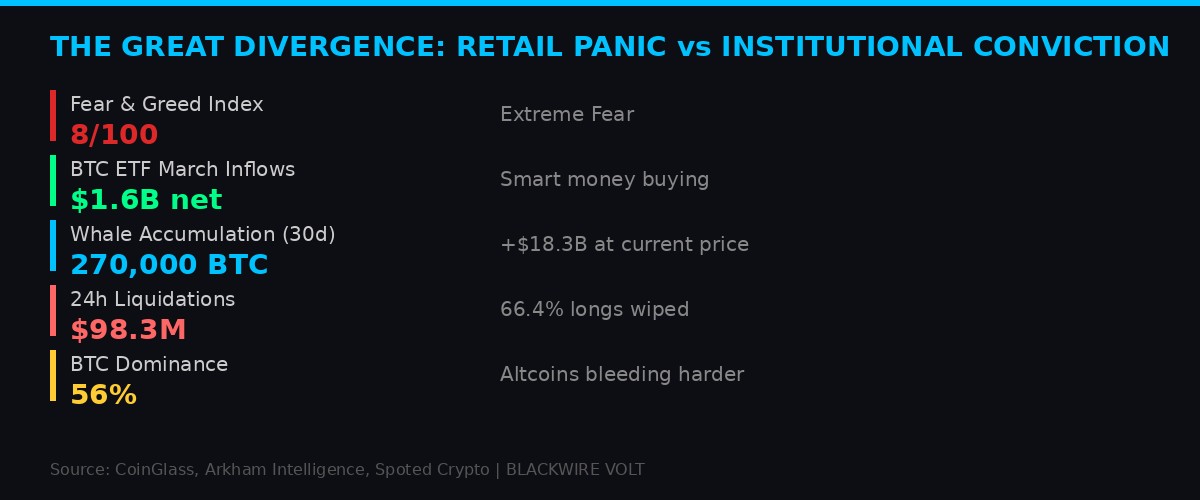
The Great Divergence: retail sentiment at historic lows while institutional capital accumulates aggressively. BLACKWIRE VOLT
1. Forty-Six Days of Extreme Fear - and What Historically Happens Next
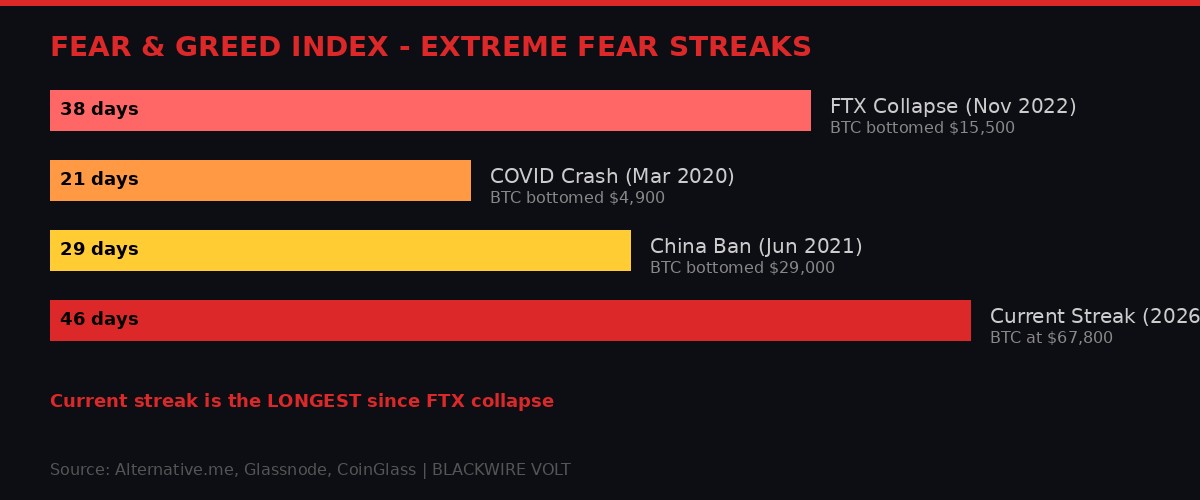
Current 46-day extreme fear streak is the longest since FTX - historically, these readings precede massive rallies. BLACKWIRE VOLT
The Crypto Fear and Greed Index, maintained by Alternative.me, aggregates volatility, trading volume, social media activity, Bitcoin dominance, and Google Trends data into a single score from 0 to 100. Anything below 25 registers as "Extreme Fear." The current reading of 8 is not just low - it is catastrophically low, lower than anything recorded during the 2022 bear market's worst weeks.
The 46-day streak matters because of what historical data shows about these extremes. According to Glassnode analytics, every time the index has dropped below 10 for an extended period, the subsequent 6-to-12 months delivered outsized returns. In March 2020, when the index hit single digits as BTC bottomed near $4,900, the asset rallied 133% within six months. In June 2022, a similar extreme reading preceded a 96% surge over the following 11 months. The median 90-day return when buying below a Fear and Greed reading of 15 sits at +38.4%, per CoinGlass historical data.
The current environment is structurally different from those prior bottoms in one critical way: institutional infrastructure now exists. In 2020, there were no spot Bitcoin ETFs, no regulated custody solutions at scale, no retirement account proposals. In 2022, the infrastructure was being built but hadn't launched. Today, it is operational and absorbing billions.
Total cryptocurrency market capitalization sits at $2.38 trillion, with BTC dominance at 56% - a signal that altcoins are bleeding harder than Bitcoin. Twenty-four-hour liquidation data shows $98.29 million in forced closures, with long positions accounting for 66.4% ($65.26 million) of the total. Leveraged bulls continue to face punishing downside pressure, while the funding rate on Binance perpetuals sits at a near-neutral 0.0008%, suggesting the speculative froth has been almost entirely wrung out.
The setup is textbook accumulation territory. Whether the bottom is in depends on the six catalysts that follow.
2. The CLARITY Act - Crypto's Biggest Legislative Bet Enters Countdown
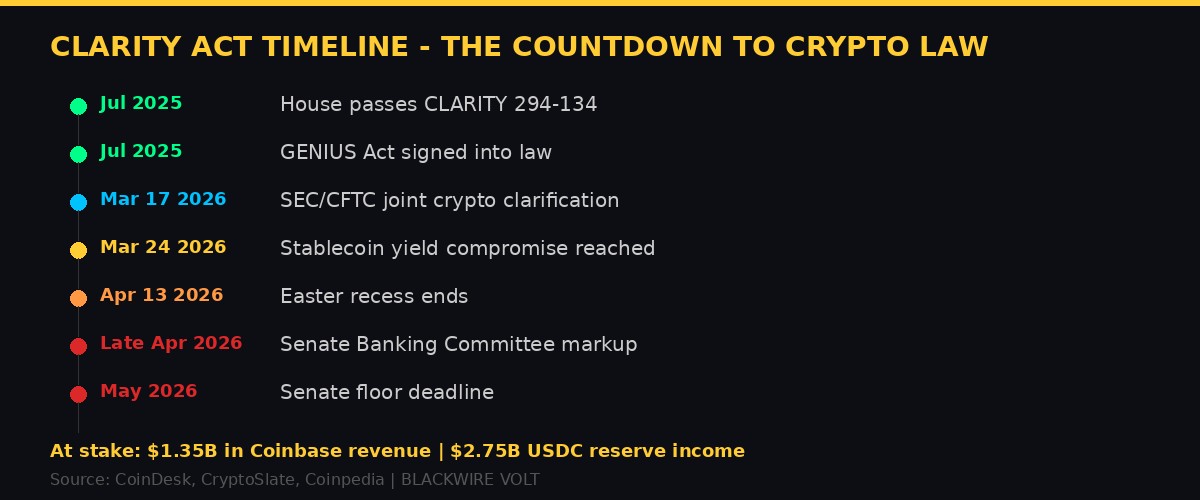
The CLARITY Act's path from House passage to potential law compresses into a few critical weeks. BLACKWIRE VOLT
The Digital Asset Market CLARITY Act represents the largest unresolved piece of crypto legislation in the United States. The House passed it 294-134 in July 2025, alongside the GENIUS Act (which became law the same month, establishing the federal stablecoin framework). The Senate Banking Committee is now targeting the second half of April for a markup, with a May floor deadline that Senator Bernie Moreno has described as do-or-die: miss that window, and serious digital asset legislation gets pushed past the 2026 midterms.
Senator Cynthia Lummis publicly confirmed the timetable. The bill would draw a bright line between digital asset securities and digital asset commodities, replace regulation-by-enforcement with a rule-based regime, and give the CFTC authority over spot markets for non-security digital assets. Bitcoin, which already occupies the commodity lane in market convention, court rulings, and political symbolism (via the Strategic Bitcoin Reserve executive order from March 2025), would receive statutory backing for that classification.
The stablecoin yield dispute nearly killed the bill. The January markup was canceled when Coinbase and Stripe objected to bank-friendly language that would have eliminated passive stablecoin returns. Senators Thom Tillis and Angela Alsobrooks reached a compromise on March 24 that Lummis described as "99% resolved." The framework bars passive yield on held stablecoins while allowing activity-based rewards tied to payments, transfers, wallet use, and similar functions.
"My memory is a little better than to trust future rogue regulators to faithfully apply the law." - Paul Grewal, Coinbase Chief Legal Officer
Alsobrooks described the deal as one that would leave both sides "just a little bit unhappy." That is usually how legislation actually passes.
The financial stakes are enormous. In 2025, Coinbase and Circle generated approximately $2.75 billion from reserves backing USDC. Coinbase's share alone was roughly $1.35 billion - close to one-fifth of its total revenue. If passive yield disappears under the final text, that revenue stream takes a direct hit. Coinbase is not opposing the entire bill. Chief Legal Officer Paul Grewal has warned that vague language could give future regulators too much power to reinterpret rules, and the company is working on a coordinated counterproposal to keep reward models viable.
Behind the scenes, tensions run deeper than regulatory text. Jamie Dimon and Brian Armstrong have reportedly clashed over stablecoin economics, even as JPMorgan and Coinbase maintain a working partnership. White House adviser Patrick Witt has made the urgency clear: act now or risk losing the window entirely.
The five-step route from Banking Committee markup to floor vote, conference with the Agriculture Committee version, final passage, and presidential signature compresses the bill's remaining journey into a matter of weeks. Easter recess ends April 13. The Senate returns with crypto legislation at the top of the stack.
3. The $12 Trillion Door - 401(k) Crypto Access Gets a Green Light
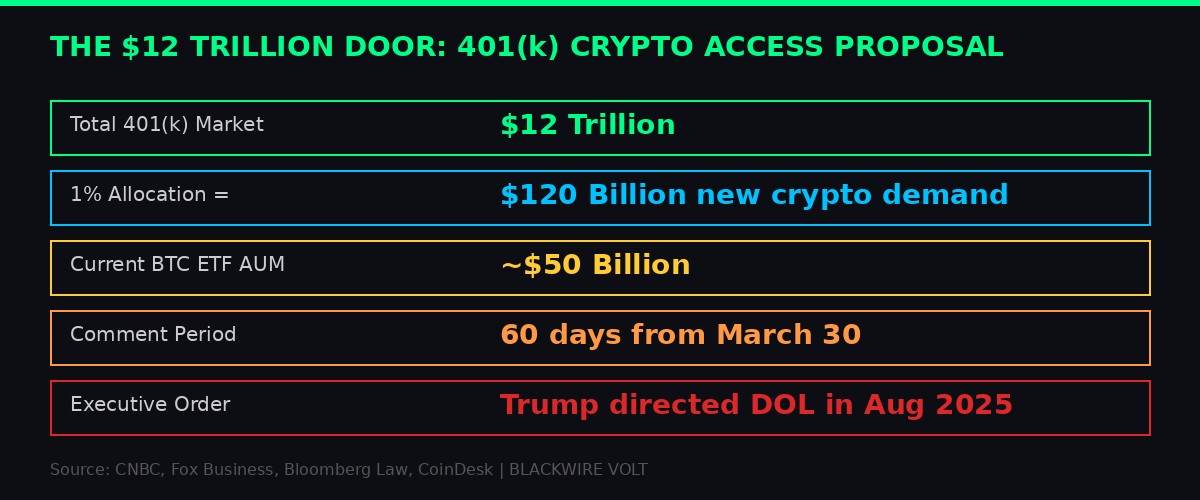
A 1% allocation from the $12 trillion 401(k) market would dwarf the entire current crypto ETF ecosystem. BLACKWIRE VOLT
On March 30, the Department of Labor proposed a rule that would allow retirement plans to more easily include alternative assets - including cryptocurrencies - as part of their investment options. The proposal follows an executive order from President Trump that directed regulators to expand access to digital assets in retirement portfolios. The rule passed through the Office of Information and Regulatory Affairs (OIRA) review before publication, and a 60-day public comment period is now underway.
The numbers here are staggering. The American 401(k) market holds approximately $12 trillion in assets. Even a 1% allocation to cryptocurrency would represent $120 billion in new demand - more than double the entire Bitcoin ETF market's current assets under management. For context, BlackRock's iShares Bitcoin Trust (IBIT) holds roughly $25 billion. A 1% 401(k) allocation would create five IBITs' worth of demand.
This is not theoretical anymore. The DOL's Employee Benefits Security Administration was given 180 days by Trump's August 2025 executive order to reevaluate guidance around alternative asset investments in plans subject to the Employee Retirement Income Security Act of 1974 (ERISA). That clock has run out, and the proposed rule is the result.
The rule does not mandate crypto inclusion - it removes the regulatory barriers that currently make plan sponsors reluctant to offer it. The shift is from "you could face liability for offering crypto" to "you have a clear framework for including it safely." That distinction matters enormously for the fiduciary-driven retirement industry, where plan administrators have historically avoided anything that could trigger Department of Labor scrutiny.
Critics, including several consumer advocacy groups, argue that volatile assets like cryptocurrency have no place in retirement accounts designed for long-term savings. Proponents counter that modern portfolio theory supports small allocations to uncorrelated assets, and that barring access to an entire asset class is itself a form of paternalism that harms workers.
If finalized after the comment period, the rule would bring major changes to the legal and regulatory landscape. Implementation would likely take 6-12 months after finalization, meaning actual crypto allocations in 401(k) plans could begin flowing in early 2027. But the market prices expectations, not implementations - and the market is now pricing the possibility of the largest capital pool in American finance opening its doors to digital assets.
4. Square Auto-Enables Bitcoin Payments for Millions of U.S. Merchants

Jack Dorsey's Block has auto-enabled Bitcoin payments across its Square merchant network. Photo: Pexels
Jack Dorsey's Block (formerly Square) announced that Bitcoin payments are now auto-enabled across its Square point-of-sale network for eligible U.S. merchants. The rollout, confirmed by CoinDesk and TradingView on March 30, represents one of the largest single expansions of Bitcoin payment acceptance in everyday commerce.
The mechanics are designed to eliminate friction. Merchants do not need to hold Bitcoin - transactions are instantly converted into U.S. dollars at checkout with near-instant settlement. The feature carries zero processing fees through the end of 2026, a subsidy that removes the primary barrier to merchant adoption. For comparison, traditional credit card processing fees run 2.5-3.5% per transaction, meaning Square is offering merchants a financially superior payment rail at no cost.
Block itself holds 8,883 BTC on its corporate balance sheet, making the company both an infrastructure provider and a Bitcoin treasury holder. The dual positioning mirrors Strategy's approach but extends it into the payment layer rather than the treasury layer.
The significance is not just adoption numbers - it is the normalization effect. When millions of small businesses can accept Bitcoin without any setup, without holding the asset, and without paying fees, the cultural barrier to cryptocurrency in daily commerce drops to near zero. You do not need to convince a coffee shop owner that Bitcoin is the future of money. You just need to make it show up as another payment option on a device they already use.
Previous attempts at merchant Bitcoin adoption - from BitPay to Coinbase Commerce - required active opt-in, technical setup, and ongoing management. Square's approach inverts this by making Bitcoin payments the default, requiring merchants to actively opt out if they don't want it. This is the same playbook that drove PayPal and Venmo adoption: reduce the activation energy to zero and let inertia do the rest.
The timing coincides with Block's Q1 2026 earnings approaching in late April, where analysts expect commentary on initial adoption metrics. If even 5% of Square's estimated 4 million U.S. merchants process Bitcoin transactions in Q2, it would represent 200,000 new Bitcoin acceptance points - more than the entire global Bitcoin ATM network.
5. The Token Unlock Flood - Billions in Supply Hitting a Fragile Market
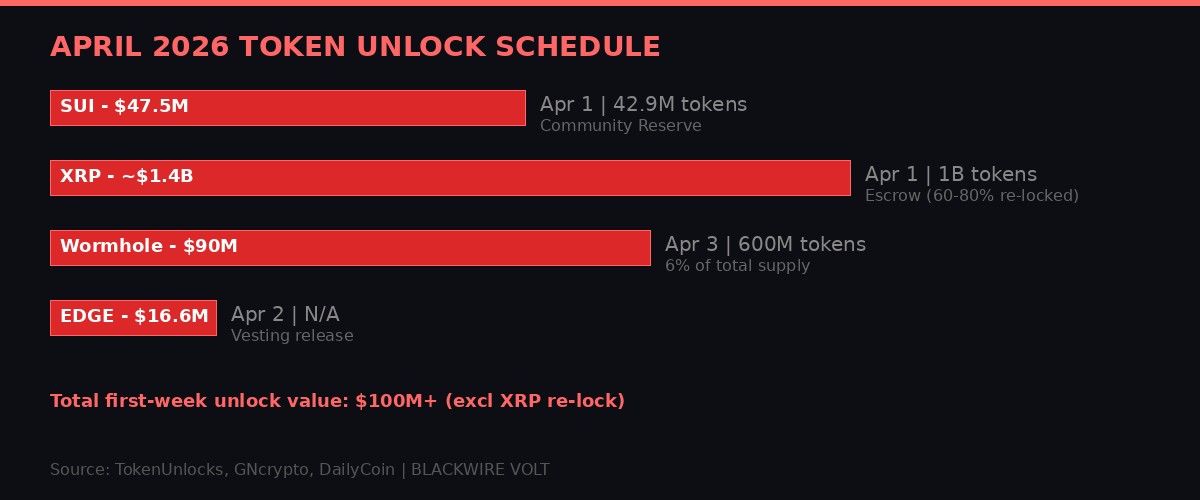
April's token unlock schedule loads billions in new supply into a market already drowning in fear. BLACKWIRE VOLT
Against this backdrop of institutional accumulation and legislative momentum, a wall of token supply is about to hit the market. April 2026 features some of the largest scheduled token unlocks in recent memory, and they are concentrated in the first week.
Today, April 1, Ripple unlocks 1 billion XRP from its escrow system - a programmatic release schedule established in 2017 that fires on the first day of each month. Based on prior months, Ripple typically re-locks 60-80% of the released tokens, limiting net circulation impact to 200-400 million XRP. But even the reduced figure represents significant sell pressure at current prices near $1.40, valuing the gross unlock at approximately $1.4 billion. Whale accumulation data from CoinTribune suggests large holders have been front-running the unlock by building positions in the $1.30-$1.45 range.
Also today, SUI releases 42.9-53.4 million tokens (estimates vary between KuCoin and GNcrypto data), worth approximately $37-$47.5 million. This is a community reserve unlock - lower risk than team or venture capital releases - but SUI is a high-attention Layer 1 with active trader positioning, meaning the supply injection will face immediate selling pressure from short-term holders.
On April 2, EDGE unlocks tokens worth $16.6 million. On April 3, Wormhole (W) releases 600 million tokens - 6% of its total supply - valued at over $90 million at the current price of $0.15. The Wormhole unlock is particularly notable because of its size relative to circulating supply: a 6% dilution in a single day for a cross-chain interoperability protocol that has already lost significant market cap from its February 2024 airdrop high.
Total first-week unlock value across the ten scheduled projects exceeds $100 million, excluding the XRP re-lock adjustment. For the full month, KuCoin analysis identifies several additional high-impact releases that could add hundreds of millions more in new circulation.
Token unlocks do not automatically equal price declines. The actual impact depends on who receives the tokens (team members versus community treasuries), current market depth, and whether the unlock was anticipated and priced in. But in a market where the Fear and Greed Index sits at 8 and leveraged positions are being liquidated daily, additional supply pressure is the last thing fragile order books need.
The smart play, according to multiple analysts, is watching on-chain flow data in the 24-48 hours after each unlock. If unlocked tokens move immediately to exchange deposit addresses, that is a sell signal. If they move to staking contracts or remain in cold storage, the supply pressure is deferred.
6. Ethereum Foundation Goes All-In - $46 Million Staking Record

The Ethereum Foundation staked its largest single-day deposit ever - a $46.2 million vote of confidence. Photo: Pexels
On March 29, the Ethereum Foundation deployed a record 22,517 ETH - worth $46.2 million - into staking protocols on the Beacon Chain. According to Arkham Intelligence data, this was the foundation's largest single-day staking deposit ever recorded, and it came at a moment when ETH is trading near $2,070, down roughly 60% from its cycle high.
The timing is deliberate. The foundation, which has faced persistent criticism for selling ETH to fund operations (a pattern that frustrated holders tracked obsessively on-chain throughout 2024 and 2025), appears to be executing a strategic pivot. Rather than liquidating treasury ETH for fiat operating expenses, the foundation is generating yield by staking - effectively switching from a "sell to survive" model to a "stake to sustain" approach.
This shift aligns with Ethereum's upcoming Glamsterdam upgrade, the most significant technical overhaul since the Merge. Glamsterdam targets a June 2026 launch and includes a gas limit increase from 60 million to 200 million per block, throughput scaling to 10,000 transactions per second, and several improvements to the staking validator experience. If the foundation is staking aggressively into the upgrade window, it signals confidence that the technical execution will land on schedule.
The broader ETH picture remains grim by the numbers. At $2,070, Ethereum has underperformed Bitcoin on a relative basis for over a year. ETH/BTC ratios have collapsed to levels not seen since 2021. The narrative around Ethereum has shifted from "ultrasound money" to questions about whether the Layer 2 ecosystem (Arbitrum, Optimism, Base) is cannibalizing the base layer's fee revenue. Ethereum's revenue per transaction has fallen as activity migrates to rollups, and the "fat protocol" thesis is being stress-tested in real time.
But the foundation's staking move is a data point that cuts against the bearish narrative. Organizations do not stake $46 million into an asset they believe is heading to zero. The foundation holds approximately $1 billion in ETH treasury assets. Deploying 4.6% of that into staking in a single day is not a hedge - it is a directional bet that ETH will be worth more, not less, when the staking rewards are eventually claimed.
For Ethereum bulls, the convergence of aggressive foundation staking, the Glamsterdam upgrade timeline, and extreme fear sentiment creates what looks like a classic asymmetric setup. For bears, the counterargument is that the foundation is staking precisely because it can no longer afford to sell at these prices - a sign of desperation, not conviction.
The truth, as usual, will be determined by execution. Glamsterdam needs to ship on time and deliver the throughput gains. If it does, the foundation's staking bet will look prescient. If it slips or underdelivers, the ETH bleed accelerates.
7. Crypto Stocks at 60% Discounts - Bernstein Calls the Bottom
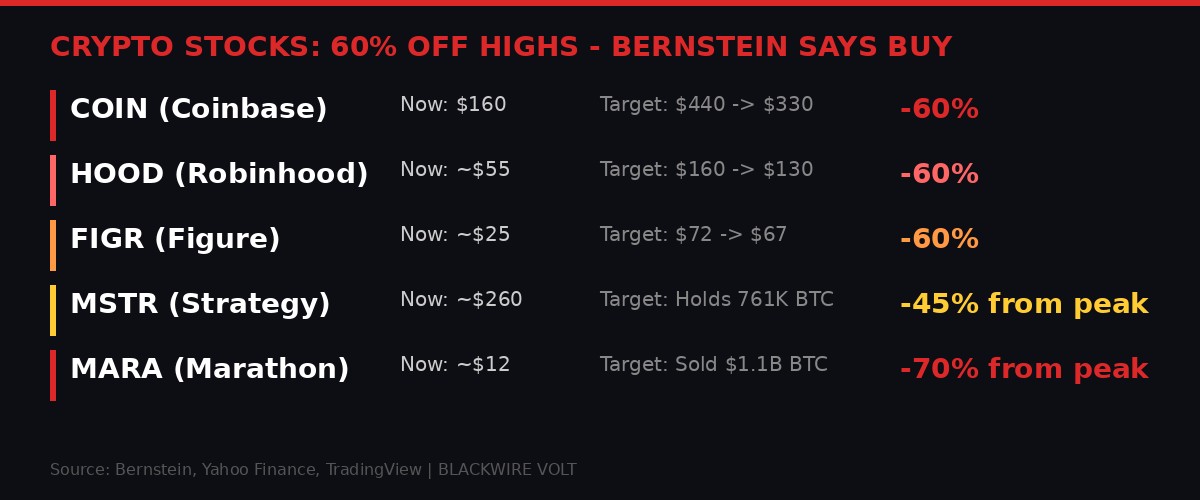
Bernstein slashed price targets but maintained Outperform ratings on all three major crypto equities. BLACKWIRE VOLT
Bernstein analyst Gautam Chhugani published a note on March 30 that read like a battlefield assessment. Coinbase (COIN), Robinhood (HOOD), and Figure (FIGR) are all trading approximately 60% below their 2025 peaks. The carnage is comprehensive: COIN at $160 (down from ~$400), HOOD at roughly $55, and FIGR near $25.
Bernstein lowered its price targets - COIN to $330 from $440, HOOD to $130 from $160, FIGR to $67 from $72 - but maintained Outperform ratings on all three. The logic: even with slashed targets, the upside from current levels ranges from 106% (COIN) to 136% (HOOD) to 168% (FIGR). These are not incremental upside calls. These are "the stocks are so beaten down that even our reduced targets imply doublings."
The specific damage to Coinbase is instructive. Spot trading volumes are tracking roughly 30% below Q4 2025 levels. Bernstein cut its 2026 earnings per share estimate for COIN by 44%, to $5.97 - a brutal revision that reflects the direct relationship between crypto prices, trading activity, and Coinbase's revenue. But Bernstein also sees crypto equities bottoming ahead of Q1 earnings reports, which begin landing in late April.
For Robinhood, the picture is slightly different. Despite a softer first quarter for both equity and crypto trading, Bernstein still forecasts earnings growth of approximately 25% in 2026. Robinhood's revenue diversification - options, equities, retirement accounts, gold trading - provides a floor that Coinbase lacks. When crypto recovers, Robinhood benefits; when it doesn't, the other revenue streams keep the lights on.
Strategy Inc. (MSTR) presents the most leveraged play. The company holds 761,068 BTC at an average cost near $75,696. With Bitcoin at $67,800, Strategy is currently underwater on its position by approximately $6 billion on paper. CEO Michael Saylor has signaled renewed Bitcoin focus and a target of 1 million BTC by end of 2026, but the company paused purchases in March and shifted attention to preferred share issuance - a sign that even the most aggressive Bitcoin treasury strategy has limits when the price is falling.
MARA Holdings (formerly Marathon Digital) took a different approach, selling $1.1 billion worth of Bitcoin and executing a huge debt buyback on March 26. The stock jumped 10% on that announcement - the market rewarding capital discipline over diamond-hands rhetoric. Riot Platforms dropped 5% in sympathy selling, caught between rising energy costs and an AI compute pivot that has yet to generate meaningful revenue.
The crypto equity landscape heading into Q1 earnings season is a binary setup. If Bitcoin stabilizes above $65,000 and the CLARITY Act advances through markup, these stocks could rip 50-100% in weeks. If BTC breaks below $60,000 on macro deterioration or geopolitical escalation, the 60% drawdown becomes 75%.
The Macro Overlay - Oil, War, and the Fed's Next Move

Macro forces - oil above $100, Hormuz tensions, Fed policy - create the backdrop against which all seven catalysts play out. Photo: Pexels
None of these seven catalysts exist in a vacuum. The macro overlay as Q2 opens is the most complex the crypto market has ever navigated.
WTI crude oil sits between $100 and $105 per barrel - the first time above $100 since 2022 - driven by the Iran conflict and Strait of Hormuz disruptions. Four dollars a gallon at American gas pumps is now the national average, injecting inflationary pressure into an economy already dealing with stagflation fears. The Iran-U.S. conflict, now in its 32nd day, has destabilized shipping lanes, spiked insurance premiums for Gulf transit, and created a $194 billion economic crater across Arab Gulf states, according to BLACKWIRE's reporting.
The Federal Reserve's April FOMC meeting could be Powell's last as Chair. Market pricing through CME FedWatch shows expectations split between a hold and a 25-basis-point hike - a scenario that seemed impossible six months ago but is now live given oil-driven inflation. Bitcoin's correlation with risk assets has tightened during the war period, meaning a hawkish surprise from the Fed would hit both equities and crypto simultaneously.
Bitcoin's hash rate declined approximately 4% in Q1 2026 - the first Q1 decline in six years, according to CoinTelegraph data. Rising energy costs from the oil spike are squeezing miners' margins, and the combination of lower hash rate and lower price creates a feedback loop: unprofitable miners capitulate, sell Bitcoin to cover costs, adding further sell pressure to an already stressed market.
The EU-U.S. economic tensions add another layer. European digital dollarization fears - 12 banks scrambling to save the euro from stablecoin dominance - have created regulatory uncertainty that makes transatlantic crypto policy coordination harder. If Europe moves to restrict dollar-denominated stablecoins while the U.S. moves to embrace them through CLARITY, the arbitrage between regulatory regimes could fragment global crypto liquidity in ways the market is not pricing.
And then there is the FTX payout. The bankrupt exchange is distributing $2 billion in creditor repayments, with funds hitting wallets in late March and early April. Historical precedent from the Mt. Gox distributions suggests that creditor payouts create temporary sell pressure as recipients liquidate recovered assets - but the pressure is front-loaded and typically dissipates within 2-3 weeks.
The Setup - Where This All Converges

Seven catalysts converging in 90 days - the most compressed window of structural change since the ETF approval wave. Photo: Pexels
Zoom out and map the seven catalysts against the calendar:
- April 1: Q2 opens. SUI and XRP token unlocks fire. BTC at $67,800. Fear at 8.
- April 3: Wormhole 600M token unlock ($90M).
- April 13: Easter recess ends. Senate returns with CLARITY Act on the table.
- Late April: Q1 earnings for COIN, HOOD, MSTR, MARA. Senate Banking Committee markup targeted.
- May: CLARITY Act Senate floor deadline. 401(k) comment period continues.
- May 29: 60-day comment period for 401(k) rule closes.
- June: Glamsterdam upgrade targeted. Fed meeting. Oil situation either resolves or escalates.
The bull case writes itself: CLARITY passes, 401(k) access gets finalized, Square adoption metrics surprise to the upside, token unlock pressure is absorbed, ETH's Glamsterdam upgrade ships, and the Fear and Greed Index mean-reverts from 8 to something resembling sanity. In this scenario, BTC retests $85,000-$95,000 by June, and the crypto equity complex rips 80-120% from current levels.
The bear case is equally clear: CLARITY stalls in committee, the 401(k) rule draws hostile comments and gets shelved, token unlocks overwhelm thin order books, the Fed hikes, oil stays above $100, and the Iran conflict intensifies. In this scenario, BTC breaks $60,000, tests $55,000, and the six-month losing streak resumes into what would be the longest sustained decline since the 2018 crypto winter.
The most likely outcome, as always, is somewhere in between - messy, volatile, and impossible to time perfectly. But the structural setup is undeniable. Institutional capital is accumulating at levels that historically mark cycle bottoms. Legislative momentum is real and compressed into a narrow window. The technology pipeline (Glamsterdam, Square integration, 401(k) infrastructure) is advancing regardless of price action.
What retail sentiment says - fear, panic, capitulation - and what institutional behavior shows - accumulation, staking, continued ETF inflows - are telling two completely different stories. In every prior cycle, the institutions were right and retail was wrong. Not because institutions are smarter, but because they operate on different time horizons and have different liquidity constraints.
Q2 2026 is not a prediction market. It is a loaded gun with seven triggers, and the market is about to find out which ones fire first.
Get BLACKWIRE reports first.
Breaking news, investigations, and analysis - straight to your phone.
Join @blackwirenews on Telegram